
Quick Answer
Use a licensed BVI registered agent to submit the incorporation application with memorandum and articles. First compare the structure with a local company, assess foreign company and owner taxation, and establish banking eligibility. After formation, maintain registers, accounting records, annual returns and the applicable ownership and economic-substance filings.
A BVI company can be useful for a solo operator, but only in a narrow set of circumstances. If your business is genuinely cross-border, your clients are comfortable contracting with an entity, and you are prepared for real compliance and documentation work, it can be a strong tool. If you are looking for a shortcut on tax, admin, or banking, it is usually the wrong one.
Use three stages to decide: compare the business benefit with annual costs, test banking and compliance requirements, then assemble the filing and maintenance plan. A local company may offer the same liability separation with simpler administration.
Use it that way. By the end, you should know whether a BVI company fits your business and, if it does, what you need in place before you move.
Stage 1: The Strategic Litmus Test - Is This Even for You?#
If you want to incorporate in BVI, start with fit rather than provider shopping. A BVI company earns its keep only when it solves a real operating problem.
Step 1: Define the benefit correctly. A company limited by shares can separate company contracts and assets from your personal affairs. That separation does not cancel personal guarantees or protect misconduct. Section 242 of the BVI Business Companies Act provides income-tax exemptions and specified securities-related exemptions; stamp-duty exceptions apply to BVI land and land-owning companies. Local payroll and other obligations still need analysis. Incorporation also leaves foreign company taxation and owner taxation to the applicable jurisdictions.
Step 2: Compare fit against admin burden. Do not build the decision on a hard revenue rule from a blog unless you verify it yourself. Confirm the current setup and annual cost range with providers and official sources, then ask an advisor to help model the break-even point for your facts. Then compare the likely benefit against the actual friction: KYC documentation, name reservation, recurring upkeep, and the need to explain your business clearly to service providers. If the structure only works when you ignore the admin, pause.
| Criteria | Strong fit | Weak fit |
|---|---|---|
| Client type | Buyers accept the entity and the structure serves a business purpose | Buyer policy excludes BVI or a simpler local company meets the same need |
| Contract size and complexity | Custom contracts, IP clauses, indemnities, longer engagements | Small one-off sales, simple checkouts |
| Cross-border invoicing needs | Clients in multiple countries or multiple currencies | Mostly one country, one currency |
| Entity expectation from buyers | Buyers expect to contract with a company | Buyers are comfortable hiring you personally |
Use one quick readiness check here: if you cannot already assemble a clean KYC file and settle on a distinct company name, you are not ready to move forward, even if the business case sounds attractive.
Step 3: Screen your liability concentration. This is where the structure either starts to make sense or falls apart. Answer yes or no to four questions: do you face meaningful lawsuit exposure, meaningful contractual liability, concentrated IP risk, or real personal asset exposure if a dispute goes badly? A proceed pattern looks like several yes answers tied to actual client work or valuable IP. A pause pattern looks like mostly no answers, with the main motive being vague tax optimism.
Step 4: Check your global footprint. Map client countries, currencies, where you work and make management decisions, and any IP licensing. The current formation route is a BVI business company under the Business Companies Act, rather than the old International Business Company label. Select the company type with your agent; limited-by-shares and unlimited forms have different liability consequences. Cross-border work is a reason to compare structures, not a legal requirement or proof that BVI is the best choice. Avoid treating a promotional 24-to-48-hour incorporation promise as an account-opening timetable.
If you want a deeper dive, read Sole Proprietorship vs. LLC: The Definitive Guide for Global Freelancers.
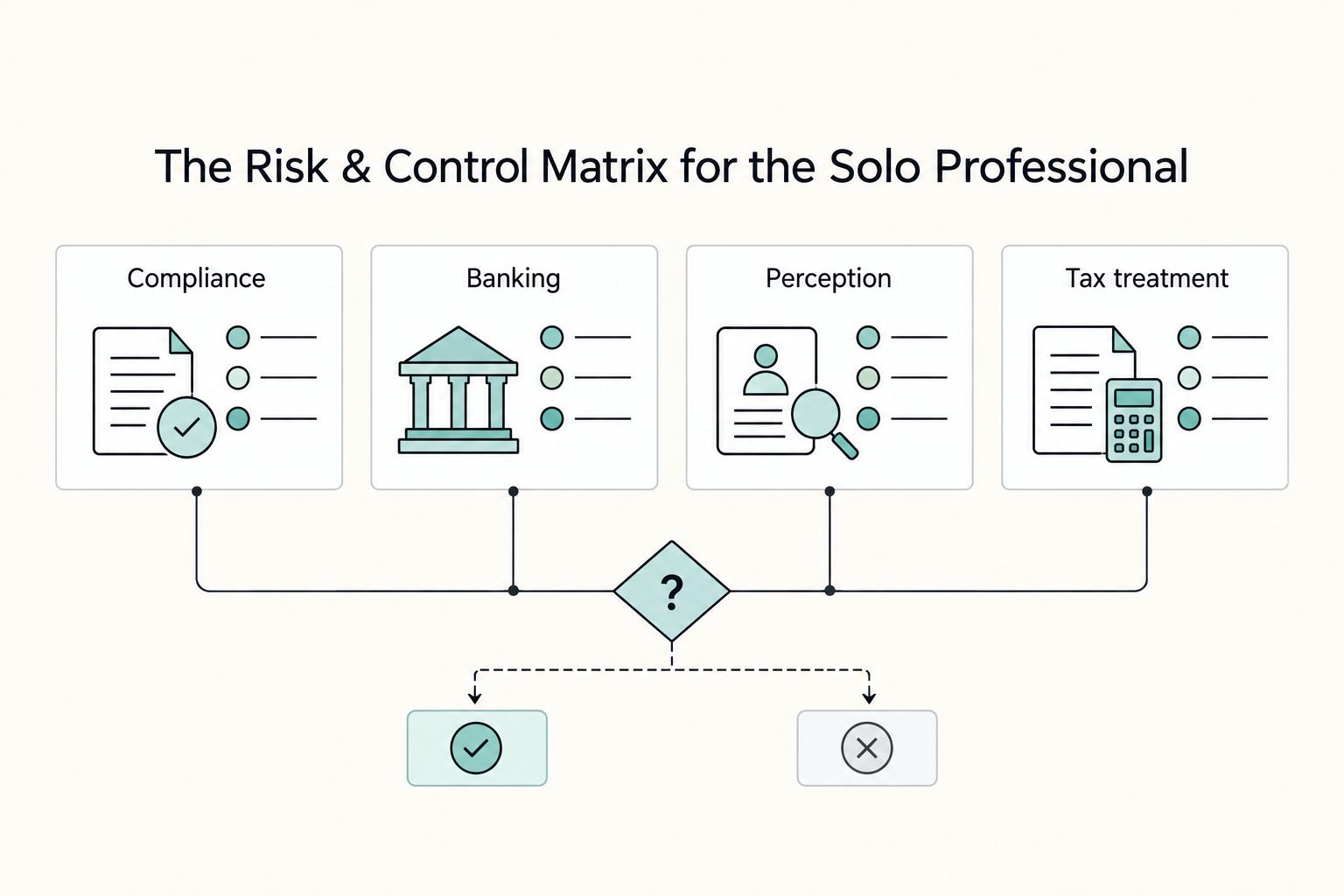
Stage 2: The Risk & Control Matrix for the Solo Professional#
A strong Stage 1 fit is not enough. Move forward only if you can actively control four risks: compliance, banking, perception, and tax treatment.
Step 1: Decide by risk-control fit, not by jurisdiction label. A BVI company is a separate legal entity, which supports liability separation, but it also adds compliance and operating controls you must run well.
| Risk | Why it happens | Your control lever | When to get specialist advice |
|---|---|---|---|
| Compliance | Company obligations and personal tax-residency obligations get mixed together, or delegated vaguely | Run two checklists: entity-level and personal-level. Confirm in writing who owns the annual-return process, the timeline, and the handoffs with your registered agent | If you cannot clearly assign what the company files, what the agent files, and what you file |
| Banking | Banks and fintech providers apply AML/KYC checks, with possible extra review for ownership/activity complexity | Build one complete ownership-and-activity file before applying, and keep a backup provider ready | If your ownership chain, business model, or payment flow is hard to explain in plain language |
| Perception | "Offshore" can trigger procurement questions about ownership, governance, and compliance | Use a short positioning framework: business rationale, governance clarity, compliance posture | If you sell to enterprise, public-sector, or regulated buyers |
| Tax treatment | BVI exemptions are mistaken for worldwide exemption; company residence and owner taxation are skipped | Map the money flow from client payment to owner receipt before first invoice | If you are tax resident where worldwide income and foreign-company reporting can apply |
Step 2: Keep entity obligations and personal obligations separate. This is the control that prevents avoidable failures.
At the entity level, the annual financial return normally goes to the registered agent within nine months after financial year-end. The FSC exemption guidance covers listed companies, qualifying regulated companies that report financial statements, companies filing annual tax returns and financial statements with Inland Revenue, and liquidation beginning before the return deadline. Regulation alone is insufficient to assume an exemption. The agent must notify the Registrar within 30 days after a missed deadline.
Ownership information also requires registry filings. From January 2025, beneficial ownership is filed through VIRRGIN, with prescribed exemptions and particulars handled by the agent. Keep filing receipts alongside the company registers. Annual economic-substance classification and reporting are a separate workflow; a nil-income conclusion does not eliminate reporting.
At the personal level, your tax-residence country may still tax worldwide income. Verify any foreign-company reporting requirement and foreign-account filing requirement from home-country records or an advisor before using the checklist.
Step 3: Pick your banking route early, with a fallback ready. First establish that a provider accepts BVI entities, your founder residence and your actual activity. A complete evidence pack helps the review, but cannot overcome an excluded jurisdiction, unsupported activity or provider risk policy.
| Route | KYC depth | Timeline reality | Document readiness | Fallback if first application is declined |
|---|---|---|---|---|
| Traditional bank | Usually deeper review, especially on ownership/control evidence | Ask for the provider-specific review process; no universal approval timeline | Incorporation file, business activity summary, source-of-funds support, director/ownership details | Reapply to your backup provider using the same coherent evidence pack |
| EMI/fintech | Still detailed; follow-up requests are common | Eligibility and review are provider-specific; a fast advertised target is not an approval commitment | Same core pack, plus governance/major-shareholder evidence when requested | Reuse the same pack and narrative; do not change core facts between applications |
Protection depends on the provider and account location. For eligible deposits at a protected UK bank, FSCS coverage is up to £120,000 per eligible depositor per banking licence from 1 December 2025. Check whether the company and the particular account qualify. An EMI account is not automatically a protected bank deposit; ask which safeguarding rules apply and how customer money would be recovered on failure.
Step 4: Use a procurement-ready positioning framework. Keep your explanation short and factual:
- Business rationale: why one cross-border company is operationally appropriate.
- Governance clarity: who in the end owns or controls the entity (beneficial owner).
- Compliance posture: how tax and reporting obligations are handled where required.
Give the buyer a consistent ownership chart, the current company documents, the contracting entity name and an explanation of where services are delivered. Ask procurement which documents it needs before signing. If the buyer cannot onboard a BVI entity, a better narrative alone will not solve the problem.
Step 5: Confirm tax flow before launch. Analyze the proposed transactions before the first invoice or distribution. Include company tax residence, permanent establishments, controlled-foreign-company rules, indirect taxes and owner taxation where applicable.
BVI statutory income-tax exemptions do not determine whether another country taxes the company because it is managed there, carries on business there, or is controlled by its residents. Model retained profits as well as salary and dividends: a home-country regime may tax an owner before cash is distributed.
Use this flow:
- Map where the company is managed, where work is performed and applicable company/owner reporting.
- Determine treatment of proposed customer receipts, retained profits, salary and dividends before trading.
- Document permitted company-to-owner transfers and their tax/accounting treatment.
- After launch, reconcile actual receipts and distributions against that analysis and update it when facts change.
If you cannot explain that flow clearly on one page, pause implementation. For reporting context, see What is FinCEN? A Guide for Freelancers and FinTech Users.
Stage 3: Execute in Order, From Registered Agent to Compliance Calendar#
If Stage 2 still holds up, execute in this order: pick the right registered agent, submit a complete filing pack through that agent, set a realistic budget, and lock a compliance calendar you can maintain.
Step 1: Approve your registered agent with a pass/fail checklist. You cannot self-file in the BVI: the first registered agent must submit the incorporation application, and self-filing is rejected.
| Check | Pass if... | Fail if... |
|---|---|---|
| Licensing status | The provider is FSC-licensed and can clearly evidence current licensing status. | Licensing is unclear, outdated, or deflected. |
| Service scope | You get written scope for incorporation, annual financial return handling, and economic substance support where relevant activity applies. | Scope is verbal only or vague on ongoing obligations. |
| Response standards | You get a named contact and written response expectations for normal and urgent issues. | No owner for urgent requests or inconsistent replies. |
| Document portal quality | You get a secure, organized portal for corporate records and submissions. | Documents are handled through scattered email threads only. |
| Escalation support | The provider explains who handles escalations for banking/EMI document requests and missed-filing remediation. | No clear escalation path for banking or compliance issues. |
Check the provider in the FSC registered-agent directory. A company-record search showing a registered agent does not itself establish that provider's current licensing. Use the separate entity search to verify your own company record after incorporation.
Step 2: Build a filing-ready pack before you ask about speed. The FSC incorporation guide requires the first registered agent to submit the application with memorandum and articles. Agree the company type, share provisions, directors, ownership and permitted activity before submission; incomplete KYC and drafting revisions can delay filing.
- Documents to prepare: preferred company names, identity and address documents requested by the agent, ownership details, business activity summary, and source-of-funds materials required in onboarding. Agree the company type, memorandum/articles, share provisions and initial director/member details.
- Who submits: your registered agent.
- What can cause delay: name conflicts, incomplete KYC, unclear ownership chain, or memorandum/articles revisions.
- Timing note: Confirm the current processing window with the registered agent or official source.
If helpful, use FSC pre-incorporation channels (for example, name reservation and pre-incorporation status inquiry) before final submission.
Step 3: Budget by cost type, not by package headline. Separate mandatory costs from optional operating costs so you can decide with fewer surprises.
| Cost item | Mandatory or optional | When it arises |
|---|---|---|
| Government incorporation and registry fees | Mandatory | Formation |
| Registered agent and registered office fees | Mandatory | Formation and annual renewal |
| Annual government fee | Mandatory | Yearly; due 31 May if incorporated 1 January-30 June, or 30 November if incorporated 1 July-31 December; ordinary annual renewal begins in the year after incorporation |
| Banking onboarding, certifications, courier/notarization, good-standing documents | As required by the chosen provider or transaction | As needed |
Use the FSC fee schedule and a dated agent quote. For a hypothetical quote, government charges of $600, agent/office services of $900 and certifications of $150 total $1,650; adding $500 for accounting and return preparation makes the first-year budget $2,150. These are illustrative amounts, not official fees or a market benchmark. Identify which charges recur and whether taxes, registry filings and substance support are included.
Step 4: Run an action calendar from day one. Treat compliance as scheduled operations, not ad hoc admin.
| Obligation | Action trigger | What you keep on file | Deadline note |
|---|---|---|---|
| Annual government fee | Annual cycle based on incorporation half-year | Payment confirmations and agent communications | 31 May or 30 November, based on incorporation window |
| Annual financial return (if no exemption applies) | Financial year end | Return pack and supporting records sent to the registered agent | Within 9 months after financial year end; confirm the current filing deadline with the registered agent or official source |
| Initial registry filings | Incorporation and first director appointment | Director/member registers and BO filing receipts | For new companies: director register within 15 days of first appointment; member and BO filings generally within 30 days of incorporation, subject to prescribed exceptions |
| Economic-substance classification/reporting | Each financial period, including nil-income cases | Classification, income evidence and filing receipt | Ordinarily six months after the financial period; apply any current ITA transition notice with the agent |
| Records and underlying documentation | Ongoing from first transaction | Records sufficient to explain transactions and financial position | Keep for at least five years |
Missed-deadline response protocol (same day):
- Confirm exactly what was missed and from which date.
- Send missing records or information to your registered agent immediately.
- Ask what notice has been or must be sent to the Registrar and by when.
- Log corrective actions and new control dates in your calendar.
A missed annual financial return requires immediate agent escalation; the 30-day notification obligation is not an extra filing grace period for the company. Keep proof of delivery and ask the agent to confirm receipt and any Registrar notification. For another formation comparison, see Cayman incorporation.
BVI Economic Substance: Classify the Activity, Then Escalate When Needed#
Separate the activity classification, the substance test and the reporting obligation. The nine relevant categories are banking, insurance, fund management, finance and leasing, headquarters, shipping, holding, intellectual property, and distribution/service-centre business. The statutory definitions decide whether your actual work falls within them.
Define the terms before you classify#
| Term | Meaning | Note |
|---|---|---|
| Legal entity | Includes a company or a limited partnership | For this regime |
| Economic substance requirements | Where applicable, directed and managed in BVI, with relevant core income-generating activity there and adequate people, expenditure and premises | Pure equity holding has reduced requirements; it does not use the general directed-and-managed or core-activity tests |
| Relevant activity | A statutory activity category assessed on the facts | Not just your general business description |
| Financial period | The period used for the test | Cannot be longer than one year |
| Declaration | The economic substance filing handled through your registered-agent workflow | Current guidance points to VIRRGIN |
Record the financial period and reporting date separately from the accounting year and annual financial return. ITA portal guidance describes the move to VIRRGIN; obtain the agent's current filing instructions and receipt, including any applicable transition notices.
Use a simple risk path for your business model#
Under ITA Rule 6.4, relevant activity with no gross income in a period is not expected to meet that activity's substance requirements, but notification and reporting remain. Document the nil-income facts. A foreign tax-residence claim requires supporting evidence and must meet the regime's jurisdiction conditions; the owner's residence alone does not establish the company's position.
| Business profile | Article guidance |
|---|---|
| No gross income from a relevant activity | Document the nil-income position; notification/reporting still apply |
| Intellectual property licensing or exploitation | Escalate to qualified advisor review |
| Intra-group financing or leasing functions | Escalate to qualified advisor review |
| Pure equity holding structures | Check the narrow equity-only definition; reduced substance obligations remain |
| Distribution or service-centre activity linked to foreign affiliates | Escalate to qualified advisor review |
Apply the definitions to the contracts and actual work. For example, consulting for unrelated foreign customers is not automatically a service-centre business; services to a foreign group affiliate warrant that classification review. Pure equity holding is narrowly limited to equity interests and dividend/capital-gain income. A bond portfolio, IP licence or mixed trading business does not become a pure equity holding entity simply because it owns shares.
- intellectual property licensing or exploitation
- intra-group financing or leasing functions
- pure equity holding structures (reduced requirements can still apply)
- distribution or service-centre activity linked to foreign affiliates
Compliance mini-checklist (section-specific)#
Keep this pack current each period so your position is defensible:
| Checklist item | What to keep current | Timing note |
|---|---|---|
| Records to keep | Transaction records and records showing financial position | Each period |
| Registered-agent alignment | Constitutional and register information consistent with what is maintained at the registered agent's office | Each period |
| Period file summary | What income was earned, business activity description, and your relevant-activity classification rationale | Each period |
| Annual return support | Materials for the annual financial return to your registered agent | Within 9 months after year-end |
- Agree the period, classification and any foreign-residence evidence with the agent.
- Send the complete reporting data before the statutory deadline and keep the submission receipt.
For a company with a 31 December accounting year-end, the ordinary annual financial return deadline is 30 September the following year. An economic-substance financial period may differ; its ordinary six-month reporting window needs its own calendar entry. Have the agent resolve any applicable extensions before relying on them.
Clean ES classification and records do not guarantee banking or counterparty approval, but they make your file easier to review when due diligence questions come up.
You might also find this useful: A Guide to Italy's 'Regime Forfettario' for Freelancers.
Conclusion: Choose the Structure You Can Operate#
A BVI company is a tool for a specific kind of operator. If the structure fits, treat it as an operating commitment, not a shortcut. You are choosing a separate legal entity that is distinct from you, plus a real compliance relationship with a BVI registered agent from day one.
BVI tax exemptions arise under the applicable statute; incorporation is not an application to make worldwide income tax-free. U.S. citizens and resident aliens generally remain subject to worldwide-income taxation. UK and Australian residence rules can also tax foreign income, subject to their reliefs and exceptions. Management and ownership of the company introduce separate questions from the owner's travel-day count.
For a limited-by-shares company, legal separation still leaves guarantees and personal misconduct to be assessed. Maintain the BVI registered office and agent, transaction records and the applicable annual financial return, registry updates and substance reports. Delegating a filing does not remove the need to provide accurate information and monitor its completion.
Proceed when the entity serves a documented business purpose, buyers and financial providers accept it, and you can fund and manage the recurring obligations. Choose a simpler alternative when it meets the same need more effectively.
- Validate your tax treatment first. Ask a home-country adviser how ownership, fees, salary, and distributions from the company will be taxed. Verification point: leave that meeting with written assumptions, not just a verbal "should be fine."
- Confirm your BVI obligations. Check whether your activities could trigger economic substance, and remember that if you carry on a relevant activity, the law imposes compliance and reporting for that activity. Red flag: treating "no local tax" as proof that substance does not apply.
- Choose a qualified execution path. Use the first registered agent route, because self-filed applications are rejected by the Registrar. Before you proceed, get the agent's exact KYC list, annual-return process, and document checklist in writing.
We covered this in detail in US LLC and BVI Company Blueprint for Asset Protection.
Frequently Asked Questions
Is a BVI company a good fit for a solo consultant or digital operator?
It can fit where a separate entity has a clear business purpose, clients accept it, suitable financial providers are available and annual upkeep is affordable. Compare a local entity before choosing BVI. Cross-border clients alone do not establish a tax advantage. A licensed registered agent must file the incorporation application; there is no founder self-filing route.
What should I budget for setup and annual maintenance?
Budget for the full operating stack, not just the formation quote. This only works cleanly when ongoing entity costs are a normal operating expense, not a stress point. Do not choose on headline price alone or assume every provider includes the same services. Verify by getting a line-by-line quote that separates formation, registered agent, registered office, due diligence, and annual return handling.
BVI or Delaware for a non-US founder?
This depends less on branding and more on where you want the company to sit, what your clients expect, and what reporting burden you can carry. Use the table below as a neutral screen, then verify which setup your clients, counterparties, and financial providers will actually accept.
Can you actually open a bank or EMI account for a BVI company?
Potentially. Approval depends on provider eligibility and risk assessment as well as documents. Confirm acceptance of BVI companies, founder residence, customer countries, activity and expected flows before applying. Then provide the incorporation documents, ownership evidence, business contracts and source-of-funds materials requested. A strong file improves review readiness but does not guarantee an account.
What ongoing compliance should you expect after formation?
Maintain the registered agent and office, pay annual government fees, keep accounting records and current registers, and deliver the annual financial return unless an exemption applies. Track beneficial-ownership and other registry updates alongside economic-substance classification and reporting. Assign an owner and obtain receipts for each filing rather than assuming the agent has completed it.
Does "tax neutral" mean tax free?
No. BVI statutory exemptions do not eliminate other local charges or foreign taxes. Another country may tax the company under residence, business-presence or controlled-company rules, while the owner may owe tax and reporting on ownership, salary, dividends or retained profits. Analyze those consequences before trading or distributing funds.
Is BVI confidentiality real, and where are the limits?
BVI ownership information is not merely held privately by an agent. Registry beneficial-ownership filings have applied since January 2025. The legitimate-interest access process launched on 1 April 2026, with notice and objection procedures. This is controlled access, alongside lawful authority access, rather than a promise of secrecy. Ensure agent notices reach a monitored address promptly.
Try a related tool
Researched and edited by the Gruv editorial team. Gruv builds cross-border billing, payouts, and finance-operations software for global businesses.
Sources
Includes 4 external sources outside the trusted-domain allowlist.
- ato.gov.au/individuals-and-families/income-deductions-o...trusted
- corp.delaware.gov/paytaxestrusted
- corp.delaware.gov/alt-entitytaxinstructionstrusted
- irs.gov/individuals/international-taxpayers/us-citiz...trusted
- bvifsc.vg/sites/default/files/bvi_business_companies_a...external
- bvifsc.vg/sites/default/files/documents/Guidance%20Not...external
- bviita.vg/wp-content/uploads/2024/04/ITA-Rules-v4-fina...external
- bviita.vg/faq_category/economic-substanceexternal
Educational content only. Not legal, tax, or financial advice.
Related Posts

Sole Proprietorship vs LLC for Global Freelancers in 2026
For most freelancers in 2026, the practical default is still simple: use the simplest structure you can run cleanly, then formalize when risk actually rises. If your work is still in validation mode and the downside is contained, a sole proprietorship is often the practical starting point. When contract exposure, delivery stakes, or dispute risk starts climbing, forming an LLC deserves earlier attention.

What Is FinCEN for Freelancers and FinTech Users
If you are asking **what is fincen**, focus first on the decision in front of you. FinCEN, the Financial Crimes Enforcement Network, is tied to FBAR filing through FinCEN Form 114 when foreign financial accounts create reporting duties. By the end, you should know whether to act now, gather records, or escalate.

Italy Regime Forfettario for Freelancers: Eligibility, Red Flags, and Monthly Checks
Start with a simple go-or-no-go call. If your facts fit the eligibility rules, `Regime Forfettario` can be a simpler way to manage freelance compliance in Italy. Then protect that decision with regular checks so your setup stays aligned as your facts change.