
Quick Answer
Start with sequence, not speed: decide employment status, model full employment cost with current-year checks, and finish legal setup before any offer. That means securing Employers' Liability insurance, registering as an employer with HMRC, preparing workplace pension duties, and completing Right to Work evidence before employment begins. Then issue written particulars on time, run payroll and records in a traceable way, and hand over repeatable tasks only after ownership and checkpoints are clear.
Making your first hire changes the business. Until now, growth has been capped by your own time. Once you hire, you are no longer just doing the work yourself; you are building the company that does it. That shift brings real risk: compliance mistakes, cash flow pressure, and the fear of creating more management work instead of buying back time.
This playbook is designed to lower that risk. It covers the practical steps of hiring in the UK, but the bigger goal is to help you make the decision well, set up the basics properly, and hand work over without losing control. The aim is simple: de-risk the hire, systematize the process, and protect your focus.
Phase 1: Classify the Role, Cost It, and Complete Employer Setup#
Before you make an offer, do three things: classify the role correctly, cost it using current-year thresholds, and complete the employer setup with hard deadlines. Many first-hire problems start when one of those steps gets skipped.
You do not need a heavy legal process to begin. You need a clear status decision, a realistic cost model, and the core HMRC and pension records in place.
Step 1. Classify the role before you decide how to pay them#
Start with how the work will actually be done, not the label in your inbox. Calling someone a contractor does not settle tax status, and off-payroll rules only apply in certain intermediary-based arrangements.
| Test | Signals employee | Signals contractor | What to keep on file |
|---|---|---|---|
| Control | You control how, when, or where work is done. | They control delivery and are engaged for outcomes. | Role scope, reporting line, working pattern, supervision notes |
| Substitution | Personal service is required. | There is a genuine right to send a substitute. | Contract clauses on substitution/personal service, substitute approval process |
| Mutuality of obligation | There is an ongoing expectation that work will be offered and accepted. | Work is assignment-based with no ongoing obligation. | Statement of work, renewal terms, notice terms |
| Financial risk | You absorb most cost/risk and provide tools. | They take real financial risk and can make a profit or loss. | Equipment terms, invoicing/payment terms, rework-at-own-cost terms |
If the signals are mixed, use HMRC's Check Employment Status for Tax tool and document why you answered it the way you did. If the tool does not give a clear outcome, pause and keep an evidence pack before you move ahead. That pack should include the draft contract, role description, control and substitution notes, and payment structure.
Optional next reading: What to Do If You've Been Misclassified as an Independent Contractor.
If services are provided through an intermediary and the client is a small private or voluntary-sector organisation, status responsibility can sit with the worker's intermediary. Even then, document the engagement clearly.
Step 2. Cost the job with live thresholds, not old rules of thumb#
First-hire budgets often fail because they price salary only and ignore the rest of the employment cost. Budget the whole role, not just headline pay. Check current HMRC and pension pages for the active tax-year window, then mark each line item as verified with the date checked.
| Cost item | Include |
|---|---|
| Salary | base pay and planned hours |
| Employer tax (PAYE/NIC) | employer liabilities and thresholds |
| Pension duties | auto-enrolment eligibility and employer contribution duties |
| Leave | statutory paid leave baseline and any enhanced policy |
| Insurance | Employers' Liability cover and premium |
| Payroll/admin | payroll software or bureau, pension admin, and filing time |
If you cannot show a dated monthly cost for this role, pause before hiring. Save a short budget note with the pages and tax-year window you used.
Common first-hire mistakes: misclassifying a managed ongoing role, budgeting salary only, and starting setup too late for payroll or pension deadlines.
Step 3. Complete the legal setup before you make the offer#
Do the setup before the offer goes out. If you leave it until onboarding week, payroll and pension deadlines land at the same time. Run this in order:
| Task | Timing | Record/detail |
|---|---|---|
| Employers' Liability insurance | As soon as you become an employer | Cover must be at least £5 million from an authorised insurer; keep the policy schedule and certificate records |
| Register as an employer with HMRC | Before the first payday; you cannot register more than 2 months before you start paying people | Keep your PAYE and Accounts Office references; make sure payroll can submit FPS on or before payday |
| Pension auto-enrolment duties | Duties start when you employ your first staff member; send required letters within 6 weeks; submit the declaration of compliance within 5 months | Choose a workplace pension scheme, record your duties start date, and keep copies of communications and filing confirmation |
| Right-to-work check | Before employment begins | Keep copies of the evidence, record the check date, and retain records during employment and for 2 years after it ends |
| Written statement of employment particulars | On or before day one | Issue the written statement of employment particulars |
In practice, do not leave this until onboarding week. Get Employers' Liability insurance as soon as you become an employer, register with HMRC before the first payday, and line up your pension scheme and communications before duties start. Complete the right-to-work check before employment begins, and issue the written statement of employment particulars on or before day one.
If you want a deeper dive, read Understanding the UK's Statutory Residence Test (SRT).
Phase 2: The Automation Engine (How to Systematize the Process)#
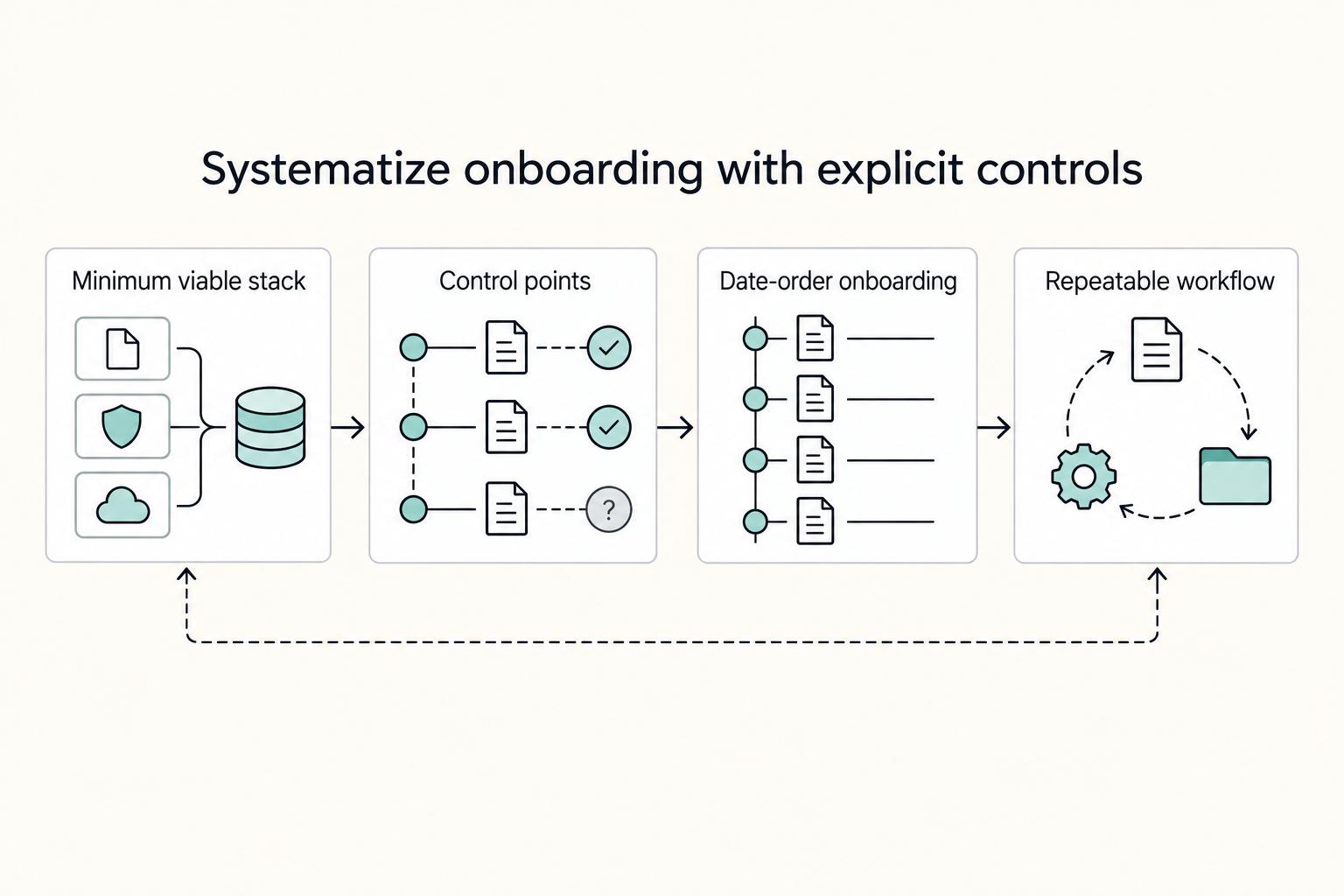
Keep this phase lean. Use a small stack you can audit quickly, then run onboarding in date order. If a task creates a filing, a contract term, or identity evidence, your process should show who did it, when, and where the final record is stored.
Step 1. Build a minimum viable stack#
For a first hire, smaller is safer. Choose by function, not brand. Your baseline stack needs payroll and PAYE handling, contract handling, and secure document storage. Also confirm your business structure early, for example sole trader or limited company, because that choice affects how you pay tax and your legal responsibilities.
| Function | What it must do | Highest failure risk | What to verify before you choose |
|---|---|---|---|
| Payroll/PAYE workflow | Run pay, produce records, and track submissions | A run looks complete, but you cannot prove what was submitted | Dated confirmations, exportable history, clear correction process, pension-duty tracking fields |
| Contract workflow | Control versions, collect approval/signature, store final terms | Signed file does not match final approved terms | Version history, sent/viewed/signed timestamps, final-file storage, named owner |
| Secure document storage | Store identity and employment records with controlled access | Sensitive files end up in general shared folders | Access permissions, check/upload dates, retrieval speed, retention/deletion fields |
In practice, that means one payroll process, one contract signoff process, and one access-controlled storage location, each with a named owner.
Step 2. Set control points before the first live run#
Set the checks before anything goes live. That is what keeps the first run calm instead of reactive. For payroll, keep a dated record pack for each cycle and a separate checklist for PAYE and pension obligations; confirm the current requirements from official HMRC guidance.
For contracts, keep one master document path from draft to signed version so the final file, approval trail, and delivery date are easy to prove. Record legal timing for written terms as Current requirement pending official verification.
For Right to Work and related identity evidence, define your verified procedure first, then keep records in a restricted location, log who checked what and when, and document handling rules as Current requirement pending official verification.
Alongside employee admin, keep your own founder tax admin current so you do not create a separate filing problem at the same time. HMRC guidance says to check whether you need to send a tax return before registering for Self Assessment. If you need to complete a tax return for the previous tax year, tell HMRC by 5 October; late notification can lead to a penalty. If you already have a Self Assessment account, reactivate it before filing to avoid delays. Keep records such as bank statements or receipts, and pay your tax bill by 31 January. If you are registering as a sole trader, you need a National Insurance number.
Step 3. Run onboarding in date order#
The safest onboarding follows a clear sequence. Finish the compliance and record steps first, then move into access and role clarity.
Before start date
- Send contract or written terms and store the final signed copy.
- Complete your verified identity and Right to Work workflow, store evidence in the restricted folder, and log check dates.
- Create the payroll record, pension-duty tracker, and employee file index.
- Provision email, device, and core systems, then test access before day one.
- Send first-week expectations: hours, reporting line, first meeting, and initial priorities.
On day one
- Confirm access works end to end.
- Confirm role expectations, priorities, and approval path.
- Show where policies, key documents, and support contacts live.
- Record completed items and open issues.
Step 4. Turn onboarding into a repeatable 30-day mission#
The first month should be outcome-based and owned by one person. If no one owns time to productivity, onboarding becomes a loose collection of tasks.
- Owner: accountable for time to productivity.
- Outcomes: 3 to 5 clear results expected by day 30.
- Checkpoints: day 7, day 14, and day 30.
- Escalation path: named backup for blockers in payroll, access, workload, or role clarity.
When the owner, checkpoints, and escalation path are explicit, onboarding becomes delegable instead of ad hoc.
You might also find this useful: How to Hire Your First Employee in Germany. If you are turning this hiring checklist into repeatable operations, review the docs to map approval-based payment flows, status tracking, and audit-ready records into your process.
Phase 3: The Autonomy Shield (How to Protect Your Time & Focus)#
Once onboarding runs in date order, the next risk is that you become the bottleneck. Protect your time by delegating complete processes with clear ownership, not isolated tasks that still send every decision back to you.
Step 1. Define what you keep, what you transfer, and what you supervise#
Use a simple ownership model with three buckets:
- Keep: direction-setting and founder-judgment work, such as strategy, pricing, role scope, and sensitive people decisions.
- Transfer: repeatable execution, such as payroll prep, onboarding admin, document collection, scheduling, and first-draft reporting.
- Supervise: any area where legal accountability remains with you, even when execution is delegated.
That supervision layer matters. If someone else runs payroll, you are still legally responsible for PAYE tasks. If someone supports health and safety, your legal duty still stays with you, even when that support comes from a competent person.
Use one control question: can you show what was done, by whom, on what date, and where the final evidence is stored?
For example, you can delegate drafting and issuing of the written statement of employment particulars. You should still supervise timing and proof. The principal statement should be provided on the first day, and the wider written statement within 2 months.
Step 2. Hand over a process with a full ownership pack#
Delegation fails when you hand over a task with no boundaries. Give the person a complete ownership pack that matches the job:
- Process doc: steps, source files, deadlines, and record location.
- Decision rights: what they can decide, what needs your sign-off, and what is out of scope.
- Definition of done: required output, quality checks, and evidence.
- Escalation path: what triggers escalation and who receives it.
- Review checkpoint: first shadow run, first solo run, and review date.
Watch for fake delegation: they are the "owner" on paper, but routine choices still come back to you. Fix that by tightening decision rights, then testing the next live cycle. A clean handoff means a solo run is completed without your intervention, followed by a written review afterward.
Step 3. Set communication rules that protect focus#
Set the rules early. Otherwise every question becomes urgent by default. Agree how and when you communicate, and keep routine contact from turning into constant interruption.
| Channel | Use it for | Escalate when |
|---|---|---|
| Async message or email | Routine questions, status updates, documented decisions | A blocker could cause a missed filing, missed contract timing, or same-day payroll issue |
| Scheduled one-to-one or team sync | Priorities, feedback, recurring blockers, development, role clarity | The same issue appears in two check-ins, or accountability is unclear |
| Urgent call or direct interruption | Safety concerns, employee welfare issues, access failures, urgent pay issue | Immediate escalation for health and safety concerns or inability to work |
Use regular one-to-ones for course correction, then keep a written record of agreed actions and share it afterward. For formal performance reviews, a practical baseline is at least once a year.
Step 4. Catch overload and dependency drift early#
Act early when warning signs appear. Start with an informal conversation, then apply a specific corrective action:
| Warning sign | Corrective action |
|---|---|
| Repeated quick questions on the same step | Update the process doc with examples and sharpen decision rights |
| Routine approvals keep returning to you | Move that decision into delegated scope and check outcomes at the next review |
| Messages creep into evenings or breaks are skipped | Reset channel boundaries and workload; sense-check against rest entitlements: a 20-minute uninterrupted break when working more than 6 hours, 11 consecutive hours daily rest, and 24 uninterrupted hours weekly rest |
| Rising conflict, complaints, absence, or performance drop | Start with an informal chat; if needed, use a structured improvement plan with specific objectives, timeline, and support or training |
For a related example, see How to Hire Your First Employee in Canada.
Conclusion: Run This as a Repeatable, Documented Process#
This is an operating shift. You need a repeatable process, not a one-off fix for too much work.
In practice, that means keeping the core decisions and evidence in order: your business structure, current tax admin, Self Assessment status, filing access, and records. The standard is simple: if someone else reviewed your file, they should be able to see what you decided, when you checked it, and what record supports it.
- Confirm the legal and tax base. Your structure affects tax treatment and legal responsibility, so verify it first. If Self Assessment applies, confirm registration or reactivation before filing, and make sure you can access filing with your UTR.
- Keep records that are usable. Store the documents you need to complete returns correctly, such as bank statements or receipts, in one organized, dated system.
- Run deadline checkpoints on time. Build clear checkpoints for registration or reactivation, filing, and payment so you reduce avoidable delays and penalty risk.
From here, confirm your business structure, test HMRC access and UTR, reactivate any old Self Assessment account if needed, assemble your records, and keep one dated operating file. If you need to notify HMRC for the previous tax year in this guidance snapshot, the key date is 5 October 2025.
That is what "CEO" means here: regular review, documented processes, and delegation only after the system is clear. You cannot remove every risk, but you can work with fewer surprises and make better decisions.
If you want a step-by-step walkthrough, see How to Hire Your First Salesperson. When you are ready to run people payments with tighter controls and cleaner reconciliation, talk to Gruv for a fit check.
Frequently Asked Questions
What is the true cost of hiring a first employee in the UK?
Start with a full cost sheet, not salary alone, and document it in the legal entity that will employ the person. Your structure matters: a sole trader is personally responsible for business debts, while a limited company is legally separate from its owners. Before you commit, verify live employer cost inputs and record current rate and threshold items with the date checked.
What is the difference between a contractor and an employee in the UK?
Treat this as a risk decision first. Verify current HMRC and legal guidance before deciding. If the role looks employment-like, pause and review What to Do If You've Been Misclassified as an Independent Contractor. Keep your written rationale, the signed contract, and the date you verified the current rules. | Route | What to do now | What to keep | | --- | --- | --- | | Employee | Verify current tax and legal obligations from official guidance | Dated compliance checklist and setup evidence | | Contractor | Verify current classification and tax treatment rules for your case | Written status rationale and contract file |
What is the absolute first step to legally hire someone in the UK?
Confirm which legal entity is hiring, then make sure your HMRC admin is current. If you need to complete a return for the previous tax year, HMRC says to notify by 5 October. First-time filers must register before using online filing, and previously inactive accounts may need reactivation to avoid delays. Keep your UTR, registration or reactivation confirmation, and a dated pre-hire checklist.
What software do I need for my first employee?
Use the smallest stack that lets you keep records and complete HMRC filing correctly. If online filing does not fit your case, use commercial software or another HMRC filing method, and keep supporting records such as bank statements or receipts. Keep filing confirmations, access controls, and a simple document index. | Tool type | Priority | Output to retain | | --- | --- | --- | | Record storage + filing method | Essential | Filing confirmations and organized records | | E-signature or task tracker | Optional early | Signed docs and task/audit trail |
Do I have to provide a pension for my first employee?
Treat pension setup as a pre-payroll compliance check, but this section does not include current eligibility rules or contribution rates. Verify the live thresholds and rates before implementation. Keep your eligibility assessment, scheme decision, and payroll configuration record.
What is a Right to Work check?
If a Right to Work check applies in your case, use current Home Office guidance for the exact route and evidence requirements, because this section does not provide the full process detail. Complete the check using the current official process and do not rely on old internal notes. Keep a dated outcome record, any required reference details, and who completed the check.
Try a related tool
Researched and edited by the Gruv editorial team. Gruv builds cross-border billing, payouts, and finance-operations software for global businesses.
Sources
Includes 3 external sources outside the trusted-domain allowlist.
- thepensionsregulator.gov.uk/en/employers/new-employers/im-an-employer-wh...trusted
- thepensionsregulator.gov.uk/employers/new-employers/im-an-employer-who-h...trusted
- acas.org.uk/performance-managementexternal
- gov.uk/employment-contracts-and-conditions/written-...external
- gov.uk/paye-for-employersexternal
Educational content only. Not legal, tax, or financial advice.
Related Posts

Understanding the UK's Statutory Residence Test (SRT)
Treat SRT like ops, not folklore. You want a repeatable workflow you can run monthly so your tax-year answer is boring, documented, and easy to defend.

What to Do If You've Been Misclassified as an Independent Contractor
Treat this as a protection problem first, not a label debate. If your work was treated as an independent contractor arrangement even though the relationship functioned differently, your first goal is to protect pay, rights, and records while you choose the least risky escalation path. You can do that without making accusations on day one, which often keeps communication open while you document what happened.

The Freelance Payment Penalty: A Modeled Audit of Platform Fees, FX Spreads, and Payout Delays
The money rarely disappears through a single, easy-to-spot fee. The real loss is stacked. A marketplace takes its commission, a processor adds a charge for international cards, a bank or payment company converts the currency at a spread, a platform holds the funds before release, and a wire sheds a little to intermediaries on the way in. Each layer looks defensible on its own, but the worker feels the combined result as a smaller deposit and a later payday.