
Quick Answer
Confirm the work province first, then decide whether you are the legal employer or using an Employer of Record. For direct hiring, set up your CRA payroll account before the first remittance due date and do not release pay until SIN, completed TD1 forms, and deduction checks are in place. Finalize a signed employment agreement before start date, assign payroll and remittance owners, and keep first-run approval records through the first 30 days.
You are not just hiring one person you are becoming an employer#
Hiring your first employee in Canada is not just a recruiting task. It is an employer-compliance project. Payroll, contract, and onboarding decisions should happen in a clear order. Use a province-first sequence so your terms, payroll, and onboarding are set before first payroll and can stay aligned through the first 30 days.
Canada is not one national employment rulebook, and it is not an at-will employment market. Core standards such as overtime, vacation pay, and statutory holidays vary by province, so confirm the governing province before you finalize pay terms, hours, or contract language.
Before you start. Use this guide as a practical sequence for what to set up, and in what order, before the employee starts and during the first 30 days. The scope is intentional. You still need to verify province-specific requirements before making final decisions.
1. Confirm the governing province before you write or promise anything. Document where the employee will primarily work, and keep that confirmation in the hiring file. That fact can determine key employment standards and what belongs in your offer, contract, and payroll setup. If the primary work province is unclear, pause and resolve it first.
2. Set up employer basics before first payroll, not after day one. Decide who owns payroll and onboarding, and whether you are hiring directly or through an Employer of Record (EOR). If you hire directly, register with the CRA for payroll deductions before the first pay run, account for mandatory obligations such as EI, and make sure you can maintain accurate employment records from the start.
3. Treat the first 30 days as a records-and-accountability window. Build a basic employer file with the confirmed work province, signed terms, payroll setup proof, and onboarding completion records. If you use an EOR, you still manage day-to-day work while the EOR handles compliance and liability. If you hire directly, those obligations stay with you. In either model, make ownership explicit before the employee begins.
What to prepare before you post the role#
Do the internal setup before you post the role. Confirm the workload supports a hire and document your core assumptions. That upfront discipline helps keep hiring organized and lowers compliance risk later.
| Prep item | Details | Timing |
|---|---|---|
| Draft written employment agreement | Core terms such as working hours, compensation/benefits, and termination policy | Before the ad goes live |
| Signed acceptance plan | Plan for signed acceptance of the written terms | Before the ad goes live |
| Background checks | Consent step and a data-minimization approach, if you plan background checks | Before the ad goes live |
| Next-step ownership | Clear internal ownership for next steps | Before the ad goes live |
1. Write down your planning facts in one place. Keep the role internally consistent before it goes live. Capture the core details you plan to offer so your team is aligned before posting.
2. Review the applicable employment and workplace rules before you draft role copy or make promises. The hiring process takes planning, structure, and an understanding of employment regulations. Keep this practical so you do not offer terms that conflict with how you will actually hire and onboard.
3. Build a short prep packet before the ad goes live. Keep it simple:
- Draft written employment agreement with core terms, for example working hours, compensation/benefits, and termination policy
- Plan for signed acceptance of the written terms
- If you plan background checks, a consent step and a data-minimization approach
- Clear internal ownership for next steps
4. Set a single go or no-go checkpoint before posting. Confirm your internal process and written terms are ready to issue for the intended start window. If the answer is unclear, adjust timing before you commit to candidates. Poor execution here is not just inconvenient. Compliance failures can become very expensive.
Lock the province before you draft anything#
Lock jurisdiction first, then draft terms. If you cannot confirm whether the role is governed by a province of employment or by a federally regulated business under the Canada Labour Code, pause and resolve that first. Do not issue an offer, draft final contract language, or set payroll until you know the right lane.
1. Choose the governing jurisdiction before writing terms. In many cases, that means the employee's primary province of employment. Do not treat this as an admin detail to fix later. Jurisdiction drives employment standards and payroll handling.
Keep the federal fork clear as well. Not every employment relationship is governed only by provincial law. The Canada Labour Code applies to a "federal work, undertaking or business." Confirm which lane applies before you draft.
2. Create a one-page jurisdiction summary in your hiring file so offer terms, onboarding, and payroll stay aligned.
| Item | What to record |
|---|---|
| Governing jurisdiction | Province of employment, or note that the role may be federally regulated |
| Minimum standards check | The statute/regulation source you will verify before issuing terms |
| Overtime approach | High-level treatment and what still needs confirmation |
| Holidays and vacation | What must be verified locally before payroll setup |
| Notice expectations | Local baseline to review contract terms against |
| Evidence | Written work-location confirmation, remote-work note, and internal signoff |
Use guidance as an organizing tool, not as the final authority. If guidance and legislation differ, legislation controls.
3. Set a hard pause rule. If the employee's primary work location is not confirmed in writing, do not finalize terms. This matters most for remote roles, where coverage can vary by provincial, territorial, or federal regime.
Document the remote-work setup in the file, including a full-time remote work agreement where relevant, and attach it to the jurisdiction summary. If province of employment is still unclear, escalate and request a formal ruling before finalizing the offer.
We covered this in detail in A Guide to Incorporating a Federal vs. a Provincial Company in Canada.
Choose direct Canadian hiring or an Employer of Record#
Choose based on ownership first. If you can run Canadian payroll and compliance internally and want full control, hire directly. If you need speed or do not yet have that capacity, evaluate an Employer of Record first.
1. Compare the models by legal-employer ownership, because that choice drives contracts, payroll administration, records, and ongoing admin work.
| Decision point | Direct Canadian hiring | Employer of Record (EOR) |
|---|---|---|
| Legal employer | Your company, after setup/registration | The EOR is the legal employer while you direct day-to-day work |
| Day-to-day management | You manage the employee | You still manage daily work and expectations |
| Payroll and remittances | You run payroll and legal administration internally | The EOR typically runs payroll, handles tax deductions/remittances, and maintains statutory records. Confirm exact responsibilities |
| Employment contract terms | You issue and maintain terms aligned to the governing province and applicable federal context | The EOR usually provides locally compliant contract administration. You still review business terms carefully |
| Ongoing admin burden | Higher internal burden | Lower internal burden, but you still manage approvals, data handoffs, and vendor coordination |
Direct hiring gives you more internal control. An EOR reduces setup friction by placing legal employment administration with a third party.
2. Use a simple rule before drafting terms. Go direct when you want long-term policy control and can support payroll and compliance operations. Evaluate an EOR first when hiring speed or internal capacity is the constraint.
One source estimates direct setup can take months and could cost up to CA$106,092 in legal, tax, and payroll setup. Treat that as directional, not universal. An EOR is also not risk-free, but it can speed initial hiring when the provider already has the legal-employer layer in place.
3. Do not assume U.S. and Canadian employment handling are interchangeable. Canadian employment requirements vary by province or federal context, so contract terms and payroll/compliance workflows need stronger upfront planning under either model.
That applies in both paths. With direct hiring, you own the contract and compliance risk. With an EOR, legal administration is outsourced, but you still need to verify who owns each obligation and what is included in scope. Resolve worker status early as well. Federal guidance exists for determining employee status, and misclassification risk can include fines and back pay.
4. Document handoffs before first payroll. This can become a failure point when ownership is unclear.
- Employment contract: who drafts, who signs as legal employer, who approves business terms
- Payroll and remittances: who runs payroll, who remits deductions, who corrects payroll errors
- Statutory records and payroll documentation: who issues documents and who answers payroll questions
- Onboarding data: who collects required fields and what cutoff dates apply for first pay
Use timing checkpoints, not assumptions. A reported EOR rollout may still need at least two to three weeks after clean employee data handoff, and bank validation can take 3 to 5 business days. Late banking setup is a common first-payroll exception driver.
If you are weighing direct hiring against outsourcing employer obligations, review this related model: Explore Merchant of Record for businesses.
Set up payroll with CRA before day one#
Once you decide the legal employer, payroll becomes the next hard gate. If you are hiring directly, treat CRA payroll setup as early setup work, not post-start cleanup. Register your payroll account before the first remittance due date, then confirm access and ownership before your first payroll run.
Before you pay the employee, make sure these are complete: Social Insurance Number (SIN), province of employment, and completed TD1 forms. If any of these are missing, pause payroll setup.
1. Register your CRA payroll account early, then document operational ownership, not just account creation. Your payroll note should name:
- who has CRA payroll account access
- who prepares payroll
- who submits remittances
- who confirms remittances were received, or reports a nil remittance when applicable
- who handles remitting errors or misallocated payments
- who coordinates year-end slips and summaries
Before processing first payroll, verify the owner can log in and explain the submission path without guesswork.
2. Set up deductions using real employee data, then validate before first live pay. CRA payroll guidance covers CPP contributions, EI premiums, and income tax deductions on amounts paid. Run a pre-live check with the Payroll Deductions Online Calculator and keep that output with your payroll setup records.
Use actual inputs, especially province of employment, pay amount, and TD1 information. Review both employee withholdings and employer CPP and EI responsibilities so remittance ownership is clear before money moves.
3. Build your filing map now so year-end work is owned from the start. Canadian payroll includes withholdings, remittances, and year-end slips. Assign an owner, reviewer, and data source for each item during setup.
| Filing item | Decide now | Owner check |
|---|---|---|
| Payroll remittances | Who submits, confirms receipt, and handles correction workflows | Is one person clearly accountable after each pay run? |
| Employer information return | What timing applies to your business and where supporting data will come from | Who prepares and who reviews before filing? |
| T4 slip | Who prepares, files, and distributes slips/summary info | Where are year-end earnings and deductions reconciled? |
| T4A slip | Whether it applies to your process and who owns it if in scope | Has someone explicitly confirmed it is covered or out of scope? |
4. Set a go-live checkpoint. Do not process first payroll until payroll passes it.
- CRA payroll account is registered and accessible to the named owner
- SIN, province of employment, and completed TD1 forms are on file
- CPP, EI, and income tax deductions were test-reviewed against the calculator
- remittance and year-end filing ownership is assigned, including T4 and any in-scope T4A responsibilities
If one item is still open, delay first payroll processing and close the gap first.
Related reading: A Guide to Employee Handbooks for a Remote-First Company.
Build the offer and employment contract with province rules#
After payroll setup, paperwork becomes a key compliance step. Draft the offer and employment contract after confirming the work province. Canadian employment law has two overlapping layers: provincial or territorial standards for most private employers, and a federal layer in some cases.
1. Confirm jurisdiction first, then draft. Start by deciding whether the role falls mainly under provincial or territorial standards, or in a federally regulated context where the Canada Labour Code applies, for example banking, telecommunications, or interprovincial transport. Record that decision in your hiring file before sending a draft.
For most private employers, align terms to the employee's province of work. If location is not final, pause and confirm it in writing. If you hire across provinces, do not assume one template works unchanged everywhere. If your template came from another country, review and adapt it before issuing so the terms align with Canadian rules.
2. Separate negotiable business terms from statutory minimums. Your letter of offer can set business terms such as role details and compensation. Statutory minimum standards still apply.
Employment standards set minimums in areas such as hours of work, overtime, minimum wage, vacation, and leave. Keep the deal terms clear, and make sure contract language does not undercut those minimums. A practical check is to read the draft once as an operator and once as a skeptical employee. If a clause seems broader than local minimum standards, send it for review.
3. Consider a targeted compliance review before signature, then lock your records. For a first hire, a focused legal or compliance review can help check alignment with core standards, especially if the draft started from an older or foreign template.
Then finalize a simple verification pack:
- final version with document date and province noted
- signed offer or contract confirming acceptance
- reviewer name and review date, if you ran a legal or compliance check
- stored copy of the exact version sent to the employee
Do not treat the hire as fully papered until you have a signed version on file and a clear record of which jurisdiction the draft was built for.
Collect employee data and compliance documents correctly#
Collect only what you need to run payroll and compliance, then verify it before payroll goes live. A common onboarding risk is over-collection, broad access, or activating with incomplete records.
| Onboarding item | Owner | Deadline |
|---|---|---|
| Employment agreement signed and filed | Hiring owner | Before payroll activation |
| Payroll enrollment details complete and reviewed | Payroll owner | Before first pay is approved |
| Tax documents, legal agreements, and NDAs collected as needed | People or operations owner | By your internal cutoff |
1. Keep data collection purpose-based. For a first hire, that typically means the signed employment agreement, payroll enrollment details, core identity fields, and relevant tax documents. Before anything is entered into payroll, check obvious mismatch points: legal name spelling, address, province of work, and start date against what the employee provided.
If you run reference or background checks, keep them separate from payroll onboarding. In Canada, these checks should be consent-based and role-relevant, so avoid broad check workflows that collect extra data without a clear purpose.
2. Use a short onboarding checklist with one owner and one due date per item.
- Employment agreement signed and filed: hiring owner, before payroll activation
- Payroll enrollment details complete and reviewed: payroll owner, before first pay is approved
- Tax documents, legal agreements, and NDAs collected as needed: people or operations owner, by your internal cutoff
If you hire across provinces, record the employee's work province on the checklist so local differences are tracked.
3. Set privacy boundaries at the start. PIPEDA and provincial privacy laws govern how employee data is collected, stored, and used, so store only what payroll or compliance needs and limit document access accordingly.
4. Add one go-live checkpoint before activation. Mark onboarding complete only when all required fields are present, reviewed, and approved by a named person. If something is missing, pause activation and fix it first.
Run day one onboarding and first payroll without misses#
Treat day one and first payroll as one compliance checkpoint: clear onboarding, verified payroll setup, and documented controls before pay is released.
| Checkpoint | What to confirm |
|---|---|
| First pay date | Confirmed with the employee and manager |
| Gross pay basis | Matches the signed agreement |
| Statutory deductions | Required statutory deductions, including EI, are active |
| Work details | Work province and start date match the onboarding file |
| Test calculation | Reviewed before approval |
| CRA payroll deductions registration | Already in place |
1. Run a short orientation that covers workplace policies, core rights under the applicable employment standards rules, and practical job expectations. In Canada, requirements can overlap across federal and provincial levels, so this should usually anchor to the employee's work province unless you are in a federally regulated sector such as banking, telecommunications, or interprovincial transportation.
Keep it practical, not a policy dump. Confirm the schedule, time approval flow, absence reporting, and where payroll questions go. Then record what was reviewed and when so your documentation is clear from day one.
2. Confirm payroll setup before the first run, not after it. Verify the first pay date, work province, start date, and that required statutory deductions, including Employment Insurance (EI), are active.
Run a pre-payroll check using the same inputs as your payroll run. If results do not align with your expected output, pause and correct setup before funds go out.
Use this first-run payroll checkpoint list:
- first pay date confirmed with the employee and manager
- gross pay basis matches the signed agreement
- required statutory deductions, including EI, are active
- work province and start date match the onboarding file
- test calculation reviewed before approval
- CRA payroll deductions registration is already in place
3. Have the manager approve the inputs that create pay, not just the final total. For hourly or variable pay, confirm attendance, time, overtime, and one-time additions before payroll preview approval. For salaried hires, confirm start date, leave, and manual adjustments.
Keep a simple first-run approval log with the payroll preview, manager sign-off, and final approver name as an internal control. This supports accurate, detailed employment records and helps prevent common misses that lead to correction work and avoidable compliance risk.
Need the full breakdown? Read How to Onboard a New Employee in a Remote-First Company.
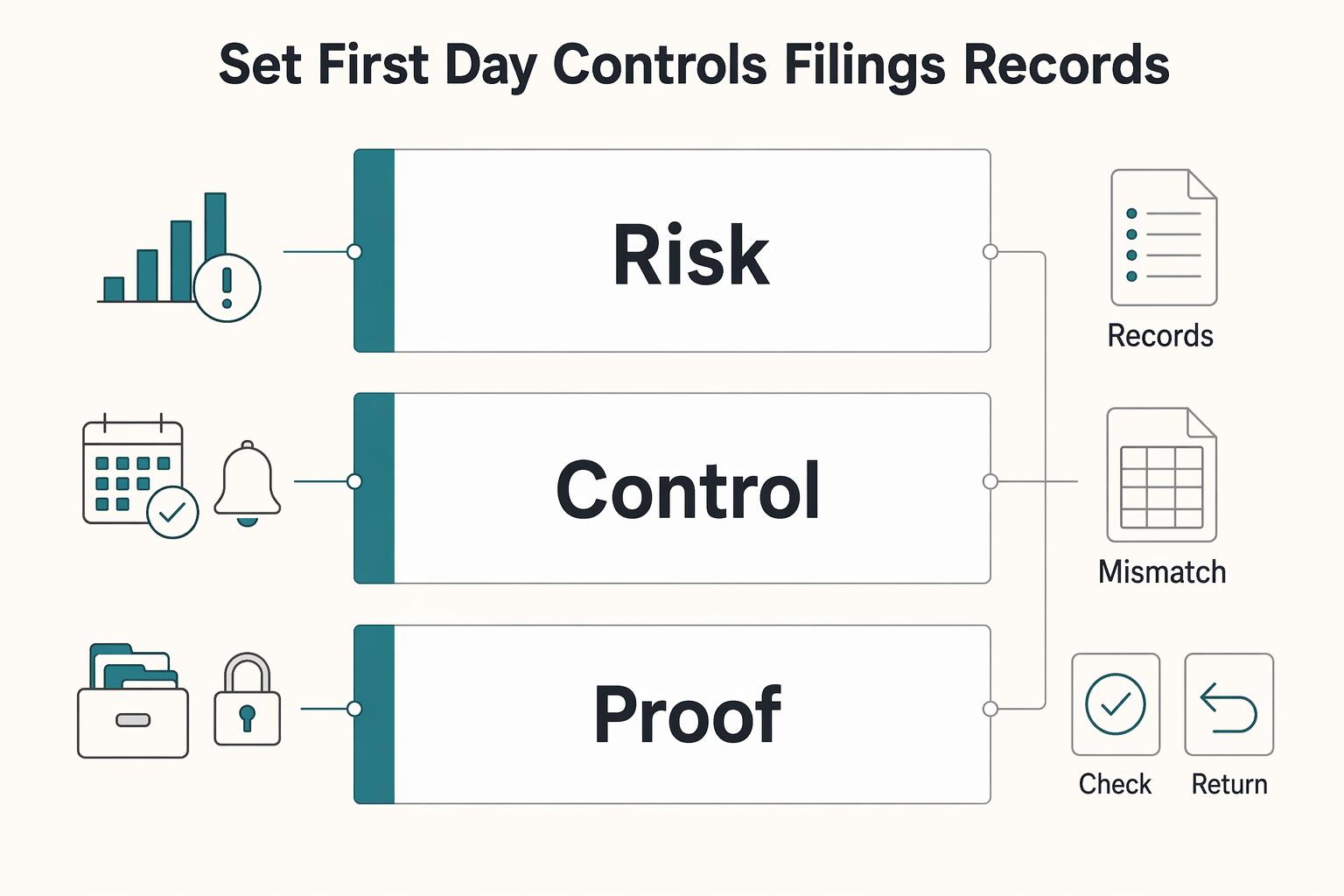
Set first 30 day controls for filings and records#
In the first 30 days, treat filings and records as an operating control. Assign owners, set reminders, and keep evidence in one place while the details are still easy to verify.
1. Build a compliance calendar with owners, not just dates. Include your filing workflow, ROE-readiness checks, and internal reminders early enough to fix missing data before submission.
Keep each entry practical: task, primary owner, backup owner, where source records live, and who approves before filing. If someone new cannot open the calendar and immediately see who does what and where records are stored, the control is not ready.
2. Set event-driven controls early for Record of Employment (ROE) readiness. Decide now who monitors events that may require an ROE later and what records must be complete when that point arrives.
The ROE guide is block-by-block and covers insurable earnings and insurable hours, so your records need to support those fields without reconstruction. As a quick test, confirm you can populate core ROE fields from existing approved records. For federally regulated employers, this discipline matters because employment conditions are set in Part III of the Canada Labour Code, and compliance guidance includes sharing records with the Labour Program.
3. Track optional workflows separately from routine payroll operations. If this hire connects to any optional process, keep a dedicated tracker for status, approved terms, reporting needs, and manager constraints.
That small separation upfront avoids mixing routine payroll data with extra conditions and approvals later. Your checkpoint is simple: in one place, you can answer what was requested, what was approved, and what evidence you must retain.
4. Maintain a current evidence pack and update it after each submission or approval. For a first hire, this can include:
- records used to populate core ROE fields, including insurable earnings and insurable hours
- owner and approval logs for filing-related inputs
- submission confirmations
- correspondence tied to filing ownership or record-sharing requests
- corrective-action notes, including policy or practice updates when applicable
Use this as your reconstruction file. If an ROE is needed or records are requested, you should be able to show how key fields were prepared, who approved them, and what was submitted. When employers fall short, corrective action can include paying amounts owing or implementing workplace policies and practices, so thin records create real risk.
For a step-by-step walkthrough, see How to Hire Your First Salesperson.
Fix common first hire mistakes fast#
When you spot a first-hire compliance miss, fix it quickly, stop the repeat, and record what changed and who approved it.
1. Start with payroll setup if that is the gap. If you started paying before your CRA employer registration and payroll account were in place, complete that setup before the next payroll run. A CRA payroll account is what lets you deduct and remit CPP, EI, and income tax, and it should be connected to your Business Number (BN).
Then document the affected pay period, the correction, and sign-off.
2. Treat a non-Canadian offer letter or contract template as a live risk. Hiring in Canada requires compliance with both federal and provincial standards, so template language written for another jurisdiction can create gaps.
Replace the working template, update active documents when needed, and keep a short remediation note with both versions so the change history is clear.
3. Do not treat province details as admin filler. Federal and provincial standards both apply, so confirm your hiring and payroll records reflect the correct jurisdiction. If they do not, update all affected records together rather than patching one field at a time.
4. Tighten records discipline before the next cycle. Weak records discipline can turn small errors into costly problems, including compliance risk. Keep accurate, detailed employment records and close any missing compliance documentation before the next cycle. Log each fix with date, owner, and approval so you can show a clean record if questions come up later.
Related: How to Hire Your First Employee in Germany.
Your next move and copy paste checklist#
If you are about to hire your first employee in Canada, use this as a go or no-go checklist. If any item is incomplete, move the start date and finish setup before first pay.
- Confirm the province of employment in writing.
Record the employee's primary work province in your hiring file and make sure payroll and contract drafting use that same note. If location is still unsettled, pause, because CRA requires you to determine province of employment before you pay an employee.
- Assign clear owners for hiring and payroll setup.
Document who owns payroll setup, employment paperwork, and ongoing compliance tasks before first pay. The risk to avoid is assumed ownership, where required steps are left incomplete.
- Set up payroll account access before payroll pressure starts.
If you are a new employer, register your CRA payroll account before the first remittance due date. Confirm who has access, who is backup, and that your payroll workflow is tested before live pay.
- Finalize and sign the employment agreement before start date.
Treat the offer letter or employment agreement as a legal contract and get it signed before work begins. At minimum, make sure it clearly states working hours, compensation and benefits, and termination policy.
- Collect required payroll inputs before first pay.
Before paying the employee, collect their SIN, confirm province of employment, and get completed TD1 forms. Store this data securely and complete day-one policy orientation so expectations are clear from the start.
- Run first payroll with a documented review, then track early onboarding.
Review pay inputs, keep an approval record, and save core documents in one place. Continue structured onboarding after the first payroll so compliance setup and manager follow-through stay aligned.
When your checklist is locked and you want implementation details for payouts, records, and integration flow, start with the technical guide: Read the Gruv docs.
Frequently Asked Questions
What must I set up before paying my first employee in Canada?
Before first payroll, lock in the work province, a written offer or employment contract, and a payroll setup if you are the employer. Have the contract signed and accepted before activation so the terms are clear for both sides. This is where setup becomes risk control, not admin.
Do I need a CRA payroll account before I can hire?
Not necessarily before posting a role or signing an offer. You may need to register for a CRA payroll account once you are acting as an employer, trustee, or payer of employment-related amounts. In practice, do not let a start date move ahead of payroll readiness.
Why does province selection come before the employment contract?
Because overtime, vacation pay, and statutory holiday rules vary across provinces. Those differences affect contract language and payroll assumptions. If you confirm the province after drafting, you can lock in the wrong standards.
What are the core employer obligations I should track from day one?
Start by confirming worker status based on the real working relationship, not just the contract label. That distinction drives whether the person is treated as an employee under a contract of service or as self-employed under a contract for services, and misclassification is a known risk. Then track clear ownership for payroll setup, signed employment terms, and year-end reporting such as T4s. If status is unclear, resolve that before first pay, and see What to Do If You've Been Misclassified as an Independent Contractor.
Is Canada an at-will employment system?
No. At-will employment is not the Canadian default. U.S.-style assumptions can create problems if copied directly, and termination wording is one area where weak language can become expensive.
What does an Employer of Record handle and what do I still own?
With an Employer of Record, the EOR is the legal employer on paper while you manage day-to-day work and output. The EOR manages compliance and liability, and may handle statutory filings like T4s and other year-end reporting, but you should confirm the exact scope. You still own operating decisions such as role scope, manager accountability, and performance expectations.
Which details still require province-specific confirmation before I proceed?
Confirm the primary work province before finalizing terms. At minimum, verify overtime, vacation pay, and statutory holiday standards for that province. Review contract clauses that depend on local standards, with extra care around termination language.
Try a related tool
Researched and edited by the Gruv editorial team. Gruv builds cross-border billing, payouts, and finance-operations software for global businesses.
Sources
Includes 4 external sources outside the trusted-domain allowlist.
- eeoc.gov/best-practices-private-sector-employerstrusted
- govinfo.gov/content/pkg/CHRG-113shrg79588/html/CHRG-113s...trusted
- ohioauditor.gov/AuditSearch/Reports/2025/Great_Parks_of_Hami...trusted
- wise.com/us/blog/batchtransfer-employer-of-record-canadatrusted
- ca.indeed.com/hire/c/info/hiring-your-first-employeeexternal
- canada.ca/en/employment-social-development/corporate/p...external
- canada.ca/en/revenue-agency/services/tax/businesses/to...external
- cfib-fcei.ca/en/tools-resources/hired-first-employee-what...external
Educational content only. Not legal, tax, or financial advice.
Related Posts

Ho Chi Minh City Digital Nomad Guide for a 30-Day Move (2026)
Ho Chi Minh City is a strong base if your priority is keeping work momentum while relocating. You get density, plenty of places to work from, and a social scene that can help you settle quickly. It is a weaker fit if your best days depend on calm streets, easy walking, and long stretches of quiet. In practice, Saigon tends to reward people who want convenience and activity more than retreat pace.

What to Do If You've Been Misclassified as an Independent Contractor
Treat this as a protection problem first, not a label debate. If your work was treated as an independent contractor arrangement even though the relationship functioned differently, your first goal is to protect pay, rights, and records while you choose the least risky escalation path. You can do that without making accusations on day one, which often keeps communication open while you document what happened.

The Freelance Payment Penalty: A Modeled Audit of Platform Fees, FX Spreads, and Payout Delays
The money rarely disappears through a single, easy-to-spot fee. The real loss is stacked. A marketplace takes its commission, a processor adds a charge for international cards, a bank or payment company converts the currency at a spread, a platform holds the funds before release, and a wire sheds a little to intermediaries on the way in. Each layer looks defensible on its own, but the worker feels the combined result as a smaller deposit and a later payday.