
Quick Answer
Start by treating sabbatical tax implications as a three-part workflow: set a foreign tax-home position before departure, maintain a rolling day count and travel proof abroad, then file from records using Form 2555 when FEIE facts are met. Separate employee wages from side-business income before choosing FEIE or FTC, and keep state residency evidence aligned with your federal timeline. If your facts conflict across countries or states, get cross-border tax review before filing.
A sabbatical can be a smart investment for an employer and a meaningful reset for you. It can also create tax friction fast if you treat it casually. The practical way through is to manage it like an operator: decide your position before you leave, collect proof while you travel, and file from evidence instead of memory.
This playbook follows that three-phase path. First, you set your tax position and documentation before departure. Then you keep that position intact while you are abroad. Finally, you turn that record into a filing strategy that matches the facts. Done well, the process is less about chasing tax savings and more about staying in control.
Phase 1: The Pre-Departure Tax Position and Records#
Before you leave, lock down your tax position and the records that support it. In this phase, you are doing three jobs: classifying each income stream correctly, confirming whether FEIE is even available, and building the evidence that supports your state-residency position if it is ever reviewed.
Step 1: Define your tax position before you book the trip#
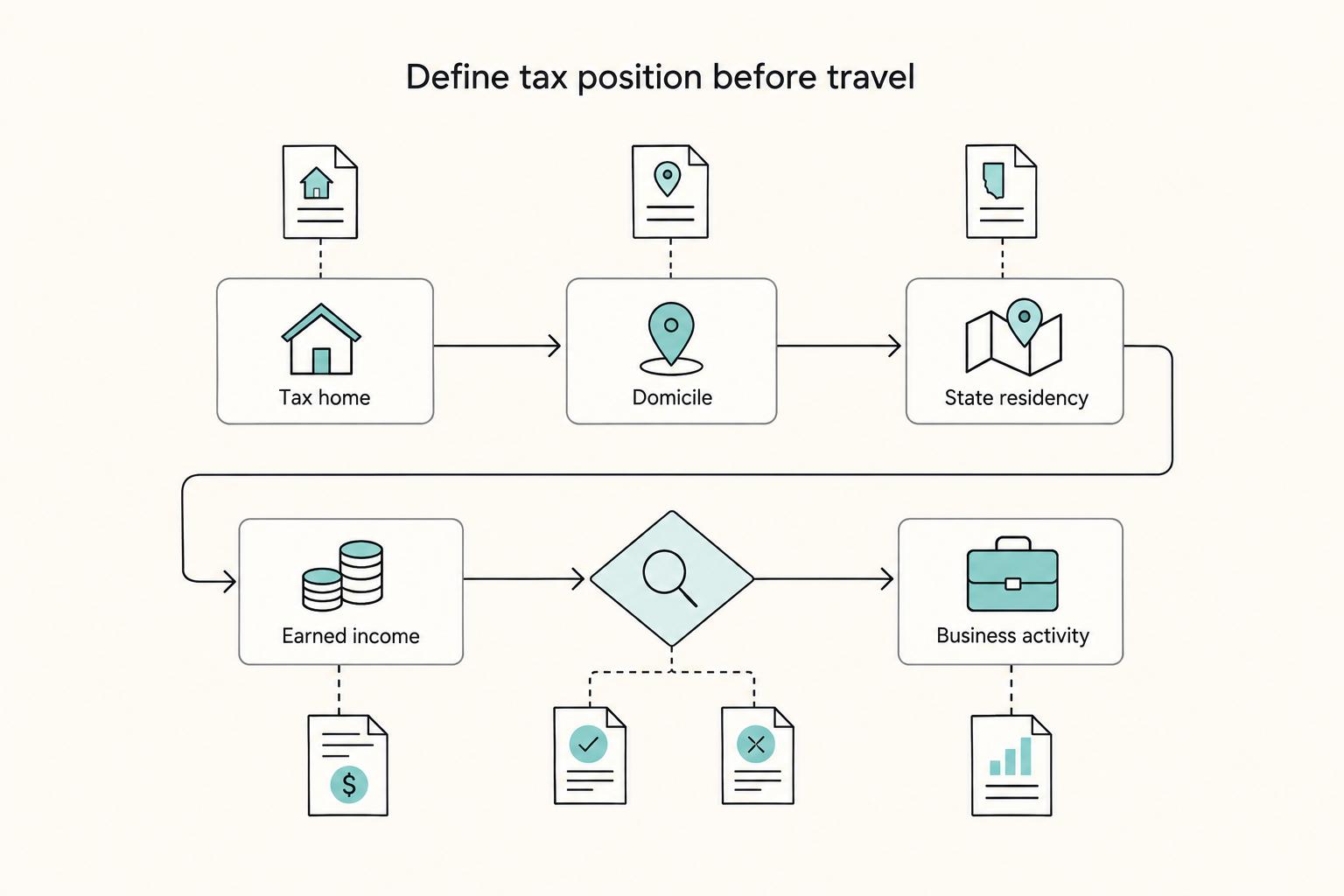
Get these definitions straight before you make travel plans. They overlap in casual conversation, but they do different work on a return:
| Term | Article definition | Main use |
|---|---|---|
| Tax home | Your regular or principal place of business, employment, or post of duty for FEIE purposes, not automatically your family home | FEIE purposes |
| Domicile | Your permanent home that you intend to return to; you can only have one at a time | Residency analysis |
| State residency | A state-law test based on facts, and rules vary by state; California uses a temporary/transitory-purpose framework | State tax analysis |
| Earned income (FEIE context) | Pay for personal services you render, such as wages, salary, or professional fees | FEIE income classification |
| Separate business activity | A side activity that is a real self-employment business, even if you also have a regular job | Business-income classification |
For FEIE to work, the pieces have to line up: foreign earned income, a foreign tax home, and a qualifying test, such as 330 full days in 12 consecutive months under the Physical Presence Test. You still file a U.S. return reporting the income. For tax year 2026, the maximum exclusion is $132,900 per person.
Before departure, write down three things: where your tax home will be, what income streams you expect, and whether each stream is pay for services.
Step 2: Classify each income stream and gather proof#
Classify each income stream before your first foreign workday. Misclassification creates avoidable problems later. The label on a payment does not control the tax result; the actual facts do, especially control and independence.
| Income path | What to confirm before leaving | What to collect now |
|---|---|---|
| Employee-only sabbatical pay | Whether payment is employee compensation for personal services, and where those services will be performed | Employer sabbatical policy, written HR pay terms, pay statements, expected Form W-2, written duty description during leave |
| Side business income only | Whether you are operating independently, billing clients directly, and carrying on a separate trade or business | Client contracts, invoices, engagement emails, payment terms, business records, expected Form 1099-NEC (if issued) or equivalent records |
| Both employee pay and side business income | Whether side work is truly separate from your employee role | All documents above, plus clean separation of clients, invoices, records, and business purpose |
The core sourcing rule here is simple: personal-service income is generally sourced by where services are performed, not where the payer is located. If you have self-employment income, FEIE can reduce regular income tax but not self-employment tax. Net self-employment earnings of $400 or more generally trigger filing.
Step 3: Build a state-exit evidence pack, not just a story#
State residency determinations are heavily fact-driven, not something you fix later with a neat explanation. One action rarely settles domicile or residency by itself, so build a record that shows both your intent and what your life actually looked like.
| Action area | What supports your position | Article note |
|---|---|---|
| Change addresses in layers | IRS address updates, bank/profile change confirmations, account statements showing the new address, and a dated change log | USPS forwarding only updates postal routing |
| Update registrations and civic ties | Dated surrender/replacement records, updated voter records, and renewal notices delivered outside the old state | Reduce old-state records that suggest ongoing residency |
| Document property and use-of-home facts | Lease or management agreements, utility records, move-out records, and other records showing actual use | If you keep property, document how it was actually used |
| Align banking and paper trail | Monthly statements, card activity, and recurring bills at the new address | Routine statements and spending should match your claimed living pattern |
Build for both elements: your intent and your facts on the ground.
Step 4: Lock down account access and foreign-account tracking#
Before departure, confirm you can access key accounts from abroad, update authentication methods, store backup access options, and save each institution's international support path.
From the first foreign account onward, track the same fields every time: institution, country, account type, owner, account identifier, highest balance, and date of highest balance. FBAR is separate from your income tax return and is filed with Treasury/FinCEN. The trigger is $10,000 aggregate foreign-account value at any point in the calendar year. The due date is April 15, with automatic extension to October 15.
Form 8938 is separate and does not replace FBAR. Keep this checklist line: Form 8938 threshold: current filing-status threshold pending IRS or tax-advisor verification. The IRS cites $50,000 as a baseline for certain taxpayers, and higher thresholds can apply.
Step 5: Escalate before departure when facts conflict#
The right time to get help is before the trip if the facts do not fit cleanly together. Waiting until filing season leaves less time for structural cleanup.
Get professional tax review before departure if any of these apply:
- You are keeping a home in your prior state for personal use.
- Your state-residency facts point in different directions.
- Employer sabbatical pay terms are ambiguous.
- You will have both employee and side-business income.
- Your travel plan does not clearly support a foreign tax home plus 330 full days abroad.
- Your cross-border residency facts are unclear.
- Your foreign-account facts may trigger both FBAR and Form 8938.
If you want a deeper dive, read our guide to a defensible 2026 filing plan.
Phase 2: The In-Sabbatical Dashboard for Active Compliance#
Once you leave, the job shifts from planning to maintenance. Your goal is to keep your U.S. exclusion path intact without creating avoidable tax residency somewhere else. The cleanest way to do that is with a short weekly review.
Step 1: Run a two-track check every week#
Run a two-track check every week, and adjust travel early if either track starts to weaken.
- Track A: U.S. exclusion eligibility
- Your tax home remains in a foreign country during your qualifying period. * The income you plan to exclude is pay for services performed in a foreign country. * Your rolling 12-month window still supports 330 full days in 12 consecutive months. * Your records are complete enough to support Form 2555 tax-home dates and any U.S.-presence detail.
- Track B: Host-country residency risk
- Do not rely on a universal "183-day rule" shortcut. * Keep one line per country in your tracker: Current residency trigger: pending official or tax-advisor verification for the country in question. * Re-check local rules before extending a stay.
Weekly verification questions:
- How many U.S. days have you used in your rolling 12-month window?
- Which country are you closest to triggering for tax residency?
Step 2: Use layered travel proof to back your day count#
Your day count is only as good as the records behind it. Use layered travel proof so you can support the timeline if someone asks later.
| Tool | What you keep | What it helps support in a review |
|---|---|---|
| Calendar log | Daily country/city, entry/exit dates, U.S. presence dates, rolling 12-month count | Your contemporaneous timeline and day-count logic for Form 2555 |
| Passport and itinerary evidence | Passport ID page, visas, entry stamps (when available), itineraries, boarding passes, e-receipts | Border crossings and travel sequence, and your presence timeline |
| Backup proof | Lodging invoices, rental/hotel confirmations, dated card transactions, transport receipts | Corroborates location when primary records are incomplete |
Step 3: Keep records to an evidence standard#
Keep records to an evidence standard, not a memory standard. In practice, this is where a manageable trip either turns into a messy filing or stays manageable.
Use one sabbatical folder, monthly subfolders, and consistent names like YYYY-MM-DD_country_city_doctype_vendor.pdf.
- Residency and tax-home support: travel log, lodging agreements, accommodation invoices, and address records. These support where you actually lived and whether your tax home remained abroad.
- Income characterization support: employer policy, HR emails, pay statements, duty descriptions, client contracts, invoices, and payment records. These support whether amounts are employee compensation, self-employment income, or mixed streams.
- Filing-position support: passport and visa copies, U.S.-presence notes, and foreign tax payment records for non-excluded income. These support Form 2555 details and FTC analysis.
Use this monthly checkpoint: if you cannot complete the key Form 2555 timeline fields from your folder alone, your evidence is not good enough. Incomplete Form 2555 information may cause exclusion or deduction claims to be disallowed.
If California is in scope, keep California-source income records separate from other income records so sourcing and residency-period treatment stay clear.
Step 4: Choose FEIE or FTC by income stream and facts#
Choose FEIE or FTC based on the stream of income and the facts behind it, not the label you give it. This decision often gets muddled when wages, freelance work, and foreign taxes all show up in the same year.
- Use FEIE for qualifying foreign-earned service income when your tax home is abroad and your qualifying test is met. For 2026, the maximum exclusion is $132,900 per person.
- Use FTC for other foreign-source income taxed abroad that is not excluded. You cannot claim FTC on the same income you exclude under FEIE, or housing exclusion, and you can re-choose credit versus deduction each tax year.
- Keep self-employment tax separate in your analysis. FEIE can reduce regular income tax on qualifying foreign earned income, but it does not reduce self-employment tax.
If sourcing, day counts, or residency facts start to conflict, do not wait until year-end to sort it out.
Related: 183-Day Rule Explained: Stop the Tax Myths Before They Cost You.
Before each move, lock your day-count and residency evidence into one working timeline: Track your tax residency timeline.
Phase 3: The Post-Sabbatical Debrief and Filing Strategy#
After travel ends, classification comes first and forms come second. The practical order is: classify each income stream, choose one relief method for each stream, and then file the forms that document that position.
| Form or filing | What it documents | Article note |
|---|---|---|
| Form 2555 attached to Form 1040 or 1040X | FEIE election, qualification path, and excluded amount | Attach to Form 1040 or 1040X |
| Form 1116 (and Schedule B when carryovers apply) | FTC amount and limitation computation | Schedule B when carryovers apply |
| FinCEN Form 114 (FBAR) | Foreign-account disclosure when aggregate foreign account value exceeded $10,000 at any point | Filed with FinCEN, not the IRS |
| Form 8938 (if applicable) | Specified foreign financial assets | Confirm the current IRS threshold for your filing status and residency category |
| Part-year resident/nonresident state return | Departure-date and income-allocation position | State filing for the departure and allocation position |
Step 1: Classify each income stream before you prepare forms#
Classify each income stream before you prepare any forms. If you skip that step and jump straight to forms, you can end up mixing wages, consulting income, and non-service amounts into one unsupported claim.
Create one line per stream and separate:
- Employee wages
- Freelance/consulting income
- Other amounts that are not pay for your personal services
For FEIE, begin with whether the stream is foreign earned income: wages, salaries, professional fees, or other amounts paid for personal services rendered by you. For each line, keep proof tied to that stream: pay statement, invoice, contract, or HR memo, plus location records showing where services were performed. Do not assume all sabbatical pay is automatically excludable.
Step 2: Map each stream to one relief method#
Map each classified stream to one relief method only. The common failure mode here is trying to stack benefits on the same income.
FEIE is elective, not automatic. If chosen, it generally remains in effect for later years unless revoked. For 2026, FEIE can exclude up to $132,900 per person when eligibility is met, including a tax home in a foreign country and a qualifying test such as 330 full days in 12 consecutive months under physical presence.
You cannot claim FTC on income excluded under FEIE or the foreign housing exclusion. Use FTC for foreign-taxed income that remains taxable in the U.S.
| Decision criterion | FEIE lane | FTC lane | Escalate when |
|---|---|---|---|
| Income source | Qualifying foreign earned service income | Income taxed abroad and also subject to U.S. tax | Sourcing is unclear or streams are mixed |
| Foreign tax paid | Low/none, so credit value is limited | Foreign tax paid/accrued supports double-tax relief | More than one country taxes the same year's income |
| Carryover impact | Not an FTC carryover lane | Unused FTC may be carried back 1 year and forward 10 years (IRS rules apply) | Carryovers require tighter tracking (Form 1116, possibly Schedule B) |
| Complexity level | Clean FEIE eligibility with complete records | Full FTC computation on Form 1116, or simplified FTC only if eligible | Simplified FTC election can forfeit carryback/carryforward of unused tax |
Step 3: Use forms that reflect a position you already supported#
Forms should reflect a position you have already supported, not create one after the fact.
- Form 2555 attached to Form 1040 or 1040X: documents FEIE election, qualification path, and excluded amount.
- Form 1116 (and Schedule B when carryovers apply): documents FTC amount and limitation computation.
- FinCEN Form 114 (FBAR): documents foreign-account disclosure when aggregate foreign account value exceeded $10,000 at any point. It is filed with FinCEN, not the IRS.
- Form 8938 (if applicable): reports specified foreign financial assets; confirm the current IRS threshold for your filing status and residency category.
- Part-year resident/nonresident state return: documents departure-date and income-allocation position.
Timing guardrail: if you qualify for the abroad automatic extension, filing may move from April 15 to June 15, and potentially to October 15 with additional extension steps, but unpaid tax still accrues interest from April 15.
Step 4: Close your state position with the same facts#
Close your state position with the same facts you used federally. A clean federal timeline paired with a loose state story is an avoidable problem.
State residency is fact-specific, and no single factor controls. Keep an evidence pack that supports your departure narrative and income allocation, including:
- Travel log and date sequence
- Accommodation agreements, invoices, and address records
- Employer and HR correspondence tied to departure timing
- Pay records split by residency period and state-source versus non-state-source treatment
Retention baseline: keep records at least the general 3-year IRS window, and longer where facts could trigger a 6-year window. Consistency check: your state departure timeline should align with your federal timeline, including Form 2555 narrative and qualifying dates.
Step 5: Escalate to a cross-border tax advisor when risk is high#
Escalate to a qualified cross-border tax advisor when judgment risk is high. This is less about form preparation and more about getting the position right.
Hand off if any of these apply:
- Mixed income streams are difficult to classify or source
- You may have filing exposure in multiple foreign countries
- State and federal residency signals conflict
- FEIE qualification facts are incomplete or inconsistent
- FTC carryovers or simplified-election tradeoffs could materially affect later years
You might also find this useful: How to Create a Financial Plan for a Sabbatical.
Verify the facts, keep the proof, then file from the record#
Once you can see the failure points clearly, this becomes a disciplined process: verify the facts, keep the proof, then file from the record.
Architect: Set filing assumptions before departure so you know what must be true. Write down the path you are testing: Form 2555 with foreign earned income, a foreign tax home, plus either 330 full days in 12 consecutive months or bona fide residence; state nonresidency under that state's own rules; and host-country exposure only after you verify that jurisdiction's current residency rules. For New York, verify domicile facts and whether you maintained a permanent place of abode plus 184 days or more. For California, do not rely on day count alone.
Execute: Collect contemporaneous records that prove those assumptions while you travel. Keep your calendar, passport stamps, flights, lodging, employer correspondence, and payroll records consistent with each other. If your U.S. employer continues wages or employee benefits on Form W-2, treat them as taxable unless a specific rule applies, and for state sourcing questions verify where services were physically performed. Common breakdowns come from FEIE claims with weak travel-date evidence, weak tax-home facts, or unverified host-country residency assumptions.
Debrief: Close with filing actions, gap review, and controls for the next cycle. If you claim FEIE, attach Form 2555 to Form 1040 or 1040X and enter your 12-month qualifying period plus arrival and departure dates exactly as your records show. For 2026, the FEIE maximum is $132,900 per qualifying person. For later years, verify the current FEIE threshold from IRS guidance or a tax advisor before use.
| End state | Next action | Escalation |
|---|---|---|
| Fully documented and consistent | File based on records and retain support for at least 3 years | Low |
| Partially documented | Rebuild the timeline from flights, lodging, payroll, and bank activity; limit claims to what you can prove | Medium |
| Conflicting facts | Pause the filing position and reconcile federal, state, and host-country facts before claiming exclusions or nonresidency | High |
Minimum viable controls:
- Keep: travel log, passport scans, flight and lodging receipts, payroll records, employer leave policy, housing records, and foreign account balances if aggregate value exceeded $10,000 at any point in the year for FBAR.
- Contact a cross-border tax pro if facts conflict, multiple countries tax the same income, New York or California ties remain, or your Form 2555 position depends on reconstructed dates.
- After filing, write a one-page debrief covering what evidence was missing, which assumptions failed, and what you will track from day one on your next trip.
For a step-by-step walkthrough, see Tax Home vs. Abode: A Critical Distinction for the FEIE.
Before you file, sanity-check your exclusion path and documentation assumptions with one dry run: Run the FEIE calculator.
Frequently Asked Questions
Can you deduct sabbatical travel or living costs on your tax return?
Usually no. Personal-purpose travel, meals, and lodging are generally not deductible, and most employees cannot use Form 2106 for unreimbursed expenses. If you also run a separate business, deduct only costs you can clearly tie to actual business activity and document with records, including invoices, agendas, contracts, and notes. If you cannot show a real business purpose, treat the expense as nondeductible.
How do you reduce double-taxation risk while traveling?
Start by classifying each income stream and where the services were performed, because foreign-source personal service income generally follows where you did the work. Use the foreign tax credit for foreign-taxed income that is still taxable in the U.S., but do not claim a credit on income you already excluded under FEIE. You can usually handle this yourself when records are clean and sourcing is clear. Bring in a cross-border advisor when sourcing is mixed or multiple countries are involved.
Does your U.S. employer's sabbatical pay qualify for FEIE?
Not automatically. For FEIE, you need earned income that is pay for your personal services, a foreign tax home that is your main work location or post of duty, and a qualifying test such as 330 full days in 12 consecutive months or bona fide residence for an uninterrupted period that includes an entire tax year. For 2026, the FEIE maximum is $132,900 per qualifying person. For other filing years, verify the current threshold. If your service-location facts or tax-home facts are weak, do not assume this income is excludable.
Do you still have state tax exposure after you leave the U.S.?
Yes, often. State residency rules are separate from federal FEIE rules. California looks at whether your presence is more than temporary or transitory, and New York can treat you as a resident if you maintain a permanent place of abode and spend 184 days or more there. Keep a consistent evidence pack with departure dates, housing records, employer correspondence, and day counts, and escalate if your facts are mixed.
What if you return to the U.S. early and miss the physical presence test?
If you miss the physical presence requirement, that route fails even when the reason is outside your control. A full day is 24 consecutive hours from midnight to midnight, and time on or over international waters does not count as time in a foreign country. Keep your calendar, passport, flight, and lodging records aligned so your filing position is consistent.
Can you file Form 2555 later if you forgot it the first time?
Yes, but only by attaching Form 2555 to Form 1040 or Form 1040X. Form 2555 cannot be filed by itself. If you claim physical presence, enter your 12-month qualifying period dates and arrival and departure dates exactly as your records show. This is usually a DIY fix when facts are clean and consistent. If dates, sourcing, or state positions conflict, get professional help before filing.
Try a related tool
Researched and edited by the Gruv editorial team. Gruv builds cross-border billing, payouts, and finance-operations software for global businesses.
Sources
Educational content only. Not legal, tax, or financial advice.
Related Posts

Digital Nomad Taxes in 2026 With a Defensible Filing Plan
With digital nomad taxes, the first move is not optimization. It is figuring out where you may be taxable, where filings may be required, and what proof supports that position.

183-Day Rule Tax Myths That Trigger Residency Filing Mistakes
If you are a mobile freelancer or consultant, start here: the "183 day rule tax" idea is not a single universal test. It is a shortcut phrase people use for different residency rules that do not ask the same question. If you mix federal and non-federal residency logic, you can create filing risk even when your travel calendar looks clean.
How to Create a Financial Plan for a Sabbatical
**Treat your sabbatical like an operating decision you can fund and defend, not a mood you can manifest.** As the CEO of a business-of-one, you do not get to outsource coverage, timing, or follow-through. Start from zero assumptions (no "someone will cover me"). Build a plan that survives late payments, uneven income, and real-world friction so the rest stays mechanical, not emotional.