
Quick Answer
Handle the saving clause by classifying your taxpayer status first, then reading the actual treaty and any protocols, and only then testing the saving clause and its exceptions line by line for each income item. Keep state residency separate from treaty analysis, tie any treaty position to the exact article, and file conservatively or escalate if your status, exception language, or documentation is unclear.
How to handle the saving clause without guessing#
Start with documents, not conclusions. Before you take any saving clause us tax treaties position, write down your residency facts, period-by-period status, and filing logic in plain language so someone else can follow your reasoning.
Use this sequence to keep your position defensible:
- Lock your facts first. Build a dated timeline for where you lived and when, then classify status by period from those facts.
- Keep state residency analysis separate from treaty analysis. For California filing, document your state residency position on its own facts and timeline before finalizing your return position.
- Apply state rules to the actual status period. In California, residency is based on all circumstances; part-year residents are taxed on worldwide income during resident periods, and nonresidents are taxed on California-source taxable income.
- Document limits and calculations before filing. California nonresident and part-year calculations use an effective tax rate method, and the FTB does not issue written opinions on whether someone was a California resident for a specific period.
A good opening test is simple: hand this sequence to another person and ask whether they can identify your facts, status periods, and filing position without asking follow-up questions. If they cannot, your file is not ready for filing.
If any part of your status, scope, or documentation is unclear, file conservatively and resolve the gap before submission.
If you want a deeper dive, read Digital Nomad Taxes in 2026 With a Defensible Filing Plan.
What to prepare before you start#
Preparation can reduce filing risk. If records are incomplete, treaty analysis can become guesswork.
| Work file | What to gather | Use |
|---|---|---|
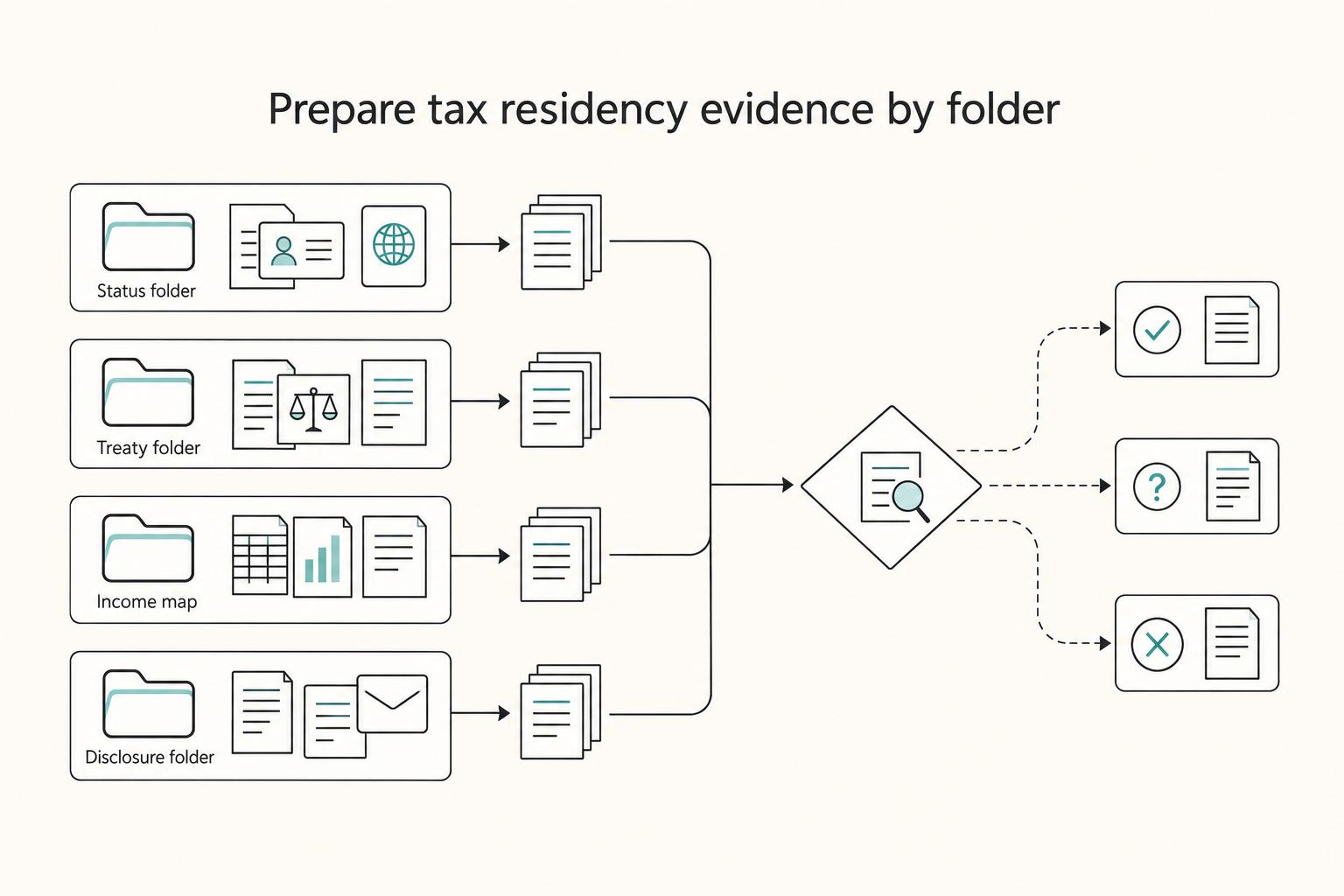
| Status folder | Travel calendar, immigration status, and where you were treated as a U.S. resident or Nonresident alien, organized in a dated timeline | Build a status fact file before interpretation |
| Treaty folder | Exact U.S. income tax treaty for your country and Publication 901 beside it as an index | Work from the actual treaty text |
| Income map | Income categories you actually earned, plus payer country and dates | Treaty treatment can change by article and taxpayer status |
| Disclosure folder | Past Form 8833, related support, and IRS correspondence on treaty issues | Collect prior-year disclosure artifacts before analysis |
The United States has income tax treaties with a number of foreign countries, but eligibility is treaty by treaty. Publication 901 (U.S. Tax Treaties) is a summary reference, so use it as a guide while you work from the actual treaty text. Most treaties include a Saving clause that preserves U.S. taxing rights over its own citizens and treaty residents, generally with exceptions for specified income types.
- Pull primary treaty materials first. Get the exact
U.S. income tax treatythat applies to your country and keepPublication 901beside it as an index. - Build a status fact file before interpretation. Compile your travel calendar, immigration status, and where you were treated as a
U.S. residentorNonresident alien, organized in a dated timeline. - Map income by type, source, and period. Split income into categories you actually earned, then tag payer country and dates. Treaty treatment can change by article and taxpayer status, and saving-clause exceptions are generally tied to specific income types.
- Collect prior-year disclosure artifacts. Gather past
Form 8833 (Treaty-Based Return Position Disclosure Under Section 6114 or 7701(b)), related support, andInternal Revenue Service (IRS)correspondence on treaty issues.Form 8833is used for treaty-based return position disclosure under Internal Revenue Code Section 6114, and dual-resident positions can involve Regulations section 301.7701(b)-7.
Before you start legal interpretation, set up your files so review is fast. Keep a status folder, a treaty folder, an income map, and a disclosure folder with matching names for country and tax year. This small setup step can help prevent mismatched documents later.
Two common errors that cause rework are assuming treaty benefits are automatic, and assuming federal treaty treatment always matches state treatment.
You might also find this useful: The Best Co-Working Spaces for Digital Nomads.
Step 1 classify your taxpayer status before reading treaty benefits#
Classify status under domestic rules before evaluating treaty benefits. If this step is wrong, treaty analysis that follows can break down.
Use Publication 519 (2025) and Publication 4152 (Rev. 9-2025) as anchor documents. Publication 519 frames the core question, Nonresident Alien or Resident Alien?, and points to the Green Card Test and Substantial Presence Test. Publication 4152 separately addresses residency status, resident versus nonresident determination, treaty effects, and Dual Status Aliens.
- Build a dated status timeline first. Record entry and exit dates, immigration-status changes, and filing-posture changes.
- Classify each period under domestic law. Use the method in
Publication 519to classify each period as resident or nonresident for federal tax purposes. - Keep taxpayer categories separate in your workpapers. Track
Resident alien,Nonresident alien, andDual-statusperiods in separate lanes. - Split mid-year changes into separate periods. If status changed during the year, classify each period on its own instead of forcing one annual label.
- Pause treaty analysis when status is unclear. If classification is uncertain, resolve and document status before applying treaty positions.
An avoidable mistake is starting with one annual status label and then trying to retrofit entries, exits, and income dates to that label. Reverse that order. Facts first, then period labels, then filing treatment.
Verification checkpoint: produce a one-page status memo listing each period, your classification, and the publication section used for that call.
Step 2 locate the treaty text that actually governs you#
Use the treaty text and any signed protocols as authority, then use the Treasury Department Technical Explanation for interpretation.
| Document | Role | Use note |
|---|---|---|
| U.S. income tax treaty | Authority | Use the treaty text that applies to your country pair |
| Protocol amendments | Updates to treaty text | Collect any protocol amendments and keep one current copy set for the return year |
| Treasury Department Technical Explanation | Interpretive guide | Use it for interpretation context and to resolve short or ambiguous wording |
| Publication 901 (U.S. Tax Treaties) | Summary/navigation aid | Use it as a guide, not a substitute for treaty text |
Publication 901 (U.S. Tax Treaties) is a summary/navigation aid, not a substitute for treaty text. Eligibility is treaty by treaty, and reduced rates or exemptions vary by country and by income item.
- Build one current treaty packet. Collect the base
U.S. income tax treatyplus any protocol amendments for your country pair. - Read structure before income articles. Start with residence and miscellaneous-rule provisions, then move to income articles. In the
United States-Canada income tax treaty,Article IV (Residence)is one example of an early section to review. - Use the technical explanation for interpretation context. It helps resolve short or ambiguous treaty wording.
- Test coverage income item by income item. If an item is not covered by treaty text, follow standard return rules for that item.
As you build the packet, mark document dates and keep one current copy set for the return year so older protocol language is not mixed with current treaty language.
Verification checkpoint: record exact article and paragraph references, including protocol modifications, with a one-sentence filing conclusion for each item.
Related: the Tbilisi digital nomad guide.
Step 3 apply the saving clause test in a strict order#
Apply this sequence before evaluating relief: residence first, saving clause text second, exceptions third.
Residence comes first because it controls the rest of treaty analysis. Under the U.S. Model Technical Explanation, Article 1 generally limits coverage to residents, and Article 4 provides tie-break rules when both states could treat someone as resident.
- Confirm treaty residence position first. Record a dated, article-level residence conclusion for each tax period.
- Locate the saving clause next, including protocol changes. Keep the clause text with your residence conclusion.
- Test each exception to the saving clause by income type. Check exception wording line by line against each income item.
- Use interpretation materials as cross-checks. Technical Explanations are official interpretive guides.
If exception language is not explicit for an income item, treat the result as uncertain and escalate for further treaty analysis before taking a final position.
Scenario contrast helps here. If one treaty line supports one income item but another item is not clearly covered by exception text, do not blend the outcomes. Keep the supported line as treaty-based and the other as uncertain until reviewed.
Step 4 test exceptions against your actual income streams#
Treaty conclusions should be line-item decisions, not annual shortcuts. A valid result for one income item should not be copied across the return.
Split the year by income type and country, then document each line before you lock a filing position.
- Classify each income line. Use clear labels such as services, dividends, or capital gains, and note paying country.
- Map each line to treaty text. Record the specific treaty article reviewed for that country.
- Log treaty variation and exception status. Mark each line as explicit, unclear, or absent.
- Set filing action per line. If support is unclear, treat that line as uncertain and do not take a treaty-benefit position until support is complete.
Use IRS materials as a process check: treaty guidance is organized by income category, includes a Unique Treaty Provisions section, and separates how treaty benefits are claimed on Form 1040-NR. IRS training on Form 1116 for certain income re-sourced by treaty is another reminder that income classification can affect treatment.
| Income type | Treaty article checked | Treaty variation notes | Exception status | Filing action |
|---|---|---|---|---|
| Services income from Country A | Services or business profits article in Country A treaty | Reviewed for this line only | Explicit or unclear or absent | Set position for this line only |
| Dividends from Country B | Dividend article in Country B treaty | Re-tested independently | Explicit or unclear or absent | Do not reuse Country A conclusion |
Before you move to disclosure decisions, run one matrix review pass. Read each row and confirm it answers five questions: what income, which country, what treaty text, what treaty variation applies, and what filing action follows. Blank cells are a stop sign, not a minor issue.
Step 5 decide your disclosure and certification actions#
This step is a filing decision, not a form-filling exercise. For each treaty position, decide whether it changes default Internal Revenue Code treatment in a way that may require disclosure, then tie that decision to your Step 4 table.
Publication 901 includes a disclosure topic for treaty-based positions that reduce tax, so use it as a checkpoint when evaluating whether Form 8833 may be needed. Keep analysis treaty by treaty, and for each flagged line, note whether the saving clause and any specified exception affect that income type.
Decide Form 8833 from line items, not a global yes/no#
- Anchor each income line to default Code treatment.
- Flag lines where treaty treatment changes that baseline and may reduce tax.
- Tie each flagged line to the exact treaty article from Step 4.
- Draft one plain-language statement per flagged line, then decide whether Form 8833 may be needed.
Use Form 8802 only when certification is actually required#
Form 8802 is used to request U.S. residency certification. Use it when your filing process requires that certification.
Keep one narrative across return, disclosure, and support#
Use the same wording for country, income type, treaty article, and claimed effect across the return, Form 8833, and any supporting statement to the Internal Revenue Service (IRS).
| Document | Must match your Step 4 table |
|---|---|
| Return line item | Income type and country |
| Form 8833 | Treaty article and claimed effect |
| Form 8802 package (if used) | Why U.S. residency certification is needed |
Final decision rule: if you cannot explain your position in three plain sentences, pause and get review.
One practical check before signing is a line-by-line readback. Read each flagged line out loud using this order: default treatment, treaty article, claimed effect, disclosure result. If the sentence feels unclear or inconsistent, fix it before filing.
Step 6 assemble an audit-ready evidence file#
Build one dated, indexed evidence file so every return position can be traced from claim to support. Keep it compact, but complete enough that a later reviewer can see what you claimed, why, and which document supports each line.
Build the core dossier in filing order#
- Create a dated index page with one row per income stream and one row per reporting form.
- Attach the documents used in Step 5, including asset-value worksheets, threshold analysis notes, and filed forms used for the position.
- Label each item consistently by country, tax year, form, and threshold treatment when relevant.
- Cross-reference each index row to the return line and exact filename.
Quick check: pick one return line and confirm you can move from return line to index row to source file quickly.
Keep Form 8938 and FBAR support separate#
Keep Form 8938 support in its own folder. Form 8938 is attached to the income tax return, and certain U.S. taxpayers report specified foreign financial assets when aggregate value exceeds applicable thresholds. A common baseline is $50,000 for certain taxpayers, and the instructions also show a $50,000 year-end or $75,000 anytime test for specified domestic entities, so do not assume one threshold fits everyone.
Keep FBAR records in a separate FinCEN folder. Filing Form 8938 does not replace a required FBAR filing. Also keep this gate in the index: if no income tax return is required for the year, Form 8938 is not required for that year.
| Folder | Include | Pass check |
|---|---|---|
| Return support | Income-tax return draft/final and indexed workpapers used for reporting positions | Each reporting position maps to one document |
| Foreign asset reporting | Form 8938 draft and final, asset-value worksheets, threshold notes | Threshold logic is explicit |
| FinCEN reporting | FBAR workpapers and account list used for FinCEN Form 114 | Accounts reconcile across records |
Keep related filing-logic notes in the same evidence file when they affect overall reporting posture. Avoid scattered screenshots or email threads without an index. If folder names do not tell the story, rebuild the index before filing.
Use one final handoff test before submission. Ask whether a reviewer who did not prepare the file could open the index, pick any return line, and reach the support in under a minute. If not, tighten labels and cross-references before filing.
Tradeoffs globally mobile freelancers should decide upfront#
Decide filing posture before filing day. Conservative positions are often easier to defend, while aggressive treaty positions generally need stronger support and may create more rework later. In many cases, the saving clause limits how much a U.S. citizen or U.S. treaty resident can reduce U.S. tax, and each treaty should be reviewed for eligibility before taking a more aggressive position.
The first tradeoff is current savings versus future cleanup. A conservative posture may mean paying more now, but it can lower correction risk if facts or treaty interpretation are challenged. An aggressive posture may lower current tax, but only when each claim is clearly supported.
The second tradeoff is simplicity versus mobility. One-country years can be easier to map and document. Multi-country years are harder because reduced rates and exemptions vary by country and by income item, so one result does not carry automatically to another country or category.
| Decision path | Benefit now | Risk later | Best use case |
|---|---|---|---|
| Conservative treaty posture | Lower controversy risk | Potentially higher current tax | Ambiguous treaty language or changing residency facts |
| Aggressive treaty posture | Potential current tax reduction | Higher amendment and substantiation burden | Clear treaty support for each income item |
| One-country filing footprint | Faster preparation and review | Less geographic flexibility | Year with heavy compliance workload |
| Multi-country filing footprint | Business and lifestyle flexibility | More treaty mapping and residence analysis | You can document each item separately |
The third tradeoff is speed versus defensibility. Skipping documentation may save time now, but it can create reconciliation or amendment work later. Publication 901 is a useful summary checkpoint, not a substitute for treaty text.
Before filing, run one checkpoint for each claim: confirm country pair, income type, and why relief applies or is limited under the saving clause. Pause if any line is unclear. This matters most in years with multiple moves or mixed income categories, because some treaty exemptions are time-limited and can trigger retroactive tax if limits are exceeded.
A practical scenario contrast helps with decisions. If you had one country and one income type all year, a conservative position may only add limited work. If you had multiple countries and mixed income, aggressive claims often require more line-level support and review.
Practical recommendation: if the year includes more than one jurisdiction or mixed income streams, budget for professional review before filing. Run a separate state check too, since some U.S. states do not honor treaty provisions.
Mistakes that cause expensive rework and how to recover#
Most expensive rework starts the same way: positions are filed from summaries, then justified later. Recover in this order: treaty text first, state treatment separately, income type by income type, then disclosure alignment.
| Mistake | Problem | Recovery step |
|---|---|---|
| Treating Publication 901 as final authority | Starts from a summary instead of the controlling basis | Re-anchor each claim to treaty text and restate the income type, treaty article, and whether the saving clause limits relief or an exception applies |
| Assuming state treatment mirrors federal treatment | Federal treaty treatment does not automatically carry to state returns | Run a separate state check and keep a short state memo with treaty conformity yes or no and the exact line impact |
| Applying one conclusion across all income types | Coverage and saving-clause treatment can differ by income type and country pair | Rebuild an income-by-income matrix with income type, country pair, treaty article, saving-clause impact, exception status, and filing action |
| Letting Form 8833 drift from the corrected position | Form 8833 has to match the return position when treaty-based disclosure is required | Prepare one corrective package with the amended return, revised Form 8833 when triggered, and indexed support tied to each claim |
1) Treating Publication 901 as final authority#
Publication 901 (U.S. Tax Treaties) is a starting map, not the controlling basis for a treaty position. Re-anchor each claim to treaty text and restate each item in one line: income type, treaty article, and whether the Saving clause limits relief or an exception applies. If you cannot tie an item to treaty language, correct that item under regular U.S. return rules.
2) Assuming state treatment mirrors federal treatment#
Federal treaty treatment does not automatically carry to state returns, and some states do not honor treaty provisions. Treat that as a practical reminder to run a separate state check before amending. Keep a short state memo that states treaty conformity yes or no and the exact line impact.
3) Applying one conclusion across all income types#
One treaty conclusion should not be pasted across all earnings. Coverage and saving-clause treatment can differ by income type and country pair, and if a treaty does not cover an item, standard U.S. rules apply. Rebuild with an income-by-income matrix: income type, country pair, treaty article, saving-clause impact, exception status, and filing action.
4) Letting Form 8833 drift from the corrected position#
When treaty-based disclosure is required, Form 8833 has to match the return position. Dual-resident treaty disclosures are one example where the form is used. Recover with one corrective package: amended return, revised Form 8833 when triggered, and indexed support tied to each claim. If your narrative is not clean and consistent, pause for technical review before filing.
Recovery timing matters. As time passes, it usually gets harder to rebuild the document trail and explain why an original line was filed that way. Once you spot one of these four mistakes, stop adding new positions and correct the record in order.
Escalate immediately when these facts appear#
Escalate before filing when foreign-asset reporting is in play and key interpretation points are unclear.
Step 1 Flag status and interpretation gaps#
If your facts involve former-citizen or former long-term-resident history, treat it as a specialist-review case. This section's source set does not provide rules for those outcomes, so do not rely on assumptions.
If your result depends on exception language you cannot tie to clear text in your file, pause and escalate instead of inferring coverage.
Step 2 Treat Form 8938 and FBAR as separate checks#
Form 8938 is attached to your income tax return, and it applies when specified foreign financial assets are above the applicable reporting threshold. The threshold is profile-dependent, and higher thresholds can apply for joint filers and taxpayers living abroad, so do not assume one universal number.
Filing Form 8938 does not replace a required FBAR. Check each requirement separately, even when they may involve the same accounts.
Step 3 Use a hard stop for threshold and entity complexity#
If no income tax return is required for the year, Form 8938 is not required for that year. If a return is required, document which Form 8938 threshold applies to your filer profile before filing.
If a specified domestic entity is involved, test its Form 8938 threshold separately, including the $50,000 year-end and $75,000 anytime tests. If other cross-border items are part of the same fact pattern and are not clearly covered by your support, escalate the full package together.
When you escalate, send a clean package. Include your status memo, disclosure draft, Form 8938 threshold notes, and FBAR account list in one indexed folder. Clear handoff materials shorten review time and reduce back-and-forth.
Copy-paste checklist for a low-stress filing season#
Use this checklist as your final pre-filing pass for what is supported here: Form 8938 and a separate FBAR check. Keep treaty, saving clause, Form 8833, and Form 8802 decisions on their own verification track, since those items are outside this checklist.
Run this checklist right before filing and again after any late document update. A second pass can help catch mismatches if one form changes and your evidence file does not.
- Step 1 Confirm return status for the year. I verified whether an income tax return is required for this tax year. If no return is required, I documented that Form 8938 is not required for that year.
- Step 2 Keep treaty items explicitly separate. I listed treaty, saving clause, exception, Form 8833, and Form 8802 assumptions for separate verification.
- Step 3 Run the Form 8938 threshold test. I confirmed whether I am a specified person and whether I hold specified foreign financial assets above the applicable reporting threshold. I treated $50,000 as a baseline figure for certain taxpayers, then checked rules for my filer profile.
- Step 4 Run entity thresholds when relevant. If a specified domestic entity is involved, I tested whether total value exceeds $50,000 on the last day of the tax year or $75,000 at any time during the tax year.
- Step 5 Apply Form 8938 scope correctly. I reviewed whether any account is maintained by a U.S. payer and excluded those from Form 8938 reporting where required.
- Step 6 Complete Form 8938 filing mechanics. I attached Form 8938 to my annual return, filed by that return's due date including extensions, and confirmed the form shows the correct calendar year or tax year.
- Step 7 Check current IRS instructions. I reviewed the latest Form 8938 instructions before filing.
- Step 8 Run FBAR as a separate check. I completed an independent FBAR review because Form 8938 does not replace FinCEN Form 114.
- Step 9 Build one indexed evidence file. I assembled forms, threshold notes, account support, and filing-date support in one place so each filing decision is reviewable.
- Step 10 Run a final pre-sign readback. I can explain my Form 8938 threshold logic, scope decisions, and separate FBAR result in plain language from the indexed file.
Red flag rule: if you cannot explain your Form 8938 threshold logic, scope decisions, and separate FBAR check in plain language from your file set, pause filing and resolve the gap before submission.
Frequently Asked Questions
What is the saving clause in U.S. tax treaties in plain English?
The saving clause generally lets each country tax its own citizens and treaty residents as if no treaty applied. In many cases, that means U.S. citizens and U.S. treaty residents cannot reduce U.S. tax based on treaty provisions alone.
Can a U.S. citizen still claim treaty benefits if an exception to the saving clause applies?
Sometimes. Eligibility depends on the exact treaty and the specific income type, so review the exception item by item rather than applying one answer across the whole return.
Does the saving clause affect a nonresident alien the same way it affects a U.S. resident?
No. For nonresident aliens, treaties can limit or eliminate U.S. tax on certain personal services and other income. That differs from many U.S. citizen or U.S. treaty resident situations, where the saving clause can block relief.
When do I need Form 8833 for a treaty-based return position?
Form 8833 is used to disclose treaty-based return positions when disclosure is required under Internal Revenue Code section 6114. Dual-resident taxpayers also use it for disclosure under Regulations section 301.7701(b)-7.
When is Form 8802 and U.S. residency certification actually required?
This article does not cover the rules or specific triggers for Form 8802 or U.S. residency certification. Treat that as a separate determination.
Why do I have to review the treaty article-by-article instead of relying on summaries?
Treaty relief is not automatic, and eligibility must be reviewed treaty by treaty. Time limits can apply to some exemptions in many treaties, and exceeding a limit can trigger retroactive tax in some cases. Summaries like Publication 901 are useful checkpoints, not substitutes for the treaty text.
If I am not sure an exception applies, what is the conservative filing choice?
Review the specific treaty and income type carefully because eligibility is treaty by treaty. If a key point is still unclear close to filing, get technical review before filing. The article also recommends filing conservatively when status, scope, or documentation is unclear.
Try a related tool
Researched and edited by the Gruv editorial team. Gruv builds cross-border billing, payouts, and finance-operations software for global businesses.
Sources
Educational content only. Not legal, tax, or financial advice.
Related Posts

Digital Nomad Taxes in 2026 With a Defensible Filing Plan
With digital nomad taxes, the first move is not optimization. It is figuring out where you may be taxable, where filings may be required, and what proof supports that position.

Tbilisi Digital Nomad Guide for 2026 Long Stays in Georgia
Start with sequence, not excitement. If your income depends on delivering work on schedule, secure your legal footing, assemble your documents, and keep month one reversible before you optimize comfort.

Best Coworking Spaces for Nomads Who Need Reliable Workdays
Start with infrastructure, not aesthetics. If a space cannot support your real work window, client calls, and first week in town, it is not a real option.