
Quick Answer
Start by separating your child’s income into earned and unearned, then run the Form 8615 gates before choosing any filing path. This kiddie tax guide uses a practical sequence: verify current-year IRS thresholds, compare a child return with a possible Form 8814 election, and choose account structure based on goal, income profile, and record quality. If the setup includes non-U.S. funds or unclear classifications, pause and get cross-border tax review before trading or filing.
The Rules of the Game: Understanding the Kiddie Tax in 5 Minutes#
Here's the quick rule: if your child has unearned income and clears the IRS Form 8615 gates, you likely need Form 8615. Use Form 8814 only when its narrower election rules are fully met, and only after you compare the tax result.
The kiddie tax is a special set of rules for certain children's unearned income. For this purpose, earned income is pay for work actually performed, such as wages. Unearned income is generally income that is not pay for work.
Step 1. Identify income as earned vs unearned#
Start with the documents, then run the eligibility tests.
- If the child only has pay for work, kiddie-tax mechanics are generally not your first check.
- If you see 1099-INT, 1099-OID, or reporting for dividends or capital gain distributions, keep going.
- Classify each line item as either pay for work or investment income before you file anything.
Step 2. Run the Form 8615 yes or no gates in order#
Run the gates in order. Form 8615 is required only if all IRS conditions are met.
| Test or case | Condition | Notes |
|---|---|---|
| Unearned income amount | For 2025, more than $2,700 | Trigger point for parent-rate mechanics if the other tests are met |
| Under 18 | Gate met | Age/support test at year-end |
| Age 18 | Gate met only if earned income was not more than half of the child's own support | Age/support test at year-end |
| Age 19 to under 24 | Gate met only if the child was a full-time student and earned income was not more than half of support | Age/support test at year-end |
| Parent-alive gate | At least one parent was alive at year-end | IRS condition |
| Joint-return gate | The child does not file a joint return | IRS condition |
Apply the threshold test first, then the age/support test, then the parent-alive and joint-return gates.
For Form 8814 age language, "full-time student" means enrolled full-time for some part of each of 5 calendar months during the year.
Step 3. Pull documents before choosing the form#
Do not choose between 8615 and 8814 from memory. Pull the records first. If you are considering 8814, also confirm income-type eligibility: interest and dividends, including capital gain distributions and Alaska Permanent Fund dividends.
| Check | Detail | When |
|---|---|---|
| Investment reporting | 1099-INT and 1099-OID, plus dividend and capital-gain-distribution reporting | Before choosing the form |
| Earned income and support | Records that support earned income and support | If the age 18 to 23 tests apply |
| Income-type eligibility for Form 8814 | Interest and dividends, including capital gain distributions and Alaska Permanent Fund dividends | If you are considering Form 8814 |
| Estimated tax payments | No estimated tax payments for the child | If you are considering Form 8814 |
| Federal income tax withholding | No federal income tax withholding on the child's income | If you are considering Form 8814 |
Step 4. Choose Form 8615 vs Form 8814 deliberately#
This is a tax decision, not just a convenience call.
- Form 8615: use when the required gates are met and unearned income is over the threshold. It attaches to the child's Form 1040 or 1040-NR. If 8615 applies, check possible NIIT exposure. The 3.8% mechanics can matter.
- Form 8814: this is an election on the parent's return, using Form 1040, 1040-SR, or 1040-NR, only when all 8814 conditions are met, including 2025 gross income under $13,500 and the eligible income-type limits.
Convenience alone is not enough to choose 8814. IRS instructions note that tax may be lower if the child files separately, because some child-level tax benefits are not available under the election.
| 2025 reference band | Current-year check | Tax treatment | Fast action |
|---|---|---|---|
| $0 to $1,350 | Confirm the current-year amount before filing | Not taxed when using Form 8814 election | If using 8814, confirm all election gates first |
| $1,351 to $2,700 | Confirm the current-year middle band before filing | Below the Form 8615 parent-rate trigger band | Confirm whether separate child filing is still the cleaner path |
| Over $2,700 | Confirm the current-year Form 8615 threshold before filing | Parent-rate mechanics can apply if all tests are met | Run age, support, parent-alive, and joint-return gates before filing |
Use this as a screening table, not a substitute for current IRS instructions. Verify the latest Form 8615 and Form 8814 updates before filing.
If you want a deeper dive, read the digital nomad tax guide.
Choose accounts, assets, and sale timing to limit unearned income#
Once you know whether these rules are in play, the next job is to keep them from becoming a recurring problem. Use this sequence in order. Fund accounts that reduce current unearned income first, move to taxable custodial accounts only when the goal requires it, and add a review gate before any sale.
Step 1. Fund tax-advantaged accounts first#
Start here if the goal is education, or if your child has taxable compensation from actual work. Often, this is the cleaner first move because qualified-use rules can reduce current-year unearned income exposure before you rely on a taxable custodial account.
| Account | Best use | Tradeoff or limit | Common mistake |
|---|---|---|---|
| 529 plan | Education funding when qualified education expenses are the intended use | Contributions are not deductible, and the tax benefit depends on qualified use | Treating it like a general-purpose account |
| Coverdell ESA | Education funding when you want another qualified-education option | Contributions are not deductible, and total annual contributions are capped at $2,000 per beneficiary across all Coverdell accounts | Overcontributing across multiple contributors or accounts |
| Custodial Roth IRA | Long-term savings when the child has taxable compensation | No taxable compensation means no contribution, and eligibility can also be limited by income rules; for 2026, total IRA contributions cannot exceed $7,500 across traditional and Roth IRAs, or taxable compensation if lower | Funding from allowance, gifts, or unsupported informal work |
Use this hierarchy, and verify account rules before funding. For Roth contributions, keep compensation support. For Coverdell, confirm combined contributions stay within the limit.
Step 2. Match the account to the real goal#
Use UTMA/UGMA only when you actually need non-education flexibility, or when suitable tax-advantaged options are already fully used. If the goal is education and qualified-use treatment matters most, stay with 529 or Coverdell first.
UTMA/UGMA gives flexibility, but it comes with two operational constraints. Deposits are irrevocable transfers to the beneficiary, and control ends under state-law termination rules. If you are not comfortable with that ownership result, do not use UTMA/UGMA.
| Goal type + income profile | Likely account fit | Likely kiddie-tax exposure |
|---|---|---|
| Education-focused, qualified-use expected | 529 plan | Low, qualified-use path |
| Education-focused, smaller annual funding | Coverdell ESA | Low, qualified-use path |
| Retirement-focused, child has documented taxable compensation | Custodial Roth IRA | Varies; review total unearned-income picture |
| Flexible non-education goal + lower current payouts | UTMA/UGMA | Moderate |
| Flexible non-education goal + interest/dividend-heavy holdings | UTMA/UGMA | Higher |
If your goal and account choice do not match, stop there and fix that before you fund anything.
Step 3. Choose assets by income profile, not headlines#
In a taxable custodial account, annual unearned income is the control point. Form 8615 becomes relevant when unearned income is more than $2,700 and the other IRS filing conditions are met, including age and support tests.
Use this quick filter:
| Asset income profile in taxable custodial account | Annual unearned-income pressure | Likely exposure trend |
|---|---|---|
| Lower current taxable payouts, more return tied to future sale | Lower | Lower to moderate |
| Recurring taxable interest or dividend flow | Higher | Higher |
Before you add or rebalance, review prior-year statements and tax reporting for interest, dividends, and other unearned income to confirm where current exposure is heading.
Guardrail: involve a tax professional if holdings include cross-border assets. That includes possible PFIC exposure and Form 8621, trust-beneficiary income, or uncertainty between the child-return plus Form 8615 path and the parent-election Form 8814 path.
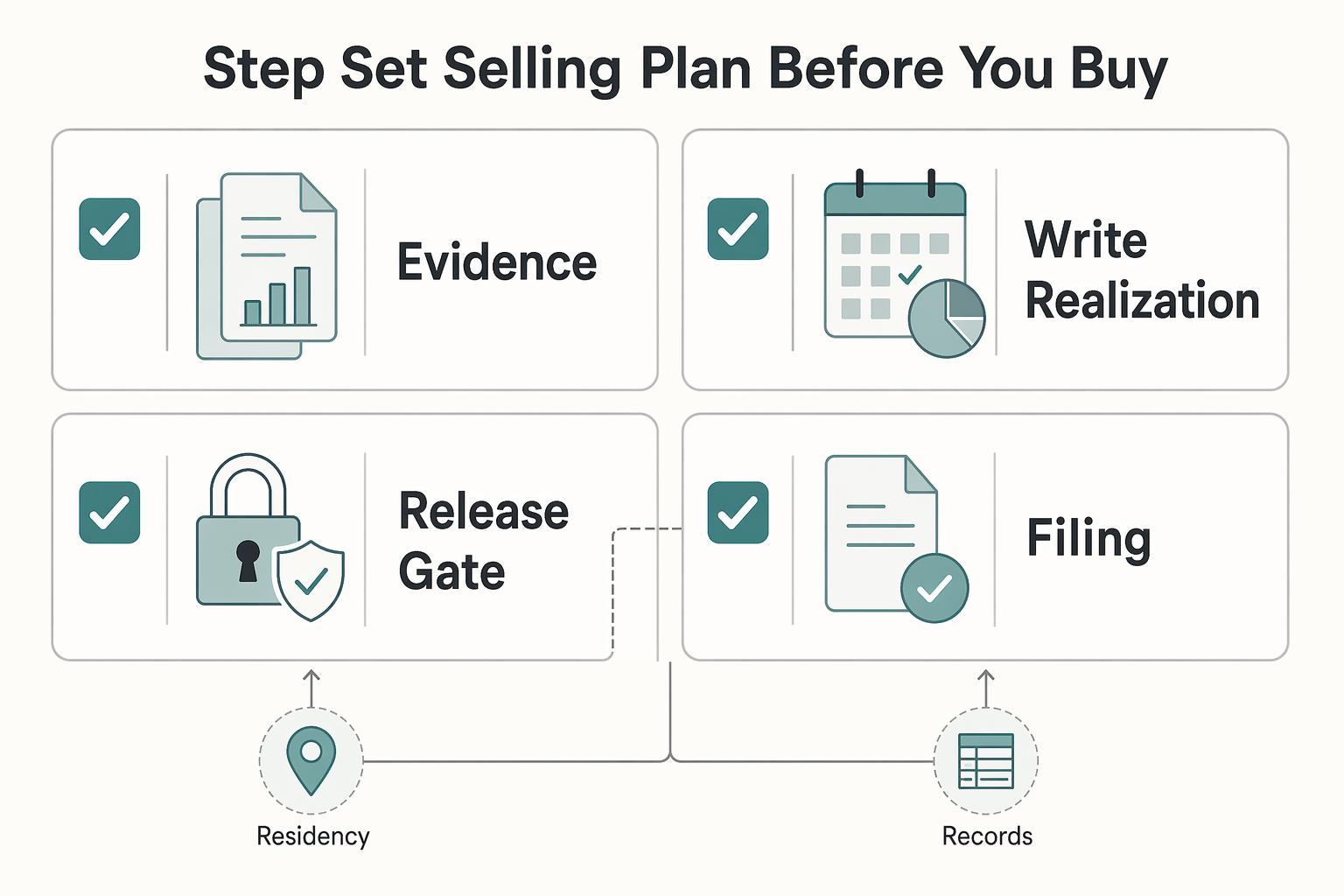
Step 4. Set the selling plan before you buy#
A common failure mode is waiting until tax season to think about realization timing. Set the rules now and require a pre-sale review.
Implementation checklist:
- Confirm account title and control: 529, Coverdell, custodial Roth IRA, or UTMA/UGMA. For UTMA/UGMA, document the current custodian and irrevocable-transfer status.
- Write a realization timing rule: "Avoid major gain realization while Form 8615 age and support conditions may apply; confirm the current-year age and support tests before approving a sale."
- Add a review-before-selling gate: before any sale or distribution, recheck expected unearned income, the Form 8615 trigger context at $2,700, and whether Form 8814 is even available under the interest-and-dividend-only path under $13,500.
- Keep a filing evidence file: statements, year-end tax forms, support records when relevant, and notes on why timing decisions were made.
Control account choice, income timing, and filing risk before year-end, not during filing.
If you want to turn this Kiddie Tax plan into a repeatable annual checklist, use the Tax Residency Tracker. It helps you keep your travel-day and filing notes organized.
The Expat Edge: Navigating the Kiddie Tax from Abroad#
Living abroad changes the paperwork, not whether U.S. kiddie-tax rules can still apply. The practical question is whether you are dealing with a routine filing issue or a cross-border issue that needs escalation early.
Step 1. Check whether this applies at all#
Start with a simple yes-or-no check. If your child is a U.S. citizen or resident alien and has unearned income, such as interest, dividends, or capital gains, U.S. filing exposure can still apply to worldwide income. If your child is not a U.S. citizen or resident alien, this U.S. framework may not be the controlling rule.
Then confirm the filing path. Form 8615 can apply when the child must file and has unearned income above the current threshold. It can apply whether or not the child is a dependent. IRS Topic 553 uses $2,700 as trigger context and $13,500 for the limited Form 8814 parent-election path. Check the latest Form 8615 and Form 8814 instructions before relying on those trigger points.
Step 2. Confirm whether Foreign Tax Credit relief is actually usable#
Treat the Foreign Tax Credit as conditional, not automatic. It is usually worth testing when foreign tax was paid or accrued and the same foreign-source income is also taxed by the U.S.
Double-tax risk can still remain if income was excluded under FEIE or foreign housing rules, if income is U.S.-source, or if the foreign tax is noncreditable. Treaty language is not an automatic fix either. The treaty saving clause often limits treaty-based U.S. tax reduction for U.S. citizens, and some treaty positions require Form 8833. Check the current form instructions and treaty-position reporting rules before filing.
Step 3. Screen PFIC risk before you buy#
Before you fund a non-U.S. account, do a quick pre-trade screen on account type, fund domicile, and product structure. Confirm whether you are buying an individual security or a pooled product, and whether that pooled product is treated as a foreign corporation for U.S. tax purposes.
| Path | Compliance burden | Likely tax complexity | Error risk |
|---|---|---|---|
| U.S. brokerage with U.S.-domiciled funds or stocks | Depends on filing facts | Depends on income-source and classification facts | Depends on documentation quality |
| Local broker with individual shares or bonds | Depends on filing facts | Depends on issuer/source and classification facts | Depends on documentation quality |
| Local-country mutual fund or ETF route | Can increase if PFIC screening is needed | Can be high when PFIC rules apply | Can be high if PFIC/Form 8621 filings are missed |
The main red flag is buying a local fund or ETF because it is standard where you live without checking the U.S. classification first. A PFIC is a foreign corporation that meets section 1297 passive-income or asset tests. A separate Form 8621 is required for each PFIC.
Step 4. Escalate early when facts are mixed#
Bring in a cross-border tax advisor early if any of these facts are in the file:
- Mixed-country custody or accounts across jurisdictions
- Unclear treaty interaction or possible Form 8833 filing
- Any potential PFIC exposure or uncertain fund domicile or entity treatment
- Uncertainty between a child return plus Form 8615 and the parent election under Form 8814
Keep one tight evidence file: prospectus or factsheet, account statements, tax slips, and proof of foreign tax paid. In practice, that file can be the difference between routine compliance and a costly cleanup later.
For a step-by-step walkthrough, see A Guide to the 'Net Investment Income Tax' (NIIT) for High-Earning Freelancers.
Conclusion: The Kiddie Tax Is a Signpost, Not a Stop Sign#
Treat these rules as a planning constraint, not a reason to stop saving for your child. The same four controls matter throughout: account priority, asset income profile, realization timing, and cross-border risk checks.
Start with account type before investment selection. If the goal is education, review 529 use first. IRS Topic 313 says earnings grow tax free and qualified higher-education distributions are not taxable. In taxable custodial accounts, remember that interest, dividends, and mutual fund capital gain distributions can create unearned income. That includes distributions credited to the account even when no shares are sold.
Then confirm the filing path before year-end pressure builds. Under 2025 Form 8615 instructions, unearned income over $2,700 can require Form 8615 when the other tests are met. Form 8814 can be available for qualifying children, including the $13,500 gross-income cap in the 2025 instructions, but it is not always the lower-tax result. Compare it against a separate child return and verify current IRS updates before filing.
Default action plan now:
- Review your current account mix and flag holdings that generate annual income.
- Set the expected filing path: child return with Form 8615, possible Form 8814 election, or advisor review.
- Document the next review date and what could change that decision.
If the facts are unclear, or if a non-U.S. fund's PFIC status is unclear, pause before trading or filing and get cross-border tax review first. Form 8621 may be required per PFIC, so early confirmation is safer than post-filing cleanup. If you can identify the account, expected income, filing path, and next review point, you are making controlled, compliant decisions.
Related: 183-Day Rule Explained: Stop the Tax Myths Before They Cost You.
If your child-investment setup is cross-border and you want a low-friction next step, start with Gruv's tools library. Pick the workflow that fits your cross-border operations process.
Frequently Asked Questions
How do you verify the current-year threshold and filing rules before you file?
Use current-year IRS instructions, not memory, old worksheets, or forum posts. Record the confirmed current-year threshold in your planning notes, then compare that value to your child’s actual year-end income.
What counts as earned income versus unearned income for a child?
Use temporary labels in your records, then confirm each item in current-year IRS instructions before you plan or file. If any item is unclear, pause and verify instead of assuming a category.
How do you legally reduce exposure to the kiddie tax?
Use a verify-first flow: confirm current-year rules in official instructions, map your facts to those rules, then escalate to a tax professional if anything remains unclear before you fund, trade, or file.
Should you use a 529 plan or a Custodial Roth IRA?
This guide does not verify 529 or Custodial Roth IRA rules, limits, or tax outcomes. Treat both as verify-first decisions: review current-year official guidance and your specific plan or account documents before acting, then keep complete records of what you do.
What should you gather if your child may need a return or Form 8615?
Start with complete year-end income and account records for the child, plus any related filing records you may need for a Form 8615 review. Add notes for any item you cannot classify yet. If you still cannot tell whether a child return or Form 8615 applies, verify current-year instructions first and prepare from documents, not estimates.
Try a related tool
Researched and edited by the Gruv editorial team. Gruv builds cross-border billing, payouts, and finance-operations software for global businesses.
Sources
- irs.gov/taxtopics/tc553trusted
- irs.gov/instructions/i8615trusted
Educational content only. Not legal, tax, or financial advice.
Related Posts

Digital Nomad Taxes in 2026 With a Defensible Filing Plan
With digital nomad taxes, the first move is not optimization. It is figuring out where you may be taxable, where filings may be required, and what proof supports that position.

183-Day Rule Tax Myths That Trigger Residency Filing Mistakes
If you are a mobile freelancer or consultant, start here: the "183 day rule tax" idea is not a single universal test. It is a shortcut phrase people use for different residency rules that do not ask the same question. If you mix federal and non-federal residency logic, you can create filing risk even when your travel calendar looks clean.
The Best Software for Creating Case Studies
**Treat case studies like a system, not a one-off design task, and you can win clients with consistency instead of guesswork.** If you have searched for the best software for case studies, you have probably seen mixed lists that lump content tools together with legal case-management products. That overlap wastes time and leads to uneven outputs.