
Quick Answer
Start with local written notice, proper service, and a complete file before filing anything. For how to handle eviction process, treat possession as a court action: confirm venue, keep lease and ledger records, and avoid lock changes or utility shutoffs without a court order. If deadlines pass, move through the local case path, such as unlawful detainer or forcible detainer, and document each step. After turnover, preserve condition evidence and finish deposit accounting before re-leasing.
Your Property is an Asset, Not a Lawsuit: An Eviction Risk Management Framework#
If you want to know how to handle eviction process without creating avoidable exposure, approach it as a controlled risk process. The goal is not just to remove a tenant. It is to protect legal compliance, cash flow, operating continuity, and a clean record if the dispute ends up in court.
| Reactive landlord behavior | Risk-managed operator behavior |
|---|---|
| Waits until rent is deeply overdue, then sends informal texts | Verifies the lease terms, payment history, and local notice rules before acting |
| Uses a generic notice template | Uses a jurisdiction-specific written notice with the correct deadline and delivery method |
| Tries pressure tactics or self-help removal | Treats removal as a court process and follows required legal steps |
| Files quickly with partial records | Files only after the lease, ledger, notices, and communication log are complete |
| Treats the case as a one-time conflict | Reviews the outcome and fixes the process gap that caused the dispute |
Eviction is a landlord-filed lawsuit to remove a tenant, but the terms and steps vary by jurisdiction. For example, California handles legal eviction through an unlawful detainer case, while Texas uses forcible detainer, and Texas requires a court order (Writ of Possession) before forced physical removal. Because notice periods, filing steps, and protections differ, start with local law, not a national checklist. To begin, use a state-specific reference such as A Guide to Landlord-Tenant Laws for Your State.
This works better when you break it into three decisions. First, decide whether the issue can be cured. Next, decide whether the case is ready to file. Last, decide how you will close out the property cleanly if possession changes.
Step 1 Prevent#
Use prevention to decide whether the issue can be fixed without filing. Confirm that you can produce a signed lease, current ledger, dated communications, and the exact written notice your jurisdiction requires before filing. Notice windows can vary widely by place and case type, so precision here helps you avoid preventable resets later.
Step 2 Execute#
Use execution to decide whether you are truly court-ready. If notice delivery is unclear or your documentation is incomplete, pause and fix that before filing. A rushed filing can create avoidable delays or other procedural setbacks.
Step 3 Recover#
Use recovery to decide how you regain control after possession changes. Secure the unit, preserve records, and report outcomes accurately. Accurate reporting helps avoid preventable harm tied to inaccurate eviction records.
You might also find this useful: How to Write a Legally Compliant Lease Agreement.
Phase 1: Prevention - The Best Eviction is the One You Never Start#
A lot of eviction risk starts before the tenant misses a deadline. If you standardize the tenancy up front, many routine problems stay routine instead of turning into legal disputes. This is the prevention side of the framework.
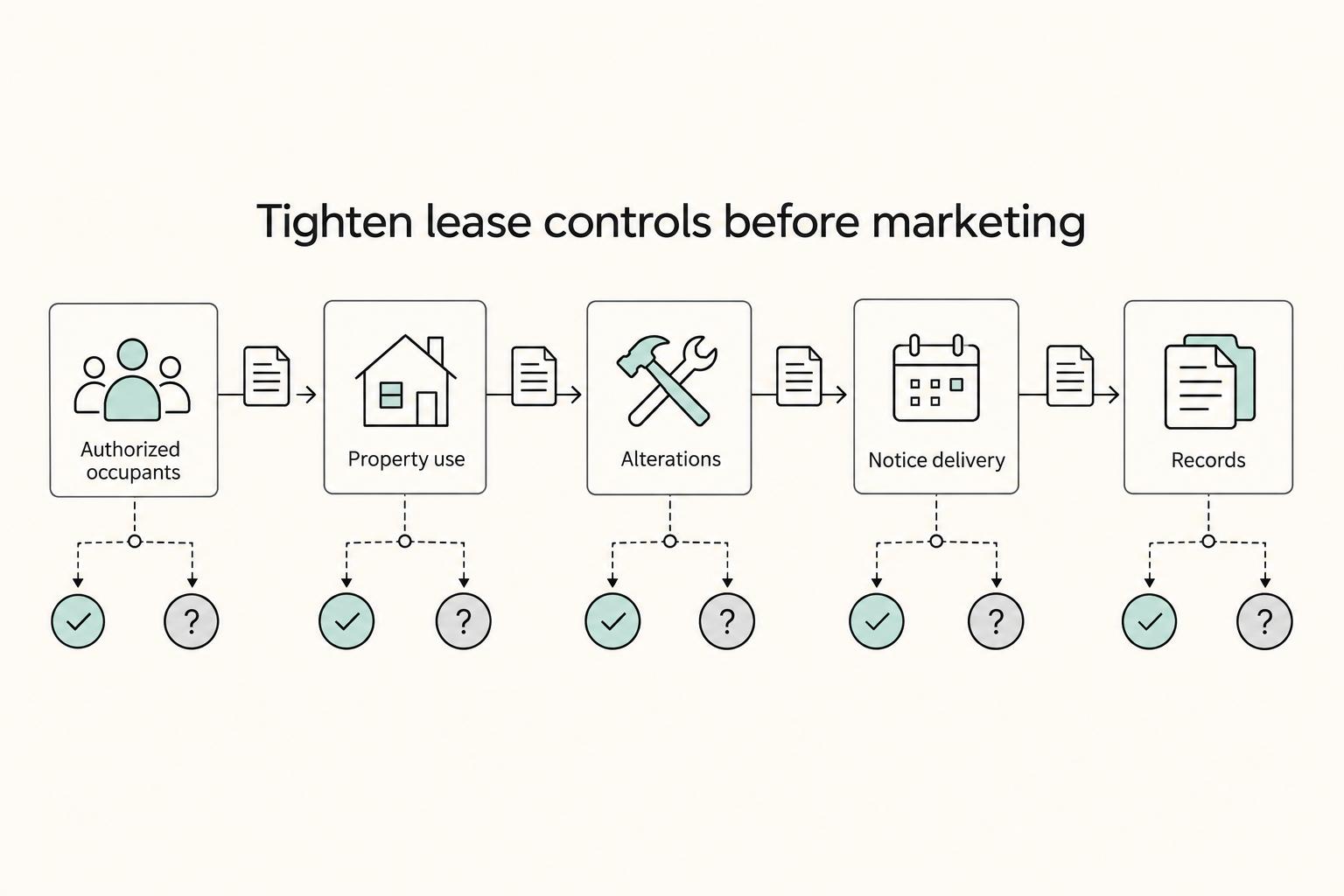
Tighten the lease before you market the unit#
A lease should work like an operating document, not just a rent form. Use a jurisdiction-specific lease and make sure the final language lines up with local landlord-tenant law. Requirements vary by location, so treat this as operational guidance rather than a universal legal minimum:
| Lease topic | What to address | Examples in article |
|---|---|---|
| Authorized occupants | Who may live in the unit; whether long-term guests need approval; whether sublets or replacements require prior written consent | long-term guests, sublets, replacements |
| Property use limits | Whether use is residential only and whether business use, short-term stays, or non-household storage is restricted | business use, short-term stays, non-household storage |
| Alterations and installations | Require written approval before physical changes | painting, fixture mounting, lock changes, added appliances |
| Notice delivery methods | Define approved channels for routine communication while keeping formal legal notice methods consistent with local law | routine communication channels; formal legal notice methods |
| Documentation standards | Require maintenance requests, approvals, and complaints to be submitted in writing through the approved channel | maintenance requests, approvals, complaints |
Before listing, you should be able to hand over a clean lease packet and show exactly where occupancy, use, maintenance, and communication rules are documented. If you are in New York, do not assume lease expiration alone solves the problem. Under the Good Cause Eviction Law, effective April 20, 2024, most landlords in covered localities cannot evict or refuse renewal solely because a lease expired. Check exceptions first, including owner-occupied buildings with 10 or fewer residential units, or 4 in Albany, and some buildings with a certificate of occupancy on or after January 1, 2009.
Verify the applicant, not just the application#
Screening helps only if it is lawful, repeatable, and documented the same way every time. Run one process for every applicant, then keep the file.
| Verification item | How to verify | Approval red flag |
|---|---|---|
| Identity verification | Match government ID to application details and check name consistency across supporting documents | Mismatched names, altered documents, or refusal to provide basic identity proof |
| Income stability | Review recent income documents and confirm employment or source continuity where appropriate | Income cannot be substantiated, documents conflict, or employment status changes during review |
| Prior tenancy behavior | Contact prior housing references (not only the current one) and document dates, rent history, and lease-compliance feedback | Vague references, unpaid balances, repeated lease issues, or only minimal reference responses |
| Lawful screening compliance | Apply the same criteria, forms, and review steps to every applicant and keep denial records where required | Ad hoc exceptions, undocumented denial reasons, or inconsistent application of criteria |
HUD guidance reinforces this approach: pre-occupancy activities must be non-discriminatory, and application recordkeeping matters. Where HUD rules apply, tenant selection criteria, waiting-list handling, records, and written denial notices are core controls.
Control communication before it becomes evidence#
Communication usually becomes evidence later, so set the rules before there is a dispute. Pick one primary written channel for routine issues and one emergency channel. Do not let key decisions live in scattered texts or phone calls without a written follow-up. Use a simple recordkeeping standard:
| Communication control | Article guidance |
|---|---|
| Routine channel | Pick one primary written channel for routine issues |
| Emergency channel | Pick one emergency channel |
| Written follow-up | Do not let key decisions live in scattered texts or phone calls without a written follow-up |
| Record log | Log date, issue, reporter, response, deadline, and resolution status |
| Tenant file | Keep notices, rent receipts, payment discussions, and property messages in one tenant file |
| Message tone | Use neutral language and avoid emotional or threatening messages |
| Repayment plan documentation | Confirm the amount due, proposed schedule, and response deadline in writing |
| Self-help threats | Do not use self-help threats |
If rent issues start, keep the discussion factual and documented. CFPB advises discussing a repayment plan before lawsuit stage. If that fits, confirm the amount due, proposed schedule, and response deadline in writing. Do not use self-help threats. In NYC, lockouts are illegal, and tenants can stay unless they leave voluntarily or are removed through court process.
Hand off a risk-control onboarding package#
Onboarding is a compliance handoff, not just key delivery. Give every tenant the same package, collect signed acknowledgments, and keep both the package and the acknowledgment in the tenant file. Include:
- Executed lease
- House-rules summary
- Written maintenance request workflow
- Escalation contacts for urgent issues
- Signed acknowledgment of receipt and understanding
Avoid these common shortcuts:
- Verbal-only rule explanations
- Casual channel changes outside the documented process
- Skipping acknowledgments because the tenant seems low-risk
- Side deals that are not put in writing
Done right, prevention feels routine. That is the point. Less ambiguity means cleaner records and fewer avoidable disputes.
Phase 2: Move to formal action with proof and procedure in order#
Move to formal action only when the tenant misses the written-notice deadline. Until that deadline passes, you are still in the notice stage, where many cases go off track.
Confirm the trigger and lock the record#
The trigger is procedural: the tenant did not do what the notice required by the deadline. It is not frustration or a difficult conversation. Before you file, freeze the case file:
- Signed lease
- Rent ledger
- Written communications
- Photos/inspection notes
- Prior warnings or incident records
Your file should let a third party answer three questions without calling you: what happened, when it happened, and what proves it. Do not use self-help. A notice is not a court order, and you still cannot lock out the tenant, shut off utilities, or remove belongings.
Use a reason-to-proof gate before serving notice#
Pick the legal reason first, then confirm that you have proof to support it. If the proof is thin or incomplete, do not move yet.
| Eviction reason | Required proof before notice | Do not proceed yet if... |
|---|---|---|
| Nonpayment | Current ledger, lease payment terms, written payment discussions | Ledger is inconsistent or balance cannot be explained line by line |
| Material lease breach | Signed lease clause, dated messages, inspection records, timestamped photos/video | You only have suspicion or verbal complaints |
| Nuisance or illegal activity | Incident reports, written complaints, agency/police records (if available), dated logs | Claims are unsupported or vague |
| Just-cause jurisdiction | The listed local just-cause reason plus supporting facts tied to that rule | You cannot name the listed reason and facts |
This checkpoint keeps you from building a case around assumptions.
Run the compliance workflow#
Once the ground is clear, follow the sequence in order every time.
| Jurisdiction/example | Procedural point | Stated requirement in article |
|---|---|---|
| NYC housing proceedings | Service method | You may not serve papers yourself, and the server must complete an affidavit/proof of service |
| California | Service proof | Keep court-ready proof forms where required, for example POS-010 for summons service |
| Texas | Notice timeline | At least 3 days' written notice to vacate unless contract changes it |
| Los Angeles covered units | Extra filing | RSO/JCO termination notices filed with LAHD within 3 business days after tenant service |
- Verify notice type
The notice must match the reason. It is not one-size-fits-all. Local rules may require extra content that you should confirm before service.
- Verify service method
Service is a procedural step, and mistakes here can undo the rest of the case. In NYC housing proceedings, you may not serve papers yourself, and the server must complete an affidavit/proof of service. Keep the full service record (who, where, when, how), including court-ready proof forms where required (for example, California POS-010 for summons service).
- Verify timeline and extra filings
Do not assume one notice period applies everywhere. Examples vary by jurisdiction, including Texas (at least 3 days' written notice to vacate unless contract changes it) and Los Angeles covered units (RSO/JCO termination notices filed with LAHD within 3 business days after tenant service). Confirm the current local notice period and any extra filing step before service.
If you need a jurisdiction check before service, use a state-specific reference such as A Guide to Landlord-Tenant Laws for Your State.
Engage counsel early and define handoff ownership#
Early legal help matters most when the file is messy, the rules are tight, or you are managing from a distance. Engage counsel before filing when the file is disputed, the unit is in a just-cause regime, you are remote, or the tenant is represented. Send a complete package:
- Lease
- Ledger
- Notice draft or served notice
- Service proof
- Correspondence log
- Photos/incident records
- One-page chronology
Once counsel is engaged, use one voice:
- Counsel owns notices, pleadings, and legal communications with the tenant or tenant counsel.
- Property manager handles access, factual updates, and on-site logistics.
- You stop direct case communication with the tenant about legal issues.
If the deadline passes without compliance, the next step is filing the case in court, often through counsel. Terminology differs by jurisdiction; for example, California uses unlawful detainer, and timelines vary.
Assign remote execution roles before court starts#
If ownership, management, and legal work are split across people or locations, assign roles before the case starts. That avoids duplicate work and bad calls made under pressure.
| Task | Legal counsel | Property manager | Owner |
|---|---|---|---|
| Validate grounds and notice choice | Lead legal analysis | Provide facts and local context | Approve strategy |
| Arrange service and preserve proof | Set compliant method; review affidavit/proof | Coordinate server; collect who/where/when/how details | Fund and monitor |
| File case and handle legal communications | Lead pleadings and tenant-facing legal communication | Route case messages to counsel; avoid legal explanations | Do not contact tenant about the case |
| Prepare possession recovery after judgment | Obtain writ/order and legal timing | Document unit condition, coordinate access/vendors | Approve spend and insurance notifications |
Final checkpoint: do not schedule lock changes based on assumptions. Physical removal is officer-executed after court process, for example, California writ of possession to sheriff, or Massachusetts sheriff or constable. NYC timing can be on or after the 15th day after the notice of eviction is served.
Related: How to Handle a Client Who Wants to Own Your 'Process'.
As you formalize your notice, timeline, and evidence checklist, mirror that same discipline in your payment operations with audit-ready status tracking and records: Review the docs.
Phase 3: Asset Recovery and Post-Mortem Analysis#
Possession is not the end of the risk. Treat this phase as a controlled closeout: regain possession, document condition, finish compliance tasks, and only then prepare for re-leasing.
For Georgia residential tenancies, treat this phase as separate from the filing stage. The Georgia handbook treats End of Lease, Security Deposit, and Evictions as distinct topics. It is an overview revised in December 2017 and may not reflect current law. Stage each step, document it, and verify current requirements under Title 44, Chapter 7 before acting.
Regain possession and preserve the initial condition#
Your first job is to preserve evidence, not turn the unit. Secure possession and hold cleaning, repairs, and removals until you capture condition evidence.
Use one immediate rule with anyone on site: do not remove, clean, repair, or discard anything yet. If you cannot show the unit's condition at the moment possession returned, pause before moving forward.
Build the condition record before any work starts#
Before any vendor starts work, build a move-out record that a third party can follow without your explanation. Do a full photo/video walkthrough, document room-by-room condition, and separate confirmed issues from items that still need estimates or legal review. Use one evidence packet standard each time:
- Move-in records
- Move-out condition photos/video
- Invoices and repair estimates
- Communication log
- Final accounting notice
This is a defensible file standard, not a statutory checklist. It lowers dispute risk and gives counsel a usable record if challenged.
Complete legal and compliance wrap-up before re-leasing#
Do not improvise here. Abandoned-property and security-deposit decisions can trigger the next dispute, so handle them before make-ready work starts.
If property is left behind, inventory it and verify current Georgia requirements before removal, storage, notice, sale, or disposal. The facts of each case control outcomes, and Georgia disputes are generally enforced through court processes, directly or through counsel, so mistakes here can become litigation issues.
Use this deposit decision aid and justify each deduction line by line:
| Decision check | What to confirm | Documentation to keep | Common dispute risk |
|---|---|---|---|
| Lease basis | The deduction is tied to the lease and current Georgia requirements | Lease language, ledger, notice/accounting support | Unsupported or unclear basis |
| Condition support | The deduction matches documented condition issues | Move-in record, move-out photos/video, related communications | Disagreement about condition |
| Amount support | The amount is real, traceable, and not duplicated | Invoices, estimates, receipts, math backup | Math errors, double counting, unexplained balances |
If a deduction is not tied to the lease, the condition record, and a real amount, treat it as high risk.
Prepare for re-leasing only after the file is complete#
Do not rush into turn work because the unit is vacant. Start cleaning, repairs, and make-ready only after the evidence packet and accounting file are complete. Keep legal closeout records and make-ready records together so the sequence is clear and defensible.
If you need a current-law check before final notices or abandoned-property handling, use a state-specific reference such as A Guide to Landlord-Tenant Laws for Your State.
Run the post-mortem as an operating loop#
The last step is to learn from the case while the details are still fresh. Identify the root cause first: screening, lease language, documentation, escalation timing, or execution handoff. Then assign one concrete fix in each bucket: lease, screening, and execution.
Update your internal process immediately: what changes, who owns it, and when it is verified in the next case. If nothing changes, the same failure path stays open.
Conclusion: From Reactive Landlord to Proactive Asset Manager#
The safest path is operational: document carefully, stay inside the court process, and use each case to tighten the next one.
Use the three phases as control points, not mindset advice. Step 1: Prevent. You are on track when you can pull one complete file with key records, including notices, service proof, and communications, and confirm local requirements before taking action. In Massachusetts, that can begin with a notice to quit before summary process. In California, unresolved issues can move into unlawful detainer. If you cannot confirm legal grounds, pause and escalate before serving anything.
Step 2: Execute. You are on track when every move stays inside the court path and avoids self-help. Utah courts state that a legal eviction requires a court order and list lock changes or utility shutoffs as illegal. California also requires proper service of court papers, and post-judgment removal runs through a Writ of Possession. Default alone is not enough if your notice, service record, or filing steps are weak.
Step 3: Recover. You are on track when each case leads to a process change. Check where delays happened, what proof was missing, and what step failed under scrutiny. Recheck rule changes as part of that review cycle. If you operate HUD-covered housing, a 30-day written notification requirement for nonpayment took effect on January 13, 2025. For PHAs, compliance with part of that rule is due by June 15, 2026.
| Focus | Reactive response | Asset-manager response |
|---|---|---|
| Behavior | Acts after pressure spikes | Verifies grounds, notice, service, and court path before acting |
| Risk exposure | Slips toward lockouts, shutoffs, or rushed filings | Stays court-compliant and escalates when facts are unclear |
| Documentation quality | Scattered records and missing proof | Audit-ready file with notices, service proof, filings, and timeline |
Keep your local legal playbook current, keep records audit-ready, and verify jurisdiction-specific steps before you act.
If legal disputes are exposing gaps in how you collect, hold, and pay funds across borders, align your workflow with compliance-gated, traceable operations: Talk with Gruv.
Frequently Asked Questions
What is the first legal step?
Start with the written notice your local process requires, then confirm venue before filing. Keep a complete notice packet: the notice used, service date, service method, and proof of delivery, plus records of the lease issue. Case names vary by court, for example, Summary Proceeding or F.E.D. A core filing checkpoint is venue: file in the court where the rental property is located. If you are unsure about notice form, service, or grounds, escalate to local counsel before filing.
What notice mistakes get cases into trouble most often?
A common problem is mismatch: the legal basis, notice content, and service method do not line up. Re-check all three before you file. Document a clean timeline with the signed notice, service proof, and supporting records such as a ledger where relevant. If anything conflicts or is missing, treat it as a filing stop. Court staff can explain procedure, but for legal advice you should escalate to a lawyer.
Can you just change locks if the tenant is clearly in default?
No. Without a court order, removing a tenant by lockout, lock change, or blocked entry is not lawful. Document that you preserved access and followed court steps only. If anyone already attempted self-help, escalate to local counsel immediately before taking another action.
What records matter most if the tenant contests the case?
Keep one file that a third party can follow: lease, notices, service proof, ledger, communications, and condition records. Keep possession issues separate from money issues, because some courts handle those phases separately. In Alaska residential guidance, the case is presented as two parts: possession first, damages later. Escalate early if your file does not clearly prove breach, notice, and service.
How much will it cost and how long will it take?
Use local court and local counsel inputs, not generic averages. Treat the filing-fee range and timeline as local variables to confirm before budgeting, then document your actual fee, service, counsel, vacancy, and repair assumptions. Keep those assumptions in your case file so budget decisions are traceable. If you need decision-grade numbers, escalate to local counsel for a venue-specific estimate.
Can you handle the case if you live in another state or country?
Requirements vary by jurisdiction. Start by confirming the correct local court and local filing process. Remote ownership does not remove local court requirements. If you are unsure how the local process applies to your situation, escalate early to local counsel.
What if the tenant files bankruptcy or says they did?
Bankruptcy issues are outside this guidance. Treat this as an immediate counsel-review event and escalate to local counsel before taking another case action.
Does this guidance apply to commercial property too?
Do not assume that it does. Some guidance is expressly limited to residential evictions, and the Georgia handbook warns it may not reflect current law. Document the property type first. If the tenancy is commercial or mixed-use, escalate to local counsel before relying on a residential process.
Try a related tool
Researched and edited by the Gruv editorial team. Gruv builds cross-border billing, payouts, and finance-operations software for global businesses.
Sources
- ag.ny.gov/publications/new-york-state-good-cause-evict...trusted
- archives.hud.gov/offices/adm/hudclips/handbooks/hsgh/43503c4H...trusted
- consumer.georgia.gov/document/document/galandlordtenanthandbookpd...trusted
- consumerfinance.gov/about-us/newsroom/as-federal-eviction-protec...trusted
- courts.alaska.gov/shc/housing/startevictioncase.htmtrusted
- federalregister.gov/documents/2024/12/13/2024-28861/30-day-notif...trusted
- lsc.gov/initiatives/effect-state-local-laws-eviction...trusted
- mass.gov/info-details/find-out-how-to-start-the-evict...trusted
Educational content only. Not legal, tax, or financial advice.
Related Posts

Germany Freelance Visa Application Path for Freiberufler and Gewerbe
Choose your track before you collect documents. That first decision determines what your file needs to prove and which label should appear everywhere: `Freiberufler` for liberal-profession services, or `Selbständiger/Gewerbetreibender` for business and trade activity.
Landlord-Tenant Laws by State for Remote Owners
A lot of landlord advice assumes you are local, reachable, and able to handle legal and physical tasks yourself. If you own from another state or country, that assumption breaks quickly. The real risk is not inconvenience. It is missed notice windows, mishandled service, unverified registration gaps, and delayed enforcement when something goes wrong.

The Freelance Payment Penalty: A Modeled Audit of Platform Fees, FX Spreads, and Payout Delays
The money rarely disappears through a single, easy-to-spot fee. The real loss is stacked. A marketplace takes its commission, a processor adds a charge for international cards, a bank or payment company converts the currency at a spread, a platform holds the funds before release, and a wire sheds a little to intermediaries on the way in. Each layer looks defensible on its own, but the worker feels the combined result as a smaller deposit and a later payday.