
Quick Answer
Handle stock or crypto donations with a compliance-first process: decide whether to sell first or donate directly, execute with the cleanest transfer-only rail, document every step, and escalate if residency, state exposure, or offshore reporting is unclear. For crypto, the IRS treats virtual currency as property, so selling, trading, or spending it can create a tax event, while clean transfer records help keep your filing position defensible.
You're about to donate stock or crypto - here's the compliance-first way to do it (without tax surprises)#
Use a compliance-first workflow, Decide → Execute → Document → Escalate, to reduce avoidable tax surprises and keep your position defensible if the IRS ever asks. As a business-of-one, your job is not to "optimize." It is to run a clean, provable process. This playbook helps you avoid two classic failures: triggering an unintended taxable event or failing to prove what happened later.
Step 1 to Step 4: the 10-minute operator system#
Step 1: Decide (write a one-paragraph decision memo). Clarify three inputs before you touch your brokerage account or wallet: your filing context (U.S. return this year or not), whether you expect to benefit from itemized deductions, and whether the asset sits in a clean custody path (brokerage lots for stock, exchange export or wallet history for cryptocurrency). You are choosing a path you can prove.
Step 2: Execute (choose the simplest clean rail). Pick a receiving rail that matches the asset and your ops tolerance. A donor-advised fund can standardize intake for donating stock. For donating crypto, some charities use third-party processors, which can simplify the receiving and confirmation flow.
If anything looks ambiguous, unclear instructions, a mismatch in names, address confusion, stop and use a more standardized option.
Step 3: Document (build the audit file as you go). Create a single folder now, for example, "Donation YYYY," and drop in the proof trail immediately: transfer confirmations, transaction hashes, and the charity's acknowledgment. For crypto, remember the IRS treats "virtual currency" as property for federal income tax purposes (Notice 2014-21). That is why records matter.
Step 4: Escalate (use triggers, not vibes). Escalate when residency gets messy, especially if California is in the picture. California treats residency as a question of fact, and California residents get taxed on all income regardless of source. Part-year status can change what California taxes while you lived there versus after you left.
Keep this separation in mind:
| Generally true in the U.S. | Depends on your facts (confirm) |
|---|---|
| IRS treats virtual currency as property for federal income tax purposes. | Whether you can actually use itemized deductions this year. |
| IRS guidance exists for digital asset transactions, and IRS FAQs note they generally apply to transactions completed before Jan. 1, 2025. | Your residency and state exposure (California residency and part-year rules can change obligations). |
| A clean transfer plus clean records keeps your story coherent. | Whether the charity can accept the exact asset (stock in-kind, specific cryptocurrency rails). |
Hypothetical: you live abroad most of the year, but you spent part of the year in California and you want to donate crypto. Treat that as an automatic "Escalate" trigger. You can still give, but confirm residency and documentation before you hit "send."
Prereqs: what to prepare before you donate (so you don't trigger a messy unwind later)#
If you're donating crypto (virtual currency), start with the IRS baseline: virtual currency is treated as property for federal income tax purposes (per Notice 2014-21). Also note the IRS's virtual currency FAQs generally apply to transactions involving digital assets completed before Jan. 1, 2025, so treat any FAQ-based assumptions as time-scoped.
This is what avoids the classic operator pain: realizing mid-transfer that you picked the wrong path and cannot easily unwind it.
Before you start: the prep checklist (IRS-baseline version)#
Step 1: Confirm whether what you're donating is a "digital asset" / "virtual currency." The IRS FAQs frame their guidance around digital assets, and they use virtual currency as the specific category treated as property.
| Step | What to do | Why it matters |
|---|---|---|
| 1 | Confirm the asset is a digital asset / virtual currency | The IRS FAQs frame guidance around digital assets, and virtual currency is the category treated as property. |
| 2 | Treat the donation like a property transfer | The IRS treats virtual currency as property for federal income tax purposes. |
| 3 | Keep a simple record folder | This helps you reconstruct what you did later without guessing. |
Step 2: Treat the donation like a property transfer (because that's how the IRS treats virtual currency). In practice, don't think "cash movement." Think "property changing hands."
Step 3: Keep a simple record folder for your own sanity. This isn't paperwork theater. It's about being able to reconstruct what you did later without guessing, especially if you're dealing with a digital asset transfer.
Is donating appreciated crypto or stock better than selling and donating cash?#
For virtual currency, the IRS treats it as property for federal income tax purposes, so selling it can create a tax event. Whether it's better to sell first and donate cash or transfer the asset directly depends on your facts and what the recipient can reliably accept and document.
Compare the two paths and default to the one that avoids taxable events and paperwork surprises you don't need.
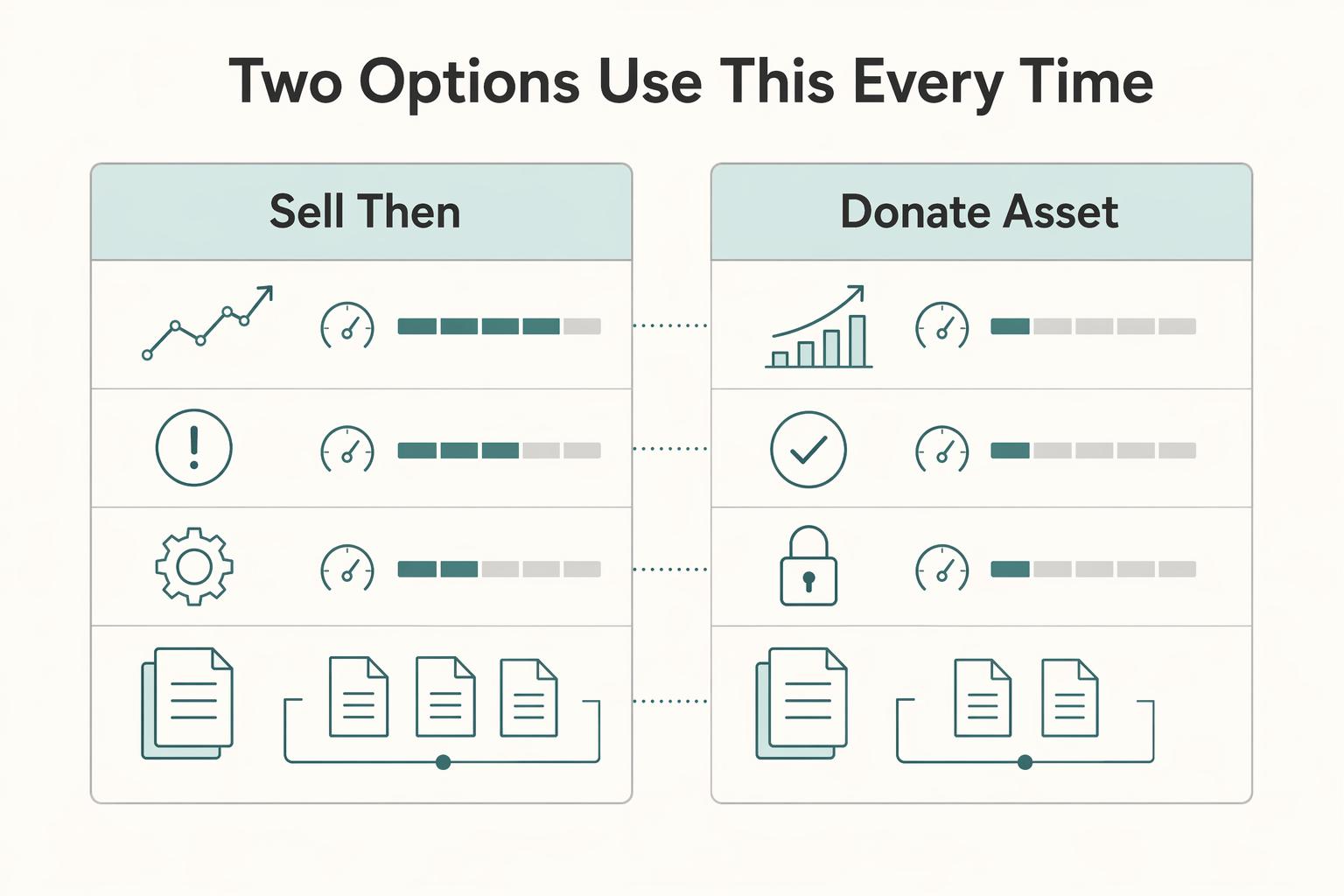
Default comparison: two options (use this every time)#
Use two columns, then pressure-test the tax friction and the ops friction.
| Option | What you do | Primary tax friction to watch | Operational friction to watch |
|---|---|---|---|
| A. Sell then donate cash | Sell the stock or cryptocurrency, then donate dollars | The sale may create taxable gain or loss and related tax reporting. | More steps and more timestamps. You must reconcile trade confirmations, proceeds, and the later cash donation receipt. |
| B. Donate the asset directly | Transfer shares or send crypto to a charity that can accept it | This path changes the tax and reporting picture because you may not be inserting a sale step first. The tax treatment of donations varies by situation, and recordkeeping still matters. | Transfer logistics and clean evidence. You need clear transfer confirmations from your broker or wallet and whatever receipt or acknowledgment the recipient provides. |
Two practical realities drive this decision:
- Selling creates a hard breakpoint. When you sell, you turn a "give" decision into a "trade plus give" workflow. That adds tax surface area and increases the chance you miss a record.
- Direct transfer can keep the chain simpler. If you avoid inserting a sale step, you may reduce avoidable complexity, but you still need the recipient and your own records to be clean.
Safe-default decision rule (if you feel any uncertainty)#
Treat this as a documentation-first decision: pick the path you can execute cleanly and support with clear records.
- Confirm the recipient can receive the asset cleanly. If they cannot accept the asset, or cannot provide a clear process or receipt, do not force it.
- Confirm your documentation readiness. If you cannot quickly produce clean ownership and transfer evidence, pick the path you can document cleanly, even if it feels less "optimized."
Hypothetical: you hold Bitcoin in a self-custody wallet and you want to support a nonprofit quickly. If the nonprofit cannot clearly confirm the receiving process and what it will provide back to you for your records, use a more standardized intake process or switch to a cash donation you can document cleanly. The goal stays the same: charitable giving with defensible paperwork, not cleverness.
Step 1 - Decide: run the 10-minute donation decision tree (Decide → Execute starts here)#
Run four checkpoints, pick Option A (sell then donate) or Option B (donate directly), then write a one-paragraph decision memo you can defend later.
This step exists so you do not second-guess yourself mid-transfer.
The 10-minute decision tree (four checkpoints)#
Use this as a literal script. If you cannot answer a checkpoint quickly, treat it as a "pause and confirm" trigger.
| Checkpoint | Question | If "yes" | If "no" |
|---|---|---|---|
| A. Tax residency and filing context | Are you filing in the U.S. this year, and do you have any California residency complexity (resident, part-year, nonresident)? | Keep the residency story explicit in writing. California says you're a resident if you are present in California for other than a temporary or transitory purpose, or domiciled in California but outside California for a temporary or transitory purpose. (And California notes you're taxed on all income regardless of source while a resident.) If you're part-year, California says you pay tax on worldwide income while a resident and California-source income while a nonresident. | Pause and confirm. Rules vary by jurisdiction, and you do not want to wing residency or filing triggers. (California also publishes gross income filing tables and says if your income is more than the amount shown, you need to file a return.) |
| B. Digital asset treatment and recordability | Is the asset virtual currency/digital assets, and can you explain its history cleanly? | Remember: the IRS has explained that virtual currency is treated as property for federal income tax purposes. If your record trail is messy, prioritize a path you can document cleanly end to end. (Also note: the IRS virtual currency FAQs generally apply to transactions involving digital assets completed before Jan. 1, 2025.) | If the asset is not virtual currency, you have more flexibility. If the history is not clean, pause and choose the path you can clearly document and reconcile later. |
| C. Jurisdiction friction | Could California treatment apply because you lived inside and outside California during the year? | Pause and confirm residency status before you do anything irreversible. California frames residency as a facts-and-circumstances question, and it taxes residents on all income regardless of source. As a nonresident, California says you pay tax on taxable income from California sources. | Proceed, but keep your state story consistent in your records. |
| D. Charity readiness | Can the recipient accept the asset, start to finish? | Confirm intake, transfer instructions, and their acknowledgment or receipt process in advance. | Do not force it. Switch rails (use an intermediary that can accept in-kind on their behalf) or switch to cash. |
Hypothetical: you hold crypto with a messy trail across wallets. Even if you want to donate it as-is, you might still choose Option A if that is the path you can document cleanly today. You might also choose it if you cannot validate the charity's acknowledgment workflow today.
Output: your one-paragraph decision memo (copy/paste)#
Write this into your "Donation YYYY" folder before you move funds:
Decision: I will use Option (A/B) for this donation. Asset: (stock ticker or crypto). Estimated value: ____. Key facts to confirm: (U.S. filing; California resident/part-year/nonresident status if relevant). Execution rail: (direct charity instructions or intermediary). Documentation plan: I will save transfer confirmation or transaction hash plus the charity acknowledgment letter in one folder.
How do you donate stock or crypto directly without accidentally triggering a taxable sale?#
To avoid accidentally creating a taxable event, do not sell, trade, or spend the asset first. Focus on a transfer-only flow and keep clear records showing what you actually did.
Avoiding an accidental taxable sale is mostly about controlling the action you take and saving proof that you did not execute a sell, trade, or spend transaction on your side.
Stock (operational steps + checks)#
Treat a stock donation like an in-kind transfer project, not a trading task.
- Confirm receiving instructions before you touch your brokerage UI. Get the recipient's transfer instructions, including receiving account details, account name, and any reference fields, from an authenticated source.
- Use a transfer flow, not a sale flow. Your practical check is simple: you never place a sell order. If you can only complete the donation by selling shares and sending cash, pause and get clarity on the implications before proceeding.
- Capture evidence immediately. Save the brokerage confirmation plus the date and time, ticker, number of shares, and the receiving account details. Keep your file organized in case questions come up later.
Crypto (operational steps + checks)#
Crypto creates risk because the line between "transfer" and "disposal" gets blurry fast. For federal income tax purposes, the IRS treats virtual currency as property (Notice 2014-21). Disposing of cryptocurrency, such as selling it, trading it, or spending it, can trigger a taxable event and a capital gain or loss, so keep your flow focused on a transfer-only send.
Use this control table, then follow the operational steps.
| Asset | "Did I accidentally sell?" check | Proof to save |
|---|---|---|
| Stock | No executed sell order. Only a transfer request. | Transfer confirmation, share count, receiving details |
| Crypto | No trade or swap. Only an on-chain send to the recipient address. | Transaction hash, wallet or exchange export, any receipt or confirmation you receive |
Operational steps:
- Verify the receiving address out of band. Confirm the address from an authenticated source, not a pasted email thread.
- Run a small test transfer if the amount feels material to you. The IRS does not require this. Operators do it to avoid fat-finger losses, then send the full amount after they see a confirmed on-chain status.
- Preserve chain-of-custody evidence. Save screenshots or exports showing the outgoing transaction and matching transaction hash, plus any confirmation you receive from the recipient.
Hypothetical: you copy an address, notice the last characters do not match what a trusted source shows, and you feel rushed. You stop, re-verify, and do not send until you can confirm the destination with confidence.
Execution safe default: If any instruction looks ambiguous, wrong account name, unclear address provenance, or the recipient cannot confirm the receipt process, stop. Get clearer written instructions or professional advice rather than forcing a brittle transfer.
What changes when you're globally mobile (or your residency is messy)?#
Global mobility means you should confirm your filing context, reporting duties, and state exposure before you donate.
Moving across jurisdictions multiplies your risk surface. Before you assume anything about outcomes, lock down your filing posture so you are not building on guesswork.
Step 1: Run a stoplight system (so you know when to pause)#
Use this operator rule: assume rules vary until you confirm them, especially around deductibility, reporting, and which jurisdiction gets a bite.
| Stoplight | What it means | Safe next action |
|---|---|---|
| Green | Single-country life, clear U.S. filing status, clear state residency | Proceed and build your documentation packet |
| Yellow | U.S. filing plus another country connection, frequent moves, unclear state ties | Pause and validate reporting and state exposure before you transfer |
| Red | You cannot clearly articulate where you are tax resident, or you have offshore structures you do not fully understand | Stop and get a professional review before you donate |
Hypothetical: you spent part of the year bouncing between countries, kept a U.S. brokerage, used a non-U.S. bank, and you are "pretty sure" no state can claim you. That "pretty sure" puts you in Yellow or Red. Treat it that way.
Step 2: Check cross-border reporting triggers (even if the donation itself feels simple)#
| Area | What to check | Grounded detail |
|---|---|---|
| Offshore accounts | Check whether FBAR (FinCEN Form 114) applies | Do not assume a donation changes what you have to file. |
| FATCA / Form 8938 | Validate whether certain U.S. taxpayers with financial assets outside the U.S. must report them | The IRS says this is generally done using Form 8938. |
| Threshold | Confirm whether the aggregate value is reportable | In general, it must exceed $50,000 to be reportable, and higher thresholds can apply in some cases. |
| Annual return | Attach Form 8938 if required | If you do not have to file an income tax return for the year, the IRS says you do not file Form 8938 regardless of asset value. |
| Penalties | Treat non-reporting as a real downside | Failure to report foreign financial assets on Form 8938 may trigger a $10,000 penalty, and up to $50,000 for continued failure after IRS notification. |
| State exposure | Do a state exposure sanity check | If you lived in more than one U.S. state or kept meaningful ties, treat state tax as a real variable; if you cannot map residency cleanly, pause. |
- Inventory offshore accounts and structures. If you hold foreign bank or financial accounts, confirm whether FBAR (FinCEN Form 114) applies to your facts. Do not assume a donation changes what you have to file.
- Validate FATCA exposure if you file U.S. taxes. The IRS states that under FATCA, certain U.S. taxpayers holding financial assets outside the U.S. must report them to the IRS generally using Form 8938, and the aggregate value must exceed $50,000 to be reportable in general (higher thresholds can apply in some cases). Attach Form 8938 to your annual tax return if required. If you do not have to file an income tax return for the year, the IRS says you do not file Form 8938, regardless of asset value.
- Treat penalties as a real downside. The IRS states that failure to report foreign financial assets on Form 8938 may trigger a $10,000 penalty, and up to $50,000 for continued failure after IRS notification.
- Do a state exposure sanity check. If you lived in more than one U.S. state, or kept meaningful ties, treat state tax as a real variable in your "sell vs donate" comparison. If you cannot map residency cleanly, pause. A short review now often costs less than a painful re-file later.
Step 3 - Document: build an audit-ready donation file the IRS won't hate#
Build one donation packet per donation event that shows what you donated, when you donated it, and how you supported the value you reported, with a clean chain from decision to filing.
This is where most people fail, not in the transfer itself but in the file they build afterward.
1) Build the "one folder, one timeline" packet (safe default)#
Create a single folder per donation event, not per year. Inside it, keep a simple timeline note, a text file works, that logs:
| Packet item | What to save | Note |
|---|---|---|
| Donation timing | Donation date and time | Use your execution timestamp, not "sometime Tuesday." |
| Asset details | Asset type, asset name, and amount | Examples given include cryptocurrency vs. stock, Bitcoin, ticker symbol, and shares or units. |
| Value support | Price source and timestamp | Keep the value reference method you relied on. |
| Basis support | Broker lot detail or exchange export | Keep cost basis source proof in case questions come up later or tax prep changes hands. |
- Donation date and time (use your execution timestamp, not "sometime Tuesday").
- Asset type (cryptocurrency vs. stock), asset name (Bitcoin, ticker symbol), and amount (shares or units).
- Value reference method you relied on (price source and timestamp).
- Cost basis source proof (broker lot detail or exchange export). Even when you donate directly, basis questions can still show up when records get incomplete or your tax prep process changes hands.
Operator note: The IRS treats virtual currency as property for federal income tax purposes (per Notice 2014-21). Treat crypto records like property records.
2) Collect the core documents (and verify each one)#
Use this as your "done means done" checklist for what to keep on file:
| What to keep | Donating crypto (via an intermediary or direct) | Donating stock (DAF or charity brokerage) |
|---|---|---|
| Recipient acknowledgment/receipt | Any written acknowledgment or receipt from the charity or DAF (example: Fidelity Charitable). Save the letter as PDF plus the email trail. | Same idea. Save the letter as PDF plus the email trail. |
| Transfer proof | Transaction hash plus wallet or exchange records showing the outgoing transfer. | Brokerage transfer confirmation showing share quantity, date and time, and receiving account details. |
| Value reference | Price source and timestamp you used to support the value you reported. | Market price reference and timestamp used to support the value you reported. |
| Basis trail | Exchange export or tax lots history that supports cost basis. | Lot detail from your brokerage that supports cost basis. |
Hypothetical: you donate crypto from an exchange, then later the exchange locks your account. If you already saved the withdrawal confirmation and transaction hash, you still control your evidence.
3) Write a clean valuation narrative (and escalate early when it gets weird)#
Keep a short "valuation note" that answers: what source, what timestamp, what market, and why it makes sense. If valuation looks complex or non-standard, plan to get professional help early. Do not wait until filing week.
Treat this packet like an audit log: decision memo → execution proof → recipient acknowledgment/receipt → filing inputs for itemized deductions. If you share documents with a bookkeeper or contractor, lock down handling with a simple process like a DPA. See: Using a Data Processing Agreement (DPA) with Subcontractors.
Step 4 - Escalate: when should you stop and talk to a tax professional?#
Talk to a tax professional when an unknown can change whether your plan works, or when a reporting miss creates outsized downside.
The goal is not to outsource your thinking. It is to buy certainty on the few facts that can swing the result.
1) Use escalation triggers instead of vibes (decision rule)#
Treat these as hard stops. If you hit one, pause the transfer, or pause filing if you already donated, and book time with a CPA or cross-border tax pro.
| Trigger type | Escalate when... | Why it matters operationally |
|---|---|---|
| Deduction impact | You feel unsure whether the donation will actually reduce your taxes this year (or how it flows through your return). | You can execute charitable giving cleanly and still get little or no practical benefit if the tax impact does not land the way you expect. |
| Cross-jurisdiction facts | You file in the U.S. plus another country, or you have multiple state filing connections and are not sure how they interact. | You need one coherent story across returns. Small residency mistakes create big rework. |
| Documentation not clean | You cannot reconstruct cost basis or transaction history, or your crypto came from multiple wallets or exchanges with gaps. | If you cannot prove inputs, you cannot defend outputs. Fix the record trail before you file. |
| Reporting complexity | You have offshore holdings and you feel uncertain about FBAR (FinCEN Form 114), FATCA, or Form 8938. | IRS ties FATCA individual reporting to Form 8938. In general, reporting can start when aggregate foreign assets exceed $50,000 (thresholds can run higher in some cases). Failure to report foreign financial assets on Form 8938 may result in a $10,000 penalty, and up to $50,000 for continued failure after IRS notification. |
| Income spikes | Selling first could push your income high enough that you worry about knock-on tax effects from the spike in your situation. | Timing can matter, and unwinding a bad sequence later can be hard without planning. |
2) Make escalation efficient (what to send, and the question to ask)#
Show up like an operator. Send your pro: (1) your decision memo, (2) the Step 3 donation folder, (3) your residency timeline and any state ties, and (4) a list of offshore accounts and platforms.
Ask one tight question: "Given these facts, will this plan work as intended for my return, and do I trigger any extra reporting (Form 8938, FATCA-related reporting, or FBAR)? If yes, what do you want me to change before I transfer?"
Hypothetical: you donated crypto from two wallets, one tied to an old foreign exchange account. You can still donate confidently, but you should not guess on Form 8938 or FBAR. Confirm the reporting path, then move.
Common mistakes (and how to recover without blowing up your filing)#
Treat every mistake as a documentation problem first, then a tax problem. Rebuild the timeline and evidence so you can recover cleanly.
If you can reconstruct the timeline and the proof, you can usually recover without improvising at filing time.
Each mistake, what to do next, and what "done" looks like#
| Mistake | What to do next (in order) | What "done" looks like |
|---|---|---|
| You sold the asset first without modeling the tax impact | 1) Export the trade confirmation(s). 2) Reconstruct the sale's tax impact using your lot selection and cost basis records. 3) Document the charitable giving as a cash donation (because you converted the asset before donating). 4) Confirm your filing approach actually supports claiming a charitable deduction before you spend time optimizing the deduction narrative. | Your file shows (a) sale details, (b) computation inputs, (c) the cash donation receipt, and (d) a note explaining why you did not donate in kind. |
| You donated crypto to the wrong address or the charity cannot confirm receipt | 1) Pull the transaction hash and block explorer evidence. 2) Screenshot the "sent" view from your wallet or exchange. 3) Contact the charity or their donation processor with the hash and timestamp. 4) Write a short incident log (what you intended, what you sent, who you contacted, and outcomes). | You can trace the transfer on-chain and you have a written trail showing your attempts to confirm receipt. |
| You do not have basis records for the donated asset | 1) For stock, pull brokerage lot history. 2) For crypto, export exchange fills and transfers, then map them to the donating wallet. 3) If gaps remain, stop guessing and escalate before filing. | You can point to source records that support your cost basis, or you have a pro-approved method to handle missing data. |
| You assumed your state does not matter because you are "nomadic" | 1) Run a state exposure check and write down ties (address, license, voter registration, work location). 2) If California appears in the facts, treat residency as a facts-and-circumstances question, not a vibe. California defines residents and part-year residents, and taxes residents on all income regardless of source. 3) If you cannot clearly classify your year, escalate. | You have a dated residency timeline and a decision on whether state income tax might enter the model. |
| You kept receipts but not the right ones | 1) Ask the charity or DAF for a corrected written acknowledgment that clearly matches the donation (what was donated, when it was received, and any relevant notes). 2) Replace scattered screenshots with a single "final donation packet" that reads like an audit binder. | One folder, one timeline, and every document ties to the specific donation event. |
Hypothetical: you meant to donate crypto directly, but you sold it on an exchange out of habit, then sent cash. You did not ruin the donation. You changed the documentation shape, and potentially the tax outcome, so you document the sale, document the gift as cash, then move on.
Conclusion: run Decide → Execute → Document → Escalate, and treat the paper trail as the deliverable#
Run Decide → Execute → Document → Escalate every time, and treat the paper trail as the deliverable. If you can make the donation file boring, filing usually gets boring too.
Your operator default (and where people get hurt)#
A workable default is this: if you're donating an asset, decide upfront whether you'll sell then donate, or transfer the asset directly. Either way, you do not win by guessing. You win by executing cleanly, documenting what happened, then letting your tax pro map that reality to the return.
Use this decision rule:
| If this is true | Do this next | Verification point |
|---|---|---|
| You know your filing context and you can produce clean records | Proceed with your chosen flow | You can build a one-folder "donation packet" in under 10 minutes |
| Anything about residency, local tax exposure, or offshore reporting feels fuzzy | Pause and escalate before you transfer | You can explain your facts in one page to a pro |
Global mobility makes "simple" fail quietly. Under FATCA, certain U.S. taxpayers with financial assets outside the U.S. must report those assets to the IRS generally using Form 8938. You attach Form 8938 to your annual tax return. If you do not have to file an income tax return for the year, you do not have to file Form 8938, regardless of asset value.
Filing Form 8938 also does not remove any separate requirement to file FinCEN Form 114 (FBAR). The IRS flags penalties for Form 8938 failures, including a $10,000 penalty and up to $50,000 for continued failure after IRS notice. In some cases, the IRS also notes a 40 percent understatement penalty.
Hypothetical scenario: you plan to donate crypto from a non-U.S. exchange account while you bounce between jurisdictions. You pause, confirm your filing posture, and ask a pro one focused question: "Do I have any Form 8938 or FBAR obligations for these accounts or assets this year?" That one check prevents a cleanup project later.
Optional ops hygiene: if you share sensitive tax documents with subcontractors, tighten your process with Using a Data Processing Agreement (DPA) with Subcontractors.
Copy/paste checklist (run this before you donate):#
- I know my filing context (U.S. vs non-U.S.)
- I recorded my own notes on cost basis and an estimated value at the time of transfer
- I chose Option A (sell then donate) or Option B (transfer directly) and wrote a 3-sentence decision memo
- I confirmed the recipient can accept the asset and I have the right transfer instructions
- I executed the transfer (if transferring directly, I did not place a sell order first)
- I saved proof: transfer confirmation / transaction hash and any receipt the recipient provides
- I checked escalation triggers (FBAR/FinCEN, FATCA/Form 8938, unclear residency)
- I archived the full donation packet in one folder for tax-time reference
Frequently Asked Questions
Is donating appreciated crypto or stock better than selling and donating cash?
It depends on your facts, filing position, and whether the recipient can reliably accept and document the asset. Selling first adds a trade step, related tax reporting, and more records to reconcile. Direct transfer can keep the chain simpler, but only if the intake and acknowledgment process are clean.
Do I avoid capital gains tax if I donate cryptocurrency like Bitcoin directly?
Do not assume a direct crypto donation automatically avoids capital gains tax. The safer approach is to confirm your filing position, use a transfer-only flow, and avoid selling, trading, or spending the asset first. Then keep clear records so the transaction can be reported correctly.
Can I deduct the full fair market value of donated stock or crypto - and what conditions apply?
Do not assume you can deduct a specific amount without confirming the rules that apply to you. Only claim a deduction you can substantiate with clear value support, transfer proof, and the recipient's acknowledgment or receipt. If valuation or facts are non-standard, escalate before filing.
Do I need to itemize deductions for a charitable donation to matter on my U.S. taxes?
It depends on how you file and what else is on your return. Run a quick draft return or ask your preparer whether the donation is likely to change your income tax outcome. The article treats this as a confirm-first checkpoint, not something to guess at.
What records do I need to keep for stock and cryptocurrency donations in case the IRS asks?
Keep one donation packet per event. Save proof of transfer, the donation date and time, asset details, your value method and timestamp, basis records, and the charity's written acknowledgment or receipt. For crypto, include the transaction hash and wallet or exchange records; for stock, keep the brokerage transfer confirmation.
When should I talk to a tax professional before donating?
Talk to a tax professional when an unknown can change whether the plan works or when a reporting miss creates outsized downside. Common triggers are unclear deduction impact, messy cost basis or transaction history, cross-border or multi-state filing issues, offshore reporting questions, and income spikes from selling first. Pause before you transfer, or before you file if you already donated.
If I’m globally mobile, how do FBAR, FATCA, or Form 8938 intersect with donations (if at all)?
Treat offshore reporting as a parallel compliance track, not something the donation fixes. Under FATCA, certain U.S. taxpayers with financial assets outside the U.S. generally use Form 8938 when the total value exceeds the applicable threshold, which in general must exceed $50,000 to be reportable and can be higher in some cases, and the form is attached to the annual tax return. You may also have to file FBAR, and the article notes potential Form 8938 penalties of $10,000 and up to $50,000 for continued failure after IRS notification.
Try a related tool
Researched and edited by the Gruv editorial team. Gruv builds cross-border billing, payouts, and finance-operations software for global businesses.
Sources
Educational content only. Not legal, tax, or financial advice.
Related Posts

Using a Data Processing Agreement with Subcontractors
Put your data processing agreement in place before a processor or sub-processor gets access to personal data. If you use a processor, UK GDPR guidance requires a [written contract or other legal act](https://ico.org.uk/for-organisations/uk-gdpr-guidance-and-resources/accountability-and-governance/contracts-and-liabilities-between-controllers-and-processors-multi/when-is-a-contract-needed-and-why-is-it-important). Set that contract boundary before support logins, shared folders, or troubleshooting access turn into live processing.

Vancouver Digital Nomad Guide 2026 for Long-Stay Remote Work
If you are planning a longer stay in Vancouver, make the go or no-go call before you commit to non-refundable flights, deposits, or a long lease. This guide is about remote work planning in Canada, not short-trip sightseeing. The goal is to help you validate route, documents, and budget in the right order so one weak assumption does not force a rushed decision later.

QuickBooks Self-Employed vs. Wave: Which is Better?
**Choose the platform that keeps invoices moving, gives you reachable support, and lets your accountant step in fast when problems hit.**