
Quick Answer
Handle rsu tax for expats by running a repeatable control loop at each vesting event: map dates and locations, classify status, reconcile withholding, and escalate unresolved treaty or social insurance issues. Use vesting as your U.S. baseline, but treat treaty and totalization outcomes as country-specific decisions. Keep audit-ready records and separate FBAR and Form 8938 checks so filing stays defensible and low-stress.
Separate fixed RSU rules from country-specific calls at each vest#
You can de-risk your RSU tax position as an expat by separating fixed rules from country-specific calls, then running the same short checklist at each vesting event.
If you're handling this yourself, your job is to build a repeatable system that survives country moves, payroll noise, and rushed filing deadlines.
RSU problems often show up when vest dates, moves, and withholding collide in the same period. RSUs can stop feeling like compensation and start feeling like operational risk.
The goal is simple: build a tight control loop you can run quickly for each vest, with safe defaults when facts are incomplete and clear escalation triggers when the stakes rise.
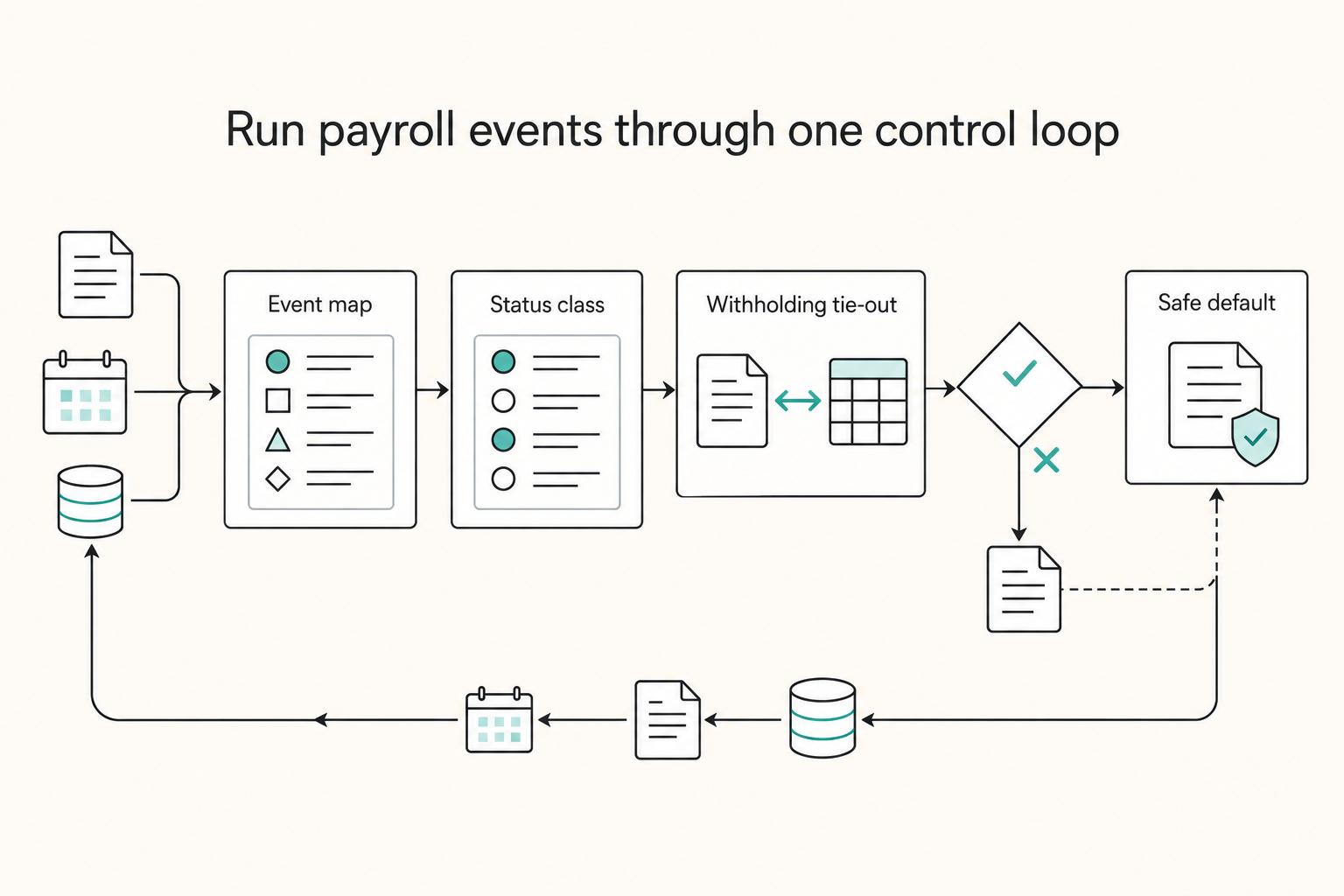
Run the control loop#
| Step | Focus | What to do |
|---|---|---|
| Map the event | Dates and service location | Capture grant, vest, and move dates, plus where you performed services before vest. |
| Classify your status | U.S. status and residency | Confirm your U.S. tax status and current residency posture before you interpret payroll output. |
| Reconcile withholding | Payroll check | Compare what payroll withheld for U.S. income tax and Social Security against your fact pattern. |
| Apply safe defaults | Conflicts and escalation | If facts conflict, treat the item as high risk, document assumptions, and escalate instead of guessing. |
Expected result: you leave each vest with a documented decision, a known owner, and a next action. The point is consistency, even when the underlying facts get messy.
Distinguish known rules from jurisdiction calls#
| Treat as known baseline | Treat as jurisdiction-dependent |
|---|---|
| In the Chief Counsel Memorandum 202327014 fact pattern, full RSU income is subject to federal income tax withholding, reporting, and payment. | A tax treaty result is not automatic. You must review treaty eligibility and account for the saving clause. |
| In that same fact pattern, RSUs are treated as wages at vesting for FICA timing. | A Totalization Agreement may change social insurance treatment in applicable cases. |
| In the memorandum, services outside the U.S. for a non-U.S. employer are not employment for FICA purposes. | Exemption support can depend on documentation such as a certificate of coverage. |
If you move countries right before a vest, do not improvise. Run the framework, mark the unknowns, and escalate when treaty interpretation, totalization scope, or mixed payroll treatment creates ambiguity.
That is how you keep your U.S. expat tax process usable under international conditions: clear defaults, documented exceptions, and records from day one. If you want a deeper dive, read Digital Nomad Taxes in 2026 With a Defensible Filing Plan.
What to prepare before you start#
Prepare the full input pack first, because your analysis is only reliable when status, withholding, and reporting records line up before you calculate anything.
The control loop is only as good as the inputs you feed it. This section is the setup: clean your core tax records once, then reuse the same structure whenever your international profile changes.
Build your starter pack#
| Task | What to prepare | Verification point |
|---|---|---|
| Event timeline data | Collect the key dates for the compensation events you are analyzing, plus any country moves tied to those periods. Keep one row per event. | You can trace each event through location changes without gaps. |
| Payroll evidence | Export payslips and payroll reports that show U.S. federal income tax withholding plus Social Security and Medicare treatment for each event. | Each event has matching withholding records. |
| Status timeline | Build a country timeline that marks work location, tax residency, and any period as a green card holder or nonresident alien. Use the U.S. resident tests as your baseline: green card test or substantial presence test. | Every month has one clear status label. |
| Reporting folder | Set up year-based folders for FBAR records (FinCEN Form 114) and Form 8938 workpapers. Treat FBAR and Form 8938 as separate tracks, not substitutes. | The reporting folder already holds the supporting files. |
- Gather your event timeline data. Collect the key dates for the compensation events you are analyzing, plus any country moves tied to those periods. Keep one row per event so you can map residency and withholding period by period. Verification point: you can trace each event through location changes without gaps.
- Pull payroll evidence before interpretation. Export payslips and payroll reports that show U.S. federal income tax withholding plus Social Security and Medicare treatment for each event. Employers generally withhold these wage taxes, so missing lines usually signal missing records or a payroll setup issue. Verification point: each event has matching withholding records.
- Classify your status timeline. Build a country timeline that marks work location, tax residency, and any period as a green card holder or nonresident alien. Use the U.S. resident tests as your baseline: green card test or substantial presence test. If you fail both, classify that period as nonresident alien, then flag any U.S. filing exposure for review. Verification point: every month has one clear status label.
- Create a reporting folder now, not later. Set up year-based folders for FBAR records (FinCEN Form 114) and Form 8938 workpapers. Treat FBAR and Form 8938 as separate tracks, not substitutes. Verification point: the reporting folder already holds the supporting files.
| Record set | What to confirm before you move on |
|---|---|
| FBAR and FinCEN Form 114 | You track foreign accounts, test whether aggregate value exceeded $10,000 at any time during the calendar year, file electronically through FinCEN when required, and retain records for five years. |
| Form 8938 support | You test applicable thresholds, including the common $50,000 baseline for certain U.S. taxpayers, and document why you filed or did not file. Thresholds can vary by filing status and residence. |
If you changed countries between events, do a dry run. Pick one event, assign it to your timeline, and match payroll lines. Then confirm the reporting folder already holds the supporting files. That dry run prevents most cleanup later.
What is known and what is still country-specific?#
Treat vesting wage timing as your default baseline, then run treaty and totalization checks as separate country-specific decisions.
With your records organized, the next move is to separate the baseline from the country calls. IRS guidance can anchor the U.S. baseline, but it does not do the country-by-country work for you. This is the control point that keeps the analysis practical instead of speculative.
Start with the U.S. baseline you can apply fast#
- Anchor on vesting timing for wages. For Restricted Stock Units (RSUs), start from the U.S. baseline that vested income counts as wages at vesting or payment timing for federal income tax withholding.
- Scope memo 202327014 correctly. Use Chief Counsel Memorandum 202327014 as a focused U.S. withholding reference for transfer-abroad mechanics, not as a universal rulebook for all international tax outcomes.
- Mark authority limits. Keep in view that Chief Counsel Advice cannot serve as precedent, and that the memo itself does not fully resolve treaty effects for transferred employees.
As international tax attorney Anthony Diosdi notes, "The rules relating to the taxation of RSUs in an international context are often complex and sometimes uncertain." That is the right operating posture. Start with a documented baseline, then isolate the few variables that actually require specialist judgment.
Separate known facts from country calls#
| Treat as known now | Escalate as country-specific |
|---|---|
| Vesting creates the baseline wage timing for U.S. withholding analysis. | A tax treaty outcome varies by country and income type. You must run article-by-article review. |
| U.S. domestic tax rules apply when treaty coverage does not apply to that income type. | A Totalization Agreement can change Social Security results only after fact-specific analysis. |
| Your payroll file helps document how U.S. withholding and Social Security were handled. | Local authority interpretation and agreement terms can change final treatment. |
Caution box: Do not force one answer across all jurisdictions. If treaty language, residency status, or totalization scope stays unclear, tag the vest event as high risk and escalate before filing.
Hypothetical example: you transfer mid-cycle, then a vest hits while payroll still follows prior-country assumptions. You keep the U.S. wage baseline, flag treaty and totalization variables, and escalate only those points. That is how you keep execution clean without turning every vest into a research project.
How do you decide your RSU tax position in 10 minutes?#
Decide your RSU tax position by classifying status at vest, mapping service location, reconciling withholding, and escalating unresolved treaty or social insurance issues before you file.
You now have the split: baseline U.S. treatment versus country-specific decisions. Next, you need a loop you can run the same way for every vest so your position stays consistent across moves.
Run the five-step decision loop#
- Classify your U.S. status at vest. Confirm whether you are a U.S. citizen, resident alien, or nonresident alien. For non-citizens, test green card status and substantial presence, including the 31-day current-year and 183-day three-year formula. If treaty tie-breaker rules apply, flag that period for review because they can change how you compute U.S. tax. Outcome: one clear status label for each vest date.
- Map services and residency to each vest. Link each RSU tranche to where you performed services, including services performed in the United States, and where you held tax residence. Then flag treaty interactions by income type, not by country label alone. Outcome: a jurisdiction map you can defend.
- Reconcile payroll against expected treatment. Check payroll lines for U.S. income tax withholding and Social Security handling. In the 202327014 fact pattern, the full RSU income is in federal withholding scope. In that same fact pattern, FICA requires allocation to U.S.-performed services and can exclude remuneration for services performed outside the United States for the CFC. Outcome: each mismatch becomes an issue ticket, not a guess.
- Assign a risk tier and choose a default action.
| Risk tier | Trigger | Action |
|---|---|---|
| Low | Status, sourcing, and payroll all align | Proceed and document assumptions. |
| Medium | One variable conflicts | Hold filing position and get payroll clarification. |
| High | Treaty or totalization agreement impact stays unclear | Escalate to cross-border tax and payroll specialists before filing. |
- Set filing checks and close the loop. Review Schedule SE only when you have self-employment income and line 4c is $400 or more. Run FBAR checks when aggregate foreign accounts exceed $10,000 at any time during the year, and keep Form 8938 as a separate test because it does not replace FinCEN Form 114. Outcome: a complete filing workflow with clear owners.
Hypothetical example: you relocate mid-grant, then payroll keeps prior-country logic for the next vest. This process isolates the conflict, applies safe defaults, and escalates only the unresolved international tax points.
Related: Tax Implications of Receiving Stock Options as a Freelancer.
What changes if you move abroad before vesting?#
When you move abroad before vesting, split income tax withholding from Social Security analysis, then escalate treaty and totalization questions before filing.
Transfer-before-vest is where mistakes compound, especially when payroll settings lag behind your facts. Use your data pack to run a strict sequence and keep the two tax tracks separate.
Run the transfer before vest decision sequence#
- Anchor the U.S. withholding baseline. In Chief Counsel Memorandum 202327014, the IRS treats the full vested RSU amount as subject to U.S. income tax withholding in that memo's fact pattern.
- Split Social Security from withholding. In the same fact pattern, compensation for services outside the United States for the controlled foreign corporation (CFC) does not count as FICA wages. Use a time-basis workday allocation to isolate U.S.-service wages for Social Security.
- Reconcile payroll outputs line by line. Compare each vest event against payroll tax bases, not just net pay. If FITW and FICA bases differ, open a payroll review ticket immediately. As one payroll-practice warning puts it, "Many payroll systems will be unable to cope with this difference without manual intervention."
- Record your logic in the vest file. Save the status, sourcing map, and payroll rationale before you finalize the period.
| Track | Safe default in transfer-before-vest review | Escalation trigger |
|---|---|---|
| U.S. income tax withholding | Start with full RSU amount in scope for memo-like facts | Tax treaty eligibility or article-level ambiguity |
| Social Security | Source wages to U.S. services under time-basis allocation | Totalization agreement terms or unclear country coverage |
Set an exception gate and escalation rule#
Treat 202327014 as scoped guidance, not universal precedent. Escalate to cross-border counsel and payroll specialists when residency status under IRC section 7701(b) is unclear, when one vest cycle spans multiple countries, or when treaty language is unresolved.
Use one practical rule: if you or your team cannot explain both tax tracks in plain English, do not file on assumptions.
If residency status changes, rerun your status check under IRC section 7701(b) and any applicable treaty rules. Refresh your framework using 183-Day Rule Explained: Stop the Tax Myths Before They Cost You.
Hypothetical example: you transfer abroad, vest in the next cycle, and payroll withholds one combined amount without service-location detail. You pause, split FITW and Social Security analysis, document unknowns, and escalate only the unresolved items.
Which records make your file audit-ready instead of stressful?#
Build one annual evidence system for every vest, then log each reporting decision so your file stays defensible under review.
Once you have a defensible position, lock it into records you can prove. This is the difference between "I think this is right" and "Here is the chain of evidence for each decision."
Build your annual evidence system#
- Capture core vest evidence. Save vest statements, payroll slips, your residency timeline, and copies of submissions tied to IRS and FinCEN workflows. Add a short memo for each vest that states what you decided and why.
- Separate FBAR and Form 8938 decisions. Evaluate both regimes every year, because one does not replace the other and you may need to file Form 8938, FBAR, or both. File FBAR through FinCEN, not with your income tax return, when aggregate foreign account value exceeds the filing trigger at any point in the year.
- Preserve FBAR support fields. Keep account name, account number, foreign institution name and address, account type, and maximum annual value. Generally, retain FBAR records for five years from the due date.
- Store social insurance proof. Keep each Certificate of Coverage and related SSA correspondence in the same yearly folder as payroll files, and present the certificate to your U.S. employer when required for totalization treatment.
- Isolate expatriation-sensitive records when relevant. Track Form 8854, USCIS Form I-407, and your renunciation documentation in a separate subfolder so high-risk items do not get buried in routine RSU records.
| Folder lane | Keep this evidence | Close check |
|---|---|---|
| RSU compensation | Vest notices, payroll tax lines, sourcing notes | Every vest has a complete document chain |
| Foreign asset reporting | FBAR workpapers, FinCEN filing copy, Form 8938 analysis | You document include or exclude logic for each account or asset |
| Social insurance | Certificate of Coverage, SSA letters, payroll reconciliation | You can explain why Social Security treatment matches your fact pattern |
| Expatriation | Form 8854 file, I-407 proof, citizenship status notes | You can hand off a clean packet to cross-border counsel |
Hypothetical example: you changed countries twice and your payroll portals changed midyear. A regular close on this folder structure lets you tie every document to a vest event and fix gaps before filing season forces rushed decisions.
Where do expats make RSU mistakes and how do you recover fast?#
You can recover from RSU mistakes faster when you run a vest-by-vest sweep, then escalate status and expatriation risks before filing.
Use your evidence file as a control system. The recovery goal is not to relitigate every rule. It is to isolate mismatches, reopen only the right questions, and close them with clear ownership.
Run the five-step recovery sweep#
- Re-check country logic for each vest event. Do not reuse one country result in another. Test tax treaty and totalization agreement impact for each jurisdiction, because treaty relief can include conditions and time limits.
- Reconcile payroll line by line. Compare each vest against U.S. income tax withholding and social-tax treatment. Flag mismatches immediately instead of trusting payroll defaults.
- Clear reporting spillover before deadlines. Run FBAR and Form 8938 as separate tests, because one filing does not satisfy the other. File FinCEN Form 114 through FinCEN, and confirm whether aggregate foreign accounts crossed the $10,000 trigger at any point in the year.
- Escalate status changes early. If facts point to nonresident aliens, green card holders, or other residency shifts, trigger specialist review before return prep locks your position.
- Split expatriation risk into its own workstream. Keep U.S. Exit Tax and Covered Expatriate analysis out of routine RSU planning. Review net-worth and five-year compliance certification tests in a dedicated track.
| Mistake pattern | Fast recovery action | Verification point |
|---|---|---|
| One-size-fits-all country treatment | Re-run treaty and totalization checks per jurisdiction | Each vest has country-specific logic |
| Blind payroll trust | Reconcile withholding and social insurance lines | You can explain every payroll variance |
| Reporting spillover ignored | Test FBAR and Form 8938 separately | Filing calendar covers both regimes |
| Status-change escalation delayed | Trigger specialist review | Advisor notes exist before filing |
| Expatriation mixed into routine work | Open a separate risk track | Exit-tax analysis stays isolated |
Hypothetical: you move during a vest cycle, payroll keeps old defaults, and your file drifts. You run this sweep, isolate each error class, and close with a clear owner and deadline for each fix. If residency assumptions still drive confusion, review 183-Day Rule Explained: Stop the Tax Myths Before They Cost You.
Run the checklist and close your RSU compliance loop#
Close your RSU compliance cycle by running one repeatable checklist at every country, residency, or vesting change, then escalate open risks before filing.
| Checklist item | Key details |
|---|---|
| Map each vest event to service location and tax residency | For transfer-abroad RSUs, map dates across the vesting period and document your sourcing logic. Use the IRS memorandum pattern as a reasonableness check in similar fact patterns, but do not treat one memo scenario as a universal rule. |
| Reconcile payroll in two tracks | Check U.S. income tax withholding and Social Security separately, because they can diverge in cross-border cases. Review Totalization Agreement impact country by country, since outcomes depend on facts. |
| Run reporting gates before deadlines | Test FBAR and Form 8938 separately against their own thresholds and account or asset rules, because one does not replace the other. If your reportable foreign financial accounts exceed $10,000 at any point in the year, file FinCEN Form 114 through the BSA E-Filing System. Track the FBAR due date (April 15) and the automatic extension (October 15). |
| Lock your evidence file | Store vest statements, payroll support, treaty and sourcing notes, and reporting decisions together so your international tax file stays defensible. Keep records that support return items, and retain FBAR records for five years from the due date. |
| Escalate unresolved uncertainty early | Use treaty tables as a starting point, then confirm treaty text before relying on relief. Escalate if treaty interpretation, totalization effects, or sourcing assumptions still conflict. |
At this point, you do not need more theory. You need consistent execution. Run the loop below every time something changes, and treat anything you cannot explain cleanly as an escalation item.
- Map each vest event to service location and tax residency. For transfer-abroad RSUs, map dates across the vesting period and document your sourcing logic. Use the IRS memorandum pattern as a reasonableness check in similar fact patterns, but do not treat one memo scenario as a universal rule. Verification point: every vest has a dated location and residency trail.
- Reconcile payroll in two tracks. Check U.S. income tax withholding and Social Security separately, because they can diverge in cross-border cases. Review Totalization Agreement impact country by country, since outcomes depend on facts. Verification point: no unexplained payroll variance remains.
- Run reporting gates before deadlines. Test FBAR and Form 8938 separately against their own thresholds and account or asset rules, because one does not replace the other. If your reportable foreign financial accounts exceed $10,000 at any point in the year, file FinCEN Form 114 through the BSA E-Filing System. Track the FBAR due date (April 15) and the automatic extension (October 15). Verification point: filing calendar and workpapers match your account and asset review.
- Lock your evidence file. Store vest statements, payroll support, treaty and sourcing notes, and reporting decisions together so your international tax file stays defensible. Keep records that support return items, and retain FBAR records for five years from the due date. Verification point: another reviewer can follow your logic without guesswork.
- Escalate unresolved uncertainty early. Use treaty tables as a starting point, then confirm treaty text before relying on relief. Escalate if treaty interpretation, totalization effects, or sourcing assumptions still conflict.
Hypothetical: you switch countries mid-cycle and payroll keeps prior settings. You run this loop, catch the mismatch before filing, and hand your specialist a clean packet with exact open questions.
- I mapped each RSU vest event to service location and tax residency period
- I reconciled payroll treatment for U.S. income tax withholding and Social Security
- I reviewed treaty and Totalization Agreement impact where relevant
- I prepared reporting support for FBAR (FinCEN Form 114) and, where thresholds are met, Form 8938
- I stored audit-ready records and set escalation triggers for unresolved issues
Frequently Asked Questions
When are RSUs taxed for expats, at grant or at vesting?
In the IRS memorandum fact pattern, RSU income is treated as wages at vesting when share payment is initiated, not at grant, for U.S. income tax withholding timing. Use that as a practical starting point for U.S. withholding, then confirm local-country treatment separately because rules vary by jurisdiction.
If I move abroad before vesting, what gets withheld for U.S. tax and what about Social Security?
Handle this as two tracks from the start. In the same IRS memo fact pattern, full RSU income counted as wages for withholding, while FICA required service-location allocation and excluded services outside the United States for a non-U.S. employer. Reconcile payroll line by line so your file shows how you handled both tracks.
Can a tax treaty change how my RSUs are taxed?
Yes, a tax treaty can change the outcome, but it never applies on autopilot. If you are a dual resident, treaty benefits may still be available when treaty tie-breaker rules support your position and you meet filing requirements. When required, attach Form 8833 and document why the treaty position fits your vest facts.
Does a Totalization Agreement change social insurance treatment for RSU income?
It can. Totalization Agreement rules aim to eliminate dual social-tax contributions for the same work, and they can exempt compensation from FICA in specific fact patterns. Test each vest against the relevant agreement instead of assuming one setup covers all international tax years.
Are RSUs part of U.S. Exit Tax analysis?
They may be, so screen them early in any U.S. Exit Tax workstream. Form 8854 frameworks include deferred compensation categories, and some cases trigger ongoing annual reporting context after expatriation filings. Do not assume every RSU becomes an eligible deferred compensation item, but do not leave the classification unreviewed.
What records should I keep to support RSU tax compliance as an expat?
Keep vest statements, payroll records, residency timeline notes, treaty or totalization analysis memos, and filing workpapers together. Run FBAR and Form 8938 as separate controls, since one does not replace the other, and test whether foreign accounts crossed the $10,000 FBAR trigger. Retain FBAR support records for five years and keep return-support records through the applicable limitations period.
When should I escalate to a cross-border tax professional instead of using safe defaults?
Escalate when facts combine multiple countries, status changes, or unresolved treaty and totalization questions near filing deadlines. Escalate immediately if expatriation planning enters scope or if payroll treatment conflicts with your vesting map. Safe defaults help you triage RSU risk, but specialists close the gaps before they become filing errors.
Try a related tool
Researched and edited by the Gruv editorial team. Gruv builds cross-border billing, payouts, and finance-operations software for global businesses.
Sources
Educational content only. Not legal, tax, or financial advice.
Related Posts

Digital Nomad Taxes in 2026 With a Defensible Filing Plan
With digital nomad taxes, the first move is not optimization. It is figuring out where you may be taxable, where filings may be required, and what proof supports that position.

183-Day Rule Tax Myths That Trigger Residency Filing Mistakes
If you are a mobile freelancer or consultant, start here: the "183 day rule tax" idea is not a single universal test. It is a shortcut phrase people use for different residency rules that do not ask the same question. If you mix federal and non-federal residency logic, you can create filing risk even when your travel calendar looks clean.
Tax Implications of Receiving Stock Options as a Freelancer
Stock options can create tax exposure at multiple moments, so sequence matters more than guesswork. Use a compliance-first order for grant, stock option exercise, and stock disposition so decisions are made before money moves.