
Quick Answer
Generally, a foreign inheritance received by a U.S. person is excluded from gross income if it is treated as a gift or bequest, but reporting can still apply. The key federal questions are whether the transfer is a direct foreign gift or bequest or a foreign trust distribution, whether Form 3520 is required, and whether separate FBAR or Form 8938 checks apply after the funds reach your accounts.
What U.S. persons should check first#
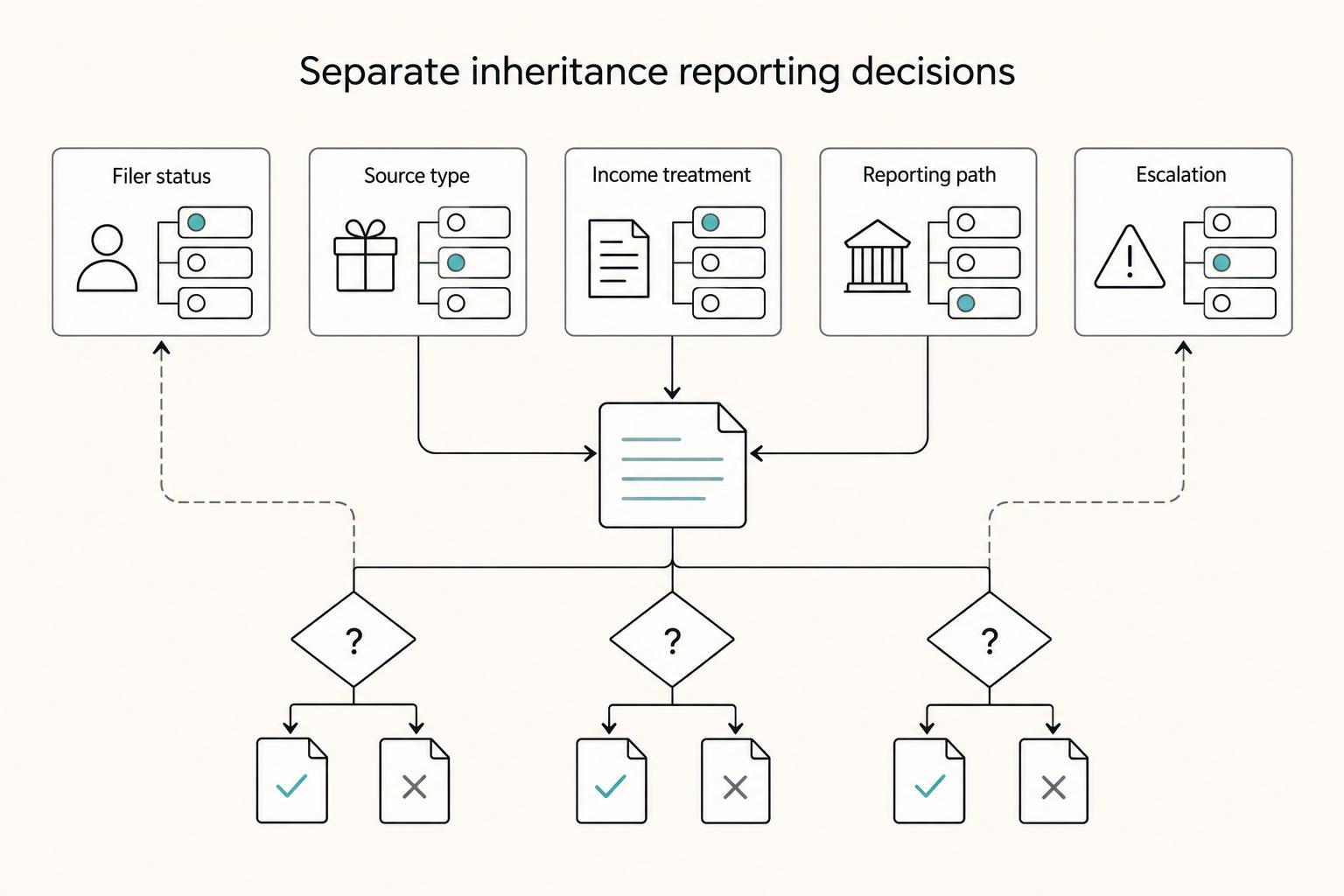
Start by separating three decisions before you touch any forms: whether a foreign transfer is treated as a gift or bequest that is excluded from gross income, whether Form 3520 reporting may apply, and when the facts are uncertain enough to require a qualified tax professional. The goal is documented judgment, not guesswork.
This article is for U.S. persons receiving a foreign gift or bequest. It focuses on U.S. federal treatment and reporting. Keep state and non-U.S. issues on a separate track so they do not blur your federal filing decisions.
Before You Start#
Build a one-page fact record before choosing a filing path. It should be simple enough to review in two minutes and detailed enough to support each filing choice:
- Confirm your filer status. Record whether you are a U.S. person for the year received. If status changed during the year, note the effective dates so your analysis stays tied to the correct tax year.
- Identify the source type. Determine whether the transfer came from a nonresident alien individual, foreign estate, foreign corporation, or foreign partnership, and make sure your records line up. If your bank memo text conflicts with legal documents, flag the discrepancy and reconcile it before filing.
- Separate income treatment from reporting. A foreign gift or bequest can be excluded from gross income, but reporting may still apply.
Form 3520includes reporting for certain foreign trust transactions and receipt of certain large gifts or bequests from certain foreign persons; reviewPart IVfor the gift or bequest lane. - Set deadline and escalation triggers early.
Form 3520is due by the 15th day of the fourth month after your tax year ends, generally April 15 for individuals. Late, incomplete, or incorrect filing may trigger section6039F(c)penalties if reasonable cause is not shown. Escalate when source classification is unclear, trust facts are incomplete, or records conflict.
Start with the core rule and its limits#
For a U.S. person, a foreign gift or bequest is generally excluded from gross income when it is treated as a gift or bequest, but that does not end the filing analysis. IRS information reporting can still apply. This article is U.S. federal only, so work through the core decision in order and avoid preventable filing errors.
- Step 1. Confirm your federal status. Verify that you were a U.S. person for the year received, since that controls the reporting path. The IRS definition includes a U.S. citizen or resident, with other entity types covered in broader rules.
- Step 2. Classify the transfer correctly. Confirm whether you received a foreign gift or bequest from a non-U.S. person, or a distribution from a foreign trust. The forms split here, so your transfer records, sender identity, and estate paperwork should align before you file.
- Step 3. Separate income treatment from reporting. Even when receipt is excluded from gross income, reporting may still be required if the applicable threshold is exceeded. When testing that threshold, aggregate gifts from related parties. Foreign trust distributions are reportable on Form 3520, Part III. Form 3520 is due by the 15th day of the fourth month after your tax year ends, generally April 15 for individuals.
- Step 4. Keep scope limits in view. This guide does not resolve state-level taxes or non-U.S. inheritance rules. Separately, IRS guidance for nonresident noncitizen estates describes estate tax as a tax on transfer of U.S.-situated property, and Form 706-NA filing can apply for certain estates above the $60,000 threshold.
- Step 5. Escalate when facts are unclear. If classification is uncertain, related-party aggregation is incomplete, or trust language is ambiguous, get professional review before filing. Missing information reporting can trigger significant penalties and may extend the tax assessment period.
After this check, write a short memo for your file: what lane you chose, what documents support it, and which items still need confirmation. That reduces rework when you prepare the return or answer follow-up questions later.
Gather your inheritance evidence pack before you file#
Build your evidence pack before you draft Form 3520. That usually cuts down on date, classification, and amount mismatches later.
| Record | What to keep | Filing use |
|---|---|---|
| Donor or decedent identity records | Identity records for the donor or decedent | Support source classification |
| Transfer records | Transfer records and related confirmations | Tie each reported amount back to a record |
| Estate letters | Estate letters and related correspondence | Support estate-source classification |
| Account statements | Statements that show receipt | Use for dry-run tracing and tie-out |
| English versions and U.S.-dollar conversion notes | English versions of originals and one conversion note for each non-USD amount | Form 3520 information must be in English and amounts must be in U.S. dollars |
| Separate trust packet | A separate packet for each trust | A separate Form 3520 is required for each foreign trust |
| Timeline file | Receipt date, amount, currency, U.S. dollar amount, source type, jurisdiction note, and document ID | Use it as the tie-out so totals match account records |
If your file is scattered across email threads, account downloads, and translated documents, stop and consolidate it first. Form prep usually goes faster when the evidence is indexed before numbers are entered.
- Step 1. Build a master packet first. Collect donor or decedent identity records, transfer records, estate letters, and account statements that show receipt. Add a simple index with document name, date, and source so each reported amount ties back to a record.
- Step 2. Separate records by source type. Keep distinct folders for each source type involved in your file, and do not mix them just because funds landed in the same account. This reduces classification errors during filing.
- Step 3. Normalize format before filing starts. Form 3520 information must be in English and amounts must be in U.S. dollars. Keep originals with English versions, and keep one conversion note for each non-USD amount so totals reconcile.
- Step 4. Keep ownership and value support for non-cash assets. Save documents that show what you received, when you received it, and prior ownership details. This helps if the asset is later reported or sold.
- Step 5. Split trust records from direct transfer records. If foreign trust involvement appears in the documents, keep a separate packet for each trust. A separate Form 3520 is required for each foreign trust.
- Step 6. Create one timeline file. Track receipt date, amount, currency, U.S. dollar amount, source type, jurisdiction note, and document ID on one sheet. Use it as your tie-out so totals match account records.
Before filing, do one dry run: pick any amount on your draft form and trace it back to the exact record in your packet. Repeat for several line items. If tracing fails, fix the indexing now instead of filing with unresolved gaps.
If your transfer involves a nonresident noncitizen estate with U.S.-situated property, determine early whether the estate has a filing requirement, including whether Form 706-NA may be required. For transfer-certificate steps, confirm whether they apply to your case; they are not required for property administered by a U.S.-appointed, qualified, and acting executor or administrator. Related: 183-Day Rule Explained: Stop the Tax Myths Before They Cost You.
Decide whether Form 3520 applies in your case#
Make the decision once and write it down: either you report this year on Form 3520, or you document why reporting is not required. Ambiguity here usually creates rework later, so put the conclusion on paper with supporting records.
- Step 1. Confirm the reporting lane. Determine whether the transfer is a foreign gift or bequest, or a distribution from a foreign trust. If it is a foreign gift or bequest, assess Part IV of Form 3520. If it is a foreign trust distribution, use Part III.
- Step 2. Aggregate before threshold testing. Before deciding filing is not required, aggregate gifts from related parties and determine whether the applicable threshold is exceeded. Base this on your timeline and source records, not memory.
- Step 3. Check timing and filing risk now. Form 3520 is due on the 15th day of the fourth month after the end of your tax year, generally April 15 for individuals. Late, incomplete, or incorrect filing can trigger penalties under section 6039F(c) if reasonable cause is not established.
- Step 4. Verify your conclusion before filing. Run a final check for filer status, source classification, aggregation, and form-part selection. Keep a short memo showing how your records support the decision.
- Step 5. Use a conservative tie-break when status is unclear. If threshold status is uncertain, consider a conservative filing position and document your interpretation. State what is known, what is uncertain, and why you chose Part III or Part IV.
A practical quality check is to ask a second reviewer to read only your memo and timeline, then state your filing lane back to you. If they cannot do that cleanly, tighten the documentation before you submit.
Classify the payer correctly to avoid the wrong filing path#
Classify the payer before you finalize Form 3520. If you get the source wrong, you get the filing path wrong. Start with legal identity documents and estate or entity records, then verify the transfer data.
| Payer classification | What it changes for your filing path | Practical check before you file |
|---|---|---|
| Nonresident alien individual | Can keep the transfer in the "certain foreign gift or bequest" analysis under Form 3520 | Confirm legal identity records and transfer records point to the same individual |
| Foreign estate | Can keep focus on gift or bequest reporting under Form 3520 and may add estate-side review | Reconcile estate letters and executor details, then check whether U.S.-situated assets exceeded $60,000 for Form 706-NA context |
| Foreign corporation | May require additional source review before Form 3520 treatment is finalized | Match entity records to the sender and account origin |
| Foreign partnership | May require the same additional source review when records conflict | Match partnership records to payment origin and transfer documentation |
When documents conflict, use this sequence:
- Identify the legal payer from primary documents first, not bank memo text.
- Reconcile the legal payer name, sending account origin, and transfer narrative across records.
- If facts indicate a foreign estate of a nonresident noncitizen decedent, check whether U.S.-situated assets exceeded
$60,000at death forForm 706-NA, note that this threshold is not indexed for inflation, and review whether an applicable estate tax treaty changes treatment. - If evidence points to more than one payer type, do not force a favorable label. Use a conservative position and document what is known versus uncertain.
When payer classification remains unresolved close to the deadline, escalate instead of improvising labels. Prioritize a supportable classification.
Handle foreign trust inheritances without guessing#
An avoidable error here is combining trust distributions and direct bequests into one narrative. Decide the legal source first, then keep your records and form logic on the same track.
Write one source statement for each transfer using primary documents, not payment labels. Then test the fact pattern against current Form 3520 instructions before you draft.
| Transfer fact pattern | Start your Form 3520 review |
|---|---|
| You received, directly or indirectly, a distribution from a foreign trust | Foreign trust transaction and distribution reporting path |
| You received certain large gifts or bequests from certain foreign persons | Foreign gift or bequest reporting path |
If your records are not filing-ready, stop and fix the file before submission:
- Ensure key documents are complete and internally consistent.
- Convert information to English and U.S. dollars.
- Keep each trust in a separate packet. If more than one foreign trust is involved, file a separate
Form 3520for each trust. - Do not blend trust and direct-bequest records just because funds landed in the same account.
One operational rule keeps this clean: each transfer should be explainable in one paragraph with matching document IDs. If you cannot write that paragraph without contradictions, you are not ready to file.
Separate non-taxable receipt from later taxable income#
Treat this as two tracks from day one: the receipt itself and what happens after receipt. That keeps the initial exclusion from being stretched to later account activity.
Open two ledgers when assets arrive: a receipt ledger and a post-receipt activity ledger. That simple split helps prevent later confusion about what was inherited versus what was generated afterward.
- Step 1. Record the receipt event as its own fact. Document date, payer, amount, and legal source. IRS guidance says a foreign gift or bequest is treated by the recipient as excluded from gross income, but reporting may still apply. If it is a foreign trust distribution, use the Part III track of
Form 3520; if it is a direct foreign gift or bequest, test Part IV applicability. - Step 2. Separate principal from post-receipt activity immediately. Start a ledger the day after receipt so later activity is not mixed into principal.
| Scenario | How to handle it in your file |
|---|---|
| Inherited cash remains parked with no new credits | Keep it tied to the original receipt record and confirm no post-receipt entries were missed |
| Inherited funds or assets later generate new account activity | Log each item by date as post-receipt activity and route it to annual return review |
- Step 3. Check
Form 3520triggers before filing season closes. For the direct gift or bequest path, reporting applies only if the applicable threshold is exceeded, and gifts from related parties must be aggregated. Keep Part III and Part IV separated so the filing path matches the legal source. - Step 4. Keep annual compliance evidence current. Maintain valuation, transfer, and date-stamped account records to support return positions year over year. Put
Form 3520on your annual calendar for the 15th day of the fourth month after tax year end, generally April 15 for individuals, because late, incomplete, or incorrect filing can trigger penalties under section6039F(c)when reasonable cause is not established.
If post-receipt activity is heavy, schedule periodic tie-outs instead of waiting for year-end. The longer you wait, the harder it is to separate inherited principal from later account movement, and that can turn a one-time receipt event into repeat annual review work unless you rebuild the file each year.
Check related reporting after funds land in your accounts#
Once you settle the inheritance classification, run account reporting as a separate pass. Form 8938 and FBAR are related but not interchangeable, so decide each obligation independently and document each decision.
| Form | When to test | Key note |
|---|---|---|
| Form 3520 | When the transfer is a foreign gift or bequest, or a distribution from a foreign trust | Use Part IV for reportable foreign gifts or bequests and Part III for foreign trust distributions |
| Form 8938 | If you are a specified person and total specified foreign financial assets exceed the applicable threshold | Attach it to the annual income tax return; if no income tax return is required, Form 8938 is not required |
| FBAR (FinCEN Form 114) | Run an independent check after inheritance classification is settled | Form 8938 coverage does not remove a separate FBAR obligation when otherwise required |
- Step 1. Confirm inheritance classification first. Finish the inheritance-side analysis before testing account-based forms. This keeps source-of-transfer issues separate from what you hold after receipt.
- Step 2. Test
Form 8938for the tax year.Form 8938applies only if you are a specified person and your total specified foreign financial assets exceed the applicable threshold. Thresholds are not universal: higher thresholds can apply to joint filers and taxpayers who reside abroad. Document which threshold framework you used, and keep asset-value support with year-end records. - Step 3. Run an independent
FBAR(FinCEN Form 114) check. Do not assumeForm 8938coverage is enough. FilingForm 8938does not remove a separate FinCEN Form 114 obligation when otherwise required. - Step 4. Finalize filing mechanics during return prep.
Form 8938must be attached to the annual income tax return, and if no income tax return is required for the year,Form 8938is not required. Also confirm account type before filing, because certain accounts are excluded fromForm 8938reporting, including certain accounts maintained by a U.S. payer or certain U.S. branches.
For quality control, keep one short worksheet that records each form decision, the threshold logic used, and where supporting records are stored. That worksheet makes later review faster and helps avoid contradictory filing positions.
Address cross-border gray areas early#
Treat cross-border ambiguity as a pre-filing gate, not cleanup work. With a foreign inheritance, unresolved U.S.-side tax questions, non-U.S. tax issues in the decedent's home country, and transfer logistics into the United States can all change your filing posture.
Do not wait until final return prep to deal with overlap. Resolve characterization and jurisdiction questions while there is still time to correct records.
- Step 1. Map jurisdictions before deciding DIY versus escalation. Build a one-page map with three lanes: U.S. tax scope, the decedent's home-country tax treatment, and transfer-to-U.S. logistics. Keep it document-based. If you are a U.S. citizen, foreign residence alone does not remove U.S. tax scope, so keep U.S. analysis in play while you assess non-U.S. issues separately.
- Step 2. Use an escalation matrix early. Choose advisor depth based on ambiguity, not stress.
| Situation | Escalation level | Why |
|---|---|---|
| One jurisdiction appears to control, records are complete, no conflicting characterization | DIY with documented assumptions | Efficient when ambiguity is low |
| U.S. position seems clear, but non-U.S. treatment or transfer steps are still uncertain | CPA with cross-border filing experience | Technical review before filing positions harden |
| Two jurisdictions could plausibly tax or characterize the transfer differently, or U.S. transfer logistics are unclear | CPA plus cross-border legal counsel | Legal characterization or transfer mechanics may change filings |
- Step 3. Apply a hard rule when overlap is plausible. If two jurisdictions could plausibly tax or characterize the transfer differently, get written advice before filing. Ask for written assumptions, characterization, and filing impact rather than relying on verbal guidance.
- Step 4. Keep a memo-to-file. Maintain a dated memo that records assumptions, materials reviewed, open risks, and next actions. Include transfer-to-U.S. logistics as a separate risk line, and pause filing if your U.S. path looks clean but foreign-side issues remain unresolved.
A useful discipline is to update this memo whenever facts change. That creates a clean timeline of why a filing position was chosen and when open issues were resolved, and it helps avoid late-stage rework when cross-border uncertainty stays open.
Fix late or incorrect filings and document reasonable cause#
If you have a Form 3520 issue, fix it quickly and document your basis. Late, incomplete, or incorrect reporting can trigger section 6039F(c) penalties if reasonable cause is not established, so treat correction work like a controlled rebuild rather than a patch.
| Item | What it covers | Why keep it |
|---|---|---|
| Dated timeline | Original due date to correction date | Supports the reasonable-cause explanation |
| Original filing and corrected Form 3520 copies | Original filing and corrected filing | Shows what was corrected |
| Change log | Each correction mapped to source records | Connects the correction to underlying records |
| Threshold and related-party aggregation workpapers | Threshold testing and aggregation analysis | Supports the reporting-duty conclusion |
| Transfer and account records | Records used for the correction | Tie the correction back to source documents |
| Translation and U.S.-dollar conversion support | Support for non-English or non-USD items | Supports the completeness check |
- Step 1. Reconfirm filing duty and define the error scope. Confirm whether reporting was required at all. Reporting applies only if the applicable threshold is exceeded, and gifts from related parties must be aggregated. Then classify the defect as late, incomplete, or incorrect, and log the tax year plus each field or attachment issue.
- Step 2. Rebuild Form 3520 on the correct path from source records. Prepare the correction from underlying documents, not memory. Use Part IV for reportable foreign gifts or bequests when applicable, and Part III for foreign trust distributions. Run a completeness check before filing: all information in English and all amounts in U.S. dollars.
- Step 3. Attach a clear reasonable-cause explanation and preserve proof. State what happened, when you identified it, what you corrected, and what you changed to reduce recurrence. Keep the explanation factual, dated, and consistent with your records. Treat IRS process-unit writeups as nonbinding guidance, not legal authority.
Reasonable-cause documentation checklist:
- Dated timeline from original due date to correction date.
- Original filing and corrected Form 3520 copies.
- Change log mapping each correction to source records.
- Threshold and related-party aggregation workpapers.
- Transfer and account records used for the correction.
- Translation and U.S.-dollar conversion support where applicable.
- Step 4. Install prevention controls before the next cycle. Set an annual filing calendar keyed to the Form 3520 due date, the 15th day of the fourth month following the end of your income tax year, generally April 15 for individuals. Add a second-person review focused on threshold aggregation, Part III versus Part IV classification, and final tie-out to source records. If any check fails, pause and correct before submission.
Before you close the correction file, confirm that your preventive checks were actually implemented. A documented control that is never gets used will not prevent a repeat error.
Build your annual compliance calendar and retention system#
After any correction cycle, keep the next year under control by running one annual close across recordkeeping, FBAR tracking, and Form 8938 decisions.
Consistency matters more than complexity here. A lean calendar and clear retention rules beat an elaborate process that is hard to maintain.
- Step 1. Build one close map for all three tracks. At the start of the tax year, define three checkpoints: core records, FBAR review, and Form 8938 review. Assign an owner and a required evidence package for each checkpoint so nothing closes without documentation.
- Step 2. Do the Form 8938 decision before drafting the return. Form 8938 is used to report specified foreign financial assets when total value is above the applicable threshold, and it must be attached to the annual income tax return. If you are not required to file an income tax return for the year, you do not file Form 8938. A common baseline reference is aggregate value exceeding $50,000, with higher thresholds for joint filers and taxpayers residing abroad; specified domestic entities use $50,000 at year-end or $75,000 at any time during the year.
- Step 3. Standardize retention with one folder structure and one naming rule. Keep one yearly folder tree for supporting records, forms, confirmations, and IRS or FinCEN correspondence so evidence is easy to retrieve. Use sortable filenames, for example
YYYY-MM-DD_document-source_amount_currency, and keep the same pattern across records. - Step 4. Hold one reconciliation day each quarter. Use one fixed day per quarter to roll forward balances, account changes, and major transfers. This keeps year-end review manageable and helps you spot changes that may affect Form 8938 analysis or separate FBAR obligations.
- Step 5. Save filing proof and close the year only when all tracks tie out. After filing, store final submitted copies, acceptance confirmations, and follow-up messages in the same year folder. Treat Form 8938 and FBAR as separate obligations when FBAR is otherwise required. If you use Gruv where supported, include audit-ready exports and traceable transaction history in the same evidence set.
If any checkpoint is incomplete, reopen the file and finish the tie-out before marking the year closed. Closing early may save time now, but it usually creates avoidable cleanup later.
Final checklist and next step#
Do not file until each item below is complete and consistent across your records and forms.
- Confirm your filer profile and core facts. Confirm your filing status for this return year and the key facts in your transfer documents. If anything is unclear, pause and escalate before filing.
- Assemble your inheritance evidence pack before form prep. Keep identity records, transfer records, estate or trust correspondence, account statements, and a dated timeline in one place. This helps prevent mismatched dates or amounts when you complete filings.
- Handle non-
Form 8938filings as separate decisions. Do not assume this section resolves filing obligations for other forms or trust-related reporting. Confirm any additional requirements directly from current IRS instructions and your facts. - Check account-based reporting separately for
FBARandForm 8938. ForForm 8938, file only if your specified foreign financial assets exceed the applicable threshold and you are required to file an income tax return. Attach it to your annual return by that return's due date, including extensions. FilingForm 8938does not replace a separate FBAR filing requirement when FBAR otherwise applies. - Do a final tie-out before submission. Match form entries to source records. For
Form 8938, confirm maximum account values and whether foreign assets were acquired or sold during the year. - Preserve proof and set reminders. Save filed copies, submission confirmations, and related correspondence with your evidence pack. Keep a short memo-to-file on assumptions and judgment calls, then set reminders ahead of next year's filing cycle.
If any checklist item is still open, close and document it before you submit. For a concrete next step, Browse Gruv tools.
Frequently Asked Questions
Do I pay U.S. tax just for receiving a foreign inheritance?
Generally, no. A foreign gift or bequest treated as a gift or bequest is generally excluded from gross income, but reporting can still apply. If your facts are not clearly covered, discuss them with a tax practitioner.
When do I need to file `Form 3520` for a foreign bequest?
It depends on the facts. First determine whether the transfer is a direct foreign gift or bequest or a foreign trust distribution, then review the correct part of Form 3520. Before deciding no filing is required, aggregate gifts from related parties and use current IRS instructions with your records.
Is `Form 3520` a tax return or an information return?
The article does not rely on a shorthand label for Form 3520. Use current IRS instructions for how it should be treated in your situation, and keep your documentation consistent with that treatment.
What changes if the inheritance comes through a `foreign trust`?
The filing path can change if the inheritance is a foreign trust distribution rather than a direct bequest. Gather trust and distribution records first, keep each trust in a separate packet, and use Part III of Form 3520 for foreign trust distributions. If the documents are unclear, get professional review before filing.
What happens if I file `Form 3520` late?
Address it promptly. Late, incomplete, or incorrect Form 3520 filing can trigger section 6039F(c) penalties if reasonable cause is not established. Rebuild the form from source records, attach a factual reasonable-cause explanation, and keep a dated timeline and correction workpapers.
Do inherited foreign accounts trigger `FBAR` or `Form 8938`?
They can, and each test is separate. Form 8938 applies only if you are a specified person, your total specified foreign financial assets exceed the applicable threshold, and you are required to file an income tax return. Filing Form 8938 does not remove a separate FBAR obligation when FBAR otherwise applies.
Are `state-level taxes` relevant even if federal tax on receipt is generally not due?
Yes, potentially. The article covers U.S. federal treatment only, so state treatment should be reviewed separately. That matters especially if residency or jurisdiction changed during the year.
Try a related tool
Researched and edited by the Gruv editorial team. Gruv builds cross-border billing, payouts, and finance-operations software for global businesses.
Sources
Educational content only. Not legal, tax, or financial advice.
Related Posts

Digital Nomad Taxes in 2026 With a Defensible Filing Plan
With digital nomad taxes, the first move is not optimization. It is figuring out where you may be taxable, where filings may be required, and what proof supports that position.

183-Day Rule Tax Myths That Trigger Residency Filing Mistakes
If you are a mobile freelancer or consultant, start here: the "183 day rule tax" idea is not a single universal test. It is a shortcut phrase people use for different residency rules that do not ask the same question. If you mix federal and non-federal residency logic, you can create filing risk even when your travel calendar looks clean.
A Guide to House Sitting for Free Accommodation
**Treat house sitting as a controlled exchange with timelines, written scope, and fallback housing, and you can use it as "free accommodation" with a lot less gambling.** If you came here for cheaper, simpler housing, this is the operating standard. This works when you run it like a professional move, not a last-minute hack you grabbed from Reddit or r/digitalnomad.