

Quick Answer
Start by separating income into employee wages and self-employment earnings, then calculate side hustle taxes from that structure. Use Schedule SE inputs for contractor activity, keep monthly records tied to invoices and receipts, and run quarterly estimated-payment checkpoints instead of waiting for year end. For globally mobile work, test Form 8938 and FBAR independently and document your residency timeline before filing.
Introduction for globally mobile side hustle taxes#
If you want less stress at filing time, use sequence instead of shortcuts. When one year includes payroll income, contractor income, and time in more than one country, the order of operations matters. This guide gives you a defensible path so you can make each decision once, document it, and avoid rebuilding the return later.
The point is not to memorize every rule up front. It is to settle the facts in an order that keeps later choices from colliding.
Start with the U.S. baseline before you calculate anything. The Internal Revenue Service (IRS) defines self-employment tax as Social Security and Medicare tax for people who work for themselves. Schedule SE (Form 1040) is used to calculate tax due on net self-employment earnings. It does more than produce a current-year number: Schedule SE data also feeds Social Security benefit calculations, and it can apply even if you already receive Social Security or Medicare.
The sequence is simple: classify the income first, decide residency exposure second, set up quarterly payments third, then keep proof for each choice. Use that order from day one, and update the file as your facts change:
- Map your tax footprint. List where you lived and where you physically worked. Verification checkpoint: if any month has mixed-country facts, flag it now instead of guessing later.
- Anchor your U.S. filing base. Separate employee income and self-employment earnings into distinct lines. Red flag: putting all gig work in one bucket creates rework when Schedule SE inputs are prepared.
- Build a minimum evidence set. Keep contracts, invoices, statements, receipts, prior returns, and filing confirmations in one organized file. If residency changes midyear, keep dated notes that explain why treatment changed.
It sounds basic, but it prevents avoidable rework. It keeps you from doing tax math on income that is not classified yet, and it keeps cross-border reporting from getting mixed into the wrong part of the process.
For globally mobile readers, one detail is easy to miss: the 2025 Schedule SE instructions include sections for U.S. citizens or resident aliens living outside the United States and for nonresident aliens. As of 20-FEB-2026, the IRS also posted a correction to those 2025 instructions, so checking the latest instruction version is basic filing hygiene, not a last-day task.
By the end, you should have a clear decision path, a document trail you can defend, and specific points where professional help is worth it. If banking setup is also part of your picture, this background on The Banking Challenge: Why It's Hard to Bank a Cayman or BVI Company may help.
What to prepare before you make any tax move#
Prep first, math second. Clean inputs make later decisions simpler, and they make your filing position easier to defend if questions come up later.
| Prep task | What to capture | Key detail |
|---|---|---|
| Map income by treatment, not by platform | Split 1099 income, employee payroll income (with withholding), and independent contractor income into separate lines | If tax was not withheld, flag it for estimated-tax review |
| Build a starter record set now | Keep contracts, invoices, bank statements, receipts, and prior return files together | Match deposits to invoices or contracts and expenses to receipts |
| Create a jurisdiction snapshot with dates | Track where you lived, where you physically worked, where clients paid from, and where accounts are held in a month-by-month timeline | Include start and end dates whenever the answer changed during the year |
| Set your operating calendar before deadlines | Schedule monthly bookkeeping, quarterly estimated-tax payment checkpoints where applicable, and year-end return prep | Add a recurring check for net self-employment earnings of $400 or more from gig work |
The first shift is to organize the year by tax treatment, not by app, client, or platform. A platform tells you how money moved; filing turns on whether the amount was payroll with withholding, contractor income without withholding, or something that still needs review.
Before you touch a calculator, make sure each income line, expense line, and location fact has a place in your records. You are building the file you will rely on later for classification, residency calls, and estimated payments.
- Map income by treatment, not by platform.
Split 1099 income, employee payroll income (with withholding), and independent contractor income into separate lines. For each line, confirm whether tax was withheld; if not, flag it for estimated-tax review. Note withholding clearly, because it changes how you think about quarterly payments.
- Build a starter record set now.
Keep contracts, invoices, bank statements, receipts, and prior return files together. Match deposits to invoices or contracts and expenses to receipts so the file is usable at return time, not just stored. A good starter file answers two basic questions quickly: what the money was for, and where the support sits.
- Create a jurisdiction snapshot with dates.
Track where you lived, where you physically worked, where clients paid from, and where accounts are held in a month-by-month timeline. That works better than an annual summary when residency changes midyear. Include start and end dates whenever the answer changed during the year. If California is part of your facts, treat it as California-specific: part-year residents may be taxed on worldwide income while resident and on California-source income while nonresident; nonresidents are taxed on taxable California-source income.
- Set your operating calendar before deadlines.
Schedule monthly bookkeeping, quarterly estimated-tax payment checkpoints where applicable, and year-end return prep. Add a recurring check for the IRS filing trigger: net self-employment earnings of $400 or more from gig work. The calendar turns taxes from a memory problem into a routine.
If any income line mixes employee and contractor treatment, escalate early. Sorting that out after deadlines is slower, riskier, and usually more expensive. The earlier you separate mixed treatment, the less cleanup you leave for filing season. Once this prep is done, Step 1 becomes classification instead of reconstruction.
Step 1 classify your income before you calculate tax#
Classification comes before calculation for a reason. Once each payment has a clear tax label, Schedule SE treatment becomes much easier to trace. Skip this step and you usually end up reworking the books under deadline.
Uncertain is a valid temporary label if the facts are not settled yet. Trouble starts when you force uncertain items into the wrong bucket and forget why.
Use a separate line for each payment type before you run any tax math:
- Label each payment as contractor, payroll, or uncertain. Do not combine payroll and contractor amounts in one ledger line, even if they came from the same client or platform. Keep the uncertain bucket narrow and revisit it promptly.
- Keep hobby and business activity separate in your records. Add a short, dated note so the treatment stays consistent when you revisit it later. One clear sentence is enough if it explains the basis for your choice.
- Map self-employment lines to Schedule SE inputs. Schedule SE is used to figure tax due on net earnings from self-employment, so this mapping should be easy to follow. If you cannot point from the ledger line to the return input, the classification needs more work.
- Escalate unclear classification early. Resolve uncertainty before filing pressure starts, when you still have time to document the reason for the choice.
By the time you finish this step, you should know which lines feed Schedule SE, which do not, and which still need review. That matters beyond the current return. The Social Security Administration uses Schedule SE information to figure benefits, so consistency matters. Validate your approach against current-year IRS materials and any posted correction, and treat older forms such as 2018 as historical only. Once the income is classified, the next question is where that activity sits for residency and reporting purposes.
If you are still building the client side of the work, How to Find Your First Freelance Client covers that part.
Step 2 decide your residency risk level and cross-border exposure#
Once the income lines are clean, decide where they sit for filing purposes. Residency exposure controls which cross-border checks you run. If the facts point in different directions across countries, use the filing position you can document clearly, not the one that only looks better in the short term.
The mistake here is trying to summarize the whole year with one address and one story. A period-based record is stronger, especially when the year changed shape.
Start with a country-by-country exposure table. Your month-by-month timeline from prep work should feed it, and the table should show when a change happened, not just that it happened.
| Area to log | What to capture | Why it matters |
|---|---|---|
| Residence signals | Where you lived during each period | Supports your residency position, especially if facts shift midyear |
| Income source | Which country paid you and for what work | Connects payer and activity details to jurisdictional exposure |
| Account and reporting touchpoints | Where financial accounts are held and controlled | Triggers separate checks for Form 8938 and FBAR |
That table should line up with your contracts, account records, and dated notes as closely as your file allows. The goal is not a perfect story. It is a supportable one.
The foreign-asset review is where people often collapse separate rules into one. Do not do that. Form 8938 is attached to your tax return, while FBAR is FinCEN Form 114 and is not filed with the IRS. Filing Form 8938 does not replace FBAR, so your answer may be Form 8938 only, FBAR only, both, or neither. Do not let the existence of one filing lull you into skipping the other check.
Use this order:
- Test Form 8938 status. Confirm you are a specified person, then apply the threshold set for your filing context. One cited threshold is aggregate value exceeding $50,000 for certain taxpayers, and higher thresholds can apply for joint filers or taxpayers residing abroad. Write down the threshold you tested, not just the conclusion.
- Test FBAR status separately. Do not assume the Form 8938 trigger logic is the same, or that one filing covers the other. A separate test keeps you from collapsing two questions into one answer.
- Confirm return dependency. If no income tax return is required for the year, Form 8938 is not required. Check that gate before you spend time drafting the form.
- Split midyear positions. If residency changed during the year, split your timeline and add a dated note explaining why treatment changed. A short dated note is better than a vague year-end explanation.
A common failure mode is flattening the whole year into one annual narrative. Keep period-based evidence, split midyear positions when facts changed, and resolve mixed-fact months before filing week. Good residency work is less about a perfect narrative and more about dated support that matches the periods on your return. With residency risk mapped, the next control is cash management through estimated payments.
Step 3 set up quarterly payments so you do not fall behind#
Quarterly payments are mostly a cash-discipline problem. If you wait until the annual return to think about them, the math may still be fixable, but the cash may already be committed elsewhere.
The IRS treats self-employed tax obligations, quarterly payments, and annual return filing as related but separate items. Focusing only on the return can hide an underpayment problem until late in the year. Mixed wage and contractor years need extra checking because withholding on one side can make the other side easy to ignore.
Run this checkpoint sequence each quarter:
- Assume exposure, then verify exceptions. Start from "estimated payments may apply," then confirm the exact treatment when your situation is not straightforward. Starting from exposure is a better control than assuming you are exempt.
- Tie payment prep to monthly close. Finalize income, log deductible expenses, and refresh your year-to-date estimate at month end so the quarterly review is based on current records, not memory.
- Verify before submitting. Confirm income is booked, deductions are logged, and calculation inputs match your records. If an input changed, update the note so the file shows why.
- Submit and archive proof. Store the payment confirmation with the quarter's calculation summary and assumptions. The confirmation should live next to the calculation, not in a separate inbox.
Use one simple control to keep this honest: a quarter is not complete until the checkpoint note and the payment confirmation are on file. That small rule catches a lot of drift.
Red flag: waiting until annual return prep and discovering underpayment after cash is already committed elsewhere. If you find a gap, escalate early and review installment-agreement and taxpayer-rights options before the problem compounds. Once payments are under control, build the evidence pack that supports the numbers behind them.
Step 4 build an evidence pack that survives an audit#
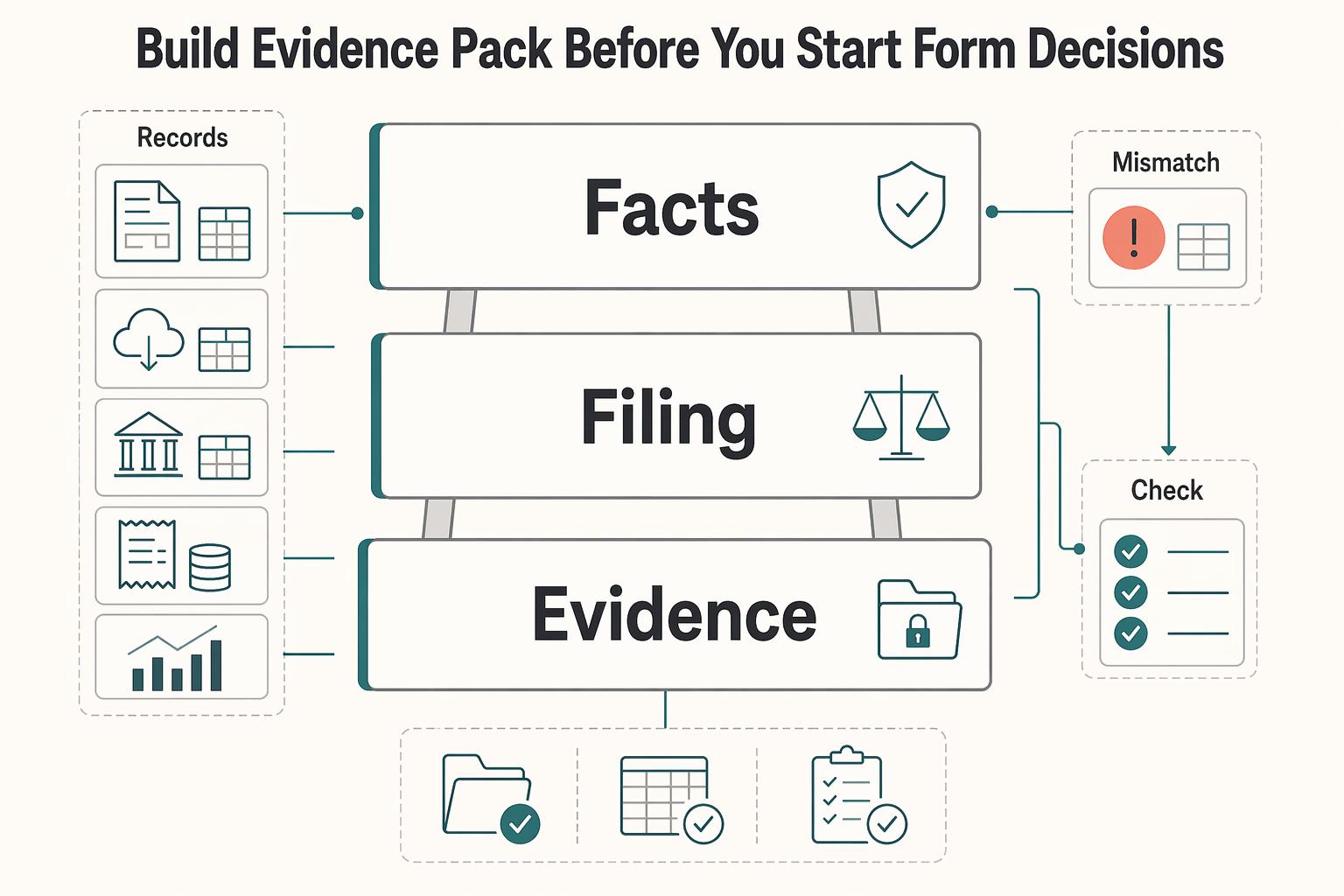
If a number cannot be rebuilt from documents in a few minutes, the file is not ready. The goal here is to make every number tied to self-employment tax reproducible from the records without a long search.
| Evidence task | What to keep | Threshold or note |
|---|---|---|
| Export and reconcile income records | Match platform and payment-tool exports to your ledger so every deposit has a payer, date, amount, and support file | Do not leave unmatched deposits hanging into the next month |
| Tag deductible expenses at entry time | Store the receipt, payment proof, and purpose note together | Writing the note at entry time is easier than trying to recreate the purpose months later |
| Maintain a Schedule SE support sheet | Keep a running record of net self-employment earnings that feed your return inputs | Preserve a clear bridge from gross activity to the numbers that hit the return |
| Flag filing thresholds in your notes | If Schedule SE line 4c reaches $400, mark the filing trigger; if church employee income reaches $108.28, track that rule separately | This makes the trigger visible before year-end |
| Archive the instruction version used | Keep the current-year Schedule SE instructions with your file, including the correction notice posted on 20-FEB-2026 | Save the version you actually relied on |
When records are thin, you waste time hunting for support and then make avoidable judgment calls. A tight evidence pack prevents both. That means linking each deposit to an invoice, contract, or payout detail, and linking each expense to a receipt plus a one-line business-purpose note. Keep clear folders for side income, deductions, residency evidence, and filing confirmations so review is fast, especially if your facts changed during the year. The note does not need to be elaborate, but it should be specific enough that someone else can follow it.
A simple monthly routine works better than a heroic year-end cleanup:
- Export and reconcile income records. Match platform and payment-tool exports to your ledger so every deposit has a payer, date, amount, and support file. Do not leave unmatched deposits hanging into the next month.
- Tag deductible expenses at entry time. Store the receipt, payment proof, and purpose note together so the reason for the expense is not lost later. Writing the note at entry time is easier than trying to recreate the purpose months later.
- Maintain a Schedule SE support sheet. Keep a running record of net self-employment earnings that feed your return inputs. The point is to preserve a clear bridge from gross activity to the numbers that hit the return.
- Flag filing thresholds in your notes. If Schedule SE line 4c reaches $400, mark the filing trigger; if church employee income reaches $108.28, track that rule separately. This makes the trigger visible before year-end.
- Archive the instruction version used. Keep the current-year Schedule SE instructions with your file, including the correction notice posted on 20-FEB-2026. Save the version you actually relied on.
Before filing, run one final tie-out. Confirm your support sheet matches current records and compare year-to-date self-employment earnings against the 2025 Social Security wage base ($176,100) shown in the instructions. That cross-check matters because Schedule SE reporting is also used to determine Social Security benefits.
By the time you file, the support sheet, the ledger, and the saved instructions should all tell the same story. Once the record trail can stand on its own, you can evaluate deductions without guessing. If you need help making the monthly habit stick, The Freelancer Year-End Tax Prep Checklist may help.
Step 5 claim deductions carefully when facts are gray#
Gray deductions deserve the most skepticism. When the business link is weak, claim less, not more. Deductions can lower taxable income, but they are not a dollar-for-dollar refund. Claim only the items you can defend.
Borderline expenses are where discipline matters most, because they are easy to rationalize after the fact. Use a conservative two-check rule before anything goes on your return: documentary support and narrative support. Documentary support means a receipt, or equivalent record, tied to date, amount, and payee. Narrative support means one clear sentence linking the cost to business activity. If either check fails, leave the item out.
That rule keeps you from claiming an item just because it feels related to work. It is especially useful when a charge looks partly business and partly personal. Sort first, then decide what survives:
- Sort expenses by support strength. Keep clearly business, mixed, and weak or personal items in separate buckets. The sorting step usually shows you which items need a second look.
- Attach proof at line-item level. Each claimed item should have a receipt and a business-purpose note a third party can follow. If the support only works when you explain it at length, the position may be too weak.
- Apply stricter debt-loss rules. A deductible bad debt loss requires a bona fide loan transaction. Nonbusiness bad debt is treated as a short-term capital loss, receives less favorable treatment, and partially worthless nonbusiness bad debt is not deductible for individual taxpayers.
When facts are borderline, the conservative answer is usually the right one. If the expense does not clearly tie to business income, do not claim it. If a deduction is material and the facts are cross-border, get written advice before filing and include your transaction record, contract or invoice context, business-purpose note, and proposed treatment. The goal is a return you can explain calmly, line by line, without stretching. After deductions, the remaining task is recognizing common mistakes early and fixing them without panic.
Common mistakes and how to recover without panic#
Most errors in this area get harder because people freeze, not because the issue cannot be fixed. The recovery pattern is simple: correct forward now, keep a dated record trail, and escalate early when a filing obligation is still unclear.
Recovery starts with stopping the bad process now, then cleaning up what is already behind you. Work from the current quarter outward if the older file is messy.
- Treating gig income as casual cash flow. Reclassify each income stream, rebuild records from the current quarter, and make sure each deposit ties to a contract, invoice, or payout record. If you cannot rebuild the full year immediately, start with the current quarter and document what is still missing.
- Skipping estimated payments. Estimate your current exposure, make catch-up payments, and save payment confirmations with the assumptions you used. Even a catch-up payment is better than pretending the issue will disappear at return time.
- Weak residency documentation. Build a dated evidence file and flag any uncertain periods for review instead of forcing one story across the whole year. Separate known periods from uncertain ones instead of blending them.
- Relying only on platform summaries. Reconcile platform totals against bank records and receipts, then document any differences clearly. Platform summaries help, but they are not a substitute for your own reconciliation.
- Waiting too long to get help. Escalate before filing if classification, residency, Form 8938, or FBAR treatment is still unclear. The longer uncertainty sits, the more parts of the return it can touch.
Foreign-asset reporting deserves its own warning because many people treat two separate tests as one. Form 8938, when required, is attached to your annual income tax return. FBAR, or FinCEN Form 114, is filed directly with FinCEN, not with the IRS. Depending on your facts, you may need one, the other, both, or neither. Do not file one and assume the job is done.
Be careful with thresholds too. A commonly cited Form 8938 trigger is aggregate specified foreign financial assets over $50,000 for certain U.S. taxpayers, with higher thresholds in other cases. Document the exact threshold test you used, and note the income tax return dependency when you apply it. A short note in the file showing the test you used is worth keeping.
Those issues usually drive the follow-up questions, so the FAQ below stays focused on the decision points that matter.
Copy and paste checklist for your next 90 days#
Use the next 90 days to turn this into a routine. The order matters: classify the income, reconcile the records, review payments, screen for foreign-asset reporting, then escalate the calls that are still unclear. If you do nothing else, follow that sequence.
- This week: classify income and set up records. Label each income stream by tax treatment, keep a support note for each decision, and open folders for income, deductions, residency evidence, and filing confirmations. Do not blend payroll and contractor receipts in the same line.
- This month: reconcile and document. Match platform statements, bank activity, and your books, resolve mismatches in writing, and attach receipts with business-purpose notes while the details are still fresh.
- This quarter: run an estimated-tax checkpoint. Review current liability, make any needed payment, and store payment confirmations with the assumptions behind the calculation. Keep the note and the confirmation together.
- Before filing: screen for Form 8938. Review filing status, residence pattern, and specified foreign asset values. Certain U.S. taxpayers are directed to report specified foreign financial assets when aggregate value exceeds $50,000, higher thresholds apply for joint filers and taxpayers who reside abroad, and for certain specified domestic entities instructions reference $50,000 at year end or $75,000 at any time. Document the threshold test you used.
- Before submission: attach and escalate. If Form 8938 is required, attach it to your income tax return; if no income tax return is required for the year, Form 8938 is not required even above the applicable threshold. Confirm FBAR (FinCEN) and Form 8938 obligations separately, and pause for written professional advice when any classification, residency, or threshold call is unclear.
If the classification, residency, or reporting call is still unresolved after this checklist, Talk to Gruv.
Frequently Asked Questions
Do I have to pay taxes on all side hustle income?
If you are paid through payment apps for goods or services, that money is taxable income and must be reported on your federal return. You may receive Form 1099-K for those transactions, but taxable income still must be reported. Treat side hustle income as reportable unless you have a clear legal exception.
When does gig work require a tax return filing?
Gig work is commonly treated as self-employment when you are an independent contractor. A widely cited trigger is $400 of self-employment income, but that figure is not universal for every filing situation. If facts are mixed, base filing decisions on your full return profile, not one number in isolation.
Do independent contractors always need estimated taxes?
Often, yes, because taxes are generally not withheld the way they are from employee wages. Many freelancers and side gig workers are required to make quarterly estimated tax payments. If withholding from another job already covers liability, confirm that with current numbers before skipping payments.
What records should I keep for side hustle taxes?
Keep clear income and expense records so your reported numbers can be traced back to dated documents. Organize invoices or payout reports, bank statements, and receipts in one place. Add short notes when a cost could appear personal.
How does hobby income differ from business income for deductions?
The IRS distinguishes profit-motivated business activity from hobbies done mainly for pleasure or recreation. No single factor decides the outcome, so facts must be reviewed as a whole. If profit intent is weak, treat deduction positions conservatively and document why.
How do tax residency and cross-border tax compliance change what I must file?
Residency can change what income is taxed and where. For example, California rules treat part-year residents differently from nonresidents, and California-source income can remain relevant even when you are not a resident. Use state and federal residency rules together, since one state example does not apply across all jurisdictions.
When should I involve a tax professional instead of handling it myself?
Get written advice when worker classification is unclear. Do the same when residency changed during the year and filing obligations are uncertain. Escalate if records cannot cleanly support your position before filing.
Try a related tool
Researched and edited by the Gruv editorial team. Gruv builds cross-border billing, payouts, and finance-operations software for global businesses.
Sources
Educational content only. Not legal, tax, or financial advice.
Related Posts
The Freelancer's Year-End Tax Prep Checklist (US Expat Edition)
Your year-end target is filing readiness. By December 31, you want a complete file for your U.S. federal return, not a last-minute chase for documents. For a globally mobile freelancer, the hard part is usually proving what happened, choosing the likely FEIE or FTC lane, and spotting the facts that need professional review.

How to Find Your First Freelance Client
For your first client, the goal is not visibility, momentum, or a full pipeline. The goal is one paid project with scope and payment timing clarified in writing. A testimonial is useful, but it is not the win. Paid work with clear terms is the win.

Why Banking a Cayman or BVI Company Gets Complicated
Treat this as a banking reliability problem first. The goal is stable banking access, not secrecy. A Cayman or BVI company can be lawful for international business, but banking access can become fragile when ownership, activity, and fund flows are not documented in one consistent record.