
Quick Answer
Separate for-cause and convenience termination, set contract-specific notice and cure rules, and define final payment and handover. If negotiating a consulting exit fee, state its trigger and calculation separately from earned fees and expenses. Send any required notice on time through the agreed channel and preserve delivery evidence; check whether the contract or applicable law requires recipient acknowledgment. Review insolvency triggers and other enforceability issues under the applicable law.
Protect Your Position When a Client Relationship Turns Risky#
Treat your consulting termination clause as an operating control, not legal filler, and you can reduce uncertainty and dispute risk when things go sideways.
Freelancers and consultants lose control when a consulting agreement starts to wobble before delivery ends. Payment slips. Scope drifts. Trust drops. If you wait until conflict peaks, the other side controls timing, the story, and often your final invoice.
Your termination clause connects the right to end the engagement with the practical work of collecting fees, handing over deliverables and closing access.
Picture this. A client keeps asking for extra work, delays approval, and hints they may pause the project. If your termination clause stays vague, you argue about process while revenue stalls. If your clause defines termination triggers, notice, and handoff steps, you can exit more cleanly without improvising.
Use this guide as a practical decision system to build a defensible first-pass clause. It is not a substitute for legal advice, and interpretation can vary by jurisdiction. It is an execution-first framework you can redline quickly, then escalate to counsel when risk or governing-law complexity rises.
-
Identify failure modes first. List the real breakpoints in your consulting agreement, including non-payment, repeated scope breach, and other objective breakdowns. Verify: You can point to objective events, not opinions.
-
Define exit mechanics in plain language. State who can end the engagement, separate for-cause and without-cause termination, and set the Notice Period. Notice Period is the advance warning time before termination takes effect. Verify: Both parties can explain the same process in one sentence.
-
Lock payment and handover protections. Define the closeout process so payment steps and handoff expectations are clear at termination. Verify: You can close the engagement without improvising.
-
Align law and escalation rules. Choice of law clause controls how a contract gets interpreted, and contract outcomes vary by jurisdiction, including state-by-state differences in the U.S. Verify: You know when to stop redlining and send the draft to counsel.
| Decision area | Safe default | Escalate to counsel when |
|---|---|---|
| Termination triggers | Use specific, provable events | Trigger wording stays ambiguous |
| Notice mechanics | Set written notice and timing clearly | Cross-border enforcement risk appears |
| Payment closure | Define payment and handover workflow clearly | Client terms conflict with your protections |
What to Prepare Before You Draft or Redline#
Prepare evidence, obligations, and decision rules before you redline, and your consulting termination clause can help protect cash flow and reputation under pressure.
Now shift from risk spotting to execution. This prep keeps negotiation fast, and it keeps you from inventing process in the middle of a tense client call.
Before You Start#
Gather the current agreement and available project records so you can identify the terms to change. Mark missing records for follow-up rather than treating a complete file as a condition of starting the redline.
| Prepare now | Why it matters | Done when |
|---|---|---|
| Current Consulting Agreement and existing Termination Clause | You need the exact baseline before edits | You can point to current wording on notice, grounds, and exits |
| Any Mutual Termination Rights language | You need symmetry checks before negotiation | You can show who can terminate and when |
| Payment and delivery records | You need proof for Final Invoice and Approved Expenses | You can produce invoices, approvals, and delivery status quickly |
-
Step 1. Gather the controlling text. Pull your current consulting agreement, the active termination clause, and related terms that affect Mutual Termination Rights. Mark where the clause sets notice, reasons for termination, and obligations that continue after exit. Outcome: You know exactly what you are changing.
-
Step 2. Map your operating facts before negotiation. List payment cadence, dependency on this client, Work Product handover complexity, and your realistic Notice Period tolerance. Imagine the client ends the project mid-handover. Your map should tell you what notice and transition terms you can accept without operational damage. Outcome: You negotiate from operating reality, not guesswork.
-
Step 3. Prepare the notice and closeout records. Draft a notice template with the termination ground, effective date and required information. Keep invoice history, deliverable status and access tasks available, then copy the contract's actual final-invoice and payment deadlines into the checklist. For example, the 2010 Coronado consulting agreement, section 6.3 requires the company to pay qualifying completed and accepted services and expenses within 30 days after termination; it does not set a general 30-day deadline for the consultant to submit an invoice.
-
Step 4. Set payment and handover priorities. If you want an immediate non-payment exit, negotiate the remedy and any cure step explicitly. Define handover, confidentiality and ownership obligations separately from fees already earned. If you negotiate an additional exit payment, state its trigger, amount or formula and due date. Here, that is a consulting contract payment; employee severance and worker status are separate questions.
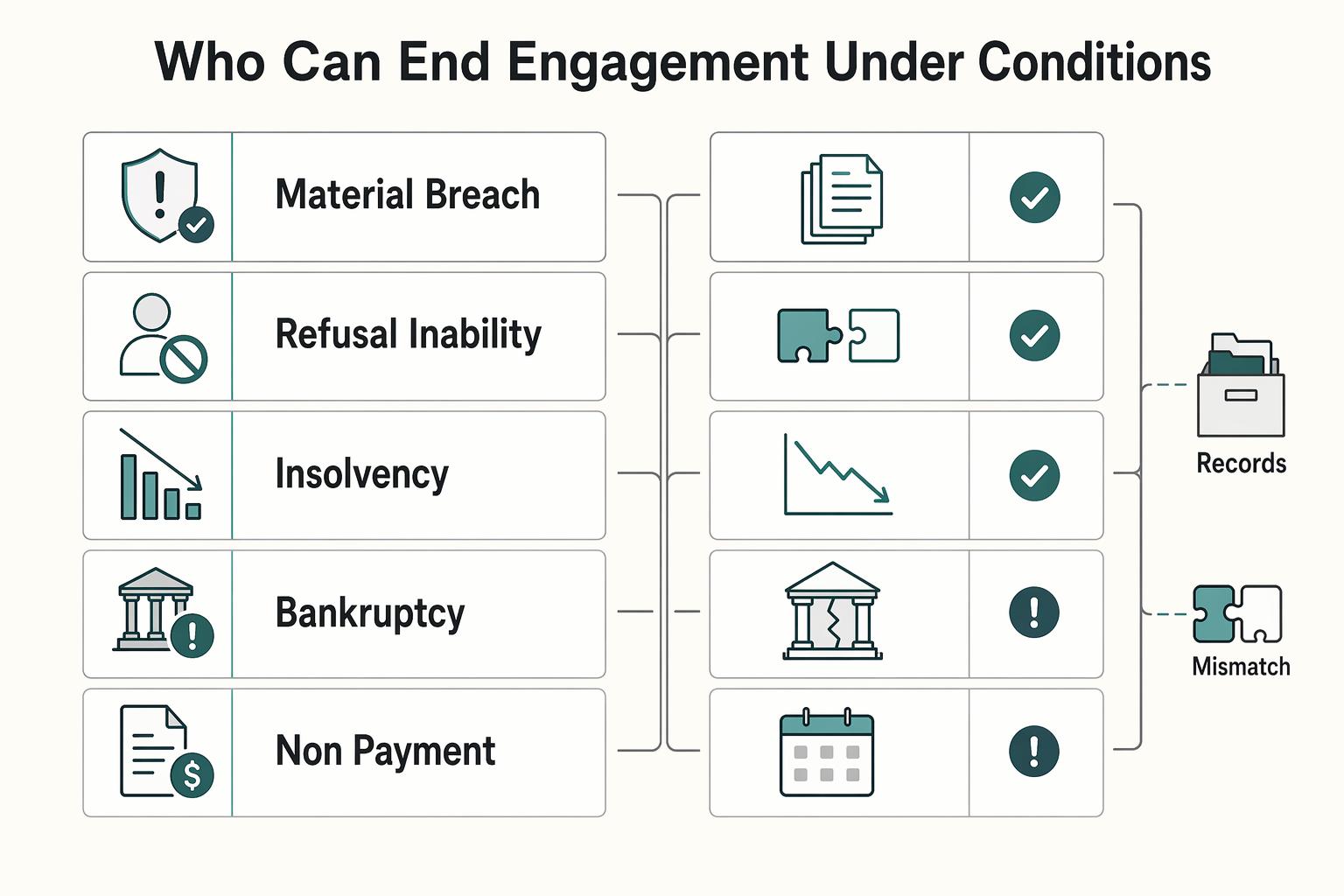
Who Can End the Engagement and Under What Conditions?#
Define who may terminate, which events qualify and which procedure applies. Specific wording gives both sides a process to follow; it does not by itself guarantee that every trigger is enforceable.
| Trigger | Clause treatment | Evidence note |
|---|---|---|
| Material Breach | Name it directly in the clause text | Support it with records you control; written breach notice should describe the alleged breach and what cure looks like |
| Refusal or Inability to Perform | Name it directly in the clause text | Support the trigger decision with records you control |
| Insolvency | Review applicable insolvency law before relying on this trigger | A financial-condition clause may be restricted even when the condition is documented |
| Bankruptcy | Check whether bankruptcy law limits termination of this contract | Do not treat case commencement as automatically permitting exit |
| Non-Payment | Include it explicitly if you want it to trigger rights | Immediate termination must be written explicitly if desired; do not assume default enforceability |
For example, U.S. Bankruptcy Code section 365(e) generally prevents termination or modification of a debtor's covered executory contract after the case begins solely because of a specified insolvency, bankruptcy or trustee/custodian clause. The section has exceptions, including specified applicable-law/non-consent and financing situations. Check whether the contract and proposed action fall within the restriction before using an insolvency trigger; this rule does not make every consulting agreement immune from termination.
- Step 1. Build a mutual rights matrix first. Map
Termination by the Consultantand client rights side by side so you can see symmetry gaps fast.
| Exit path | Termination by the Consultant | Client right | Evidence standard |
|---|---|---|---|
For-Cause Termination | End engagement when named trigger events occur and remain uncured when cure applies | Same right under Mutual Termination Rights | Written record of trigger, notice, and cure status |
Without-Cause Termination | End engagement for convenience if contract allows it | Same or negotiated equivalent right if stated | Written notice and timing compliance |
Verify: Both parties can read this table and reach the same outcome on who can terminate.
-
Step 2. Define cause and convenience with concrete triggers. Keep for-cause and without-cause paths separate. Define material breach through the obligations that matter to the engagement, and specify non-payment or refusal to perform where appropriate. If the draft includes insolvency or bankruptcy, review those triggers under the applicable law rather than assuming that naming them makes them usable. Verify: Each proposed trigger has a defined procedure and any legal restriction is accounted for.
-
Step 3. Write trigger language so you can prove it. Require written breach notice that specifies the alleged breach in reasonable detail and states what cure looks like. If you want immediate termination for
Non-Payment, write that explicitly and do not assume default enforceability. In a dispute where a client withholds payment and still demands delivery, your matrix should tell you exactly which path applies and what notice you send. Verify: You can attach documents that support each trigger decision. -
Step 4. Run a documentability check before redline close. For each trigger, ask one question: can you prove this with records you control? If you cannot, tighten wording, add evidence requirements, or narrow the trigger. Verify: If a trigger lacks proof, you revise before signing.
What Notice Period Should You Actually Accept?#
Accept a notice period you can operationally support, and split for-cause and convenience exits so your consulting termination clause is explicit under stress.
You already defined who can end the engagement and which triggers count. Now convert those rights into timing mechanics so notice and effective date are clear.
Build your notice model#
-
Step 1. Pick a specific, negotiable interval. State how long notice must precede termination and how the interval is counted. Contract examples differ: the 2004 InNexus agreement, section 2 gives the company a minimum two-week early-termination notice requirement, while the 2010 Coronado agreement, section 6.2 uses fifteen days for both parties' convenience exits. These are agreed terms in particular contracts, not a legal standard. A hypothetical 30-day period should be assessed against your handover needs and client dependency.
-
Step 2. Separate
For-Cause TerminationfromWithout-Cause Termination. DefineWritten Noticefor each path and state exactly when notice becomes effective. Keep convenience exits on prior written notice. Treat immediate action as an explicit clause choice for named cause events, not a default assumption. Outcome: Your termination clause avoids mixed rules and reduces dispute risk.
| Exit path | Preferred starting point | Why it helps legal protection |
|---|---|---|
Without-Cause Termination | Prior written notice with a clear interval | Preserves handover time and reduces surprise exits |
For-Cause Termination | Distinct notice and cure mechanics tied to named triggers | Keeps enforcement tied to documented facts |
-
Step 3. Trade terms deliberately in negotiation. Start with your preferred term. If you move on notice length, ask for clearer cure and payment mechanics in return. There is no single standard negotiation sequence, so keep the tradeoffs explicit in the clause text. Outcome: You concede structure, not safety.
-
Step 4. Stress test the worst delivery moment. Imagine the client sends notice right before a critical handoff. Check whether your notice model still protects final delivery quality, billing, and reputation. If it fails that scenario, revise before signature. Outcome: You keep control when timing turns hostile.
Use market examples as references, not standards. If you need language patterns, review How to Write a Termination Clause That Protects You.
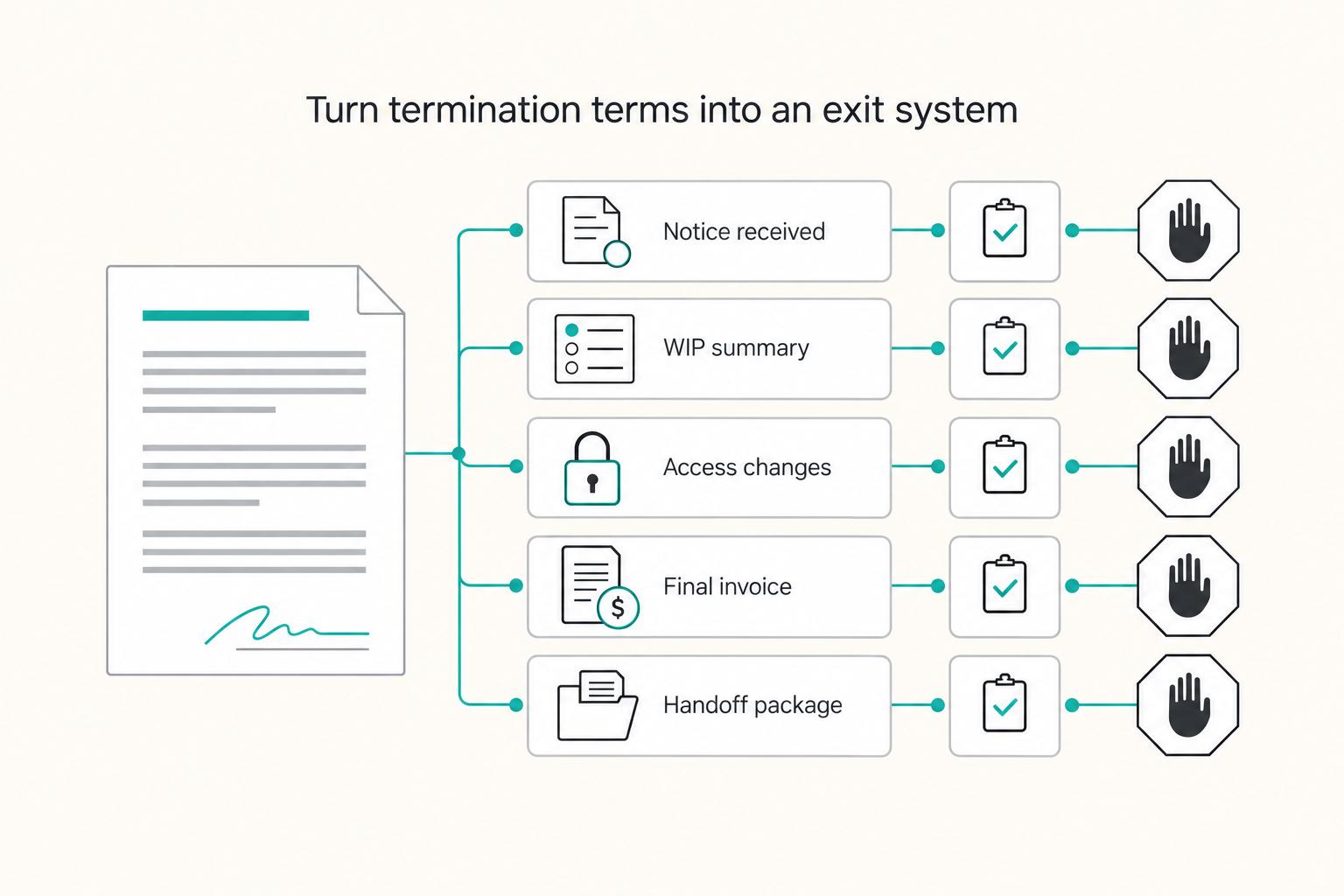
What Happens on Day 1 After Termination?#
Run a Day 1 termination runbook that documents notice, handover, and payment records so closeout is clear and disputes are less likely.
| Closeout item | What to document | Article note |
|---|---|---|
| Written Notice | Termination ground, effective date, required information and dispatch/delivery evidence | Use the agreed channel and apply the contract's actual or deemed receipt rule |
| Work Product handover | Handover items and acceptance confirmations | List each item in writing |
| Access cessation | Access cessation tasks and proof | Include it in the written sequence |
| Confidentiality or ownership duties | Any duties that survive termination | State surviving obligations in writing |
| Final Invoice pack | Itemized fees, expenses, and prorated amounts when the contract allows them | Match the consulting agreement line by line |
| Outstanding delivery and payment items | Delivery evidence, payment status and any disputed amounts | Record unresolved items and follow the agreed deadlines; do not wait indefinitely for a reply |
You set notice mechanics in the last section. Now execute the exit exactly as your consulting agreement and termination clause require. Treat this as the execution layer, not admin cleanup.
Before You Start#
Find the signed notice provision, available delivery log and billing records. Check the recipient, delivery method, required information and deadline. Send a timely notice using the available facts required by the clause, and mark any missing closeout records for follow-up rather than delaying notice until every record is complete.
-
Step 1. Send notice through the agreed channel. State the required ground, effective date and next actions. Apply the contract's dispatch, delivery or deemed-receipt provisions; a request for acknowledgment can help, but a recipient's reply is not a universal prerequisite. If termination was discussed verbally, follow the operative written-notice rules. Verify: Keep the sent notice, destination, timestamp and available delivery evidence, and identify the provision used to calculate effectiveness.
-
Step 2. Sequence Post-Termination Obligations in writing. List Work Product handover items, access cessation tasks, and any surviving confidentiality or ownership duties. Include a transition component when knowledge transfer matters. Imagine a client removes your system access before approving the final handoff. Your written sequence should still let both teams close cleanly. Verify: Each obligation has an owner, a due date, and an acceptance checkpoint.
-
Step 3. Reconcile money with a Final Invoice pack. Send a Final Invoice with an itemized breakdown of owed fees, expenses, and prorated amounts when your contract allows them. If your clause includes a cure period, align your payment reminders and escalation timing to that clause text. Verify: Your invoice package matches the consulting agreement line by line.
| Day 1 artifact | What you include | Why it strengthens legal protection |
|---|---|---|
| Written Notice file | Ground, effective date, required content and dispatch/delivery evidence | Supports the contract-specific notice and timing analysis |
| Handover log | Work Product list, acceptance confirmations, access cessation proof | Supports review of delivery and scope disputes |
| Final Invoice pack | Itemized fees, expenses, payment confirmations | Creates a clean and auditable closeout |
- Step 4. Track unresolved closeout items separately. Check the agreed notice rules and any applicable legal requirements when parties operate across jurisdictions. Record what was delivered, paid or disputed, who must act next and when follow-up is due. Distinguish the termination's effective date from later handover or payment completion. Verify: The file shows the notice basis and open items; apply the agreed closeout requirements and record any missing response.
How Do You Keep Termination Terms Aligned with the Rest of the Contract?#
Align your termination clause with liability, indemnification, and dispute terms before you sign, or your legal protection weakens when conflict starts.
At this point you have a Day 1 runbook. Next, pressure test the full consulting agreement so each clause supports the same enforcement path.
- Step 1. Cross-map termination outcomes to risk allocation terms. Put your termination clause beside
Limitation of LiabilityandIndemnification. Confirm the remedies you expect afterFor-Cause TerminationorWithout-Cause Terminationmatch the exposure model in those sections. These clauses allocate risk, so treat them as one system. Outcome: You can explain who pays, what gets capped, and what survives termination.
| Clause pair | Alignment question | Failure mode if misaligned |
|---|---|---|
| Termination Clause + Limitation of Liability | Do your termination remedies fit within the stated cap structure and carve-outs? | You expect recovery that contract text blocks |
| Termination Clause + Indemnification | Do indemnity triggers and scope match termination triggers and duties? | One section promises protection another section narrows it |
| Governing Law + Jurisdiction + Dispute Resolution | Do forum and process support your termination mechanics and timeline? | Delay, forum fights, or unexpected interpretation |
-
Step 2. Identify the dispute process. Name the governing law and chosen forum, then confirm whether disputes go to court or arbitration. Check the procedure for starting a claim and how it fits the notice and cure timetable. For cross-border contracts, review the practical enforcement route rather than treating a forum clause as a guarantee of recovery.
-
Step 3. Standardize trigger definitions across the contract. Define
Material BreachandJust Causein your agreement, then use those same definitions consistently across sections. Rules vary by jurisdiction, so avoid assuming one legal threshold applies everywhere. If your for-cause path uses cure mechanics, keep the sameWritten Noticeand cure logic wherever it appears. Outcome: You remove internal contradictions before they get used against you. -
Step 4. Run a two-reader ambiguity test. Imagine a client in one jurisdiction claims cause while you claim a without-cause path under the same facts. If two reasonable readers can interpret one clause two ways under your chosen governing law, rewrite it before signing. Use How to Write a Termination Clause That Protects You as a drafting checkpoint. Outcome: You identify wording that needs clarification before signing.
Negotiate Faster with Scripts That Protect You#
Use short, balanced scripts that lock mutual exit rights, payment protection, and a clear yes or no decision in every redline round.
Use the scripts below as negotiation drafts. Replace placeholders with the agreed obligations, notice interval and cure window, then confirm the proposed changes in the contract text.
- Step 1. Open with a balanced Mutual Termination Rights script. Use this primary script:
Negotiation draft: “Either party may end this consulting agreement for convenience on [number] days' written notice delivered under [notice provision]. Either party may end for cause if a specified material breach remains uncured after the agreed notice and cure period.” If the client keeps a unilateral convenience right, you could propose matched rights or a defined exit payment and handover commitment in exchange. Ask which option they can accept and record the agreed text.
- Step 2. Tie Non-Payment to a For-Cause Termination script. Use this script:
Negotiation draft: “Non-payment of an undisputed amount due under [payment clause] is a material breach. If it remains unpaid after notice under [notice provision] and [cure window], the consultant may terminate under [termination clause]. Accrued payment obligations identified in [survival provision] continue after termination.” Picture the client delaying payment while asking for final files and support. This draft gives you notice and cure steps to negotiate, while the payment and ownership clauses determine what remains due and what must be handed over.
- Step 3. Handle pushback with calm, non-adversarial responses.
| Client objection | Response script | Decision close |
|---|---|---|
| "Your Notice Period is too long." | "I can shorten the Notice Period if we keep clear Post-Termination Obligations on handover and payment obligations." | "Approve this trade, yes or no?" |
| "Written Notice is too formal." | "Written Notice protects both sides with one timestamp and one record for contract negotiation and enforcement." | "Keep Written Notice, yes or no?" |
| "Post-Termination Obligations are too detailed." | "The checklist prevents fights over work product return and payment obligations after exit." | "Keep this language, yes or no?" |
Ask the client to accept the proposed wording or identify the specific change they need. Save the agreed redline rather than treating a yes-or-no answer as the contract amendment itself.
Common Mistakes That Create Expensive Termination Fights#
Termination fights often start when vague drafting meets weak execution, so define triggers, balance exit rights, align risk clauses, and document every notice.
Scripts get you to signature, but they are not the finish line. This section keeps you from signing a clause that looks fine until you need it.
- Step 1. Replace generic trigger language with objective definitions. If your termination clause says
Material Breachwithout criteria, each side can argue a different standard later. Define each trigger with observable facts and required proof.
- Name which obligations count as material breach.
- Identify supporting records, such as delivery logs or payment records.
- Tie each trigger to the agreed cure or immediate-action path, subject to applicable legal restrictions.
-
Step 2. Pair convenience termination with defined payment and handover terms. A private consulting agreement can provide a without-cause exit under agreed notice rules. The FAR 12.403 example concerns U.S. federal commercial acquisitions and does not set a universal private-contract rule. Imagine a client exits just before handover while invoices remain open. Specify notice, fees due, any negotiated exit payment, handover and access shutdown rather than borrowing government settlement rules for that engagement.
-
Step 3. Run a clause dependency review before signature. Many teams draft termination language in isolation, then miss conflicts across
Indemnification,Limitation of Liability, and governing-law terms.
| Mistake | Recovery |
|---|---|
| Termination remedies conflict with liability caps | Align remedy text and cap carve-outs in one pass |
| Indemnification scope conflicts with exit triggers | Match indemnity triggers to termination definitions |
| Governing-law terms clash with indemnification and liability language | Review these terms together so risk allocation stays consistent |
Outcome: Your termination clause supports enforcement instead of fighting it.
- Step 4. Keep a dated notice and payment trail. Use the contract-approved notice channel and recipient, and retain dispatch and available delivery evidence. Apply any deemed-receipt provision rather than waiting for acknowledgment unless the governing terms require it. Then track handover, the final invoice, payments and disputed items on their own deadlines. Outcome: You can reconstruct notice timing without confusing it with completed closeout.
Verify Each Risk Control in Writing Before You Sign#
Treat your consulting termination clause as an execution workflow, then approve the contract only after you verify each risk control in writing.
| Checkpoint | What to confirm | Why it matters |
|---|---|---|
| Termination rights | Who can terminate and on what basis is explicit for both parties | Removes ambiguity before it turns into a dispute |
| Cause paths | For-Cause Termination and Without-Cause Termination are separately defined | Keeps one path from being blended into the other |
| Named triggers | Material breach and non-payment are defined; any insolvency or bankruptcy trigger has been checked under applicable law | Distinguishes contractual wording from an available legal remedy |
| Written Notice | Method, channel, recipient, and timeline are unambiguous | Supports exact execution |
| Post-Termination Obligations | Handover, return of materials, and access shutdown tasks are defined | Covers execution after exit |
| Final Invoice | Outstanding amounts and payment timing are documented | Preserves payment protection |
| Contract alignment | Confidentiality, Indemnification, Governing Law, Jurisdiction, and Dispute Resolution align with termination terms | Keeps the enforcement path consistent |
You now have the structure, the runbook, and the negotiation scripts. This final pass turns the clause into a pre-sign control you can actually run.
- Step 1. Reconfirm the four risk decisions that control outcomes. Check these in order before signature:
- Triggers: Separate cause and convenience, define the relevant breaches and review any insolvency or bankruptcy condition under applicable law.
- Notice: Check the channel, recipient, required content, delivery/deemed-receipt rule and timeline. Treat 30 or 90 days as proposed contract terms, not universal notice standards.
- Payment: Document earned fees, qualifying expenses, any negotiated exit payment and their due dates.
- Execution: Define handover, return of materials and access shutdown, and record unresolved closeout items separately from notice effectiveness.
-
Step 2. Pressure test the workflow, not just the clause text. Run one short scenario. Imagine the client misses payment, then asks for full work product transfer while procurement delays closeout. Your contract should tell you exactly what to send, when to send it, what cure path applies, and what payment rights survive. If you cannot execute that path from the draft alone, the clause is not ready. Outcome: You confirm operational coverage, not just drafting quality.
-
Step 3. Copy and paste this pre-sign checklist into your deal file.
- Termination rights identify who may terminate and on what grounds.
- Cause and convenience paths are separate, with any cure window defined.
- Relevant breaches are described; insolvency/bankruptcy triggers are checked under applicable law.
- Notice channel, recipient, required content and actual/deemed-receipt timing are clear.
- Handover and access tasks have owners and agreed dates.
- Final fees, expenses, any negotiated exit payment and payment deadlines are documented.
- Confidentiality, ownership, liability, indemnity and dispute terms have been checked for conflicts.
Before you sign, validate market-specific enforceability with counsel and confirm your team can execute this workflow exactly as written.
Frequently Asked Questions
What should a consulting termination clause include?
A strong consulting termination clause should define who can end the consulting agreement, on what grounds, and through which process. Include for-cause and without-cause paths, written notice method, notice period, effective date, transition duties, return of property, final invoice process, and any obligations that survive termination. If you want a practical drafting model for contract negotiation, review How to Write a Termination Clause That Protects You.
Can a consultant terminate immediately for non-payment?
Some contracts allow Termination by the Consultant for just cause without notice, and many treat Non-Payment as a serious breach trigger. Your clause must state that remedy clearly and define whether a cure step applies before termination takes effect. Treat immediate exit as negotiated protection, not an automatic default.
How much notice is standard for terminating a consulting agreement?
No single notice period applies to every consulting agreement. Published examples use different intervals: the 2004 InNexus contract gives the company a minimum two-week early-termination notice requirement, while the 2010 Coronado contract uses fifteen days for either party's convenience exit. Negotiate an interval that fits the project and specify delivery, effective-date and cure rules separately.
Should termination rights be mutual in a consulting agreement?
Mutual termination rights usually reduce friction because both sides follow the same exit mechanics. If a client wants broad Without-Cause Termination rights, request matched rights for you or stronger payment and handover protections. Balanced rights also make negotiation cleaner because the decision rules stay consistent.
What is the difference between for-cause and without-cause termination?
For-cause termination requires a defined breach path, usually tied to written notice and cure mechanics. Without-cause termination allows a convenience exit under agreed notice rules even when no breach exists. Keep both paths separate so each side applies one standard at a time during a dispute.
What happens to work product, final invoices, and approved expenses after termination?
Your consulting agreement should sequence post-termination obligations in plain language. State how parties handle work product handover, return of property, transition support, and confidentiality or payment obligations that survive, then define final invoice timing and payment for services rendered. Clear sequencing reduces closeout fights because everyone knows what happens next.
How do governing law and jurisdiction affect enforceability of termination terms?
The governing law affects how termination terms are interpreted and which legal restrictions apply. The forum or arbitration provision identifies the agreed dispute route, but does not guarantee recovery or cross-border enforcement. Check these terms together with notice, cure and remedy provisions; insolvency or bankruptcy can introduce additional limits.
Try a related tool
Researched and edited by the Gruv editorial team. Gruv builds cross-border billing, payouts, and finance-operations software for global businesses.
Sources
- acquisition.gov/far/12.403trusted
- acquisition.gov/far/part-49trusted
- ecfr.gov/current/title-48/chapter-1/subchapter-G/part...trusted
- govinfo.gov/content/pkg/USCODE-2024-title11/pdf/USCODE-2...trusted
- sec.gov/Archives/edgar/data/1278730/0001278730040000...trusted
- sec.gov/Archives/edgar/data/1429260/0001193125112301...trusted
- uscode.house.gov/view.xhtmltrusted
Educational content only. Not legal, tax, or financial advice.
Related Posts

Germany Freelance Visa Application Path for Freiberufler and Gewerbe
Choose your track before you collect documents. That first decision determines what your file needs to prove and which label should appear everywhere: `Freiberufler` for liberal-profession services, or `Selbständiger/Gewerbetreibender` for business and trade activity.
How to Write a Termination Clause That Protects You
**A freelance contract termination clause should explain how the engagement can end, what remains payable and what must be handed over.** Write the exit rules before the project starts so notice, unfinished work and final billing can be handled against agreed terms. A clause can reduce uncertainty; it cannot guarantee collection or make every unfinished task billable.

The Freelance Payment Penalty: A Modeled Audit of Platform Fees, FX Spreads, and Payout Delays
The money rarely disappears through a single, easy-to-spot fee. The real loss is stacked. A marketplace takes its commission, a processor adds a charge for international cards, a bank or payment company converts the currency at a spread, a platform holds the funds before release, and a wire sheds a little to intermediaries on the way in. Each layer looks defensible on its own, but the worker feels the combined result as a smaller deposit and a later payday.