
Quick Answer
Handle it by matching your worker status, tax forms, and records before responding. Pull your contract, payout history, invoices, year-end tax forms, pay slips, and bank records, then reconcile them to your filed return. Platform records support your case but do not replace your filing responsibility. If status, residency, or foreign account facts are unclear, get qualified tax help before you respond.
Deel, the IRS, and the Global Professional: Your Guide to an Audit-Proof Business#
You cannot prevent an audit, but you can make your return easier to defend. In an audit involving Deel income, one core question is whether your worker classification and income reporting stay consistent from contract to platform records to filed return. Even if Deel or Remote handled onboarding, payroll support, or payouts, you are still responsible for what appears on your tax return.
An IRS audit is a review of books, accounts, and financial records, and initial audit contact is by mail. Start by aligning your status and reporting trail, not by guessing from platform branding.
Before you start
Pull your contract, payout history, invoices, year-end tax forms, and any pay slips.
Confirm your worker status#
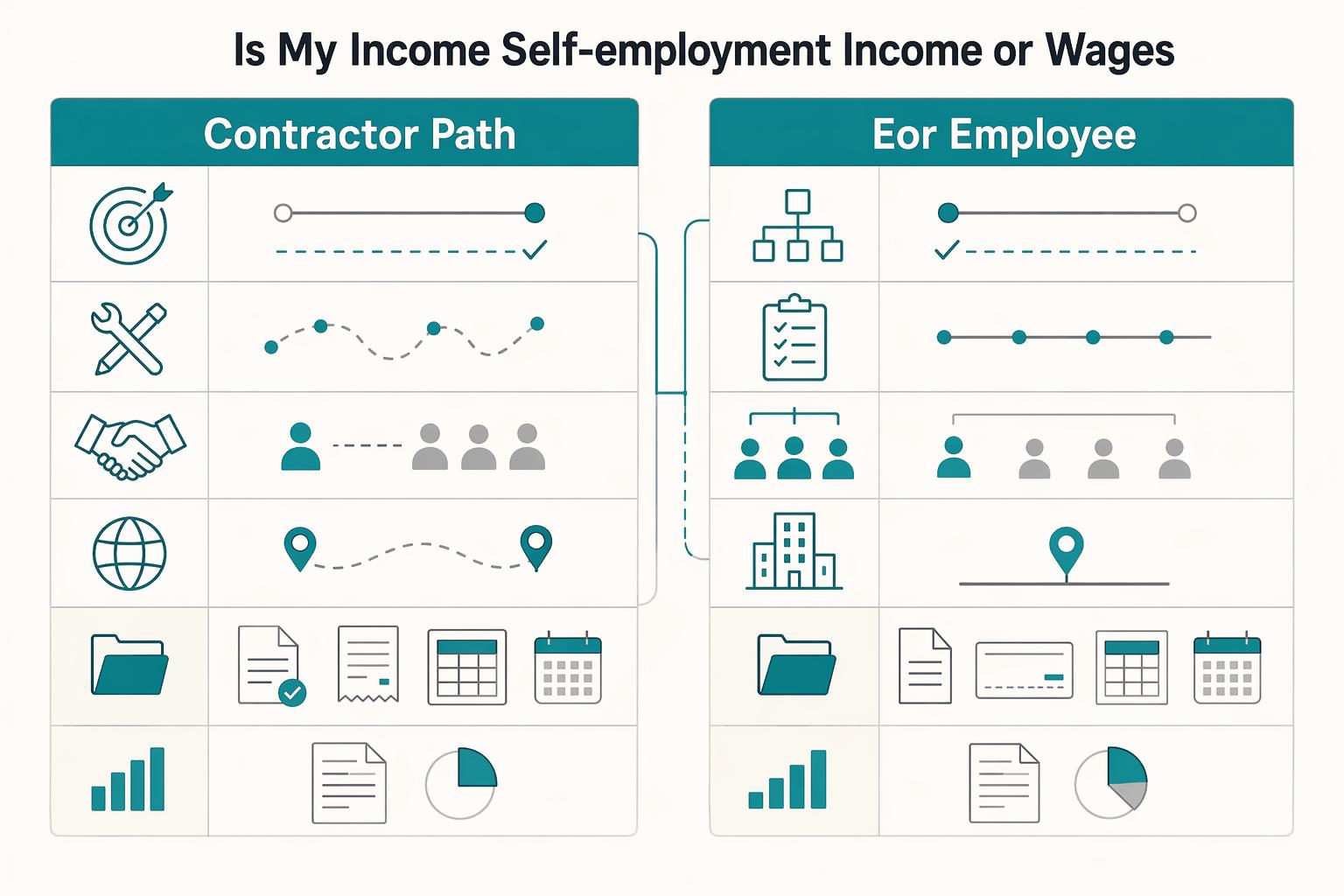
Start with the facts, not the label on the platform or contract. The IRS looks at behavioral control, financial control, and the relationship of the parties. It does not rely on a single deciding factor. Use these checks to compare the facts:
- Contractor: you generally control how the work is done and handle your own taxes.
- EOR employee: a third party legally employs you; that EOR handles payroll, taxes, benefits, and compliance, while the client can still direct day-to-day work.
Do a three-way check across contract terms, pay documents, and who actually remitted taxes. If those do not match, treat that as a review item. If the facts are mixed, Form SS-8 is the IRS path to request a worker-status determination.
Match the form flow to your facts#
Once status is clear, make sure the form trail matches. The platform name does not determine your tax form. Your engagement model and payment flow do.
| What you receive | What it means | What you must do next |
|---|---|---|
| Form W-2 from an EOR payroll setup | This can indicate employee payroll treatment. | Match payroll documents to your filed return. Investigate if contract and payment behavior suggest something else. |
| Form 1099-NEC from the payer company (including eligible workflows supported by Deel or Remote) | You were treated as a nonemployee service provider. Deel states US-entity clients can file US contractor income via 1099-NEC through Deel. Remote states it may pre-fill eligible 1099-NEC workflows but does not file forms on your behalf. | Reconcile to invoices and bank receipts, then report using your own records. |
| Form 1099-K from a payment app, card company, or marketplace | Reports payment volume for goods/services. Box 1a is gross payment amount, not net taxable income. | Reconcile gross amounts to your records and report correct income. Do not treat Box 1a as automatic profit. |
| No form | You may be under a reporting threshold or did not receive an information return. | You still must report income using your contracts, invoices, and payment records. |
For 1099-K, current IRS guidance references a threshold of more than $20,000 and more than 200 transactions, and says recipient copies are due by January 31.
Keep platform records separate from filing responsibility#
Platform records are evidence, not your filed return. Deel or Remote may support payment and form workflows, but those records do not replace your duty to file accurately.
This matters most with 1099-K. The IRS describes it as gross payments and says you must use the form plus your own records to report correct income. In practice, reconcile gross reporting to your ledger, including invoices, payouts, fees, refunds, and claimed expenses, so your return tells one consistent story.
Start with this first-pass review#
Run this first pass before you go deeper into recordkeeping and filing. It will tell you what story your records need to support:
- Confirm status using contract terms, control of work, payroll handling, and who remitted taxes.
- Map expected forms so W-2, 1099-NEC, 1099-K, or no form aligns with your facts.
- Verify January documents against platform dashboards, pay slips, invoices, and bank records.
- Flag mismatches early when contract, payment flow, and forms point to different treatments.
- If facts are unclear or changed during the year, get professional review and consider Form SS-8.
Those checks tell you what story your records need to support. The rest of this guide is about making that story easy to prove. If you want a deeper dive, read our guide to a defensible 2026 filing plan.
Step 1: Fortify Your Foundation - Build an Unshakeable System of Record#
If the IRS asks for support, you want to hand over the same records you used to prepare the return. They should already be organized by year and by income and expense type, with a clear summary. That is what a defensible recordkeeping setup looks like in practice.
A system of record is any setup that clearly shows your business income and expenses and summarizes transactions in your books or ledger. Co-mingling means mixing funds that should stay separate, which makes business activity harder to prove. Contemporaneous documentation means records created at or near the time of the transaction, not rebuilt later. This is the standard you need because the burden of proof is on you.
Set up your records framework#
Use a business checking account for business activity when possible. For many small businesses, it is the main source for entries in the books. Then keep one folder structure for the current cycle:
Business Records/2026/01_Contracts_and_SOWsBusiness Records/2026/02_Invoices_and_Payment_ProofBusiness Records/2026/03_Bank_Statements_and_Deposit_SlipsBusiness Records/2026/04_Expense_Receipts_and_BillsBusiness Records/2026/05_Tax_Forms_and_Filed_ReturnBusiness Records/2026/06_Estimated_Tax_Payments
Use one consistent naming pattern across folders, for example 2026-02-14_vendor_amount_purpose.pdf. It is not an IRS-required format, but consistency reduces audit friction.
Keep evidence that is audit-defensible#
Strong support ties a transaction to what happened, when it happened, who was involved, and why it belonged in the business. Weak support usually fails on one of those points.
| Record type | Strong evidence | Weak evidence |
|---|---|---|
| Expense record | Receipt or invoice with amount, date, vendor, and business purpose | Screenshot missing date or business purpose |
| Income or payment record | Invoice plus matching bank statement, deposit slip, or payout record | Payout line with no matching invoice |
| Disbursement record | Paid bill plus card or bank transaction that ties to your books | Canceled check alone |
Run a regular reconciliation checkpoint so invoices, statements, receipts, and ledger totals match before filing. Do not rely only on collected tax forms or platform defaults. Platform workflows differ, and some platforms state they do not verify contractor tax-form accuracy.
Retention workflow and escalation triggers#
Once the file structure is working, decide how long to keep records and when a routine filing becomes a professional-review issue.
| Situation | Keep records for |
|---|---|
| Default retention window | 3 years |
| Unreported income is more than 25% | 6 years |
| Worthless securities or bad debt claims | 7 years |
| No return is filed or a fraudulent return is filed | Indefinitely |
| Employment tax records | At least 4 years |
Keep records based on the applicable IRS retention window. The default is 3 years, 6 years if unreported income is more than 25%, and 7 years for worthless securities or bad debt claims. Keep records indefinitely if no return is filed or a fraudulent return is filed. Keep employment tax records for at least 4 years.
Escalate to a tax pro if any of these are true:
- Worker status is still unresolved and you may need Form SS-8.
- Key records are missing or cannot be tied back to your return.
- You use foreign financial accounts and may cross the $10,000 aggregate at any time FBAR threshold.
Step 2: Master Global & State Compliance - Tame the Risks Competitors Ignore#
Clean records are only the first layer. Next, you need to know where you may have to report and file. Track three things at the same time: where your accounts are located, where you were physically present, and which state can still tax you. In Deel or Remote workflows, your compliance duties follow your legal status, account location, and physical-presence facts, not the platform name.
Step 2.1 Define your exposure correctly#
Bad labels lead to bad filings, so define the moving pieces before you file anywhere. Separate foreign account reporting, tax residency, treaty issues, and state residency before you decide what is due.
- Foreign account reporting obligation: For U.S. persons, this is triggered by account location and your financial interest or signature authority, plus the aggregate-value test for the year.
- Tax residency: Whether a jurisdiction can treat you as a resident under its own rules. For the IRS substantial presence framework, verify the current test; the IRS currently describes a 3-year window with current-year and weighted prior-year day counts.
- Treaty tie-breaker concept: If two countries both claim you as resident, a treaty rule may resolve that conflict and can change U.S. tax treatment.
- State domicile vs tax residency: Domicile is your intended permanent home; state tax residency can also arise under statutory abode and day-count rules.
Step 2.2 Check foreign-account reporting before year-end#
If income flows into any non-U.S. financial account in which you have a financial interest or signature or other authority, treat reporting as a live compliance item. FBAR reporting is filed on FinCEN Form 114. Verify the live threshold before filing; IRS FBAR guidance currently references $10,000 aggregate value at any time during the calendar year.
Keep one monthly account inventory to prevent missed filings. Include the institution name, country, owner, whether you had signature or other authority, highest balance, and supporting statements. Keep the payout trail that shows how income reached each account. By quarter-end, you should be able to produce one sheet with all reportable accounts and support for the balances.
Do not treat FBAR and Form 8938 as interchangeable. Form 8938 thresholds vary by filing context, so verify the threshold that applies to your filing status and residency situation.
Step 2.3 Log residency facts before you need to defend them#
Residency disputes are hard to rebuild after the year closes. Your best defense is a real-time day log, not a reconstruction. Track overnight location and retain matching support records, such as travel and housing records.
| Residency checkpoint | Article fact |
|---|---|
| Generic "183-day rule" | Do not rely on it across jurisdictions; rules differ by country |
| IRS current-year day count | 31 days in the current year |
| IRS 3-year period day count | 183 days in the 3-year period |
| Treaty-based return positions | Require disclosure on Form 8833 |
| Claiming treaty residence in this form-set context | Requires Form 1040-NR with Form 8833 attached |
Do not rely on a generic "183-day rule" across jurisdictions. Rules differ by country, and the IRS uses the substantial presence framework. Verify the current IRS test; IRS guidance currently references 31 days in the current year and 183 days in the 3-year period.
If two countries may both claim residence, escalate early. Treaty tie-breaker outcomes are not automatic. Treaty-based return positions require disclosure on Form 8833. The Form 8833 instructions state that, in this form-set context, claiming treaty residence requires Form 1040-NR with Form 8833 attached.
Step 2.4 Test state domicile and source income separately#
State filing risk often turns on two separate questions: where you remained domiciled, and where you still had source income. Do not collapse those into one issue.
Leaving a state is a facts-and-documents issue, not just travel, so test domicile and source-income filing separately. New York can treat you as resident through domicile. It can also apply statutory residency when you maintain a permanent place of abode for substantially all of the year and spend 184 days or more in the state. Virginia distinguishes domicile and actual residency. It can treat someone with a place of abode in Virginia for more than 183 days as an actual resident, and nonresidents can still have Virginia filing obligations on Virginia-source income.
Build a state evidence file that shows which ties ended, which remained, and what state-source income continued after you moved.
| Risk area | Trigger signal | Records to keep | Immediate next action | Escalate to a cross-border tax professional when |
|---|---|---|---|---|
| Foreign account reporting | You had a financial interest in, or signature or other authority over, any non-U.S. account and may meet the aggregate threshold after verification | Statements, account-opening records, highest-balance log, authority or ownership proof, payout trail | Build account inventory; verify current FBAR and Form 8938 rules | You are unsure whether an account or authority right is reportable |
| Cross-border tax residency | You spent material time in multiple countries or may meet day-count tests | Day log, travel records, housing records, work-timing records | Compare your facts against each jurisdiction's rules and current IRS test | Two countries may both claim residence, or treaty relief may be needed |
| State domicile and source income | You moved but kept state ties, or still earned state-source income | Domicile-change documents, housing or tie records, state-source income records | Analyze domicile and source-income obligations separately for each state | Part-year or nonresident treatment, or residency classification, is unclear |
For a step-by-step walkthrough, see How to Handle Tax on US Partnership Income as an Expat.
If your residency position still feels unclear, document your travel pattern and keep one audit-ready log with the Tax Residency Tracker.
Step 3: Get the Numbers Right Across Three Tracks#
Once you know what you are and where you may have to file, the next job is getting the numbers right. Run this on three tracks: substantiate deductions, pay tax during the year, and hand off a reconciled file. If platform payouts, bank deposits, and your Schedule C line 31 flow do not reconcile, resolve that first.
Step 3.1 Define the numbers before you deduct anything#
Start from gross receipts, your top-line business receipts, then reconcile down to net profit or loss on Schedule C line 31. Gross receipts are not reduced by returns, allowances, cost of goods sold, basis, or expenses, and line 31 is what flows into your individual return.
Use one reconciliation trail from gross receipts to net profit. If payouts from Deel, Remote, or direct invoices are split across accounts or periods, document timing differences so your totals still tie.
Apply the deduction standard exactly. An ordinary expense is common and accepted in your industry. A necessary expense is helpful and appropriate for your business, even if not indispensable. Personal, living, and family expenses are not deductible. Do not rely on Publication 535 as a current living guide; the IRS discontinued it after the 2022 revision.
Use this table as substantiation guidance, not as an automatic-deduction list.
| Expense area to evaluate (must be ordinary, necessary, and substantiated) | Document it with | Common weak-proof risk |
|---|---|---|
| Software and online tools used in your trade | Receipt or invoice, payee, amount, proof of payment, date incurred, short business-use note | Mixed personal and business use with no allocation or explanation |
| Contract labor or professional services | Contract or scope, invoice, proof of payment, delivery evidence such as emails or files | Payment with no clear record of what work was delivered |
| Business travel tied to a documented business purpose | Itinerary, business-purpose note, transport or lodging receipts, proof of payment | Trip appears personal because business purpose is missing or thin |
| Education tied to current business activity | Course invoice, description or syllabus, proof of payment, note linking to current work | Expense looks like a new career path or personal enrichment |
Your burden of proof is on you. Keep records that show payee, amount, proof of payment, and date incurred. Daily bookkeeping is the safer approach, and the IRS can request accounting software backup files early in an exam through Form 4564.
Step 3.2 Run estimated tax as pay-as-you-go compliance#
Estimated tax is not a year-end cleanup exercise. Treat it as in-year compliance. Use the Form 1040-ES worksheet process, and update it before each payment window. Underpayment can trigger penalty even if you later receive a refund. The IRS also states an ordinary benchmark of paying at least 90% of your tax during the year.
| Payment window | Due date |
|---|---|
| Jan. 1 to Mar. 31 | Apr. 15 |
| Apr. 1 to May 31 | Jun. 15 |
| Jun. 1 to Aug. 31 | Sep. 15 |
| Sep. 1 to Dec. 31 | Jan. 15 of the following year |
Use a simple routine instead of a March catch-up:
- After each payout, book gross receipts and move your tax reserve in the same week.
- Before each estimated payment, run year-to-date P&L, update 1040-ES, and compare tax paid versus your current target.
- Working payment windows: Jan. 1 to Mar. 31 -> Apr. 15; Apr. 1 to May 31 -> Jun. 15; Jun. 1 to Aug. 31 -> Sep. 15; Sep. 1 to Dec. 31 -> Jan. 15 of the following year. Weekend or holiday rules can shift due dates.
If net self-employment earnings are $400 or more, self-employment tax applies. Do not wait for a 1099 to reserve cash; income can still be taxable even if no form is issued.
Step 3.3 Hand off a pre-filing package your accountant can use#
Your accountant can only move as fast as your file. Send a package that is reconciled first, then complete. Use this sequence:
- Reconcile before delivery
- Gross receipts to platform reports and bank deposits * Expenses to bank or card statements * Inter-account transfers so nothing is double-counted
- Deliver the package
- Year-end profit and loss * Balance sheet as of Dec. 31 (if maintained) * Statements for each business bank or card account * Platform payout reports, invoices, contracts, receipts * Accounting software export or backup file
- Add cross-border support when relevant
- Foreign account inventory and FBAR support * Day log plus travel or housing records * Foreign tax payment records
- Escalate before filing when facts are mixed
- More than one foreign country involved, because Form 1116 is country-by-country * Potential treaty position * FEIE physical-presence analysis (including whether the 330 full-day test is met) * Worker-status ambiguity, because status is based on control and independence facts, not the label, and Form SS-8 exists for determinations
Final check: confirm who filed what. Do not assume the platform filed on your behalf; Remote states it does not file users' tax forms. Related: Deel vs. Remote: A Comparison from the Freelancer's Perspective.
Keep Records, Monitor Changes, and Review Before Deadlines#
If some of your income comes through Deel, treat compliance as an operating discipline, not a once-a-year scramble. Control comes from three repeatable habits: keep complete records, monitor compliance changes, and review your file before deadlines close in.
Maintain one system of record#
Keep one place where your full income story lives: contracts, scopes, invoices, platform payout reports, bank deposits, receipts, and year-end reports. The point is not perfect software. It is one complete record trail, not scattered files across inboxes and apps.
Use one simple test: pick any deposit and trace it to the contract or invoice, the payout record, and the bank line. If that chain breaks, fix the recordkeeping before you file. Filing pressure often exposes data errors and stale processes, so treat those gaps as control issues to close now.
Manage compliance as an ongoing task#
Compliance is easier when you treat it as year-round work, because the rules and your facts can change. A practical baseline is to sign up for IRS alerts, keep a current-year filing calendar, and confirm whether any key facts changed during the year.
If your payment setup changes, keep the same discipline across paths. For example, if you are paid through an EOR, keep your employment agreement and payroll records with the same consistency you would apply to contractor invoices and payout records.
Run a review cadence#
Do the review while the year is still fresh. After tax season, note where your process broke down. Then keep a simple cadence: reconcile payouts, invoices, and bank activity regularly, and run a deeper file-readiness check before filing deadlines.
Your readiness standard is practical: can you assemble an audit-ready compliance file without rebuilding documents from memory? If not, close the gaps now.
If records are complete and reconciled, file and archive the evidence pack. If evidence is missing, stop and rebuild support before finalizing. If key facts are unclear, pause and get qualified tax advice before filing.
- Organize one folder for contracts, invoices, payout reports, bank statements, receipts, and year-end reports.
- Set a recurring reconciliation routine so payouts, deposits, and books tie out.
- Run an audit-file readiness check: can you explain each income total and each claimed expense with source documents?
If cross-border reporting may apply to your situation, run a quick compliance sense-check with the FBAR Calculator.
Frequently Asked Questions
Is my income self-employment income or wages?
Decide worker status first, then choose the reporting path. Use facts about control, payroll handling, and the relationship of the parties, not just platform labels. Contractors generally handle their own taxes, while an EOR employee is generally on the employee path. If the facts are mixed, get qualified advice before filing.
Does Deel or Remote report my income for me?
Not by itself. Information returns such as a W-2, 1099-NEC, or 1099-K may be part of the process, but you are still responsible for reporting income correctly on your own return. Even if no form is issued, the income may still be reportable.
Is a platform payout record enough to prove my income?
No. A payout record can support your income trail, but tax-ready books must also show gross income, deductions, and credits with source support. Reconcile payout reports, invoices, bank deposits, and your year-end profit and loss before you file.
How do I prepare for an audit involving Deel or Remote income?
Prepare from records you already keep, not from records you try to recreate later. Pull contracts, scopes, invoices, payout reports, bank deposits, receipts, proof of payment, reconciliations, and any cross-border records that apply. IRS audit contact starts by mail, and unclear classification, residency, or foreign-account facts are reasons to get qualified tax help before responding.
If I am paid into Wise or another foreign account, do I need an FBAR?
Maybe. If you are a U.S. person and the aggregate value of foreign financial accounts exceeds $10,000 at any time during the year, FBAR is triggered. Keep an account inventory, highest-balance support, and the payout trail that shows how income reached each account. FBAR is separate from your income tax return.
What business expenses can I deduct as a contractor?
Deduct only expenses that are ordinary, necessary, and substantiated for your business. Keep records showing the payee, amount, proof of payment, and date incurred, plus a business-purpose note when needed. Mixed personal use, missing receipts, and weak documentation can create audit issues.
Can the IRS see my Deel account directly?
The article does not say the IRS can see your Deel account directly. It says the IRS can receive information returns and can request supporting documentation during an audit. The main risk is a mismatch between payout records, bank deposits, and the numbers on your filed return.
Try a related tool
Researched and edited by the Gruv editorial team. Gruv builds cross-border billing, payouts, and finance-operations software for global businesses.
Sources
Educational content only. Not legal, tax, or financial advice.
Related Posts

Digital Nomad Taxes in 2026 With a Defensible Filing Plan
With digital nomad taxes, the first move is not optimization. It is figuring out where you may be taxable, where filings may be required, and what proof supports that position.
Deel vs Remote for Freelancers Who Need a Clear First-Payout Decision
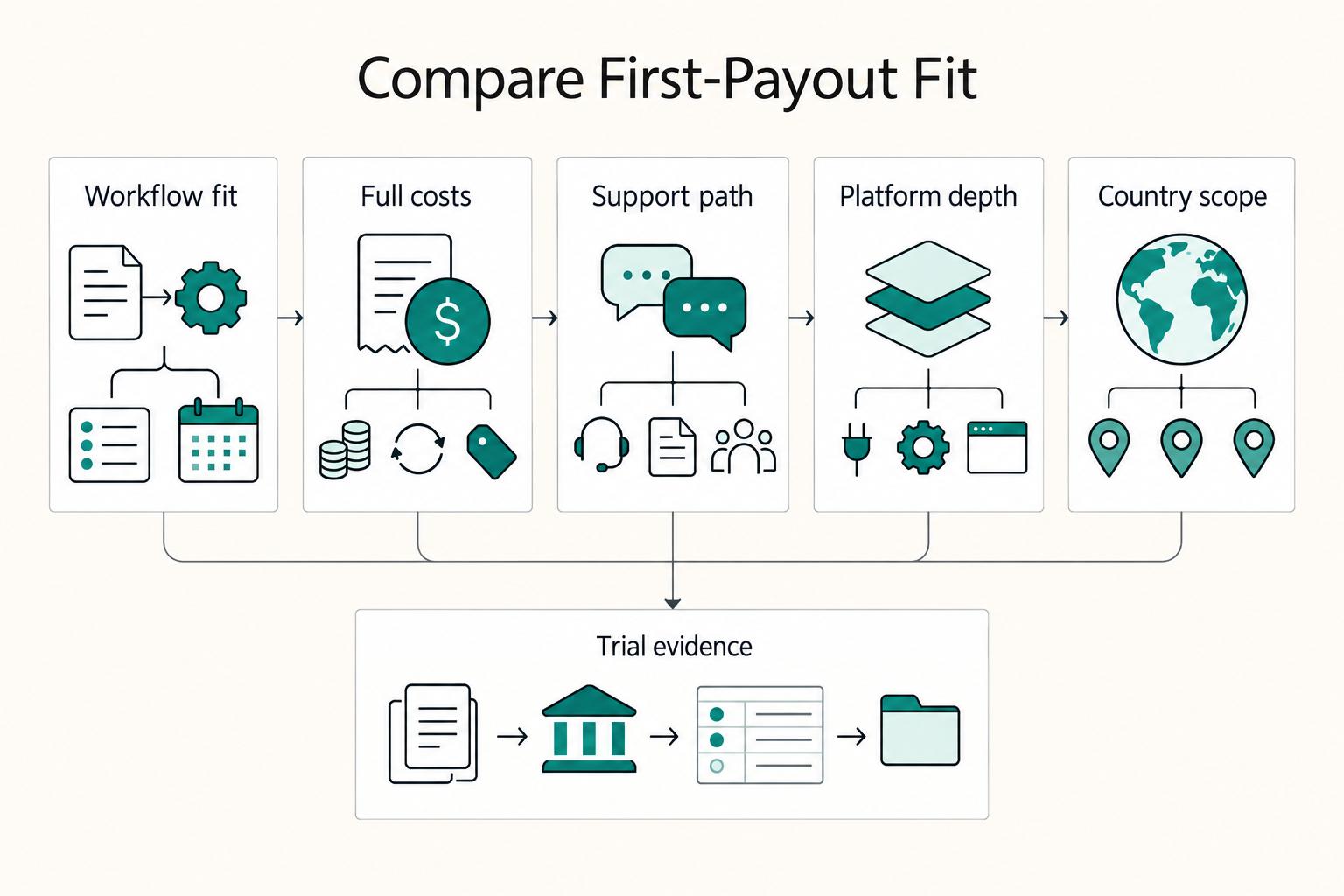
Choose the platform that makes your first payout cycle predictable and your contracts easier to defend. This is an operating decision, not a brand contest.

The Freelance Payment Penalty: A Modeled Audit of Platform Fees, FX Spreads, and Payout Delays
The money rarely disappears through a single, easy-to-spot fee. The real loss is stacked. A marketplace takes its commission, a processor adds a charge for international cards, a bank or payment company converts the currency at a spread, a platform holds the funds before release, and a wire sheds a little to intermediaries on the way in. Each layer looks defensible on its own, but the worker feels the combined result as a smaller deposit and a later payday.