
Quick Answer
Use a three-tier protocol to handle negative airbnb review situations: assess first, reply only when useful, then implement an operational fix. Start by documenting the stay and checking whether the issue is routine feedback or a possible Airbnb Content Policy case. If you post publicly, keep it brief and factual for future guests, not argumentative for the past guest. Then update one concrete item in your listing, guest messaging, or cleaning workflow and track whether the same complaint appears again.
The Professional's Protocol for Handling Negative Airbnb Reviews#
When a bad review goes live, do three things in order: assess it, decide whether a public reply helps, and turn the useful part into an operating fix. Your goal is not to win an argument with the last guest. It is to protect booking performance, response quality, and future guest trust.
Use this protocol any time you need to handle a negative Airbnb review in a calm, evidence-based way. For routine criticism, such as cleanliness concerns, noise complaints, or a mismatch in expectations, you are usually deciding how to acknowledge the issue and clarify the context. For higher-risk situations, such as a retaliatory review after you enforced house rules or content that looks coercive, spammy, extortionate, or plainly misrepresents the stay, start with documentation first. Then check the current Airbnb Content Policy and Help guidance before you file a removal request. Keep the policy check pending until you verify current Airbnb guidance and the host's own reservation records for the stay.
The key rule at the start is simple: do not post a public response until you know which lane you are in. There is conflicting advice on whether hosts should always reply to unfair reviews, so make that a predefined decision, not a mood-based one.
| Tier | Purpose | Your primary decision | Output before you move on |
|---|---|---|---|
| Tier 1 | Separate routine criticism from policy-risk cases | Is this feedback, a mismatch, or a possible Content Policy issue? | A short classification note plus your evidence pack |
| Tier 2 | Publish a response that builds trust with future guests | Should you reply publicly, and if yes, what should you signal? | A concise drafted response or a documented no-reply decision |
| Tier 3 | Improve the business instead of repeating the problem | What change in listing, cleaning, messaging, or rules does this trigger? | One logged improvement action with an owner and due date |
How should you assess before you react?#
Start by preserving the record. Screenshot the review, save message threads, note timestamps, pull the relevant house rule or listing description, and gather anything else that shows what happened. If you later ask for intervention, guidance usually emphasizes concrete evidence such as spam, extortion, incentivized content, or misrepresentation of personal experience.
| Evidence item | What to save | Why it matters |
|---|---|---|
| Review record | Screenshot the review | Preserves the record |
| Guest communication | Save message threads | Shows what happened |
| Timing | Note timestamps | Supports the timeline |
| Disclosures | Pull the relevant house rule or listing description | Shows what was stated before the stay |
| Policy-related proof | Gather concrete evidence such as spam, extortion, incentivized content, or misrepresentation of personal experience | Supports a later intervention request |
Your checkpoint is simple. Before you write anything public, you should be able to summarize the issue in one sentence and attach the proof behind that summary. If you cannot do that yet, you are still in assessment.
When should you reply publicly?#
A public reply helps when it gives future guests useful confidence. For routine criticism, that usually means showing professionalism and control. For a review that looks retaliatory or potentially policy-violating, posting too fast can create a defensive tone and distract from the removal path you are trying to document.
So the output here is not a clever comeback. It is a short response that either acknowledges a real miss and states the corrective action, or calmly clarifies a mismatch without arguing point by point.
How do you turn the review into process change?#
A negative review should leave a paper trail inside your business. Log what happened, what pattern it may point to, and what you changed: a cleaner checklist, a tighter check-in message, a clearer amenity description, or stricter pre-booking communication. If you keep seeing the same complaint, that is no longer a review problem. It is an operations problem.
That is the core protocol for an Airbnb host: assess first, respond with intent, then improve the underlying process.
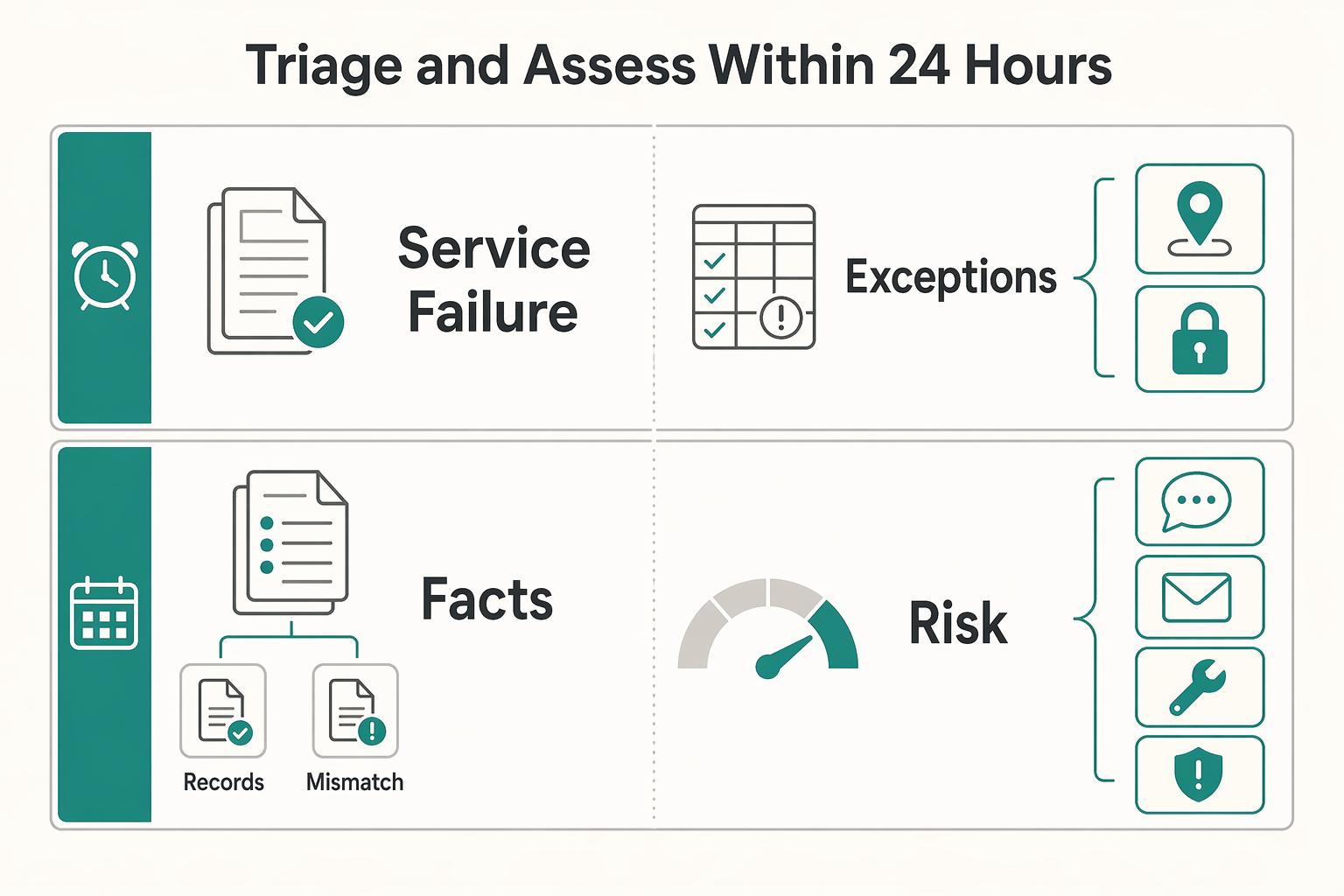
Tier 1: Triage and Assess Within 24 Hours#
Treat the first 24 hours as a risk-control window: document facts, assess booking risk, and choose the right route before you post anything public.
Use two checkpoints. In the first 2-12 hours, act and document. In the 12-24 hours window, route the case to public response, private follow-up, internal fix, or platform escalation.
Step 1. Pause before you post. Do not post a public reply on first read. A short cool-down helps you avoid a defensive response that can weaken trust with future guests.
Exception boundary: if the review raises safety concerns, possible policy-risk behavior, or a severe service failure that could leave a guest without accommodation, preserve evidence first and check current platform guidance before any public reply. Keep the escalation path pending until you verify current platform guidance and the host's own incident records for the stay.
Step 2. Classify by risk, then route. Classify the review by the dominant risk, not by how unfair it feels.
| Issue type | Likely booking risk | Evidence to collect | Route |
|---|---|---|---|
| Service failure | Medium to high when core stay delivery is questioned | Listing promise, pre-check-in condition records, maintenance/cleaning records, outage notes | Respond publicly in Tier 2 after confirming corrective action; run internal fix now |
| Subjective mismatch | Low to medium when expectations and preferences differ | Listing description, amenity photos, disclosure language, check-in guidance | Respond publicly only if clarification helps future guests |
| Factual error | Medium when a claim could mislead future guests | Listing screenshots, message timeline, timestamped proof, house rules | Respond publicly with a short correction; escalate only if verified policy grounds apply |
| Policy-risk review | High because a premature reply can weaken a dispute/removal path | Full message history, review screenshots, timestamps, evidence of coercive/spam/retaliatory pattern | Escalate to platform support after policy check; hold public reply until that check is complete |
If a review spans categories, route by the highest-risk element.
Step 3. Build one incident file before drafting. Keep all proof in one incident file so the timeline is clear and reusable.
- Listing records: live listing text, amenity disclosures, house rules, listing photos.
- Message logs: complete platform thread with timestamps.
- Operational records: cleaning logs, pre-check-in photos/video, repair receipts, outage notes, booking records when relevant.
Checkpoint: another person should be able to review the file and understand the complaint, timeline, and proof in about two minutes.
Step 4. Write a one-line routing note and stop. Before Tier 2, write one sentence with category, risk level, evidence status, and route. Example: "Service failure, medium booking risk, evidence complete, public reply after fix confirmation."
This keeps you from replying before the facts are organized and helps you avoid policy mistakes. Once routing is clear, Tier 2 can focus on a calm response that protects trust. For a step-by-step walkthrough, see Airbnb Resolution Center: How to Document, File, and Escalate a Damage Claim.
Tier 2: Respond as Marketing for Your Next 1,000 Guests#
Write your public reply for future guests, not for the guest who already checked out. Because review exchanges are publicly visible, your goal is to protect trust by showing three things quickly: what happened, what is accurate, and what you did next.
Keep the response short and decision-useful. Future guests usually need clear context, not the full incident file. Some hosts have also reported tighter review length constraints, so your reply may be the main place where booking-relevant context becomes clear.
Use this test before posting: if someone reads only the review and your reply, can they tell what happened, what changed, and whether the risk is contained?
Choose the right response style by issue type#
Use one structure every time: acknowledge, clarify, action, close. Change the emphasis based on the issue.
| Review type | When to use | Include | Avoid | Intended perception |
|---|---|---|---|---|
| Service failure | A core stay promise did not hold (for example cleanliness, access, heat, Wi-Fi, booking accuracy) | Direct apology, brief fact, concrete fix, current safeguard | Excuses, blame, unverifiable promises | "This host fixes real problems." |
| Subjective mismatch | The issue is preference or fit (taste, firmness, layout, neighborhood feel) | Respectful acknowledgment, fit clarification, where expectations were set | Treating preference as defect, sarcasm, arguing taste | "This host is transparent about fit." |
| Factual inaccuracy | A booking-relevant point appears incorrect | One calm correction, where correct info appears, pre-arrival instruction/disclosure | Point-by-point fights, calling guest dishonest, public escalation threats | "This host is factual and organized." |
Adaptable templates you can personalize#
Service failure "I'm sorry that [specific issue] affected your stay. We confirmed [brief factual context] and completed [repair/process change] on [timing]. Guests now have [current safeguard]."
Subjective mismatch "Thank you for sharing your perspective. The home is [accurate characteristic], as shown in [listing photos/description/house rules]. It may not suit guests who prefer [opposite preference], and we try to make that clear before booking."
Factual inaccuracy "Thanks for the feedback. For clarity, [specific point] is described in [listing section/message/check-in guide]. We share [instruction/disclosure/map/photo] before arrival so guests can plan accurately."
Only claim what you can prove. If you reference listing disclosures, use the exact wording you have on record.
Before you post: 3-point quality check#
| Check | Confirm | Avoid |
|---|---|---|
| Tone | Keep the voice calm and reader-focused | Lines written to punish, win, or "set the guest straight" |
| Consistency | Match every concrete claim to your listing, messages, and ops records | Naming a fix that is not already done |
| Policy-safe wording | Verify current platform guidance before posting | Accusations, threats, private details, or unverified removal claims |
- Tone check
Remove lines written to punish, win, or "set the guest straight." Keep the voice calm and reader-focused.
- Consistency check
Confirm every concrete claim against your listing, messages, and ops records. If you name a fix, make sure it is already done.
- Policy-safe wording check
Avoid accusations, threats, private details, or removal claims unless you verified current platform guidance. Keep the live review, response, and escalation check pending until you confirm current Airbnb rules and the host's own case records.
Tier 3: Turn Negative Feedback into Business Intelligence#
Use Tier 3 as a repeatable improvement loop: capture, diagnose, prioritize, implement, verify. Your goal is to fix the cause of complaints, not just improve the wording of your response.
| Stage | What to do | What to check |
|---|---|---|
| Capture | Include the public review, private guest messages, post-stay comments, and any support thread in one place | Centralizing feedback makes pattern tracking easier |
| Diagnose | Classify each issue as a service failure, expectation mismatch, or factual inaccuracy | Check listing copy, house manual, and pre-arrival messages for consistency |
| Prioritize | Screen fixes by effort required, guest trust impact, and booking risk | Move low-effort, high-trust fixes first |
| Implement | Track one row per issue and add proof links where relevant | Use screenshots, messages, and photos when relevant |
| Verify | Check the next set of stays for complaint frequency | If the topic keeps returning, assume your operation or expectation management is still inconsistent |
Start by capturing every signal in one place. Include the public review, private guest messages, post-stay comments, and any support thread tied to that stay. Centralizing feedback makes pattern tracking easier and lowers the chance that important issues get missed. If you use automation for alerts or draft replies, route sensitive or negative cases to a human before anything is posted.
Next, diagnose the probable root cause. Classify each issue as a service failure, expectation mismatch, or factual inaccuracy. Then check for consistency across your listing copy, house manual, and pre-arrival messages. If those three sources do not match, your expectation-setting is likely part of the problem.
Prioritize fixes with a simple impact screen before spending time or budget: effort required, guest trust impact, and booking risk. Move low-effort, high-trust fixes first, then address higher-risk issues that can affect booking decisions. If you track performance, set a baseline before changes; keep any benchmark pending until you verify the relevant source records and the host's own booking and review records.
| Fix path | Best used for | Typical action | Verify by |
|---|---|---|---|
| Quick communication fixes | Repeated confusion or missed expectations | Rewrite pre-arrival note, tighten check-in steps, confirm key tradeoffs before arrival | Fewer repeat questions and fewer reviews describing things as unclear or unexpected |
| Operational fixes | Clear service failures | Repair or replace, retrain cleaner, update turnover checklist | Same issue stops appearing in the next review cycle |
| Listing-detail fixes | Conditions that are true but underexplained | Update photos, captions, amenities text, house rules, and neighborhood description | Guests mention the condition as expected, not surprising |
During implementation, track one row per issue so you can see whether changes work:
| Issue type | Source signal | Probable root cause | Owner | Action taken | Review checkpoint |
|---|
Add proof links where relevant (screenshots, messages, photos). That record helps if you later request review removal, since removal depends on policy violations and evidence, not disagreement alone.
Finally, verify outcomes in the next set of stays. Check whether the same complaint frequency drops; do not treat a polished public reply as proof the issue is solved. If the topic keeps returning, assume your operation or expectation management is still inconsistent.
You might also find this useful: A Guide to Getting Your First Five-Star Review on Airbnb.
Your Reputation Shield is Your Strongest Asset#
Use your Reputation Shield as a repeatable operating playbook: classify the issue, respond for future guests, and tighten your standards so the same complaint is less likely to repeat.
| Tier | Purpose | Your action | Visible outcome for future guests |
|---|---|---|---|
| Tier 1 | Separate signal from emotion | Classify the complaint and confirm what evidence you checked | Your next move looks measured, not reactive |
| Tier 2 | Protect trust in public | Acknowledge what is true, clarify expectations, avoid argument | Guests see professionalism and clearer expectations |
| Tier 3 | Convert feedback into standards | Update communication, listing accuracy, and core operations | Your hosting experience looks more consistent stay to stay |
Tier 1: Classify the signal. Name the complaint type before drafting anything. Example: if the complaint is cleanliness, check your turnover notes and photos; if it is an expectation mismatch, check listing copy, visuals, and pre-arrival messages.
Tier 2: Reply for the next guest. Keep your response short and practical. Example: for a confirmed miss, state what you fixed; for a mismatch, calmly restate the expectation you now make clearer.
Tier 3: Fix the standard. Treat the review as an operational input, not a one-off event. Build a communication system from first contact through post-stay review, and tighten the recurring trust drivers: guest vetting, cleanliness, clear expectations, and accurate listing presentation.
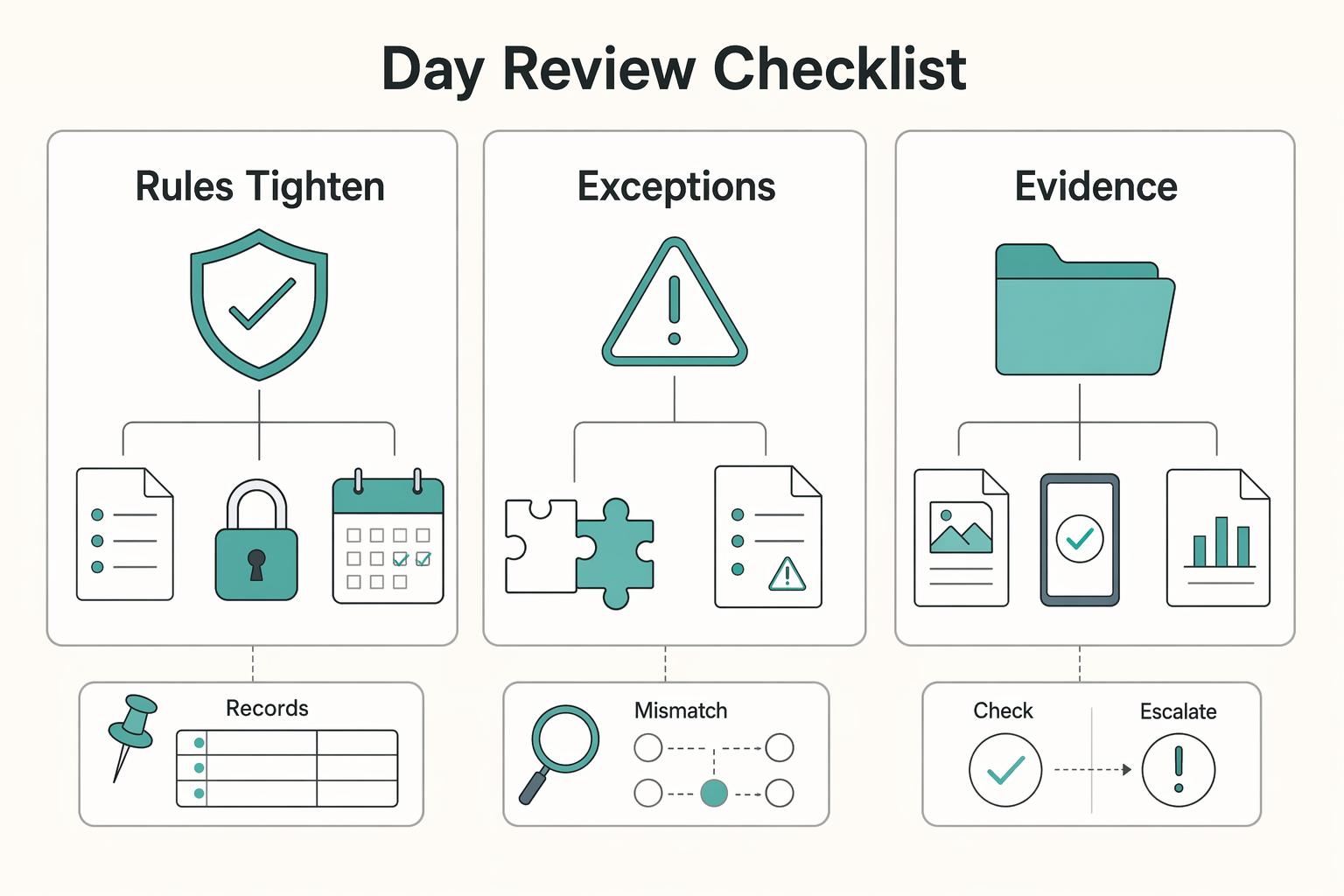
After any negative review, run this checklist:
- Save the message thread, timestamps, photos, and cleaner or co-host notes.
- Classify the complaint before writing your public response.
- Post only after you can state the corrective action or expectation clarification.
- Update one concrete item the same day in your listing, house rules, or guest messages.
We covered related systems in How to Automate Your Airbnb with Smart Home Tech.
Frequently Asked Questions
Can you offer a refund if the guest changes or removes the review?
No. Airbnb’s review policy says users may not exchange something of value, including a refund or discount, to influence a review. Resolve the service issue separately through Airbnb’s official channels and keep a clear in-platform record, including any Resolution Center or AirCover claim details. If you tie money to review behavior, you create a policy risk that can go beyond the review itself.
Should you reply to a mid-range or mixed review?
It depends on context. Start with Tier 1 and decide whether you are looking at a service failure, an expectation mismatch, or a possible policy issue. Then use Tier 2 logic for the reply style: acknowledge a real miss and state the fix, or calmly clarify a mismatch without arguing. There is no fixed rating cutoff that always requires a response, so decide based on what happened in the reservation.
How long do you have to respond, and can you edit it later?
Airbnb’s response and edit windows can change, so verify the current rules in-product before you post. The practical rule is the same: do not answer before you classify the review, check the reservation thread, and confirm whether a policy-based review dispute is the better first move. If you think the review is fake, irrelevant, or retaliatory under Airbnb’s policy, file a review dispute before you spend time polishing the public reply.
What is the quick decision checklist?
Respond now if the review is first-hand, policy-compliant, and best handled with a short public answer.. Escalate if you can point to a policy issue such as fake, irrelevant, or specific retaliatory grounds.. Log for follow-up if the review reveals a repeat operational or listing-accuracy problem, even if you also reply publicly.
Try a related tool
Researched and edited by the Gruv editorial team. Gruv builds cross-border billing, payouts, and finance-operations software for global businesses.
Sources
Includes 6 external sources outside the trusted-domain allowlist.
- hammer.purdue.edu/ndownloader/files/34907289trusted
- wp0.vanderbilt.edu/lawreview/wp-content/uploads/sites/278/2024/...trusted
- airbnb.com/help/article/2673external
- airdna.co/blog/airbnb-double-bookingexternal
- betterhomephotos.net/how-to-handle-bad-vacation-rental-reviews-re...external
- blog.tokeet.com/how-to-handle-retaliatory-airbnb-guest-reviewsexternal
- community.withairbnb.com/t5/Support-with-your-bookings/Review-charact...external
- community.withairbnb.com/t5/Community-cafe/How-to-deal-with-a-bad-or-...external
Educational content only. Not legal, tax, or financial advice.
Related Posts

Thailand's Long-Term Resident (LTR) Visa for Professionals
For a long stay in Thailand, the biggest avoidable risk is doing the right steps in the wrong order. Pick the LTR track first, build the evidence pack that matches it second, and verify live official checkpoints right before every submission or payment. That extra day of discipline usually saves far more time than it costs.
How to Handle Difficult Guests as an Airbnb Host
Your property may perform like a strong asset, but every accepted booking still introduces one variable you do not fully control: the guest. Even experienced operators feel that tension. The answer is not better luck. It is better process.

The Freelance Payment Penalty: A Modeled Audit of Platform Fees, FX Spreads, and Payout Delays
The money rarely disappears through a single, easy-to-spot fee. The real loss is stacked. A marketplace takes its commission, a processor adds a charge for international cards, a bank or payment company converts the currency at a spread, a platform holds the funds before release, and a wire sheds a little to intermediaries on the way in. Each layer looks defensible on its own, but the worker feels the combined result as a smaller deposit and a later payday.