
Quick Answer
Handle it by tying the clause to a specific breach, using a reasonable pre-agreed amount or formula that reflects documented loss, and avoiding anything that looks punitive. In a freelance contract, the safest approach is to define the trigger clearly, match it to your SOW, milestones, and invoice terms, and keep records showing how you estimated the amount before signing.
What a Liquidated Damages Clause Is, and Why Penalty Framing Creates Risk#
A liquidated damages clause is a pre-agreed payment term tied to a specific trigger, written into the contract before problems start. Its job is simple: set the remedy while expectations are clear, instead of improvising after trust breaks down and timelines slip.
The first check is practical. Make sure the term reads like a business remedy, not a pressure tactic. In the reported dispute below, that penalty framing is what created enforceability risk.
A practical warning appears in a reported March 25, 2022 decision summary. A federal judge would not enforce a liquidated-damages provision that required a systems integrator to hand over 25 percent of revenue from soliciting a vendor's clients, in a project involving work across 600 Cumberland Farms stores. The reported problem was that the term looked like a penalty clause. Use that as your filter. If you cannot explain the amount in plain business terms, revise it.
| Approach | Purpose | Amount handling after breach | Enforcement risk |
|---|---|---|---|
| Liquidated damages provision (reported case) | Pre-agree a payment formula tied to a defined trigger | Amount was set as 25 percent of covered revenue | Not enforced in the reported dispute |
| Penalty clause (reported label) | Frame a term as punitive | Amount is treated as punishment | Linked to unenforceability risk in the reported dispute |
With that baseline in place, the real drafting question is not whether to use the clause. It is where it fits and how to tie it to a specific breach you can actually prove. Related: What is a 'Force Majeure' Clause and Do You Need One?.
The 'Cash Flow Armor' Clause: Your Antidote to Late Payments#
For late payment, the safest use of a pre-agreed charge is narrow. It can compensate for a predictable cash-flow hit and collection burden, rather than punish a client for being slow. If you cannot support the amount from records you already keep, a simpler payment remedy may be the better call.
Step 1. Define the trigger in plain language#
Write the trigger so finance and legal can apply it the same way every time. Identify which invoice due date controls, what event turns the charge on, and what notice or cure steps apply. Do not lock in a grace period, percentage, or daily amount until you verify what fits the contract context.
Start with an unresolved draft clause, then complete the timing, amount, notice, cure, and invoicing mechanics only after contract and counsel verification:
If an invoice remains unpaid beyond the grace period verified from the contract and counsel after the due date stated on the invoice, and after any required notice under this Agreement, Client will pay the amount or formula verified from the governing jurisdiction, contract, counsel, and source records as a pre-agreed estimate of the reasonable administrative and financing costs caused by the delayed payment. The parties intend this amount as compensation for anticipated loss, not as a penalty. Any notice, cure, or invoicing mechanics must be verified from the contract and counsel before use.
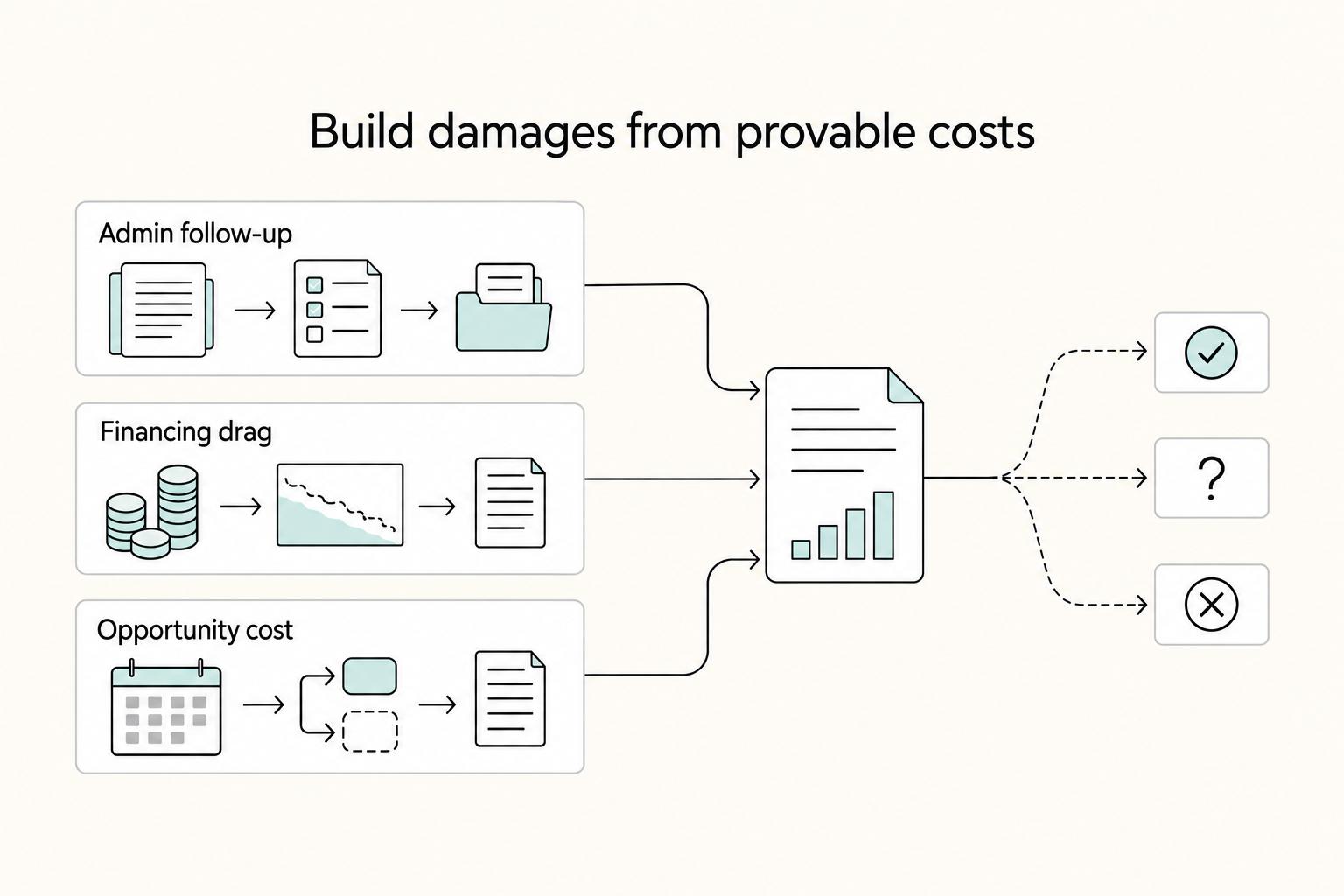
Step 2. Build the amount from costs you can prove#
Do not start with a number and reverse-engineer a rationale. Start with repeatable cost categories, then keep the support in your deal file.
| Cost type | Practical basis for the estimate | Evidence to retain |
|---|---|---|
| Administrative follow-up | Reminder cycles, statement reissues, account reviews, internal approvals | Time logs, email trail, calendar entries, collections notes |
| Financing drag | Cost of carrying receivables longer than planned | Bank records, credit terms, accounting notes on cash-timing impact |
| Opportunity cost | Work or capacity you could not redeploy while cash stayed tied up | Capacity plan, subcontractor records, rescheduling notes |
A useful checkpoint is whether you could recreate the estimate from existing records in minutes. If you need a fresh story each time, the amount may be too loose.
Step 3. Use this clause only when it fits better than simpler tools#
This approach may fit when your late-payment harm is predictable and documentable, but awkward to prove line by line in a dispute. If you just want a familiar invoice consequence with less friction, ordinary interest or standard late-fee language may be cleaner. If your goal is to stop exposure from growing, milestone holds or suspension rights may be more practical than trying to price the damage after the fact.
Also be careful about importing labels from unrelated legal regimes. A merits-stage reply brief in the California Supreme Court includes a dedicated heading arguing that Section 226.7's remedy is not liquidated damages. The same brief also includes headings on treatment of Section 226.7 premium wages and on ten percent prejudgment interest for wages under that statute. Treat that as a boundary signal, not a plug-and-play rule for a standard services contract, and do not assume that ten percent figure applies outside that wage context.
Step 4. Operationalize enforcement so it stays routine#
A late-payment term is easier to apply when it is procedural, not personal. The contract term, invoice reference, billing automation, and escalation path should all point to the same trigger and the same amount logic.
Use a simple flow:
- Contract or SOW: include the verified trigger and amount logic.
- Invoice: repeat a short reference to the same term.
- Automation: flag only when the verified trigger is reached.
- Escalation: send finance notice, then sponsor escalation, then collections or counsel review if justified.
If those pieces do not match, you may create a dispute before you collect a dollar. We covered this in detail in Limitation of Liability Clause for Freelance Software Developers.
The 'Client Accountability' Clause: Protecting Your Time from Delays#
Delay charges are easy to overuse and hard to defend unless a client-caused delay creates documented project loss. If the delay just moves dates around, extend the timeline and leave the charge out.
Step 1. Define the dependency before pricing any consequence#
Before you assign money to a delay, make the dependency objective. The contract should state what the client had to provide, when it was due, and what work could not move without it.
| Term | Meaning |
|---|---|
| Client dependency | Work that cannot proceed until the client provides a required item or action. |
| Milestone input | A contract-listed approval, asset, access credential, decision, or dataset tied to a milestone event. |
| Timeline extension | An adjustment to delivery or performance dates when qualifying delay occurs. |
| Cure period | A written-notice window to fix a missed input before stronger remedies apply. |
Use those definitions consistently so enforcement is not subjective.
Use this verification check before you draft the consequence. Each dependency should map to one milestone, one owner, and one due trigger. If you cannot identify the blocked activity and date, the charge will look arbitrary later.
Step 2. Use a modular clause with placeholders#
Once the dependency is clear, keep the clause modular until you verify the timing and loss logic. That reduces the chance that the amount outruns the actual project impact.
If Client does not provide the required milestone input described in the verified Schedule or SOW section within the response window verified from the contract and counsel, Provider may issue written notice identifying the blocked task and project impact. If Client does not cure within the verified cure window, delivery dates will be extended by the period of delay. If the delay causes material project impact and Provider can document resulting delay cost, Client will pay the amount or formula verified from the contract, SOW, counsel, and source records as a pre-agreed, reasonable estimate of that cost, not a penalty. This amount excludes delay attributable to Provider fault or negligence.
Drafting benchmarks in some contract frameworks include 30 calendar days for a response window and 10 days or more for cure. Treat those as reference points, not defaults.
Step 3. Decide when to charge versus extend only#
This is the main judgment call. Charge only when the missed input blocks real work and creates loss you can document. A schedule extension is enough when the impact is minor, the task had usable float, or your side also contributed to the delay.
Apply delay damages only when all three are true:
- A missed client input blocked a scheduled milestone.
- The project impact was material.
- You can document delay cost with a reasonable compensation logic.
Charging for every late comment, missed email, or slow approval can create penalty risk. If you plan to enforce a delay clause, build the proof path before kickoff. A responsibility matrix makes that practical.
Step 4. Make enforcement procedural with a responsibility matrix#
| Required client input | Owner | Due trigger | Consequence path |
|---|---|---|---|
| Brand assets or source files | Client PM | Within [response window] of written request | Notice to cure window to timeline extension |
| Draft approval or rejection | Named approver | By milestone review date | Notice to cure window to extension to verified charge logic only if material delay cost is documented |
| System access or credentials | Client admin | Before build/test start | Notice to cure window to extension. Charge only if blocked time is documented |
If this matrix is incomplete at kickoff, do not expect delay charges to save you later. Need the full breakdown? Read Limitation of Consequential Damages in Freelance Contracts.
The 'Anti-Ghosting' Clause: Securing Revenue Against Sudden Cancellation#
Cancellation language is where even a good clause can drift into penalty territory. The better approach is to recover documented cancellation loss by phase, invoice event, and committed capacity, not with one flat number that has to cover every scenario. Keep any liquidated-damages amount reasonable relative to anticipated or actual harm, because unreasonably large amounts can be treated as penalties.
Step 1. Define each exit event before you set money terms#
Start by separating the exit paths. Enforcement is cleaner when each event has one clear meaning and one remedy path.
| Exit event | Meaning | Key detail |
|---|---|---|
| Cancellation | End of contract for breach by the other party. | Separate from no-fault termination. |
| Termination for convenience | A no-fault right to end all or part of the work if the contract allows it. | Applies only if the contract allows it. |
| Pause or suspension | A written stop or delay that does not automatically end the contract. | Does not automatically end the contract. |
| Abandonment | Define this in your contract with written triggers, for example no response, no approval, or no direction after notice. | Do not rely on a generic legal meaning. |
| Non-refundable amounts | Sums tied to work already delivered, capacity already reserved, or project-specific setup already performed. | Tie them to delivered work, reserved capacity, or setup already performed. |
Define these paths in the contract itself rather than relying on assumptions, especially for abandonment and non-refundable amounts.
Use a simple verification check here too. If a pause can quietly become a termination, or abandonment has no written trigger, the charge will look arbitrary.
Step 2. Tie remedies to phases and invoice events, not a flat fee#
A phase-linked structure is easier to defend because it tracks anticipated harm as the project deepens. It also forces you to connect the remedy to actual commitment points in the SOW.
If Client exercises termination for convenience, or if Client abandons the project as defined in the contract section verified for abandonment, Provider will be paid for conforming work performed up to the effective date stated in the written notice, plus any demonstrable non-refundable amounts expressly identified in the SOW for reserved capacity, onboarding, or project-specific procurement. If termination occurs after the Phase or Milestone A invoice event verified from the SOW, Provider may retain the deposit or threshold amount verified from the contract and counsel as stated in the contract. If termination occurs after the Phase or Milestone B acceptance event verified from the SOW, Client will also pay the additional liquidated damages amount verified from the contract, counsel, and source records as a reasonable pre-agreed estimate of cancellation loss that would be difficult to calculate after the event. Provider will use reasonable efforts to mitigate avoidable loss. Any change to these terms must be in writing.
Step 3. Use a decision table for charge logic and proof#
Once the exit events and phases are set, use the remedy that matches the point the project actually reached, then document it.
| Cancellation scenario | Remedy type | Rationale | Required documentation |
|---|---|---|---|
| Client ends before work starts and before any reserved-capacity trigger in the SOW | Apply the contract's refund/deposit rule; avoid retention not tied to documented commitment | Little or no performance; weak basis for retention beyond documented loss | Signed contract, invoice status, no kickoff or setup record |
| Client ends after kickoff or after a stated reservation/setup event | Retain only the deposit or listed non-refundable amount expressly stated in the SOW | Capacity or setup was already committed and may be hard to reassign | SOW clause naming non-refundable items, kickoff record, calendar allocation, invoice |
| Client ends after a milestone invoice is issued but before acceptance | Payment for work performed to effective date; possible retained deposit | Compensation for performed work, not a charge for unperformed future work | Timesheets or task log, draft deliverables, notice with effective date and scope |
| Client ends after milestone acceptance or after defined abandonment trigger | Payment for accepted work plus additional liquidated damages (if contract-defined and reasonable) | Deeper project commitment can make cancellation loss harder to prove after the fact | Acceptance record, notice trail, milestone invoice, capacity notes, mitigation notes |
Step 4. Connect this clause to SOW, acceptance, and notice mechanics#
This clause becomes usable only when the contract mechanics line up. The remedy in the master agreement has to connect to the phase names, invoice events, and acceptance steps in the SOW.
- Cross-reference exact SOW phases, milestone names, and invoice events that trigger retention or added fees.
- Tie milestone acceptance language to conforming deliverables.
- Require written notice that states the effective date and extent for termination or cancellation, and use written orders for pause/suspension.
- List required records: invoices, acceptance emails, delivery logs, timesheets, and reserved-capacity notes.
- Keep a mitigation sentence so recovery excludes avoidable loss.
If you cannot show the phase reached, the notice sent, and the work or capacity committed, treat the fee as weak on enforcement. This pairs well with our guide on How to Structure a Payment on Termination Clause in a Freelance Contract.
How to Test Whether Your Clause Would Hold Up#
Most drafting mistakes show up in one place: the term reads like punishment instead of compensation. Start with that filter, because polished wording will not fix a number that cannot be tied back to expected loss.
Step 1. Run the compensation test first#
Ask the direct question first. Does this amount estimate business harm, or is it trying to punish behavior?
A liquidated damages term should be a fixed amount or formula tied to loss. A penalty clause is an unreasonably high charge that acts like a fine. Under UCC § 2-718(1) (in the UCC sales context), the core test is whether the amount is reasonable in light of anticipated or actual harm and the difficulty of proving that loss later. Treat that as a drafting standard, not a universal rule for every contract type.
A good practical test is the language you use when you explain the clause. If your explanation sounds moral instead of economic, revise it. "We had reserved capacity and lost billable time" is defensible. "They should not get away with this" is not.
Step 2. Pressure-test the number before signing#
Before you sign, pressure-test the amount the way the other side or a judge would. The question is not whether the number feels fair in the abstract. It is whether the trigger, the loss logic, and the records all line up.
Use this three-part check:
- Identify the likely harm from this exact breach trigger.
- Write the estimate method, whether a formula, phase-based amount, or trigger-based retention, not just the final number.
- Confirm trigger-to-loss fit so the charge changes with materially different outcomes.
A useful checkpoint is whether you can explain the amount in two sentences using records you already keep. If you cannot, the term is probably too loose.
Step 3. Keep a short drafting file#
A short drafting file can help show the amount was reasoned in advance instead of invented after the dispute started.
Keep a compact evidence file created at contract formation:
- assumptions about expected loss by trigger
- estimate method or formula
- draft notes showing how the amount was set or revised
- negotiation notes on clause edits
- version history of clause language
These items are not universally required, but they make it much easier to show your work.
Step 4. Map each breach to logic and proof#
A practical way to test enforceability is to match each breach scenario to an estimation method and a record set. If you cannot make that match cleanly, the term likely needs work.
| Breach scenario | Defensible estimation logic | Evidence to retain |
|---|---|---|
| Client pays after stated due date | Pre-estimate tied to follow-up/admin burden and related cash-flow friction [your method] | Invoice terms, reminder trail, internal assumption notes, draft history |
| Client misses a required dependency and blocks work | Pre-estimate tied to idle reserved capacity or rescheduling loss for blocked time [your method] | Timeline, dependency list, calendar holds, timesheets, rescheduling notes |
| Client terminates for convenience after kickoff/setup trigger | Pre-estimate tied to nonrecoverable setup and committed capacity [your method] | SOW trigger, kickoff/setup records, allocation notes, invoice history |
| Client abandons after defined notice trigger | Phase-based estimate tied to cancellation loss once commitment is made [your method] | Notice trail, trigger record, milestone status, mitigation notes |
If you cannot point to the trigger record and the linked loss record, treat the term as weak.
Step 5. Add a jurisdiction check before relying on the clause#
Even a well-structured term can fail if you assume the same enforceability test applies everywhere. Governing law and contract type matter.
| Framework | Test described | Scope note |
|---|---|---|
| UCC § 2-718(1) | Whether the amount is reasonable in light of anticipated or actual harm and the difficulty of proving that loss later. | State law; sales-contract scope. |
| California Civil Code § 1671 | Generally validates these clauses unless unreasonableness is shown, evaluated under circumstances at contract formation. | Different treatment in certain consumer or dwelling contexts. |
| English law | Whether the detriment is out of all proportion to legitimate interest. | UK Supreme Court test. |
UCC § 2-718 is state law and provides a reasonableness test in its sales-contract scope, but it is not the whole story. California Civil Code § 1671 generally validates these clauses unless unreasonableness is shown, evaluated under circumstances at contract formation, with different treatment in certain consumer or dwelling contexts. Under English law, the UK Supreme Court test asks whether the detriment is out of all proportion to legitimate interest.
Before you rely on the clause, confirm governing law and venue, then have local counsel adjust the language if needed. Calling something "liquidated damages" does not make an overbroad or unsupported amount enforceable.
You might also find this useful: How to Write a Limitation of Liability Clause for a Freelance Contract.
Before you negotiate numbers, draft a clean baseline agreement with the Freelance Contract Generator so your liquidated damages language sits in a complete contract structure.
How to Negotiate This Clause Without Sounding Adversarial#
The negotiation usually goes better when you frame this clause as routine risk allocation, not a threat. Start with the project objective, narrow the trigger, then support the amount with records. That keeps the conversation commercial and can help support enforceability.
Before you start. Do one practical setup step before the call: open your draft clause, the exact triggering events in the SOW or timeline, and your short estimate file. If you cannot point to the trigger, the loss logic, and the records behind the amount, tighten the draft before you send it. Use a quick test on your own explanation. Can you describe the clause as compensatory and specific, without sounding punitive or personal? If not, simplify the language first.
Step 1. Set shared project goals first#
Open with the shared project interest, not the fallback remedy. That lowers the temperature and makes later pushback easier to diagnose.
Tell the client the clause is there to preserve predictability and reduce disputes if a defined event disrupts the work.
Collaborative version: "I include this in my standard agreement so we are clear upfront about what happens if payment, approvals, or cancellation affects the timeline. It keeps the project predictable for both of us."
Firmer fallback: "I use this term consistently because some losses are real but hard to prove later. Agreeing the trigger and formula now is cleaner than disputing damages after a disruption."
If they push back, identify what they actually object to: the clause itself, the trigger scope, or the amount. Negotiate that point, not the whole provision at once.
Step 2. Explain why the clause exists#
Keep the explanation short and factual. The term sets pre-agreed compensation for defined breach events where losses may be hard to prove later. It is not there to punish.
Email version: "This provision allocates risk in advance if a specific event happens, such as overdue payment after the agreed due date, delayed client inputs, or cancellation after a committed phase starts. It is not a fine. It is a pre-agreed way to handle losses tied to project disruption."
Keep the wording contractual, not emotional. "This applies if the project is abandoned after the agreed notice event" is much stronger than personality-based language.
Step 3. Negotiate scope and triggering events#
When you make concessions, narrow the trigger before you cut the amount. Specific milestones and triggering events can reduce friction and are often easier to defend later.
| Common client objection | Non-adversarial response | Acceptable concession that supports enforceability |
|---|---|---|
| "This feels punitive." | "Agreed, it should not be punitive. The trigger and amount should reflect expected loss." | Limit the clause to named events and milestones instead of broad terms like "any delay" or "any breach." |
| "The amount seems arbitrary." | "It comes from an estimate method, not a random figure. I can show the assumptions." | Use a formula tied to reserved time, setup work, or admin/rescheduling burden. |
| "This is too broad for our project." | "Then let's narrow where it applies instead of removing clarity." | Apply it only after kickoff, after a defined dependency miss blocks work, or after a defined cancellation trigger. |
After redlines, verify that the final trigger language matches records you actually keep, such as milestone dates, approval deadlines, invoice due dates, or dependency logs.
Step 4. Justify the amount with evidence, not confidence#
When the other side asks, "Why this number?", answer with objective criteria tied to the actual trigger. For example: "This amount is based on [X hours/days] of reserved capacity, [setup work completed], and [admin/rescheduling burden] if [specific trigger] occurs. We documented those assumptions when preparing the agreement."
Keep a short backup file with the estimate method, assumptions, draft history, and negotiation notes. A calm tone helps the deal move, but the records are what support the clause if the deal later goes sideways.
For a step-by-step walkthrough, see How to Write a 'Force Majeure' Clause That Covers Pandemics and Geopolitical Events.
Conclusion: Set the Trigger, the Amount, and the Records Before Signing#
Treat this clause as an operating control, not legal theater. The real work happens before signing: deciding which breach event activates it, what compensatory amount or formula applies, and what records support that choice.
1) Set clear breach triggers before signing. Name the trigger in exact terms and make sure it matches the contract documents you actually use. Clear trigger language can reduce avoidable disputes later.
2) Enforce it through one consistent workflow. Use the same trigger and amount or formula across the contract, invoices, reminders, and internal notes. Keep a short pre-estimate file showing your logic and why the amount is a reasonable forecast of loss, not a punishment.
3) Protect schedule and cash flow before problems start. When the term is agreed in advance and tied to loss that is hard to prove later, you can respond from the signed process instead of improvising. That can support cleaner escalation, steadier scheduling, and better cash-flow control.
What to do next.
- Confirm each trigger is specific and aligned with your SOW, milestones, invoice terms, and approval deadlines.
- Confirm your pre-estimate documentation is complete and understandable to a third party.
- Confirm negotiation language reflects the final commercial deal, not assumptions left in email.
- Confirm jurisdiction-specific legal review for material amounts, cross-border contracts, or uncertain governing-law interpretation.
Used this way, the clause supports professional risk management and mutual clarity, not confrontation.
To make these protections easier to enforce in real projects, define scope, milestones, and handoff points with the SOW Generator.
Frequently Asked Questions
Can you use a liquidated damages clause as a freelancer?
Yes, often, if the term is clearly stated in the contract and agreed before signing. Use it for a specific client breach that may cause real loss that is hard to prove later, and keep the matching records together. If the deal is cross-border or the client paper is heavily one-sided, ask counsel to review governing law and forum selection as separate clauses.
What does a workable clause look like?
A workable clause ties a specific breach trigger to a fixed amount or formula and states that the amount is a reasonable forecast of loss, not a penalty. It should also include any notice or cure timing that applies. Before signing, make sure the trigger matches your SOW, milestone table, dependencies, and invoice terms.
How do you calculate a reasonable amount?
Calculate it from anticipated harm at signing, not from frustration after a breach. Keep the amount reasonable in light of expected or actual harm, proof difficulty, and whether other remedies are practical. Document the logic in a short file, including reserved time, setup work, admin collection effort, rescheduling impact, and negotiation notes.
What is the difference between this and a penalty?
Liquidated damages are a pre-agreed amount or formula for breach. A penalty is an unreasonably high charge meant to punish breach. If your draft reads like a deterrent or fine instead of compensation, narrow the trigger, adjust the amount, and get legal review for higher-risk deals.
Are these clauses always enforceable?
No. Enforceability depends on drafting and evidence, not the label. The term should be explicit before signing, tied to defined triggers, and reasonable relative to anticipated or actual harm and proof difficulty. If the trigger is vague, the amount is arbitrary, or your records do not show how you set it, fix the clause before execution.
Should you get a lawyer to review it?
Yes, if the amount is material, leverage is uneven, or the contract touches more than one country. Cross-border deals can create choice-of-law uncertainty, and governing law does not automatically choose the court or forum. In the U.S., state-level differences can matter, so send counsel the full contract plus your trigger and amount backup notes.
What should you check before you sign?
Before you sign, confirm each trigger is specific and matches your SOW, milestones, invoice terms, and approval deadlines. Confirm the amount is a fixed sum or formula you can explain from records you already keep, and save your support file with the estimate method, assumptions, draft history, and negotiation notes. If the deal is cross-border, confirm both governing law and forum selection, and pause for legal review if the amount is large, redlines are heavy, or the rationale looks punitive.
Try a related tool
Researched and edited by the Gruv editorial team. Gruv builds cross-border billing, payouts, and finance-operations software for global businesses.
Sources
- acquisition.gov/far/11.501trusted
- acquisition.gov/far/52.242-17trusted
- govinfo.gov/content/pkg/CFR-2006-title48-vol3/html/CFR-2...trusted
- jud.ct.gov/LegalResources/Docs/LJDocs/CTReports/FullVol...trusted
- law.cornell.edu/wex/liquidated_damagestrusted
- law.cornell.edu/wex/penalty_clausetrusted
- law.stanford.edu/wp-content/uploads/sites/default/files/event...trusted
- michigan.gov/dtmb/-/media/Project/Websites/dtmb/Procureme...trusted
Educational content only. Not legal, tax, or financial advice.
Related Posts

Germany Freelance Visa Application Path for Freiberufler and Gewerbe
Choose your track before you collect documents. That first decision determines what your file needs to prove and which label should appear everywhere: `Freiberufler` for liberal-profession services, or `Selbständiger/Gewerbetreibender` for business and trade activity.
Do Freelancers Need a Force Majeure Clause in Client Contracts?
If you do cross-border client work, this clause is not filler. It is a risk-control tool for moments when an extraordinary event directly prevents performance. Whether it works depends on your wording and the governing law in the contract.

The Freelance Payment Penalty: A Modeled Audit of Platform Fees, FX Spreads, and Payout Delays
The money rarely disappears through a single, easy-to-spot fee. The real loss is stacked. A marketplace takes its commission, a processor adds a charge for international cards, a bank or payment company converts the currency at a spread, a platform holds the funds before release, and a wire sheds a little to intermediaries on the way in. Each layer looks defensible on its own, but the worker feels the combined result as a smaller deposit and a later payday.