
Quick Answer
Handle the request by separating deliverables from your method, diagnosing the real concern, and documenting the split in the contract and SOW. Offer visibility, approvals, or listed process access if the issue is trust or control, but keep pre-existing methods, templates, know-how, and reusable assets out of the deliverables unless a specific transfer is separately defined, priced, written, and signed.
Your Shield and Sword: How to Codify Control in Your Contract and SOW#
Treat this as risk allocation, not a personality clash. Start by separating ownership. You can grant rights in agreed deliverables while reserving your method, know-how, and reusable process assets, then document any broader transfer explicitly in the contract. Under U.S. copyright rules, copyright transfers should be written and signed. Use this roadmap: diagnose the request, define the collaboration boundary, then document that split in the SOW and contract.
| Client ask reflects | Response path |
|---|---|
| Trust concern | Offer more visibility through quality checks, milestones, and approvals |
| Compliance requirement | Ask for the exact policy, procurement rule, or data-handling requirement driving the ask |
| Control behavior | Narrow the conversation to decision rights, reporting cadence, and acceptance criteria instead of ownership |
Use that frame early so you do not end up debating ownership language before you know what is really driving the ask.
Diagnose the real issue first#
Diagnose before you negotiate terms. "Own everything" is often a position, not the real issue. Your job is to identify the underlying need. By the end of the call or email thread, you should be able to state their real concern in one sentence.
Define the boundary in the SOW#
Define the boundary in the SOW by describing required results, not your internal method. Keep scope, timelines, dependencies, and acceptance criteria explicit, and keep your internal workflow out of scope.
If your contract sits under U.S. copyright rules, keep the legal split clear. Delivering a file does not by itself transfer copyright, and any transfer must be written and signed. If you see broad assignment language or "work made for hire," treat it as a review point, not harmless boilerplate, because qualifying work-made-for-hire terms can shift authorship and ownership.
Put the split in both documents#
Document the split in both places: rights language in the contract, execution language in the SOW. The contract should state what the client receives in the final deliverables and what you retain in pre-existing know-how, templates, and reusable process assets. The SOW should list deliverables without turning your process into a deliverable.
Before you sign, compare the deliverables list to your working materials. If your checklist, template set, or review method is listed as a deliverable, tighten the draft. Then move into the right response path for the underlying concern and keep the deal moving without giving away your core operating asset. For related guidance, see How to Protect Your Intellectual Property as a Strategic Consultant.
First, Diagnose: Why Does Your Client Really Want to Own Your Process?#
Diagnose first, then redline. Treat "own your process" as a hypothesis to test, not a fact. Use concrete procedural signals before you infer motive, and confirm what is actually required before you discuss ownership terms.
| Hypothesis to test | Observable signals | Risk if you misread it | Best posture before contract redlines |
|---|---|---|---|
| Trust gap | Concerns about visibility, quality, or dependency | You debate legal wording when they mainly want reassurance | Increase transparency and keep ownership language narrow |
| Formal process requirement | Requests tied to a policy, questionnaire, or disclosure-style fields and deadlines | You treat a required intake step as overreach and create friction | Ask for the exact document, owner, and mandatory fields |
| Control preference | Strong involvement in approvals, sequencing, or day-to-day direction | You over-focus on clauses and miss an operating-model issue | Define decision rights, review points, and intervention limits |
Identify who is asking and why#
Start by identifying who is driving the request and what document is driving it. The same phrase can come from different stakeholders, and the right response depends on the source.
Before the next call ends, pin down the request owner, the form or policy behind it, and whether it is mandatory or preferred. If they cannot identify those basics, treat it as a yellow flag and ask: "Before we change ownership terms, who needs this, what document requires it, and what problem is it solving?"
Test whether the issue is really trust#
If the ask sounds more relational than procedural, test the trust hypothesis first. Ask what visibility would resolve the concern: milestone demos, review checkpoints, status updates, or explicit acceptance criteria.
Request artifacts that confirm the need, such as their reporting format and acceptance template. Then set the boundary clearly: "I can provide visibility and review structure. My internal method, templates, and reusable materials are not project deliverables unless listed separately."
Treat formal asks as compliance until you confirm otherwise#
If the ask sounds formal, treat it as a process requirement until proven otherwise. In litigation contexts, Rule 26 requires certain initial disclosures without awaiting a discovery request. Those disclosures can include individuals likely to have discoverable information (with contact details), documents, ESI, and tangible things that support claims or defenses, damages computations with supporting material, and relevant insurance agreements. Rule 26 also ties timing to the Rule 26(f) conference, with a default 14-day window for initial disclosures (and 30 days for a party later served or joined). This framework does not govern ordinary freelance deals.
If you see terms like protective orders, motions to compel, or objections to subpoenas, do not infer intent. Ask for the exact policy, questionnaire, or exhibit, and confirm which fields are required.
Convert control concerns into operating rules#
If the client is focused on directing how work gets done, test for control preference. Ask which decisions they must approve, what review cadence they need, and what happens when feedback is delayed. Then convert that into concrete operating rules.
Keep the language narrow instead of getting stuck in an abstract IP ownership debate: "You approve scope, priorities, and final acceptance. I choose the working method used to produce the deliverables." Once the diagnosis is clear, you can move into the right collaboration model with much less friction.
Next, Define: Present Tiered Collaboration Models#
After diagnosis, give the client a clear three-tier choice and tie each tier to the right legal package. Keep the boundary explicit: access, approvals, and file delivery are not the same as ownership transfer.
Match the request to the right tier#
Match the request to a tier before you discuss price or redlines, and make the ownership line visible from the start.
| Tier | Best fit when the ask is really about | Ownership boundary | Governance and approvals | Included artifacts | Change-control burden | Liability position |
|---|---|---|---|---|---|---|
| Advisor | Trust gap with standard expert-led delivery | You retain pre-existing methods, templates, and reusable materials; client receives deliverables and contract-defined usage rights | Client approves scope and final acceptance, with limited checkpoints | Final deliverables and agreed reporting | Low | Liability stays tied to deliverables, not your internal method |
| Collaborator | Higher visibility needs or control preference | You retain the underlying method; client gets defined process access or a defined license to listed materials | Named review gates, approval windows, and decision rights | Deliverables, checkpoint outputs, and only listed process documents | Medium | Coordination risk rises, so approval timing and delay handling must be documented |
| Transfer | A genuine ownership requirement tied to policy, legal, or strategy | Ownership transfers only for specifically listed assets; the agreement should state which rights are excluded and remain yours | Deep involvement, formal signoff, often handoff or training obligations | Deliverables plus explicitly listed transferred files, documents, or know-how | High | Higher exposure, so scope, exclusions, and responsibility split must be explicit |
If you cannot list the exact artifact bundle, the tier is still too vague.
Use the right legal concept for each tier#
Use the right legal concept for each tier so process access does not get mistaken for process ownership.
| Legal concept | What it means | Key note |
|---|---|---|
| License | The client can use defined IP, and you keep ownership | It can be exclusive or nonexclusive, and limited by scope such as field or geography |
| Assignment/transfer | Ownership of defined IP assets moves to the client | Rights can be transferred in whole or in part, so you can define a limited transfer instead of using an all-or-nothing approach |
| Work made for hire | Not a default label for every freelance engagement | Treat it as a specific legal structure that needs careful drafting |
Keep these guardrails in view:
- Copyright ownership and ownership of a file or copy are legally distinct.
- Sending source files or documentation alone does not transfer copyright rights.
- In U.S. copyright law, a transfer is not valid unless it is in signed writing by the rights owner or authorized agent.
- Rights can be transferred in whole or in part, so you can define a limited transfer instead of using an all-or-nothing approach.
- If sensitive process detail is shared during negotiation, put an NDA in place first.
Present the tier as a business choice#
Present each tier as a choice, not a concession, and move unclear asks into contract language quickly.
- Advisor script: "You receive the project deliverables and agreed usage rights. I retain my pre-existing methods, templates, and reusable materials. If you want more visibility, I can add checkpoints without changing ownership."
Decline: broad phrases like "all work product and process." Escalate: explicit pre-existing IP exclusions and a tight deliverables definition.
- Collaborator script: "If your team needs more control, we can add approval gates and provide listed process materials under license. That gives access and governance without ownership transfer."
Decline: vague "shared ownership" wording. Escalate: list licensed materials, license type, whether exclusive or nonexclusive, and scope limits.
- Transfer script: "If you need ownership of a defined process asset, we can structure a separate transfer with separate pricing. The agreement must identify exactly what is assigned and what is excluded."
Decline: blanket transfer language covering anything created, used, or learned. Escalate: a schedule of transferred assets, excluded materials, handoff duties, and jurisdiction-specific formalities.
Once they choose a tier, move it into enforceable contract and SOW terms right away. We covered this in detail in How to Set Up a Retainer Agreement with a Client.
Finally, Document: Fortify Your Contract and SOW#
Once the client chooses a tier, capture it in signed writing early, where appropriate for your jurisdiction and contract type. Most disputes here do not start with bad intent. They start with ordinary pressure, unclear expectations, missing documentation, and terms that do not clearly address the issue or scope.
Split the documents cleanly and keep them aligned#
Use a clean document split, then keep those documents aligned. This is a practical structure, not a universal rule.
| Document | Role | Examples named here |
|---|---|---|
| MSA (if used) | Stable legal terms and definitions | How changes are handled and what controls if documents conflict |
| SOW | Engagement specifics | Listed deliverables, responsibilities, review steps, and acceptance criteria |
| Order form (if used) | Commercial snapshot | Price, payment timing, term, and reference to the controlling MSA and SOW versions |
Quick check: obligations and deliverables named in one document should map to matching terms in the others.
Define ownership buckets in plain language#
Define boundaries in plain language so permissions are not mistaken for ownership. Avoid broad phrases like "all work product" unless you also define what that includes.
State key boundaries clearly:
- what the client receives,
- what each party retains,
- what each party may use with permission.
If a neutral third party could not sort each file or artifact from the definitions alone, rewrite the definitions. If ownership language keeps getting mixed up, use Work for Hire vs. Assignment of Rights as a reset point.
Lock the highest-friction clauses first#
Lock the highest-friction clause areas first, then mirror them in the SOW.
| Clause area | Purpose | Protects who | Common client pushback | Fallback path |
|---|---|---|---|---|
| Pre-existing materials | Clarifies what each party brings into the project | Both sides | "We need everything used on the project" | List materials in writing and define permitted use |
| Deliverables boundary | Separates final outputs from materials used to produce them | Both sides | "If we paid for it, we own it" | Limit ownership language to specifically listed deliverables |
| Source files | States whether editable or native files are included | Both sides | "We need full control later" | State source-file terms clearly in the contract documents |
| Change requests | Prevents scope creep from being treated as included work | You | "These are minor tweaks" | Require written approval before extra work starts |
| Acceptance criteria | Defines how completion is measured | Both sides | "We'll know it when we see it" | Use objective criteria in the SOW |
Use short prompts you can enforce later#
Use short drafting prompts you can fill in quickly and enforce later.
- "Source files: state whether they are included. If they are, list exact file types and delivery format. If they are not, state that clearly in the contract documents."
- "Change request process: document the request in the agreed channel, price it before work starts, and record approval by the responsible client contact."
- "Acceptance: deliverables reviewed only against SOW criteria documented in writing."
- "Approvals and key communications must be documented in writing and stored with the contract file."
This discipline matters because risk often shows up later, at the trigger event, not at signing. If you are using California counsel or templates, keep contract basics explicit. That includes offer, acceptance, consideration, capable participants, and lawful purpose, consistent with the cited framework under CC §1549 and CC §1550.
For a step-by-step walkthrough, see How to Handle a Client Who is Micromanaging Your Project.
Before you send terms, build a clean draft you can redline for ownership and liability boundaries with the SOW Generator.
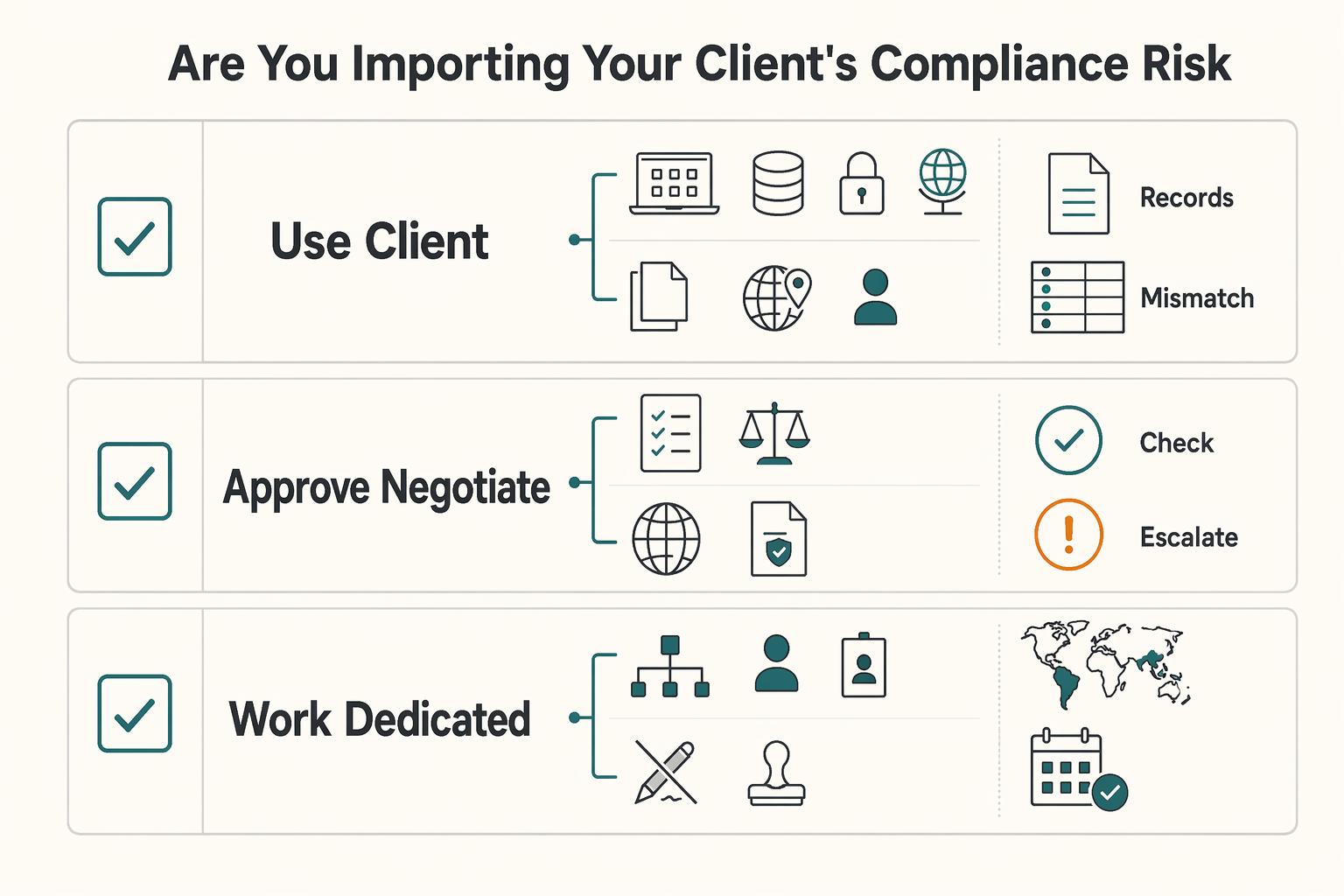
The Global Professional's Blind Spot: Are You Importing Your Client's Compliance Risk?#
Yes, you can import real compliance risk when a client requires you to use its systems, data, and workflows. The practical move is to map the required setup first, classify your role from actual activities, and contract only the responsibilities that match that role.
Start with a written access map before kickoff. Cover required tools, data types, permission levels, countries involved, whether you are customer-facing, and whether you can approve or sign anything in the client's name. If that cannot be documented, pause before accepting access.
| Client requirement | Risk imported to you | Contract control to add | Operational step before starting work |
|---|---|---|---|
| Use client tools with EU/UK personal data | You may be a processor for that activity and must follow documented instructions | Data-processing terms with mandatory controller-processor clauses, including documented-instruction limits and required audit or inspection cooperation for your processing | Get written instructions, data categories, access scope, and transfer paperwork ownership, including whether SCCs are used where relevant |
| Approve or negotiate contracts in client's name | Facts may support dependent-agent PE analysis | State you have no authority to conclude contracts or bind the client unless separately agreed in writing | Remove signature or approval permissions and any external positioning that implies binding authority |
| Work from a dedicated client location as if part of local operations | Facts may support fixed-place PE analysis | Record the intended contractor setup and whether any client place of business is made available for carrying on the client's business | Document where work happens, how often, and how you are represented externally |
For data protection, keep one rule in mind: labels do not control by themselves, actual behavior does. If the client decides the purpose and means and you only process on documented instructions, your contract needs the mandatory controller-processor terms, including required audit or inspection cooperation for your processing activity. At the same time, avoid taking on a broad duty to audit or guarantee the client's full privacy program.
For tax exposure, screen early for PE facts instead of arguing legal conclusions by email. HMRC describes two broad routes useful for triage: fixed place and dependent agent. PE rules vary by jurisdiction. Use that as an early warning test, then escalate jurisdiction-specific questions to local counsel.
Use a short clause blueprint:
- Allocate responsibility by role, with the client responsible for legality of its mandated tools, instructions, and business decisions.
- State you are not engaged to audit the client's overall privacy, tax, or regulatory framework.
- Include processor commitments only to the extent your role requires, including documented-instruction limits and required cooperation.
- Require a client warranty that it can lawfully grant access and lawfully operate required systems and transfer arrangements.
- Add a written escalation-and-pause path if an instruction appears to create legal risk.
Before signing:
- Map every required system, permission level, and data category.
- Confirm role classification per activity, whether controller, processor, or neither.
- Document which compliance duties stay client-controlled.
- Route unresolved cross-border privacy or PE issues to qualified local counsel before production access starts.
You might also find this useful: How to Handle a Client Dispute Over Intellectual Property.
Conclusion: Decide Ownership Early and Put It in Writing#
Treat "Me, Inc." as your operating rule: make ownership and responsibility decisions early, explicitly, and in writing. If a term is too vague for the contract or Statement of Work (SOW), it is too vague to rely on in a client call.
Diagnose before you negotiate#
Diagnose the request before you negotiate language. When a client asks to own your process, ask what they actually need: accepted deliverables, editable source files, audit visibility, training, or continuity coverage. If you cannot name the exact right or artifact in one sentence, pause and clarify before agreeing to ownership wording.
Define the deal in business terms#
Define the deal in concrete business terms. In the conversation, separate final deliverables from your pre-existing methods, tools, and working materials, then state what is included and what is not. If the client needs more access, frame it as added rights to named materials, not a blanket transfer.
Document the boundary before signature#
Document the boundary in the contract and SOW. Use the SOW to define scope, timeline, and cost, and to align expectations and responsibilities on both sides. List deliverables, ownership treatment, source-file handling, and how scope changes will be handled so the contract, SOW, and proposal all match before signature.
In practice, this gives you clearer scope boundaries and ownership terms, and it can help reduce disputes and unexpected cost or delay caused by misunderstandings. A repeatable structure also helps you avoid ad hoc email language from deal to deal.
Before your next proposal, review your current contract and SOW language and tighten any weak ownership or liability wording. This pairs well with our guide on How to Structure a 'Limitation of Liability' Clause when using OpenAI's API in a Client Project.
If this client setup includes cross-border payment ops and compliance handoffs, contact Gruv to confirm fit before you finalize the engagement.
Frequently Asked Questions
What contract clauses most directly protect my process and other pre-existing IP?
Use a pre-existing IP clause plus a deliverables clause. The first should state that your methods, templates, know-how, and other assets from before the engagement remain yours. If editable files may be handed over, add a separate source-file transfer clause and avoid broad catch-alls unless the carve-outs appear in the same section.
How do I respond when a client wants to own process?
Keep the discussion on specific rights instead of abstract ownership language. Ask whether the client actually needs visibility, continuity, audit access, source files, training, or transfer of defined materials. Then grant those named rights in the contract while stating that your pre-existing IP stays yours unless separately transferred and priced.
How do I separate deliverables, tools, and source files without creating confusion?
Use one compact ownership table in the agreement so each category is explicit. Define final deliverables, pre-existing tools and methods, and source or native files separately, and document each category in the main IP clause and SOW. Do not rely on unstated defaults.
Are source files included automatically?
Do not assume source files are included automatically. List the exact file types, delivery method, timing, and whether rights are licensed, temporary, or permanently transferred. State clearly that only files named in the source-file clause are included.
How should I price extra ownership, deeper access, or heavy client involvement?
Price extra ownership, deeper access, or heavy client involvement separately from your base service fee. Keep them on distinct line items and confirm the terms at the fee agreement checkpoint so ownership and responsibility are documented before work starts. Avoid ad hoc concessions in chat.
What is the practical difference between a deliverable and my process?
A deliverable is the agreed output for the engagement. Your process is the reusable method, sequencing, internal checklists, and know-how you use to produce results. The contract should give the client the deliverable and any expressly granted usage rights while keeping your process protected as pre-existing or retained IP.
What if we cannot agree and I need to off-board cleanly?
Close in writing so scope, payment status, and file boundaries are clear under the agreement. Send written notice, confirm what was completed versus not started, reconcile invoices and payments, and return or delete client materials as the agreement requires. Keep internal templates, methods, and unlisted working files outside transfer unless they are expressly listed.
Try a related tool
Researched and edited by the Gruv editorial team. Gruv builds cross-border billing, payouts, and finance-operations software for global businesses.
Sources
- acquisition.gov/far/subpart-37.6trusted
- commission.europa.eu/law/law-topic/data-protection/international-...trusted
- copyright.gov/circs/circ30.pdftrusted
- copyright.gov/title17/92chap2.htmltrusted
- edpb.europa.eu/system/files/2023-10/EDPB_guidelines_202007_...trusted
- eur-lex.europa.eu/eli/reg/2016/679/oj/engtrusted
- law.cornell.edu/rules/frcp/rule_26trusted
- law.cornell.edu/uscode/text/17/202trusted
Educational content only. Not legal, tax, or financial advice.
Related Posts

Work for Hire vs Assignment of Rights for Freelancers
A freelance agreement is not just about price and scope. It decides who controls the rights in the work. If the ownership language is loose, rights can move earlier than you expect, cutting down your control once the work is delivered or used.

Germany Freelance Visa Application Path for Freiberufler and Gewerbe
Choose your track before you collect documents. That first decision determines what your file needs to prove and which label should appear everywhere: `Freiberufler` for liberal-profession services, or `Selbständiger/Gewerbetreibender` for business and trade activity.

How to Protect Your Intellectual Property as a Strategic Consultant
**Build a repeatable IP system that defines ownership scope, sets confidentiality rules, and makes governing law and dispute forum explicit before work starts.** As the CEO of a business-of-one, your IP is not "nice to have." It is core operating value. You are not trying to lawyer up every project. You are setting safe defaults so deals move fast and preventable disputes stay contained.