
Quick Answer
Treat repeated feedback delays as a process problem, then reset scope, approval ownership, and decision deadlines. Use one named approver, one shared decision record, and dated review windows with a clear escalation path. If comments introduce new deliverables or reopen approved work, treat them as scope changes and route them through written change control before continuing.
Why client feedback delays keep repeating#
When feedback delays keep happening, treat them as a process problem first, not just a personality problem. Often, the issue is unclear scope, decision ownership, or timing. The practical response is a defined approval process and an escalation path focused on the issue.
These delays often follow a similar pattern. Multiple reviewers respond in different places, comments do not get consolidated, and no one is clearly accountable for the final call. That is a decision-ownership gap, not just "slow feedback."
Start by checking the two places that reveal this fastest: your SOW and your active review thread. If they do not clearly define who approves, where final decisions are recorded, and when feedback is due, delays are likely to repeat. Use this quick diagnostic before the next review cycle:
- Is there one named approver and one backup?
- Is there one channel where final decisions are captured?
- Is feedback tied to a specific date for this milestone?
If any answer is no, tighten the process now. A simple decision map or RACI-style role split is often enough to clarify who reviews, who decides, and who is informed.
Separate true review delay from scope confusion. If "feedback" keeps introducing new deliverables or changing the original intent, you are likely dealing with scope creep, and reminders alone usually will not fix it. Re-anchor to the agreed scope, revision limits, and change-order handling.
Keep escalation professional and issue-focused. Escalate the blockage in the process, not the person. This approach helps protect timeline, margin, and the working relationship without sounding combative.
This guide follows that sequence: prevention first, then active delay handling, contract protections, recovery steps, and a checklist you can reuse. You might also find this useful: How to Create a Client Welcome Packet That Wows.
Diagnose the real bottleneck before you react#
Do not send another reminder until you know what is actually blocked. If feedback deadlines are missed in two consecutive cycles, you can use that as an internal trigger for a formal process reset, but treat it as a team rule, not a universal standard.
Classify the type of delay#
| Delay type | Article guidance |
|---|---|
| One-off miss | Usually a coordination problem |
| Chronic client-side delay | Repeated misses can point to a broken approval process |
| Scope change presented as "feedback" | Treat requests that add deliverables, change intent, or reopen approved items as scope changes, not normal review comments |
Each case needs a different response. A one-off miss is usually a coordination problem. Repeated misses can point to a broken approval process. Requests that add deliverables, change intent, or reopen approved items should be treated as scope changes, not normal review comments. Keep that distinction tight: changes to authorized work should be identified and coordinated before approval. Uncontrolled scope growth is common, and PMI's 2018 Pulse reported scope creep in 52% of projects, up from 43% five years earlier.
Run triage across scope, channels, and stakeholders#
- Check project scope against your SOW. If requested work is not authorized, treat it as scope management.
- Check the feedback loop. If comments are split across email, chat, and calls, you may have a tracking failure, not just a timing delay.
- Check the stakeholder map. If many people comment but no one owns the final decision, decision authority may be the bottleneck.
By the end of triage, you should be able to name the blockage in one sentence.
Verify decision rights and the record#
Before you escalate, verify decision rights and the record. Confirm who can approve, who can only comment, and where final decisions are stored in the main decision record so the team is working from the same information. A RACI-style split can clarify participation, but it does not replace explicit approval authority in your SOW or active agreement.
Use a simple checkpoint: a clearly named approver, one decision record, and one current version. If any of those is missing, reset scope, roles, and review handling before the next cycle.
Need the full breakdown? Read How to Manage Client Communication Across Different Time Zones.
Prepare the minimum prerequisites before resetting the project#
Before you reset the project, build a clear baseline. If you cannot show the current scope, schedule, decisions, and approval ownership, the reset can turn into another vague loop.
Build one baseline pack#
Start with one baseline pack. Include the Statement of Work (SOW), the current scope/schedule/cost baseline, and a short list of pending decisions blocking progress. If you already maintain revision or version history, include it for context.
| Baseline pack item | Use in the reset |
|---|---|
| Statement of Work (SOW) | Show what was agreed |
| Current scope/schedule/cost baseline | Show what changed |
| Pending decisions blocking progress | Show what is still unresolved |
| Revision or version history | Include for context, if already maintained |
Before the reset meeting, verify the SOW still covers the work description, period of performance, and deliverable schedule. Use the pack to show three things clearly: what was agreed, what changed, and what is still unresolved. Compare current client-owned activities to the original plan so schedule slippage is visible before you discuss new dates.
Set approval ownership before the meeting#
Name one accountable approver, then list reviewers and informed parties. Add a backup approver only if needed.
Keep the test simple. If reviewers disagree, one person must still be able to give final approval. If that is unclear, fix that first.
Define the communication rails in writing#
Use one shared record for decisions and project status, and record final decisions there every time.
You can still use meetings for clarification, but document who gets information, when they get it, and how it is delivered so the process is predictable. A cadence like monthly or after significant milestones is a practical option.
Draft your delay messages before you need them#
Define your escalation path before delays persist, including the next steps, stakeholders to involve, and processes to initiate. If useful, prepare short reminder or escalation templates aligned to that path so responses stay consistent under pressure.
Related reading: How to Present a Creative Concept to an Enterprise Client.
Lock scope and decision rights in a kickoff reset#
A kickoff reset works best when it locks two controls right away: confirmed scope and clear approval authority. If either stays vague, delayed feedback can turn into rework and unplanned requests.
Reconfirm deliverables against the SOW#
Reconfirm every active deliverable against the Statement of Work (SOW), line by line. Use the current draft, timeline, and version history so you are comparing work against the documented baseline, not memory.
Classify each new request in the meeting as either already in scope or potential out-of-scope work pending review. Keep one simple rule: if you cannot place an item clearly, scope is not locked yet and it should be treated as pending written change order review.
Restate who can decide#
Restate decision rights inside the approval workflow so review input is not mistaken for approval authority. A RACI-style split is often enough: who approves, who reviews, and who is informed.
Put this in writing: reviewer comments are input unless the named approver adopts them. If someone outside approval authority starts directing execution, route that request back through the approver.
Set revision boundaries before the next draft#
Set revision boundaries before the next draft cycle starts. If revisions are included, define total rounds, what counts as one round, and what "approved" means using objective acceptance criteria.
Keep approval testable, not taste-based. If requested edits change the substance of the deliverable instead of checking it against agreed criteria, treat that as a scope decision rather than a normal revision.
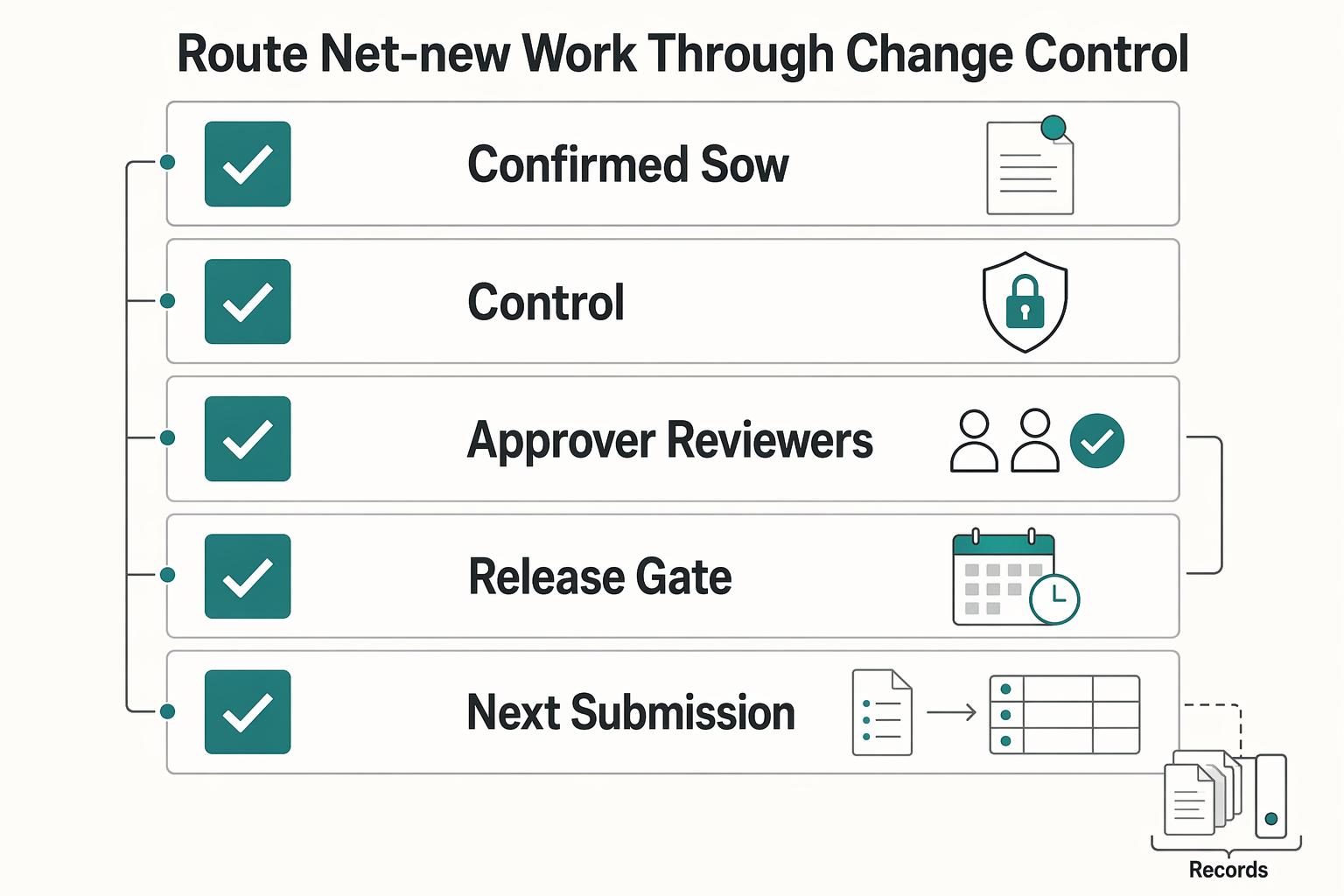
Route net-new work through change control#
Route net-new work through written change control, then circulate the decision record within 24 hours of the kickoff meeting. For private client projects, treat this as an operating control and do not let informal side requests redefine included work.
Use a simple rule: when feedback introduces a net-new deliverable or an added approval layer not covered by the SOW, route that item through a written change record (for example, a change order) before treating it as included work. After the meeting, share a concise decision summary in your shared record with:
- confirmed SOW deliverables
- items flagged as out-of-scope pending change control
- approver, reviewers, and informed stakeholders
- revision limits and approval criteria
- next submission date and client-owned decision deadlines
Set feedback windows and enforce escalation triggers#
Feedback windows should be treated as decision deadlines, not loose expectations. Once a deadline is missed, the process should move automatically to the next agreed step instead of drifting.
Turn each review stage into a dated decision deadline#
Define a clear window for each review stage and assign an owner for each one: first review, consolidated comments, and final approval. Use calendar dates, not "as soon as possible," and publish them with the submission date, version, and approver.
Treat the deadline as the trigger. Also define what counts as feedback received. If comments are fragmented and the named approver has not submitted a consolidated decision, approval is still pending.
Build the escalation ladder before the next miss#
Decide who gets notified first, who receives the next escalation, and what action happens at each step. Keep the language prewritten and factual so each message names the missed date, the unresolved deliverable, and the required next decision.
If your process supports reminders or automatic forwarding of pending approvals, use it. Manual approval handling depends on follow-up and creates more room for oversight.
Tie missed windows to dependent dates#
Tie missed windows to timeline movement through your project dependencies. If the next delivery phase depends on client approval or consolidated comments, show that dependency directly in the timeline and in your escalation messages.
Use your documented timeline and dependency rules as operating controls. When a client-owned dependency slips, downstream dates may need to be rebaselined. This is process management, not emotion.
Log the miss and trigger the next action#
Document each missed window the same day, then issue the next agreed action immediately. Keep the log simple: deliverable, version, due date, missed date, approver, escalation step, and updated next action.
For a related walkthrough, see How to Conduct a Client Post-Mortem and Gather Feedback.
Add contract protections before the next milestone#
If late feedback keeps creating ad hoc renegotiation, fix the contract before the next milestone. The point is to move delay handling out of scattered email threads and into terms you can actually operate from.
| Protection | Covers | Define |
|---|---|---|
| Timeline extension and dependency clauses | Delivery dates depend on timely client decisions, approvals, content, and access | Approver, approval date, required inputs, and the consequence if those inputs are late |
| Revision limit clause | Revision cycles that exceed scope | What is included, what becomes an extra paid round, and what counts as new direction that needs a change order |
| Reactivation fee clause | Projects that stall and later restart | The inactivity trigger and the restart charge |
Pair timeline and dependency clauses#
Use a timeline extension clause and dependency clause together. State that your delivery dates depend on timely client decisions, approvals, content, and access, and that client-caused delay can move completion dates and can create additional charges.
Make this concrete in the SOW for the next phase: approver, approval date, required inputs, and the consequence if those inputs are late. Avoid vague wording like "respond promptly." If you approve delay-based relief, document it in writing. Update the contract or SOW instead of relying on scattered email history.
Put revision limits into the contract#
Set a revision limit clause so revision cycles stay finite and billable when they exceed scope. Define what is included, what becomes an extra paid round, and what counts as new direction that needs a change order.
Keep a revision log with version number, date sent, date feedback received, and whether feedback is corrective or directional. If comments reopen approved work or introduce new deliverables, treat that as outside the original scope and bill under the agreed revision terms or a new change order. If you need more guidance on drawing that line, see How Freelancers Prevent Scope Creep Without Slowing Client Deals.
Define reactivation terms for stalled projects#
Add a reactivation fee clause for projects that stall and later restart. Restarting work can require re-planning, context rebuild, and schedule reshuffling, so define both the inactivity trigger and the restart charge in advance.
Sample clauses sometimes use repeated non-response over fourteen (14) days, for example three or more unanswered messages, and sometimes apply a twenty percent (20%) reactivation fee. Treat those as examples, not defaults, and set terms that match your actual restart cost. Keep the paper trail: unanswered messages, pause date, and suspension date.
Get unclear language reviewed before reissuing the SOW#
If the delay, dependency, or extra-charge wording is unclear, get contract counsel review before re-issuing the updated Statement of Work (SOW). Then circulate a clean redline, a short change summary, and the version date.
Do not move into the next milestone until the updated SOW is signed, so you are not relying on older signed terms while revised clause language is still in draft form.
Run a weekly feedback cadence the client can actually follow#
A weekly cadence works best when the client can follow it without guessing where decisions live. Keep the loop structured, keep the record centralized, and end each cycle with clear status.
Use one standing review record#
Use one standing review record for every cycle. Structured agendas and follow-up make meetings more useful, and a central record helps you carry context from one review to the next.
Use the same fields each time:
- item under review
- decision needed
- owner
- due date
- dependencies or blockers (if any)
- link to current version
- status: pending, approved, needs changes, out of scope
Assign owners before the meeting so each item has a clear next step.
Keep final decisions in one shared place#
Store final decisions and approved edits in one shared record. Keep execution tied to that record so everyone is working from the same information, not conflicting versions across email, chat, and notes.
Use that location for:
- current version
- decision log
- approved next steps
If feedback arrives somewhere else, move it into the central record before work continues.
Save approval meetings for decision-ready items#
Limit approval meetings to decision-ready items. Keep exploratory discussion separate unless you are intentionally defining new work.
Before an item gets meeting time, confirm that it includes:
- a clear decision request
- an assigned owner and approver
- a current version linked in the shared record
End each cycle with a real approval checkpoint#
Close each cycle with a clear approval checkpoint. Work should be reviewed and approved before it progresses, and some processes include pre-approval before final sign-off.
Before you close the cycle, verify:
- comments are consolidated into one set
- the approver has signed off, or has explicitly delegated next review
- each action item has an owner and due date
- blocked items name the dependency
- out-of-scope requests are recorded separately for later review
If sign-off is missing, keep the item marked as pending rather than approved.
For a step-by-step walkthrough, see How to Automate Client Reporting with Google Data Studio and Supermetrics.
Decide whether to wait escalate rebaseline or pause work#
Not every delay deserves the same response. Use a simple decision grid. Wait when the impact is low. Escalate when misses repeat or cannot be resolved at the current level. Rebaseline when schedule variance is real. Pause when commercial or scope risk is no longer acceptable.
Judge each delay on two axes: pattern and impact. One missed review with float is very different from repeated missed approvals that block dependent work under your Statement of Work (SOW).
| Decision | Use it when | What you do next | Verify before moving |
|---|---|---|---|
| Wait | Delay is isolated, low impact, and the task is non-critical with enough float | Keep unaffected work moving and use available buffer | Confirm the item is not on a critical path and is not blocking dependent deliverables |
| Escalate | Local resolution failed, or misses are repeating | Move to the next step in your escalation ladder with dates, owner, and required decision | Confirm you already made a real attempt to resolve it at the current level |
| Rebaseline | Actual dates have drifted and the approved schedule is no longer credible | Run a formal timeline reset through change control, with written updates to dates and dependencies | Compare actual performance to the approved schedule baseline and show the variance |
| Pause | Delay now creates commercial exposure or unresolved scope expansion | Pause dependent work under contract terms and require written next steps | Confirm contract notice requirements, missing approvals or assets, and any out-of-scope asks |
Decide if it is still a wait case#
Treat an expected miss as a risk and a missed date as an active issue. Once a date is missed, assign an owner, due date, and next action.
Wait only when the blocked item has real float. If the delay blocks QA, launch preparation, milestone approval, or another dependency, it is not a wait case.
Escalate once local resolution fails#
Escalate when the issue cannot be resolved at the current level or when the same breach repeats. Keep escalation operational and depersonalized. Escalate the problem, not the person.
A practical timing check is to escalate within two workdays of knowing local resolution will not work. Use your escalation ladder to state what is overdue, what it blocks, and which decision is required.
Rebaseline when the schedule is no longer credible#
Rebaseline when the approved schedule no longer reflects reality. This should be variance-driven and handled through formal change control, not informal schedule edits.
Send a written rebaseline notice with the original milestone, missed client-side dates, affected dependencies, and proposed revised dates. Interdependency slippage can cascade, so document the chain early.
Pause when delay becomes commercial or scope risk#
Pause work when repeated delays are paired with growing asks or real commercial risk. If delays and expanding requests appear together, treat it as scope creep and move added work through a written change order (or equivalent contract change-control step) before further delivery.
Pause triggers are contract-specific, not universal. Some contracts use five days of no response, while others use a one-week overdue checkpoint, so follow the signed terms and notice method exactly.
Choose a pricing model that can absorb slow feedback#
If approval timing is uncertain, compare fixed price and Time and Materials (T&M) before you lock terms. Start with that tradeoff, then decide whether your approval process is stable enough to support fixed assumptions.
Match pricing to approval reliability#
Use this comparison before you sign:
| Model | Better fit when | Delay-related risk to watch | What to verify in the Statement of Work (SOW) |
|---|---|---|---|
| Fixed-price contract | Scope and approvals are stable enough for fixed assumptions | Review how delays could break those fixed assumptions | Fixed-scope assumptions, how changes are handled, and risk-management terms |
| Time and Materials (T&M) | Scope or approvals may shift during delivery | Review how delays affect documented effort and approvals | How effort and approvals are documented, plus risk-management terms |
Use fixed fee only when assumptions can hold#
Use fixed fee when project assumptions and approval reliability are stable enough to support it. If those assumptions fail, resolve the issue through documented change control rather than informal extra work.
Use T&M when effort or approvals may shift#
Use Time and Materials (T&M) when uncertainty is mostly about changing effort, scope, or approval timing. Keep your documentation clear so tradeoffs stay visible as delivery conditions change.
Add a conversion path before work begins#
Add a mid-project conversion path up front. If you begin with a fixed-fee contract, define how you will reassess whether Time and Materials (T&M) is a better fit if project conditions change.
Handle common mistakes and recover without damaging the relationship#
When feedback delays repeat, recovery works better when it is documented and staged. Start with a voluntary correction step, then move to a formal escalation path if that does not happen.
Clarify ownership for consolidation#
When input is fragmented, pause execution and restate ownership in writing. Define who consolidates feedback, who backs them up, and how approvals are documented in your stakeholder map.
Ask the client to confirm who approves, who comments, and where final decisions are recorded before the next revision cycle starts. This helps keep decisions traceable instead of scattered across channels.
Reset the timeline formally if late reviews continue#
If late reviews continue, escalate through a formal timeline reset. Treat missed approvals as an operating dependency, not a personal conflict. Reference the missed milestone, the blocked deliverable, and the revised target date.
Keep the note factual and attach the current tracker or timeline showing affected dependencies. The goal is a clear record of what changed and why.
Reclassify new asks before work resumes#
If delayed feedback introduces new deliverables or extra rounds, document whether the request is in scope or needs a scope update before work resumes.
Before work resumes, set one status in writing: approved under the current Statement of Work (SOW) or pending scope update.
Replace open-ended revisions with clear limits#
If revision terms are open-ended, define review limits and acceptance checks in writing against the agreed brief or deliverables.
Track each round by date, reviewer, and requested change so the revision history stays verifiable. If this pattern repeats, consider tightening scope controls upstream: How Freelancers Prevent Scope Creep Without Slowing Client Deals.
Keep recovery language operational#
Keep recovery language operational, not accusatory. Write updates against milestones, pending approvals, revision counts, and next actions. This keeps records centered on decisions and documented dependencies rather than motives.
Related: How to Handle a Client Who is Micromanaging Your Project.
Keep an evidence pack so every decision is defensible#
If you ever need to pause work, reset dates, or charge for extra rounds, your position is only as strong as the record behind it. Keep the file current enough that you can explain any change quickly and factually.
Keep a live issue log#
Maintain a live issue log in your project record. Track each approval, missed review date, escalation step, and resulting timeline shift in the shared record. For each issue, log the owner, open date, target closure date, current status, and impacted deliverable.
Use a simple test: could someone outside the thread understand what happened without searching Slack or email? If not, the entry needs more detail.
Archive the contract versions that changed delivery#
Archive every contract version that changed delivery. Keep the signed Statement of Work (SOW), each written change order, and any contract updates that affect timing. Preserve the version that controlled the work at that time, including any revised delivery schedule.
This is what makes commercial and timeline decisions defensible later.
Count revision rounds against the agreed limit#
Track revision rounds against the agreed limit, not from memory. If your contract sets a revision limit, count each round by date, reviewer, and request type, whether corrective or net new.
This gives you a clear basis for a pause, a change order, or a fee discussion.
Close with a short retrospective#
Close with a short retrospective before the file goes cold. Capture root causes, unresolved issues, fixes that worked, and contract updates for the next engagement. A brief closing review with stakeholders helps confirm ownership gaps and approval breakdowns while details are still fresh.
Copy and paste this operating checklist#
Use this checklist when delayed feedback becomes a pattern. The goal is simple: make decisions traceable, keep scope bounded, and handle delays through written contract administration.
- Confirm scope and approvers in the Statement of Work (SOW) before work starts.
Your Statement of Work (SOW) should define what the work must accomplish and where its boundaries sit. Before first delivery, confirm in writing the project scope and the person who can approve, not just comment. If that approver is unclear, conflicting edits and slow signoff usually follow.
- Set one approval workflow, one feedback loop, and one shared decision record.
Keep the review path explicit: where feedback goes, who consolidates it, who gives final approval, and where the final record lives. If people cannot point to the same current record, rework risk usually increases.
- Add written delay and revision protections to the active agreement.
If your contract allows updates, define in plain language how delay notices are given, how revisions are handled, and how timeline or fee changes are approved in writing. Do not rely on informal email norms. If delay handling is missing from the signed agreement, timeline resets are harder to defend.
- Use an escalation ladder when review windows are missed, and document each step.
Escalate missed process commitments, not frustration. Log when feedback was due, which decision is blocked, who was asked, and the next action proposed. Good records support better decisions and protect you if disputes follow.
- Convert repeated scope creep into out-of-scope work and require written change approval.
Treat unapproved expansion without matching time, budget, or resources as scope creep. When requests add net-new deliverables, decision rounds, or material rework, reclassify them as out-of-scope work and route them through a written change order or equivalent written amendment. If you want a practical boundary check, see How Freelancers Prevent Scope Creep Without Slowing Client Deals.
- Choose pricing terms that match approval uncertainty.
If scope or review timing is still hard to estimate, a rigid fixed-fee contract increases your cost risk. Time and Materials (T&M) is commonly used when extent or duration cannot be estimated accurately up front, but it also requires tighter oversight. If approvals are unstable, consider a pricing structure that can absorb uncertainty until the process is predictable.
- Close every project with an evidence pack.
Keep the signed SOW, revision history, approval log, missed review dates, escalation notes, timeline changes, and executed change order records. If a third party cannot reconstruct what changed, who approved it, and why the schedule moved, the file is not complete enough.
Frequently Asked Questions
What should I do first when a client delays feedback for the second time?
Pull the missed review dates, pending decisions, named approver, and impacted deliverable from your issue log. Then send a formal reset note that treats the second miss as a process issue, not a personality issue. Ask for one accountable approver and one written due date.
How long should I wait before escalating a late approval?
Escalate after you have made a real attempt to resolve the issue at the current level. If it is clear the delay cannot be resolved there, escalate within two workdays. Use escalation for high-impact blockers, not every late response.
How do I stop endless revision cycles without sounding difficult?
Anchor the discussion in the signed SOW and the quality of the decision, not in personalities. Show which revision rounds were used and separate corrective edits from net-new requests. When a request changes scope, price, or schedule, route it through a written change order.
Which contract clause best protects me from delayed client responses?
No single clause solves every delay scenario. Clear written language should explain what happens to schedule, scope, and fees when client approvals are late, and it should define how contract changes are approved in writing. Delay events and revision drift are easier to manage when those adjustments are documented instead of handled informally.
Should I rebaseline timelines or pause work when feedback keeps slipping?
Rebaseline when the work is still viable but the current dates are no longer realistic. Pause when key decisions are blocked and continuing would force unapproved assumptions or extra risk. Only pause with contract authority and written notice. Some stop-work structures use a defined period such as 90 days, but only if your agreement includes it.
Is a fixed-fee contract ever safe when the client approval process is unclear?
It can be, but only when scope and pricing are well defined at the start and the approval path is clear. A firm-fixed-price structure puts maximum cost risk on the provider, so prolonged approval delays can increase that risk. If approvals are unclear at kickoff, tighten the SOW first or consider Time and Materials until scope and timelines are predictable.
Researched and edited by the Gruv editorial team. Gruv builds cross-border billing, payouts, and finance-operations software for global businesses.
Sources
- acquisition.gov/far/subpart-43.2trusted
- acquisition.gov/far/8.405-2trusted
- directives.doe.gov/terms_definitions/change-ordertrusted
- ecfr.gov/current/title-48/chapter-1/subchapter-C/part...trusted
- fda.gov/medical-devices/postmarket-requirements-devi...trusted
- gta-psg.georgia.gov/psg/project-re-baselining-guidelines-gm-22-001trusted
- pmc.ncbi.nlm.nih.gov/articles/PMC11131125trusted
- va.gov/opal/nac/fss/sow.asptrusted
Educational content only. Not legal, tax, or financial advice.
Related Posts

Thailand's Long-Term Resident (LTR) Visa for Professionals
For a long stay in Thailand, the biggest avoidable risk is doing the right steps in the wrong order. Pick the LTR track first, build the evidence pack that matches it second, and verify live official checkpoints right before every submission or payment. That extra day of discipline usually saves far more time than it costs.

The Freelance Payment Penalty: A Modeled Audit of Platform Fees, FX Spreads, and Payout Delays
The money rarely disappears through a single, easy-to-spot fee. The real loss is stacked. A marketplace takes its commission, a processor adds a charge for international cards, a bank or payment company converts the currency at a spread, a platform holds the funds before release, and a wire sheds a little to intermediaries on the way in. Each layer looks defensible on its own, but the worker feels the combined result as a smaller deposit and a later payday.

How to Respond to a Subpoena for Business Records
Move fast, but do not produce records on instinct. If you need to **respond to a subpoena for business records**, your immediate job is to control deadlines, preserve records, and make any later production defensible.