
Quick Answer
Handle a client IP dispute by checking your contract, organizing your evidence, and escalating in measured steps. Confirm who owns the work, when rights transfer or a license begins, whether payment is complete, and whether any background IP or subcontractor rights are involved. Then document use and approvals, send a factual written notice, and escalate only from what you can prove.
Phase 1: Fortification - Architecting Your Pre-Project Defenses#
To avoid an IP dispute with a client, settle ownership, payment triggers, and transfer formalities before work starts. Many problems begin with contracts that describe deliverables but leave rights, timing, or legal form unclear. Before you start, confirm scope, deliverables, milestones, invoice timing, legal entity names, and every contributor who will touch the work.
Step 1. Define the core clauses before you negotiate price#
Under U.S. copyright rules, the author owns copyright at creation unless an exception applies. Start from creator ownership, then state clearly whether your deal uses an assignment, a license, or work made for hire where it actually fits.
| Clause | What it protects | What to confirm before signature | Dispute risk if missing |
|---|---|---|---|
| IP ownership and transfer clause | Who owns deliverables, which rights transfer, and when | Assignment vs license vs work made for hire, and whether signed writing is required | Client assumes delivery alone transferred ownership, or you assume rights stayed with you when the contract says otherwise |
| Payment and milestone terms | The payment trigger tied to rights transfer and final file release | Amounts, due dates, milestone acceptance, late-payment handling, final-payment trigger | Rights timing conflicts with invoicing, which can make nonpayment disputes harder to resolve |
| Governing law and forum clause | Which law governs and where disputes are heard | Your location, client location, court vs arbitration, local enforceability checks | Time and cost can be spent arguing forum before the IP issue is even addressed |
| Background IP and reuse clause | Your pre-existing tools, templates, methods, and materials | What stays yours, what the client can use, and on what terms | Client claims your underlying materials were part of the sale |
| Subcontractor rights flow clause | Your ability to pass contributor rights to the client | Signed contributor terms that let you transfer or license downstream | A contributor later claims ownership in part of the deliverable |
Quick check before signature: read the ownership clause and payment clause together. If one says rights transfer on delivery and the other says on payment, fix it before you agree to price.
Step 2. Choose the right ownership model#
Assignment, license, and work made for hire are not interchangeable. Pick the wrong model and the rest of the contract gets harder to interpret later.
| Model | When used | Key detail |
|---|---|---|
| Assignment | When the client is buying ownership | In U.S.-governed deals, use signed writing so transfer validity is not at risk |
| License | When you plan to reuse methods, templates, or components | Specify whether it is exclusive, sole, or non-exclusive, plus scope, territory, duration, and purpose |
| Work made for hire | For certain commissioned works only | Requires an express written instrument signed by both parties and does not fit every freelance deliverable |
Assignment is a sale of the IP asset. Use it when the client is buying ownership, and in U.S.-governed deals, use signed writing so transfer validity is not at risk.
License gives usage rights while you keep ownership. Use it when you plan to reuse methods, templates, or components, and specify whether the license is exclusive, sole, or non-exclusive, plus scope, territory, duration, and purpose.
Work made for hire has limits. For certain commissioned works, work-for-hire status requires an express written instrument signed by both parties, and it does not fit every freelance deliverable. If a client insists on it, verify the wording instead of relying on the label. For a deeper comparison, see Work for Hire vs. Assignment of Rights: A Freelancer's Guide to Owning Your IP. If you include a fallback model, state the sequence and timing clearly so the models do not conflict.
Step 3. Tie ownership transfer to payment clearly#
This is a common dispute trigger. If your deal is payment for ownership, state that rights transfer only after full and final payment is received. Then mirror that same trigger in the IP clause, payment section, milestone terms, and invoice language.
Define what full and final payment means. If work is staged, state whether rights transfer per milestone or only after total project payment. Align release of final source or editable files to that same trigger. Also separate possession from ownership in plain language. Delivering files is not the same as transferring IP ownership.
Step 4. Set the cross-border terms on purpose#
If the work crosses borders, do not recycle old template language. Choose governing law and forum deliberately. Party choice of governing law is recognized in EU cross-border contracting, but assignment and license formalities can still vary by country.
Use this pre-sign checklist:
- Name the governing law clearly and confirm it matches your ownership model.
- Choose one forum path, court or arbitration.
- If arbitration is selected, keep the clause in writing.
- If using an exclusive court clause, get local counsel review for enforceability in the client's location and dispute type.
- Add explicit placeholders where local legal verification is needed, such as
[confirm local formalities for IP assignment]and[confirm registration or other local steps].
Then close the other ownership gaps before they show up later.
Step 5. Lock down background IP and subcontractor rights before you sign#
This is where a lot of projects get messy. If background materials or contributor rights are fuzzy at the start, they usually become the center of the dispute later. Before signature, run this micro-checklist:
- List your pre-existing IP, tools, methods, and reusable materials in the contract or schedule.
- State whether the client gets ownership of only final deliverables, plus any license needed for embedded background IP.
- Confirm your reuse rights for your own background materials.
- Get written rights terms from subcontractors before work begins.
- Confirm those terms let you transfer or license rights downstream to the client.
Subcontractor-created IP does not automatically flow to you without explicit written rights transfer. If you cannot pass those rights through, your client handoff is weaker than it looks.
You may also find this useful: How to Structure a 'Limitation of Liability' Clause when using OpenAI's API in a Client Project.
Before you send your next proposal, build a rights-and-payment baseline you can tailor to this client with the Freelance Contract Generator.
Phase 2: Documentation - Building an Unassailable Paper Trail#
A good contract sets the rules, but your records show what actually happened. In practice, paper trails usually break in a few predictable places: undocumented scope changes, unclear version history, and approvals that are hard to tie to a specific file.
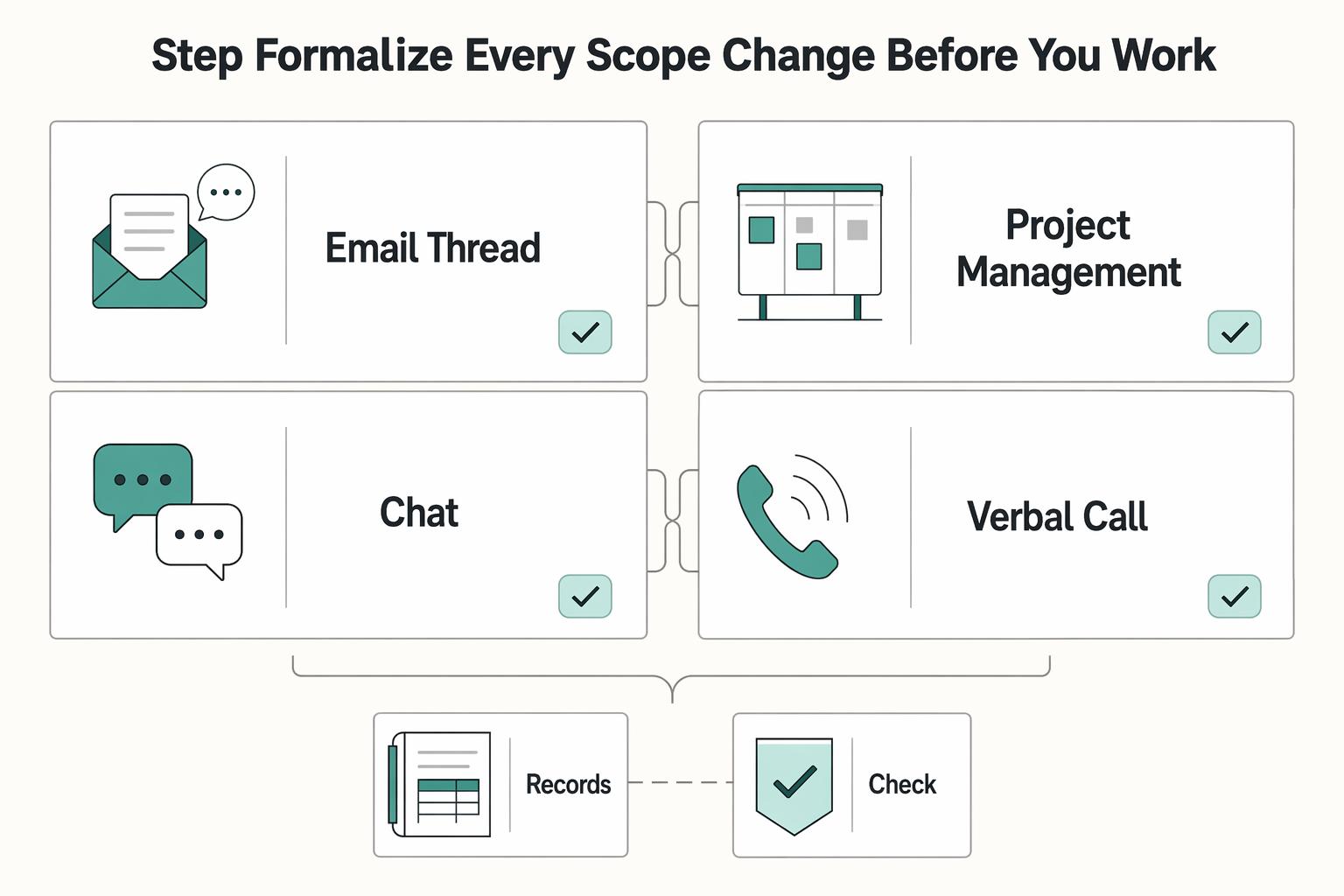
Step 1. Formalize every scope change before you do the work#
Do not rely on informal approvals. If a change affects deliverables, timing, usage, or payment, document it before you start the extra work.
Use a simple Change Record format: Date | Change | Rationale. Keep it consistent so each update shows what changed and why. When a client asks for a change, use this sequence every time:
- Trigger a record when the request changes deliverables, revision rounds, timeline, usage, or file type.
- Write a short change summary covering the new work, price impact, timeline impact, and affected files or milestones.
- Get explicit written sign-off on that summary in the same thread or project record.
- Do not start until confirmed.
Quick check: before you begin, you should have one dated record that matches the requested change.
| Communication channel | Documentation clarity (practical) | Common failure point | Safer documentation habit |
|---|---|---|---|
| Email thread with attached change summary | Higher | Request and approval are split across replies | Keep one subject line and attach the dated summary |
| Project management comment | Moderate | Approval text and files are stored separately | Link the exact file version in the approval comment |
| Chat or DM | Lower | Informal wording and missing context | Copy the decision into email or your source-of-truth log |
| Verbal call only | Lowest | No timestamped wording to verify later | Send a same-day written recap and wait for confirmation |
Step 2. Maintain version history you can prove#
File names alone are not enough. Keep one source-of-truth location for working files and maintain a version or revision log you can produce later.
For each milestone, record:
- Version number
- Date
- What changed
- Who received the file
Treat major handoffs like formal submissions: one dated package, one version number, one transmittal note. The checkpoint is simple: the approved file should match the file listed in your handoff log.
Step 3. Capture approvals with one format and keep a retention pack#
Consistency matters more than elegance here. If every approval follows the same format, it is much easier to tie an approval to a specific version and next step.
| Approval field | What to record |
|---|---|
| Milestone name | The milestone covered by the approval |
| Files reviewed | The exact files reviewed |
| Decision status | The decision given |
| Revision list | Any revisions requested |
| Next step authorized | What you are authorized to do next |
| Date | The approval date |
| Timezone | The timezone used |
Use the same approval format each time: milestone name, files reviewed, decision status, revision list if any, next step authorized, date, and timezone. Keep this retention pack until the matter is fully closed:
- Contract, amendments, and change records
- Version history export or revision log
- Handoff emails, upload receipts, and submission notes
- Approval messages tied to exact file versions
- Invoices, payment records, and final delivery records
If a dispute comes up later, this pack should let a third party follow the project without guessing.
For a step-by-step walkthrough, see How to Write a 'Work Made for Hire' Clause Correctly.
Phase 3: Enforcement - A Calm, Professional Escalation Ladder#
When a dispute turns active, the goal is not to sound aggressive. The goal is to move one step at a time from what you can prove. Each rung should have one purpose, one message, and one clear trigger for the next step.
Use this escalation decision checklist#
Before you send formal notices, make sure your file is ready for a real decision:
| Check | What to confirm |
|---|---|
| Notice parties | You have correctly identified the sender and recipient for the notice |
| Observable use | You can tie each allegation to specific, observable use of the work |
| Dated records | You have documented the alleged infringement with dated records, such as screenshots, URLs, and relevant communications |
| Clear timeline | You have organized the key records so the timeline is clear |
| Rights position | You have completed an internal rights-position check, including prior-art/validity review where relevant |
| Jurisdiction review | You have flagged jurisdiction complexity and a local-counsel review point, especially for cross-border issues |
| Outcome goal | You know your immediate outcome goal: stop-use, settlement, or another defined resolution path |
If most of this is not ready, stop and fix the record first.
Step 1. Send a formal written notice#
Start with the narrowest step that matches the problem. Keep the message factual and focused on documented issues.
Include these required elements:
- Correct sender and recipient identification
- Clear notice of the alleged issue
- Identification of the specific work at issue
- A concise mapping between your allegation and observable use
- A direct request for response and next-step resolution
Keep the tone factual and professional. Do not lead with threats, insults, or legal claims you cannot support. If the other side goes silent, use short follow-ups in the same thread to confirm receipt and restate that unresolved issues may move to formal enforcement.
Escalate only after you have a clean written record and a reviewed legal framing.
Step 2. Issue a cease and desist only when unauthorized use is documented#
Do not send this on instinct. Use it only when you can show the work is being used, published, distributed, or exploited without authorization.
Your letter should:
- Correctly identify sender and recipient
- Give clear notice of alleged infringement
- Identify the specific work at issue
- Map each allegation to observable use, for example a webpage, ad creative, downloadable asset, or campaign material
- Preserve supporting records, including dated screenshots, URLs, and other relevant case records
Request two actions:
- Stop the disputed use while the matter is addressed
- Preserve records tied to the disputed use, with counsel tailoring this request to local rules
Use a professional delivery method and follow your contract notice clause. Because this step can push the dispute toward litigation, verify your position before sending. Be careful about the boundary between an inquiry and a formal accusation. If the matter is cross-border, have local counsel review the draft before it goes out.
Step 3. Choose the next forum deliberately#
At this point, the question is not which option sounds strongest. It is which forum fits your contract, your evidence, your business risk, and the jurisdiction issues in front of you.
| Path | Decision control | Timing | Confidentiality | Outcome status | Relationship impact |
|---|---|---|---|---|---|
| Negotiation | Parties set terms directly | Depends on both sides engaging | Depends on party agreement and handling | Usually documented in a signed settlement if reached | Varies by conduct and tone |
| Mediation | Parties decide whether to settle | Depends on mediator availability and participation | Depends on agreement and applicable rules | Usually needs a signed settlement to lock in terms | Varies by participation and process |
| Arbitration | Arbitrator decides if no settlement is reached | Depends on clause, forum, and schedule | Depends on clause and provider rules | Ends in an award under the selected process | Varies by process and stakes |
| Court | Judge and court process decide outcomes | Depends on court timelines and procedure | Public filing exposure may apply | Formal judgment mechanisms are available | May increase relationship strain |
If your contract names a required forum, start there. If notices are ignored while use continues, stop the informal back-and-forth and get tailored legal advice promptly.
If you want a deeper dive, read How to Handle a Client Who Wants to Own Your 'Process'.
Conclusion: Your IP is Your Ultimate Asset - Protect It Like One#
When disputes happen, three controllable factors matter most: what the contract says, what your records show, and how you respond. Treat this as routine risk control, not a dramatic legal event.
Phase 1: Contract setup (payment leverage). Set ownership and use terms before work starts, and state exactly when rights transfer or when a license begins. Do not rely on labels alone. Work-for-hire is not automatic, and without clear written terms, ownership disputes are more likely and default copyright ownership may stay with the creator. Before each deal, identify what you plan to reuse and confirm whether you have any obligation to disclose, license, or assign it.
Phase 2: Documentation discipline (evidence quality). Keep one clean record with the signed agreement, version history, written scope changes, approvals, delivery records, and payment status. Your file should make it easy for a third party to verify what was created, what was approved, what rights were granted, and what remains unpaid.
Phase 3: Response control (escalation readiness). Respond from what you can prove. Quote the exact contract language, align it with the timeline, and avoid claims your records do not support, especially when ownership language is silent or mixed.
For your current matter, review the rights clause, payment status, approvals, and any live client use. For your next contract, choose one ownership model and write it clearly. For deeper follow-up, see Work for Hire vs. Assignment of Rights: A Freelancer's Guide to Owning Your IP and A Guide to Mediation for Resolving Freelance Disputes.
Related: How to Set Up a Retainer Agreement with a Client.
If you want a cleaner operating setup after this dispute, map your next steps from invoice to payout in the Freelancer MoR workflow.
Frequently Asked Questions
Who owns the IP if there is no contract?
Without a written contract, ownership can become a dispute over facts instead of a clean answer. Gather your full record, including the proposal, scope, invoices, delivery emails, approvals, and reuse messages, then verify the ownership rule that applies in the relevant jurisdiction before taking a firm position.
What is the most important clause to prevent IP disputes?
There is no single clause that controls every case, but the clause that states exactly when rights transfer or when a license starts is often high impact. Clear timing can reduce ownership and use disputes, while vague timing can create ambiguity when payment or use is contested.
How do you handle IP in an international client contract?
Define the governing law, forum, and dispute path in writing before work starts. Then verify jurisdiction-specific legal terms and local formalities for the countries involved, especially if the matter is cross-border.
Can a client use my work if they have not paid me?
It depends on your contract language and the facts you can prove. Before alleging infringement, verify unpaid amounts, the exact rights clause, and documented use, then check how the relevant jurisdiction treats those facts before you escalate.
What is the difference between work for hire and licensing?
Work for hire and licensing are different contract approaches with different ownership and use outcomes. Work-for-hire language depends on the exact wording and whether local law accepts it, while license language focuses on who owns the IP and what usage rights the client receives.
Try a related tool
Researched and edited by the Gruv editorial team. Gruv builds cross-border billing, payouts, and finance-operations software for global businesses.
Sources
- copyright.gov/title17/92chap2.htmltrusted
- copyright.gov/circs/circ30.pdftrusted
- dodcio.defense.gov/Portals/0/Documents/Library/RequirementsAcqu...trusted
- ecfr.gov/current/title-19/chapter-III/part-351trusted
- grantspassoregon.gov/DocumentCenter/View/23455trusted
- law.nyu.edu/sites/default/files/Bambauer%20-%20IP%20Para...trusted
- leg.colorado.gov/initiative_files/3308/downloadtrusted
- leginfo.legislature.ca.gov/faces/billCompareClient.xhtmltrusted
Educational content only. Not legal, tax, or financial advice.
Related Posts

Work for Hire vs Assignment of Rights for Freelancers
A freelance agreement is not just about price and scope. It decides who controls the rights in the work. If the ownership language is loose, rights can move earlier than you expect, cutting down your control once the work is delivered or used.
Freelance Mediation for Client Disputes That Need a Clear Outcome
When direct negotiation stalls, move to a structured settlement process while both sides are still exchanging facts in writing. The point is to keep control: settle if you can, then move to the next option if cooperation or evidence breaks down.

The Freelance Payment Penalty: A Modeled Audit of Platform Fees, FX Spreads, and Payout Delays
The money rarely disappears through a single, easy-to-spot fee. The real loss is stacked. A marketplace takes its commission, a processor adds a charge for international cards, a bank or payment company converts the currency at a spread, a platform holds the funds before release, and a wire sheds a little to intermediaries on the way in. Each layer looks defensible on its own, but the worker feels the combined result as a smaller deposit and a later payday.