
Quick Answer
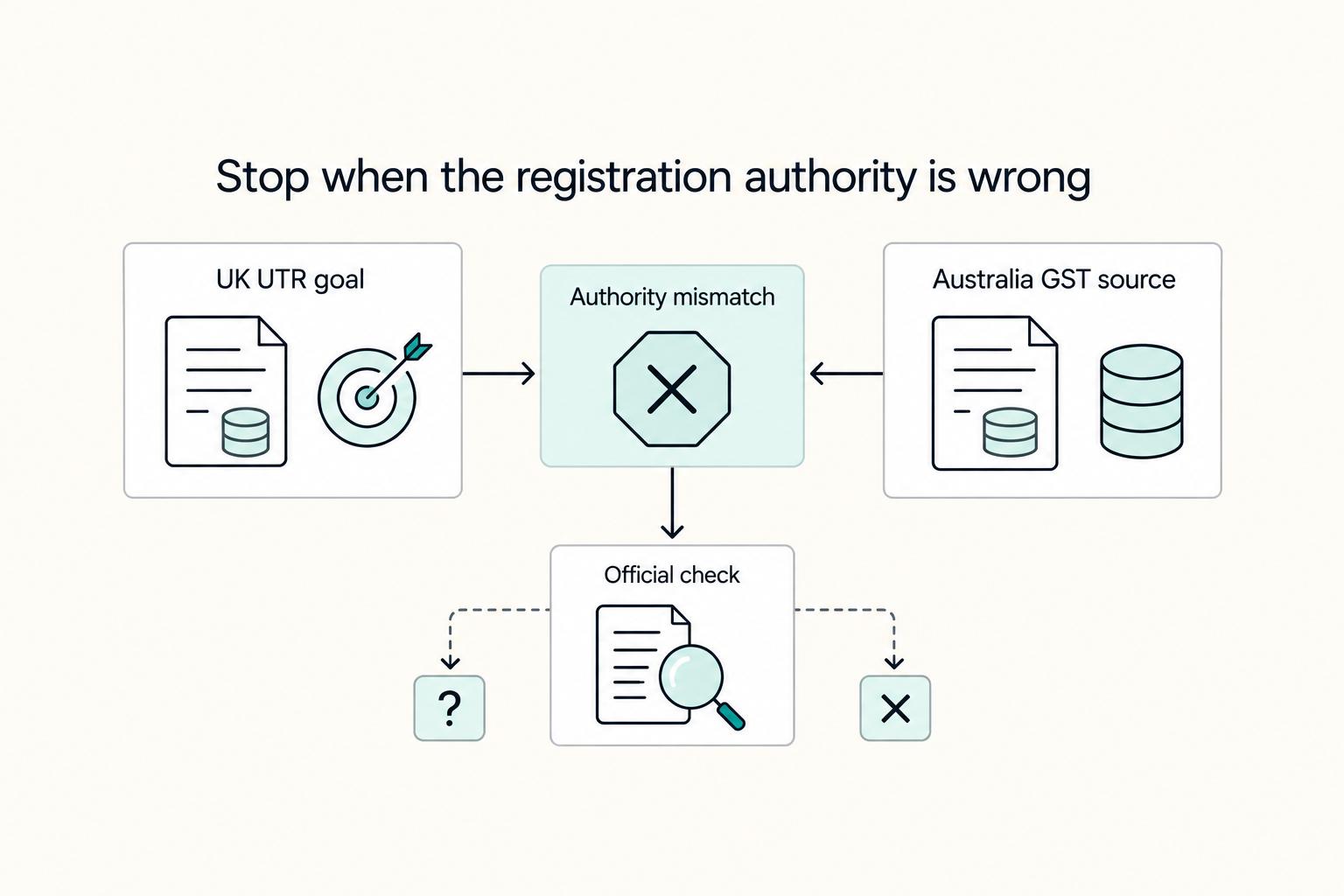
Start with a jurisdiction check before any filing action. For get utr number uk, this article’s central warning is that mixed evidence creates real risk: the loaded material is largely Australia-focused (GST, ABN, BAS, ARN), so UK steps must be validated separately with HMRC channels before submission. Once country scope is clean, keep one entity path per income stream, log each registration handoff, and file only after account status and identifier records are consistent.
Confirm Which Country's Rules Apply First#
Start by locking your filing identity, then register through the matching HMRC path and capture proof as you go. The focus here is registration and recovery, not tax planning.
If you work across borders, keep personal and company records separate from day one. Your business structure affects tax treatment and legal responsibilities, so the practical goal is simple: pick one route per entity, prepare records once, and avoid avoidable delays.
A practical way to protect yourself is to treat a country mismatch as a hard stop, not a minor edit. If your notes include terms from more than one tax system, pause and resolve the jurisdiction before you submit anything. That pause can reduce cleanup later by helping you avoid the wrong form, identifier, or support channel in your records.
Before You Start#
Finish this prep first so filing decisions stay clean under deadline pressure.
This stage can feel administrative, but it removes most filing stress. If your records are grouped clearly and your route is decided early, later steps become straightforward. If your inputs are scattered, every later step becomes slower and riskier because you are rechecking identity, status, and deadlines while the clock is already running.
- Choose your filing identity first.
Decide whether you are registering as a sole trader, operating through a limited company, or managing both separately. A limited company is legally separate from its owners, so keep personal and company records apart. Checkpoint: Write one line per entity with its filing route.
- Confirm whether registration is required now.
If you are filing for the first time, register for Self Assessment before using the online filing service. If you are a sole trader and earn more than £1,000 in a tax year, you need to register for Self Assessment. HMRC guidance also shows notification timing in listed cases, such as 5 October 2025 for the tax year 6 April 2024 to 5 April 2025. Checkpoint: Calendar the relevant 5 October notification date and the 31 January payment date.
- Prepare minimum records before submission.
Keep your National Insurance number and core personal and business details in one place, alongside account sign-in details and space for HMRC confirmations. Failure mode to avoid: Submitting without reactivating an existing account, which can delay your return.
- Set escalation triggers early.
Get professional help if you cannot separate personal and company records, if your UK filing duty is clear but residence facts are not, or if HMRC correspondence conflicts with account records near a deadline.
If residence is the unclear piece, review Understanding the UK's Statutory Residence Test (SRT) before you submit.
The one-minute answer for getting a UK UTR#
Do not take UK UTR filing action from this guide on its own. It covers Australian GST and ABN rules, so treat HMRC steps for UTR, Personal Tax Account checks, and HMRC app checks as unconfirmed until you verify them with HMRC, and use this as a decision gate before you act.
A key risk here is mixed evidence. A checklist can look complete and still be unsafe if it mixes UK terms with Australia-only thresholds and registration logic. Separate those inputs first, then continue only with the country-matched set.
- Check country markers first.
If your notes include GST, ABN, BAS, 10%, 21 days, or A$1,000 or less, this pack is pointing to Australian rules, not a UK filing path.
- Use the Australia split only for Australia obligations.
Australian GST registration has two paths: simplified and standard. General GST registration requires an ABN before registering, while simplified registration also covers non-resident cases where a business does not need an ABN and becomes a limited registration entity not entitled to one. Standard registration includes BAS lodgment and GST payment monthly or quarterly.
- Hold UK action until UK-source guidance is loaded.
Do not map ABN or GST logic to UK sole trader or limited company records. Do not infer UK entity steps from Australian GST rules.
- Do not reuse timelines across countries.
The 21-day timing here applies to GST registration when required. It is not a UK proxy.
One-minute rule: confirm the country first, then follow only the path backed by that country's authority.
Choose the right registration path before you start#
You still cannot choose a reliable UK registration path from this guide. It is Australia GST-focused, so use it to avoid acting under the wrong authority.
A simple control helps here: keep a short "known" list and a short "unknown" list while you decide. Put any item you can prove from the loaded evidence in "known," and move all UK process assumptions to "unknown" until verified. That stops unsupported details from being copied into your filing notes and treated as settled.
- Confirm jurisdiction before choosing an entity path.
If your notes contain GST, ABN, ARN, or the 21-day registration timing, you are relying on Australia-only evidence. Do not infer UK steps from those markers.
- Separate activity by contract and invoice ownership.
Keep one lane for personal contracts and another for company contracts. If you run both, track them separately from the start.
- Keep identifier families separate.
ABN and ARN belong to Australian GST processes. Do not substitute them for UK identifiers such as UTR or CRN. Mark gaps as unknown until UK-grounded evidence is loaded.
- Treat partnership and trust setups as escalation points.
Confirm the entity path with HMRC or a qualified adviser before filing a UK tax return.
Use one decision rule: pick a registration path only when jurisdiction and entity evidence match. Related: A Guide to the Best No-Code Tools for Freelancers.
Gather your application pack before you touch the form#
Build your pack before you open any form. That helps you avoid misfiled records and deadline pressure.
| Pack item | What to keep | Grounded note |
|---|---|---|
| Key dates | Notify-HMRC date and payment date | Guidance snapshot shows 5 October 2025 for 6 April 2024 to 5 April 2025 and 31 January for payment |
| Registration details | National Insurance number plus core personal and business details | National Insurance number is required for sole trader registration |
| Account status | First-time registration status or existing account needing reactivation | Complete registration first or reactivate before filing to reduce delay risk |
| Entity records | Separate sole trader and limited company folders | Map each record to exactly one entity |
| Separate checks | Company-specific UTR handling, Companies House alignment, and partnership filing path | The standard online filing service does not cover partnership returns |
Treat your pack as a working file, not a static folder. As details are confirmed, update the same record set so you know what is current. A shared naming pattern helps. Keep identity records, account access notes, correspondence, and submission proof in separate, clearly labeled groups. That makes retrieval quicker when you need to verify a field or respond to a query.
- Lock key dates first.
Track your notify-HMRC date and payment date together. The guidance snapshot shows 5 October 2025 for the previous tax year (6 April 2024 to 5 April 2025) and 31 January for payment. Treat both as year-specific and re-check each cycle.
- Prepare registration details in one place.
For sole trader registration, your National Insurance number is required. Keep your core personal and business details together so you can complete submission in one pass.
- Confirm account status before online filing.
If you are filing for the first time, complete registration first. If you already have an account, reactivate it before filing to reduce delay risk.
- Separate entity records and ownership.
Keep sole trader and limited company records in separate folders. Maintain one note that maps each record to exactly one entity.
- Flag unsupported company and partnership tasks as separate checks.
Use a separate checklist for company-specific UTR handling and Companies House alignment, and treat those steps as unconfirmed until you check them against official UK guidance. Confirm partnership filing path early, since the standard online filing service does not cover partnership returns.
If your details change during preparation, update the pack before you submit rather than relying on memory. Record details, account status, and entity labels drifting out of sync can force you to revisit steps you thought were complete.
Register for Self Assessment if you are a sole trader freelancer#
Use a fixed sequence and document each handoff. The sequence set out below covers the GST route, so treat the UK Self Assessment process as unconfirmed until you verify it against official UK guidance.
To reduce follow-up friction, keep a clear record of what was submitted, when it was submitted, and which registration path you used.
- Confirm whether GST registration is required.
Not every business or enterprise needs to be registered for GST, but penalties may apply if you fail to register when required.
- Register within the required timeframe.
Once you are required to register for GST, complete registration within 21 days.
- Choose the correct registration path before you submit.
For standard GST registration, get an ABN first. For non-resident businesses, simplified GST registration is available to register, lodge, and pay GST online, with AUSid used to access online services for non-residents.
- Plan for outside-Australia lodgment in the standard route.
If you are lodging from outside Australia through standard GST registration, you cannot lodge electronically and may need an Australian registered tax agent.
If you are a non-resident business making sales of low value imported goods (A$1,000 or less) to consumers, confirm whether simplified GST registration applies before you file.
When account details or registration status look inconsistent across your records, resolve that first before making another submission.
Register as a limited company without mixing personal and company records#
Keep one evidence trail per entity from day one. Cleanup gets harder once contracts and invoices are mixed.
In practice, this section is about attribution discipline. Each contract, invoice, and payment needs a clear owner that matches the entity and GST registration route you intend to file under. If that ownership is unclear, correcting it later can mean rewriting records and rechecking references across multiple channels.
- Open separate records and label them clearly.
Keep one folder for sole trader activity and separate folders for each GST registration route you use. Store contracts, invoices, bank records, filing confirmations, and correspondence in date order, with a front note showing entity name, identifier used, and contact details.
- Keep one compliance route per entity.
Do not blend record types that follow different rules. In non-resident GST examples, standard registration uses an ABN, requires identity proof, and uses BAS lodgment and GST payment monthly or quarterly. Simplified registration uses an ARN, requires quarterly GST returns, and does not allow tax invoices or GST credit claims.
- Map each contract and invoice stream before billing.
Run three checks every time: entity named on the contract, account receiving payment, and identifier on the invoice. If they do not match, correct it before invoicing.
- Run a monthly mismatch review and log exceptions.
Sample recent invoices, compare them to your mapping rule, and record each correction with date, document, and action taken. Also flag work that may be employee activity, since ABN entitlement does not apply to employee activity.
If you use country-specific labels in your records, verify those directly before filing: one entity, one reference set, one evidence trail. A useful habit is to log why a correction was made, not just what changed. That note helps later when the same pattern appears again and you need to make a consistent call under deadline pressure.
Plan for postal timelines so your UK tax return is not blocked#
Build your timeline around HMRC dates and documented checkpoints, not best-case post delivery.
| Date or checkpoint | Applies to | Note |
|---|---|---|
| 6 April 2024 to 5 April 2025 | The previous tax year shown in guidance | Pin key dates in one calendar before submission |
| 5 October 2025 | Listed first-time or inactive-account scenarios where HMRC must be told | Late notification could lead to a penalty |
| 31 January | Payment deadline | Keep it protected in your calendar |
| HMRC's stated expected-reply point | Waiting for a UTR | Do not assume a fixed waiting window |
| Missed checkpoint | No UTR correspondence by the expected-reply point | Consider follow-up through your account and HMRC contact channels and log each attempt |
Pin key dates in one calendar before submission. For the previous tax year shown in guidance, that is 6 April 2024 to 5 April 2025. In listed first-time or inactive-account scenarios, HMRC must be told by 5 October 2025, and late notification could lead to a penalty. Keep 31 January protected as your payment deadline.
Planning detail matters here. Keep the expected-reply checkpoint tied to your submission record so each follow-up has clear context. If you track only dates without the related evidence, escalation becomes slower because you have to rebuild the history before contacting support channels.
- Register early and keep dated proof.
Submit registration as soon as details are ready, then save confirmation evidence the same day. Log submission date, local time, account used, and postal address on file.
- Use HMRC reply-time guidance as your checkpoint.
If you are waiting for a Unique Taxpayer Reference (UTR), use HMRC's stated expected-reply point and add it to your calendar. Do not assume a fixed waiting window.
- Check account status before filing.
If you registered before but did not file last year, confirm whether reactivation is needed. Filing without reactivation may delay your return.
- Escalate once your checkpoint is missed.
If the expected-reply point passes without UTR correspondence, consider follow-up through your account and HMRC contact channels. Log each attempt with date, channel, reference, and outcome.
When timing is uncertain, register earlier, keep clean handoff records, and escalate as soon as a checkpoint slips. Also separate timing risk from data risk so your next step stays clear.
Set up online access and verify your UTR in two places#
Set up online access early, then treat HMRC correspondence as your primary UTR record so one channel issue does not block filing.
| Situation | Service status | Next step |
|---|---|---|
| First return | Register for Self Assessment before using online filing | Complete registration first |
| Past returns | You can use the service to view returns you have made before | Sign in and confirm access before deadline pressure |
| Partnership return | The online service is not for partnership returns | Confirm the partnership filing path early |
| Lived abroad as a non-resident | You cannot use the online service | Flag it early so it is resolved before return prep |
| Registered before but did not file last year | You may need to reactivate your Self Assessment account | Reactivate it before filing |
| Waiting for a UTR | Check when you can expect a reply from HMRC | Handle timing early and keep HMRC correspondence as your primary UTR record |
Digital access helps, but consistency is what protects you. If account details differ from your letter record, log the difference and resolve it before relying on that reference in return activity.
- Confirm online filing access before deadline pressure.
Sign in and confirm you can reach the online filing service. If this is your first return, you must register for Self Assessment before using online filing.
- Use the online service within its limits.
You can use it to view returns you have made before. It is not for partnership returns, and you cannot use it if you lived abroad as a non-resident.
- Handle UTR timing and account status early.
If you are waiting for a Unique Taxpayer Reference (UTR), check when you can expect a reply from HMRC. If you registered before but did not file last year, you may need to reactivate your Self Assessment account, and filing without reactivation may delay your return.
- Keep a simple records control.
Keep one confirmed correspondence record for key references and update it only after discrepancies are resolved.
If access drops near a deadline, avoid changing core records in haste. Work from your confirmed correspondence record and escalate through the proper support route.
Recover a lost UTR without restarting registration#
If you already registered, confirm your account status first. If this is your first return, register for Self Assessment before using online filing.
The key control in recovery is sequence. Check your HMRC status first, then take the next required step based on whether you are waiting for a UTR or need to reactivate an existing account.
- Check whether you are waiting for a UTR.
HMRC says you can check when you can expect a reply if you are waiting for a Unique Taxpayer Reference (UTR).
- Confirm whether your account needs reactivation.
If you registered before but did not send a return last year, you may need to reactivate your Self Assessment account.
- Confirm account status before any filing submission.
If this is your first return, complete registration before using online filing. If you have an existing account, reactivate it where required.
- File only when the service applies to your case.
HMRC says your tax return may be delayed if you file without reactivating an existing account, and the online service cannot be used in some cases (including partnerships).
Before filing, make sure your status is clear: first-time registration complete, or existing account reactivated where needed. This keeps your next action aligned with HMRC's published process.
Avoid the mistakes that trigger delays and compliance stress#
Most avoidable delays start with account-status issues and weak records. Keep each filing track and evidence trail separate from day one.
Small admin errors can compound. HMRC notes that your tax return may be delayed if you file without reactivating an existing Self Assessment account, so confirm account status before you submit.
- Step 1: Keep reference numbers separate on purpose.
Business structure affects how you pay tax and your legal responsibilities, so treat each field label as authoritative and do not swap numbers across different processes. Before you submit, confirm form type first, then confirm the identifier label in every number field.
| Task or document prompt | Use first | Quick check before submit |
|---|---|---|
| Online return account actions, tax return steps, or HMRC tax correspondence | The reference requested in that HMRC process | Confirm it matches the correct person or entity |
| Any form that explicitly asks for a Company Registration Number | CRN | Confirm the field label is for company registration, not a tax reference |
- Step 2: Map each income stream to one tax track.
Start by confirming business structure: a sole trader is the simplest structure, while a limited company is legally separate from its owners. Write one line per income stream and mark which track applies. If you work as a construction subcontractor, check whether CIS registration is needed. If you earn more than £1,000 in a tax year from self-employment, treat sole trader registration as an active requirement.
- Step 3: Resolve cross-border status before relying on online filing.
If you lived abroad as a non-resident, you cannot use the standard online filing service. Flag that early so it is resolved before return prep.
- Step 4: Keep a filing evidence pack that is audit-ready.
Record hygiene is a control, not admin overhead. HMRC says you need records such as bank statements or receipts to complete your return correctly, and filing without reactivating an existing account may delay your return.
Use this minimum checklist before filing:
- HMRC letters and notices are saved and labeled by tax year.
- Government Gateway access works and is verified before deadlines.
- Tax return account status is confirmed, including reactivation where needed.
- Return evidence is complete, including statements and receipts.
- Key dates are pinned in your calendar, including
5 October(notification point in listed cases) and31 January(payment date).
If a mismatch appears, correct the source record first, then update downstream records in order.
Know when to escalate to a tax adviser#
Escalate as soon as your filing position stops being clear, especially near a deadline. If you cannot produce one consistent record set, a short adviser review may be safer than another solo retry.
Escalation is not a failure step. It is a risk control used when evidence, timelines, or entity mapping no longer support a confident filing decision. It is often better to escalate while uncertainty is still contained, not after multiple partial submissions create extra reconciliation work.
- Step 1: Escalate when income ownership is unclear across entity types.
If you used more than one entity type in the same period and cannot map each payment to one entity, one filing route, and one identifier, stop and escalate.
- Step 2: Escalate early in cross-border cases with GST exposure.
If Australia is in scope, treat GST decisions as a hard checkpoint: GST is 10% on most goods and services, not every business must register, and penalties may apply if you fail to register when required. Once registration is required, the deadline is 21 days. If low value imported goods (A$1,000 or less) are involved, get adviser confirmation before filing.
- Step 3: Escalate when key records conflict across channels.
If required registration details are unclear near a deadline, or records do not match across channels, escalate instead of guessing. Use a simple test: can you show one timeline of what was checked, when, and what each channel showed?
- Step 4: Escalate when obligations overlap and boundaries are unclear.
If you cannot separate your tax obligations from other duties, do not proceed on assumptions. In Australia-linked cases, this can include GST and other taxes such as PAYG withholding and fringe benefits tax. For standard GST registration, non-residents outside Australia cannot lodge electronically and may need an Australian registered tax agent; BAS is lodged and GST paid monthly or quarterly.
- Step 5: Prepare a handoff pack before the first adviser call.
Use this minimum pack:
- Timeline log with dates, channels, and unresolved points.
- Tax authority letters and notices grouped by tax year.
- Screenshots where records conflict.
- Entity map showing income streams by entity.
- Draft return notes with assumptions clearly flagged.
If you cannot explain your position in five minutes using only that pack, escalate now and file only after the position is confirmed. A clear handoff can shorten adviser turnaround. Keep assumptions explicit, keep unresolved items grouped, and keep your most recent account and correspondence checks visible at the top of the pack.
Final checklist and next move#
Close with a validation-first check. This guide is Australia-focused, so do not take UK filing steps unless they are confirmed from official UK guidance.
This final pass is where you turn a useful draft into an executable filing plan. Keep only confirmed actions in your immediate queue, and keep unresolved points visible rather than buried in notes. That makes your next move clearer and prevents unsupported assumptions from slipping into submission.
- Confirm your entity path in writing.
Pick one path for each income stream, such as sole trader or another entity type confirmed by official guidance for your jurisdiction. If any contract could sit under more than one path, pause and resolve that first.
- Build your draft document pack, then label certainty.
Collect only the documents explicitly required by the authority route you confirmed. Tag each item as verified or pending, and treat every pending item as a blocker.
- Use one validated official route per entity.
Record the exact route name only after confirming it applies to your case. Keep personal and business references separate from the start.
- Log submission evidence at filing time.
Store submission timestamp, account used, confirmation screen, and any reference number in one place. This helps prevent duplicate submissions and cleanup delays.
- Verify the issued identifier across confirmed records.
When the identifier arrives, compare it across official correspondence and your confirmed records. For Australia simplified GST registration, this is the 12-digit ARN. Keep working notes masked and full values in secure tax records.
- Run a jurisdiction-conflict check before final filing.
If any decision still depends on Australia-only rules, such as 21-day GST timing, the $75,000 GST trigger, simplified registration limits, or a 12-digit ARN, stop and get professional advice before submission.
If you complete every check above and still have unresolved ambiguity, do not force a submission. Escalate with your handoff pack, close gaps, then file from a clean, verified record set.
Frequently Asked Questions
How do I get a UTR number in the UK as a freelancer?
Confirm the UK UTR application steps from official HMRC guidance before you act. If your facts span more than one country, use adviser support early.
How long does it usually take to receive a UTR from HMRC?
No verified UK UTR timeline appears in this material. The only deadline confirmed here is Australian GST registration within 21 days once registration is required. Keep timelines separated by country so one rule set does not overwrite another.
Can I find my UTR online if I lost the original letter?
This guide does not confirm UK online retrieval steps. It does confirm that, for standard GST registration, businesses lodging from outside Australia may need an Australian registered tax agent. For a missing UK identifier, do not reuse non-UK recovery steps.
Do I need separate UTRs for sole trader work and a limited company?
Confirm UK identifier rules for sole trader versus limited company activity with HMRC before filing. Registration route can change obligations, including simplified versus standard GST pathways. Treat entity separation as a decision checkpoint and confirm UK-specific rules before filing.
What details should I prepare before registering for Self Assessment?
For the UK Self Assessment registration route, confirm the prep checklist with HMRC directly. For Australian GST, general registration guidance says an ABN is needed before registering, while simplified GST registration is for non-resident businesses and does not entitle you to an ABN or GST credits. Do not transfer those conditions into a UK checklist.
What is the difference between a UTR and a Company Registration Number?
This section does not define UK identifiers, so it cannot verify that distinction. The safe rule is not to substitute identifier types across different authority forms or contexts. If a field label is unclear, pause and validate before submission.
What should I do if timelines or steps in non-government guides conflict?
Use official authority rules as the baseline and treat unsupported guide claims as untrusted. For Australian GST, confirmed examples include GST at 10%, a 21-day registration deadline once required, and filing cadence differences between simplified (quarterly) and standard (monthly or quarterly) GST registration. If instructions still conflict in a cross-border case, escalate early to a qualified adviser.
Try a related tool
Researched and edited by the Gruv editorial team. Gruv builds cross-border billing, payouts, and finance-operations software for global businesses.
Sources
Includes 2 external sources outside the trusted-domain allowlist.
Educational content only. Not legal, tax, or financial advice.
Related Posts

Digital Nomad Taxes in 2026 With a Defensible Filing Plan
With digital nomad taxes, the first move is not optimization. It is figuring out where you may be taxable, where filings may be required, and what proof supports that position.

Understanding the UK's Statutory Residence Test (SRT)
Treat SRT like ops, not folklore. You want a repeatable workflow you can run monthly so your tax-year answer is boring, documented, and easy to defend.

Best No-Code Tools for Freelancers Who Need Clean Handoffs
Choose for maintainability first. If you do repeat client work, the right no-code tools are the ones you can still explain, hand off, and troubleshoot a year later. A strong demo matters far less once real client data, deadlines, and day-to-day edits show up.