
Quick Answer
Start by getting written yes-or-no confirmation from your exact consulate or filing office, then pay only for a policy whose certificate and contract clauses match that response. For a health insurance spain nomad application, keep one evidence folder with date-matched files, add a requirement-to-clause sheet, and submit with receipt logging. Run an early follow-up checkpoint so any requested correction is handled before it becomes a visa delay.
Start Here and Avoid a Visa Delay#
Insurance can move your case forward or stall it, so treat it as an opening task, not an end-of-process purchase. If the policy wording or supporting documents do not match what the reviewing office expects, you raise the chances of delays, follow-up requests, or refusal. This article stays focused on the insurance side of Spain's Digital Nomad Visa and does not replace full immigration guidance.
First lock your dates and filing path. Then build the evidence you will need. Next, clear up any ambiguities with the office that will actually review your case. Only then should you pay. Insurer marketing can help you build a shortlist, but it should not make the decision for you. The real standard is simpler than most sales pages suggest: every requirement in your case should point to a document, and every document should be easy to retrieve fast. If any required point is still unresolved in writing, keep the policy in draft status and do not pay yet.
- Define your target before shopping. Set your coverage window and filing timeline first. Common checklist points include health insurance valid for the full stay, comprehensive cover, and checks around co-payments and waiting periods. Write those checks down before you ask for quotes so you compare answers against one list, not against memory.
- Shortlist with claims, decide with verification. One guide frames private plans from Spanish providers as the typical fit, while another says private and international plans are common for new arrivals. Use that difference as a prompt to verify your own case early. If two plans look similar, favor the one that can produce clear policy wording and a clean certificate quickly.
- Verify first, pay second. Get written confirmation that your shortlisted policy fits your filing context, then finalize and assemble evidence with the rest of your visa documents. A common failure mode is ending up with a policy that looks right in marketing copy but does not match the actual filing standard. Missing required health insurance can lead to denial.
Set expectations for public coverage at the same time. Access usually depends on registration steps, so keep private coverage active until your transition path is fully documented. In practice, that first decision shapes the rest of the process. Buy before verification, and every later section becomes cleanup.
What to Prepare Before You Compare Plans#
Do the document work before you compare prices. Once your timeline, route, and evidence are clear, insurer answers get easier to test and easier to reuse at filing. Most confusion starts when people ask broad questions to insurers without first fixing dates, route, and document names.
- Lock your visa route and date anchors. Write down your route, target move date, and application timeline before you request quotes. If you are non-EU/EEA/Swiss and plan to stay longer than 90 days, treat those dates as hard constraints. A plan that starts too late or ends too early can force a replacement purchase even if the monthly premium looks good.
- Collect core eligibility documents early. Start the NIE process and gather proof-of-work records such as contracts or payslips before you get deep into plan comparison. That keeps insurance questions tied to the same identity and employment evidence you will file later. If your passport name, contract name, and insurance name format differ, fix that early so your packet stays consistent.
- Define your coverage window in writing. Put policy start date, arrival date, and initial coverage period on one page. Ask each insurer to confirm the policy certificate can match those dates exactly. A small date mismatch can trigger a clarification cycle that costs more time than any premium difference.
- Turn route requirements into checks. List the coverage terms tied to your visa category as yes or no questions. Ask where each point appears in contract wording and certificate language. If an insurer cannot point to specific wording, mark the item unresolved and keep comparing.
- Build one dated evidence folder before comparing price. Store insurer replies, policy wording, draft certificates, and filing-office emails in one place with consistent file names. Keep a short log with document date, version, and what changed so you do not submit an outdated file by mistake.
A useful discipline here is to separate screening from decision. Screening is for collecting candidates and basic documents. Decision starts only after a plan has passed your document checks. Add one more control: use the same short question sheet with every insurer so answers are comparable line by line. That sounds procedural, but it prevents rushed purchases and makes later submission much cleaner.
Once your dates and document names are fixed, the next question is whose interpretation matters when advice conflicts. That is where your exact consulate or filing office comes in.
If you want a deeper dive, read Tax Guide for Digital Nomads in Thailand.
Confirm the Rules With Your Exact Consulate First#
Treat online insurance advice as unverified until your exact filing office confirms what applies in writing. The deciding office may use a route-specific standard that does not match a forum post, a sales-page summary, or guidance copied from another visa category.
| Commonly claimed in search results | Must verify with your consulate or filing office |
|---|---|
| Insurer marketing statements about acceptance | What your office accepts for your route |
| Generic compliance wording | Whether that wording matches the visa documents your case needs |
| Advice copied across visa types | Which route standard your case is actually assessed under |
- Confirm your route standard first. Ask whether your case is being assessed under the Digital Nomad Visa route, the Non-Lucrative Visa route, or another path. Keep route standards separate so you do not mix requirements from different visa categories. If your route is unclear at this step, stop and resolve that first because every insurance choice depends on it.
- Ask strict yes or no insurance questions. Request direct answers on required coverage and whether private versus public proof is acceptable in your context. If the reply is promotional instead of binary, treat the point as unresolved. Short questions usually produce cleaner answers than long narratives.
- Get written confirmation before purchase. Save the reply alongside draft policy wording and draft certificates. Keep route-specific checklist items visible, including documents like
Modelo EX-18andModelo 790, code 012when they apply to your case. The point is not to collect more files. It is to keep one clear trail from requirement to evidence. - Set a hard purchase gate. Buy only when unresolved items are closed and the insurer can mirror confirmed terms in your application papers. If filing is close and answers are still open, escalate to the deciding office instead of guessing.
A simple message structure helps. Use one question per line, ask for yes or no where possible, and give one sentence of route context. That keeps replies easy to map against policy clauses later. It also gives you a cleaner record if a second reviewer touches your file. If you receive partial answers, resend only the unresolved lines and ask the office to confirm those points explicitly.
Once the office standard is clear, plan selection becomes much more practical. You are no longer choosing the most attractive product. You are choosing the policy type that can survive review.
Choose the Right Policy Type for Your Situation#
Pick policy type by visa-document fit first and price second. The common expensive mistake here is buying a cheap plan that cannot produce usable paperwork. The right plan is the one that supports your filing evidence without requiring the reviewer to make assumptions for you.
- Rank options by document fit before features. Compare private health insurance, expat health insurance, and travel medical insurance by how well they support your filing evidence. Travel plans can help with mobility and emergency care, but emergency scope alone does not prove visa fit. A plan with broad benefits but weak documentation can still fail at review.
- Treat DNV criteria as verification targets. You will see repeated claims about co-payments, waiting periods, and scope. Use these as items to verify with your filing office and contract text, not assumptions to rely on. Keep each item in your checklist marked as claimed, verified, or unresolved.
- Buy only if the proof documents are usable. Before payment, confirm the policy certificate can show key fields clearly: personal details, coverage statement, territory, and dates. If timing is tight, also verify change terms and how updated documents are handled before you pay.
- Use vendor claims as a filter, not proof. Regulatory references and compliance language can help you narrow the field. Final decisions should come from office confirmation plus clause-level document checks.
A simple comparison table keeps this grounded:
| Decision factor | What to check before payment | Why it matters at filing |
|---|---|---|
| Certificate quality | Can the insurer issue clear, route-appropriate wording | Reviewers assess documents, not marketing pages |
| Clause traceability | Can support point to exact contract language | Reduces back-and-forth on disputed terms |
| Update process | How corrected documents are requested and reissued | Helps if revision requests arrive during review |
| Cost structure | Upfront payment terms and change terms | Helps estimate replacement risk if a policy is rejected |
When two policies are close on price, choose the one that lowers revision risk. That usually matters more than a modest premium difference. A small premium saving is rarely worth it if you expect document corrections, slow support responses, or unclear clause references during filing.
Related: The Crypto Cautionary Tale: Why Freelancers Should Be Wary of Crypto Payments.
Pressure Test Policy Terms Before You Buy#
Clause clarity matters more than headline price. Marketing language is only a starting point until the contract and visa documents say what you actually need them to say. This is where preventable delays begin, because buyers accept broad labels instead of reading the policy text that will support the application.
- Read the full contract before comparing premiums. Check deductibles, waiting periods, co-payment language, exclusions, pre-existing-condition terms, and coverage duration. If support cannot point to exact clause locations, treat the point as unproven. Keep your own notes with section name and line reference so you can recheck quickly.
- Confirm repatriation appears in the submission set. Request the certificate, full policy wording, and any official insurer letter, then verify that repatriation is explicit where required. You may also see minimum medical cover figures cited for visa criteria. Treat those as verify-first checkpoints, not universal rules. Do not assume a reviewer will infer terms from general language.
- Verify language and format requirements before payment. Ask the consulate or filing office what format they accept, then confirm what the insurer can issue and when. A strong policy can still cause delay if the submitted format does not match office expectations.
- Treat support quality and payment terms as one risk check. Many insurers require substantial upfront payment, often for a full year. If answers stay generic and clause references never arrive, move on.
Before purchase, run a final red-flag review:
- The insurer repeats visa-compliant language but never sends clause references.
- The certificate wording and the contract wording do not align.
- Support promises future corrections without confirming issuance timing.
- Payment is due now, but key verification points are still unresolved.
One extra safeguard helps when timing is tight. Keep a side-by-side sheet with each required point, the exact clause text, and the file you plan to submit. If any row still depends on verbal assurances, postpone purchase until the written version is available.
Once clause text, certificate wording, and filing format line up, packet assembly gets much easier. If they do not line up, do not pay yet.
Build the Minimum Visa Insurance Packet#
A clear, compact packet is usually easier to review than a large stack of loosely related files. Aim for traceability, not volume. Every claim should point to one document and one line of wording, and the reviewer should not have to guess where proof lives.
- Start with core proof. For most long-term visa and residency filings, keep proof of valid health insurance together, including the supporting certificate and policy wording that show coverage is comprehensive, valid in Spain, and covers medical expenses throughout your stay. Confirm names, policy details, and coverage dates match across files.
- Map each requirement to exact text. Add a one-page table with three columns: requirement claim, document location, and clause sentence. Use policy or certificate wording only, not sales copy. This page becomes your control sheet during submission and revision.
- Add extra documents only when they reduce friction. Include more pages only when they directly clarify compliance wording. Extra files help only when they answer a specific review question faster than the reviewer could answer it alone.
- Run a final consistency check. Insurance compliance is assessed at application or registration, so recheck wording and date continuity before filing. Incorrect or non-compliant wording in supporting insurance documents is a common cause of delays and rejections.
For file handling, keep a simple naming pattern by date and document type. Then lock the folder before submission so you do not accidentally upload a draft. After filing, keep the same structure for revised versions. That continuity matters when a follow-up request lands and you need to respond quickly without rebuilding the whole packet. Put your mapping sheet at the top of the folder so you can open it first and handle the rest in seconds.
Before submission, pressure-test your timeline and required docs with this practical planner: Visa Cheatsheet for Digital Nomads.
Submit and Verify Before It Becomes a Delay#
Once the packet is clean, delay risk usually shifts from plan choice to submission quality and response speed. A short verification loop right after filing can save days of back-and-forth later. Your goal is to show what you sent, when you sent it, and how each requested change was handled.
- Validate consistency before filing. Check that key details are clear and consistent across insurance and visa files. This pass can catch avoidable conflicts and formatting issues. Read the key fields aloud against your checklist if needed. It is a simple way to catch small mismatches your eyes may skip.
- Submit in the required format and log receipt proof. Follow the local instructions from your consulate or immigration office and record what was sent, where, and when. Confirm the insurance evidence was received, not only that an upload or appointment occurred. Keep any acknowledgement in the same folder as your packet.
- Set an early status checkpoint and keep monitoring. Schedule a follow-up date soon after submission and keep monitoring until insurance and document questions are clearly resolved. If authorities request clarifications or extra documents, answer quickly and with the exact file set requested.
- Answer revision requests with a focused pack. Send the updated policy certificate plus a short mapping note to the relevant clauses. If asked, include the specific additional evidence requested, such as newer financial statements, more detailed contracts, or extra income proof. Keep the reply tight so you do not create fresh ambiguity while solving the original issue.
If you cannot confirm receipt or cannot isolate the issue quickly, treat the case as delay-prone and escalate follow-up. A practical escalation message has three parts: what changed, where it appears in the updated documents, and what confirmation you need from the office. Keep the subject line and attachment names consistent with your first submission so reviewers can connect both versions without extra clarification.
Plan Arrival and the Public System Transition#
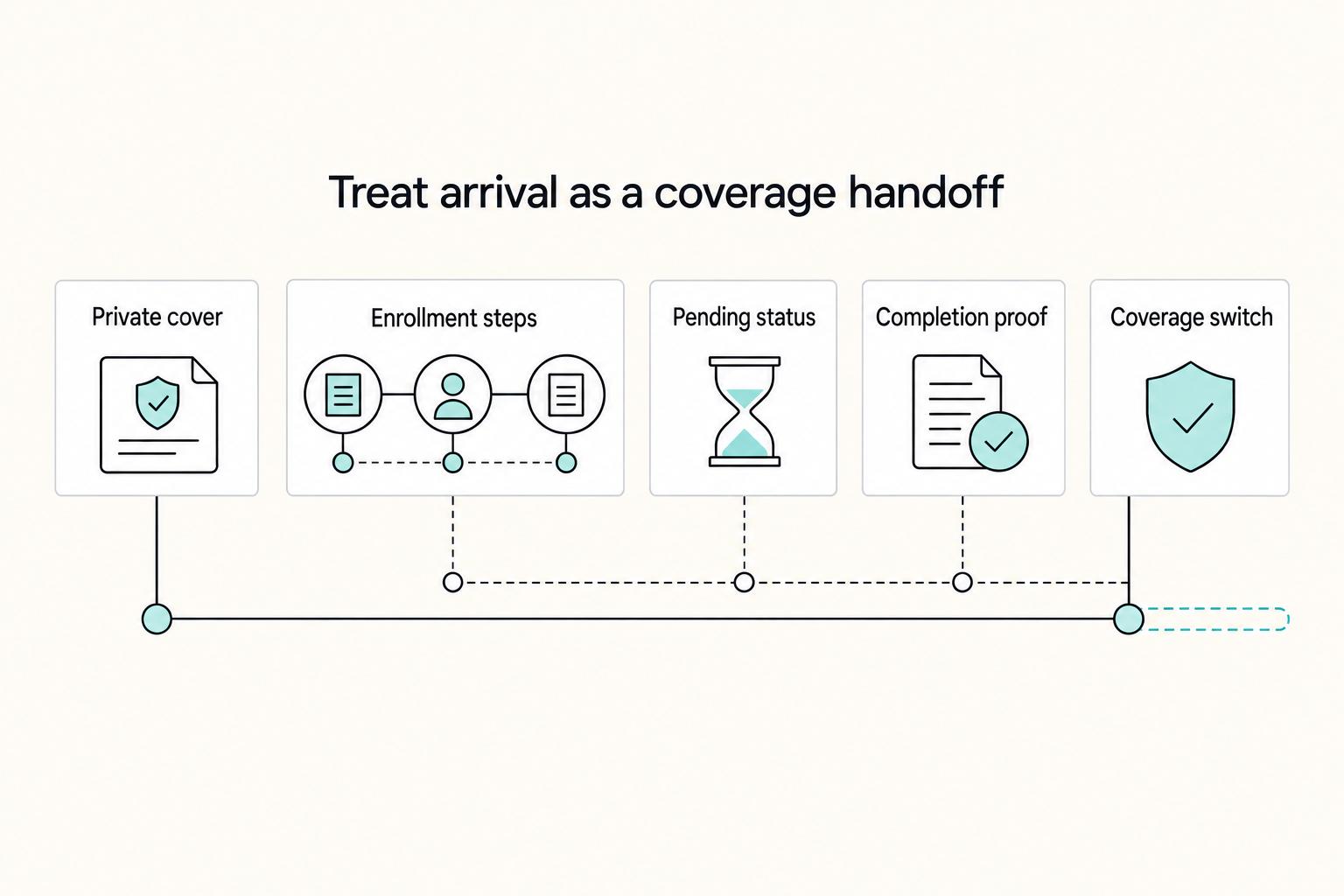
Treat arrival as a coverage handoff, not an instant switch. It is safer to keep private or expat coverage active while public enrollment steps are still pending, then end any overlap only when completion is documented. That approach is less elegant on paper, but it is much less fragile in real life.
Step 1: Keep continuity coverage active through arrival#
Set the policy start date to your travel date and confirm it stays active through your first registration steps. Before departure, get written confirmation of cancellation notice requirements and the earliest end date. Keep that confirmation with your active policy certificate and payment proof.
Verification point: keep an active policy certificate, payment proof, and a note showing how cancellation takes effect.
One avoidable mistake is canceling right after landing because public access feels close. If registration steps take longer than expected, you can end up with both a coverage gap and a documentation gap at the same time. Keeping overlap until completion is recorded is usually the safer call. This is mostly an evidence problem, not just a medical one, so plan for proof continuity as carefully as you plan for care continuity.
Step 2: Plan for uncertainty in public-system timing#
Do not build your arrival plan around an assumed activation date. Map the required steps for your case and track each one as booked, pending, or complete. Keep that status list in the same folder as your insurance files so your timeline stays visible.
Decision rule: if any required step is unbooked, pending, or undocumented, keep expat coverage active.
A short timeline note helps more than people expect. List the coverage start date, appointment dates, and the date each public enrollment step is confirmed. You are not creating new requirements with that note. You are making your own decision path clear and easier to defend if questions come later. If appointments move, update the note the same day so your current status never depends on memory.
Step 3: Keep contribution documents separate from healthcare enrollment proof#
This distinction matters. In cross-border cases, check whether a Totalization agreement applies to your Social Security contribution status. Employers and self-employed workers can request a Certificate of Coverage online and request email confirmation for approved requests. The SSA request process requires identity details such as the worker's full name.
Scope check: a Certificate of Coverage supports contribution status. It is not proof of enrollment in Spain's public health system.
Treat these files as parallel tracks. One track is contribution-status evidence. The other is healthcare coverage evidence. Mixing them often creates avoidable confusion, even when each document is valid on its own. Clear separation also makes follow-up requests easier because you can send only what answers the exact question.
Step 4: Keep one transition evidence pack#
Store transition records in one folder with consistent names and dates: visa documents, policy files, insurer confirmations, appointment records, and Social Security paperwork. Add a one-page timeline with coverage start, pending public steps, and issue dates. Update that sheet whenever any document is replaced.
Expected outcome: if you need to explain your transition later, you can show continuity quickly.
This pack also pays off if you update a policy, replace a certificate, or answer a renewal question. Instead of reconstructing your history from scattered emails, you already have a clean record of what changed and when. Keep old versions archived in a clearly marked subfolder so the current packet stays easy to scan.
Handle Home Country Visits Without Coverage Gaps#
Short trips back home create risk when territorial terms are assumed instead of confirmed. Keep your core policy active until you have written confirmation of what is covered abroad and what is excluded. Do not rely on memory from purchase calls for this step. It is a small admin task up front, but it is much easier than untangling a gap after the fact.
Step 1: Confirm where your current plan applies#
Before booking travel, request written territorial coverage for your exact trip details.
- Whether temporary stays outside Spain are covered
- Whether coverage includes only emergencies or also routine and mental health care
- Whether medical evacuation and repatriation are included
Expected outcome: one written summary of covered services, limits, and exclusions.
Ask for these details in writing even when the policy looks clear. Territorial clauses are often where assumptions break, especially with short or repeated trips. If your travel window changes, request an updated confirmation so your documents match the dates you actually use.
Step 2: Separate home-country access from Spain compliance#
If you return to your home country, treat any domestic coverage there as separate from maintaining valid insurance evidence for your Spain file. A plan that helps you access local care at home does not automatically replace what your Spain process requires.
Working rule: do not cancel your ongoing policy until you can still provide valid proof if requested.
That separation keeps your decisions cleaner. You can optimize trip coverage without putting your core immigration evidence at risk. It also reduces the chance that a short convenience decision creates a longer documentation problem later.
Step 3: Use travel medical as a bridge, not a default replacement#
Travel medical insurance can help on short visits, but the scope may be narrower than long-term IPMI-style coverage. Compare benefits and exclusions line by line before using a travel plan as primary coverage. If you depend on monthly products, check renewal terms closely.
You may see checkpoints like emergency cover amounts, evacuation limits, or zero deductible language. Verify each item with your insurer and filing office before you rely on it.
A practical test is to write one realistic scenario for your trip and ask which policy responds first. If the answer stays vague, your coverage design is probably too fragile. Use that scenario test before every trip so your decision is based on current wording, not old assumptions.
Step 4: Keep a trip-ready proof packet#
Keep cloud and offline copies of active policy dates, the policy certificate, payment proof, and emergency contact details. Update those files before every trip, not after booking.
Expected outcome: if care is needed during travel, or documents are requested later, you can prove continuity quickly.
That small preparation prevents two common problems: delayed care because documents are not accessible, and delayed filings because the evidence trail broke during travel. Keep one clearly named current folder and replace older copies in your travel device so you always reach the right files first.
You might also find this useful: How to Handle Taxes on Income from Multiple Countries.
Fix the Most Common Mistakes Fast#
Most insurance mistakes are document mistakes in disguise. The plan may be fine, but the proof is weak, inconsistent, or based on sales language instead of contract text. A short cleanup pass before payment or submission catches more than most people expect.
Step 1: Map each promise to actual policy text#
List the claims that influenced your choice and match each one to contract language and certificate wording. Keep the list short and specific so you can review it before submission without rereading the full policy.
Working rule: if you cannot point to the clause, treat that point as unresolved.
This step also makes revision requests much easier to handle. Instead of digging through long PDFs under time pressure, you can answer with one clause reference and one file location. Keep this map beside your submission checklist so both documents are updated together.
Step 2: Verify with the deciding office before you pay#
Ask the office reviewing your case for written confirmation on the wording that matters. Keep questions short and save replies with your policy files. Ask only what you need to close unresolved items, not every question you could imagine.
If office guidance and marketing language do not align, pause and clarify before purchase.
That can feel slower up front, but it often prevents disputes after payment or a last-minute packet rebuild. The moment you get confirmation, add the date and file name to your map so your decision trail remains complete.
Step 3: Keep Social Security proof separate from health-insurance proof#
Do not treat Social Security paperwork as a substitute for visa insurance evidence. Under Totalization agreements, a Certificate of Coverage shows which country handles Social Security contributions and helps prevent dual taxation. It is not a health-insurance policy document.
If you need a Certificate of Coverage, request it through SSA and verify identity fields carefully before submission.
SSA provides online Certificate of Coverage requests and form-help contact information. Keep contribution-status records on a separate track from visa insurance proof so each document answers the question it is actually meant to answer. If a reviewer asks for one track, send that track only and avoid mixing in unrelated files.
Step 4: Use forum posts to generate questions, not final decisions#
Anecdotal threads can surface edge cases, and that can be useful. But they are not filing standards. Convert each claim into a specific question for your insurer or reviewing office, then decide from written answers. That lets you learn from other applicants without outsourcing your decision to them.
Expected outcome: a clear decision trail based on clause text, office confirmation, and complete documents.
Run this section as a final cleanup pass and you will usually find a few weak points that are quick to fix before they turn into bigger delays. Treat unresolved items as blockers, not minor notes, until they are closed in writing.
Final Copy and Paste Checklist#
Use this final pass to make each requirement in your case traceable to one document before you submit. Requirements can vary by reviewing office, so confirm anything unclear in writing.
- Confirm case rules in writing. Send short yes-or-no questions to your reviewing office and save the reply as a dated PDF.
- Prioritize document clarity over price alone. Compare wording clarity, certificate quality, and correction speed before monthly cost.
- Verify clause text before paying. Use a mapping sheet with office question, clause location, and file name. If references are missing, pause and request clearer certificate language.
- Assemble one complete packet with consistent file names. Keep the documents you plan to submit in one folder. Confirm names, dates, and policy details match across files.
- Add Social Security evidence when your case needs it. If your contribution status depends on a Totalization agreement, request a Certificate of Coverage through SSA and keep confirmation records. The certificate is used to show exemption from Social Security taxes in the other country under the agreement.
- Track your own follow-up checkpoint after submission. Keep coverage active based on your plan, and if a revision request arrives, answer with updated files and an updated mapping sheet in one response.
Final quality check before you click submit:
- Every requirement points to one clause and one file.
- Every file in the packet is the current version.
- Every unresolved item is closed in writing.
- Coverage dates are documented for the period you intend to cover.
If all four checks pass, your insurance file is in strong shape for review.
After your insurance packet is locked, plan your post-move money operations with a compliance-first setup: Talk to Gruv.
Frequently Asked Questions
Do I need private health insurance for the Spain Digital Nomad Visa, or can I rely on public healthcare?
This is case-dependent, not one-size-fits-all. Private insurance is required in some cases and not in others, including guidance that it may not be mandatory if you commit to Spanish Social Security registration and contributions after visa grant. Get a written answer from the office reviewing your file before you rely on public access. If the answer is conditional, ask what document proves the condition is met.
Does visa acceptance usually require no co-payments and no deductibles?
This guide does not establish a universal no co-payment/no deductible rule for every case. Treat these terms as case-specific checks. Ask for a clear yes or no, then confirm your policy wording matches it before submission. If wording is unclear, request corrected certificate language before you upload anything.
Is travel medical insurance enough, or do I need expat health insurance?
No universal answer is supported for all applicants. IPMI is one option discussed for digital nomads, and monthly plans can create renewal and total-cost tradeoffs. Decide from your case guidance and your policy documents, not from generic plan labels. If your timeline is tight, prioritize the option with faster document correction and reissue support.
What exact visa documents should my insurer issue before I submit?
One concrete artifact cited here is a Spanish-language certificate from an officially registered Spanish insurer. This guide does not establish one universal packet for every case. Request the exact checklist from the reviewing authority and keep certificate wording aligned with policy terms. Then map each required point to one file and one clause so your packet is easy to review.
What should I do if my move date is close and Spain public health system registration is not done yet?
Do not assume public access is active until registration and contribution steps are completed and documented. Keep private coverage active while those steps remain unresolved. If you continue contributing to your home-country pension track, confirm whether equivalent private coverage is still expected in your case. Do not cancel existing coverage based on expected appointment outcomes.
How should I stay covered during visits to my home country while living in Spain?
Do not assume a Spain-based policy automatically covers home-country visits. Confirm territorial scope, exclusions, dates, and limits in writing before each trip. If you use monthly IPMI, set strict renewal controls to avoid preventable gaps. Keep your trip proof packet updated so you can show continuity quickly if asked.
Try a related tool
Researched and edited by the Gruv editorial team. Gruv builds cross-border billing, payouts, and finance-operations software for global businesses.
Sources
Includes 4 external sources outside the trusted-domain allowlist.
- ssa.gov/international/CoC_link.htmltrusted
- digitalnomadvisainspain.com/private-health-insurance-digital-nomad-visa-...external
- healthplanspain.com/blog/expat-tips/2233-digital-nomad-visa-dela...external
- ipmiglobal.com/in-focus/digital-nomads-insurance/12-frequen...external
- visalimmigration.com/en/news/do-i-need-private-health-insurance-t...external
Educational content only. Not legal, tax, or financial advice.
Related Posts

Thailand Tax for Digital Nomads Without Residency Mistakes
The most expensive mistakes here happen before anyone opens a tax return. People pick a visa, assume the tax answer comes with it, then try to rebuild the year from scraps after the fact. By then, the damage is usually not one dramatic error. It is a pile of small gaps: an unverified day count, a transfer with no clear purpose note, invoices that do not line up cleanly with payments, and assumptions nobody wrote down when the facts were still fresh.
Freelance Crypto Payments That Protect Cashflow and Reduce Disputes
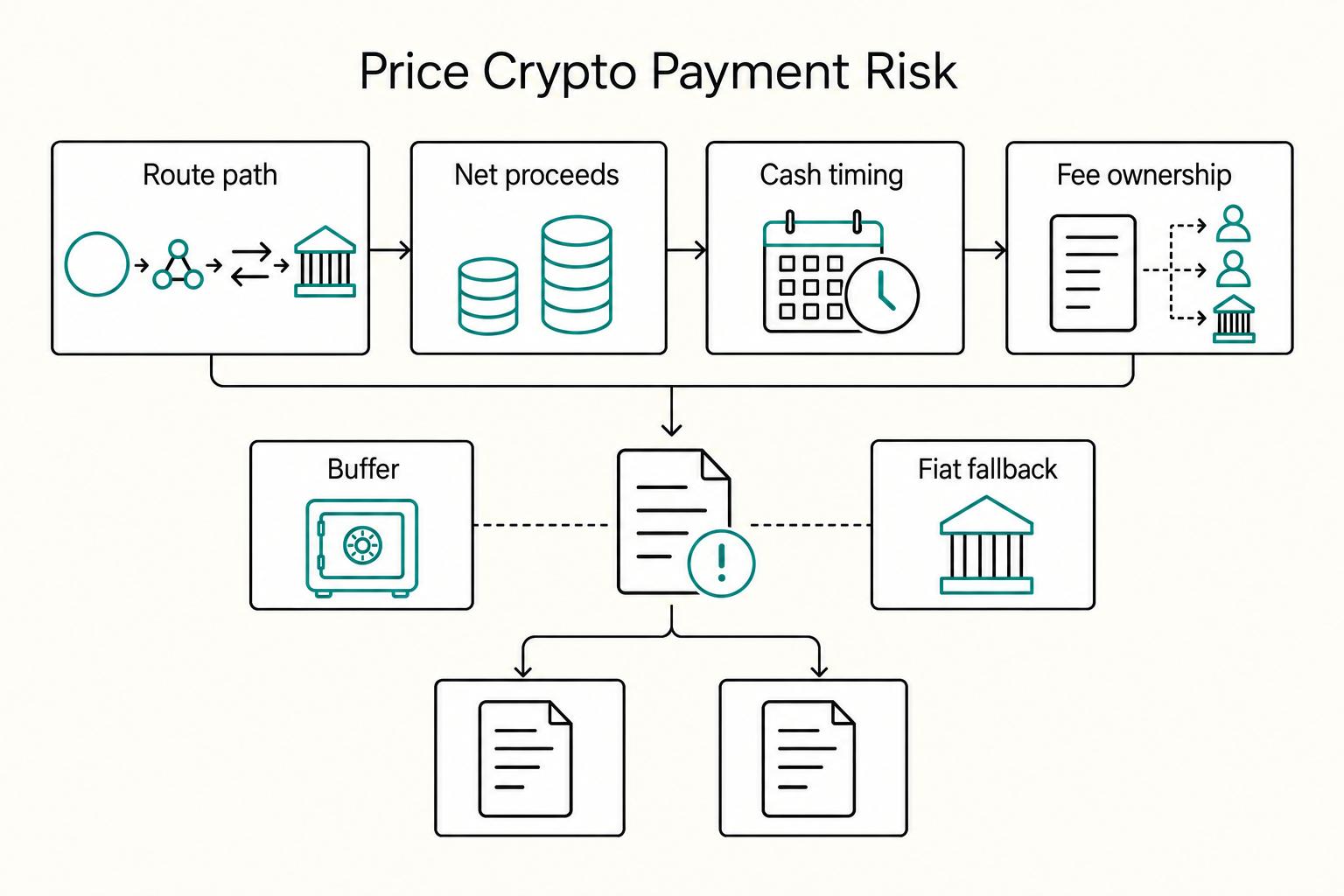
Crypto payments make sense only when they improve how reliably you get paid after you plan conversion, compliance, and recordkeeping up front. They can reduce friction in some international setups where traditional platforms add fees, restrictions, or extra steps. They also move risk onto conversion timing, exchange-fee exposure, and documentation quality, so use a simple acceptance test before you agree:
How to Handle Taxes on Income from Multiple Countries
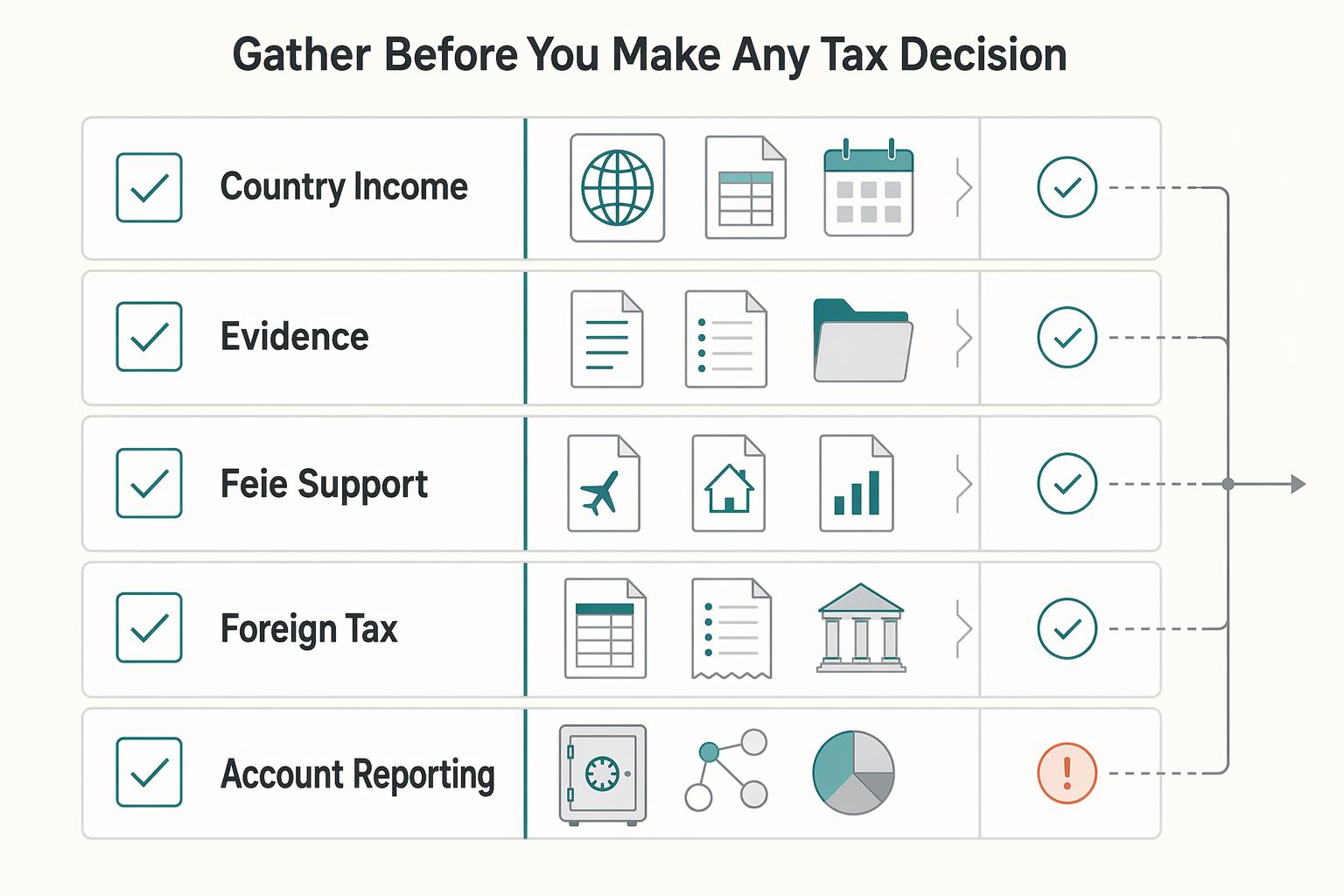
Start with a compliance objective, not a minimization objective. First identify where you may owe tax, then test relief only when a specific rule fits a specific income item. Keep records that will still make sense if the Internal Revenue Service (IRS) or a local authority later asks how you got there.