
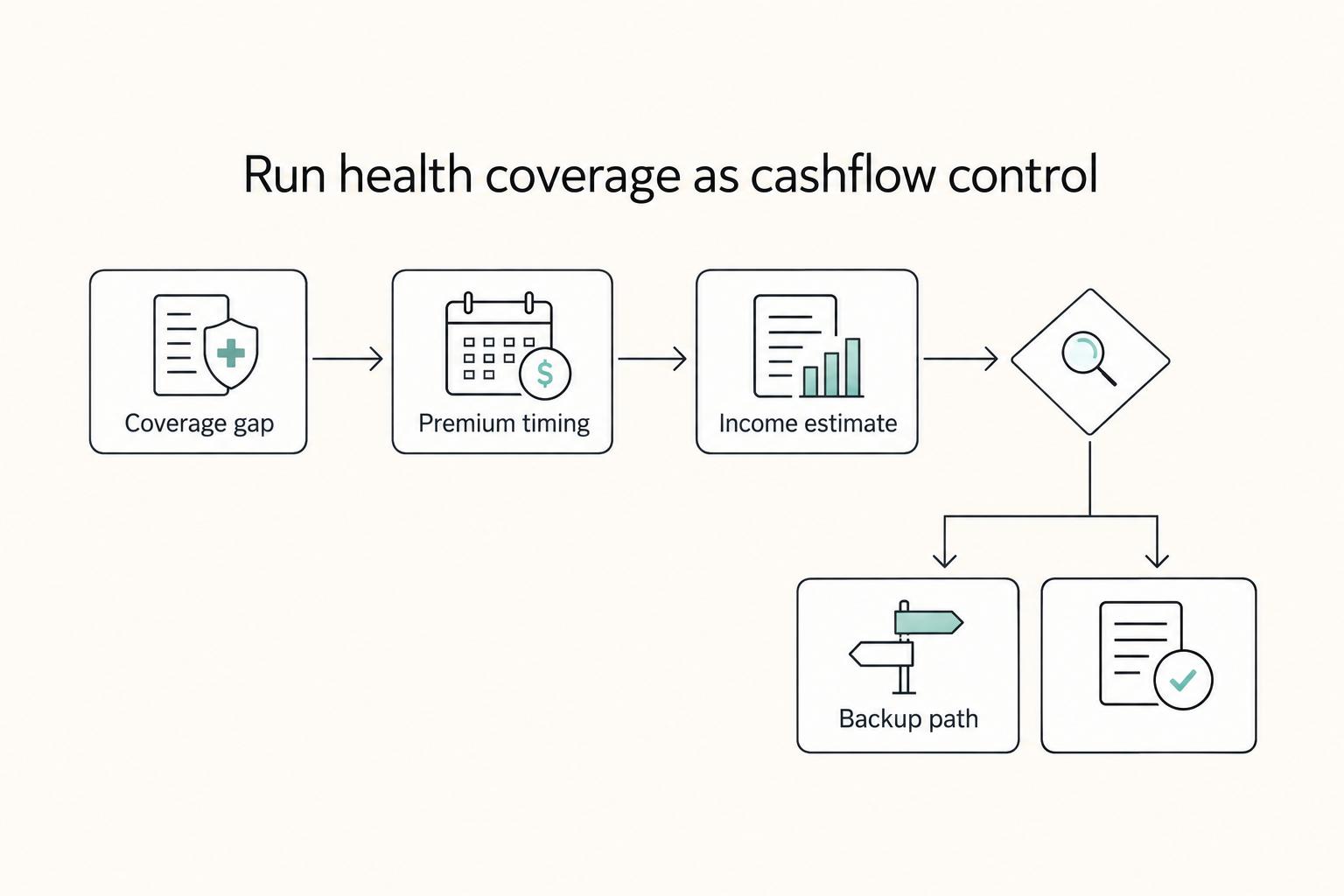
Quick Answer
To get health insurance as an early retiree before Medicare, build a no-gap coverage system: confirm your current plan end date, choose the fastest viable next path, and verify enrollment timing, effective date, and first payment. Compare Marketplace, spouse/partner coverage, COBRA, Medicaid, and retiree programs based on total cost and care continuity. Then run monthly income and annual renewal checks so coverage stays stable as your situation changes.
You're retiring early - now don't let health insurance become the thing that breaks your cashflow#
Treat health insurance in early retirement as an operational bridge to Medicare, then run a simple system that prevents coverage gaps and financial surprises. You already made the early-retirement call. Now you need execution discipline. The goal is not "find the perfect plan." The goal is continuous coverage that protects runway.
| Situation | What it unlocks | Key timing |
|---|---|---|
| Retiring before Medicare | A multi-year bridge period of coverage | Commonly discussed until age 65 |
| Losing job-based coverage | Access to the Health Insurance Marketplace and a possible Special Enrollment Period | Can let you enroll outside the annual window |
| Marketplace Open Enrollment | Annual chance to enroll in a Marketplace plan | November 1 to January 15 each year |
Retiring before Medicare, commonly discussed as coverage needed until age 65, creates a multi-year bridge period, not a one-time checkbox. In the U.S., if you retire before 65 and lose job-based coverage, you can use the Health Insurance Marketplace to buy a plan. Losing coverage can also qualify you for a Special Enrollment Period, which lets you enroll outside the annual window. Also write this down now: the Marketplace Open Enrollment Period runs November 1 to January 15 each year.
The 10-minute, risk-first decision framework (run it like cashflow ops)#
Step 1: Lock your timeline. Write your last day of current coverage, your target start date for the next plan, and the next Open Enrollment dates. Outcome: "no uncovered days" becomes a hard requirement you can enforce.
Step 2: Pick scenarios, not vibes. Choose what your next 90 days most likely look like: stable income, volatile income, or income drop. Outcome: you stop designing from optimism.
Step 3: Run verification gates before you commit. Verify eligibility windows, effective dates, and what the Marketplace application says about premium tax credits (it depends on income and household size). Outcome: paperwork friction does not turn into a coverage gap.
Step 4: Install an annual reset. Put Open Enrollment on your calendar. Add a quick review trigger when income changes. Outcome: you treat coverage like a living system, not a "set and forget" purchase.
| Risk you're managing | What it breaks for a Business-of-One | Your safe default control |
|---|---|---|
| Coverage gap | One incident can force you into bad client terms to raise cash fast | Timeline first. Backup path identified |
| Premium surprises | You drain your operating buffer | Track premium due dates like recurring bills |
| Income estimate errors | You may not get the financial help you expected | Update estimates when income changes |
Why this matters more when you invoice for a living#
A medical bill does not just hit your personal life. It can break invoicing cadence, push you into rush work, and shrink the buffer that keeps you selective with clients.
Hypothetical scenario: you leave a role, delay enrollment because you "feel fine," and then an unexpected issue shows up. You end up negotiating from pressure instead of strength. That is the real cost.
Next, we get practical. You will prep dates, income assumptions, and documents so you can compare options without guessing.
Prerequisites: what to prepare before you compare a single plan#
Before you compare plans, gather the inputs that actually drive the decision: dates, income, household needs, documents, and a tracking system. If "no uncovered days" is your standard, do the setup work that prevents delays, wrong networks, and cashflow surprises.
Step-by-step: your pre-shopping prep (operator-grade)#
Step 1: Write down your dates and windows. Capture your work end date, your desired coverage start date, and any enrollment deadlines you may be subject to. Also list any recent changes in your household or employment that could affect your options. Rules vary, so do not interpret them yet; just list what changed.
| Prep item | What to gather | Why it matters |
|---|---|---|
| Dates and windows | Work end date, desired coverage start date, enrollment deadlines, recent household or employment changes | Helps prevent uncovered days and delays |
| Income map | Month-by-month forecast of the income figure you expect to use when applying for coverage | Stops assumptions based on bank balance or an optimistic pipeline |
| Household needs | Who needs coverage, must-stay prescriptions, preferred providers | Supports plan comparison and continuity needs |
| Document stack | IDs, prior coverage dates, medications, preferred providers, employer or insurer paperwork you already have | Keeps paperwork from becoming your bottleneck |
| Tracking system | Premium due dates, plan documents, what you paid and when | Protects runway and helps avoid missed payments |
Verification: you can point to a single start date and you know how close you are to Medicare eligibility at age 65. That way, you do not over-optimize a plan you may only need for a short bridge.
Step 2: Build an income map (separate from business cashflow). Create a month-by-month forecast of the income figure you expect to use when applying for coverage. Keep it distinct from "revenue collected."
Horizon Wealth puts the core reality plainly: if you retire early before Medicare, "it becomes your responsibility to manage the full expenses of your health insurance," including premiums. The point is simple: do not make assumptions based on bank balance or an optimistic pipeline.
Step 3: Inventory your household and must-keeps. List who needs coverage, your must-stay prescriptions, and any providers you strongly prefer to keep in-network. Then list your live coverage paths:
| Coverage path to evaluate | What to record now | Why it matters operationally |
|---|---|---|
| Individual plan / Marketplace plan (where available) | Household members, provider list, prescriptions | A common way to cover the gap between early retirement and Medicare |
| Spouse/partner employer plan | Enrollment window, cost impact | "You may consider joining their employer-sponsored plan" (Horizon Wealth), but paycheck deductions may increase |
| Employer retiree plan | HR contact, plan documents | Some large firms offer retiree coverage (Horizon Wealth) |
Step 4: Assemble your document stack. Collect IDs and prior coverage dates, plus a clean list of medications and preferred providers. File anything you already have from your employer or insurer so paperwork does not become your bottleneck.
Step 5: Install the operational toolset. Use one tracker for premium due dates, plan documents, and what you paid and when. If you already run Xero, log premiums as a recurring item so you protect runway and avoid missed payments. Use this: A Guide to Xero for Freelancers and Small Businesses.
Hypothetical scenario: you map dates first and realize you only need a short bridge to Medicare. You prioritize continuity and admin simplicity over perfection, and you save optimization energy for after you stabilize.
How do you avoid a coverage gap when you stop working?#
Avoid a coverage gap by locking the exact end date of your current coverage, lining up the earliest start date of the next plan, and building buffer for verification and first payment processing. With your dates, income estimate, and documents ready, you can turn prep into an execution timeline. The goal stays simple: no unprotected days, because one uncovered incident can turn into a long-tail cashflow problem.
Build a coverage timeline (with verification checks)#
Step 1: Confirm the exact last date of your current coverage. Ask HR, or the plan administrator, one precise question: "What is my coverage end date?" Do not guess. In Canada, one source notes most group health benefits end the day you retire, not later.
| Path | Verify now | Likely friction |
|---|---|---|
| Individual coverage (including Marketplace coverage, where applicable) | What documentation you may be asked for | Follow-up requests |
| Employer continuation or conversion option (if offered) | Administrator contact and required forms | Forms and administrator steps |
| Spouse/partner coverage (if available) | Enrollment window and what proof they require | Timing and proof requirements |
This detail tells you how aggressively you need to push your next enrollment.
Step 2: Identify the fastest path you can actually activate. "Fastest" means the path with the fewest dependencies you control today. Your job is to pick the option you can turn on with the information you already have, plus a backup you can trigger if your first choice hits a snag.
Practical verification checks:
- Individual coverage (including Marketplace coverage, where applicable): Confirm what documentation you may be asked for and plan for follow-up requests.
- Employer continuation or conversion option (if offered): Get the administrator contact and required forms now, not after you exit.
- Spouse/partner coverage (if available): Confirm the enrollment window and what proof they require.
Step 3: Set a decision deadline that leaves room for friction. Pick a date well before coverage ends so you can handle documentation requests, payment processing, and corrections.
If you are converting an employer group plan to a personal plan, timing can matter. For example, one Canada-focused source says you may be able to convert within 31 to 90 days to avoid medical underwriting, so confirm the window that applies to your situation.
The IRS explicitly tells taxpayers to "Report changes in circumstances when you re-enroll in coverage and during the year," so treat enrollment as an ongoing ops task, not a one-time click. Also note: IRS instructions for Form 8962 mention that reporting entities no longer must automatically send minimum essential coverage (MEC) forms, so you may need to pull your own records quickly when tax time arrives.
The trap and the failover (operator rules)#
Do not wait until you "feel healthy" to enroll. Mercer Advisors cites the 2023 Retirement Confidence Survey: 38% of retirees say health expenses run higher than expected. You do not want your first surprise to land during a gap. If you are retiring early, that can mean bridging coverage until Medicare eligibility at age 65.
Practical check: before you resign, list two viable paths, primary plus backup. Hypothetical scenario: your primary enrollment hits a verification snag. You activate your backup path, keep coverage continuous, and finish setup without panic.
The 10-minute decision matrix: which pre-Medicare path fits your reality?#
Pick the option that matches your income controllability and care continuity needs, then choose a primary plan plus a backup plan so you are not gambling on a single enrollment path. You win by reducing downside risk, because healthcare costs can punch a hole in runway fast.
Hack Your Wealth puts the framing bluntly: "healthcare financial planning is retirement planning." Treat this like an ops decision, not a vibes decision.
Step 1: Run the scenario matrix (best when, weak when, must-verify)#
Use this as a heuristic, then verify details before you enroll.
| Path | Best when | Weak when | Must-verify today (no guessing) |
|---|---|---|---|
| Health Insurance Marketplace (ACA Marketplace) | You want an individual plan not tied to a single employer | Your preferred providers are not available in-network or the costs do not fit your runway | Total expected cost (premium plus out-of-pocket), provider and drug coverage, and any eligibility or documentation requirements (details vary) |
| Spouse/partner employer plan | The coverage fits your doctors and budget | Dependent premiums strain cashflow or coverage does not match your needs | Enrollment timing, required proof, total dependent cost, and how this choice might interact with other coverage options or financial help (rules vary) |
| COBRA | You want to continue the same employer plan for a limited period (when available) | Premiums strain your monthly burn | Whether continuation coverage is available to you, the full cost, and the exact steps and timing from the plan administrator |
| Medicaid | You think you may qualify and the coverage works for your care | Provider access limits your real choices | Your state's eligibility rules and what happens if your situation changes during the year (rules vary by state) |
| Employer or state retiree program | You have access and the benefits are genuinely competitive for your situation | Eligibility rules, timing, and plan design options narrow what you can actually do | The controlling plan documents, eligibility criteria, enrollment timing, and the specific benefits and costs you would get |
Step 2: Apply decision gates (safe defaults)#
Gate A (cost control with volatility): If your income swings, lean toward coverage paths that are not tied to one employer and that you can keep as your work situation changes. Build your plan around what you can actually control, then re-check it as reality updates.
Gate B (continuity under medical load): If you are in active treatment or rely on specific providers, compare staying on your current-style coverage, when available, versus switching. Cashflow pain hurts. Care disruption can hurt more.
Practical check (fast, no debate):
- Circle one primary plan and one backup plan.
- Write down the single must-verify item that could disqualify each.
- If your primary path stalls on verification or timing, be ready to pivot to the backup path, where available, so you can keep coverage continuous.
Can early retirees get ACA subsidies - and how do you keep them without nasty surprises?#
Yes, many early retirees can qualify for financial help through the ACA Marketplace, and you keep it by treating your income estimate like a live forecast instead of a one-time guess. If the Marketplace is your primary path, this is the failure mode to control. The fastest way to create a surprise bill is to ignore how sensitive Marketplace pricing can be to the income estimate you're using.
Step 1: Translate "subsidy mechanics" into operator language#
Use a clean mental model: Marketplace financial help is commonly discussed in terms of your expected household income for the year and often discussed using MAGI, depending on context. It can change as your situation changes. If you treat that estimate like a set-it-and-forget-it number, you are choosing volatility.
Use this table to keep your brain out of trouble:
| What you track | Why it matters | Common early-retiree mistake |
|---|---|---|
| Cash in accounts | Cashflow safety, runway, reserves | Confusing cash-on-hand planning with how Marketplace financial help is discussed |
| Business revenue | Sales performance | Treating revenue as identical to the income figure you'll use for planning |
| Your Marketplace income estimate | Can affect what you pay during the year | Setting it once, then never revisiting it |
One reason to take this seriously: an MIT study of a subsidized exchange found take-up "dropping about 25 percent for each $40 increase in monthly enrollee premiums" as subsidies declined. Small premium swings change behavior fast. Your system should prevent accidental swings.
Step 2: Install an income-control loop (freelancer-safe)#
Step 1: Set a guardrail range. Pick a realistic floor and ceiling for your annual income estimate, then choose a plan assuming you land inside that band. Do this before you enroll, not after you panic.
Step 2: Run a monthly review. Put a 10-minute recurring calendar block: "Marketplace income check." When a contract starts, ends, or changes, revisit your estimate and follow your Marketplace's process for updating it. Each state's process and timing can differ, so verify yours.
Step 3: Hold a subsidy reserve. If you're receiving advanced help that lowers monthly premiums, treat it like something that can shift if your income estimate or final income changes. Keep a buffer until your year is fully settled, because you may need to true things up later depending on the rules and your actual results.
Practical checks before you commit (no guessing):
- Ask a tax pro, CPA, or enrolled agent what your situation includes in the Marketplace income concept people often call MAGI. Self-employment results, capital gains, and distributions can matter, but rules depend on your facts.
- Confirm how your state Marketplace handles mid-year updates and when changes affect premiums.
- Hypothetical: you pick up an unexpected consulting retainer mid-year. You update your estimate the same week, increase your reserve, and avoid a year-end cash crunch.
Greenbush Financial Group frames it plainly: "Why income planning is critical when considering exchange subsidies." Build the system once, then run it monthly.
Treat every coverage option as unconfirmed until you verify it#
Treat every early-retirement coverage option as "unconfirmed" until you verify it against official sources and the controlling plan documents for your exact employer or program. This is where people get burned. They act on generic advice while the actual rules, availability, and deadlines are local. The fix is a tight verification script.
Step-by-step: run local verification (no generic advice)#
Step 1: Verify public-program rules in writing. Do not rely on forum summaries, even well-meaning ones. Go to the official agency site for the program you are considering and confirm what they count as income and how they want you to report uneven freelance income. Your verification point is a page, PDF, or official FAQ you can save.
Step 2: Verify what actually exists on your Health Insurance Marketplace. Log in, or use the browse tool, and list the insurers and plan types you can buy where you live. Then check provider access by looking specifically for your doctors, hospitals, and key prescriptions inside each plan's directory and formulary. Operator rule: if you cannot confirm your must-have providers, you cannot treat that plan as a primary.
Step 3: Verify employer coverage and COBRA details with the plan administrator. Skip assumptions and go straight to the source: your HR benefits contact or the plan administrator. Ask for the controlling summary, deadlines, and how they treat effective dates and first payments. Save the email or PDF as your audit trail.
| Verification item | What you need to find | Output you save |
|---|---|---|
| Public program | Official eligibility and income handling guidance | Link or PDF + notes |
| Health Insurance Marketplace | Insurers, plan types, network and drug coverage | Shortlist screenshot + plan PDFs |
| Employer and COBRA | Administrator instructions and required forms | Email thread + forms |
Retiree-plan example: Indiana's RMBA (how to verify, fast)#
If you evaluate a State of Indiana retiree-related option, anchor on the official Indiana Public Retirement System (INPRS) page for the Retirement Medical Benefits Account Plan (RMBA). INPRS states: "The State has established this plan as a benefit to retired employees," and it describes reimbursement from a reimbursement account for qualifying expenses for the retiree and/or covered dependents.
The same page also lists Key Benefit Administrators (KBA) as the claims administrator and provides contact info, including 800-558-5553, for account and claims system questions. It also notes that since July 1, 2021, State of Indiana employees in the "My Choice: Retirement Savings Plan" are included in RMBA.
Hypothetical: you plan to use a retiree benefit plus a Health Insurance Marketplace plan. You confirm RMBA eligibility on INPRS, call KBA to confirm how reimbursements work, then enroll in the Marketplace as your primary coverage so you never depend on an unclear benefit mid-year.
Practical check: if you cannot locate the controlling document, official plan page, participant handbook, rules, fact sheet, FAQs, or plan PDFs, mark that option "not confirmed" and default back to coverage you can verify until you do.
How do you actually pick a plan and enroll without getting burned?#
Pick the plan you can show will cover your care at a predictable worst-case cost, then enroll with an audit trail. Once your options are verified, you switch from research mode to execution mode. This is where plans fail. People optimize premiums, skip verification, and then pay for it with disrupted care or cashflow shocks.
Step-by-step execution (with controls)#
Step 1: Shortlist a few real options and compare total annual exposure. Pull one candidate from each lane you actually have access to, for example: retiree coverage if offered, a spouse or partner plan, or an individual plan. Then compare the cost drivers that hit runway, not just the monthly premium. Remember that during working years employers often pick up at least some of the cost, and in retirement the economics of buying similar coverage may not add up.
| Cost driver to compare | What you're trying to prevent | What to capture |
|---|---|---|
| Premium | Death by recurring fixed costs | Monthly premium, payment method |
| Deductible | "Everything is out of pocket until..." surprises | Individual and family deductible |
| Out-of-pocket max | Catastrophic cashflow event | OOP max + what counts toward it |
| Copays and coinsurance | High-frequency leakage | Primary care, specialist, urgent care, ER |
| Supplementary coverage | Surprise bills for common add-ons | What's covered for prescriptions, dental, paramedical services (massage, chiropractic, podiatry, etc.), and eyeglasses |
Step 2: Run a provider and prescription verification check that you can screenshot. Do not assume your doctors "take" the insurer. Confirm your exact plan's network and your prescription coverage using the plan's own lookup tools and plan documents. Save screenshots.
Step 3: Confirm start date and first payment details before you celebrate. You want proof that coverage starts when you think it starts. You also want proof that the insurer received your first premium. Save the enrollment confirmation and payment confirmation in the same folder.
Step 4: Install reminders for premium drafts and annual renewals. This is not "set and forget." Put recurring reminders on your calendar. If you track expenses in Xero, set the premium up as recurring so you spot misses fast: A Guide to Xero for Freelancers and Small Businesses.
Two "must-verify before you click enroll" gates (plus documentation discipline)#
Gate A (financial): sanity-check affordability under your own worst-case year. Model the year where you actually use the plan, not the year where nothing happens. If you're moving from an employer plan, where the employer often paid part of the cost, stress-test the new premium plus your worst-case out-of-pocket exposure.
Gate B (medical): confirm your must-have care path, or choose a continuity workaround. If the plan does not include your key providers or facilities, do not enroll hoping it works out. If you have any legitimate continuation or bridge option available through your situation, treat it as a tool for continuity while you re-shop, not as a default.
Documentation discipline (treat it like contract ops): keep one folder with plan documents, provider and prescription screenshots, your approval page, and your payment receipt. If a dispute pops up, you will want the same clarity you demand in client contracts.
High-trust reality check: as The Retirement Manifesto puts it, "the thought (and expense) of having to replace [employer coverage] on our own is a major reason many people wait until age 65 to retire." Treat that as your operator signal. You protect your freedom by running enrollment like a controlled cutover, not a vibes-based purchase.
Common mistakes early retirees make (and how to recover fast)#
Treat mistakes as operational incidents: contain the risk, restore coverage continuity, then schedule the clean fix at the next allowed window. Even if you enroll cleanly, real life changes things. Income shifts, networks change, deadlines slip, and cashflow takes the hit unless you have an incident response plan.
Step-by-step: the 24-hour recovery protocol (safe defaults)#
Step 1: Stop the bleed with a "coverage status" check. Log into your insurer, or plan administrator, and confirm: active status, effective date, premium paid through date, and your member ID access. If anything looks off, call the insurer and ask for the specific document you need to prove eligibility, not a verbal "you're fine."
Step 2: Recalculate your real exposure (not just the premium). Retirees often miss the non-premium costs. Sun Life captures the core problem plainly: "many of us aren't aware of, or prepared for, out-of-pocket medical expenses."
Build a one-page view of your likely worst month and worst year cost. Then decide whether you tolerate the plan until the next enrollment window you can use, or switch sooner if you qualify.
Step 3: Create a bridge plan if continuity breaks. If you need ongoing care and your current plan fails you, ask your current or former benefits administrator, if applicable, what continuation options exist and what timing rules apply. Also ask your providers about temporary cash-pay rates so you can keep appointments while you re-shop.
Each mistake, what it breaks, and the fast recovery move#
| Mistake | What it breaks | Fast recovery move |
|---|---|---|
| Assuming premiums equal total cost | You under-budget healthcare costs | Re-run your total exposure view (premium plus out-of-pocket medical expenses). Decide whether you ride it out or switch at the next enrollment window you can use. |
| Missing a deadline and creating a gap | You risk uncovered services | Call the plan administrator immediately. Ask what options you still have and what proof they require from you. |
| Underestimating income (pricing/assistance risk) | You get surprised by what you owe later | If any part of your pricing or assistance is based on reported income, check the program rules and update your information when your income trajectory changes. Until you regain certainty, hold a reserve in cash and treat it like you treat tax set-asides. |
| Choosing the wrong network | Your doctors become out-of-network | Ask your providers for cash-pay options and any continuity process they support. Use this as a trigger to re-shop with network-first rules instead of premium-first rules. |
| Ignoring local variability | You follow advice that does not apply locally | Rules vary by jurisdiction and by plan. Re-run your verification playbook for your own plan and location rather than guessing. |
A quick hypothetical: you retire early, pick an individual plan, then a key specialist suddenly shows as out-of-network. You contain the risk by locking in a cash-pay rate for the next visit, ask the office about any continuity options they support, and then re-shop with network-first rules instead of premium-first rules. That is how operators protect runway.
Lock it in: your pre-Medicare coverage system (copy/paste checklist)#
Run pre-Medicare coverage like a system: lock dates, verify the real options, enroll with proof, and reset the process each year. The repeatable workflow is the win. Chasing a "perfect plan" is not.
Treat coverage like you treat client payments: a risk surface with controls. You do not rely on vibes. You rely on dates, documents, reminders, and a backup path.
The workflow (use this loop each calendar year)#
Use this as your control loop. Run it annually and anytime your coverage, income, or household situation changes.
| Phase | Your output | Your "done" signal |
|---|---|---|
| Timeline lock | Current coverage end date + target next start date | You documented the exact last day of current coverage, the target start date for the next plan, and a "no uncovered days" rule |
| Option map | Primary path + backup path | You listed the real options available to you, such as Marketplace coverage, spouse/partner coverage, COBRA, Medicaid, or a retiree plan, and chose a backup |
| Verification | Eligibility, effective dates, network and drug checks | You saved the controlling documents, administrator instructions, and provider/prescription screenshots for the option you're treating as primary |
| Enrollment | Submitted application + payment proof | You have the approval page, the confirmed start date, and proof the first premium was received |
| Income-control loop | Current estimate + review rhythm | If you use Marketplace coverage, you set a monthly "Marketplace income check" and know how to report changes in circumstances during the year |
| Annual reset | Open Enrollment review plan | You put November 1 to January 15 on your calendar and set a trigger to re-check the plan when income, providers, or household details change |
Copy/paste checklist (run each calendar year)#
- I confirmed the exact end date of my current coverage and wrote it down.
- I set a target start date for the next plan early enough to handle verification, corrections, and first payment processing.
- I mapped my primary path and backup path instead of relying on a single enrollment route.
- I verified eligibility, effective dates, provider network, prescription coverage, and required documents before enrolling.
- I saved the plan documents, screenshots, enrollment confirmation, and first payment receipt in one folder.
- If I use Marketplace coverage, I set a monthly income review and know how to update my estimate when income changes.
- I added Open Enrollment, November 1 to January 15, to my calendar and set an annual review.
- I know whether this is a short bridge to Medicare at age 65 or a longer pre-Medicare period.
Operator note: if you cannot verify an option against the controlling plan document or the official program source, mark it "not confirmed" and default back to the path you can verify until you do.
Frequently Asked Questions
What are my health coverage options when I retire in Canada?
Start with your provincial health insurance plan. Government plans vary by province, and they cover physicians’ care and hospitalization. Then plan for the costs your employer benefits used to absorb, because those often shift onto you after you retire.
Do employer group health benefits continue after I retire?
Often, no. In Canada, most group health benefits end the day you retire, so confirm the exact end date and any continuation options with your employer or plan administrator.
What costs may shift to me after I retire?
Expect more of the bill to land on you. Once you retire, health, dental, and medical expenses that were covered by your employer can become your responsibility.
Is retirement health insurance worth it?
It can be, depending on your needs and budget. Retirement health insurance is described as offering flexible, customizable health plans intended to keep out-of-pocket costs low, so compare options based on what you actually spend money on and what coverage you want to protect.
Can I stay on a spouse or partner’s plan after I retire?
Sometimes, but it depends on the specific plan’s rules. Treat it like a documentation problem: confirm eligibility, when coverage can start, and what proof you’ll need if a claim gets questioned.
How do I avoid a coverage gap when I retire?
Get the dates right and get them in writing. Write down the exact end date of your current group coverage (if any), line up the start date of whatever comes next, and set a decision deadline early enough to handle paperwork and first payment. If you cannot verify timing in writing, treat that path as unconfirmed and line up an alternate.
Try a related tool
Researched and edited by the Gruv editorial team. Gruv builds cross-border billing, payouts, and finance-operations software for global businesses.
Sources
Educational content only. Not legal, tax, or financial advice.
Related Posts
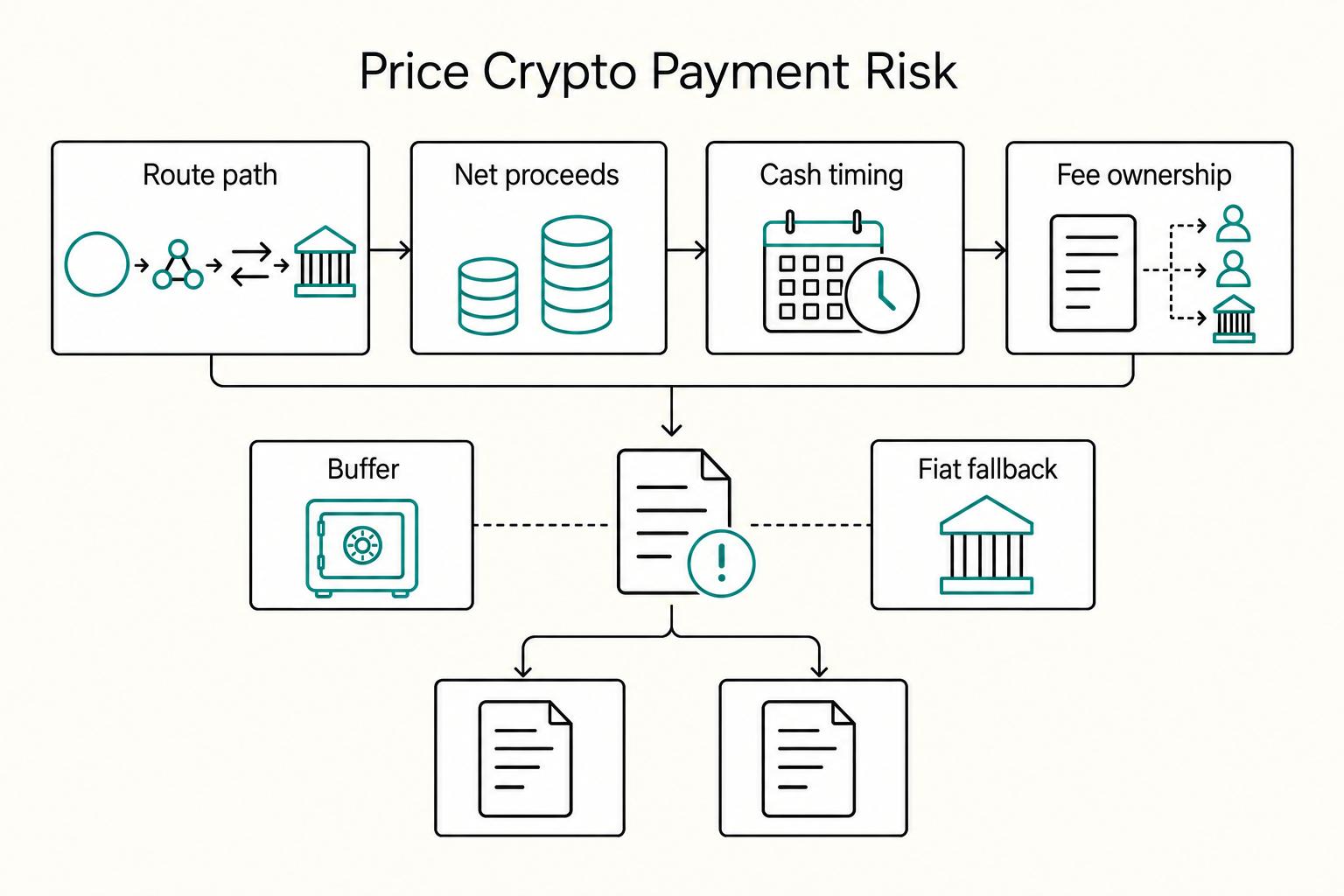
Freelance Crypto Payments That Protect Cashflow and Reduce Disputes
Crypto payments make sense only when they improve how reliably you get paid after you plan conversion, compliance, and recordkeeping up front. They can reduce friction in some international setups where traditional platforms add fees, restrictions, or extra steps. They also move risk onto conversion timing, exchange-fee exposure, and documentation quality, so use a simple acceptance test before you agree:

Beneficial Ownership Reporting in 2026 for FinCEN BOI Decisions
Use this as an execution guide, not a legal memo. Your job is to make a current BOI decision, document why you made it, and avoid cleanup later. The outcome is straightforward: confirm whether your entity is in scope, prepare what you need if it is, and keep dated proof of the basis you used.

A Guide to Xero for Freelancers and Small Businesses
**Treat Xero for freelancers as a get-paid system, not a feature checklist.** Most freelancers do not struggle because their accounting software lacks features. They struggle when payments arrive late or when the process for delays, disputes, or partial payments is unclear. In a business of one, your job is to make cash collection a repeatable system, not a personality trait.