
Quick Answer
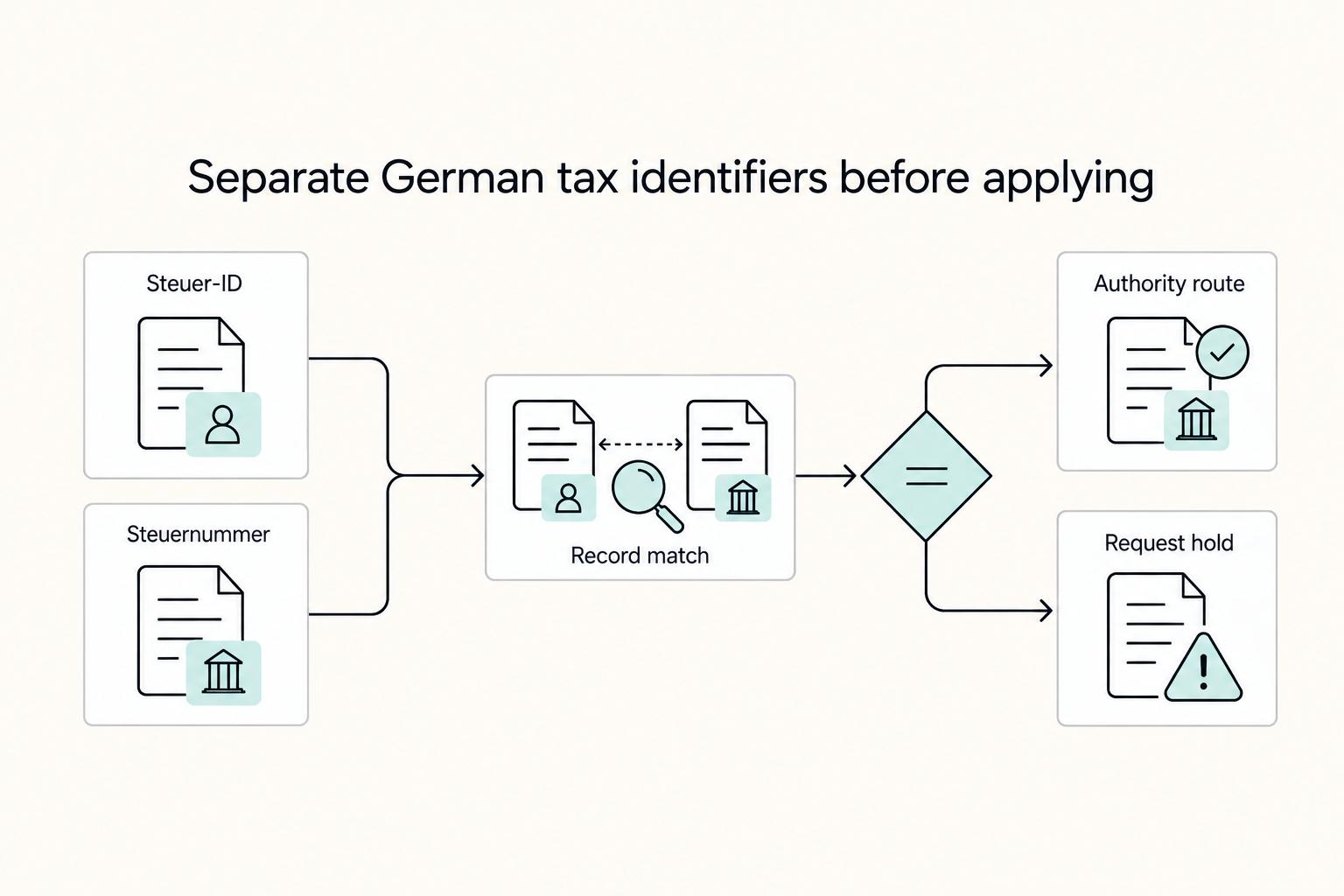
Start by separating the two tracks: use the 11-digit Steuer-ID (IdNr) for personal identification, and use Steuernummer only for freelance tax administration where applicable. After Anmeldung, expect postal IdNr delivery and set a six-week follow-up checkpoint in your timeline. Before requesting anything again, review documents you already hold to avoid duplicate submissions. If key details still do not match, escalate with one clean evidence pack instead of running parallel requests.
Start here so you do not request the wrong German tax number#
Define the task before you open any form. In Germany, mix-ups usually start when a request goes out for the wrong number type or to the wrong office.
Use this routing line first: task -> number type -> office -> evidence log -> escalation trigger. If you cannot fill in all five parts in plain language, pause before you submit anything. Keep the core distinction strict:
- Steuer-ID (IdNr): your unique, permanent personal tax identification number. It is 11 digits, issued by the Bundeszentralamt für Steuern (BZSt), and every German resident has one.
- Steuernummer: a separate tax number used in Germany's multi-number tax system.
For the IdNr, the trigger is your first Anmeldung. The number is sent by post, typically in 4 to 6 weeks. Treat that as a planning range, not a guarantee, and verify current expectations for your case before you plan around it.
If you are unsure whether your next step is personal identification or freelance tax administration, use this guide on Germany's tax system for freelancers to classify the task first.
Use the clean-record rule from day one#
Keep one dated trail per request, tied to one number type only. Your log should show what you requested, when, which address you used, and what your next checkpoint is. This matters because some people never receive the first IdNr letter. A clean log lets you request it again without guesswork.
Before you start#
- Step 1. Define the task in one sentence.
Write the immediate job and label the number type beside it: Steuer-ID (IdNr) or Steuernummer. Verification point: you can state what you need and why in one line.
- Step 2. Match number type to office.
For Steuer-ID (IdNr), the issuing authority is the BZSt, with first issuance tied to Anmeldung. For Steuernummer, confirm the correct route for your case before you submit. Verification point: you can name the office path before you send documents.
- Step 3. Create the evidence log before first submission.
Track: date, task, number type, office, channel used, mailing address used, documents sent, and next follow-up date. If this is an IdNr case, keep proof of your Anmeldung and the exact registered address. Verification point: another person can read your log and understand the status immediately.
- Step 4. Set the escalation trigger now.
For an initial IdNr after first registration, use 6 weeks as the checkpoint. If nothing arrives by then, request it again. Verification point: put the follow-up date on your calendar on day one.
Keep the terminology strict#
Use Steuer-ID (IdNr) only for the permanent personal identifier. Use Steuernummer only for the separate tax number category. Do not switch labels mid-process or use "German tax number" as a catch-all in your notes.
If payroll starts before your IdNr letter arrives, you can still work and get paid, but salary tax can be higher until you reclaim it later. That is why the sequence matters: define the task first, then match number type and office, then log every step. Related: A Deep Dive into the German Trade Tax ('Gewerbesteuer') for Freelancers.
Decide first whether you need Steuer-ID, Steuernummer, or both#
Choose by task, not by label. If the task is personal tax identification, use Steuer-ID (IdNr). If the task is freelance tax administration, treat Steuernummer as a separate number track that may apply in your case. If both tasks exist, run both tracks separately.
The Steuer-ID (IdNr) is your personal tax identifier. It is 11 digits, used for tax matters and many administrative procedures, and it stays the same for life, including if you move within Germany or leave temporarily. Steuernummer is different, and some freelancers receive it as a separate tax number.
| Immediate task | Number to use | Primary track | Decision note |
|---|---|---|---|
| Personal tax identification for employment, taxes, or administration | Steuer-ID (IdNr) | Personal identification | This identifies you as a person. |
| Freelance tax administration | Steuernummer (if applicable) | Freelance administration | Separate from your IdNr; some freelancers receive it. |
| Both situations apply | Both, on separate tracks | Split-track | Keep each purpose, record, and follow-up separate. |
Before you submit anything, run this branching check:
- Write one sentence: "I need this for ..."
- If that sentence is person-level identification, use the IdNr track.
- If that sentence is freelance administration, check whether you need a Steuernummer track.
- If both are true, split them into two separate lines and run them separately.
The overlap case can happen when you have employment and freelance work at the same time. Do not combine those requests into one generic "tax number" thread. Keep separate purpose lines and records:
- "Personal tax identification"
- "Freelance tax administration"
If you confirm that you are on the freelance administration path, review Germany's tax system for freelancers before you proceed. This pairs well with our guide on Freiberufler vs Gewerbetreibender for German Freelancers.
Prepare your documents before you start any application#
Do the record check before you contact any authority. A common failure point is mixing labels like Steuer-ID or IdNr with Steuernummer, or starting multiple request paths for the same issue.
Use one rule throughout: check existing records first, choose one authority path second, then log the channel, address, and status before you send anything. This is practical process advice, not a legal requirement.
| Prep item | Pre-submit check | Decision outcome |
|---|---|---|
| Anmeldung confirmation | Confirm you have your Anmeldung confirmation (Meldebestätigung) and that name and address match the details you will use | If registration details are missing or inconsistent, correct that first |
| Existing records | Check letters, saved PDFs, and portal exports for any already issued tax number | If you find one, reuse it under its exact label instead of starting a new request |
Steuer-ID / IdNr | Verify whether you already have an 11-digit personal identifier | If yes, keep it on the personal identification track |
Steuernummer | Verify whether the tax office (Finanzamt) already assigned one for freelance or self-employed tax administration | If yes, keep it on the freelance tax administration track, separate from IdNr |
| Authority path | Decide the single office or path before drafting any request | If unclear, resolve routing first, then submit |
| Timing note | Verify the current processing window from the relevant official source before relying on a timeline | Plan with buffer; do not assume one fixed timeline from secondary guides |
Before you start#
- Collect your
Anmeldungconfirmation in one folder and confirm your mailbox name, registered name, and address all match. - Search existing records before creating any new request.
- Copy each label exactly as shown:
Steuer-ID,IdNr, orSteuernummer. - Record the number length as a validation checkpoint during follow-up.
- Choose one authority path, then log the channel, address, and current status before sending.
- If you are preparing freelance documentation, review A Deep Dive into Germany's Tax System for Freelancers first.
Complete Anmeldung correctly so your IdNr can be issued#
Anmeldung is the key trigger for getting your personal IdNr. After first address registration, the tax ID is automatically generated by the German Central Tax Office.
Treat this as a pre-submit checklist. The goal is one accurate record, one reliable address, and one dated log you can reuse if anything goes missing.
- Use a stable address for registration.
Register at an address where you can realistically receive official post, not a short-term placeholder. Expected outcome: your resident record is tied to an address you can actually use for official correspondence. If your housing is unstable, review our guide to a defensible 2026 filing plan before you file.
- Capture details exactly as recorded.
Save your Meldebestätigung and copy the registered name and address exactly as shown. Expected outcome: you have a clean reference record for any follow-up without guessing.
- Check mailbox delivery in real life.
Confirm that mail sent to the registered address can actually be recognized and received by you under the registered name. Expected outcome: fewer avoidable delivery mix-ups.
- Log the registration date and planning note.
Record the Anmeldung date, address used, and document received, then add a planning note so you avoid working from guessed deadlines. Expected outcome: you plan with buffer instead of a guessed deadline.
- If your address changes, update records and keep one log.
Update records promptly, and keep one dated log entry of what changed and when. Expected outcome: one consistent timeline you can audit.
For employment, your employer needs your 11-digit tax ID before first payroll. If it is missing, you can be placed in tax class 6 until the ID is available.
When you receive your IdNr, verify that it is 11 digits. It is often shown as 00 000 000 000. Then archive the original and a clean digital copy, since this tax ID remains the same for life.
You might also find this useful: How a German Freelancer Can Handle US Sales Tax with a US LLC.
Track and verify your Steuer-ID once the letter arrives#
Do not drop the number straight into payroll or freelance paperwork without checking it first. The goal is simple: one person, one identifier, and one clean record trail. Corrections and records requests can take time, so treat any mismatch as a stop signal and log it before it spreads.
Step 1. Treat the letter as your control document#
Do this: treat the letter as your control document. Confirm it is your personal Identifikationsnummer (IdNr) and copy the number exactly into your private record. Confirm this: the name and address on the letter match your saved personal records. If mismatch, pause: do not reuse the number elsewhere until you log the exact difference.
Step 2. Cross-check the identifier against records tied to you#
Do this: cross-check the same identifier against any records already tied to you, for example an assessment, an employer statement, or other official correspondence. Keep this personal identifier context separate from other tax-reference numbers in your files. For structure, see A Deep Dive into Germany's Tax System for Freelancers. Confirm this: records that should point to your personal identifier point to the same person and the same number. If mismatch, pause: select one control copy, usually the letter, log the conflict, and hold new submissions based on guesses.
Step 3. Verify current process details through official channels#
Do this: verify current process details through official channels before you update live filings or payroll records, and confirm your core personal details line up across records. Exact portal matching steps can change, so do not rely on assumptions. Confirm this: your record is not split across old address data, spelling variants, or a second identifier trail. If cross-border details are still changing, settle consistency decisions first in Digital Nomad Taxes in 2026 With a Defensible Filing Plan. If mismatch, pause: use documented follow-up channels such as the Federal Government's Make it in Germany portal, including its FAQ and adviser contact paths. For EU guidance such as EURES, confirm the site uses the europa.eu domain. Verify any exact process requirement from the relevant official source before using it.
Step 4. Store a secure full copy and a masked working note#
Do this: store the letter in two forms: one secure full copy and one masked working note for routine admin use. Log the date received, storage location, and access owner. Confirm this: you can retrieve the record quickly without exposing the full identifier in every note or email. If mismatch, pause: if your stored copy, working note, and live records differ, fix storage records first before payroll or advisor handoff. Use this discrepancy log as soon as anything diverges:
| Document checked | Observed value | Expected value | Next action | Owner |
|---|---|---|---|---|
Letter / payroll record / other official record | What you see | What should match | Verify, contact, or hold | You / employer / advisor |
Keep the log dated and open until the issue is resolved. That is what makes follow-up manageable when responses are delayed or incomplete.
Recover a missing or lost IdNr without guesswork#
If your IdNr is missing, keep one clear record trail: check your own records first, submit one documented official request second, then wait for a written result you can verify.
| Decision point | What to confirm | Stop or next move |
|---|---|---|
Found in your records | One number matches your identity details consistently | Stop. Use that as your control copy. |
Not found | Your identity details are consistent before you submit | Submit one documented official request and log it. |
Submitted | Request date, identity details used, and current status are recorded | Move to waiting status. |
Written result received | The result matches your identity trail | If yes, close the case. If no, request formal clarification with your log. |
Step 1. Start with the records you already hold#
Start with the records you already hold. If you find one clear match tied to your identity details, stop there and use it as your control copy.
If you are unsure whether a document refers to your personal IdNr or a separate tax record, clarify that distinction first. A Deep Dive into Germany's Tax System for Freelancers can help.
Step 2. Run a consistency check before you submit anything#
If the number is still missing, run a consistency check before you submit anything. Make sure the identity details you plan to provide are consistent across your records.
Line up the record trail before you submit. See the digital nomad tax guide.
Step 3. Submit one official request, then track it#
Submit one official request through the authority channel indicated for your case, then stop and track it. One clean request plus a dated log is easier to follow than parallel requests.
Step 4. Wait for written information you can verify#
After submission, stay in waiting status until you receive written information you can verify against your record trail. Use a compact tracker and keep it current:
| What was checked | Current status | Next action |
|---|---|---|
Records + identity details reviewed | Found / not found / submitted / waiting / mismatch | Stop, wait, follow up, or request clarification |
Step 5. Escalate when the case remains unresolved after follow-up#
Escalate when the written result does not match your identity trail or the case remains unresolved after documented follow-up. Bring one control copy and your dated tracker so an advisor can act without rebuilding the case from scratch. Related reading: How to Get a German Driving License Through Umschreibung.
Decide when freelance activity triggers a Steuernummer#
Once the personal ID track is clear, decide separately whether you need a domestic freelance tax administration track and whether an EU cross-border VAT route applies. Before you register anything, use this quick flow:
| Activity type | Required task | Registration action |
|---|---|---|
| Personal identity or resident-record task | Person-level identification | Stay on your personal ID track. |
| Domestic freelance admin task in Germany | Filing or invoicing under a self-employed tax record | Verify the current authority path for a Steuernummer before relying on it in invoicing. |
| EU cross-border VAT task | VAT treatment or reporting across Member States | Check whether OSS is relevant; for complex cross-border VAT transactions involving two or more participating EU countries, assess whether a CBR request is appropriate in the participating EU country where you are VAT-registered. |
Do not assume VAT routes handle domestic filing for you. OSS is optional, and OSS VAT returns are additional to domestic VAT returns, not a replacement. If you choose an OSS scheme, you must declare all supplies that fall under that scheme via the OSS return.
For the broader filing picture around steuernummer and freelance administration, see A Deep Dive into Germany's Tax System for Freelancers.
Escalate early if your setup is mixed, for example clients in multiple countries. Prepare a one-page evidence note with your service type, first planned invoice date, client countries, and B2B or B2C split, then verify the current authority path before acting. If this is your situation, read our guide to a defensible 2026 filing plan.
Act now if invoicing or filing is imminent. Wait only if you are still on a personal ID task and no domestic freelance admin or cross-border VAT task exists yet.
Build an evidence pack you can hand to any tax advisor#
Your evidence pack should let a new advisor understand your status in minutes, not hours. That does not mean saving every tax-related file you have ever touched. It means keeping the small set of documents that proves identity, current status, and your filing history with the Finanzamt, plus any platform records that may be reported to BZSt.
This matters most when you have already been through one round of registration or follow-up. Advisors move faster when they can see the timeline immediately instead of reconstructing it from scattered emails and screenshots.
Build the pack in four passes#
- Collect anchor documents.
Include your Steuer-ID letter, any Steuernummer notices, and your latest Lohnsteuerbescheinigung (annual income and tax statement). Keep the latest copy of each document in one obvious location.
- Add filing records.
Save key tax filing submissions and acknowledgements, plus relevant platform income records when applicable, so identifiers and reported amounts can be reconciled across records. These files are especially useful when two documents appear to conflict and you need one reliable reference point.
- Run a consistency check.
Compare the same personal number across the Steuer-ID letter and your core tax records. The checkpoint is simple: the same 11-digit ID appears consistently and is not confused with Steuernummer. Note the date of this check so you know when the file was last verified.
- Maintain a dated timeline.
Log what you submitted, what you received, and what is still open with your tax office. If you sell through a platform, note any platform-reported income periods as well, because mismatches between platform-reported and self-reported income can trigger follow-up questions from authorities. A basic timeline makes deadline risk visible before it becomes urgent.
When you hand this pack to an advisor, add one short summary note with current status, open questions, and next deadlines. That lets the advisor start with decisions instead of document hunting. An index page at the top of the folder also helps: list each document, its date, and why it matters. A clean pack reduces back-and-forth and gets any professional to the real issue faster.
Keep your residency timeline and authority notes in one place with the Tax Residency Tracker before you submit new requests.
Avoid the mistakes that cause rework and missed deadlines#
Most rework starts the same way: a known mismatch gets ignored because pushing ahead feels faster. Usually it is not. The faster path is to pause early, map the issue clearly, and submit once.
- Map each document to one job before submitting.
Keep a short note that links each key document to its purpose: your Steuerbescheid for assessment checks, your Lohnsteuerbescheinigung for annual payroll data, and your ELSTER account for official communication with the Finanzamt.
- Plan around official correspondence, not informal timelines.
Use concrete checkpoints in your plan. The annual payslip (Lohnsteuerbescheinigung) should arrive by the end of February, and the simple-amendment path after a Steuerbescheid is described with a one-month window. Informal timelines from peers can be useful context, but they are not your filing schedule.
- Use the right correction path after a
Steuerbescheid.
For straightforward fixes, request a simple amendment (schlichte Änderung) within one month. This path is described as changing the assessment only when the result is favorable to you.
- Escalate to
Einspruchonly when needed.
If a simple amendment is not enough, file an Einspruch. In that route, the full application can be reexamined, and you may not control which items are reviewed. Also keep filing status clear: self-employed workers are typically required to file, while mandatory employee filing depends on specific conditions under § 46 EStG.
Use these four checks as your pre-submit gate. If one fails, stop and fix it before you file. That discipline is usually the quickest way to avoid repeat submissions.
A short weekly review helps during an active filing period. Recheck open items, confirm expected documents have arrived, and close resolved tasks in your log. Small regular checks are easier than reconstructing everything when a deadline is already close.
Know when to escalate to a professional#
Bring in help when the issue stops being a straightforward admin task and turns into a judgment call. Early advice can help you avoid late cleanup, especially when your records and tax office correspondence stop lining up.
You do not need a professional for every missing document or routine follow-up. You probably do need one when the next step depends on interpretation, when multiple records conflict, or when a deadline is approaching and the basics are still unresolved.
- Escalate if classification or filing treatment is unclear.
If you cannot clearly explain how your case should be classified or which filing route applies, pause and get advice before you file anything else. A short review at this stage can prevent correction work later.
- Escalate when key records conflict or a BZSt decision creates legal uncertainty.
If details across your tax records and tax office correspondence do not align, resolve that mismatch before making new submissions. If a German withholding-tax refund or exemption application is rejected by the BZSt, treat that as an escalation point. An appeal may be possible and can progress to tax-court litigation, with uncertain outcomes and evolving guidance.
- Escalate early when a deadline is near and key tax details are unresolved.
Do not wait for a last-minute outcome. Treat unresolved core issues near a filing deadline as an immediate escalation trigger. Late submissions can result in penalties and legal consequences.
- Ask for a written action plan.
Before ending the advisory call, get four items in writing: the responsible authority, the required form or channel, the required evidence, and the deadline for each action. Written next steps cut down on miscommunication and make follow-through much easier.
A strong escalation request includes your timeline log, key documents, and the exact decision you need. If you contact an advisor by email, keep the first message structured: state the decision you need, list your deadline, and attach the core documents already summarized in your index note. Clear inputs usually lead to clearer advice.
Need the full breakdown? Read How to Get a 'Tax Clearance Certificate' when Leaving a Country.
Final checklist to get the right number on the first try#
Run this once before contacting any authority: choose the correct identifier first, check your records second, and keep one evidence trail all the way through.
| Check | Decision | Action | Evidence |
|---|---|---|---|
| Map the identifier to the task | Is this person-level identification or self-employed tax administration? | Use the Tax ID (Steuer-ID/Steueridentifikationsnummer) for personal tax identification. Use a separate Steuernummer when self-employed tax administration requires it, including invoicing. | Record the purpose, the exact number needed, and the authority you plan to contact. |
| Confirm Anmeldung is complete | Has your German registration been completed? | Complete Anmeldung before expecting automatic Tax ID assignment. | Keep registration proof and the address details tied to that registration. |
| Check existing records before recovery | Do you already have the number in documents you control? | Check your annual income tax statement and tax assessment first. | If found, confirm it is the same 11-digit personal Tax ID across documents. If labels or number formats conflict, pause and re-check the identifier type. |
| Use one official recovery path | Is the personal number still missing after record checks? | Submit one recovery request through an official channel. An online request may be possible, but delivery is by post. | Log the request date and status, and verify the current processing window from the relevant official source before using it. |
| Keep one evidence pack and one log | Could another advisor or authority follow your case quickly? | Keep one folder for registration proof, tax letters, and request history. | Use one log for your own tracking with: purpose, authority, submission channel, address used, status, next action. |
| Escalate when records conflict or recovery stalls | Are identifiers inconsistent, or are follow-ups not resolving the issue? | Escalate early through the relevant authority or advisor, and keep the Federal Central Tax Office route documented as a last-resort path for a missing personal tax number. | Capture the written next step in the same log. |
- Map the identifier to the task.
Decision: Is this person-level identification or self-employed tax administration? Action: Use the Tax ID (Steuer-ID/Steueridentifikationsnummer) for personal tax identification. Use a separate Steuernummer when self-employed tax administration requires it, including invoicing. For a quick refresher, see A Deep Dive into Germany's Tax System for Freelancers. Evidence: Record the purpose, the exact number needed, and the authority you plan to contact.
- Confirm Anmeldung is complete.
Decision: Has your German registration been completed? Action: If not, complete Anmeldung before expecting automatic Tax ID assignment. Evidence: Keep registration proof and the address details tied to that registration.
- Check existing records before any recovery request.
Decision: Do you already have the number in documents you control? Action: Check your annual income tax statement and tax assessment first. Evidence: If found, confirm it is the same 11-digit personal Tax ID across documents. If labels or number formats conflict, pause and re-check the identifier type.
- Use one official recovery path if the Tax ID is still missing.
Decision: Is the personal number still missing after record checks? Action: Submit one recovery request through an official channel. An online request may be possible, but delivery is by post. Evidence: Log the request date and status, and verify the current processing window from the relevant official source before using it.
- Keep one evidence pack and one log.
Decision: Could another advisor or authority follow your case quickly? Action: Keep one folder for registration proof, tax letters, and request history. Evidence: Use one log for your own tracking with: purpose, authority, submission channel, address used, status, next action.
- Escalate when records conflict or recovery stalls.
Decision: Are identifiers inconsistent, or are follow-ups not resolving the issue? Action: Escalate early through the relevant authority or advisor, and keep the Federal Central Tax Office route documented as a last-resort path for a missing personal tax number. Evidence: Capture the written next step in the same log.
Non-negotiables#
- Do not treat Tax ID and Steuernummer as interchangeable.
- Do not run parallel recovery requests with conflicting details.
- Do not split documents and follow-ups across multiple trackers.
For related reading, see How to Get a Sales Tax Permit as a Freelancer. If your setup includes cross-border client payments and you want clearer operational controls, talk to Gruv.
Frequently Asked Questions
What is the difference between Steuer-ID (IdNr) and Steuernummer?
The Steuer-ID (IdNr) is your permanent personal tax identifier. The Steuernummer is assigned by the tax office for tax returns and tax payments. Keep a simple note showing which forms and records use each number, and use A Deep Dive into Germany's Tax System for Freelancers if you want fuller context. Steuer-ID (IdNr), Steuernummer, and USt-IdNr. are not interchangeable, and Steuernummer length can vary by federal state.
Do freelancers in Germany need both a Steuer-ID (IdNr) and a Steuernummer?
Often, yes. Freelancers commonly use a Steuer-ID (IdNr) for person-level identification and a Steuernummer for tax administration, and tax numbers are described as necessary for self-employed people and freelancers. Store them in separate fields and attach each number to the document that issued it. Having one does not replace the other.
How do I get my Steuer-ID (IdNr) after Anmeldung?
After first Anmeldung, BZSt sends your Steuer-ID (IdNr) once the registration office has transmitted the required data. Wait for the postal notification. If you have not received a notification after three months, use the BZSt entry form or write in. Avoid duplicate requests with varying personal details.
I lost my Steuer-ID (IdNr); where can I find it before requesting it again?
Check your last income tax assessment or employment tax statement first. If it is still missing, use one official BZSt re-notification path and log the request date, since notifications can be delayed at high volumes. If records conflict, use one official recovery path and document follow-up before any parallel outreach. You are being re-notified of the same number, not issued a new one.
Can BZSt send my Steuer-ID (IdNr) by email, or only by post?
Based on the BZSt material referenced here, postal notification is the supported route. Email disclosure is not described. Submit via the BZSt entry form or in writing, then verify your registered name and mailing address. Do not treat informal email or phone messages as equivalent to the official postal notification.
Can I submit a tax return to the Finanzamt if I do not yet have my Steuer-ID (IdNr)?
That depends on the exact return and filing channel, and there is no confirmed general filing rule without a Steuer-ID (IdNr). Check the current rule with your Finanzamt or advisor. If the number is missing, use one official recovery path and document each follow-up before contacting other offices. If records conflict, do not guess digits or run parallel requests. For cross-border edge cases, use our guide to a defensible 2026 filing plan.
Does my Steuer-ID (IdNr) stay the same if I move or change marital status?
Yes. The Steuer-ID (IdNr) is permanently assigned to one person. Keep one verified copy in your records and keep registration details current after a move. A replacement letter is re-notification of the same Steuer-ID (IdNr), not a new issuance.
Try a related tool
Researched and edited by the Gruv editorial team. Gruv builds cross-border billing, payouts, and finance-operations software for global businesses.
Sources
- bjs.ojp.gov/content/pub/pdf/manual.pdftrusted
- brockport.edu/academics/catalogs/current-courses/show-coursestrusted
- conservancy.umn.edu/server/api/core/bitstreams/b2707bbb-a1c5-4d6...trusted
- ecfr.gov/current/title-28/chapter-I/part-35trusted
- eures.europa.eu/living-and-working/living-and-working-condit...trusted
- govinfo.gov/content/pkg/GOVPUB-W-6f4d860eb1913c11b8de137...trusted
- govinfo.gov/content/pkg/CHRG-113shrg80224/html/CHRG-113s...trusted
- hed.nm.gov/uploads/documents/PSA_Course_Catalog_V15.pdftrusted
Educational content only. Not legal, tax, or financial advice.
Related Posts

Digital Nomad Taxes in 2026 With a Defensible Filing Plan
With digital nomad taxes, the first move is not optimization. It is figuring out where you may be taxable, where filings may be required, and what proof supports that position.
Germany Freelance Tax Decisions for Globally Mobile Consultants
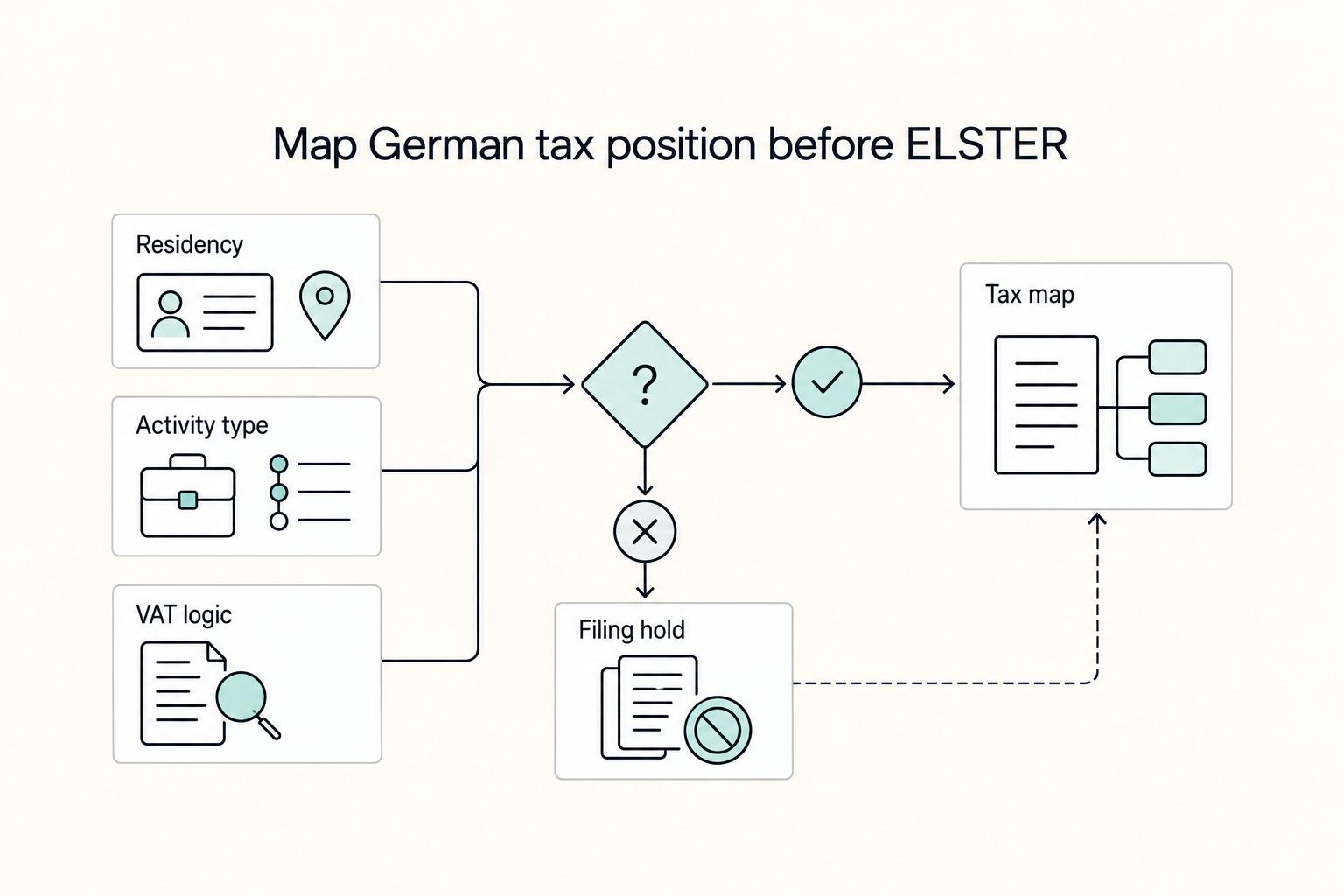
Set your German tax position first, then register and file. If you are a globally mobile consultant, a lower-risk approach is a clear decision order, not a tax shortcut.

How to Set Up Google Analytics 4 on Your Freelance Website
**Treat GA4 as operational infrastructure, not a marketing toy.** That's how you trust your website analytics when you make pricing and channel decisions. The win is not "GA4 installed." The win is GA4 that is **owned cleanly**, **configured intentionally**, **verified fast**, and **credible** enough that you stop second-guessing your numbers.