
Quick Answer
Start with a 30-day DIY cycle: build a fit-based outlet list, send concise expert pitches, and log each line in one tracker with status and next action. Prepare a Press Evidence Pack before outreach so every claim is supportable and quick to verify. Follow up only when you can add new relevance, then close stale pitches. If your angle is clear but weekly execution keeps slipping, test narrow hired support and keep final claim approval with you.
Start Here and Set the Right Expectation#
Treat press outreach as a repeatable earned media channel, not a lottery ticket. The goal is to be quoted, mentioned, or featured because your expertise fits a real story, not to expect instant placement in outlets like Forbes or TechCrunch.
Keep scope tight from day one. Be explicit about what you are pitching, the expected deliverables, timelines, communication, and revision expectations. That boundary helps prevent miscommunication, scope creep, and missed deadlines.
A useful early test is simple: if someone asks why this angle, why this outlet, and why you, you should be able to answer each in a sentence or two. If you cannot, tighten the pitch before you add volume.
Run outreach in weekly cycles. Keep the sequence simple: build a fit-based target list, send focused pitches, follow up with added value, then revise your angle or targeting based on response quality.
Persistence matters, but magical thinking does not. Editors and content managers are often very busy, and one writer reports that around 20% of commissions came after a follow-up email in this IJNet freelancer outreach account. Use that as a reason to stay consistent when your first send gets no reply, not as a promise that every follow-up will convert.
Treat each cycle as a short weekly review, not just an activity log. At the end of the week, look at message fit, contact fit, and next actions. When one of those is weak, fix it before you add volume. That keeps you from mistaking activity for progress.
By the end, you should have three practical outputs: decision rules for what to pitch, a weekly rhythm you can sustain, and a copy-ready checklist for each outreach cycle.
Choose DIY Outreach or Hired Support#
Start with DIY outreach if you can protect focused weekly time and your positioning is still evolving. Bring in hired support when your message is clear but execution keeps slipping. Early on, control of the angle and voice usually matters more than raw send volume.
| If this is true | Start here |
|---|---|
| Your niche or angle still feels broad | DIY outreach for one full cycle |
| You can protect weekly list-building, outreach, and follow-up blocks | DIY outreach |
| You miss blocks even with a clear angle | Test hired support with a tight brief |
Consider running one DIY cycle before you hire so you can judge outside support against a real baseline. Build a short potential-client list, send pitches, and track responses in one place. That baseline helps you diagnose the real bottleneck: unclear message, weak targeting, or missed execution windows. It also gives you concrete examples to hand to a contractor instead of vague instructions.
Use a practical decision rule. If your replies are low because the angle is vague, keep ownership in-house and sharpen your positioning first. If your angle is clear but you still miss weekly outreach blocks, outside support can help with consistency.
If you hire through Upwork or another marketplace, keep scope narrow and measurable. Define weekly deliverables, require written rationale for target selection, and review response quality before expanding scope. Ask for one sample pitch from your brief before you commit to a broader engagement. If you cannot tell why a target made the list, ask before anything goes out.
Treat the first contract period as a test, not a handoff. You should still approve claims, angle framing, and target fit. If those controls disappear, quality falls and the chance of poor-fit volume rises even if send volume rises.
Prepare the Prerequisites Before You Pitch#
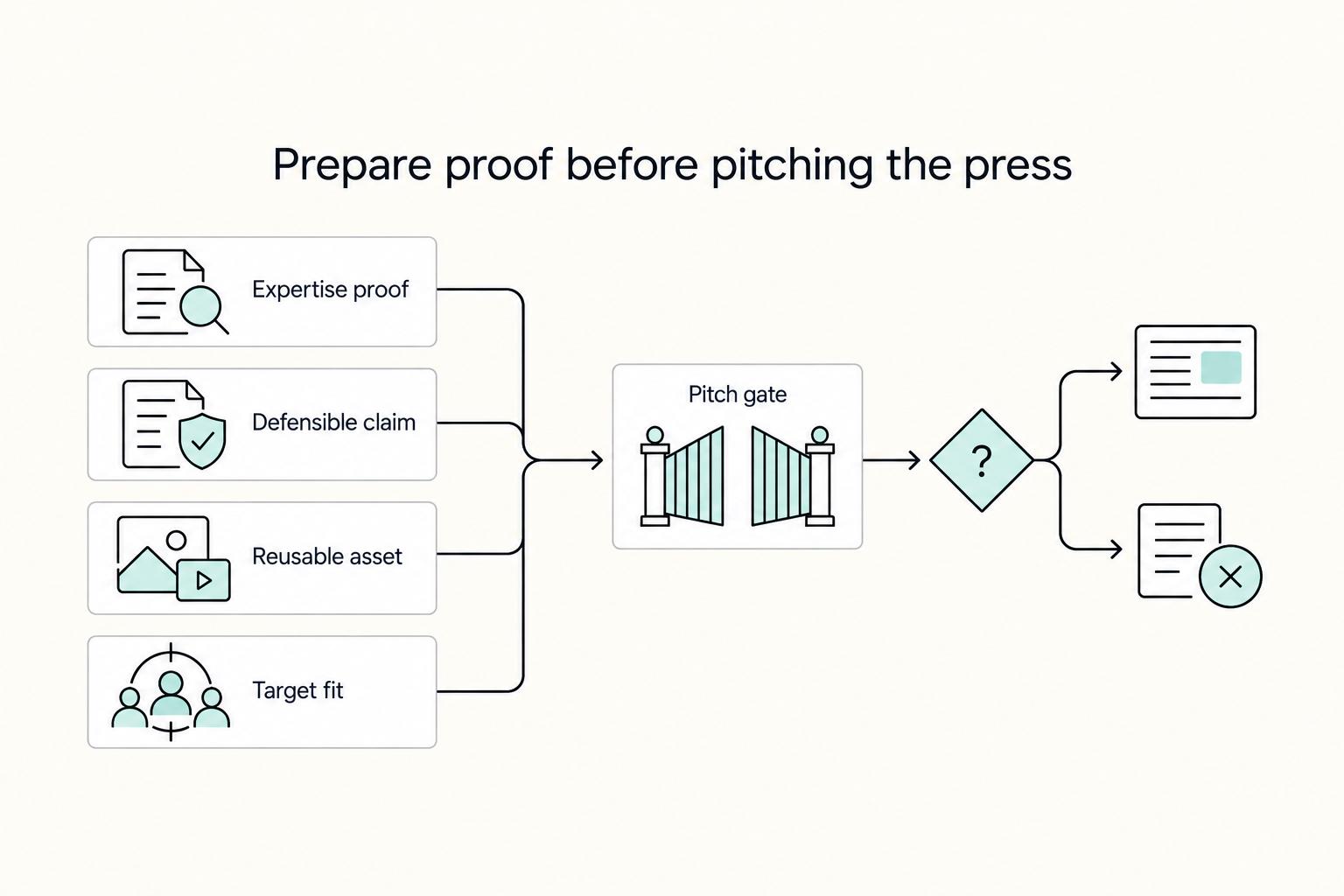
Strong outreach starts before the first email. Clear proof, defensible claims, and reusable assets improve your odds while keeping you out of preventable trouble. Even with a strong pitch, publication is never guaranteed.
| Prep item | What to prepare | Why it matters |
|---|---|---|
| Press-ready evidence pack | One-line bio, service niche, proof points, substantiated client outcomes, and a short founder story | Lets you answer quickly when an editor asks for support |
| Claims review | Cut or generalize any line you cannot support | Claims that overreach can reduce trust |
| Pitch assets | A concise expert pitch email and a longer press release for true announcement moments | Keep both aligned to the same approved claims list |
| Publication fit check | Read recent coverage and align your angle to what the outlet actually publishes | Helps reduce generic outreach |
| Paid support terms | Written scope, approved claims, deliverables, and review rights before any outreach is sent | Sets terms before paid support begins |
Before you start, create one folder named Press Evidence Pack and keep your core materials in one place. The goal is speed under pressure. When an editor replies and asks for support, you should be able to answer quickly without rebuilding your story. Use file names you can actually find in a hurry. The point is not a beautiful archive. It is a fast, accurate reply. If you do not already have one, build a reusable proof bundle with How to Build a Media Kit for Your Freelance Business.
- Build a press-ready evidence pack. Include a one-line bio, service niche, proof points, substantiated client outcomes, and a short founder story. Keep each item short enough to paste directly into an email. If any line needs a long explanation, tighten it until the core value is obvious.
- Remove inflated claims. If a line sounds impressive but you cannot support it, cut it or generalize it. Editorial decisions depend on factors outside your control, including budget and inbox volume, even when the pitch is good. Claims that overreach can reduce trust.
- Prepare reusable pitch assets. Draft a concise expert pitch email and a longer press release for true announcement moments. Use the short pitch for expert commentary and the longer draft when there is actual news. Keep both aligned to the same approved claims list.
- Check publication fit before every send. Read recent coverage and align your angle to what that outlet actually publishes. This is one of the most important pitching habits and helps reduce generic outreach. If you cannot explain fit in one sentence, your angle may be too broad or the target may be wrong.
- Set contract terms before paid support begins. Require written scope, approved claims, deliverables, and review rights before any outreach is sent.
Treat this prep work as risk control. It helps you move faster later because everyone uses the same facts, same constraints, and same quality bar. Good prep does not guarantee coverage, but it does reduce avoidable errors once replies start coming in.
Use a simple weekly volume guardrail so quality survives scale: first, send 8 to 12 high-fit initial pitches; then, run 3 to 5 value-added follow-ups; finally, close any row with no quality signal after 14 days. However, if reply quality drops for two consecutive weeks, reduce volume and rework fit logic before sending more.
Build a Target List That Matches Your Actual Expertise#
Build your list as a fit filter, not a status list. A clear angle in front of the right person beats a long list of recognizable logos.
Start by deciding where your current expertise is genuinely useful and which target market you want to reach. Positioning around clear expertise can reduce objections and gatekeeping. If you build the list from publication prestige alone, you risk broad outreach with weaker fit. Fit should decide priority, not brand recognition.
- Create fit tiers first. Group targets by audience fit and expected feedback speed, and keep each tier active so you are not waiting only on long-shot placements.
- Prioritize visibility, not just quality. For each target, ask whether your pitch is likely to be seen by a decision-maker. It will not matter how strong the pitch is if no one sees it.
- Filter by match before outreach. If your angle does not match what the target has covered recently, move it down a tier or remove it.
- Run one pre-send checkpoint. Every target should have a clear angle match, a clear audience match, and a one-sentence takeaway without asking to be featured.
Within each target, try to find the person closest to the beat rather than defaulting to a generic inbox when you have a better option. The point is not to over-research every name. It is to make sure the pitch has a plausible path to the right editor or writer.
Add one more practical rule: keep list size small enough to review manually each week. If you cannot explain why each target is on the list, the list is too big for this cycle.
When a target fails any checkpoint, cut it quickly. Protecting fit at this stage keeps follow-ups focused and avoids low-quality outreach.
Develop Angles Editors Can Use Without Rewriting Your Idea#
The best angle is usable on arrival. Keep one defensible idea, adapt it for audience fit, and make the action clear.
Lead with a story that serves readers now, not your biography. Connect your expertise to that reader need in language that can run with minimal editing. A quick test: if the pitch still works after you remove your bio from the opening, the angle is probably strong enough. If it falls apart, the framing may still be too self-focused.
- Start with one claim you can defend. Pull from your
Press Evidence Pack, then state the reader problem and the practical takeaway in plain language. If your opening sounds like personal promotion, rewrite it until the reader benefit appears first. - Reframe instead of reinventing. You can turn one core idea into several pitches by changing emphasis for each audience while keeping facts consistent. Done well, this can save time and help you build expertise.
- Use the same angle card each time. Record three lines for every angle: why now, who this affects, and what readers can do this week. This structure helps you spot weak framing quickly.
- Add career-stage contrast. Show what changes for newer freelancers versus established independents so the pitch stays specific. Broad advice can read safe and be easier to ignore.
- Run a usability check before sending. If an editor would need to rewrite your framing to use it, narrow scope and sharpen the action.
One common mistake is trying to pack too much into one angle. Pick one problem per pitch, not several. If you want to cover adjacent points, create a second angle card and send it in a later cycle. If the angle only works when you explain your whole backstory, it is not ready yet.
Before you send, try writing a one-line headline or takeaway for yourself. If that line is muddy, the pitch usually is too. Over time, credibility grows when your angles are useful, audience-aware, and easy to verify.
If you want a deeper dive, read How to Manage Your Personal Brand as a Freelancer.
For sharper positioning language before you pitch, it also helps to tighten your differentiator with How to Create a Freelance USP.
Write Pitches and Press Releases That Survive First Read#
Lead with publication fit, keep the pitch short, and use supporting materials only when they add value. Editors can receive from around a dozen to almost 200 cold pitches in a day, so clarity in the first lines matters.
Unclear fit and bloated openings make a pitch easy to reject. You can fix both before sending by tightening structure and removing lines that do not move the story forward. One workable order is fit, angle, why it matters now, who it affects, and what you can evidence.
- Confirm beat fit before drafting. Review recent coverage and submission guidelines, then make fit obvious in your opening line. If fit is vague in your own notes, the recipient will likely notice quickly.
- Write for inbox reality. Keep intros short and move straight to the angle, why it matters now, who it affects, and what you can evidence. Put your strongest point first, not in paragraph three.
- Apply the format rule early. Send a direct pitch first. If you add a press release, use it as support for concrete, verifiable facts, and do not duplicate the same text in both places. A press release is supporting material, not a substitute for a clear email.
- Separate confirmed facts from open questions. When any part of the story is still uncertain or controversial, label what is confirmed and what is still developing. Clear boundaries help establish mutual trust.
- Cut unsupported promises before sending. Keep only claims you can back up quickly from your
Press Evidence Pack.
Do one final pre-send read focused on risk. Check claim accuracy, tone, and ask clarity. If the recipient replies with a yes, your next step should already be obvious from your message. Read the opening aloud once before you send. If you trip over it or have to explain it, tighten it again.
One inflated claim can sink an otherwise strong pitch, so quality control before send is not optional.
Run a Weekly Outreach Cadence With a Tracker#
Keep outreach activity in one visible tracker and review it on the same day each week. A consistent cadence keeps the work from feeling scattered and makes it easier to see whether the real problem is fit, message quality, or follow-through.
Use consistent fields each time so records are comparable across weeks. Keep the setup simple enough that you can maintain it reliably. If the tracker becomes too detailed to update, it stops helping.
Treat status labels as decision tools, not decoration. Define clear stages that fit your process, and update stale rows so you are not guessing what happened. A good tracker makes the next move obvious at a glance.
Your weekly review should end with clear decisions, not notes. To avoid spreading effort too thin, focus on one or two outreach approaches and go deep, then choose one action: continue, revise, or retire. If no action is clear, rewrite the angle or remove the target.
Follow-ups should add value when you send them. Add a new datapoint, tighter framing, or clearer relevance, then move on when you have nothing meaningful to add. If you skip reviews for a week or two, weak targeting and stale follow-ups can hide inside a busy-looking tracker.
This discipline also helps when you work with outside support. Shared tracking makes quality and accountability easier to see because you can review what was sent, what got a response, and what needs to change next.
Use HARO and Direct Pitching Together#
Treat HARO and direct outreach as two distinct lanes with different jobs. HARO is reactive and can move fast. Direct pitching can help build long-term authority and relationship quality over time.
HARO can generate high email volume, including three rounds per day, so filtering discipline matters. Respond only when the request clearly matches your expertise and your evidence. If replies increase but fit gets worse, narrow your filter and skip prompts that force generic answers.
Use saved language carefully. A template can speed you up, but it should only be a starting point. If the response reads like it could have come from anyone in your field, it is probably too generic to send.
Direct outreach needs protected time because it is often slower and relationship-driven. You are not only answering a request. You are showing consistent relevance to people who may come back to you for future stories.
A practical workflow is simple: use HARO for fast, high-fit opportunities and reserve dedicated blocks for direct email and LinkedIn relationship building. Then verify balance in your tracker. You should see both reactive responses and early outreach activity in the same week.
Do not let one good week in HARO rewrite your whole plan. Keep your quality bar consistent across channels: clear claim, clear fit, and evidence you can provide quickly. HARO speed can tempt you to answer outside your lane, and that usually shows in the final quote or the lack of one.
Some HARO queries are tied to fast deadlines, but keep expectations grounded. Earned media is an editorial decision, and it does not always map to immediate sales. The distinction between editorial selection and paid distribution is also reflected in this freelancer expectations guide.
Separate Press Credentials From Media Coverage Goals#
If your goal is expert-source coverage, do not start with press credentials. Credentials are mainly relevant when you plan to report from events as working media.
| Item | What it does | When relevant |
|---|---|---|
| Expert-source coverage | Focuses on earned media quotes | Use when the cycle goal is source outreach |
| On-site event reporting | Covers events as working media | Choose this as the cycle outcome instead of mixing it with expert coverage |
| Press credentials | Establish your ability to cover news | Relevant when you plan to report from events |
| Press pass | Provides event-specific access | Can still be denied |
| Credential routes such as IFPO | Offer a recognized media-organization credential route | Pursue only if event reporting is part of your service mix |
Treat press pass steps and expert quote outreach as different tracks. Separating them early keeps your time focused on the right work. It also makes your tracker cleaner because you are not mixing event-access tasks with source-pitching tasks in the same review cycle.
- Define this cycle's outcome first. Choose one goal: expert-source coverage or on-site event reporting. Mixing both in one month can create confusion and diluted effort.
- Separate document types. Press credentials and a press pass are different. Credentials establish your ability to cover news, while a press pass is event-specific access and can still be denied.
- Check reporting-readiness requirements. Event access requests may require assignment proof from a reputable outlet. Confirm this before you spend time preparing materials.
- Apply credential routes only when relevant. Pursue recognized media-organization credential routes such as IFPO only if event reporting is part of your service mix. If your goal is earned media quotes, focus on pitch quality and target fit.
Use a simple filter each week: if the task does not improve source outreach, remove it from this cycle. That keeps effort aligned with the goal you actually set.
Hire and Manage PR Support Without Losing Control#
Keep control by locking scope, requiring transparent reporting, and reviewing quality on a fixed timeline instead of trusting placement promises.
Outside help can improve consistency, but only when standards are explicit. If scope and approval rights stay vague, you can get more activity and worse outcomes at the same time. A good provider should be comfortable with clear boundaries.
- Step 1: Write a strict brief before you post on a freelance marketplace or contact a PR agency. Define your niche, approved claims, outlet tiers, weekly deliverables, and no-go lines in one page. Include examples of acceptable angles and unacceptable claims. Verification checkpoint: a new hire should be able to draft one sample pitch from your brief without inventing facts.
- Step 2: Compare freelancer and agency options with one scorecard. Use the same criteria for every option: niche fit, writing quality, response handling, and reporting clarity. Some hiring platforms market freelancer hiring as a way to reduce agency-fee exposure while keeping control, but treat vetting claims as screening signals, not outcome guarantees.
- Step 3: Require weekly artifacts before judging performance. Ask for the pitch list, sent logs, response capture, and rationale for outlet choice. Review those artifacts before discussing outcomes. Failure mode to watch: send volume rises while message fit falls.
- Step 4: Set an early review gate (for example, 30 days) tied to quality. Review what was sent, who replied, and whether responses match your audience and topic depth. Renew when fit improves, revise scope once if results are mixed, or pause and return to DIY outreach if drift continues.
Keep final approval on claims and target fit with you. Outsourced execution should reduce workload, not transfer editorial judgment to someone who does not own your long-term positioning. You know the nuance of your work better than a contractor who is optimizing for weekly output.
Any promise of guaranteed placement, including guaranteed Forbes coverage, is a red flag.
Recover From the Most Common Failure Modes#
Treat misses as diagnosable patterns, not personal verdicts. Setbacks can take many forms, and they can include both a practical problem and an emotional drag.
When outreach underperforms, resist the urge to repeat the same approach immediately. A miss might come from weak timing, thin evidence, poor targeting, or simply not protecting time to follow through. First identify what failed: financial conditions, mechanical/technical/production issues, physical limits, or emotional strain. Then make targeted changes and track what improves.
- Step 1: Name the setback type before you act. Classify the issue as financial, mechanical/technical/production, physical, or emotional so the fix matches the problem.
- Step 2: Own what you can control. If the setback was self-caused, acknowledge the mistake clearly and define the behavior you will not repeat.
- Step 3: Manage the emotional response on purpose. Expect a reaction, create space to process it, and avoid making major decisions at peak frustration.
- Step 4: Run a short recovery cycle. Apply the revised plan, review results, and adjust again if the same pattern appears.
Add one short debrief after each cycle. Note what worked, what failed, and what rule changes next month. This keeps setbacks from repeating and protects momentum. The goal is not zero misses. The goal is a shorter gap between setback, diagnosis, and the next stronger round.
Take the Next 30 Days and Execute#
Run the next 30 days as one controlled cycle. Treat this as an execution framework, not a guarantee of press mentions. Stay consistent, prioritize earned media over paid promotion, and judge progress by decision quality rather than pure volume.
| Week | Focus | Checkpoint or decision |
|---|---|---|
| Week 1 | Finalize your brief, evidence pack, and target list | Every target has a clear angle, and every angle is backed by evidence you can provide |
| Week 2 | Send the first outreach wave and log every contact | Every sent pitch has a defined next step |
| Week 3 | Run structured follow-ups and retire weak angles quickly | Each open pitch is advanced, rewritten, or closed with a clear reason |
| Week 4 | Review outcomes and decide DIY versus hired support | Review fit, response quality, and execution consistency before locking next-month scope |
- Week 1: Finalize your brief, evidence pack, and target list. Build one concise, confidential brief with your niche, approved claims, proof points, and two strong angles. Add a short fit reason for each outlet before drafting outreach. Checkpoint: every target has a clear angle, and every angle is backed by evidence you can provide. End the week with a clean draft folder so week two is execution, not setup.
- Week 2: Send the first outreach wave and log every contact. Send a focused batch and track date sent, contact, outlet, angle, status, and next action date in one place. Checkpoint: every sent pitch has a defined next step. If a message underperforms, capture why immediately so you can adjust before the next send.
- Week 3: Run structured follow-ups and retire weak angles quickly. Follow up only when you can add value, such as sharper relevance or stronger framing, then close lines that no longer have meaningful updates. Checkpoint: each open pitch is advanced, rewritten, or closed with a clear reason. Do not carry low-fit targets forward just because they were hard to source.
- Week 4: Review outcomes and decide DIY versus hired support. Review fit, response quality, and execution consistency. If you test outside help, keep scope small and evaluate profiles, reviews, and ratings before expanding; treat platform pricing and matching claims as platform-specific terms, not market benchmarks. Lock next-month scope only after this review is complete.
Add a weekly decision note to your tracker before you start the next week. Keep it short: what improved, what slipped, and what you are changing immediately. This simple habit can help reduce repeat mistakes because your next send reflects the last review instead of vague memory.
Use an escalation rule when results are mixed. If targeting quality is improving but replies are still weak, refine angles before adding volume. If angles are clear but execution keeps slipping, reduce scope and protect the core actions most likely to improve outcomes: list quality, message quality, and disciplined follow-up.
Treat month one as calibration, not judgment. You are building a repeatable outreach practice that can get stronger when each cycle ends with cleaner decisions. If you bring in outside help later, your tracker, evidence pack, and sample pitches will give that person something concrete to work from.
Close the month with three rule updates: one for targeting, one for message quality, and one for hire or renew decisions. Then start the next cycle with those rules already in your brief, not as informal notes.
Frequently Asked Questions
Can a freelancer get featured in the press without a PR agency?
Yes. Earned media is based on editorial choice, not payment, so agency support is optional. Keep pitches brief and specific. Focus on fit and consistency rather than agency branding.
Should I hire a media-pitch freelancer or do outreach myself first?
Start with one DIY cycle if your niche and angles are still unclear. Hire when your message is solid but you cannot execute consistently each week. If you use a marketplace, compare rate quotes and time estimates before selecting anyone. A practical sequence is to clarify positioning first, then pay for execution support if needed.
What is the difference between earned media and paid press release distribution?
Earned media is coverage selected by editors. In this context, paid press release distribution is paid placement for announcements. They can both be useful, but they are not interchangeable. Use earned media when the value is expert insight, and use distribution when you have a concrete announcement to publish broadly.
What is the difference between press credentials, a press pass, and being quoted as an expert?
For outreach planning, treat expert quotes as a pitching and editorial selection process. If event access matters, verify credential requirements directly with organizers. Keep that track separate so credential tasks do not distract from quote-focused outreach.
What should be included in a freelance media outreach tracker?
Use one tracker with date sent, story idea, publication, contact name, email, status, and next follow-up date. Add a fit reason so each pitch has a documented rationale. If the fit reason is weak, rewrite the angle or remove the target. The tracker should also make the next action obvious, so no line sits without a decision.
How many follow-ups are appropriate before I close a pitch?
There is no universal number that fits every outlet. One writer reports that around 20% of commissions came after a follow-up, which supports sending at least one useful follow-up when you can add value. Close the pitch when you cannot add new information or a sharper angle. More follow-ups are not automatically better if message quality is flat.
How should I use HARO without letting it consume my entire week?
Use HARO (Help a Reporter Out) as one focused channel, not your whole plan. It can generate multiple email rounds per day, so time-box responses and filter hard for fit. Reply only where you can provide specific, supportable expertise. Protect separate outreach blocks for direct pitching so HARO speed does not crowd out relationship building.
Try a related tool
Researched and edited by the Gruv editorial team. Gruv builds cross-border billing, payouts, and finance-operations software for global businesses.
Sources
Includes 2 external sources outside the trusted-domain allowlist.
Educational content only. Not legal, tax, or financial advice.
Related Posts

How to Manage Your Personal Brand as a Freelancer
Your brand is not a mood board. Think of it as the experience people have of your work: the promise you make, the proof you can show, and the way you present yourself across client touchpoints. Get that clear first, and your fit is easier to read from profile to proposal.

How to Write an Arbitration Clause for a Freelance Contract
**Build a simple dispute playbook so both sides know what happens next. Use it when conflict starts.** When you run a solo business, you cannot absorb unpaid work, vague terms, or open-ended civil court uncertainty. You are the CEO of a business-of-one, which means your contracts need to function like systems, not wishful thinking.

The Best Standing Desks for a Home Office
Treat this as a durable business purchase, not a roundup-driven impulse buy. To reduce the odds of replacing a desk next year, follow a simple sequence: shortlist by how you actually work, separate directional claims from facts you can verify, then run pass/fail checks before you pay.