
Quick Answer
To get an international driving permit, first confirm your destination’s rule status on official government pages, then apply through an authorized issuer path for your jurisdiction using a complete document packet. Submit through one channel, keep proof until your permit is delivered, and carry the IDP with your original license when required. Build buffer time and close any unresolved country-rule checks before departure.
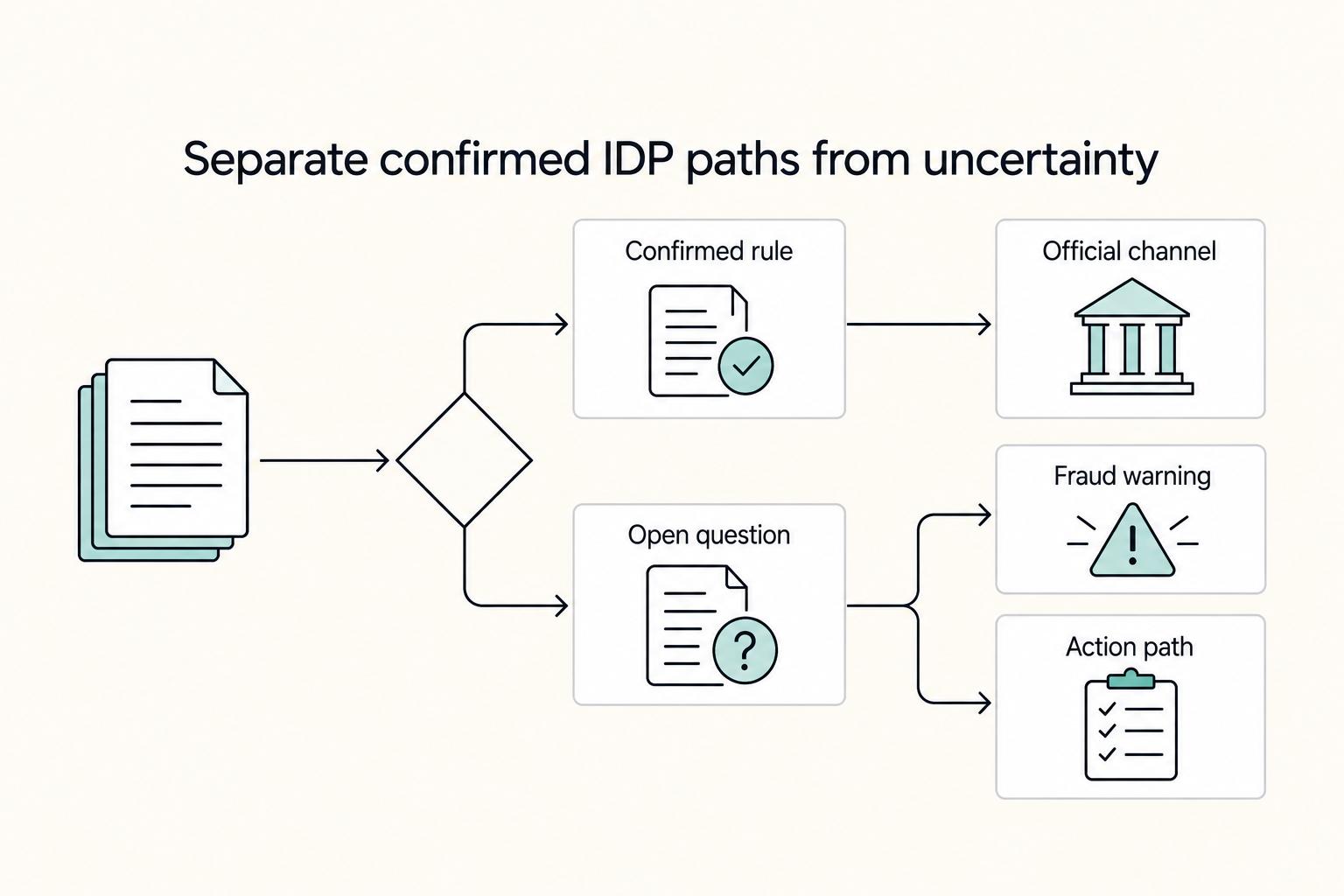
Your IDP Plan Starts With a Clear Decision Tree#
Start by separating what is confirmed, what is still unclear, and which paths are plainly promotional before you take any IDP action.
This is an execution playbook for a departure workflow, not a travel-blog recap. If you're trying to figure out how to get an international driving permit, use this to sequence decisions across visas, housing, and transport. The goal is to avoid making compliance calls under time pressure.
Set your operating baseline first#
Treat IDP work like any other ops task: assign one owner, use one checklist, keep one folder. That keeps the process from disappearing across tabs while the rest of your move speeds up.
- Define your trip pattern first: short trip, long stay, or relocation with ongoing local transport.
- Mark each destination-rule item as
confirmedorunclear, then schedule a recheck before departure. - Track IDP actions on the same timeline as visa and housing tasks.
- Keep one audit trail with drafts, confirmations, and final document checks.
Run the decision tree and lock decisions#
One listing titled "International Driving Permit Application Apply Now" promotes idpglobe.com and labels website content "AS IS." Treat pages like that as promotional context, not decision authority.
| Step | Ask this question | Decision rule | What you do next |
|---|---|---|---|
| Step 1 | Is my destination requirement status confirmed or unclear? | If unclear, do not assume. | Record the uncertainty and set a verification checkpoint before departure. |
| Step 2 | Is this page informational or promotional? | If it pushes quick application language or includes an "AS IS" notice, treat it as promotional. | Do not rely on it as your primary decision input. |
| Step 3 | Is my application packet complete and internally consistent? | If key details are missing or conflicting, pause. | Resolve the gaps before you submit anything. |
| Step 4 | Are all pre-departure checks closed? | If any verification item is still open, the workflow is not finished. | Close the open items and finalize your travel document set. |
For full move prep, pair this workflow with a pre-travel checklist for digital nomads. If you want a deeper dive, read a global digital nomad visa index.
Do You Actually Need an IDP for Your Destination?#
Use State Department country pages as your decision source, verify each page is an official secure .gov site, and treat unresolved items as risk to close before departure.
Run this check country by country. Do not outsource it to memory, forums, or a single itinerary assumption. Your target output is simple: what is confirmed, what is unclear, and what you are doing about it before travel dates get tight.
Use a repeatable baseline#
A .gov website is an official U.S. government organization, and a Secure .gov website uses HTTPS.
- Verify the page is on a
.govdomain. - Confirm the page uses HTTPS before logging it as a decision input.
- Use the U.S. Department of State International Travel Country Information Pages for destination checks.
- Record one status per country in your tracker:
confirmed,unclear, oraction needed.
Run the country check workflow#
| Step | Action | Verification point |
|---|---|---|
| Step 1 | Open the destination page in the International Travel Country Information Pages. | You confirm .gov and HTTPS before using the page for decisions. |
| Step 2 | Classify the destination as confirmed, unclear, or action needed. | You can state why you chose that status in one clear line. |
| Step 3 | Run separate checks for each destination in your itinerary, including cross-border segments. | You keep separate entries for each country and your exact stay type. |
| Step 4 | Recheck unclear items on official U.S. government pages and the destination page. | If uncertainty remains close to departure, treat it as unresolved risk and close it before driving. |
Apply a safe default when timing gets tight#
If guidance is still unclear near departure, stop guessing. Escalate through official U.S. government channels, then recheck destination rules before pickup day or cross-border driving so the plan still works.
| Resource | Use | Detail |
|---|---|---|
| STEP | Security updates | Enroll to receive security updates from the nearest U.S. embassy or consulate |
| State Department 24/7 consular number | From abroad | +1-202-501-4444 |
| State Department 24/7 consular number | From the U.S. and Canada | +1-888-407-4747 |
For resilience, keep support items in the same file as your core travel documents:
- Enroll in STEP to receive security updates from the nearest U.S. embassy or consulate.
- Save the State Department 24/7 consular numbers: +1-202-501-4444 (from abroad) and +1-888-407-4747 (from the U.S. and Canada).
- Keep these contacts with your core travel documents for faster response if plans change.
What Should You Prepare Before You Start?#
Prepare one application folder, recheck destination rules, and time your submission so your IDP is valid when you actually need to drive.
An International Driving Permit (IDP) is a companion document, not a replacement license. It is only valid when presented with your original license.
Before you submit, verify destination-specific requirements through official destination channels, such as the destination embassy or consulate. Save that confirmation with your travel records. IDP requirements are jurisdiction-dependent, so do not treat one country's rule as universal.
Set timing gates early. An IDP is valid for 1 year from its issue date, so align application timing to your actual driving start date. Also account for pre-arrival rules where relevant. For example, Quebec guidance says you must obtain an IDP before arriving.
Use a simple document-control checklist so relocation admin does not fragment:
- Keep your original license and IDP-related records together.
- Store confirmations and application records with visa and lease paperwork.
- Build in timing buffer so delays do not affect your planned driving start date.
Which Issuer Path Should You Choose for Speed and Certainty?#
Choose only AAA or AATA, then use the application channel you can complete and verify for your timeline.
Official U.S. IDP issuers are AAA and AATA. For U.S. citizens, that is the full approved list. If a site or service is not one of those two, stop and reroute before you submit payment or documents.
Use the two-lane framework first#
| Path | How you apply | Rule |
|---|---|---|
| AAA | Online, in person, or by mail | Official U.S. IDP issuer |
| AATA | Online with your passport photo and U.S. driver's license | Official U.S. IDP issuer |
| Non-AAA/AATA seller | "Instant international driver's license" seller that is not AAA or AATA | Stop and reroute before you submit payment or documents |
- AAA lane: You can apply online, in person, or by mail.
- AATA lane: You apply online with your passport photo and U.S. driver's license.
- Hard stop: Reject any "instant international driver's license" seller that is not AAA or AATA.
Choose your lane by timeline and execution fit#
- If departure is close: Pick the channel you can complete and confirm right away.
- If your timeline is stable: Compare AAA online or mail with AATA online based on the workflow you prefer.
- If an online flow adds account or handling prompts: Follow only the official issuer instructions shown in that flow, and save each confirmation step.
Add a fraud-control gate before payment#
- Verify issuer identity on USAGov before you pay.
- Recheck destination rules on U.S. Department of State country pages for travel beyond Canada and Mexico.
- Remember: your U.S. driver's license is valid in Canada and Mexico, and when an IDP is required, you carry it with your U.S. license.
Related: A Guide to Renting a Car Long-Term in Europe.
How to Apply Step by Step Without Rework#
If you're using the CAA flow, apply in one clean pass: use the official CAA channel, submit the exact required materials, and keep proof of submission until your IDP is in hand.
| Item | Requirement | Note |
|---|---|---|
| Driver's license | Valid Canadian driver's license or a photocopy of the front and back | Build the package exactly as listed |
| Passport photos | Two signed passport photos | Build the package exactly as listed |
| Fee payment | $32 CAD | Build the package exactly as listed |
| Shipping and handling | $15 may apply within Ontario; fees may vary outside Ontario | Mail applications |
An International Driving Permit (IDP) works only when it is issued through the recognized channel and your package matches the listed requirements. Keep it boring: one issuer flow, one channel, one complete submission.
- Step 1: Confirm the issuer and channel first. For this flow, IDPs are available through a CAA Store, and there is also a mail path that starts with an online application and then mailed materials.
- Step 2: Build the package exactly as listed. Prepare a valid Canadian driver's license, or a photocopy of the front and back, two signed passport photos, and the required fee payment ($32 CAD). For mail applications, shipping and handling of $15 may apply within Ontario, and fees may vary outside Ontario.
- Step 3: Submit through one channel without mixing steps. If you apply by mail, complete the online application first, then mail the required materials as instructed.
- Step 4: Retain proof and monitor your submission. Keep payment records, copies of what you sent, and any mailing proof or tracking details so you can follow up if needed.
What Mistakes Cause Delays and How Do You Recover Fast?#
The easiest way to avoid delays is to use legal authority as your decision source and treat reviews or marketing as secondary signals.
Most delays come from treating convenience signals as proof. Keep your standard consistent: official guidance for go/no-go decisions, and reviews only for service experience. That one rule keeps your timeline stable when sources conflict and gives you a clean way to correct course.
Use this recovery loop before you lock travel dates#
| Step | Delay trigger | Recovery action | Verification point |
|---|---|---|---|
| Step 1 | You rely on review sentiment to decide legal validity | Treat reviews as non-authoritative for legal claims. Trustpilot says it does not fact-check reviews, and a "Verified" label can mean a business interaction was confirmed, not legal authorization. | Your notes separate customer experience from legal requirements. |
| Step 2 | You treat guidance content as binding law | If a handbook says it is a guide, move to the governing statute for official decisions. Use orientation content to learn the process, then confirm rules in the legal source. | Your final decision is tied to an official legal reference. |
| Step 3 | You assume an IDP stands alone | Keep jurisdiction context explicit. For example, AA Ireland describes IDP use with a valid Irish driving license; do not generalize that wording to other license holders without local confirmation. | Your checklist states companion-license requirements for your specific jurisdiction. |
| Step 4 | You finalize travel before legal checks are complete | Pause bookings until legal requirements are documented in your file. If anything is unclear, mark it as uncertain and resolve it before departure. | You have a dated, written decision record with no unresolved legal assumptions. |
A trust signal is any rating, testimonial, or marketing claim that can help with vendor screening but does not establish legal permission. Use trust signals last, after legal authority and process evidence are aligned.
How Does This Fit Your Full Relocation Operations Stack?#
Run your IDP timeline and your U.S. tax-reporting timeline in parallel, but keep them as separate compliance decisions.
Treat driving readiness as a first-class workstream, not a last-minute errand. Put it on your master calendar next to visa, housing, and onboarding milestones so it does not quietly slip.
Keep it clean by running two lanes on one board: Mobility for IDP and destination driving-document tasks, and Tax for foreign-asset reporting tasks.
- Mobility lane: Track IDP preparation and your pre-departure readiness check for driving abroad.
- Tax lane: Track FATCA, Form 8938, and FBAR (FinCEN Form 114) tasks separately from mobility decisions.
- Form 8938 is attached to an annual tax return, and if you do not have to file an income tax return for that year, you do not file Form 8938 for that year.
- Use the IRS comparison resource to determine whether Form 8938, FBAR, or both are required; do not assume they are the same requirement.
- Thresholds and penalties vary by situation, so log uncertainty early: in general, reportable thresholds are framed around exceeding $50,000 (with higher thresholds in some cases), and Form 8938 penalties can begin at $10,000 and rise for continued failure after notification.
| Lane | Core task | Weekly check |
|---|---|---|
| Mobility | IDP and destination driving-document readiness | Do I have what I need before departure? |
| Tax | FATCA/Form 8938/FBAR decision tracking | Did I record what applies, who owns it, and when to revisit it? |
If you want one practical companion process, tie this board to Digital Nomad Pre-Travel Checklist for Long-Stay Moves.
Run This Checklist and You Are Ready to Submit#
Use this checklist to confirm your destination driving rules, record what the official guidance says about IDPs, and leave with the right documents in hand.
Before you submit anything, check your destination's Travel and Transportation guidance. Write a dated note with what it says about local traffic laws, driver license requirements, and road safety. Keep that note with your move plan, including the digital nomad pre-travel checklist.
- Record destination guidance first. Save a dated note from the destination guidance page so your decision is tied to the rules you reviewed.
- Make an IDP decision from official wording. For Canada, guidance says people planning to use a foreign licence should get an IDP in their home country.
- Define what the IDP does. International Driving Permit (IDP) is a translation document; Canada guidance says it translates your licence into French and English.
- Pack documents together for departure day. Carry your licence whenever you drive, and keep your IDP with it when your destination guidance says one is needed.
Frequently Asked Questions
How do I get an IDP in the United States step by step?
Check your destination on the U.S. Department of State country page and read the travel and transportation section. If an IDP is required, apply only through the two U.S.-authorized issuers: AAA or AATA. Choose one channel you can complete cleanly (AAA supports online, in-person, and mail; AATA provides an online application) and keep your submission artifacts in one folder until delivery.
Can I get an IDP online and still receive a physical document in time?
You can apply online through AAA or AATA. The approved guidance does not provide guaranteed processing or delivery timelines. If driving is time-critical, apply early and do not lock driving-dependent plans until your IDP is in hand.
Do I need an IDP if I already have a U.S. driver's license?
For Canada and Mexico, USAGov says your state driver's license is valid. In other countries, you may need an International Driving Permit (IDP). An IDP is a translation document, not a replacement license, and it must be carried with your original U.S. license when required.
Who is officially authorized to issue an IDP for U.S. license holders?
Only two organizations are authorized by the U.S. Department of State: AAA and AATA. If a provider is not one of those two, do not treat it as valid by default. Verify issuer details through USAGov before you submit payment or documents.
How far in advance should I apply before international travel?
The approved guidance does not provide a guaranteed advance timeline. Apply as soon as your destination check shows an IDP is needed. Build buffer time before departure so document issues do not become a trip-blocker.
Can I apply after I leave the United States?
Do not rely on post-departure application as your default plan. Some destinations, such as Quebec, require obtaining an IDP before arrival. Confirm your destination's requirements first, then complete IDP steps before you leave.
Is a digital IDP valid for driving abroad?
Do not assume a digital-only IDP is valid for driving abroad. The approved guidance here does not establish digital-only validity. Carry your original driver's license and the required IDP from an authorized issuer.
Try a related tool
Researched and edited by the Gruv editorial team. Gruv builds cross-border billing, payouts, and finance-operations software for global businesses.
Sources
Educational content only. Not legal, tax, or financial advice.
Related Posts

The 2026 Global Digital Nomad Visa Index for 50+ Countries
Start with legal fit, not lifestyle filters. The practical order is simple: choose a route you can actually document, then decide where you want to live. That single change cuts a lot of wasted comparison work and stops you from falling in love with places that were never a real filing option.

A Guide to Renting a Car Long-Term in Europe
**For a 90-day move, the safest car decision is the one that clears route, paperwork, and return risk before you compare price.** Provider pages are built to sell. Your relocation plan can still fail on eligibility, border limits, or return conditions that only show up in the terms.

Digital Nomad Pre-Travel Checklist for Long-Stay Moves
Set your departure dates first. Long-term travel planning breaks down when timing stays vague. Vague timing usually turns into rushed paperwork, rushed bookings, or unresolved home obligations.