
Quick Answer
To get a Cyprus Yellow Slip, eligible EU citizens and EU family members who are also EU citizens should confirm the correct route, prepare a complete MEU1 file, and submit within 4 months of arrival if staying longer than 3 months. Core documents are the form, a valid passport or ID and copy, and Cyprus address proof. Local offices may also require appointments, translations, certifications, and extra supporting evidence.
Three phases: confirm your route, build the file, then submit#
Handle this in three phases: confirm the right registration route, build a complete file, then submit and manage the outcome. In practice, the Cyprus Yellow Slip refers to the registration certificate process for eligible EU citizens and family members who are also EU citizens. It applies if you plan to stay longer than 3 months, with filing due within 4 months of arrival. This guide focuses on a few recurring problems:
- confusion about whether your route is MEU1, MEU2, or later MEU3
- rejected or delayed files caused by missing supporting documents, translations, or certifications
- avoidable delays caused by office-specific appointment and submission processes
- post-submission issues such as missed mail or outdated address details
Procedures can vary by office, and forms or submission channels can change. Treat official pages as live checkpoints. If you see an updated channel or form label, such as MEDU1 or MEDUM1, use the current version and add local specifics only after you verify them.
| Phase | Inputs | What you do | Outcome |
|---|---|---|---|
| 1. Confirm route and deadline | Your status and arrival date | Verify whether MEU1 applies to you, or whether MEU2 applies for a non-EU family member; note the 3-month stay trigger and 4-month filing window | You start on the correct legal track and timeline |
| 2. Build a complete file | Form, ID documents, category-specific supporting documents | Prepare a submission-ready pack with required official translations or certifications, then verify the correct office and whether an appointment is required | You reduce avoidable rejection and timeline risk |
| 3. Submit and manage outcome | Final file, fee payment, current address details | Submit with the currently stated fee for your route (MEU1 is published as EUR 20 for Union citizens and family members who are also Union citizens), track the post-submission outcome, and keep your address updated | You complete registration and avoid preventable compliance issues |
The published examination time of up to 1 month applies only to a duly completed application with all supporting documents. Noncompliance may trigger a financial penalty, but published figures differ, so re-check the current amount before you act. Once issued, the registration certificate is described as not having an expiration date.
You might also find this useful: A guide to getting a freelance 'Artist Visa' in Germany.
Phase 1: Arrive with a clean, consistent file#
Once you confirm that MEU1 is your route, arrive with a clean, consistent file and stay on track to apply within 4 months of arrival if you plan to stay more than 3 months. Most avoidable problems start here, not at the appointment.
Step 1. Build your MEU1 starter file first#
Start with the core documents explicitly listed for this route:
| Core document | Detail |
|---|---|
| Completed form | Completed MEU1 form, or MEU2 if that is your applicable route |
| Identity document | Valid passport or ID card, plus a copy |
| Address proof | Proof of address in Cyprus, such as a rental or sales agreement |
Before you add anything else, run one consistency check across the file. Make sure the name spelling, key dates, and address format match everywhere.
Step 2. Organize extra supporting material as one bundle#
A scattered file slows review. Beyond the core items above, the supporting-documents file is office-specific, so treat it as optional preparation and confirm current expectations with your local office before you rely on it.
Step 3. Verify address proof before travel#
Address proof is a named checkpoint, so review it the way an officer will. It should be complete, readable, and internally consistent. Use this quick check:
- the full Cyprus address is clearly shown
- your identity details match your passport or ID
- key dates are visible and readable
- the document is complete, not partial or cut off
If you are relying on a lease, confirm current lease-duration expectations with the relevant office before you book.
Step 4. Pre-check insurance documents for clarity#
Insurance expectations can vary by office in practice and are not confirmed in this checklist. Verify directly with the relevant office whether insurance evidence is required and what wording or format they currently accept.
Ready to book#
Do not book until the file is genuinely ready. That means a completed MEU1, a valid passport or ID and copy, proof of address, and one final cross-check of names, dates, and address details. If the office requires translation or legalization, confirm that first and complete it before the appointment.
For a step-by-step walkthrough, see How to Get a Residence Permit in Germany as a Freelancer.
Before you lock your application plan, sanity-check alternative relocation paths with Gruv's Visa Cheatsheet for Digital Nomads.
Phase 2: Submit a consistent MEU1 file through the right local process#
Once your address proof is in order, move from preparation to execution. The goal is simple: submit a consistent MEU1 file through the right local process before timing becomes a problem.
Step 1. Book in your province and confirm the local process first#
Appointment handling is usually where local variation matters most. Because MEU1 is a time-bound filing from entry date, book early enough that appointment availability does not create late-filing risk.
| Booking route | What to do |
|---|---|
| Online booking | Book there and keep the confirmation |
| Send a clear request with your full name, contact details, province of residence, and requested service | |
| Phone | Call during listed hours and note who you spoke with and when |
| Walk-in or first come | Confirm current rules and required intake documents before you go |
MEU1 is stated as due within 4 months from entry. The official framework also notes potential penalties of up to EUR 2,500 for noncompliance.
Before you travel, identify your district or province office route first and work through the relevant booking path above.
If your route uses the government-hosted appointment channel, the posted notice says replies are sent within 5 working days. If nothing arrives in that window, follow up through the same channel. Before you travel, re-check the live MEU1 page for the current application window, appointment handling, and penalty wording.
Step 2. Run a consistency check across your full file#
At this stage, mismatches can create avoidable delays. Your form, identity records, and supporting documents should tell the same story. Check these points together:
- Activity label and evidence match: if you file as employed, Part III and employer evidence should align; if self-employed, include the listed Social Insurance self-employed registration evidence where required.
- Identity details match everywhere: same name spelling, ID or passport number, and date format across MEU1, contracts, insurance, and address documents.
- Address package is consistent: property or rental records and utility evidence should support the same address details.
Treat inconsistency as a delay risk.
Step 3. Attend with a complete, submission-ready pack#
Treat the appointment as a completeness test, not a working session. Your file should be ready to hand over, including any required official translations and certifications. Your day-of pack should include:
| Submission item | Detail |
|---|---|
| Form | Completed MEU1 form |
| Identity document | Valid passport or ID card, plus copies if requested |
| Address documents | Cyprus address documents that match your booking details |
| Work or status evidence | One organized bundle |
| Insurance documents | Where required |
| Translations or certifications | Required certified translations or certifications |
| Fee | EUR 20 |
| Appointment details | Appointment confirmation or details, if applicable |
| Smooth submission | Delay trigger |
|---|---|
| MEU1 status and supporting evidence align | Form status and supporting evidence conflict |
| Address package includes rental or property plus utility evidence | Address evidence is partial or inconsistent |
| Names, ID details, and address format match across documents | Typos, old address, or mixed identity details |
| Required translation or certification is complete | Required formalities are missing |
The process also includes photo capture tied to your submission receipt and valid travel document, so keep both available.
Step 4. Track status and protect delivery#
After submission, the main risk shifts from file quality to follow-through. Keep your receipt safe and easy to access, because it is your reference point for any follow-up.
Use the same office or channel that handled your application, and include your receipt details, full name, and submission date in any status request.
If approved, the Registration Certificate is issued and sent by post, so your address details need to stay current. If your address changes, update the relevant office promptly and keep proof of the update request.
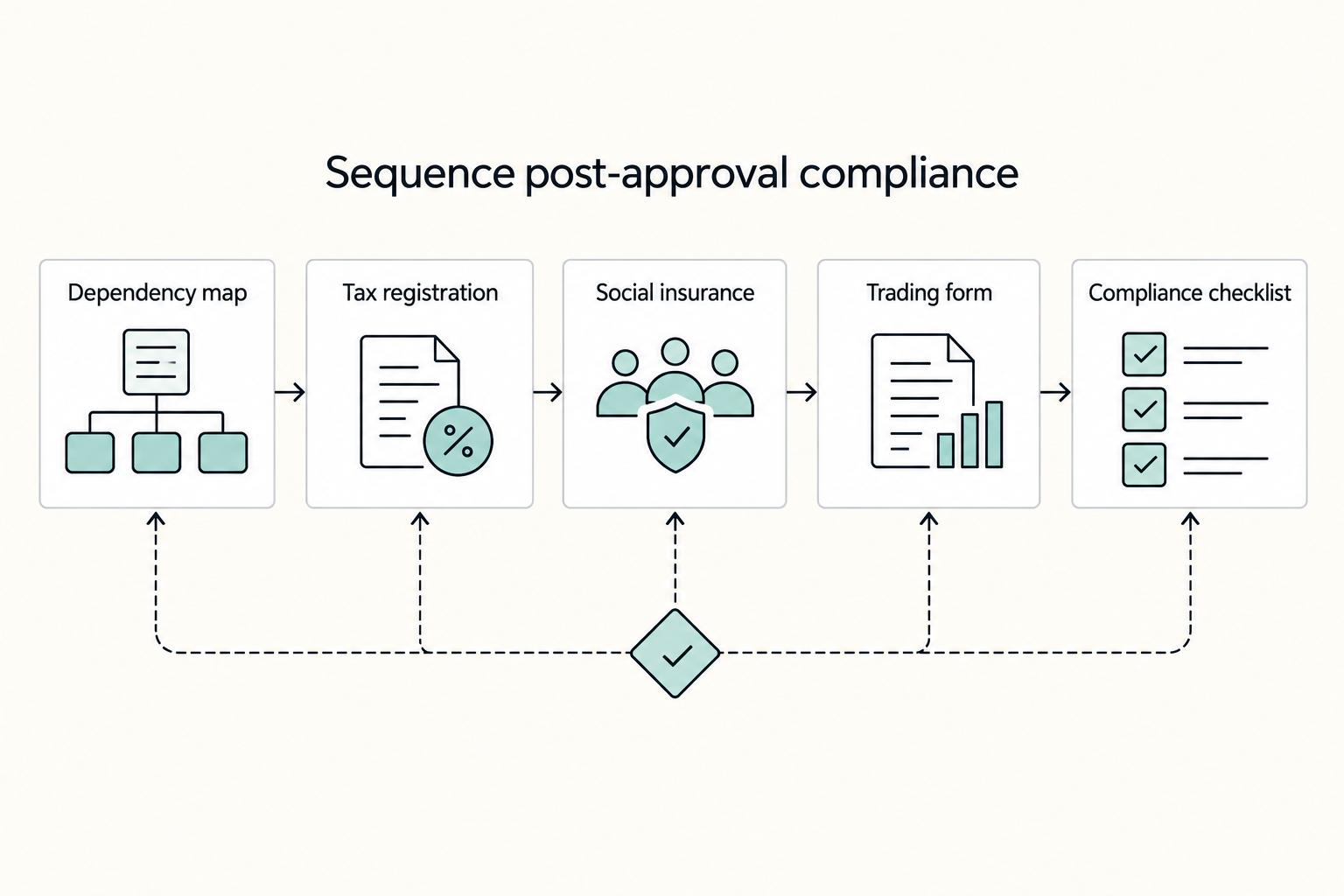
Phase 3: Your Post-Approval Compliance Roadmap (The Integration)#
Approval is not the end of the process. Once the certificate is issued, treat the next compliance steps as items to verify before you file anything. The sequence below is a planning checklist for post-approval setup, not a confirmed Cyprus authority workflow.
Dependency map#
Use this working order until you confirm current Cyprus rules: Registration Certificate -> tax registration check -> social insurance check -> invoicing readiness and any healthcare enrollment you pursue after confirming current rules. Do not assume invoicing rights are in place before your registration status is confirmed.
Step 1. Register for your tax number#
Start here so you know which obligations actually apply.
Purpose. Confirm whether registration is required, which pathway applies, and what obligations start after approval.
Required documents. Prepare your document pack (Registration Certificate, passport or ID, proof of address, and business activity details) and be ready for additional identity-proof requests where required.
Where to submit. Use the competent Cyprus tax registration route after you verify the current portal or process.
Common blockers. Incorrect pathway selection, identity/detail mismatches across documents, missing follow-up proof requests, and assuming a route before you confirm which obligations apply.
Checkpoint. Keep written confirmation with your registration reference and effective date.
Timing to confirm. If registration is required, confirm the current deadline and any late-registration consequences before relying on a filing plan.
Step 2. Set up social insurance#
Do not assume this is automatic. Confirm current Cyprus social insurance mechanics before you rely on this step.
Purpose. Confirm whether social insurance registration is required, whether it is separate from tax registration, and what completion evidence you must retain.
Required documents. Confirm the official document list before you file.
Where to submit. Use the competent Cyprus social insurance route after you verify the current portal or process.
Common blockers. Treating tax and social insurance as automatically linked without confirmation, or relying on status before written completion evidence is available.
Step 3. Decide whether to trade as a sole trader or through a limited company#
Make this decision once Steps 1 and 2 are underway. It affects liability, administration, banking, and when you need advisor support.
| Decision point | Sole trader | Limited company |
|---|---|---|
| Liability | One owner is legally responsible for the business, including debts. | Legal effect is jurisdiction-specific; confirm Cyprus legal impact before relying on it. |
| Admin burden | Confirm current Cyprus requirements. | Confirm current Cyprus requirements. |
| Banking and compliance | Confirm current Cyprus and bank requirements. | Confirm current Cyprus and bank requirements. |
| When to seek advisor input | If rules are unclear for your activity mix. | Before relying on incorporation for liability, ownership, or cross-border planning. |
Post-approval checklist#
- Tax registration requirement and pathway verified, with written confirmation saved
- Registration deadline and penalty exposure verified from current Cyprus guidance
- Social insurance requirement, route, and completion evidence verified
- Structure decision made after confirming local legal and tax effects
- Core records stored together: ID, Registration Certificate, address proof, and confirmations
- Invoicing, banking, and healthcare steps started only after required registrations are confirmed
If you want a deeper dive, read The 2026 Global Digital Nomad Visa Index for 50+ Countries.
Conclusion: You Are Now in Control#
You now have a practical path through the registration process. Build a complete file, apply on the right timeline, and keep your follow-through organized so loose ends do not create new problems. This will not remove every variable, but it does reduce avoidable delay.
1) Recheck your core file before filing. Keep the required documents for your case consistent and easy to review in one package for your registration certificate application.
2) Verify current instructions before every step. If you are an EU or EEA national planning to stay longer than 3 months, do not rely on old checklists alone. Local office practice and document handling can change, so confirm live requirements each time. If your case includes a non-EU family member, confirm the separate route, such as MEU2, rather than assuming your filing covers everyone.
3) Complete case-specific follow-through immediately. After you receive the registration certificate, move straight to any follow-on local administrative steps that apply to your situation, and verify the current process for each one.
The key rule from start to finish is simple: verify current instructions before each filing step, because requirements can change.
Next, use A Guide to Tax Residency in Cyprus for Digital Nomads to plan what comes after residence registration.
Related: Tax Residency in Ireland for Digital Nomads and Tech Contractors.
As you move from residency setup into ongoing compliance, track your days and decision points in one place with the Tax Residency Tracker.
Frequently Asked Questions
How do you prove sufficient funds if you are self-employed or working remotely?
Show stability rather than a one-day snapshot. Include evidence of income, deposits, and comprehensive health insurance, and make sure names, addresses, and dates match across the file. Bring your original passport or ID and confirm any extra office-specific item before you attend.
What are the biggest MEU1 failure points?
The biggest failure points are timing and document handling. If you stay longer than 3 months, filing is due within 4 months of entry, and noncompliance can lead to a financial penalty of up to €2,500. Other common problems are bringing copies without the original passport or ID and missing required translations or certifications. If an application is rejected, the authority sends a letter to the latest declared address with the reasons.
Can you use Revolut or Wise statements?
Revolut or Wise statements should be treated as supporting evidence that needs advance validation, not as automatically sufficient on their own. Check current office practice before your appointment. Make sure your full name, account details, statement period, transaction history, and balance trail are clear, and confirm whether certification or translation is required.
What is the difference between the Cyprus yellow slip and tax residency?
No. MEU1 is residence registration, while tax residency determines how your income is taxed. MEU1 is handled by migration authorities and is triggered by a stay longer than 3 months with filing within 4 months of entry. Tax residency follows Cyprus tax residence rules, and one does not automatically create the other.
Is the registration certificate the same as permanent residence?
No. MEU1 is the registration step for your current residence period, while permanent residence is a separate status. The article states permanent residence is tied to 5 consecutive years of legal residence. Keep clear records of continuous lawful stay if you plan to pursue it later.
How should you handle timeline uncertainty and appointment readiness?
Assume timelines vary by office and verify whether an appointment is required before you go. To reduce delays, confirm appointment logistics early, complete any required translations or certifications before attending, and re-check the current fee reference of EUR 20 before submission. Make sure your address is current, your original ID plus copy is packed, and your financial and insurance evidence are aligned.
Try a related tool
Researched and edited by the Gruv editorial team. Gruv builds cross-border billing, payouts, and finance-operations software for global businesses.
Sources
- ato.gov.au/businesses-and-organisations/international-t...trusted
- ato.gov.au/businesses-and-organisations/international-t...trusted
- businessincyprus.gov.cy/doing-business-in-cyprus/start-your-business...trusted
- eures.gov.cy/mlsi/dl/eures/eures.nsf/page14_en/page14_entrusted
- eures.gov.cy/mlsi/dl/eures/eures.nsf/page14_en/page14_entrusted
- mip.gov.cy/dmmip/md.nsf/All/0C6B5279E8E5086CC2258933003...trusted
- mip.gov.cy/dmmip/md.nsf/All/905EE5BC6E2A0B5FC22589B8003...trusted
- state.gov/report/custom/dbe1c9ab37trusted
Educational content only. Not legal, tax, or financial advice.
Related Posts

The 2026 Global Digital Nomad Visa Index for 50+ Countries
Start with legal fit, not lifestyle filters. The practical order is simple: choose a route you can actually document, then decide where you want to live. That single change cuts a lot of wasted comparison work and stops you from falling in love with places that were never a real filing option.
Cyprus Tax Residency for Digital Nomads in 2026
Your core decision is not whether Cyprus looks attractive on paper. It is whether you can build a residency position you can defend. In practice, that means choosing between the 183-day route and the 60-day rule, then checking whether your facts, documents, and non-Cyprus ties actually support that path.
Tax Residency in Ireland for Digital Nomads and Tech Contractors
Pick one status for the current year in Ireland, then document it so you can defend it. The goal is a position built on records you can prove now, not a perfect answer to every edge case.