
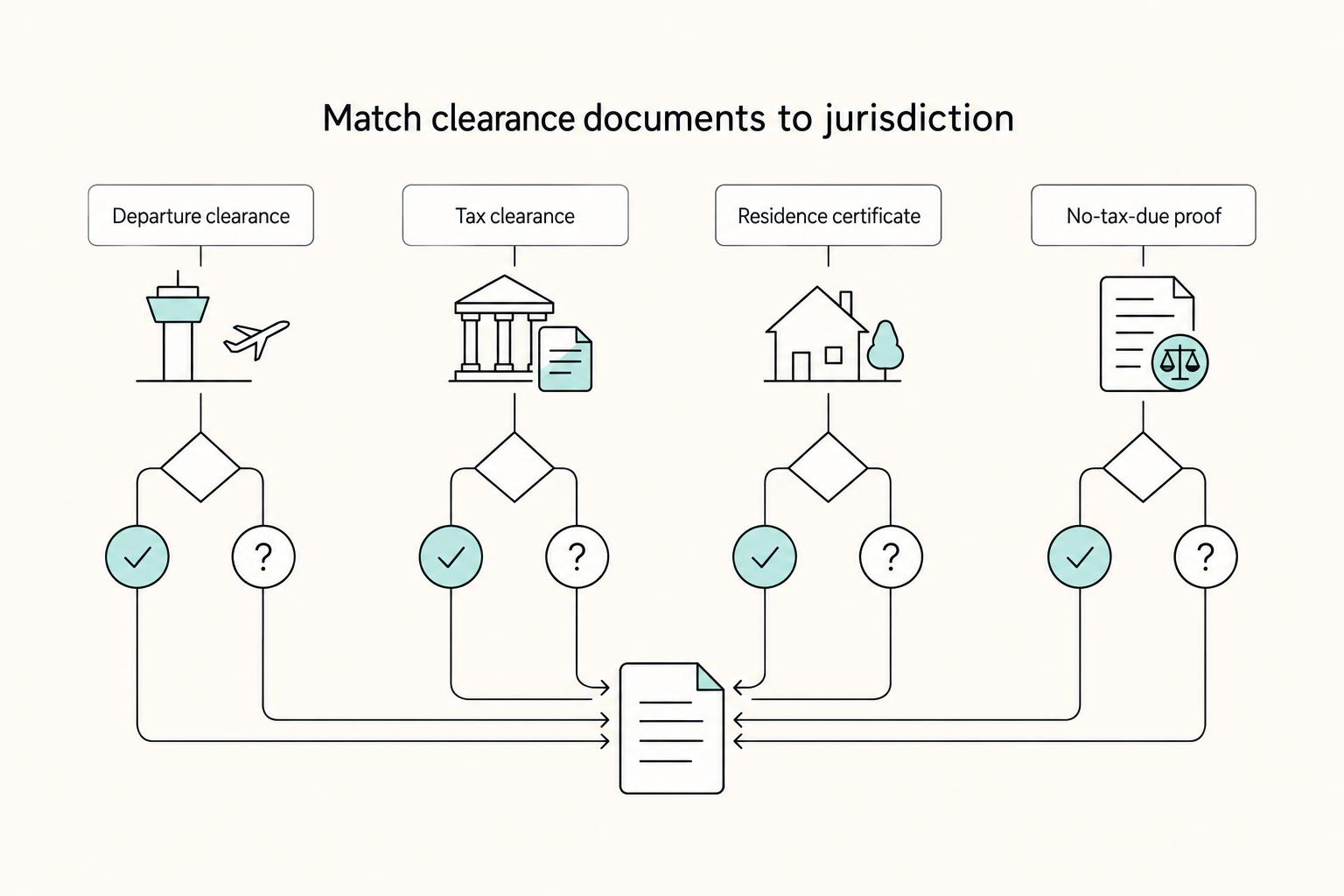
Quick Answer
To get departure-related tax compliance proof when leaving a country, first confirm that your case actually requires it and identify the exact document name in that jurisdiction. The correct document may be a Tax Clearance Certificate, a departure permit, a sailing permit, or another scope-specific form. Verify the issuing authority and purpose, clear all filings and balances, then submit through the accepted channel and save the issued proof.
You are leaving a country and need proof you are tax compliant#
Start by confirming whether your departure actually requires proof of tax compliance. The requirement, issuing authority, and document name are jurisdiction-specific. Your first job is to identify the right document in the right jurisdiction and keep evidence for later residency checks.
Step 1. Confirm the scope of the problem#
For freelancers and consultants, this is departure compliance when you leave a country, not generic business paperwork. A document can be valid for one purpose and still be the wrong proof for exit or residency issues.
Missouri's Certificate of No Tax Due is a good example. It is a real tax-compliance document used in business licensing processes, but that does not make it emigration proof. If your issue is personal departure or residency status, rely only on documents the issuing authority explicitly ties to that purpose.
Step 2. Name the document by jurisdiction, not by guesswork#
Document names vary, even when people casually call them all "tax clearance." In the U.S., the IRS says departing resident or nonresident aliens usually need a tax-clearance document, commonly called a "departure permit" or "sailing permit," and describes departing alien clearance as proof that U.S. tax liabilities were settled before a planned, long-term, or permanent departure. In Singapore, IRAS says to check first whether tax clearance is required. Where it is, the process includes Form IR21 and withholding.
Ireland uses "Tax Clearance Certificate" to confirm tax affairs are in order. The UK Certificate of Residence is for double-tax relief on foreign income, not departure clearance.
| Jurisdiction or example | Document name used | What it is for |
|---|---|---|
| U.S. IRS | Departure permit or sailing permit | Departure tax-compliance proof tied to settling U.S. tax liabilities before leaving |
| Singapore IRAS | Tax clearance (Form IR21 process) | Applies in certain employee departure cases, so verify first whether it applies |
| Ireland Revenue | Tax Clearance Certificate | Confirmation that tax affairs are in order |
| UK HMRC | Certificate of Residence | Double-tax relief support, not departure clearance |
| Missouri state | Certificate of No Tax Due | Business licensing compliance, not cross-border exit proof |
This is why blanket advice causes mistakes. India publicly clarified on 20 AUG 2024 that it is factually incorrect to say all citizens must get an income-tax clearance certificate before leaving. It also stated that only certain persons are required to obtain one.
Step 3. Create a verification note before you do anything else#
Before you file anything, write one short verification note with the exact document name, issuing authority, purpose, source page, and the date you checked it. That note prevents common mix-ups between similar labels.
Use this checkpoint before moving on: can you point to an official page that connects the document to departure compliance, settlement of liabilities, or confirmation that tax affairs are in order? If not, keep verifying before you gather records or submit forms.
Start by naming the exact document you need#
If the authority is asking you to prove liabilities were settled, ask for a Tax Clearance Certificate or the local equivalent first. Do not start with similarly named documents and assume they will do the same job.
Step 1. Separate the three lookalikes#
Use this quick rule: these documents are often not interchangeable.
| Document | What it helps show | What to avoid assuming |
|---|---|---|
| Tax Clearance Certificate (may also be called a certificate of tax clearance or tax compliance certificate) | Tax obligations were fulfilled up to a specified date | Name variations do not change the core function |
| Tax Residency Certificate | A different purpose than clearance proof | It is not the same as clearance proof |
| No Tax Due Letter | No balance due in a specific context | It is not automatically accepted as a substitute for formal clearance |
If the request language says "settled liabilities," "clearance," or something similar, use the clearance document name in your request.
Step 2. Reject wrong-context examples early#
A lot of confusion comes from valid tax documents built for different purposes. For example, Texas Certificate of Account Status and Form 05-391 Tax Clearance Letter Request are business-entity documents. IRS Form 5173 is tied to estate administration for deceased nonresidents with U.S. situs assets. Treat those as scope-specific examples, not default personal emigration templates.
Step 3. Write the one-line note#
Before you gather records or file anything, add one line to your notes: Document name | Issuing authority | Purpose.
When you contact the authority, include your taxpayer identifier, such as a TIN, registration number, or VAT number where applicable, so the request is matched to the correct record.
Confirm whether your move actually triggers a clearance requirement#
Do not assume your move automatically requires tax-compliance proof. Confirm the trigger first. In most cases, the requirement comes from a specific country rule, a day-count outcome, or a third party asking for evidence.
Step 1. Check who is actually requesting proof#
If a tax authority, bank, employer, or other party asks for compliance evidence, verify the requirement before departure. Get the exact wording, the issuing authority, the required document name, and the deadline.
The U.S. shows why this matters. Many departing aliens are usually expected to show U.S. tax compliance before leaving, often through departure or sailing-permit rules, but there are explicit exceptions. So treat online examples as prompts, not as your rule. Keep one note with three answers: who is requesting proof, which exact document they named, and by what date.
Step 2. Check whether timing changes your tax status#
If your departure is near a 183-day threshold or a proof deadline, confirm status before you file or request clearance. Timing can change residency treatment.
For the U.S. substantial presence test, the rule includes 31 days in the current year and 183 days across the current year plus the prior two years. In the UK, 183 days or more in the relevant tax year can trigger residence under an automatic test. The same departure date can lead to different outcomes depending on your day count.
Before you change tax address details, write down your physical-presence days for the current year and the prior two years. If you are close to a threshold, treat that as a risk flag.
Step 3. Separate actual rules from assumptions#
There is no universal rule that every emigrant must obtain a clearance certificate. Requirements are jurisdiction-specific, and some are conditional. India is a clear example. Section 230 is not an automatic certificate requirement for every person domiciled in India. It depends on whether the tax authority considers it necessary in the circumstances.
If the rules are still unclear and your travel date is fixed, escalate before you change tax address details or close registrations. At that point, the priority is a clear answer on status, timing, and whether departure proof is required at all. For a step-by-step walkthrough, see How to Get an FBI Police Clearance Certificate for a Foreign Visa.
Build your prerequisites before filing anything#
Do not file the request first. Build a complete, matchable file before you submit to reduce follow-up requests.
Step 1. Assemble a departure evidence pack#
Your goal is simple: prove identity, filing, and payment in one place. At minimum, collect:
| Record type | What to collect | Example noted |
|---|---|---|
| Identity | Taxpayer ID details for the country you are leaving, plus passport and any immigration or registration document tied to your tax file | IRS Topic 858: valid passport, alien registration card or visa |
| Filed returns | Copies of filed returns for the relevant recent years | IRS Topic 858: copies of U.S. returns filed for the past two years |
| Payment proof | Payment receipts or confirmations tied to those returns | IRS Topic 858: receipts for taxes paid |
| Status filings | Departure-year or expat-related filings that explain your status | Use filings that explain your current status before requesting clearance |
| Prior correspondence | Any prior correspondence that is relevant to your current tax status | Keep correspondence that is relevant to your current tax status |
For U.S. departing-alien clearance, IRS Topic 858 is a useful completeness check: valid passport, alien registration card or visa, copies of U.S. returns filed for the past two years, and receipts for taxes paid.
Step 2. Check Exit Tax or Departure Tax exposure before requesting clearance#
Check the liability side first, then ask for proof that liabilities are settled.
Canada is a clear example. When Canadian residency ceases, certain property is deemed disposed of at fair market value on departure, with exceptions. If the total fair market value of listed properties exceeds $25,000, CRA requires Form T1161.
If your departure-year liability changes, update your filing and evidence pack before you submit the clearance request.
Step 3. Reconcile identity and registration details across records#
A technically correct filing can still stall if the records do not match. Before submission, confirm your legal name, tax account details, status, and registration records are aligned across the documents in your pack. If your status changed, complete that process first where required.
SARS states this sequencing directly for non-resident Tax Compliance Status requests: complete the "Cease to be a Resident" process before requesting TCS.
Step 4. Verify that "filed" is now "cleared"#
Use a strict checkpoint before submission:
- no overdue return
- no unpaid tax debt
The IRS tax compliance report approach reflects this standard. It also notes posting lag. Payments can take about 2 weeks to appear, and returns about 4-6 weeks. If you filed and paid recently, verify posted status in the authority system before you submit.
If this checkpoint is clean, you should have one complete evidence pack, matched records, and fewer open items likely to delay the request. Related reading: How Foreign Professionals Can Decide Tax Residency in Japan.
Identify the issuing authority and channel before you submit#
Confirm the exact document and issuing authority first, then choose the submission channel. Most mistakes here are category errors, where the label looks right but the document belongs to a different legal purpose.
Public tax pages often use overlapping terms like clearance and certificate. Those labels are not interchangeable across different legal and administrative processes.
Step 1. Match the document to its legal purpose#
Use purpose before portal. If you need departure-related tax compliance proof, confirm that the document is explicitly for that purpose.
The CRA clearance-certificate context is a good scope check. It applies to estates, trusts, and corporations, and is tied to distributing assets without personal responsibility for unpaid amounts. CRA also notes that if a corporation continues to operate, a comfort letter may be needed instead of a clearance certificate. That shows why the title alone is not enough.
New Jersey examples show the same risk from the other side. A tax-sale "tax certificate" is a lien instrument, and Tax Court rules are court procedure. Both are real tax or legal materials, but neither is automatically an emigration-clearance path.
Step 2. Confirm authority before channel#
Only after the authority and document family are confirmed should you use a portal, paper route, or unit-level process.
| Example you may encounter | Safe inference | Still verify before filing |
|---|---|---|
| CRA clearance certificate page | Estate/trust/corporation tax-clearance context | Whether your case type falls within that scope |
| CRA mention of a comfort letter | A different document may apply when a corporation continues operating | The exact document name requested and the submission steps |
| New Jersey tax-sale "tax certificate" materials | Property-tax lien instrument context | Not an emigration-clearance document |
| New Jersey Tax Court rules material | Court practice and procedure context | Not a filing channel for tax-clearance requests |
Step 3. Use one hard checkpoint before submission#
Before you submit anything, confirm these four items in writing:
- exact document name requested
- issuing authority name
- required submission channel
- case type: personal, business, estate, trust, or mixed
If any item is unclear, pause and verify with official instructions or direct authority confirmation. Keep a simple verification record with the authority page, form title, and date checked. If a requester asks for a specific certificate name, match that wording exactly.
Clear blockers in the right order to avoid reset loops#
Use this order every time: complete filings, settle balances or confirm an accepted payment plan where allowed, request the exact clearance document, then archive the proof set. Submitting early usually creates rework, not speed.
Step 1. Resolve every open filing before you ask for clearance#
Start with filings, not payment and not the request packet. You can still appear noncompliant if required returns or reports are missing.
Use a checkpoint before moving on: no open required return and no missing business report tied to the same taxpayer or entity. In some jurisdictions, clearance review can span all tax types and related accounts, not just one return stream.
Step 2. Pay balances and reconcile account details#
Once filings are complete, clear the liability side. In many cases, clearance requires filed returns and paid liabilities, or an active payment plan if that jurisdiction accepts one.
Reconcile core account details across returns, payments, and registrations. Also treat entity-status letters carefully, because they may not reflect standing with other agencies.
Step 3. Request the exact document only after the account is clean#
Do not submit the clearance request while filings or liabilities are still pending. Depending on the jurisdiction, that can mean a response listing unresolved requirements instead of issuing the document, and some requests can be denied when required information is missing.
This is why waiting to submit is often faster overall. In jurisdictions where requests are handled in queue order and missing details can trigger denial, an early or mismatched submission adds another cycle without getting usable proof. Request only the exact document the authority requires for your case.
Step 4. Archive the issued proof like you expect to need it again#
Once issued, save more than the final PDF. Keep filing acknowledgments, payment confirmations, and submission records tied to the approval.
If you manage multiple accounts or entities, label records by account so each clearance artifact is traceable later. The goal is not only approval now, but a clean proof trail of what was filed, paid, and cleared.
Submit and track the request like a project#
Once your account is clean, the risk shifts from tax status to submission control. Handle this as a tracked process so you do not lose time to missing references, wrong channels, or document-type drift.
Step 1. Create a minimum tracker before you submit#
Use one log you will actually maintain. Record:
| Field | What to record | Article note |
|---|---|---|
| Submission date | The date the request was submitted | Know without guessing when it was sent |
| Issuing authority and contact | The authority handling the request and the contact used | Be able to say who has the request |
| Channel used | The submission channel used | Be able to say how it was sent |
| Reference or confirmation number | Any reference or confirmation number generated | Capture it before closing the tab |
| Stated response window | The published response window for that channel, if any | Use the stated timing for follow-up |
| Next follow-up date | The next date you plan to follow up | Track the process instead of following up at random |
Your checkpoint is simple: you can say, without guessing, who has the request, how it was sent, and what confirms receipt. If your process gives you a confirmation number, as in Georgia, or a status-check function, as in Kansas, capture it before closing the tab.
Step 2. Keep proof that matches your submission channel#
Keep evidence tied to the channel you used:
Premier Business Services (PBS) portal: save the portal confirmation or receipt. For eligible New Jersey businesses, paper applications can be returned if PBS registration is available.- Paper submissions, where allowed: keep delivery proof, a full packet copy, and any cover or payment records sent with it.
This helps you avoid the common "submitted but invalid channel" problem.
Step 3. Follow up against stated timing, then escalate cleanly#
Follow up against published timing signals for that jurisdiction and channel, not at random. Use your reference number, submission date, taxpayer identifier, and exact requested document name.
| Jurisdiction example | Published timing signal |
|---|---|
Connecticut (myconneCT status letters) | Generally immediate when good standing is verified |
| Georgia | Tax Clearance Letter available online next day |
| Washington (tax status request letter) | Generally right away, but may take up to 3 business days |
If New Jersey business-assistance clearance stalls, use the published NJ escalation contacts instead of resubmitting blindly. Also confirm document type if the terminology shifts. A "tax status letter" is not automatically equivalent to a clearance document, and Washington explicitly says its status letter is not verification of correct reporting.
Step 4. Store final outputs with disciplined naming#
Save the issued document with a consistent internal naming pattern, for example: Tax Clearance Certificate + jurisdiction + issue date + taxpayer identifier. That is an operating convention, not a legal requirement.
Store companion artifacts beside it:
- submission confirmation
- status screenshots
- authority correspondence
- any verification detail, such as Kansas verification of certificate or confirmation number
The certificate matters, but the record of how it was issued is what protects you later if status is questioned.
Handle freelancer edge cases the SERP pages barely cover#
If you are leaving a country personally and also operating through a business or local license, treat this as two compliance tracks. A practical risk is trying to use one document for two different legal purposes.
Step 1. Separate your personal exit file from your business file#
Start with two questions: what proves you settled departure-related tax obligations, and what proves your entity or permit is in good standing with a local authority. In the U.S., departure compliance for many aliens is tied to IRS departing-alien clearance, or the sailing or departure permit. The IRS describes it as proof you settled U.S. tax liabilities before a planned long-term or permanent departure.
That is different from city or state business clearance. A New York City Department of Finance tax clearance is a city tax document. A New Jersey Business Assistance Tax Clearance Certificate is tied to grants, loans, incentives, or rebates, and New Jersey states that form is not for business dissolutions.
Use separate outputs for:
- your personal departure or residency position
- your entity's tax standing
- any city permit or license renewal requirements
Checkpoint: every document in your tracker should clearly show issuing authority and purpose.
Step 2. Distinguish permit clearance from departure compliance#
Permit-side clearance and departure compliance are not interchangeable.
| Workflow | What it covers | What it does not cover |
|---|---|---|
| IRS departing alien clearance | Personal departure tax-compliance evidence before long-term or permanent departure | City license or permit standing |
| NYC DOF tax clearance in TLC context | City business-tax standing for taxi or limousine licensing contexts | Personal emigration or departure compliance |
| NYC vendor rule change (effective March 29, 2024) for certain DCWP/DOHMH applicants | Removes a DOF clearance requirement in those specific vendor processes | Any general conclusion that departure compliance is complete |
Also account for non-return blockers in permit matters. DOHMH states permits and licenses cannot be renewed until outstanding fines are paid.
Step 3. Sequence mixed cases in the right order#
If your case spans emigration and city licensing, keep departure-related documents and local permit documents in separate tracks and follow each authority's timing requirements. That helps prevent sending the right document to the wrong authority near your move date.
Keep two evidence folders:
- Departure folder: filed returns, payment proof, taxpayer IDs, departure-date support, and the exact departure document requested.
- Local entity or permit folder: DOF confirmations, TLC or other agency notices, fine-payment receipts, and renewal correspondence.
Final control check: confirm each issued document's title, issuing authority, and stated purpose against your original requirement. If your position is later reviewed, contemporaneous, complete documentation is useful evidence.
Avoid the most common mistakes and recover fast#
If something goes wrong, recover by fixing format and evidence first. Submit the request correctly, explain the issue clearly, and use the formal escalation path when needed.
Step 1. Submit in the right format from the start#
In IRS penalty-relief handling, request format is an explicit checkpoint, including separate handling for unsigned or oral requests. Start with a signed request and keep your supporting records organized before you submit.
Step 2. Classify the mistake clearly under Reasonable Cause#
If your issue involves an error, explain it directly and align it to the IRM's Reasonable Cause contexts. The IRM explicitly includes Mistake Was Made and Erroneous Advice or Reliance, so state which one applies and include matching evidence.
Step 3. Use the named escalation path when regular processing is not enough#
When you need Taxpayer Advocate Service assistance, use Form 911. Keep the same evidence pack consistent so your escalation file matches your underlying request.
Build an audit-ready file for future residency disputes#
Treat approval as the start of your evidence file, not the end of the process. If a future adviser, bank, or tax authority questions your residency history, you should be able to send one clear package that shows what you filed, paid, and received.
Step 1. Assemble one final departure file#
Create one folder with a short index at the top. Include your issued residency-certification or clearance document(s), payment proof, filing acknowledgments, and a correspondence log.
Keep submission evidence with it: portal confirmations, courier proof for mailed items, notice responses, and request reference numbers. The handoff test is simple: another person should be able to match the issued document to the filings and payments behind it.
If you also requested U.S. residency certification, store it in the same archive but label it as a separate artifact. Form 6166 is an IRS residency certification letter requested through Form 8802 for treaty and certain other foreign tax benefits. It is not the same as departure clearance.
Step 2. Build a one page timeline that explains the story#
Add a one-page timeline that shows the sequence at a glance. Tie together the departure date, filing completion, payments, request submission, and authority response.
| Milestone | Date to record | Why it matters |
|---|---|---|
| Last day in-country or declared departure date | Departure date | Shows when the move happened |
| Each final or amended return filed | Filing date | Shows when filings were completed |
| Each balance paid | Payment date | Shows when liabilities were settled |
| Request submitted | Submission date | Shows when the clearance or certification request was made |
| Authority issued the document | Issue date | Shows when the residency-certification or clearance document was issued |
For U.S. requests, record the date the Form 6166 residency-certification document was issued.
Sequence is often what gets questioned later, and this gives you a fast way to answer without rebuilding the full history each time. It also helps you map facts to residence-test questions like 183-Day Rule Explained: Stop the Tax Myths Before They Cost You.
Step 3. Redact for sharing, but preserve traceability#
Keep two copies: a full archive and a redacted share version. Remove sensitive identifiers when sharing, but keep enough visible to link the document to the underlying filing or payment.
Avoid over-redaction that hides key matching fields, such as reference numbers or issue dates. Also keep original letters or PDFs in your archive, not only screenshots, so your records stay easier to verify.
Step 4. Tie the package into your ongoing expat tax records#
Fold this file into your ongoing expat tax records instead of treating it as a one-off. Use consistent naming and keep returns, residency certificates, payment confirmations, and authority correspondence together.
For U.S. residency certification records, keep the full Form 8802 package with the issued Form 6166 and submission proof. For current-year requests, keep a copy of the signed penalties-of-perjury attestation. Uploading an application to Pay.gov does not by itself complete IRS processing, so include proof that the Form 8802 package was submitted by mail or fax. Also verify issued Form 6166 details, including corrected re-mails for certificates issued July 29 through Nov. 13, 2024.
Copy and paste departure checklist#
Use this sequence in order: confirm the exact document and issuing office, clear filings and balances, submit through the accepted channel, then archive final proof.
Step 1. Confirm the exact document and office#
Record three fields first: exact document name, issuing authority, and purpose. Do not rely on a generic label. The requested document might be a tax clearance certificate or status letter, or, in the U.S. departing-alien context, a departure permit (sailing permit).
A Tax Residency Certificate is not automatically accepted as a departure-clearance substitute, and a business-program clearance is not automatically cross-border emigration proof. For example, New Jersey's Business Assistance Tax Clearance Certificate process is often submitted through the Premier Business Services (PBS) portal, but that is not a universal departure rule.
Step 2. Verify all filings, balances, and departure-tax items#
Before requesting any clearance, confirm there are no open returns, unpaid balances, or unresolved notices. If you file through both a personal account and an entity, check both.
Then verify whether departure-tax rules apply in your case. If you cease Canadian residency, certain property can be deemed disposed at fair market value on exit, with resulting gains or losses reported on that year's return. If total fair market value of relevant property at departure is more than $25,000, Form T1161 can be required. In the U.S., expatriation tax rules can apply to certain renouncing citizens and long-term residents ending status. That includes a covered-expatriate test tied to net worth of $2 million or more on the expatriation date.
Step 3. Submit through the confirmed channel and capture proof#
Submit only through the channel the authority accepts. Examples: New Jersey business-assistance applications generally use the PBS portal, with paper Form GTB-10 available if a PBS account cannot be obtained. Connecticut status letters can be requested through myconneCT or by paper request, and online letters are generally immediate once good standing is verified. U.S. departing-alien clearance follows the IRS departure-permit process.
Capture evidence at submission time:
- portal confirmation PDF or screenshot
- reference number or case ID
- full copy of the submitted packet
- mailing, fax, or delivery proof for non-online channels
If the authority changes the document label during review, update your tracker so your archive matches the issued record.
Step 4. Follow up on schedule and archive the final approval#
Set follow-up based on the authority's stated timing, including cases where issuance is generally immediate after good-standing verification. If there is a delay, contact the named unit with your reference number and ask whether the blocker is a missing return, unpaid balance, or document-type mismatch.
When approved, save the final file with a consistent name: jurisdiction + document name + issue date + taxpayer ID suffix. Keep the issued letter or permit, timestamped submission proof, and any correction or reissue notice together. Include exception-resolution correspondence in the same folder.
Related: A Guide to Canada's 'Departure Tax' on Emigration. Before you submit anything, map your move date, filing deadlines, and clearance milestones in the Tax Residency Tracker.
Leave with proof, not assumptions#
Leave in sequence: confirm the requirement, clear liabilities, request the exact document, then archive the evidence. That order helps you avoid submitting the wrong proof or leaving before your compliance status is actually clear.
Step 1. Confirm the exact document before you act#
Before you contact anyone, write down three items: document name, issuing authority, and purpose. A tax clearance document and tax residence status answer different questions, and an alternative proof document works only if the requesting entity confirms it accepts that substitute.
Ask the requester exactly what document they accept and who must issue it, ideally in writing. Agencies, banks, and employers may request formal tax-compliance proof, and acceptance can vary by requester. In the U.S. departing-alien context, the relevant proof is a departure or sailing permit, and you usually must show compliance before departure unless you fit an exception category.
Step 2. Clear filings and balances before you request anything#
Treat "filed" and "cleared" as separate checks. Before issuance, required returns or statements must be filed, and required taxes must be paid. In some cases, an active payment plan can count, but confirm that rule for your exact case.
Run a pre-submission check:
- all required returns are filed
- no unpaid balance you cannot explain
- no unresolved tax issues
- filing and payment status is consistent across your records and authority records
If you are in the U.S., a tax compliance report can help verify whether returns were filed and taxes were paid on time.
Step 3. Pause if tax residence is still unsettled#
If your case spans jurisdictions, pause before final residency actions. Tax residence status changes tax treatment, and official guidance says outcomes depend on the full facts.
In the U.S., the substantial presence test includes 31 days in the current year and 183 days across the 3-year formula. If your move timing is close to those thresholds, review your facts before taking final residency-position steps or representing yourself as nonresident.
If key facts are still uncertain across jurisdictions, get professional review before final tax-residency decisions.
Step 4. Archive the proof like you will need it again#
Once the document is issued, keep more than the final PDF:
- issued certificate or permit
- filing acknowledgments
- payment confirmations
- notices or official correspondence
- appointment emails
- written confirmation that an alternative document was accepted, if applicable
Add a one-page timeline with departure date, submission date, issue date, authority contact, and taxpayer identifier. Keep redacted copies for sharing and unredacted originals for records. As a practical floor, keep records for 3 years, since the IRS assessment period is generally 3 years from filing.
If your exit plan involves multiple countries or mixed personal/entity obligations, request a practical review of your workflow via Gruv contact.
Frequently Asked Questions
What is this document when you leave a country?
In many jurisdictions, this document shows that the tax authority considers your liabilities settled for the specific purpose at issue. In the U.S. departing-alien context, the closest example is a sailing or departure permit used before a planned long-term or permanent departure. Treat it as departure-compliance proof, not a generic good-standing letter.
Do I always need one before I emigrate?
No. There is no universal rule that every emigrant must obtain clearance before leaving. In the U.S., the IRS lists six categories of people who are exempt from a departure or sailing permit, so you should confirm what your jurisdiction or receiving authority actually requires.
Who issues a Tax Clearance Letter in practice?
It depends on the jurisdiction and the use case. In the U.S. departing-alien context, the IRS handles the permit. In New Jersey business-assistance cases, the Division of Taxation issues the certificate through the PBS portal, but that process is not a template for personal emigration.
How is it different from a Tax Residency Certificate?
They answer different questions. IRS Form 6166 is residency certification, typically used for treaty claims and similar foreign tax benefits. A clearance document addresses whether liabilities are settled, while a residency certificate addresses tax residency status.
Is a No Tax Due Letter accepted instead?
Sometimes, but only if the receiving authority accepts that document for that specific purpose. Missouri's Certificate of No Tax Due is used in business-license processes where agencies verify business tax compliance. Do not assume it automatically substitutes for departure clearance.
What documents should freelancers prepare before requesting clearance?
Prepare a complete evidence pack that is easy to match to your tax record. Include taxpayer ID details, passport and any immigration or registration document tied to your tax file, copies of relevant recent returns, payment receipts, status filings, and relevant correspondence. The goal is to show confirmed compliance status, not just that a return was filed.
What should I do if my move date is near but my tax status is still unclear?
If a clearance requirement may apply, treat it as a pre-departure task and resolve it before you leave. In the U.S. departure-permit context, this is handled with a local IRS Taxpayer Assistance Center by appointment before departure. Move quickly and account for posting lag, since payments can take about 2 weeks to appear and returns about 4 to 6 weeks.
Researched and edited by the Gruv editorial team. Gruv builds cross-border billing, payouts, and finance-operations software for global businesses.
Sources
- comptroller.texas.gov/taxes/franchise/certificate-letter-request.phptrusted
- dor.wa.gov/manage-business/close-business/request-tax-s...trusted
- irs.gov/taxtopics/tc858trusted
- irs.gov/individuals/international-taxpayers/departin...trusted
- michigan.gov/taxes/business-taxes/clearance/questions/tax...trusted
- mytax.mo.gov/rptp/portal/home/business/no-tax-due-selecti...trusted
- nj.gov/treasury/taxation/busasst.shtmltrusted
- pa.gov/content/dam/copapwp-pagov/en/revenue/documen...trusted
Educational content only. Not legal, tax, or financial advice.
Related Posts

Digital Nomad Taxes in 2026 With a Defensible Filing Plan
With digital nomad taxes, the first move is not optimization. It is figuring out where you may be taxable, where filings may be required, and what proof supports that position.

183-Day Rule Tax Myths That Trigger Residency Filing Mistakes
If you are a mobile freelancer or consultant, start here: the "183 day rule tax" idea is not a single universal test. It is a shortcut phrase people use for different residency rules that do not ask the same question. If you mix federal and non-federal residency logic, you can create filing risk even when your travel calendar looks clean.

A Guide to Canada's 'Departure Tax' on Emigration
If you hear the term **canada departure tax**, think capital-gains rule, not a fee you pay to leave the country. It can apply when you stop being a Canadian tax resident. CRA may treat you as having a **[deemed disposition](https://www.canada.ca/en/revenue-agency/services/tax/international-non-residents/individuals-leaving-entering-canada-non-residents/dispositions-property.html)** of certain property even if you did not sell anything.