
Quick Answer
Get a PTIN before you accept paid work preparing or assisting with a federal return or claim for refund. If you have an SSN, sign in with ID.me, gather the IRS checklist items, authenticate with a prior-year individual return if needed, submit the application, and pay the fee. PTINs expire on Dec. 31, so renew annually.
Classify the work, choose the credential lane, then apply and renew#
If you are paid to prepare a federal return or claim for refund, or paid to assist in preparing one, get a PTIN before you take the work. For most solo operators, that is the safest move when scope starts drifting from planning into hands-on filing support.
Most PTIN mistakes are classification mistakes, not form mistakes. Use the same sequence every time. Classify the work, choose the right credential lane, then treat application and renewal as recurring compliance tasks. That sequence matters because the form itself is usually the easy part.
The risk shows up earlier, when a client asks for "just a quick review," "a cleanup," or "help getting this over the finish line." At that point, the work can quietly move from advice into preparation. If you build your process around the functional test first, you reduce the chance of taking paid preparer work before your setup is in place.
Step 1. Classify the engagement by the work performed#
Do not rely on labels like review, coaching, or advisory. The IRS test is functional. If you are paid to prepare or assist in preparing federal returns or claims for refund, PTIN rules apply.
| Deliverable | Article signal |
|---|---|
| Planning memo | Usually fits the advice lane if it stops there |
| Tax estimate | Usually fits the advice lane if it stops there |
| General answer to a filing question | Usually fits the advice lane if it stops there |
| Corrected return draft | Points in a different direction |
| Completed return package | Points in a different direction |
| Line-by-line changes that bring the filing to completion | Points in a different direction |
| Work pattern | PTIN signal | Operator action |
|---|---|---|
| General tax advice that does not amount to preparing a return | Lower | Keep scope narrow in writing and re-check if deliverables move toward return completion |
| Paid preparation of a federal return or claim for refund | Required | Apply before doing the work |
| Paid assistance in preparing a federal return or claim for refund | Required | Treat as preparer activity and use your PTIN process |
| Blended or unclear engagement | High-risk gray area | Pause, re-scope, and verify current IRS rules before proceeding |
A reliable trigger is the deliverable. If your work moves from advice into paid preparation or paid assistance with a filing, you are outside pure advice territory. Put the new scope in writing at that point, not after filing is finished.
In practice, that means looking at what you will actually hand back to the client. A planning memo, tax estimate, or general answer to a filing question usually fits the advice lane if it stops there. A corrected return draft, a completed return package, or line-by-line changes that bring the filing to completion point in a different direction. The title on the invoice does not change the requirement if the work product functions like return preparation.
For a business-of-one, the simplest control is to classify at intake and then classify again when the engagement changes. Ask yourself what the client wants at the end of the project. Ask what documents you will touch. Ask whether your work is being used to finish the federal filing rather than to inform the client's own decision-making. If the answer shifts during the engagement, update the file immediately instead of treating the original scope as a permanent shield.
There are real edge cases. Attorneys and CPAs generally do not need a PTIN unless they prepare for compensation all or substantially all of a federal return. Some e-file support roles also do not require one. In mixed roles, focus on what you are being paid to do on the return, not your title.
That last point matters because mixed engagements are where solo practices get exposed. A client may hire you first for planning, then ask you to review a draft, then ask you to make the changes, then ask you to submit the final package. Those are not all the same service. The safest habit is to mark the transition point in writing as soon as your involvement starts doing the work of completion. When you stay disciplined about the function of the work, the PTIN decision gets much clearer.
Step 2. Separate the credential lanes before you overpromise#
Once you know the work falls into preparer activity, keep the credential lanes separate. A PTIN covers one lane: you as the individual paid preparer. It does not replace e-file authorization, and by itself it does not grant broad IRS representation rights.
| Credential or authority | What it covers | What you should do |
|---|---|---|
| PTIN | Individual paid preparer identity | Use when you prepare or substantially assist with returns for compensation |
| EFIN | Individual or firm authorization as an IRS e-file provider | Apply separately if you will electronically file returns through that setup |
| Representation authority | Who may represent a taxpayer before the IRS | Confirm credential status before offering audit or collections help; use Form 2848 when eligible |
Keep the boundaries explicit. PTINs belong to individuals, not firms. EFINs identify individuals or firms approved through the IRS e-file application. In many paid-preparation workflows that include e-filing, you may need both, but not every e-file-related role requires both.
Representation is a third lane. A PTIN holder without a qualifying credential or AFSP status has authority to prepare returns, not unlimited representation rights. Unlimited rights belong to enrolled agents, CPAs, and attorneys.
The practical reason to keep these lanes separate is that clients do not separate them for you. They hear "tax preparer" and may assume you can also e-file under your own setup, speak to the IRS for them, fix a notice, or step into an audit. If you do not draw clean boundaries early, you can end up promising a service that your current authority does not support. That is not a PTIN application problem. It is a positioning problem.
For solo operators, this is easiest to manage when you describe each service in plain language. You can prepare returns. You may or may not have the e-file authorization needed for e-filing in your own workflow. You may or may not have the credential status required for broader representation. Saying that clearly is not friction. It is risk control. It also helps clients understand why a separate form, separate approval, or a referral may be necessary.
Another common failure mode is assuming that once the PTIN is handled, the rest of the workflow is handled too. It is not. If your service includes electronic filing through your own setup, confirm that lane separately. If the client is asking for contact with the IRS, confirm representation authority separately. If the job is only return preparation, say so and stop there. That keeps you from building an engagement around assumptions that your credentials do not match.
The main discipline here is simple. Define the lane before you sell the service. Put that lane into your engagement terms, your internal checklist, and your client communications. If the client asks for more later, you can assess the add-on request against the correct lane instead of improvising.
Step 3. Re-scope the moment advisory work turns into preparer work#
Scope drift is the common failure mode, so treat the transition point seriously. When advisory work becomes return-completion work, issue a scope change before continuing. Update the engagement terms, confirm you are acting as preparer, and check whether e-file authorization is also required.
| Scenario | What it signals | Action |
|---|---|---|
| Planning only | Advice-only lane | Hold that line and refer out if you want to stay advice-only |
| "Clean up" or submit a draft return | Decision point | Move into the preparer lane deliberately and document it, or stay advice-only and refer out |
| Making the changes that complete the filing | The engagement has changed | Pause and update the engagement before more work is done |
| E-filing through your setup | Separate authorization question | Check whether e-file authorization is also required |
| Representation help later | Separate authority question | Confirm whether the client is expecting representation help later |
A client may start with planning, then ask you to "clean up" or submit a draft return. That is the decision point. If you want to stay advice-only, hold that line and refer out. If you want to take the work, move into the preparer lane deliberately and document it. If you need help deciding who should handle that work, use this guide to choose a tax preparer for your freelance business.
The mistake to avoid is continuing the work first and fixing the paperwork later. Once you are making the changes that complete the filing, the engagement has changed whether the invoice has changed or not. For a solo practice, the cleanest response is to pause, identify exactly what the client now wants, and decide which lane you are willing and able to occupy. Then update the engagement before more work is done.
That scope change does not need to be dramatic, but it should be clear. Confirm whether you are remaining in advisory mode or stepping into paid preparer activity. Confirm whether the workflow also involves e-filing through your setup. Confirm whether the client is expecting representation help later. Each of those points affects the controls around the job, and none of them should stay implied.
It also helps to separate the phases in your own records. If the client first hired you for planning, close that phase mentally and administratively before opening the preparer phase. That reduces confusion about what authority applied when, what documents belong in which file, and when your PTIN-related obligations attached to the engagement. For a business-of-one, clarity in the file is often what keeps a small scope adjustment from turning into a compliance mess later.
A useful rule is this. When the deliverable changes, your classification work starts over. Do not assume that because the same client is involved, the original answer still holds. A tax-planning engagement and a return-completion engagement may sit next to each other, but they are not the same thing. Treat the handoff between them as a formal checkpoint.
Step 4. Apply and renew like an operating task, not a scramble#
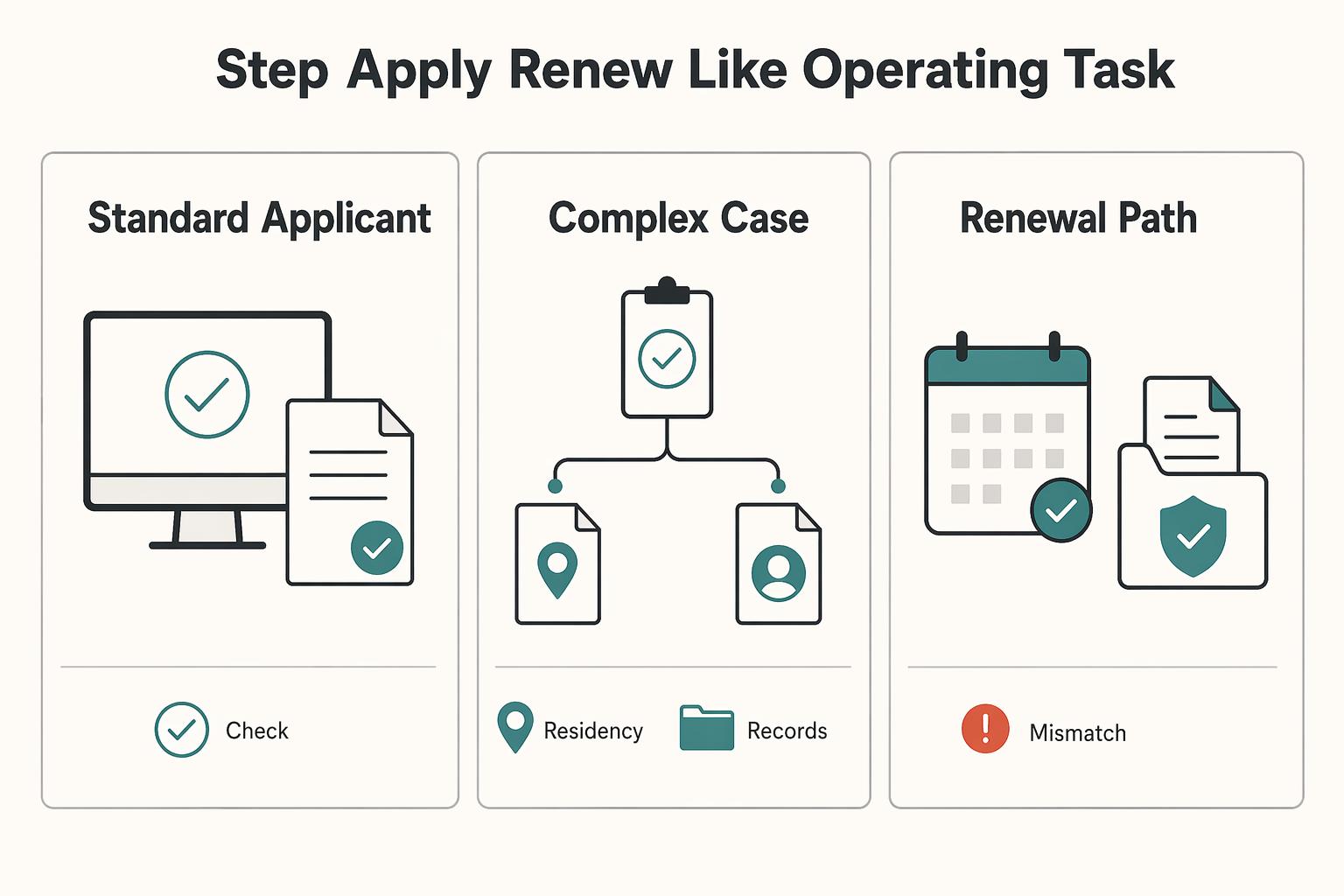
Once the work and credential lane are clear, the remaining job is operational discipline. Use one checklist, then branch by applicant type:
| Path | Who it applies to | Key details |
|---|---|---|
| Standard applicant path | Applicant with an SSN | Sign in with ID.me, gather the IRS checklist items, and use a prior-year individual return for authentication if the latest return was filed in the past 8 weeks; for 2026, the fee is $18.75 and should be verified before payment |
| Foreign applicant path | Foreign person without an SSN | Use Form 8946 to establish identity and foreign status, and provide the original or notarized documents required by that form |
| Renewal path | Existing PTIN holder | PTINs expire on Dec. 31 of the calendar year issued; next-year applications generally open in mid-October; verify current-season timing before relying on reminders |
- Standard applicant path: If you have an SSN, sign in with ID.me, gather the IRS checklist items, and use a prior-year individual return for authentication if your latest return was filed in the past 8 weeks. For 2026, the PTIN application or renewal fee is $18.75. Verify the current-season fee before payment.
- Foreign applicant path: If you are a foreign person without an SSN, use Form 8946 to establish identity and foreign status, and provide the original or notarized documents required by that form.
- Renewal path: PTINs expire on Dec. 31 of the calendar year issued, and next-year applications generally open in mid-October. Verify current-season timing before relying on reminders.
The checkpoints are straightforward. Online issuance is generally immediate after complete submission and payment, while paper processing can take 6 weeks. Save your confirmation, payment record, and form-path documents in one compliance file. For foreign applicants, include the identity-status evidence used with Form 8946.
That file is your control point. It lets you show when you applied, which path you used, and whether renewal was on time. A PTIN is not a prestige signal. It is the boundary marker for paid preparer activity in a business-of-one practice.
If you want this to stay simple year after year, treat the PTIN like any other recurring operating control. Build a standard checklist once. Keep the login path, payment record, confirmation, and supporting documents together. Set your reminders before renewal season is urgent. Verify active status before you accept paid preparer work for the year, not after the first return is already underway.
The value of that discipline is not just speed. It reduces small failures that create bigger headaches later. Losing the confirmation, forgetting which application path you used, or searching for support documents at renewal time turns a routine task into a scramble. That is avoidable if you keep one clean compliance file from the start.
The same goes for timing. Renewals are easier when you do not rely only on memory, inbox reminders, or a busy-season to-do list. Put the open season and expiration points into whatever system you already trust for recurring business tasks. Then make one last verification part of your annual kickoff for tax work: active status, current fee, and current scope. That keeps your PTIN process attached to the actual work you are taking, which is where the risk lives.
For foreign applicants, the same operating logic applies even though the branch is different. The more important your identity-status documents are to the application path, the more important it is to keep them organized, complete, and easy to retrieve. You do not want to rebuild that file from memory when a deadline is close.
If you want a deeper dive, read the digital nomad tax guide. To keep renewal and scope-change decisions from slipping, map your compliance tasks in the Tax Residency Tracker. If your preparer workflow also involves cross-border money movement, contact Gruv to confirm fit, policy requirements, and program coverage.
Frequently Asked Questions
Do I need a PTIN if I only give tax advice?
No, not if the paid work stays in advice and does not become preparing, or assisting in preparing, all or substantially all of a federal return or claim for refund. Labels like coaching or advisory do not control the outcome. If the work shifts into execution, re-scope the engagement before continuing.
What if I only review a return?
Not automatically. If paid review turns into material corrections or completion work that helps finish all or substantially all of the return, treat it as preparer activity and move into the PTIN lane. Give review engagements a clear boundary so comments do not become return-completion work.
I live outside the U.S. and do not have an SSN. What is the right branch?
For foreign persons without an SSN, the PTIN branch is Form 8946 with the required identity and foreign-status documents. Do not use Form 8946 if you have, or are eligible to get, a U.S. SSN, and a foreign preparer who resides outside the U.S. and gets a PTIN without an SSN is not authorized to prepare U.S. returns in the U.S. for compensation. If your residency or work location creates ambiguity, escalate to a qualified tax professional before proceeding.
Does a PTIN let me represent clients before the IRS?
No. A PTIN identifies you as an individual paid preparer and does not grant blanket representation rights. Form 2848 is for representation authorization, while Form 8821 only authorizes access to confidential tax information. Do not offer representation services unless your credential status clearly supports that scope.
How do I keep PTIN compliance current after I apply?
Treat PTIN compliance as a recurring control, not a one-time task. Keep one file with your confirmation, payment record, and any Form W-12 or Form 8946 support, and set reminders for renewal open season and Dec. 31 expiration. Verify active status and the current fee before taking paid preparer work each year, and re-check the setup when your engagement scope or authority lane changes.
Try a related tool
Researched and edited by the Gruv editorial team. Gruv builds cross-border billing, payouts, and finance-operations software for global businesses.
Sources
Educational content only. Not legal, tax, or financial advice.
Related Posts

Digital Nomad Taxes in 2026 With a Defensible Filing Plan
With digital nomad taxes, the first move is not optimization. It is figuring out where you may be taxable, where filings may be required, and what proof supports that position.

How to Choose a Tax Preparer for Your Freelance Business
**Choose a tax preparer for freelancers by ranking compliance controls ahead of speed and price, then shortlist only candidates who can show strong documentation habits.**

The Freelance Payment Penalty: A Modeled Audit of Platform Fees, FX Spreads, and Payout Delays
The money rarely disappears through a single, easy-to-spot fee. The real loss is stacked. A marketplace takes its commission, a processor adds a charge for international cards, a bank or payment company converts the currency at a spread, a platform holds the funds before release, and a wire sheds a little to intermediaries on the way in. Each layer looks defensible on its own, but the worker feels the combined result as a smaller deposit and a later payday.