
Quick Answer
Start by confirming, in writing, that your visa authority accepts the FBI Identity History Summary Check for your case. Then choose FBI direct or an FBI-approved Channeler based on how much delay your timeline can absorb, and log references, check dates, and escalation ownership in one tracker. Before you leave fingerprinting, verify all impressions are usable; after issuance, file DS-4194 with the exact country so legalization follows the right certificate path.
Plan the FBI clearance as three gates: acceptance, submission, legalization#
Treat the fbi police clearance for visa as a three-gate project: confirm acceptance, choose your submission path, then legalize for the exact country of use. That sequence keeps you from paying for the right document on the wrong timeline.
The FBI document is the Identity History Summary Check, and the FBI says it can support foreign living, work, or travel requirements. FBI materials also note this is not a full national-plus-state background check and is not provided for licensing or employment purposes. The visa authority still decides what it will accept, so lock that rule in writing before you submit anything.
The easiest mistake here is procedural, not legal. People start by ordering the document because it feels like progress. Then they discover later that the receiving office measured recency differently, wanted the legalized version for a different country of use, or expected a different timing sequence in the rest of the application. A simple order can turn into a reset if you do not define acceptance first.
Think about the process the way you would handle any other executive-level dependency. You do not start work because a task exists. You start once the acceptance criteria, owner, deadline, and fallback are visible. This document is the same. Your goal is not merely to obtain an FBI record. Your goal is to obtain an FBI record that is still usable, in the right form, for the right country, at the moment your visa file needs it. That is why the three gates matter:
- Gate 1: Acceptance. Confirm that the authority you will file with will accept this specific document, and capture the wording.
- Gate 2: Submission path. Decide whether FBI direct or a Channeler gives you the better recovery window for your real filing date.
- Gate 3: Legalization. Match the legalization path to the exact country of use before you submit DS-4194.
If you keep those gates in order, you reduce common preventable failures: ordering too early, ordering through a route with no visibility, losing time to weak fingerprints, or legalizing for the wrong country. If you skip the order and try to solve everything at once, the timeline becomes harder to control because one unclear assumption hides the next one.
Use the table below as your operating dashboard. It is less about paperwork than about forcing every ambiguous point into a yes, no, owner, or checkpoint before it can surprise you.
| Decision point | What to verify first | What to log | Escalate when | Fallback |
|---|---|---|---|---|
| Acceptance rule | Exact checklist line/email/official page, destination country, any recency condition | Source link or screenshot, capture date, target filing date | Requirement wording is vague or country of use is unclear | Pause and get written clarification before ordering |
| Submission path | FBI direct fee is $18; electronic submission should be faster; Channeler appears on the official FBI-approved list; additional fees may apply | Route chosen, payment proof, portal/carrier reference, next check date, escalation owner | No status movement by your checkpoint date | Escalate with FBI/Channeler immediately; switch route only before paying again |
| Legalization path | Country of use entered on DS-4194; apostille for Hague countries, authentication for non-Hague countries | Country entered, certificate type, submission date, fee paid | Country changes or certificate type is uncertain | Stop and correct DS-4194 before submission |
A useful way to read that table is this: every row is a separate decision, and every decision needs a record. If you are applying under time pressure, memory is not enough. Save the screenshot. Save the email. Save the receipt. Save the reference number. Write down the next date when you will check status. If someone else is helping you, write down who owns follow-up. That one discipline makes the process much calmer because it turns vague anxiety into a list of known checkpoints.
Another benefit of this approach is that it protects you from "almost right." In visa paperwork, "almost right" still means rework. A document ordered for the wrong timing window is not useful simply because it exists. A legalization request with the wrong country of use is not useful because the rest of the form was correct. A Channeler that looked convenient but gives poor status visibility is not convenient if you only realize there is a problem after your recovery window is gone.
This is why the sequence matters more than speed. Speed only helps after you know what you are trying to produce.
Step 1. Confirm the acceptance rule in writing#
Start by capturing proof of what the receiving authority will accept. Save the exact wording, where it came from, and when you captured it.
| Check | What to confirm | What to record |
|---|---|---|
| Accepted document | Whether the FBI Identity History Summary Check is the accepted document for your situation | The exact checklist line, official page, or email response |
| Recency timing | Whether the timing rule applies when you submit the file or when you attend the appointment | Any recency wording and the event it appears to be tied to |
| Legalization expectation | Whether the office expects the base document only or the legalized version for the filing country | Whether legalization is clearly required or still uncertain |
Do not settle for your own paraphrase. Save the exact line from the checklist, official page, or email response. If there is a downloadable checklist, keep the version you used. If the requirement appears on a website, capture the page and the date you viewed it. If the office responds by email, store that message where you can find it quickly when you assemble the file later. Once you pay and start the process, you want to be able to answer one question without guessing: what exactly am I trying to satisfy?
That written rule becomes the anchor for every later decision. It tells you whether you even need the FBI document, whether you need to care about recency, and whether legalization needs to happen before filing. Without that anchor, people often optimize the wrong thing. They focus on speed when the actual risk is recency. They focus on ordering quickly when the actual risk is that the country of use is still unsettled. They focus on obtaining the base document when the actual requirement is the legalized version.
If the wording is broad, ask directly whether they require this specific document and how recency is measured, at filing or at appointment.
That follow-up matters because broad wording creates expensive ambiguity. A checklist item that simply says "police certificate" leaves at least three practical questions open:
- Is the FBI Identity History Summary Check the accepted document for your situation?
- Does the timing rule apply when you submit the file or when you attend the appointment?
- Will the receiving authority expect the base document only, or the legalized version for the filing country?
If the office does not answer in a single clear sentence, keep the exchange going until it does. You are not being difficult. You are defining scope before you commit time and money.
A good way to keep this concise is to ask one closed question at a time. Instead of writing a long message with several assumptions mixed together, ask for confirmation in plain terms. For example, you can frame the request around the exact document name and the exact date that matters to you. The goal is not elegance. The goal is an answer you can act on.
Once you have that answer, log it in a simple tracker. At minimum, record:
- the destination country
- the visa route you are using
- the exact source of the requirement
- the date you captured the requirement
- any recency wording
- the event that recency appears to be tied to
- whether legalization is clearly required or still uncertain
This tracker does two things. First, it prevents you from reopening the same question every few days because you no longer trust your memory. Second, it gives you a clean handoff if a partner, assistant, or relocation professional is helping with the file. They can see the rule you are working from instead of guessing from partial context.
If you are still comparing countries, this is the stage where comparison is most useful. Compare acceptance rules before you compare speed. One country may have a straightforward police-certificate requirement that fits easily into your timeline, while another may create more pressure because the recency window is harder to coordinate with an appointment date. You do not need to invent a grand scoring model. You just need to avoid assuming that all "police clearance" requirements behave the same way.
Another practical point: do not let a broad country decision hide a document decision. "I'm moving abroad" is not enough. "I'm filing in a specific country under a specific visa path" is practical. "I may choose between two countries" means you may need to delay ordering until the country of use is fixed. A document can be correct in substance and still fail the process if you cannot route legalization for the exact country later.
Once acceptance is clear, you can choose the submission route with less guesswork. You may still have to choose under uncertainty, but now it is the right uncertainty. You are no longer asking, "Do I even need this?" You are asking, "Which route gives me enough visibility and recovery time to get this done?" That is a much better project-management problem.
Before you leave Step 1, run one last check against your broader application timeline. Ask yourself:
- Do I know the filing country?
- Do I know what document is accepted?
- Do I know whether recency is measured at filing or at appointment?
- Do I have written proof of the requirement?
- Do I know whether the legalized version is part of the expected file?
If any answer is no, pause here. The delay you take now is usually smaller than the delay created by ordering first and correcting later.
One more operational habit helps here: label your saved files so they make sense later. "Screenshot 4" is useless two weeks from now. "Country checklist police certificate captured June 3" is useful. The same goes for emails and receipts. You are building a record that future-you can understand under deadline pressure.
Keep one final contrast in mind:
- If the acceptance rule is clear, ordering becomes a logistics decision.
- If the acceptance rule is unclear, ordering becomes a gamble.
Most avoidable problems in this process start in Step 1 because people treat ambiguity as if it were a small detail. It is not a small detail. It is the difference between managing the process and hoping the process works out.
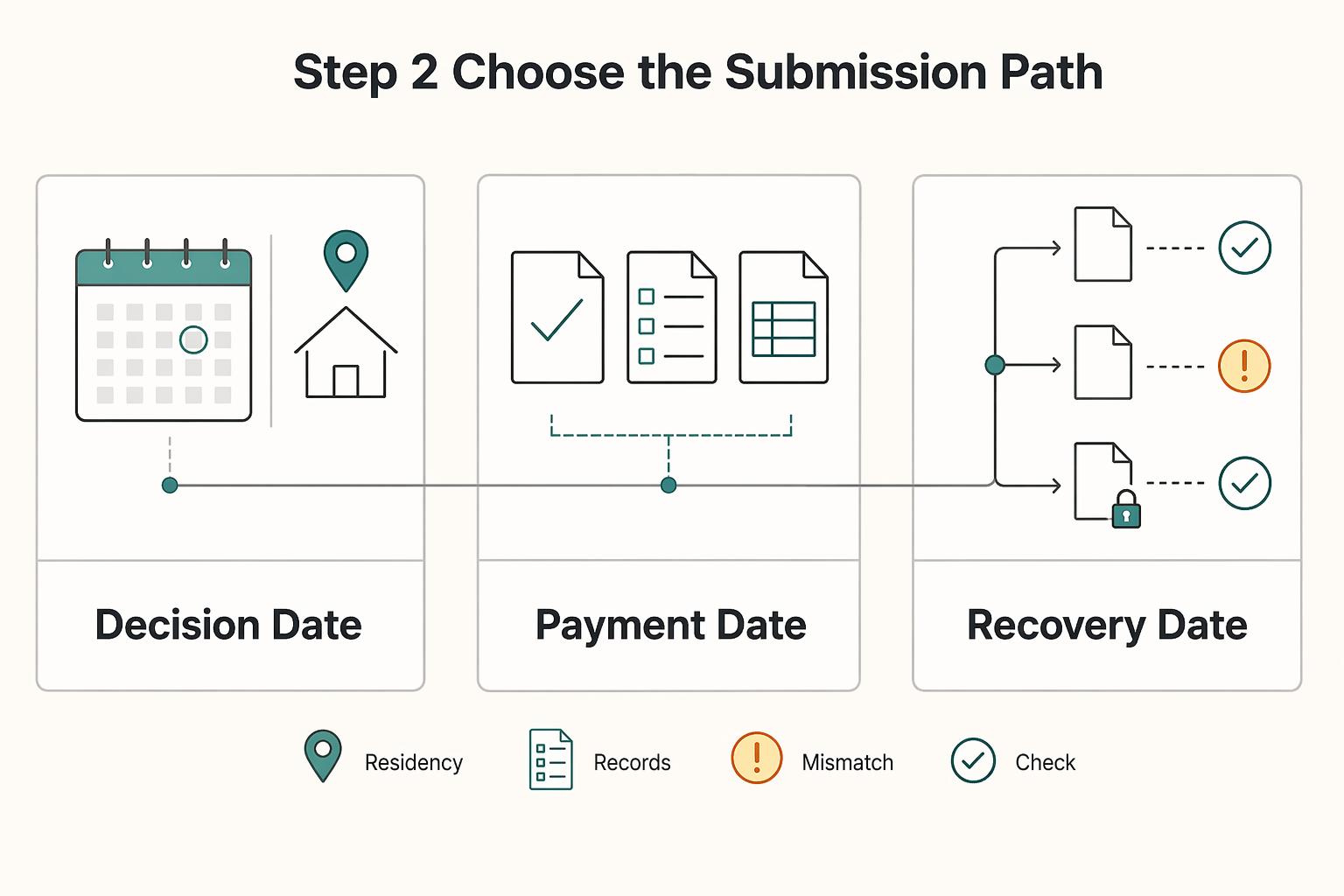
Step 2. Choose the submission path, then set a recovery date#
Choose the route by delay risk, not just sticker price. You need a path where stalls become visible early enough to recover.
| Milestone | Definition | Use |
|---|---|---|
| Decision date | The day you chose your route | Separate it from the payment date and recovery date |
| Payment date | The day the order became live | Pair it with saved payment proof |
| Recovery date | The date by which a lack of progress becomes a problem | If it passes with no status change, escalate immediately |
That is the core decision rule. People naturally compare price first because price is obvious. But for a time-sensitive visa process, visibility is often more valuable than a small savings. A cheaper route is not actually cheaper if it leaves you blind until your backup option is no longer practical. do not ask only, "What does this route cost?" Ask, "How quickly will I know if this route is drifting off plan?"
FBI direct is the baseline: $18, date-order processing, and faster results expected for electronic submissions. Some electronic options include fingerprint submission at participating U.S. Post Office locations, and additional fees may apply. If you evaluate providers, leave fee and timing fields unresolved until each item is verified against official source records.
That baseline matters because it gives you a neutral reference point. Once you know what FBI direct offers, you can evaluate whether a Channeler is actually solving your problem or simply adding another layer. For some applicants, the main issue is not speed but predictability. For others, the route needs to fit a narrow timeline and the value is in faster delivery or clearer status handling. The right choice depends on what would hurt you more: paying more up front or discovering a delay too late to recover.
Before paying a Channeler, confirm it is listed, confirm how you will see status, and confirm the escalation path. Then log the receipt, reference number, next check date, and who owns follow-up. Do those checks in that order.
First, confirm the Channeler appears on the official FBI-approved list. Do not rely on branding language or search results. If the provider is not clearly present on the official list, stop there.
Second, confirm how status will be shown. "We send updates" is not the same as knowing where you will check, what reference number you will use, and how you will tell whether the file is moving. You do not need a complicated portal to make a good decision, but you do need enough visibility to know when something has stalled.
Third, confirm the escalation path before you pay. If there is a problem, who do you contact and what information will they ask for? If you do not know that in advance, it is harder to move quickly when the checkpoint passes with no update.
At this stage, build a short operating log. A minimal version looks like this:
- route selected
- reason you chose it
- payment date
- payment proof saved
- portal or carrier reference saved
- next status check date
- escalation owner
This can live in a notes app, a spreadsheet, or your broader visa tracker. The format matters less than the discipline. The moment you pay, the task should stop being mental and become visible.
After you choose the route, the next avoidable delays usually come from fingerprints and legalization. That sentence is easy to skim past, but it gives you your next project move: as soon as the submission path is set, prepare the quality gate behind it. Do not wait for a stall to start thinking about fingerprints, and do not wait for issuance to start thinking about legalization. The strongest project rhythm here is overlap without confusion: finish the route decision, then prepare the next gate before it can become urgent.
A recovery date is what makes this workable. A recovery date is not the final deadline. It is the date by which you expect enough movement to stay comfortable on your timeline. If that date passes with no status change, you escalate immediately rather than reassuring yourself for another week.
For example, if your route should be moving and your next check date arrives with no status movement, that is your signal. Do not downgrade the issue because you are busy with other parts of the visa file. A police certificate delay tends to become more painful, not less, because other application pieces often depend on the same filing window.
The same logic applies if you are using a Channeler. "No news" is not neutral once you hit your checkpoint. If the provider gave you a reason to expect progress or visibility by that date, use the escalation path. Ask the narrowest question possible: what is the current status, and what is the next expected movement? You are trying to re-establish control, not start a long debate.
One of the most useful habits here is to separate decision date, payment date, and recovery date in your tracker. Those are different milestones:
- Decision date: the day you chose your route
- Payment date: the day the order became live
- Recovery date: the date by which a lack of progress becomes a problem
Why does that matter? Because people often remember only the payment date and then rely on vague impressions about whether enough time has passed. A recovery date removes that vagueness. You know in advance when to act.
Here is the discipline that keeps you from creating duplicate work: switch route only before paying again. The fallback in the table says exactly that for a reason. If you panic late and start a second route without understanding the status of the first, you can spend more money without solving the underlying timing problem. A better sequence is:
- confirm that your checkpoint has actually been missed
- escalate with the current provider immediately
- decide whether the issue is visibility, delay, or an unresolved input problem
- switch routes only if you are comfortable paying again and the second route still helps
That last condition matters. A second route is only useful if it can still change the outcome.
As you evaluate the route, keep your notes factual. For example, avoid writing "fast" when what you really mean is "faster results expected for electronic submissions." Avoid writing "cheap" when what you really mean is "FBI direct fee is $18." Concrete wording is better because it reflects the real basis of the decision and makes later review easier.
This is also where placeholders protect you from accidental misinformation. If you are comparing providers and have not yet verified a fee or a current processing note, do not fill the gap with memory or a stale screenshot. Use placeholders until verified:
- Current fee pending official source verification
- Current processing note pending official source verification
Once the route is chosen, move directly into execution mode. That means you should be ready for the fingerprint step, because a strong submission plan can still lose time if the fingerprint quality is weak or incomplete. In project terms, Step 2 is where people think they have "ordered the thing," but the real work is making sure every downstream dependency is ready.
A good way to pressure-test your Step 2 decision is to ask yourself three blunt questions:
- If there is no status movement by my checkpoint date, do I know exactly who I will contact?
- If I need to explain the route choice later, can I point to a clear reason other than habit or convenience?
- If the route takes longer than I hoped, is there still time in the overall visa plan to absorb that delay?
If you cannot answer those questions, the route may not be wrong, but it is under-managed.
Another practical contrast helps here:
- Price-first choice: you select a route because the fee is lower, then hope the timing works.
- Recovery-first choice: you select a route because you can see problems early enough to act.
For a strict filing timeline, the second approach is usually the safer one because it gives you a decision point before the deadline becomes critical.
Also remember that the submission path does not exist in isolation. It interacts with the rest of your application schedule. If you are coordinating other visa documents, Step 2 is the moment to line up dependencies rather than treating the FBI clearance as a side task. Add it to the same checklist as the rest of the file and note what other steps should not be triggered until the acceptance rule and route are stable. That keeps one document from quietly becoming the blocker while you are busy elsewhere.
Finally, treat silence as data. If you expected movement and did not get it, that is not a reason to wait passively. It is a reason to use the escalation path you already logged. The whole point of setting a recovery date is to remove hesitation when the plan stops matching reality.
Step 3. Treat fingerprints and legalization as hard quality gates#
Fingerprint quality is a go or no-go gate. The FBI checklist requires all 10 rolled impressions and plain impressions, including both thumbs, so review the prints before you leave and redo weak impressions on the spot.
| Lane | Timing | Notes |
|---|---|---|
| Travel in 5+ weeks | $20 per document | |
| Walk-in drop-off or pick-up | Travel in 2 to 3 weeks | Processed in seven business days; $20 per document |
| Less-than-2-weeks lane | Less than 2 weeks | May qualify only under emergency appointment criteria; $20 per document |
This is one of the most practical lines in the process because it tells you exactly where preventable rework often starts. If you treat fingerprinting as a quick errand, you can lose time that no later "expedite" choice fully fixes. If you treat it as a quality gate, you give yourself the best chance of keeping the rest of the timeline intact.
The key discipline is to review before you leave. Do not assume that because prints were taken, the step is finished. The checklist requirement is specific enough to support an immediate review: all 10 rolled impressions and plain impressions, including both thumbs. That means you should pause and make sure the set is complete and usable before you walk out. If something looks weak, redo it while you are still there rather than discovering the issue later when your options are narrower.
The broader lesson is that quality checks belong at the edge of the task, not after the fact. In a project setting, the cheapest moment to correct a defect is usually the moment you can still see it and fix it without reopening the whole process. Fingerprints are a perfect example of that rule.
After issuance, legalize the document for the exact destination country. The State Department requires Form DS-4194, and the country of use determines the certificate type: apostille for Hague countries, authentication for non-Hague countries.
That sentence carries more operational weight than it first appears to. "Exact destination country" means exactly that. Do not treat the country field as a minor administrative detail to fill in later from memory. The country of use determines the certificate type, so if the country changes, the path may change. That is why the draft's fallback is strong: if the country of use changes, stop and correct the legalization path before filing.
legalization is not a generic finishing step. It is a country-specific step. A mismatch here does not become less serious because the base FBI document is otherwise correct.
A clean way to manage this is to create a small legalization checklist as soon as the FBI document is issued:
- confirm the country of use one more time
- confirm the certificate type that follows from that country
- complete DS-4194 with the exact country
- log the submission date
- log the fee paid
- keep a copy of what you submitted
This checklist is short by design. The point is not to make the process feel heavier. The point is to create one final verification layer before you commit the document to the legalization lane.
Plan timing from posted lanes, not assumptions: mail for travel in 5+ weeks; walk-in drop-off or pick-up for travel in 2 to 3 weeks, processed in seven business days; and a less-than-2-weeks lane that may qualify only under emergency appointment criteria. Fee is $20 per document. If the country of use changes, stop and correct the legalization path before filing.
This timing guidance is especially useful because it keeps people from making casual assumptions like "legalization is just a quick final step." It may not be. The posted lanes are the planning baseline, so build your calendar from them rather than from optimism. If you need the legalized document for a filing target, work backward from that target using the lane that actually matches your situation.
The project-management move here is to separate issuance timing from legalization timing. Receiving the FBI document is not the same as being ready to file the visa packet if legalization is still required. That distinction sounds obvious, but it is a common planning error. People feel relief when the underlying document arrives and mentally treat the task as complete, even though the document still needs to move through the correct State Department path for the country of use.
A practical timeline mindset looks like this:
- the FBI clearance is one deliverable
- the legalized FBI clearance is a second deliverable
- only the second one may be usable for your filing
When you think in those terms, Step 3 stops being an afterthought and becomes part of the main schedule.
The "hard quality gate" idea applies just as much to DS-4194 as it does to fingerprints. Once the form is prepared, check the country of use again before submission. Do not assume that your destination has remained fixed simply because it was fixed last week. If you are deciding between locations, changing visa paths, or coordinating with someone else, that single field deserves a final review.
A strong operational habit is to ask yourself two yes-or-no questions right before filing DS-4194:
- Is the country of use exactly the country where this document will be used?
- Does the certificate type match that country?
If you are not sure, do not submit and hope the rest of the packet carries you through. Pause and correct it.
Another helpful distinction is between quality failure and timing failure:
- A quality failure happens when the fingerprints are weak or incomplete, or the legalization request does not match the country of use.
- A timing failure happens when you planned from assumptions instead of posted lanes, or when you did not leave enough room for recovery.
Most stressful situations come from a combination of both. For example, a delayed route can still be manageable if the fingerprints were strong and the country of use was stable. But a delayed route plus weak fingerprints plus a late country change can compress the schedule quickly. That is why Step 3 is not just "paperwork." It is the stage where you protect the schedule from avoidable quality problems.
You can also use brief scenario contrasts to keep the sequencing straight:
- Good sequence: confirm country of use, obtain the FBI document, enter the exact country on DS-4194, submit through the right legalization path.
- Bad sequence: obtain the FBI document, assume the country detail can be fixed later, prepare DS-4194 from memory, notice the destination changed after submission.
The facts have not changed between those two scenarios. Only the sequence has changed. But sequence is often what determines whether the document remains usable on time.
If you are managing this while also handling the rest of a visa application, treat legalization as a separate line item in your tracker, not as a sub-note beneath "FBI clearance." Give it its own status, date, and owner. That keeps the task visible long enough to finish properly.
One more practical point: when you log the fee, the country, and the submission date, you are creating an audit trail for yourself. That matters if you need to answer a simple but important question later: "What exactly did I submit, for which country, and when?" Those are the kinds of details that become surprisingly hard to reconstruct from memory under deadline pressure.
If there is one theme to Step 3, it is that both fingerprints and legalization deserve immediate verification. Do not assume completeness. Check completeness. Do not assume the country field is obvious. Verify the country field. Do not assume timing will work itself out. Build from posted lanes. These are small actions, but together they turn a fragile process into a controlled one.
Can I use an FBI-approved Channeler instead of applying directly?#
Yes, if the provider appears on the official FBI-approved list. The FBI describes Channelers as helping expedite delivery, but fees and support terms differ by provider, and additional fees may apply. Before payment, verify the current fee, how status is shown, and what the escalation steps are.
The practical reason to slow down here is that "approved" and "useful for your timeline" are not the same thing. Approval answers one question: whether the provider appears on the official list. It does not answer the follow-up questions that matter when you are project-managing the document for a visa file. You still need to know what you will pay, how you will monitor progress, and what happens if the process stops moving when you expected it to move.
A clean decision process looks like this:
- confirm the provider is on the official FBI-approved list
- verify the current fee directly
- verify how status is shown
- verify what the escalation path is
- decide whether that combination fits your filing timeline better than FBI direct
That sequence keeps you from making the decision on marketing language or convenience alone.
Status visibility matters more than people expect. If your visa timeline is tight, you need a way to know whether you are on track before the deadline is at risk. That does not necessarily mean one provider is always better. It means you should choose based on what information you will have and when you will have it. A route that feels easier at checkout can feel much harder later if you cannot tell whether anything is happening.
The same goes for support. "Support exists" is not enough. What you need is a usable escalation path. If your checkpoint date passes without movement, you want to know exactly how to contact the provider and what reference information you will need. That is why it helps to save the receipt and reference number immediately and keep them with your tracker instead of buried in an inbox.
It is also worth separating the decision to use a Channeler from the decision to rush. A Channeler can be the right operational choice even if your schedule is not compressed, simply because you prefer the route's visibility or handling. And FBI direct can be the right choice even if you care about timing, if it fits your window and you are comfortable with the process. The right question is not "Which route do other people pick?" The right question is "Which route gives me the clearest path to a usable document on my actual timeline?"
If you compare routes, avoid mixing verified facts with placeholders. Where you have confirmed information, log it. Where you have not, leave the placeholder in place until verified. That keeps your comparison honest and keeps you from making a decision based on half-remembered details.
One final decision rule can save money and confusion: make the route choice once, monitor it against your recovery date, and escalate promptly if needed. Do not drift into repeated second-guessing after payment. Post-payment anxiety is normal, but unmanaged anxiety often leads to duplicate actions rather than better actions.
Do I need an apostille or an authentication certificate?#
It depends on where you will use the document. Hague-country use requires an apostille, and non-Hague-country use requires an authentication certificate. Enter the exact country on DS-4194 so the legalization path matches your filing destination.
The operational point is straightforward: the certificate type follows the country of use, not your preference, not a general region, and not the fact that the underlying FBI document is the same. That is why the country entry on DS-4194 deserves more attention than it sometimes gets. It is not just a label. It directs the legalization path.
If your destination is already fixed, this step should be simple: confirm the exact country, then make sure the certificate type aligns with that country before submission. If your destination is still unsettled, that uncertainty matters. It is usually better to resolve the country first than to push ahead and hope the path can be adjusted later without cost or delay.
This is also why broad language like "I'm going abroad" is not enough for legalization. Legalization is country-specific. The clean input is the exact country where the document will be used.
A simple way to avoid mistakes is to treat DS-4194 as the last place where you verify, not the first place where you decide. In practice, that means:
- you already know the country of use before you start the form
- you already know which certificate type follows from that country
- you check both again before submitting
That sequence is more reliable than using the form itself to think through the decision while you fill it out.
If the country changes, the safest response is the one already built into the draft: stop and correct the legalization path before submission. Do not assume that because the underlying FBI record is unchanged, the legalization details can remain unchanged too. The whole point of Step 3 is to align the final document form with the exact place it will be used.
I'm applying to Germany. What should I verify first?#
Start with Germany's current acceptance wording and recency expectation before you choose submission speed or legalization timing. Then align your checklist with your visa path so the police-certificate step does not block the rest of the file. If your route is a freelance or self-employment path, Germany Freelance Visa: A Step-by-Step Application Guide is a useful way to map that document against the rest of the filing sequence.
Resist solving the wrong problem first. If you begin by chasing the fastest route before you know Germany's current acceptance wording and recency expectation, you are optimizing logistics before you have locked the rule. That can leave you with a document that arrived quickly but fits poorly into the actual filing sequence.
A better order is:
- capture Germany's current acceptance wording
- confirm how recency is being measured for your filing
- map that requirement onto your visa path
- only then choose the submission route and legalization timing
That fourth step matters because timing is not abstract. It depends on where the police certificate sits in your broader Germany application flow. If the certificate is one of several items that need to converge at a filing point, then your real planning job is not simply "get the FBI document." It is "get the FBI document at the moment it can move with the rest of the file without forcing rework."
This is where the project-management approach pays off. Once the rule is captured, you can place the police-certificate task into the broader checklist instead of letting it float as a separate errand. That helps you see whether the document is on the critical path or whether another application step is actually the pacing item. In either case, you avoid the common problem of treating one document in isolation and only later discovering that the sequence did not line up.
If Germany is your destination, the practical first move is still the same as anywhere else: get the acceptance rule in writing, log it, and plan from that written rule rather than from memory or forum-style summaries. Once you do that, the rest of the process becomes much easier to manage.
Frequently Asked Questions
Can I use an FBI-approved Channeler instead of applying directly?
Yes, if the provider appears on the official FBI-approved list. The FBI describes Channelers as helping expedite delivery, but fees and support terms differ by provider, and additional fees may apply. Before payment, verify the current fee, how status is shown, and what the escalation steps are. The practical reason to slow down here is that "approved" and "useful for your timeline" are not the same thing. Approval answers one question: whether the provider appears on the official list. It does not answer the follow-up questions that matter when you are project-managing the document for a visa file. You still need to know what you will pay, how you will monitor progress, and what happens if the process stops moving when you expected it to move. A clean decision process looks like this: confirm the provider is on the official FBI-approved list verify the current fee directly verify how status is shown verify what the escalation path is decide whether that combination fits your filing timeline better than FBI direct That sequence keeps you from making the decision on marketing language or convenience alone. Status visibility matters more than people expect. If your visa timeline is tight, you need a way to know whether you are on track before the deadline is at risk. That does not necessarily mean one provider is always better. It means you should choose based on what information you will have and when you will have it. A route that feels easier at checkout can feel much harder later if you cannot tell whether anything is happening. The same goes for support. "Support exists" is not enough. What you need is a usable escalation path. If your checkpoint date passes without movement, you want to know exactly how to contact the provider and what reference information you will need. That is why it helps to save the receipt and reference number immediately and keep them with your tracker instead of buried in an inbox. It is also worth separating the decision to use a Channeler from the decision to rush. A Channeler can be the right operational choice even if your schedule is not compressed, simply because you prefer the route's visibility or handling. And FBI direct can be the right choice even if you care about timing, if it fits your window and you are comfortable with the process. The question to settle is "Which route gives me the clearest path to a usable document on my actual timeline?" If you compare routes, avoid mixing verified facts with placeholders. Where you have confirmed information, log it. Where you have not, leave the placeholder in place until verified. That keeps your comparison honest and keeps you from making a decision based on half-remembered details. One final decision rule: make the route choice once, monitor it against your recovery date, and escalate promptly if needed. Do not drift into repeated second-guessing after payment, which tends to produce duplicate actions rather than better ones.
Do I need an apostille or an authentication certificate?
It depends on where you will use the document. Hague-country use requires an apostille, and non-Hague-country use requires an authentication certificate. Enter the exact country on DS-4194 so the legalization path matches your filing destination. The operational point is straightforward: the certificate type follows the country of use, not your preference, not a general region, and not the fact that the underlying FBI document is the same. That is why the country entry on DS-4194 deserves more attention than it sometimes gets. It is not just a label. It directs the legalization path. If your destination is already fixed, this step should be simple: confirm the exact country, then make sure the certificate type aligns with that country before submission. If your destination is still unsettled, that uncertainty matters. It is usually better to resolve the country first than to push ahead and hope the path can be adjusted later without cost or delay. This is also why broad language like "I'm going abroad" is not enough for legalization. Legalization is country-specific. The clean input is the exact country where the document will be used. A simple way to avoid mistakes is to treat DS-4194 as the last place where you verify, not the first place where you decide. In practice, that means: you already know the country of use before you start the form you already know which certificate type follows from that country you check both again before submitting That sequence is more reliable than using the form itself to think through the decision while you fill it out. If the country changes, the safest response is the one already built into the draft: stop and correct the legalization path before submission. Do not assume that because the underlying FBI record is unchanged, the legalization details can remain unchanged too. The whole point of Step 3 is to align the final document form with the exact place it will be used.
I'm applying to Germany. What should I verify first?
Start with Germany's current acceptance wording and recency expectation before you choose submission speed or legalization timing. Then align your checklist with your visa path so the police-certificate step does not block the rest of the file. The key is to resist solving the wrong problem first. If you begin by chasing the fastest route before you know Germany's current acceptance wording and recency expectation, you are optimizing logistics before you have locked the rule. That can leave you with a document that arrived quickly but fits poorly into the actual filing sequence. A better order is: capture Germany's current acceptance wording confirm how recency is being measured for your filing map that requirement onto your visa path only then choose the submission route and legalization timing That fourth step matters because timing is not abstract. It depends on where the police certificate sits in your broader Germany application flow. If the certificate is one of several items that need to converge at a filing point, then your real planning job is not simply "get the FBI document." It is "get the FBI document at the moment it can move with the rest of the file without forcing rework." This is where the project-management approach pays off. Once the rule is captured, you can place the police-certificate task into the broader checklist instead of letting it float as a separate errand. That helps you see whether the document is on the critical path or whether another application step is actually the pacing item. In either case, you avoid the common problem of treating one document in isolation and only later discovering that the sequence did not line up. If Germany is your destination, the practical first move is still the same as anywhere else: get the acceptance rule in writing, log it, and plan from that written rule rather than from memory or forum-style summaries. Once you do that, the rest of the process becomes much easier to manage.
Try a related tool
Researched and edited by the Gruv editorial team. Gruv builds cross-border billing, payouts, and finance-operations software for global businesses.
Sources
- fbi.gov/how-we-can-help-you/more-fbi-services-and-in...trusted
- fbi.gov/how-we-can-help-you/more-fbi-services-and-in...trusted
- forms.fbi.gov/cjis-ucr/identity-history-summary-checks-rev...trusted
- forms.fbi.gov/cjis-ucr/identity-history-summary-checks-reviewtrusted
- travel.state.gov/content/travel/en/replace-certify-docs/authe...trusted
Educational content only. Not legal, tax, or financial advice.
Related Posts

The 2026 Global Digital Nomad Visa Index for 50+ Countries
Start with legal fit, not lifestyle filters. The practical order is simple: choose a route you can actually document, then decide where you want to live. That single change cuts a lot of wasted comparison work and stops you from falling in love with places that were never a real filing option.

Germany Freelance Visa Application Path for Freiberufler and Gewerbe
Choose your track before you collect documents. That first decision determines what your file needs to prove and which label should appear everywhere: `Freiberufler` for liberal-profession services, or `Selbständiger/Gewerbetreibender` for business and trade activity.
How to Obtain a Police Clearance Certificate for a Long-Stay Visa Application
A police clearance mismatch can slow your case, leave your file incomplete, or trigger rejection where document rules are strict. In U.S. workflows, police records are routine in immigrant civil-document packages but not routinely required in nonimmigrant cases. For visa use, treat the police certificate as a civil document from the exact government authority named in your destination program instructions. Do not treat it as just any criminal record printout.