
Global professionals often face high withholding taxes and payment delays from Indian clients, making a Permanent Account Number (PAN) a business necessity rather than an option. The core advice is to treat the application as a strategic project, focusing on meticulous preparation—primarily ensuring exact name consistency across all documents and securing the correct international attestation (Apostille)—to prevent common rejections. By obtaining a PAN, you gain financial control through lower tax rates, improve cash flow, and establish a compliant presence that unlocks long-term business opportunities in the Indian market.
The Global Professional's PAN Project Plan: A Framework for Securing Your Indian Business Presence#
Like any well-managed project, our framework begins not with paperwork, but with a strategic brief. The goal is to move from a reactive state of uncertainty to a proactive position of control by identifying precisely when obtaining a Permanent Account Number (PAN) shifts from a "nice-to-have" to a business necessity. Getting this right prevents future payment delays and compliance headaches, transforming the process from a bureaucratic task into a strategic action.
Phase 1: The Strategic Brief — When a PAN Becomes a Business Necessity#
Securing a PAN isn't a reactive task you perform when a client suddenly demands it; it's a proactive business decision. A PAN is a unique ten-digit alphanumeric identifier from the Indian Income Tax Department, essential for tracking financial transactions. For a foreign national, this Indian tax ID becomes critical when triggered by specific commercial events.
Mapping the Triggers#
The most significant trigger you will encounter is India's Tax Deducted at Source (TDS) mechanism. Think of TDS as a form of advance tax payment. Your Indian client is legally obligated by Section 195 of the Income Tax Act to withhold a portion of your payment and remit it directly to the government.
Here’s the critical point: without a PAN, the default TDS rate applied to your earnings can be 20% plus applicable surcharges. With a PAN, however, you may be able to take advantage of lower rates stipulated in the Double Taxation Avoidance Agreement (DTAA) between India and your country of residence. This single factor can have a substantial impact on your immediate cash flow. There is no minimum payment threshold; TDS applies from the very first rupee your income becomes taxable in India.
The Contract Clause Litmus Test#
You can often predict the need for a PAN long before your first invoice is due by scrutinizing your client contracts. Learning to spot these signals allows you to begin the application process using Form 49AA—the correct form for foreign citizens—well in advance.
Look for clauses that include phrases like:
- "All payments are subject to the deduction of applicable taxes as per the Income Tax Act, 1961."
- "Vendor shall be responsible for compliance with all Indian taxation laws."
- "Payments will be made net of any statutory deductions, including Tax Deducted at Source (TDS)."
When you see this language, it’s a clear indicator that your client’s finance department will require a PAN to process your payments correctly and at the most favorable withholding tax rate.
PAN vs. Intermediary: A Cost-Benefit Analysis#
For smaller, one-off projects, using an intermediary service like an Employer of Record (EOR) can seem tempting. This is a valid short-term strategy, but it’s crucial to weigh the trade-offs against the long-term benefit of securing your own PAN.
| Factor | Using an Intermediary / EOR | Securing Your Own PAN |
|---|---|---|
| Upfront Cost & Effort | Low. Minimal paperwork for you; faster market entry. | Higher. Requires meticulous documentation (Form 49AA, attestations) and time. |
| Ongoing Cost | High. Typically a percentage of your monthly invoice or a significant flat fee. | None. A one-time application fee. |
| Control & Client Relationship | Lower. The EOR is the legal entity contracting with your client, which can distance your direct relationship. | Full. You contract directly as an independent professional, building your own brand equity. |
| Future Opportunities | Limited to the EOR's framework. Each new client may require a new arrangement. | Unlocks the entire Indian market. You can seamlessly engage with any number of clients directly. |
| Compliance Burden | Outsourced. The EOR manages TDS, payroll, and statutory filings. | Your responsibility. You must understand your obligations (though a PAN simplifies TDS). |
For a foreign national planning more than a single, brief engagement in India, the strategic benefits of owning your own PAN almost always outweigh the initial convenience of an intermediary. It establishes you as a serious, independent professional ready for long-term engagement.
Phase 2: The Pre-Flight Checklist — De-Risking Your Application#
Having established the strategic imperative, we now shift to execution. The primary source of anxiety in this process isn't complexity, but the fear of a simple, avoidable error leading to rejection. This phase is your risk mitigation framework, a meticulous pre-flight check designed to eliminate the most common points of failure before your application even leaves your desk.
The Name Consistency Audit#
This is the single most critical step. The number one reason for the rejection of a Form 49AA application is a name mismatch. The Indian tax authorities' verification process is automated and unforgiving; even the smallest deviation will flag your file.
- Action: Before you sign anything, perform a character-by-character audit. Place your passport, your proof of address, and your application side-by-side. Your name must be 100% identical across all three.
- Common Pitfalls:
- No Initials: If your passport says "John Albert Smith," do not write "John A. Smith."
- No Abbreviations: "William" cannot be abbreviated to "Wm."
- Full Match Required: Every part of your name must be present and spelled identically.
Meeting the Attestation or Apostille Requirement#
This is the most frequently mishandled part of the compliance puzzle. A simple notarization from your local notary public is not sufficient and will be rejected. You need a specific type of certification depending on your country of residence:
- Apostille: If you reside in a country that is a signatory to the Hague Apostille Convention of 1961 (this includes the US, UK, Australia, and most of Europe), your supporting documents must be certified with an Apostille by a competent authority in your country.
- Consular/Embassy Attestation: If your country is not a Hague Convention member, you must have your documents attested by the Indian Embassy or High Commission in your country.
- Critical Exemption: Individuals holding a valid Person of Indian Origin (PIO) or Overseas Citizen of India (OCI) card are typically exempt from this requirement when submitting a copy of that card as proof.
The "Proof of Address" Stress Test#
Your proof of address document must be current, clear, and consistent with your application. A foreign bank account statement is a common choice, but it must be recent (typically less than six months old) and clearly show your name and the foreign address you listed on Form 49AA. Credit card statements are generally not accepted.
To ensure you have a valid document, consider these strong alternatives:
| Document Type | Key Requirements |
|---|---|
| Copy of Passport | Must contain your address. |
| OCI/PIO Card | Must contain your address. |
| Bank Account Statement | From your country of residence or an NRE/NRO account in India. |
| Recent Utility Bill | Landline phone, electricity, or gas bill showing your name and address. |
| Foreigner Registration Certificate | If you are residing in India, a certificate showing your Indian address is acceptable. |
Phase 3: Execution & Tracking — Managing the Process with Confidence#
With your meticulously prepared documents sent, the project enters a new phase that can feel like a powerless waiting game. By treating this stage with the same strategic rigor as the preparation, you can demystify the process, manage expectations, and maintain complete control.
Choosing Your Courier: A Deliberate Business Decision#
Using standard international post is a false economy. The risk of loss and lack of detailed tracking are unacceptable. View the use of a reputable international courier like DHL or FedEx as a non-negotiable project expense. They provide end-to-end tracking, proof of delivery, and expertise in navigating Indian customs—a vital piece of your project documentation.
Decoding the Tracking Portal Status#
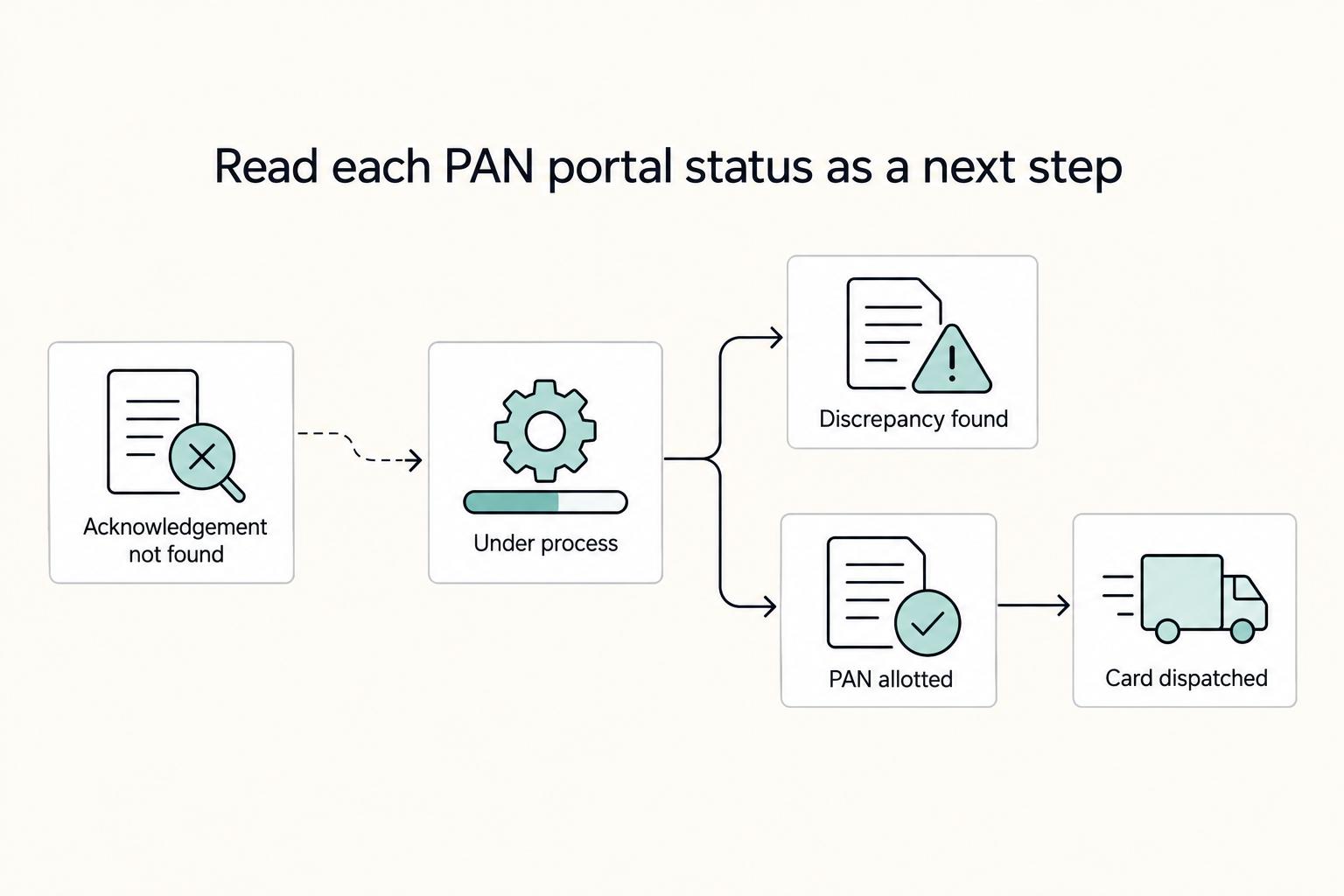
Once your courier confirms delivery, you can track your application on the websites of the processing agencies (Protean or UTIITSL) using the 15-digit acknowledgement number from your online submission. The status messages can be opaque; here is what they mean:
| Portal Status Message | Translation & Required Action |
|---|---|
| Acknowledgement Number Not Found | Your documents have arrived but are not yet scanned into the system. Action: Wait 24-48 hours and check again. This is normal. |
| Application is under process | Your application is in the queue and being reviewed. This is a standard waiting period. Action: No action required. Be patient. |
| Discrepancy found / Application is pending... | An issue has been identified, often related to the document mismatches or attestation errors we worked to prevent. Action: Act immediately. The agency will email you with details. Follow the instructions to rectify the error. |
| PAN allotted and sent for printing | Success. Your application has been approved and a PAN has been assigned. Action: You will typically receive a digital copy (e-PAN) via email within a few days. |
| PAN card dispatched by Post | Your physical card is on its way to your foreign address via international post. Action: Monitor the tracking, if provided, and anticipate its arrival. |
Setting Realistic Timelines#
Managing your own expectations—and those of your Indian clients—is crucial. Based on current processing, budget for a total of 4 to 6 weeks from the day you send your documents to the day you hold the physical card. This includes international transit, processing, and final delivery.
Phase 4: Post-Acquisition Protocol — Your "What's Next" Roadmap#
Receiving your PAN card is not the end of the project; it's the beginning of your compliant presence in India. This protocol addresses the next steps, cementing your position as a prepared global professional.
Immediate Next Steps: Activation and Verification#
Your first action upon receiving your PAN is to verify its status on the official Indian Income Tax e-Filing portal (incometax.gov.in). Use the "Verify Your PAN" service on the homepage. You will need your PAN, full name, and date of birth. A successful verification will confirm that your card is active in the government's database.
Linking PAN to Your Indian Bank Account (NRE/NRO)#
If you have or plan to open an Indian bank account (such as an NRO or NRE account), linking your PAN is mandatory. Banks require it for nearly all significant financial transactions. Failing to do so can lead to higher TDS rates on interest income and restrictions on transactions.
Understanding Your New Tax Filing Obligation#
This is a critical point of clarity: possession of a PAN card does not automatically mean you owe taxes in India. Your tax liability is determined by your residential status (based on physical presence in India) and the source of your income. As a non-resident, your liability is generally restricted to income that you earn or that accrues in India. Double Taxation Avoidance Agreements (DTAA) between India and your home country can also significantly impact your final obligations. Once you begin earning income from India, it is wise to consult with a Chartered Accountant who specializes in cross-border taxation.
Safeguarding Your PAN#
Finally, treat your PAN with the same security as your passport. It is a sensitive and permanent financial identifier. Store the physical card securely and share the number only with legitimate entities that require it for financial or tax purposes, such as your bank, clients, and the Income Tax Department.
Conclusion: You Are Now in Control#
You began this process facing a bureaucratic requirement that felt complex and opaque. By executing this project plan, you have fundamentally changed your position. You have navigated the process not as a passive applicant, but as the strategic CEO of your Business-of-One.
Every step was a deliberate act of risk mitigation. The meticulous name audit, the mastery of the Apostille requirement, and the choice of a secure courier were all acts of control. This wasn't about filling out a form; it was about executing a strategy.
Your PAN card is far more than a ten-digit code. It is the official instrument that enables your financial engagement with one of the world's most dynamic economies. It is the key that unlocks smoother transactions, proper tax compliance, and the ability to seize future opportunities without hesitation. You didn't just acquire an Indian tax ID; you secured a foundational piece of your professional infrastructure. You've done the work with the diligence and foresight that defines a true global professional. You are now in control.
PAN Application Timeline and Cost Control Table#
Operationally, verify each milestone against the Income Tax portal, Protean PAN process notes, and UTIITSL channel guidance. This reduces avoidable rework when foreign founders submit identity and address packets.
| Milestone | Expected Time Window | Primary Failure Point | Control Step |
|---|---|---|---|
| Document prep | 2-5 business days | Name mismatch across passport and forms | Run a one-page identity consistency check before submission |
| Application submission | 1 business day | Incorrect applicant category | Validate residency status and applicant type before payment |
| Processing and tracking | 7-15 business days | Unclear status interpretation | Assign one owner to monitor portal updates daily |
| Post-issuance activation | 1-3 business days | Bank KYC mismatch | Use exact PAN data in banking and tax profile setup |
Cross-Border Founder Checklist for 2026#
When budgeting your setup, document numeric guardrails in your memo: cap courier and admin overhead at $75 per filing cycle, reserve $150 for notary and document handling, and keep a 2026 escalation budget of $300 for corrections.
What is the fastest way to avoid PAN rejections for foreign applicants?#
Run a pre-submit identity check across passport, address proof, and form fields. Most avoidable rejections come from spelling or format mismatches, not from complex tax analysis.
Do remote founders need an internal SOP before applying?#
Yes. Link your file-control process in document naming SOP, your onboarding workflow in offer-letter controls, and your operations routing in platform/process stack planning.
Frequently Asked Questions
How long does it take for a foreigner to get a PAN card in India?
Plan for a total of 4 to 6 weeks from the day you mail your physical documents. This timeline accounts for international courier time (5-7 business days), document processing in India (2-3 weeks), and the final delivery of the physical card to your foreign address (2-3 weeks).
What is the most common reason a foreigner's PAN application is rejected?
The most frequent reasons are preventable. The top two are: 1. Improper Document Attestation: Providing a standard notarization instead of the required Apostille (for Hague Convention countries) or Indian Embassy/Consulate attestation. 2. Mismatches in Details: Even minor discrepancies between the name on your application form and your supporting documents (passport, proof of address) will trigger a rejection.
Do I need an Indian address or phone number to apply?
No. Form 49AA is specifically designed for foreign nationals applying from abroad. You must provide your foreign residential address for communication and delivery of the card, along with your foreign mobile number (including the country code).
Does getting a PAN card mean I have to pay taxes in India?
No. Possessing a PAN does not automatically create a tax liability. Your requirement to pay taxes is determined by your residential status and the source of your income. The PAN is the instrument that enables compliance; it is not the trigger for the liability itself.
Can I complete the entire PAN card application process online?
No. This is a common misconception. The process is hybrid. You begin by submitting Form 49AA online, but you must then print the generated acknowledgment, affix photos, sign it, and physically mail it along with attested copies of your documents to the designated processing center in India. Your application is incomplete until this physical package is received.
What is the fastest way to avoid PAN rejections for foreign applicants?
Complete a strict identity and format consistency check before submission, with one owner responsible for final verification.
Do remote founders need an internal SOP before applying?
Yes. A short SOP for document prep, submission ownership, and tracking prevents delays and duplicate filings.
Researched and edited by the Gruv editorial team. Gruv builds cross-border billing, payouts, and finance-operations software for global businesses.
Sources
Includes 4 external sources outside the trusted-domain allowlist.
Educational content only. Not legal, tax, or financial advice.
Related Posts

Digital Nomad Taxes in 2026 With a Defensible Filing Plan
With digital nomad taxes, the first move is not optimization. It is figuring out where you may be taxable, where filings may be required, and what proof supports that position.

Do I Have to Pay State Taxes While Living Abroad as a Digital Nomad?
Living abroad does not end `state income tax` exposure by itself. The first decision is practical: choose a filing position your facts can support, then build records that support the same story all year.

Section 44ADA for Freelancers in India Who Need a Defensible Filing Path
For a globally mobile freelancer, a safer tax move is the one you can defend six months later, not the one that feels fastest this week. Start with classification under `PGBP`, test whether `Section 44ADA` actually fits your facts, then file with records that support every major number you report.