
Quick Answer
Confirm your local office requirements first, then file one complete, consistent packet to obtain a thailand certificate of residence. The process works best when your address chain is fully documented, including TM30 and 90-day reporting records where that office requires them, and when you avoid mixing guidance from other branches. After submission, keep written pickup instructions and deploy the certificate quickly for priority tasks like banking or DLT transactions. Handle Revenue Department tax residency documents as a separate track.
Your Time is Non-Negotiable. Your Compliance is Critical.#
Treat this as a focused compliance task. Get your Thailand Certificate of Residence efficiently, avoid repeat visits, and keep dependent tasks from slipping.
Start with the key distinction: the immigration-side Certificate of Residence is an address-related process handled by the immigration office for the area where you live. It is not the same as the Revenue Department certificate used for foreign-country tax matters, which references a more-than-180-days tax-year standard. If your issue is tax residency, run that as a separate track.
Many avoidable problems come from three places:
- Document readiness: processing starts only after an officer confirms your required documents are complete, so "almost complete" can still mean nothing starts.
- Local office requirements: immigration listings place Section 38 (TM.30) and Section 37 (90-day notification) alongside residence-certificate workflows, but exact handling is office-specific.
- Timing and dependency planning: one immigration handbook shows 08.30-16.30 service hours and a 3 working day total time, but that is not a nationwide standard. Embassy routes also vary, and the U.S. mission stopped notarizing residency affidavits on March 1, 2023 while directing applicants to Thai Immigration.
If you need this document for something downstream, such as driver's license conversion, confirm the exact office, document set, and pickup timeline before you go. This guide follows that order: prepare, execute, and then use the certificate where it matters most.
You might also find this useful: Digital Nomad Tax Residency in Thailand for 2026.
Phase 1: The Pre-Mortem - Bulletproofing Your Application#
Phase 1 is where you cut down avoidable failures. Before you collect papers or book anything, confirm what your specific office actually accepts.
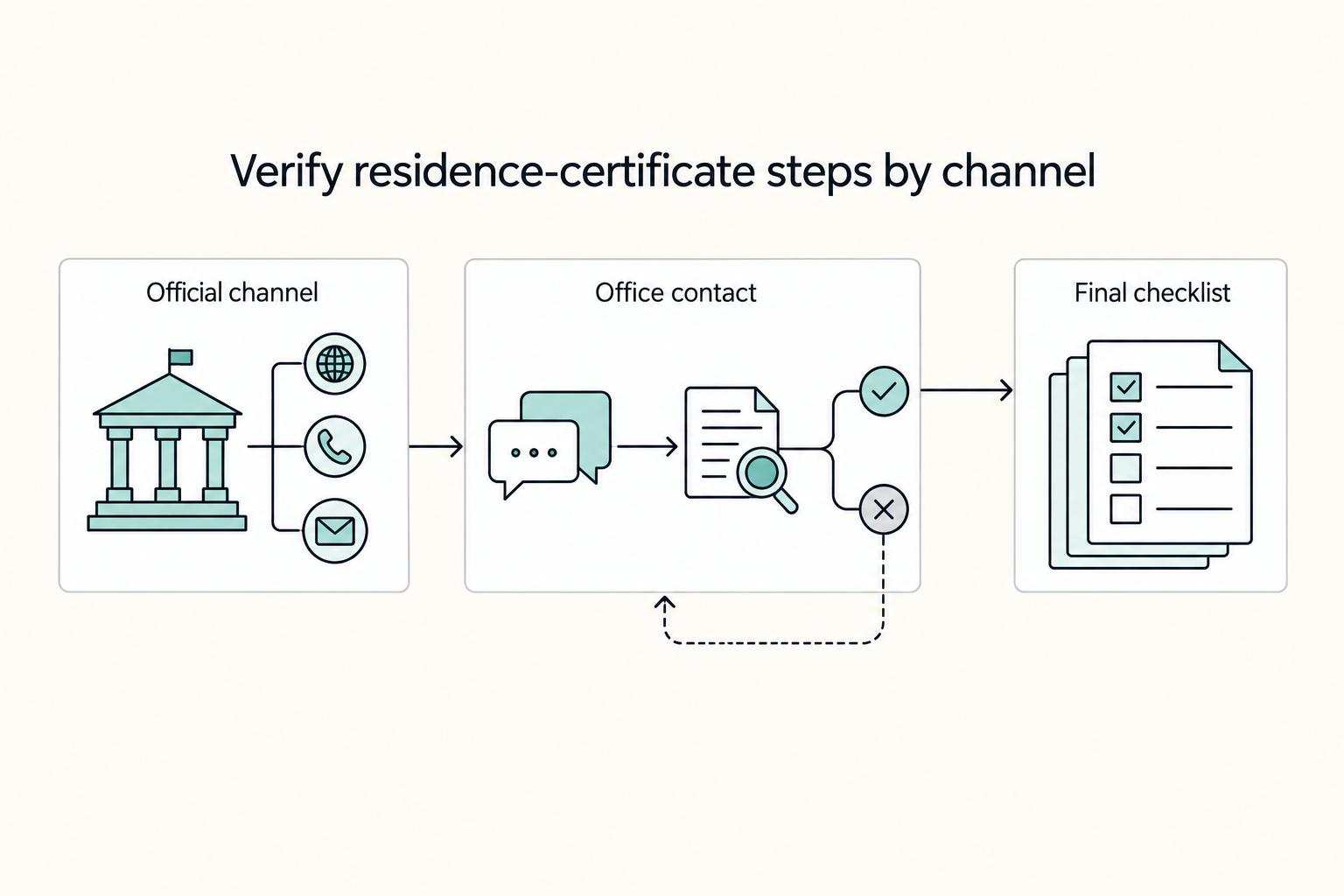
Step 1. Verify current requirements by channel, then lock one checklist#
Do requirement verification first and document collection second. The available research includes a historical Thailand investment report from March 2010, not current immigration desk instructions. Treat that as a reminder that official-looking search results can still be irrelevant to this process today.
| Order | Action | What to confirm |
|---|---|---|
| 1 | Check the official channel for your target office or mission | Confirm it currently handles this request |
| 2 | Contact that office directly | Clear up accepted document categories, submission method, and pickup process |
| 3 | Record one final, office-specific checklist | Include a verification date, channel used, and any staff reference you received |
Use this flow:
- Check the official channel for your target office or mission and confirm it currently handles this request.
- Contact that office directly to clear up anything unclear, including accepted document categories, submission method, and pickup process.
- Record one final, office-specific checklist with a verification date, channel used, and any staff reference you received.
If you do not have one current checklist tied to one office, stop there.
Step 2. Build a sequence, not a document pile#
What matters is not how many papers you have, but whether each required link in your address chain is complete under that office's current rules. Treat your file as a set of dependencies:
- Any address or occupancy evidence the office explicitly requests.
- Any third-party confirmation the office explicitly requests.
- Any local status or reporting proof the office says applies in your case.
If one dependency is missing, pause and get an approved substitute from that office before you book. Do not plan to explain gaps at the counter.
Step 3. Choose route by verified fit, not assumptions#
If you are comparing an immigration route and an embassy or consular route, do it only after direct verification. The right route is the one you confirmed both for issuance and for downstream acceptance.
| Decision criteria | Immigration route (if available) | Embassy/consular route (if available) |
|---|---|---|
| First check | Whether your local office currently issues this document | Whether your mission currently offers an equivalent document |
| Inputs to verify | Current accepted evidence categories and process steps | Exact document type offered and acceptance by your receiving authority |
| Common friction | Office-level variation and unclear substitutions | Service availability limits or receiving-office mismatch |
| Best fit | You have a complete, office-verified checklist | You confirmed both issuance and downstream acceptance |
| Fee/time field | Confirm the current fee and processing time with the issuing office | Confirm the current fee and processing time with the mission |
Ready to move to Phase 2#
Move forward only when all of these are true:
- You selected one route and one specific issuing office.
- You have one current, office-verified checklist on record.
- Every required dependency in your address chain is complete or pre-approved as a substitute.
- Identity and address details are consistent across your pack, or mismatches are pre-cleared.
- You know the submission and pickup mechanics for that office, and any payment step if applicable.
If any item is unresolved, delay execution and close the gap first. If you want a deeper dive, read our guide to a defensible 2026 filing plan.
Before you book your immigration visit, organize your stay timeline and document checkpoints in one place with the Tax Residency Tracker.
Phase 2: The One-Trip Execution - A Tactical Plan for Immigration Day#
On execution day, the job is simple: follow one verified instruction set, not competing advice. This section does not include Thailand authority excerpts for office workflow, timing, or document specifics, so treat those details as unknown until your target office confirms them.
Step 1. Run a strict go/no-go check before you leave#
Treat this as binary: if any line is unclear, stop and re-verify with the same office.
| Check | Pass condition |
|---|---|
| Checklist locked | You have one current checklist tied to one office, with verification date, channel, and staff reference if provided |
| Requirements confirmed | Every required field, signature, date, and supporting item in that office's instructions is complete |
| Instructions available offline | You can show the exact guidance you relied on without needing a data signal |
| Channel check done | Use the office's case-help path for case questions; some website feedback channels only handle site-help issues |
| Consistency check | Names, numbers, and address formatting are consistent across your pack |
- Checklist locked: You have one current checklist tied to one office, with verification date, channel, and staff reference if provided.
- Requirements confirmed: Every required field, signature, date, and supporting item in that office's instructions is complete.
- Instructions available offline: You can show the exact guidance you relied on without needing a data signal.
- Channel check done: Use the office's case-help path for case questions; some website feedback channels only handle site-help issues.
Final check: names, numbers, and address formatting are consistent across your pack.
Step 2. Time your visit using office-confirmed signals only#
Ignore generic timing advice from other branches, cities, or old forum posts. If timing details were not explicitly confirmed by your target office, treat same-day timing as uncertain and keep buffer time.
Step 3. Move through the day in a controlled sequence#
The point here is control, not speed. Use this as a working flow, not as a claim that every office runs the same process.
| Step | What you do | What can go wrong | Safe fallback |
|---|---|---|---|
| Office-directed sequence | Follow the sequence the office gives you that day. | You act on assumptions from another office or an old note. | Pause and ask the handling staff to confirm the current next step. |
| Submission check | Present materials in the order requested and keep supporting items easy to access. | An item is treated as missing, unclear, or inconsistent. | Ask for the exact missing or unclear item and write down the wording. |
| Exit check | Confirm any follow-up proof, timing, and reference details before leaving. | You leave without clear next-step instructions. | Repeat instructions back in simple terms and keep a photo of any slip or note. |
Step 4. Handle blockers with low-risk actions#
When something goes wrong, do not improvise from memory or from third-party advice. Get one clear instruction from the office handling your case, then act on that.
- Requirement mismatch: Ask which current requirement applies at this office for your case.
- Unclear instruction: Ask staff to restate the requirement in simple terms and note the exact wording.
- Language friction: Keep requests short and point to the exact document field in question.
- Return-visit notice: Leave with a written list of what to bring and how to re-enter the process.
If instructions conflict, stop and re-verify with the same office before taking the next step. Related: London, UK: A Guide for Expats and Remote Workers.
Phase 3: Strategic Deployment - Turning a Document into an Asset#
Once you have the certificate, use it where rejection risk is highest. In practice, prioritize banking and Department of Land Transport (DLT) tasks before optional admin. A common failure is using up the accepted use window on low-friction errands before you finish the tasks most likely to be blocked by branch or office discretion.
Step 1. Lock the verified use window#
Do not rely on a generic expiry claim from old posts. Record the issue date, keep a scan, and verify the accepted certificate validity window with the issuing office or receiving authority before you rely on it.
Your baseline file should always show:
- Certificate copy
- Issuing office
- Verified use window you are planning against
If you are using a Bangkok immigration route, keep issuing-office details visible. Office-level details can matter later. For U.S. citizens, the U.S. Embassy points Bangkok applicants to Chaeng Wattana and notes Nonthaburi does not issue these certificates.
Step 2. Run banking first#
Do banking first because requirements vary by institution, product, and branch. Verify current branch-level requirements before you visit.
| What to compare | What to verify | Why it matters |
|---|---|---|
| Foreigner onboarding ease | Whether this branch opens the exact account type for your status | Product rules are not uniform across banks |
| Required docs | Identity and residence evidence required for that product | Document lists differ by product and customer type |
| Branch consistency | Whether this branch will process the application in person | Some onboarding is still branch-first |
| Digital usability | App quality and onboarding or compliance steps | Digital flows exist, but capability is uneven |
For banking, use this dependency checklist:
- Passport and any status documents the branch requested
- Certificate, if this branch accepts it as address evidence for that product
- Copies or signed copies, if requested
- Note with branch name, product name, and checklist confirmation
If you are rejected, do not argue from another branch's experience. Ask whether the blocker was product eligibility, identity evidence, or address-proof format, then retry with a different branch or product using a newly verified checklist.
Step 3. Use the same file for DLT and vehicle tasks next#
After banking, move to DLT-related tasks. Government guidance for foreign license conversion includes a passport and Certificate of Residence, and U.S. Embassy guidance identifies this document as typically required for DLT license and vehicle transactions.
For DLT and vehicle tasks, use this dependency checklist:
- Passport original and copy
- Residence certificate
- Office-specific checklist for your exact transaction
- Confirmation that the handling office accepts this document for your case
If someone tells you to use a U.S. Embassy residency affidavit, re-check immediately. That notarization channel ended March 1, 2023 for U.S. citizens, so confirm the currently accepted Thai Immigration document.
Step 4. Leave optional admin for last#
Only after banking is active and your DLT task is filed should you spend remaining time on optional address-based tasks. Use this simple sequence:
| Segment | Action |
|---|---|
| Window start | Scan the certificate, verify the acceptance window, and book the highest-friction visit |
| First segment | Bank application submitted |
| Middle segment | DLT license or vehicle transaction filed |
| Final segment | Optional tasks only after office-level acceptance is confirmed |
Your checkpoint is a usable output, not just a visit: account opened, app access working, or DLT receipt or written next-step instructions in hand.
For a step-by-step walkthrough, see How to Get a Certificate of Residence.
Conclusion: From Bureaucratic Hurdle to Strategic Milestone#
The goal is straightforward: get the right certificate for the right job, then use it before process friction builds. Keep the sequence simple:
-
Prepare. Confirm your local office checklist first, not just a Bangkok example. Build one complete file with the documents your office lists, including proof of stay such as a TM.30 receipt where that channel requires it. Reconfirm office hours and timing before you go, because published timelines vary by channel and office, for example, 3 working days in one local immigration handbook versus 15 days in BOI LTR guidance.
-
Execute. Submit one complete file and keep copies of everything. Aim to leave with either the certificate or clear pickup instructions, plus the exact name and address format the office accepted. Avoidable failures include incomplete address evidence, including missing TM.30 proof where required, and assuming one office's checklist applies everywhere.
-
Deploy. Use the certificate first for your most time-sensitive task. Official driving-licence guidance includes a Certificate of Residence in Thailand in the resident document set, so prioritize that if mobility is urgent. If you also need it for other local admin, start immediately and reuse the accepted document set where permitted.
Safe default: treat immigration or embassy residence proof as address evidence only. It is not the same as a Revenue Department tax residency certificate. For tax purposes, the Revenue Department ties residence to the taxable year and filed returns. Resident status is linked to more than 180 days in a calendar tax year, with supporting documents such as filed P.N.D. 90 or P.N.D. 91.
Keep a dated PDF record set with the certificate, application papers, and any submission or pickup receipts, including TM.30 records if used. Recheck requirements before renewals or related applications because local practice can change. If guidance conflicts, your visa status is complex, or you are unsure whether you need address proof or a tax certificate, pause and consult a qualified advisor.
We covered this in detail in How to Get a 'Tax Clearance Certificate' when Leaving a Country.
Before your next renewal cycle, sanity-check whether your visa path still supports your compliance plan with the Visa Cheatsheet for Digital Nomads.
Frequently Asked Questions
What should you bring to immigration?
Build one folder for your exact immigration office, because the strongest checklist available here comes from recent Chaeng Watthana (Bangkok) experience and may not transfer exactly elsewhere. Treat the items below as your baseline, then confirm office-specific details before you travel. | Required | May vary by office | | --- | --- | | Passport | Exact proof-of-address format | | Current visa page | Number of photocopy sets | | TM30 receipt confirming your reported address | Whether copies must be signed | | Completed 90-day report receipt | Local application form or version | | Proof of address | Pickup timing and payment flow | | Application form | | Before visiting, confirm whether your case needs at least one completed 90-day report, since that is a known turn-away point. If you are using Chaeng Watthana as your reference, reported figures are 200 THB. Typical processing is 1-2 business days, with up to 15 working days officially allowed and a reported 30-day validity from issue date.
Can you apply if you are in Thailand on a tourist visa?
Do not assume yes or no from forums, because there is no blanket tourist-visa eligibility rule confirmed here. Ask the issuing office directly whether your current status is accepted, whether a completed 90-day report is required for your case, and what address evidence format they want. If the answers are unclear and timing matters, pause and get qualified immigration or tax advice before you plan banking or driving-licence steps around assumptions.
Is this the same as a Tax Residency Certificate?
No. These are different documents with different issuers and different use cases. Use this quick check before you request either one: | Document | Issuer | Purpose | Common use cases | | --- | --- | --- | --- | | Certificate of Residence | Thai Immigration | Confirms your address in Thailand | Thai driving licence, bank account applications | | Tax Residency Certificate | Thai Revenue Department | Proves Thai tax residency for a specific tax year | When an authority asks for year-specific Thai tax residency proof | For the tax version, practitioner guidance says you apply after filing the relevant Thai personal income tax return, and it is valid for that tax year only. Where residency criteria are discussed, verify the current threshold through official Thai Revenue Department guidance or qualified tax-adviser records before use. Then follow the Revenue Department process, including Ror.Aor.01, not the immigration counter.
What if your landlord has not done the TM30 filing?
Treat the TM30 receipt as a dependency, because it is the address-reporting proof tied to landlord or hotel filing. If filing is missing, request completion and receipt confirmation before you book immigration, and confirm what alternatives, if any, the office accepts. Also confirm your 90-day reporting status, since that is another reported turn-away point in Bangkok practice. If the landlord keeps delaying, ask immigration what proof they can verify on record. If the document is time-critical and still blocked, escalate to a qualified advisor.
Try a related tool
Researched and edited by the Gruv editorial team. Gruv builds cross-border billing, payouts, and finance-operations software for global businesses.
Sources
- 2009-2017.state.gov/e/eb/rls/othr/ics/2010/138154.htmtrusted
- assets.publishing.service.gov.uk/media/5bbadf4ced915d23aa4c2df6/How_to_open_a...trusted
- docs.un.org/sp/A/HRC/8/3/Add.1trusted
- ecfr.gov/current/title-13/chapter-I/part-124/subpart-Atrusted
- govinfo.gov/content/pkg/FR-2025-01-02/pdf/FR-2025-01-02.pdftrusted
- govinfo.gov/content/pkg/FR-2025-03-24/pdf/FR-2025-03-24.pdftrusted
- irs.gov/irm/part21/irm_21-003-007rtrusted
- oecd.org/content/dam/oecd/en/publications/reports/202...trusted
Educational content only. Not legal, tax, or financial advice.
Related Posts

Digital Nomad Taxes in 2026 With a Defensible Filing Plan
With digital nomad taxes, the first move is not optimization. It is figuring out where you may be taxable, where filings may be required, and what proof supports that position.

London, UK: A Guide for Expats and Remote Workers
Get two calls right early and the rest of the move gets easier: how you'll be in the UK, and where you'll work when conditions are less than ideal. Make those decisions before you lock dates or prepay a long stay. If you book first and sort the basics later, admin and work reliability usually collide in your first week.
Digital Nomad Tax Residency in Thailand for 2026
Low-stress compliance in Thailand comes from early decisions and clean records, not last-minute cleanup. Most costly problems start as small assumptions about visas, day counts, and money movement that stack up over time.