
Quick Answer
To get a Carte Vitale in France as a self-employed person, first register your activity and secure your social-security affiliation, then open your health-insurance rights with a clean, internally consistent dossier. Wait until you have a permanent 15-digit social security number, confirm the correct local CPAM or CGSS route, submit through compte ameli when possible, and use your attestation de droits as proof of coverage while the card is being issued.
To get a Carte Vitale in France as a self-employed person, first register your activity and secure your social-security affiliation. Then open your health-insurance rights, submit a clean dossier, and follow up until your rights and card are live. Most long delays happen when those steps are done out of order or the file does not hold together internally.
Treat the process like a practical project: set the sequence, verify each checkpoint, keep proof of what you did, and do not move to the next step until the last one is actually in place.
Phase 1: The Self-Employed Mandate - Secure Your URSSAF Affiliation First#
If you will be self-employed in France, do not start by asking CPAM for a card. Start by registering your activity so your social-security affiliation exists before you move into health-insurance rights opening.
- Choose the correct path first.
This section applies if you are freelance, independent, or otherwise self-employed. If you are a salaried employee, the default route is different. Ameli states that your employer handles the steps to open your rights in France, and your employment is declared to Urssaf. In practice, if you are on an employer-led route, stop here and confirm that your employer has actually started the process.
- Register your business activity before you build a CPAM file.
For self-employed applicants, the trigger is your business registration. Since 1 January 2023, formalites.entreprises.gouv.fr is the electronic guichet unique for company formalities. At the same time, Ameli's independent-worker pages still refer to Urssaf and CFE wording, and state that a complete CFE dossier counts as a declaration to recipient bodies, including CPAM or CGSS.
The practical point is simple: use the current business-registration portal, but verify locally which office and terminology your case is being routed through. Your checkpoint here is not "I filled in a form." It is "my activity registration is accepted, and I can show proof that the declaration has been transmitted or recorded."
- Confirm your social-security status before moving to Phase 2.
This is where many files go sideways. A Carte Vitale requires a social-security number. If you were born abroad, you may first receive a temporary NIA (numéro d'identification d'attente) while your rights are being opened. Ameli is clear that with an NIA, you cannot yet open an ameli account or get a Vitale card.
If you are trying to get a Carte Vitale as a freelancer, this is the sequence that matters: registration first, rights-opening dossier second, card last. Phase 2 begins when you are ready to prepare the rights-opening file, including Cerfa S1106, for your local health-insurance fund.
| Checkpoint | Ready to move to Phase 2 | Not ready yet |
|---|---|---|
| Path confirmed | You are self-employed and know you are not on an employer-led route | You are salaried but trying to self-file anyway |
| Activity registration | Proof of business registration submission or acceptance via guichet unique or the locally indicated route | No registration proof, or unclear whether the file was accepted |
| Receiving authority identified | You know your local health-insurance fund is CPAM or CGSS | You do not know which local office will handle the file |
| Number status understood | You know whether you have no number yet, a temporary NIA, or a definitive number | You are treating an NIA as if it were card-ready status |
Risk control before you send anything to your health-insurance fund#
Before you send a rights-opening file, make sure the basics are locked down. Most avoidable delays start here.
- Do not submit a card request with no definitive status check. If you only have an NIA, expect temporary rights only, not ameli access or a card.
- Keep proof of registration handy. Save the business-registration receipt or confirmation page so you can show the affiliation chain started correctly.
- Verify the local handoff. Before sending Cerfa S1106, confirm the correct local fund and submission route for your place of residence.
For a broader comparison piece, read The 2026 Global Digital Nomad Visa Index for 50+ Countries. For the next operational step, browse Gruv tools.
Phase 2: Assembling Your Dossier - A Zero-Failure Approach#
Your best move in Phase 2 is simple: verify the evidence first, assemble the file in order, and only complete forms after the evidence is clean.
Confirm you are dossier-ready first#
Do not build the dossier until your permanent 15-digit social security number is in place. If you only have a temporary number or no number, pause and resolve that first.
| Bucket | Item |
|---|---|
| Required now | Permanent 15-digit social security number |
| Required now | One identity document you will use consistently across the file |
| Required now | Proof of your current address in France |
| Required now | Your birth-certificate source document |
| Required now | Your RIB, if your local office asks for bank details at this stage |
| Verify with CPAM or CGSS | Which birth-certificate format they accept |
| Verify with CPAM or CGSS | The local recency expectations for birth certificate and proof of address |
| Verify with CPAM or CGSS | Whether your route uses Form S1106 |
| Verify with CPAM or CGSS | Whether non-French documents need official translation, and whether they require a traducteur assermenté |
Use a strict rule: if a claim in your file is not backed by paperwork, treat it as unresolved before submission.
Collect and standardize evidence before any form#
Collect identity and residency evidence first, then standardize it. Make sure names, dates, and address details are consistent across documents before you fill anything in.
For scans, keep the full document visible and readable, one document per file. Use a simple naming pattern so resubmission is easy if the office asks for one item again. Then complete Form S1106 only if your local office confirmed that route, and copy details from validated documents, not memory.
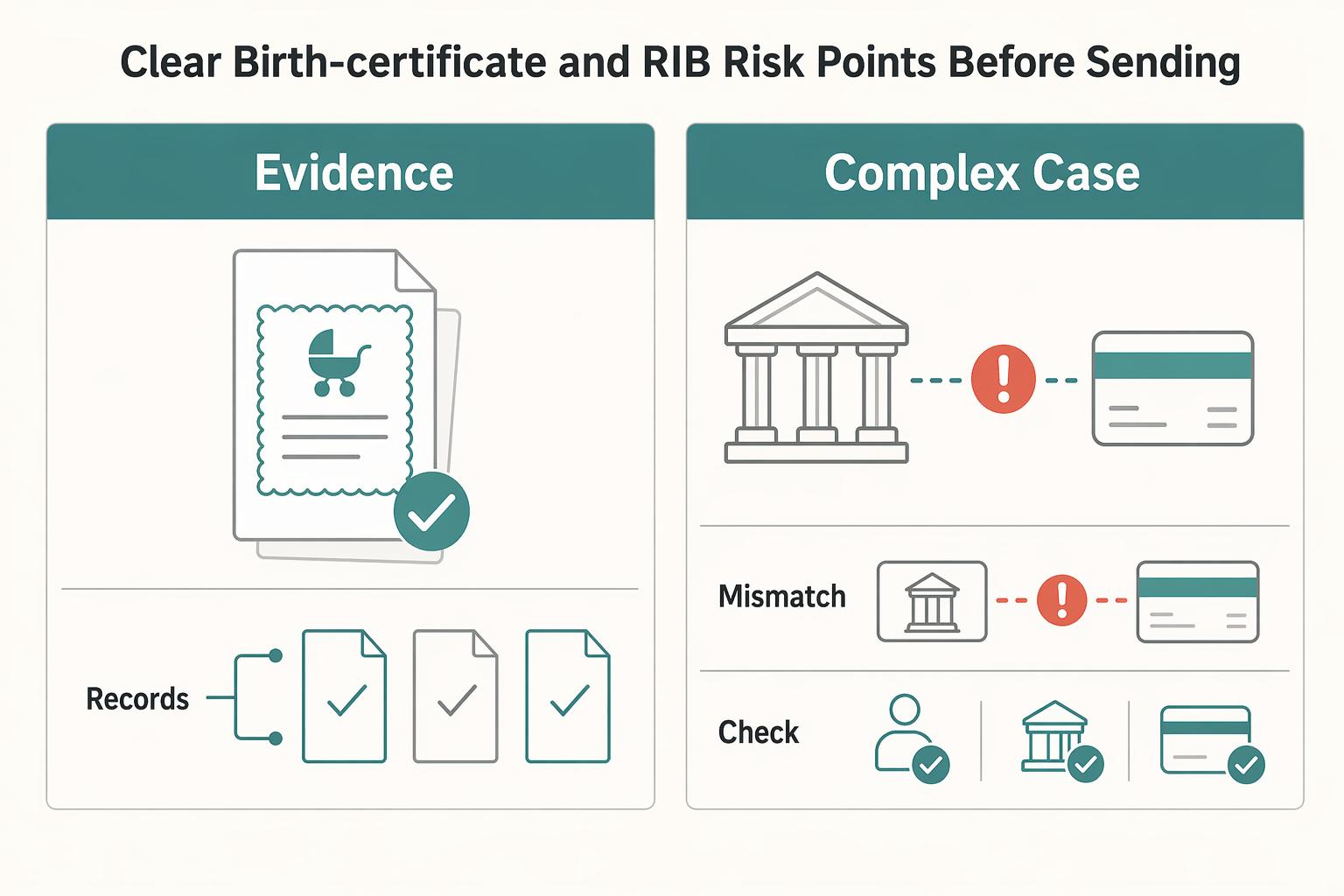
Clear birth-certificate and RIB risk points before sending#
Most avoidable delays come from birth-certificate handling and bank-detail mismatches. Resolve both before you submit.
Birth-certificate decision flow:
- If the certificate is in French: confirm accepted format and local recency expectations.
- If it is not in French: obtain official translation, then confirm whether your office requires a traducteur assermenté.
- If names, dates, or place names differ between original and translation: correct that before submission.
For your RIB, confirm the bank details can be clearly tied to the same identity used in your dossier. If name format or account-holder details create doubt, pause and fix that first.
| Common trigger | What it causes | Prevention before submission |
|---|---|---|
| Missing official translation | The office cannot assess a key document cleanly | Confirm translation requirements first and submit original plus translation together |
| Proof of address outside local acceptance window | Address evidence may be treated as insufficient | Verify local timing expectations and replace the document if needed |
| Unreadable or partial scans | Documents are present but not usable | Re-scan full pages and check legibility before upload |
| Bank details not clearly aligned with identity documents | Reimbursement setup can stall | Make sure the RIB is clearly linked to the same identity details used in the dossier |
If you apply this verify-first workflow, Phase 3 becomes execution and tracking, not file repair. For a step-by-step walkthrough, see How to Get a SIREN/SIRET Number as a Freelancer in France.
Phase 3: Execution and Proactive Timeline Management#
Once your dossier is ready, use compte ameli first. It gives you one place to submit, check status, and follow up.
Submit in compte ameli, then confirm traceability#
Submit first, then confirm the request actually appears in your account. Log in to your compte ameli, complete the relevant carte Vitale or rights-related démarche, and save each confirmation screen (PDF or screenshot). Then go to Démarches and confirm the request is visible, since this is where you can track carte Vitale issuance.
If you need status on the broader file, stay in compte ameli and use the Assurance Maladie chatbot with "dossier." Check the estimated processing-delay indicator in your account before escalating.
Do not assume digital re-upload is always available. In some caisses, online document upload opens only after a complément de dossier notification, so keep your full document set ready.
| Channel | Traceability | Follow-up ease | Resubmission friction |
|---|---|---|---|
| Compte ameli | Strongest built-in trail (démarches view + your saved confirmations). | Direct follow-up from the account, including chatbot guidance for "dossier." | Lower when digital requests are enabled by your CPAM; not universal. |
| Postal submission | Manual trail (you must keep your own copy set and mailing proof). | Follow-up usually shifts to phone support or later account checks. | Higher if one item is unclear, since you may need to resend documents. |
Use the attestation as coverage activation proof#
Your first real milestone is the attestation de droits, not the physical card. It is available immediately in digital format and is used to prove your affiliation to Assurance Maladie. Treat it as your coverage activation proof while you wait for the carte Vitale, and keep a saved copy ready to share when needed.
Follow a fixed check sequence and escalate with evidence#
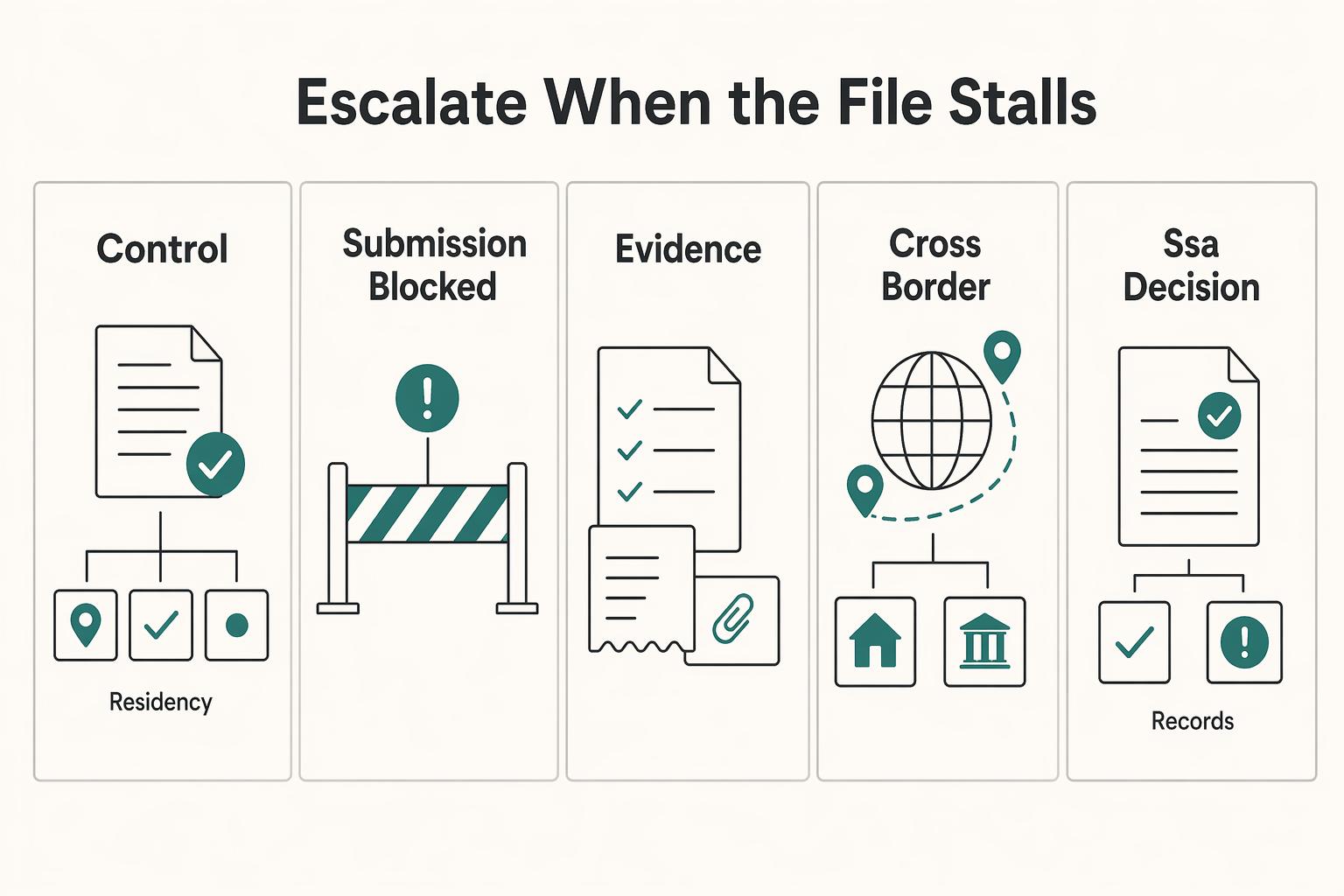
Use a routine, not guesswork. First: recheck Démarches and the estimated delay indicator in your account. Second: verify the current follow-up interval in your account or with CPAM before using it; if there is still no movement after that verified interval, send a secure message or call with a tight evidence pack.
| Situation | Channel | Detail |
|---|---|---|
| Routine status check | Compte ameli | Recheck Démarches and the estimated delay indicator in your account |
| Current follow-up interval pending official account or CPAM verification | Secure message or call | Include full name, social security number, submission date, the exact démarche or document concerned, any mismatch notice or request for additional documents, and copies of what you already submitted |
| Cannot access compte ameli | Phone | 3646 from France or +33 184 90 36 46 from abroad |
| Handling quality issue rather than normal delay | Complaint by mail | Use Réclamation in the subject line, then use the mediator route if needed; formal decisions by your caisse can also be contested |
If you cannot access compte ameli, call 3646 (from France) or +33 184 90 36 46 (from abroad). If the issue is handling quality rather than normal delay, you can file a complaint by mail with "Réclamation" in the subject line, then use the mediator route if needed; formal decisions by your caisse can also be contested.
Phase 4: Activation and Full System Integration#
When your card arrives, treat activation as a verification step, not the finish line. You want a usable record, written proof, and clean alignment across any related coverage files.
Activate the card and verify the result#
Follow the instructions that came with your card, then confirm a dated result in writing. The current evidence set does not support one universal activation location or one standard confirmation screen, so rely on your official instructions and account notices instead of generic forum guidance.
If activation fails, stop and open a support case with an evidence pack: card mailing, instruction sheet, screenshots, your social security number, and the date/time of the failed attempt. That gives the reviewer enough to diagnose the issue quickly.
Keep card activation separate from cross-border Social Security status#
If you still have U.S. work ties, treat cross-border Social Security status as a separate track. The U.S.-France Social Security agreement is listed as in force from July 1, 1988, and SSA describes Totalization agreements as assigning coverage to one country while exempting employer/employee taxes in the other.
| Point | Detail |
|---|---|
| Agreement status | The U.S.-France Social Security agreement is listed as in force from July 1, 1988 |
| Totalization rule | SSA describes Totalization agreements as assigning coverage to one country while exempting employer/employee taxes in the other |
| Action if it applies | Request a Certificate of Coverage through SSA's online service and keep the approval confirmation |
| Web submission note | Web submissions cannot be guaranteed against interception/decryption, so send only required data and store confirmations securely |
If this applies to you, request a Certificate of Coverage through SSA's online service and keep the approval confirmation. SSA also notes web submissions cannot be guaranteed against interception/decryption, so send only required data and store confirmations securely.
First week after card arrival: integration checklist#
Use a short checklist so each record is confirmed on purpose.
| Layer | What to verify now | Proof to keep |
|---|---|---|
| Base health-rights record | Activation status is reflected in your record | Dated confirmation notice or account screenshot |
| Complementary cover (if you have one) | Contract is active and identity details match your current record | Policy schedule and written confirmation |
| U.S.-France Social Security position (if relevant) | Which country's Social Security system applies to your work | Certificate request copy and approval confirmation |
Run mise à jour on two triggers: routine maintenance at the currently recommended interval, which must be verified from official ameli or CPAM records before use, and any life change that affects your profile data.
Quick troubleshooting (post-activation): if a provider cannot read the card, reimbursements do not sync, or profile data looks outdated, identify which single record is wrong first and contact the support channel listed for that record in your official documents.
You might also find this useful: A Guide to Health Insurance for Freelancers in France.
From Applicant to Beneficiary: Project Carte Vitale Complete#
You can treat this process as complete only when your rights are active, your attestation de droits is available, your card is usable, and reimbursements are flowing.
| Status | What it lets you do | Proof to keep |
|---|---|---|
| Application submitted | Confirm your file exists and follow up with the right office | Submission receipt, document copies, reference numbers |
| Rights active | Prove affiliation (including for hiring or complementary coverage) | Current attestation de droits (PDF) |
| Card usable | Enable automatic reimbursement (typically around 1 semaine), and in some cases avoid upfront payment | Card, latest attestation, reimbursement record |
Your first operational check is rights, not the physical card. If you can download a current attestation de droits from ameli (Documents), you have formal proof of affiliation. If your file is still on an NIA, treat it as an in-progress state: that temporary number does not allow compte ameli creation or Carte Vitale issuance.
For your first months after rights activation, keep a simple routine:
- Download your attestation and store a local copy.
- Keep your RIB, ID documents, and care invoices in one folder.
- Run one reimbursement check after a routine care visit and confirm the payment arrives.
- If your bank details change, submit a new RIB with IBAN and BIC immediately.
- Review/export reimbursement statements from ameli as needed (history is available for the 27 derniers mois).
Then keep the file healthy: update your card au moins 1 fois par an and after any personal or professional change (pharmacy/health-insurance terminals support updates quickly). If the card is lost, stolen, or defective, declare it in ameli so the old card is invalidated. If your post-approval file is blocked or a decision seems wrong, use official channels in order: complaint first, then the médiateur if needed, and verify the exact deadline/routing rule on your notice before escalating.
Frequently Asked Questions
What is the real first step if you are self-employed or salaried?
If you are self-employed, start by registering your activity so your social-security affiliation exists before you open health-insurance rights. If you are salaried, the route is employer-led, so confirm that your employer has started it. If your case is unusual, verify the exact first step with the authority handling your file.
What is the difference between an attestation de droits and a Carte Vitale?
The attestation de droits is the first usable proof that your rights are active. The Carte Vitale is the physical card that follows. If you need narrower usage rules for a specific situation, confirm them with the French authority handling your file.
Do you need a French bank account?
This guide does not establish a universal rule that you must have a French bank account. It does say that if your local office asks for a RIB at this stage, the bank details need to align cleanly with the identity used in your dossier.
How long does the process take?
This guide does not provide a verified national processing timeline for French coverage or card issuance. Use the delay indicator in your account and current local confirmation instead of relying on a rule of thumb.
What if you still have U.S. work ties while sorting out French coverage?
Keep French health coverage administration separate from Social Security tax coverage between countries. SSA lists France as an agreement country, with the U.S.-France agreement in force from July 1, 1988, and says Totalization agreements assign coverage to one country and can exempt employer and employee Social Security taxes in the other. If the agreement assigns your coverage to the United States, request a Certificate of Coverage through SSA's online service. If you need help with SSA's online certificate forms, SSA lists (410) 965-7306, Monday to Friday, 8 a.m. to 3 p.m. Eastern U.S. time.
Is the card free, and how do you avoid scams?
This guide does not verify current Carte Vitale fees, replacement costs, or anti-fraud payment workflows. For fee and payment instructions, rely only on direct written guidance from the authority handling your file.
Try a related tool
Researched and edited by the Gruv editorial team. Gruv builds cross-border billing, payouts, and finance-operations software for global businesses.
Sources
Includes 5 external sources outside the trusted-domain allowlist.
- eur-lex.europa.eu/legal-content/EL/TXT/PDFtrusted
- ssa.gov/international/CoC_link.htmltrusted
- ssa.gov/international/agreement_descriptions.htmltrusted
- ameli.fr/assure/droits-demarches/europe-international...external
- ameli.fr/assure/remboursements/suivre-remboursements/...external
- entreprises.gouv.fr/espace-entreprises/realiser-mes-demarches/gu...external
- service-public.fr/particuliers/vosdroits/F265external
- service-public.gouv.fr/particuliers/vosdroits/F265external
Educational content only. Not legal, tax, or financial advice.
Related Posts

The 2026 Global Digital Nomad Visa Index for 50+ Countries
Start with legal fit, not lifestyle filters. The practical order is simple: choose a route you can actually document, then decide where you want to live. That single change cuts a lot of wasted comparison work and stops you from falling in love with places that were never a real filing option.

Can Digital Nomads Claim the Home Office Deduction?
Claim the deduction only when your facts and records can carry it. With the home office deduction for digital nomads, the real decision is usually a three-way call: claim it, do not claim it, or pause and get help because your file is not ready.
Health Insurance for Freelancers in France During Your First Year
This guide helps you sequence health coverage so you stay protected while French enrollment catches up. In France, coverage is split between public insurance and private top-up cover, so your **Carte Vitale** and reimbursements may not go live quickly.