
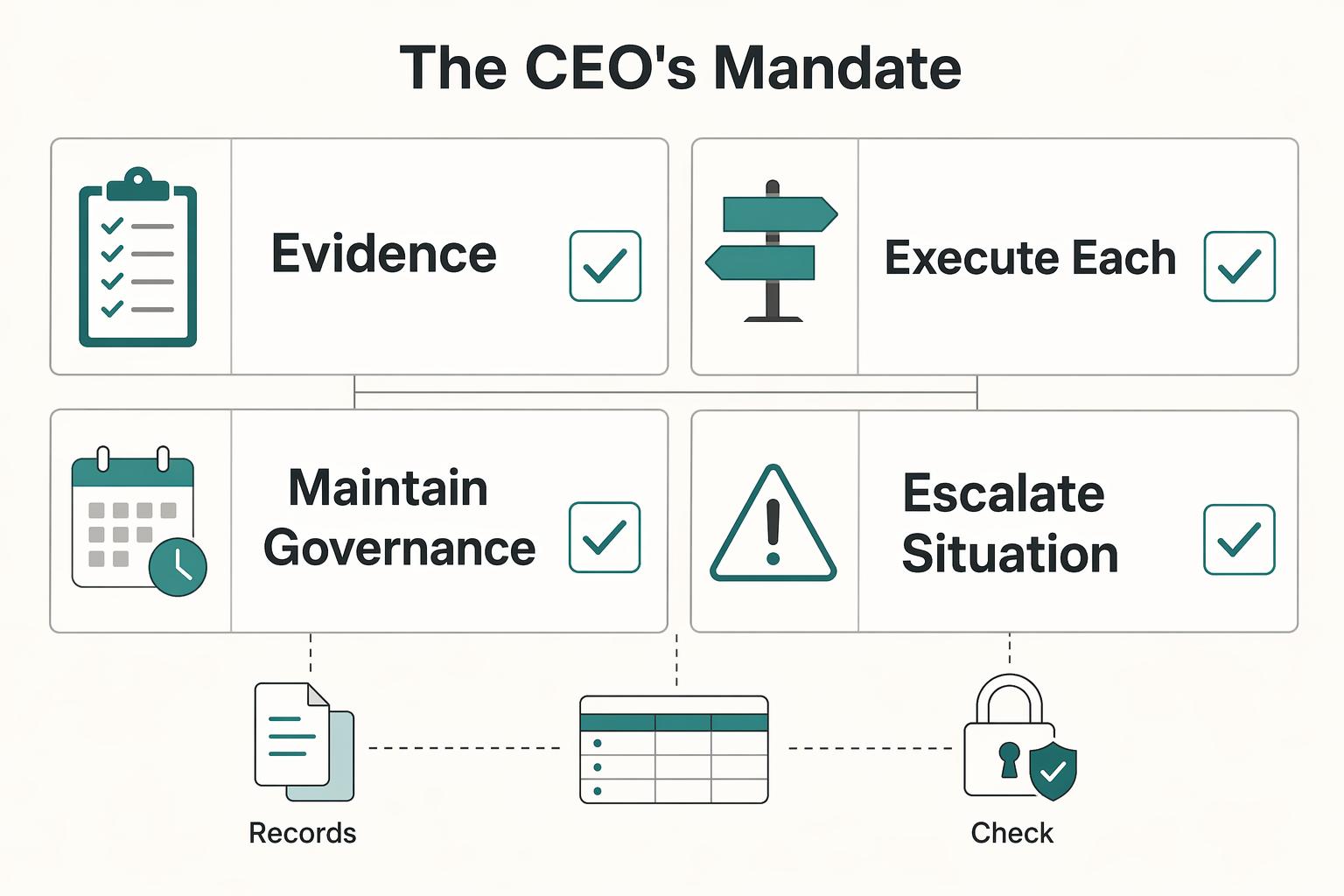
Quick Answer
Start by treating how to fund a trust as an ownership-control workflow, not a paperwork event. Audit each asset against current records, then choose the right path: retitle where allowed, use beneficiary designation where plan rules control, and pause items that need legal or tax review. For mortgaged property, verify loan terms and the inter vivos trust conditions before recording a deed. For crypto and online accounts, document both authority and access so a trustee can actually act later.
A revocable living trust is only useful if your assets are actually aligned with it. Many people stop after signing the trust and assume the plan is done. It isn't. An unfunded trust leaves assets outside the structure you meant to rely on. That can mean avoidable probate risk, administrative delays, and preventable mistakes when someone later has to step in.
Funding the trust is where estate planning becomes operational. For a global professional with real estate, LLC interests, foreign accounts, crypto, and equity compensation, "just retitle the assets" is not enough. The transfer path depends on the asset, the governing documents, the institution, and sometimes the jurisdiction. A bad move can create tax issues, fail outright, or leave the asset outside the trust despite a signed document.
This guide follows a practical sequence. First, audit what you own. Then transfer what can be moved cleanly. Finally, set a governance process so new assets do not fall through the cracks. That is how you turn the trust from a signed document into something your successor can actually use.
Phase 1: The Strategic Asset Audit#
Before you move anything, build an asset audit. The goal is not to list your net worth. The goal is to decide, asset by asset, whether it should be transferred now, handled through a beneficiary designation, or paused for specialist review.
Step 1: Build a transfer inventory (not a net-worth list)#
For each asset, capture:
- current legal owner
- title or registration status
- jurisdiction
- likely transfer pathway
- known restrictions
- required documents
Not every asset has a title document, but every line should tie to a current ownership record. You should be able to pull a deed, title, account record, operating agreement, trademark or copyright record, or beneficiary form for each relevant entry. If you cannot verify ownership from a current document, move that item to a missing-document list before you start any transfer work.
For accounts, also note whether the institution has its own ownership-change process and whether it may accept a certificate of trust instead of the full trust document. Record any existing beneficiary or TOD setup, because those records can control how the asset passes and may supersede what you expected from a will.
Step 2: Sort by transfer route#
Once the inventory is backed by documents, sort each asset by transfer path. This is where you separate straightforward retitling from assets that need a different route or a legal check first.
| Asset class | What you verify | Common blocker | Next action |
|---|---|---|---|
| Real estate and other titled property | Owner shown on deed/title and local filing requirements | Title-based assets need updated ownership paperwork; real estate typically needs a newly prepared, signed, and recorded deed | Transfer now when paperwork path is clear |
| Bank and brokerage accounts | Exact registration, beneficiary/TOD status, institution process | Institution may require trust proof and institution-specific steps before changing ownership records | Transfer now or keep beneficiary designation route, based on your plan |
| LLC interests | LLC agreement terms on assignment, consent, and rights | Agreement can restrict assignment; assignment alone may not grant full member powers | Hold for specialist review unless the agreement clearly permits your intended transfer |
| IP (trademarks, copyrights) | Current registered owner and assignment records | Ownership changes generally require formal assignment, and record updates may be needed | Transfer now with assignment and any required recordation steps |
| Foreign accounts/assets | Account ownership, jurisdiction, and whether aggregate foreign accounts exceeded $10,000 at any time during the year | Cross-border legal and tax complexity; FBAR review may apply | Hold for specialist review |
| Digital assets and online accounts | Where access and authority sit, and whether user consent exists | Fiduciary access to some communications can be restricted without user consent under RUFADAA-style rules | Hold for specialist review |
Step 3: Create the Phase 2 handoff package#
Phase 1 is complete only when you have a clean handoff package for the transfer work. That package should include:
- a prioritized transfer queue for all transfer now items
- an exception list for legal and tax review, especially LLC, foreign, and digital-access items
- a missing-document checklist for deeds, titles, beneficiary forms, operating agreements, and institution-required trust documentation
If you do not have all three, you are not ready to start retitling. This package keeps Phase 2 from turning into guesswork.
Related reading: How to Set Up a Donor-Advised Fund (DAF).
Phase 2: The Risk-Managed Transfer#
In this phase, keep one rule in mind. A signed document is not enough if the underlying records never change. For each asset, confirm the transfer is allowed, review the controlling documents, use the right transfer instrument, and then verify that the institution, recorder, or registry updated its records.
| Asset type | Primary transfer document | Common blocker | Proof-of-completion to retain |
|---|---|---|---|
| LLC or other business interest | Written assignment of the ownership interest, plus any required consent document | Operating agreement limits assignment or separates economic rights from management rights | Executed assignment, written member consent if required, updated company records showing trust ownership |
| Real estate | State-appropriate deed into the trust | Due-on-sale clause, lender notice process, state recording rules | Recorded deed, recording receipt, lender correspondence, updated servicing file confirmation |
| Foreign account or foreign-situs asset | Jurisdiction-specific transfer document and institution ownership-change forms | Local-law recognition issues and U.S. reporting exposure | Local counsel instructions, accepted institution paperwork, reporting workpapers |
| Issued shares or securities | Issuer or transfer-agent ownership-change documents | Books and records not updated after signing | Transfer agent or issuer confirmation showing the trust on the holder record |
| Digital assets | Platform-specific ownership change where available, plus separate access authorization and custody instructions | Trust language alone does not guarantee account-content access | Consent records, access inventory, custody instructions, confirmation of any platform designation |
Review business interests first#
Start with business interests. They can look simple on paper and then stall because the governing agreement says otherwise.
| Path | When it applies | Key point |
|---|---|---|
| Transfer now | The trust transfer is clearly allowed by the operating agreement | Treat the move as complete only when company records changed |
| Get written consent first | Approvals are required | Keep any written consents with the executed assignment |
| Escalate to counsel | Restrictions are unclear | Do not assume an assignment gives the trust full member rights |
Review the operating agreement first. Then sort the interest into one of those three paths: transfer now if the trust transfer is clearly allowed, get written consent first if approvals are required, or escalate to counsel if the restrictions are unclear.
Do not assume an assignment gives the trust full member rights. For LLCs, the agreement may limit assignment, separate economic rights from management rights, or require a member vote or consent before an assignee becomes a full member.
Completion means the company records changed, not just that the assignment was signed. Keep the executed assignment, any written consents, and the updated company ownership records together.
Transfer mortgaged real estate with the lender process in view#
For mortgaged real estate, lender process is part of the transfer. Build that into the job from the start.
| Step | What to do | Why it matters |
|---|---|---|
| Loan documents | Pull the note, mortgage, or deed of trust and identify due-on-sale language | Due-on-sale language can create acceleration risk after an unauthorized transfer |
| Federal exception | Verify whether your facts fit the federal inter vivos trust exception before relying on it | Federal law includes an inter vivos trust exception only when the required conditions are met |
| Lender package | Ask the lender or servicer for its required notice package | Lender process is part of the transfer |
| Deed | Prepare the state-appropriate deed into the trust | You need both the deed process and the loan review |
| Recording | Record the deed under local rules and keep the recording receipt | Keep the recording proof in your file |
| Servicer records | Confirm the lender or servicer updated ownership and correspondence records | Keep the lender or servicer confirmation in your file |
Due-on-sale language can create acceleration risk after an unauthorized transfer. Federal law includes an inter vivos trust exception, but only when the required conditions are met. That means you need both the deed process and the loan review.
Use this checklist:
- Pull the note, mortgage, or deed of trust and identify due-on-sale language.
- Verify whether your facts fit the federal inter vivos trust exception before relying on it.
- Ask the lender or servicer what notice or documentation package it requires before you record or update its records.
- Prepare the state-appropriate deed into the trust.
- Record the deed under local rules and keep the recording receipt.
- Confirm the lender or servicer updated ownership and correspondence records.
Keep both the recording proof and the lender or servicer confirmation in your file.
Pause cross-border transfers until local law and reporting are clear#
Cross-border assets need two checks: local-law validity and U.S. reporting. Institution acceptance by itself does not answer either question.
If you are a U.S. person and foreign financial accounts exceed an aggregate $10,000 at any time during the year, FBAR filing can apply. FBAR is due April 15 with an automatic extension to October 15. Certain foreign-trust transactions are reportable on Form 3520. It is generally due the 15th day of the 4th month after year-end, or the 15th day of the 6th month if you live and work outside the United States. A stated Form 3520 penalty for failing to report a transfer to a foreign trust is 35% of gross value transferred.
Get local counsel input, confirm the institution will recognize the transfer, and keep the reporting workpapers with the transfer records. If either the legal effect or the reporting impact is still unclear, pause the move.
Separate digital ownership from digital access#
Digital assets require two separate tracks: ownership and access. Combining them is a common failure point.
RUFADAA does not give a trustee unrestricted access to electronic communications without user consent. So even if the trust language is sound, you may still have an access problem unless consent and custody details are documented separately.
Create two files for digital assets:
- ownership file: transfer or designation records allowed by the platform
- access file: consent records, access inventory, custody details, and trustee instructions
Handle equity compensation the same way. Review plan rules, award type, and vesting status before any trust move. ISOs are generally nontransferable except by will or laws of descent and distribution, and some nonstatutory option transfers can trigger immediate income consequences. If transfer is allowed only after issuance into shares, treat the move as complete only when the issuer or transfer-agent holder records are updated.
For a step-by-step walkthrough, see How to Choose a Trustee for Your Trust.
Strategic Exclusions: What to Keep Out of Your Trust#
Some assets should not be directly retitled into the trust unless a specific review clears the transfer. If the move could change tax treatment, violate licensing rules, or fail under local law, keep title where it is and use the right control point instead.
| Asset type | Do-not-transfer reason | Safer alternative | Who to confirm with |
|---|---|---|---|
| Retirement accounts (IRAs, 401(k)s) | These accounts are plan-governed, and trust-beneficiary design can change distribution treatment if the trust is not structured correctly | Keep ownership in your name; handle trust planning through beneficiary designation | Plan custodian and estate counsel |
| Professional corporations and other licensed entities | Statutes and governing documents can restrict ownership and transfers to licensed or otherwise authorized persons | Pause assignment until state-law eligibility and entity-document limits are confirmed | Licensing counsel and corporate records custodian |
| Vehicles | Title and probate-avoidance pathways are state-specific, and DMV beneficiary options may avoid immediate retitling | Use transfer-on-death (TOD) or beneficiary title procedures where available | DMV and lienholder, if any |
| Foreign assets | Local law controls whether the transfer is effective, and U.S. reporting can apply separately | Keep current title while legal and tax review is completed | Local counsel and U.S. tax adviser |
Use beneficiary designations for retirement accounts#
For many retirement accounts, beneficiary designation is the key control point, not retitling.
The account owner must follow the plan's beneficiary procedures, and naming a non-individual beneficiary can mean no designated beneficiary treatment under plan rules unless the trust qualifies appropriately. In practice, the important question is not "can the trust be involved," but "is the trust structured correctly for this role and has the custodian accepted the designation?"
Use this verification checklist:
- Confirm with estate counsel that the trust is drafted for retirement-beneficiary use, including conduit vs accumulation review.
- Confirm the custodian accepts the trust beneficiary designation on its required form and process.
- Keep the accepted form, percentage allocations, and custodian confirmation in your funding file.
Your checkpoint is account-level written confirmation from the custodian.
Review professional entities under state law first#
Professional and licensed entities need a jurisdiction-first review. Do not assume your trust planning overrides ownership rules.
In California, professional-corporation shares may be issued only to a licensed person, and noncompliant share issuance is void. Texas also limits certain professional-entity transfers to an owner, the entity, or an authorized person.
Before any assignment, review the governing statute for your jurisdiction. Then review the entity documents, including the shareholder agreement, bylaws, or operating agreement, and any regulator registration requirements. For California law corporations, include State Bar registration status in that review.
Keep the statute section, required consents, and updated entity records in your file.
Follow the DMV path for vehicles#
Where available, vehicles can be handled through the DMV's beneficiary pathway instead of immediate trust retitling.
California allows TOD beneficiary transfer at death, and Arizona provides a beneficiary designation process for sole owners. Start by verifying the exact state form and process. If there is a lienholder, confirm its filing requirements before you submit anything. In California, ownership or lienholder changes must be reported to DMV within 10 days.
Use the state-specific path that actually controls the title record.
Keep foreign assets in place until both reviews are done#
Foreign assets should stay put until local-law validity and U.S. reporting are both mapped.
| Reporting item | When it can apply | Timing or note |
|---|---|---|
| FBAR | Aggregate foreign accounts exceed $10,000 during the calendar year | Due April 15 with an automatic extension to October 15 |
| Form 8938 | Baseline $50,000 threshold for certain U.S. taxpayers, with higher thresholds possible by filing status and residency | Direct foreign real estate is not itself a specified foreign financial asset, but an interest in a foreign entity that holds that real estate can be reportable |
| Form 3520 | Certain foreign-trust transactions | Generally due the 15th day of the 4th month after year-end, or the 15th day of the 6th month if you live and work outside the United States; a stated penalty for failing to report a transfer to a foreign trust is 35% of gross value transferred |
Direct foreign real estate is not itself a specified foreign financial asset for Form 8938, but an interest in a foreign entity that holds that real estate can be reportable. Form 8938 and FBAR are separate regimes, and one does not replace the other.
FBAR can apply when aggregate foreign accounts exceed $10,000 during the calendar year. Form 8938 includes a baseline $50,000 threshold for certain U.S. taxpayers, with higher thresholds possible by filing status and residency.
Escalate any transfer that could create foreign-trust reporting exposure, including Form 3520 or Form 3520-A. Keep current title until local counsel confirms local-law effectiveness and your U.S. tax adviser confirms the reporting impact.
Related: How to Use a Trust to Avoid Probate.
Phase 3: The Governance Protocol#
Funding is not a one-time signing task. What works is a repeatable cycle: when an asset or account changes, you log the event, decide the next step under your governing documents, execute that step, and store proof. That is what keeps administration aligned with your actual holdings over time.
Log each new asset event right away#
Capture each new asset event immediately. The goal is a documented decision, not an assumption.
At intake, record the action path and who needs to be consulted before execution. If terms, procedures, or applicable rules are unclear, treat that as an exception and pause for specialist review.
The output here is a written decision. That matters because later administration can break down where people relied on assumptions instead of records.
Record the path and the reason#
Choose the path and record the reason. Governance works only if you know who needs to be consulted and what rule controls the next move.
Use this working logic:
- Start with what the trust document and applicable rules require.
- Document why you selected the current path.
- Escalate when requirements are unclear.
This is where you prevent future confusion about which rule set applies and what action was supposed to happen.
Collect acceptance proof, not just submission proof#
Execute the selected path and collect acceptance proof. Submission is not completion.
For any action, keep accepted records from the institution or system involved. Store the final proof in the trust file so your successor does not have to reconstruct the history from memory.
Use Schedule A as a control log#
Maintain Schedule A as a control log for administration and accountings. Treat it as a recordkeeping tool, and confirm any transfer or titling effect through the appropriate legal process for your jurisdiction.
If it helps your internal controls, track fields like:
| Field | What to record | Why it matters |
|---|---|---|
| Owner of record | Name currently shown on the official record | Helps confirm current recorded ownership |
| Account/title reference | Account, deed, certificate, or other identifier | Lets you locate the exact asset quickly |
| Jurisdiction | State, country, or institution controlling the record | Flags where procedures may differ |
| Status | Confirmed, pending, blocked, or needs specialist review | Prevents "in progress" from being treated as done |
| Supporting documents | Final confirmations and accepted records | Provides evidence for administration and accountings |
Run a periodic control review#
Run a periodic control review and assign one clear status per asset. Annual accounting discipline is a good model here: reconcile each line item to evidence, not intent.
If an item is marked "confirmed" but there is no supporting document, move it back to pending and resolve it before you treat the funding work as finished.
You might also find this useful: How to Run a Special Needs Trust After It Is Signed.
If your trust governance process includes business receivables, centralize how money comes in and goes out so records stay traceable for successors and advisors: Explore Gruv payouts.
Audit the assets, execute each transfer, and keep governance running#
The trust works only when ownership records, beneficiary designations, and trust documents all point in the same direction. Getting there is not complicated, but it does require discipline. Audit the assets, execute the right transfer path, and keep the governance process running as new assets appear.
- Audit assets against real records, not assumptions.
List each asset, its current title, and whether control turns on title or beneficiary designation. Treat the actual record as the source of truth. This is where you catch assets that were never moved and may still sit outside the trust.
- Execute each transfer, then confirm it was accepted.
Use the correct transfer path for each asset and verify acceptance by the institution, recorder, or registry. A signed document is not the finish line if the record status did not change.
- Maintain governance so handoff is workable.
A successor trustee can step in only when the current trustee can no longer fulfill the role, and trustee authority applies only to property that is actually in the trust. Keep current asset lists, proof of accepted transfers, and updated beneficiary designations so someone else can step in without rebuilding your file from scratch.
- Escalate when the situation is not routine.
Bring in legal or tax review for business interests, property in another state, major life or ownership changes, and foreign-trust involvement. Business ownership transfers often need attorney support, and foreign-trust involvement can add U.S. reporting and tax complexity, including Forms 3520, 3520-A, 8938, and FinCEN Form 114.
Keep new assets titled correctly from day one. Review beneficiary and ownership alignment after major changes, and run a full funding check every 2 to 5 years using the same audit, transfer, and governance cycle.
If you want a deeper dive, read A Guide to Superannuation for Australian Freelancers.
Before you operationalize a cross-border money workflow alongside your trust plan, confirm program coverage and compliance requirements for your setup: Contact Gruv.
Frequently Asked Questions
What assets should you usually keep out of a living trust?
Retirement accounts are often handled through beneficiary designations under plan procedures, rather than ownership retitling. Owner and beneficiary are different roles. You should also pause on professional entities and vehicles until you confirm jurisdiction-specific ownership rules and DMV transfer requirements. If you are still choosing structure, start with A Guide to Setting Up a Trust for Asset Protection.
How do you transfer your LLC into a trust?
Start with the LLC agreement, because it can limit whether and how interests are assignable. If assignment is permitted, use the assignment document and then confirm the company records were updated as required. Do not assume assignment alone gives the trust full member rights or management powers. For the broader sequence, pair this step with your estate workflow in A Guide to Estate Planning for Digital Nomads.
Can funding a trust trigger your mortgage’s due-on-sale clause?
Yes. It can if you transfer mortgaged property without meeting the right conditions. Federal law includes a conditional inter vivos trust exception, but you should verify that your facts match those conditions before you transfer. Check lender-consent requirements and confirm the transfer steps are complete before you treat the asset as funded.
What is the difference between a trustee and a beneficiary?
A trustee is the person or entity authorized to hold and manage trust assets. A beneficiary is the person or entity designated to receive benefits. Keep the labels precise in every transfer record.
What is the difference between retitling and assignment?
Retitling changes an official ownership record. Assignment transfers rights or property from one party to another and is often used for LLC interests. If a public title system exists, do not assume a private assignment alone is enough. The real completion check is accepted record status, not just a signed document.
How do you handle retirement accounts if you want the trust involved?
Use beneficiary designation, not ownership retitling, unless your advisors give you a specific exception path. The account owner must designate the beneficiary under plan procedures, and a beneficiary can be a person or an entity. That is why a trust may be named as beneficiary in some plans. If you skip or fail to update that designation, your trust instructions may not control the account.
How do you fund a trust with cryptocurrency?
Treat this as a custody-and-access problem, not a standard retitling problem. Your trust records should clearly address how the trustee can store and access the assets. Lost private keys can permanently block access.
What is a Certificate of Trust, and when should you use it?
Use it when a bank, broker, or recorder asks for it, and confirm exact format requirements before you submit transfer paperwork. Keep proof of acceptance.
How do you handle personal property like art, jewelry, or collectibles?
For untitled valuables, assignment documents are often used to transfer rights. Keep a specific inventory with identifying details and storage information so your successor can locate the assets. If rules are unclear, confirm jurisdiction-specific formalities before relying on a generic assignment.
Try a related tool
Researched and edited by the Gruv editorial team. Gruv builds cross-border billing, payouts, and finance-operations software for global businesses.
Sources
- copyright.gov/recordationtrusted
- delcode.delaware.gov/title6/c018/sc07trusted
- delcode.delaware.gov/title6/c018/sc07/index.htmltrusted
- dmv.ca.gov/portal/vehicle-registration/titles/title-tra...trusted
- ecfr.gov/current/title-26/chapter-I/subchapter-A/part...trusted
- irs.gov/businesses/corporations/basic-questions-and-...trusted
- irs.gov/businesses/international-businesses/foreign-...trusted
Educational content only. Not legal, tax, or financial advice.
Related Posts
When a Trust for Asset Protection Makes Sense for Your Business
Use a trust only after your core liability setup is solid. A trust for asset protection is an escalation layer, not a substitute for entity separation, insurance, or clean operations.
Estate Planning for Digital Nomads: Legal Intent and Cashflow Continuity
Treat estate planning for digital nomads as a two-part continuity system: legal intent plus operational execution, so your business keeps moving when you cannot. The common trap is thinking, "I have a will, so I'm covered." If you run a business-of-one, cashflow, logins, and process often live in your head until you deliberately externalize them.

A Guide to Superannuation for Australian Freelancers
**Treat superannuation for freelancers australia as a repeatable operating decision, not a guess you make under invoice pressure.** As the CEO of a business-of-one, your job is to turn fuzzy compliance questions into a simple system you can run on demand. Freelance income moves, contract terms shift, and one wrong super call can squeeze cashflow or create a compliance problem you only notice later.