
Quick Answer
Start by defining one constraint and then find a freelance mentor for that exact lane, not for general encouragement. Use the article’s board model to choose a CFO, COO, or CMO seat, then send a short paid-scope outreach note with boundaries, expected output, and relevant documents. Avoid “pick your brain” language, test fit through first-response quality, and run a brief review checkpoint after the initial engagement to decide whether to continue.
Name Your Current Constraint, Then Recruit One Seat Against It#
Step 1 Define the current constraint#
If revenue is uneven, delivery feels messy, or your pipeline has gone soft, do not start by chasing the most visible advisor you can find. Start by naming the one business constraint that is costing you money or time right now, then choose support by role.
A practical way to map that constraint here is to think in three seats: CFO for money decisions, COO for delivery and operations, or CMO for positioning and demand. Use a quick checkpoint: if you can describe the problem in one sentence and point to one recent example, such as late invoices, a broken handoff, or a weak proposal close rate, it is narrow enough to recruit against.
| Model | What you ask for | Best fit | Tradeoff |
|---|---|---|---|
| Single generalist mentor | Broad business advice | You are early and the issue is still fuzzy | Depth can be thin in finance, ops, or marketing |
| Three-seat board | One seat per constraint: CFO, COO, CMO | You need sharper decisions and clearer next steps | You have to coordinate multiple conversations |
| Ad hoc advice calls | One-off feedback on a live issue | You need a quick read on a specific decision | Easy to leave with opinions instead of ownership |
Step 2 Screen for observable fit#
When you're looking for a mentor, use signals you can verify before outreach. On BobaTalks, mentor cards show topic tags and a direct "Book" checkpoint, and one directory snapshot displayed "Showing 161 of 161 BobaMentors." MentorCruise also shows concrete buying signals like "1-on-1 mentoring sessions," "Free trial," and, on some listings, pricing such as "Starting from $800/month." Capacity matters too. "Only 1 spot left" may simply mean a good candidate is nearly full.
If you need help with the relationship side of outreach, How to Network Effectively as a Remote Freelancer is a useful companion.
Step 3 Apply this today#
Use this quick filter before you message anyone:
| Constraint | Seat | Expected output |
|---|---|---|
| Cash flow is lumpy | CFO | A pricing, payment-term, or invoice-timing recommendation |
| Projects feel chaotic after kickoff | COO | One cleaner client-delivery sequence |
| Leads are not converting | CMO | A sharper offer, proposal angle, or positioning change |
Use the table as your first-pass outreach filter.
Seat 1: Recruiting Your "CFO" Mentor (The Financial Architect)#
Fill this seat first when your biggest risk is structure, cash flow, or compliance. The goal is to reduce decision risk before growth moves: choose the right setup, make money movement across currencies trackable, and confirm which filing duties still apply even when FEIE is in play.
Step 1 Gather the evidence pack before you book#
Start with documents, not opinions. A strong CFO mentor should ask for context first, because recommendations change based on your residency history, prior filings, account footprint, and where contracts and payments sit.
Bring these five items to the first real conversation:
- your most recent filed tax return
- a timeline of where you lived and worked
- a list of bank and financial accounts
- the currencies you invoice in and spend in
- current business registration documents
Each item should map to a decision:
- registration documents -> structure review
- account list and invoice currencies -> cash-handling workflow
- residency timeline and prior return -> filing and reporting responsibilities
If someone gives a confident entity recommendation before asking about your specific situation, treat it as a red flag.
For U.S. filers abroad, FEIE is a useful screening checkpoint. The foreign earned income exclusion is not a no-file shortcut; claiming it still requires filing a U.S. return reporting the income. A careful advisor should also handle the physical presence path correctly: 330 full days in any 12 consecutive months, with a full day counted as 24 consecutive hours from midnight to midnight.
Step 2 Screen for document-first judgment#
You are not hiring a replacement for a CPA or tax lawyer. You are hiring someone who improves decision prep, states assumptions clearly, and makes explicit handoffs when licensed advice is needed.
| Screening area | Strong signal | Red flag | Handoff point |
|---|---|---|---|
| Structure choice | Reviews tax residence, tax home, client geography, registration status, and liability context before discussing options | Pushes one entity type on the first call | Formal entity setup, legal formation, or signed tax position |
| Currency process | Asks how invoices are issued, paid, converted, and recorded, then proposes a monthly tracking method | Talks only about tools or bank apps and skips bookkeeping impact | Accounting treatment, local statutory books, or FX reporting questions |
| FEIE and FBAR literacy | Explains FEIE still requires filing, asks how you count days abroad, and tells you to recheck current year notices on IRS and FinCEN FBAR guidance | Says FEIE means no U.S. return, treats 330 days as flexible, or quotes FBAR timing from memory | Current filing obligations, current eligibility rules, and current filing timing |
Use one verification question in every screening call: "What do you need to review before you advise me?" Strong candidates usually ask for move history, prior returns, account list, and entity documents. Better candidates also flag exception handling, including yearly IRS waiver-procedure checks and dated FinCEN extension notices.
Another strong signal is restraint with year-specific limits. FEIE amounts change by tax year, so they should verify the filing year before using numbers.
Step 3 Buy a scoped first engagement#
Once a candidate clears the screen, buy a paid, time-bound first engagement. Paying for clarity early usually prevents expensive cleanup later, similar to other operational investments in The Best Ways to Invest in Your Freelance Business.
Send this brief before work starts:
- Scope: review structure risk, multi-currency cash handling, and cross-border filing assumptions
- Deliverables: one short memo with options, one monthly money-handling process, one list of items requiring CPA or legal signoff
- Assumptions to validate: tax residence, tax home, FEIE path, current eligibility rules, and current filing timing
- Review checkpoint: 45-minute review after document analysis to decide whether to continue, narrow scope, or hand off
A good CFO mentor helps you reach a cleaner decision, then makes their role boundary explicit.
Seat 2: Appointing Your "COO" Mentor (The Systems Scaler)#
Appoint this seat when your bottleneck is operational flow, not strategy: your goal is better throughput, cleaner handoffs, and more reliable execution from inquiry to payment. This is not a tool-shopping role. The right mentor helps you reduce recurring friction without forcing rigid process where judgment is still needed.
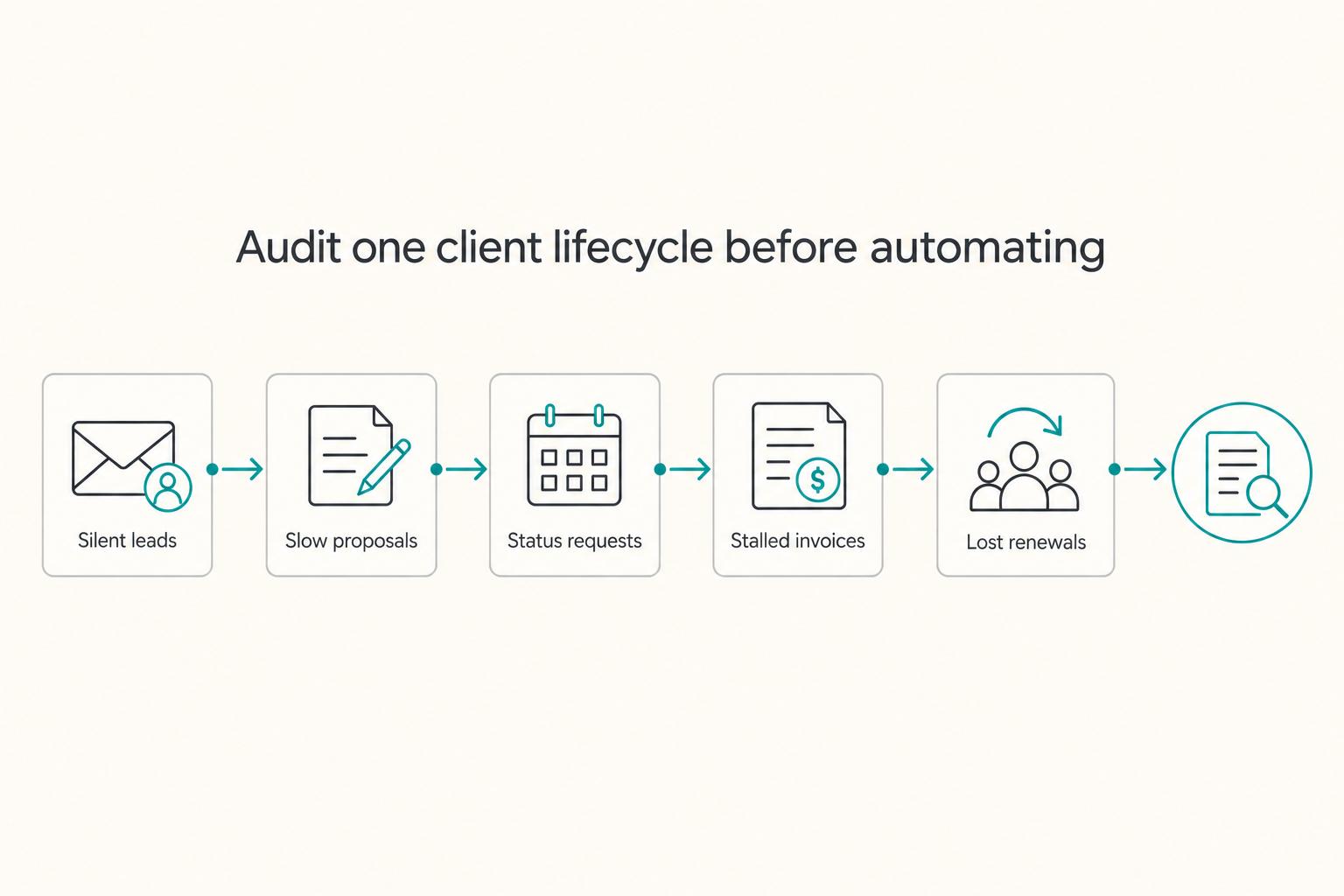
Step 1 Audit one real client lifecycle before you ask for fixes#
Start with one recent project and map it end to end: intake, scoping, delivery tracking, approvals, invoicing, and follow-up. For each stage, define the owner, the entry condition, and the exit condition.
| Symptom | Likely gap | Trigger-based fix | Owner | Entry condition | Exit condition |
|---|---|---|---|---|---|
| Leads go quiet after inquiry | Intake questions change case by case | Standard intake form plus a clear "next step booked" trigger | You | Inquiry received | Qualified call booked or declined |
| Proposals take too long | Scoping details live across scattered messages | Reusable scoping checklist and one proposal input sheet | You | Discovery notes complete | Proposal sent |
| Clients ask for constant updates | Delivery status is not visible | Shared milestone tracker and scheduled update point | You or delegate | Work started | Current status visible to client |
| Work is finished but invoices stall | Approval and billing are disconnected | Final approval triggers invoice creation | You or bookkeeper | Deliverable accepted | Invoice issued |
| Past clients do not return | No closeout or follow-up routine | Closeout checklist and scheduled check-in | You | Project closed | Follow-up sent |
Use one quick clarity test: hand this map to someone else and ask, "Can you tell what starts the next action?" If not, tighten the stage triggers. If weak intake is feeding poor-fit conversations into your pipeline, improve that upstream flow too with How to Network Effectively as a Remote Freelancer.
Step 2 Vet for implementation sequence, not opinions#
Screen for execution order, not just confidence. Use this sequence as your interview rubric: diagnose, redesign, pilot, standardize, review.
Ask: "Tell me about a service process you improved. How did you diagnose the issue, what changed first, what did you pilot, what did you standardize, and how did you review results?" Strong candidates can walk the sequence in order, explain what evidence they needed, and show where they tested before scaling. A useful detail is introducing automation only after the manual process is clear, for example a scheduled daily refresh once inputs are stable.
Watch for red flags: jumping straight to software, skipping diagnosis, or trying to eliminate all operational disorder. There is no single blueprint, and over-structuring can remove useful flexibility.
Step 3 Keep a lightweight scorecard and buy a scoped first engagement#
Track only the stage you are fixing, and tie the scorecard directly to your lifecycle map:
- Intake-to-scope time: measure your current baseline from your own records, then set a target after the pilot
- Proposals waiting on missing inputs: measure your current baseline from your own records, then set a target after the pilot
- Invoice lag after approval: measure your current baseline from your own records, then set a target after the pilot
- Follow-up completion rate: measure your current baseline from your own records, then set a target after the pilot
If your first search returns no suitable match, do not force fit. Some platforms may return no matches and offer an email-request fallback with a stated one-business-day response. Treat that as a backup path, not a quality guarantee.
Keep the first paid engagement tightly scoped:
- Process to fix: one stage only (for example, intake to proposal)
- Expected artifact: one current-state map plus one revised checklist or template
- Handoff owner: named owner for the next action after each trigger
- Review point: short post-pilot check to decide keep, revise, or stop
Seat 3: Finding Your "CMO" Mentor (The Market Positioner)#
This seat is about buying decisions: clarify your positioning so buyers quickly understand your offer, trust it, and see why the scope is worth the price. Focus on positioning, offer clarity, and conversion quality, not broad marketing activity.
Step 1 Screen for proof in buyer-facing work#
Choose this mentor using artifacts you can inspect, not broad visibility claims. Ask for concrete before-and-after examples from homepage messaging, proposal language, and scope terms.
| Positioning choice | Weak signal | Strong signal | Artifact they should improve |
|---|---|---|---|
| Generalist vs specialist | "I help anyone who needs this service" | Clear client type plus clear business problem | Homepage headline and services page intro |
| Feature-led vs outcome-led message | Lists deliverables, tools, or process steps | Explains the result the client is buying | Proposal opening narrative and case-study summary |
| Reactive pricing vs value-anchored pricing | Price sits alone as a number | Price is tied to scope, risk, and expected value | Pricing section, scope notes, and approval language |
A strong candidate should be able to show how they produced a recommendation, not only the recommendation itself. If you are deciding whether to fund positioning help before a larger rebrand or site rebuild, see The Best Ways to Invest in Your Freelance Business.
Step 2 Rewrite the three assets that affect buying decisions first#
Start with the assets closest to the sale before you attempt a full brand overhaul.
| Asset | First-pass change | Verification point |
|---|---|---|
| Homepage message | Rewrite "I offer [service]" into "I help [client type] achieve [outcome] by solving [problem]" | A buyer can explain who you help and what changes after one read |
| Proposal narrative | Lead with business problem, desired result, and why this scope fits | The proposal reads like a decision document, not a task list |
| Scope terms | Add one sentence covering what is included, what is excluded, and when changes need approval | Fewer "Can you also..." surprises during delivery |
If messaging gets sharper but scope terms stay vague, you may create more interest while increasing delivery friction. Treat that as a boundary failure, not a win.
Step 3 Vet for method, sequence, and boundaries#
Use one simple screen: proof, diagnosis, first-pass sequence, and role boundaries.
- Show one example where you narrowed an offer or rewrote positioning for a service business.
- What would you review first: homepage copy, recent proposals, lost-deal notes, or referral sources?
- What is your first-pass sequence after review?
- What is explicitly outside your role: ad buying, full website rebuild, or sales management?
Before the call, verify your current conversion baseline from source records and review notes from lost proposals or confused prospect calls. Build a shortlist by comparing candidate evidence consistently, including relevant work experience, side projects, and personal accomplishments. Then pick the advisor who asks for documents before advice and can state what they would change first and why.
The Board Recruitment Process: How to Engage High-Caliber Advisors#
Once you know which seat you need, treat this as a scoped advisory hire, not a chemistry test. Each step should end with a decision artifact: fit, scoped engagement, or closeout.
| Step | What to prepare or send | Decision artifact |
|---|---|---|
| Step 1 Choose the advisor format | One sentence naming the seat, the constraint, and why you need outside help now | Fit decision on format, source, and shortlist |
| Step 2 Send paid-scope outreach | A short note with one seat-specific constraint, one defined outcome, required inputs, and explicit boundaries | Yes/no response to a fit call, plus a draft scope worth discussing |
| Step 3 Send a proof-only pre-call brief | One page of context, outcome, questions, decision criteria, and only documents that prove the issue | Scoped engagement, smaller test project, or decline |
Step 1: Choose the format and widen sourcing. Start with one sentence like: "I need a COO-style advisor to reduce handoff errors between proposal approval and kickoff." If you cannot state the constraint that clearly, pause before outreach. Use your network, but avoid sourcing only from one circle; that can create a monoculture of advice. If your outreach quality needs work, apply the same discipline from How to Network Effectively as a Remote Freelancer: clear reason for contact, specific ask, and no vague "pick your brain" message.
Step 2: Send paid-scope outreach before booking time. Require four items before any call: the exact seat-specific constraint, one defined outcome, required inputs, and explicit boundaries. Example: "I run a small studio serving B2B SaaS teams. My CMO-seat constraint is that proposals explain deliverables but not business outcomes, and close rates have softened. I want a paid advisory sprint to rewrite proposal narrative and scope language. I can share three recent proposals and lost-deal notes. I am not looking for a full website rewrite or ongoing sales coaching. If relevant, are you open to a short fit call to confirm scope, inputs, and limits?"
Use this message as a filter. It tests whether they engage on one specific issue and helps you avoid broad, unscoped conversations. A practical red flag is persistent unavailability before any agreement.
Step 3: Send a one-page brief with proof-only documents. Keep it tight: what you sell, who you serve, the current constraint, the outcome you want, two to four questions, and your yes/no/not-yet criteria. Then enforce the proof-only rule: include only documents that prove the issue. Do not send full workspaces, long transcript dumps, or unrelated screenshots.
Too much context usually creates vague advice loops. A strong early signal is whether their first comments anchor to your documents instead of generic opinion.
Use the same framework at hiring, onboarding, and renewal so decisions stay consistent:
| Phase | Problem fit | Evidence quality | Boundary discipline | Execution plan | Decision artifact |
|---|---|---|---|---|---|
| Hiring | Do they narrow the issue quickly? | Do they use your documents, not just opinion? | Do they state what is out of scope? | Can they name the first change they would make? | Hire, test with smaller scope, or decline |
| Onboarding | Are they still focused on the agreed constraint? | Are requests for more material relevant and limited? | Are they resisting scope creep? | Are priorities and outputs written down? | Confirm scoped engagement or reset expectations |
| Renewal or closeout | Was the original constraint reduced? | Did their advice improve decision quality? | Did they stay in role instead of expanding endlessly? | Is there a new, separate constraint worth solving? | Continue, narrow to new scope, or stop |
Continue when advice is evidence-based, boundaries hold, and decisions become clearer. Stop when sessions drift, the same issue stays fuzzy, or progress depends more on charisma than resolved constraints. If you want advice that actually helps, treat renewal as a business decision.
Conclusion: You Are the Chairman of Your Board#
You now have something more useful than a vague mentor plan: a role-based advisory board model and a practical lens for making business decisions. Used well, distinct advisor roles and combined perspectives can help you make better-informed decisions and stay focused on long-term goals.
An advisory board is still advice, not governance. That distinction matters. Unlike a governing board, an advisory board does not make decisions for you, so your job is to define each advisor's role clearly, weigh their input, and make the final call yourself.
- Choose your first gap. Pick the one business decision or constraint creating the most friction right now.
- Define a narrow scope. Turn that gap into a clear advisory brief, and make sure each advisor's role is explicit.
- Set expectations in writing. Confirm that the engagement is advisory and non-binding, and that you remain the decision owner.
- Run and review. Hold a focused meeting, track recommendations, and check whether the input improved your decision quality. If you add members later, focus on quality over quantity.
If you use a mentor program, treat matching as a fit check and plan for limited mentor capacity in each cohort.
That is the operating model. Keep your board role-specific, quality-first, and under review. You do not need a guru. You need good advice, clear boundaries, and the discipline to revisit what your business needs next.
For a step-by-step walkthrough, see How to Find Your First Freelance Client.
This pairs well with our guide on How to Create a Lindy-Proof Freelance Career.
Frequently Asked Questions
Should you ask for an ongoing mentorship, or propose a scoped paid ask?
Do not open with “be my mentor” in your first message. A narrower ask works better because very few people want to take on an official mentee role, and direct first-message mentor asks often get no reply or a no. If you want to spend money, keep it to one defined outcome instead of vague ongoing access so scope and expectations are clear. If you need help thinking through that kind of spend, The Best Ways to Invest in Your Freelance Business is a useful companion read.
How should you approach someone cold, and what should the first message say?
Warm the contact first if you can. Follow, subscribe to, and engage with their content before you reach out, because a sudden mentor ask can land as desperate or overly intense. Keep the note short and concrete: name one problem, why you think they are relevant, what material you can share, and what is outside scope. Do not ask to “pick their brain,” and do not make the first message about a long-term relationship. If you need help with the outreach mechanics, How to Network Effectively as a Remote Freelancer is the right companion read.
Where should you look first, and how do you verify fit quickly?
Start with channels that let you match a real business problem to a real person, not channels that simply feel prestigious. The right test is whether they engage with your actual constraint and the proof you send, not whether you admire their brand. Guidance on channels here is limited and partly user-generated, so treat channel choice as a test, not a rule. | Channel | What to do now | What to verify yourself | | --- | --- | --- | | Expert platforms | Use them as a matching tool and filter for the exact problem you need help with | How vetting works, what the engagement costs, and whether advice quality fits your situation | | Public communities or forums | Look for niche groups where mentor-seeking posts or introductions already happen | Whether the group has any real vetting and whether the person has relevant operating experience | | Direct outreach to relevant experts | Contact the person with one bounded ask after you have engaged with their content | Whether they reply with scope, boundaries, and interest in your evidence instead of generic encouragement | One practical verification point is their first useful response. A stronger match usually narrows the issue, asks for relevant context, and sets boundaries; a weaker match often stays broad or ignores the specific problem you need solved.
Try a related tool
Researched and edited by the Gruv editorial team. Gruv builds cross-border billing, payouts, and finance-operations software for global businesses.
Sources
Includes 4 external sources outside the trusted-domain allowlist.
- cn.edu/wp-content/uploads/2024/08/2024-25-Undergrad...trusted
- fincen.gov/report-foreign-bank-and-financial-accountstrusted
- irs.gov/individuals/international-taxpayers/foreign-...trusted
- irs.gov/individuals/international-taxpayers/figuring...trusted
- boardroomadvisors.co/key-roles-and-responsibilities-of-an-effecti...external
- bobatalks.com/mentorsexternal
- evisors.com/searchexternal
- indexventures.com/scaling-through-chaos/consider-a-chief-opera...external
Educational content only. Not legal, tax, or financial advice.
Related Posts

Digital Nomad Health Insurance Comparison for Long-Stay Moves
Use focused time now to avoid expensive mistakes later. Start with a practical `digital nomad health insurance comparison`, then map your route in [Gruv's visa planner](/tools/visa-for-digital-nomads) so we anchor policy checks to your real plan before pricing pages pull you off course.

How to Network Effectively as a Remote Freelancer
Treat **remote freelance networking** as recurring relationship work, not a burst of applications or random visibility. That shift turns a noisy week into a useful one. You spend less time in low-fit conversations, lose less time to busywork, and end each session knowing the next move.

Invest in Your Freelance Business by Protecting Cashflow First
Start with payment reliability before you buy another growth tool. Courses, coaching, and software can help delivery, but they do not protect cashflow when payment is delayed, disputed, or never sent. A practical move is to make each engagement payable, traceable, and harder to derail from kickoff to settlement.