
Quick Answer
Start by treating the meeting as a scoped discovery workshop with one exact prompt and one decision owner. To facilitate brainstorming session work with a client, gate the invite until objective, scope note, and output format are confirmed in writing. Run ideation and selection in separate modes, keep one shared board as the record, and send tangents to a Parking Lot with owner and next review trigger. Close with a written approval ask tied to named Work Packages.
Stop giving away your best thinking for free. A "client brainstorm" too often turns into an unpaid, chaotic meeting that produces vague ideas and unbillable scope creep. That is not a creativity problem. It is a process problem.
If you need to facilitate a session with a client, do not treat it like a loose brainstorm. Treat it as a scoped discovery workshop. The simplest way to keep control is to use a clear sequence: Contain, Extract, Convert.
In practice: lock one prompt, separate idea generation from evaluation, and turn the output into named work packages with owners and next steps.
Part 1: CONTAIN - Frame the Session for Maximum Control#
Do not send the invite until three things are true. The objective is specific. One person owns the decision path. Everyone knows what will happen to the ideas after the session. If any of those are missing, do not run the session yet. Moving fast in that state does not protect creativity. It creates confusion.
Gate the session before it hits anyone's calendar#
Gate the session before it reaches anyone's calendar. What matters most in planning is still the same: the desired outcome and the agenda. Pair that with one clear prompt only. When a brainstorm tries to answer multiple questions at once, it usually drifts into side debates.
| Readiness item | What to confirm |
|---|---|
| Objective and exact prompt | one sentence for the outcome, one sentence for the question on the board |
| Decision owner | one named person who will decide how outputs move forward |
| Scope note | what is in scope, what is out of scope, and the time box for the session |
| Working agreements | short room rules, including no evaluation during idea capture and one speaker at a time |
| Capture owner | one facilitator and one recorder assigned before the meeting starts |
| Output format | how the notes will leave the room, ideally as an action list with what, who, and by when |
| Post-session use | whether ideas will be prioritized, parked for review, or turned into a follow-up proposal |
Use this as your pre-invite readiness checklist. Treat any missing item as a stop signal.
If the client says things like "we'll know the question when we get in the room," "everyone will decide together," or "let's just see what comes up," pause the setup. Those are not harmless placeholders. They often signal that stakeholders are solving different problems under one invite.
A reliable verification check is simple. Ask the client contact to send back the objective, prompt, and decision owner in writing. If they cannot restate those clearly, you do not have alignment yet.
Send an agenda brief that acts like an operating note#
Send an agenda brief that works like an operating note, not a topic list. Circulating it in advance gives people time to prepare, which matters even more when scope is likely to expand in the room.
| Moment | Include |
|---|---|
| Before the meeting | objective, exact prompt, time box, roles, working agreements, and capture method |
| At kickoff | confirm the decision owner, restate the desired outcome, and show where ideas and off-topic items will be captured |
| Right before ideation | restate the single prompt, remind the room that discussion and clarification are paused during initial capture, and explain what happens next once the idea list is complete |
Keep the brief short, but make it do those three jobs.
That last point matters. If people do not know whether the output becomes a shortlist, a Parking Lot, or a follow-up action list, they may start evaluating in real time. If your work often blends positioning and idea generation, A guide to running a 'Brand Workshop' with a client is the adjacent pattern.
Set inclusion controls before the loudest person does it for you#
Set inclusion controls before the loudest person does it for you. Good facilitation is not just keeping time. It is protecting the process so the session stays on course and more than two people shape the output. A concise inclusion control block works well:
- Start with 5 to 10 minutes of silent idea writing
- Move to structured turn-taking, one contribution at a time
- Keep capture visible to the whole room
- Use a visible Parking Lot for off-topic items
- Hold all evaluation and clarification until the initial list is complete
These controls protect against two common failure modes. The first is production blocking, where people lose ideas while waiting to speak. The second is evaluation apprehension, where they self-censor because the room starts judging too early.
| Pitfall | Facilitator control | Early warning signal | Immediate corrective move |
|---|---|---|---|
| Multiple problems hidden in one invite | One visible prompt only | People answer different questions in the first 5 minutes | Stop, rewrite the prompt live, and park extra questions |
| Early critique or clarification | No discussion during initial capture | "That won't work" or "what do you mean?" appears early | Restate the rule and return to silent or round-robin capture |
| Dominant voices crowd out others | Silent start plus turn-taking | Two people speak repeatedly while others stay quiet | Go person by person and take one idea each before open discussion |
| Tangents eat the session | Visible Parking Lot | Side issues start generating their own debate | Record the tangent, assign a review point, and return to the agenda |
| Notes disappear into private docs | Visible recorder and shared board | Participants ask for repeats or duplicate ideas | Read back what was captured and keep one public list only |
Your checkpoint at the end of containment should be concrete. Every participant can state the prompt, see the rules, identify the decision owner, and name the output format. Once that is true, you can move into idea generation without giving away control.
Related: Best Icebreaker Activities for a Client Workshop.
Part 2: EXTRACT - Facilitate for Value, Not Just Volume#
To get usable output, run the room in two explicit modes, keep one visible record, and close with clear ownership for what happens next.
Run two modes and name the switch#
Start in divergent mode: generate options for one specific question, and defer evaluation. Then switch to convergent mode: compare, cluster, and narrow.
Use direct facilitation cues so the room can follow the mode:
- "We are in idea mode: add options only. No critique or feasibility checks yet."
- "We are now in selection mode: we will group, test, and narrow."
Watch behavior, not agreement. If critique appears during idea capture, pause and restate the current mode. In many sessions, the active brainstorm window is about 15 to 60 minutes, so early drift costs you usable output.
When tangents appear, use the same intervention each time: acknowledge the point, tie it back to the session question, then route it now or park it. For example: "Useful point. Does it help answer today's prompt right now? If yes, add it as an idea. If not, we'll park it for follow-up."
Match the method to the problem shape#
Choose the method by problem type, not preference.
| Method | Use it when | Facilitator prompt style | Misuse signal | Recovery move |
|---|---|---|---|---|
| SCAMPER | You are improving an existing component, process, or strategy | Run the seven prompt types (substitute, combine, adapt, modify, put to another use, eliminate, reverse) against the current artifact | Team drifts into blank-slate ideation with no shared object | Put the current artifact on the board and restart from it; if needed, use three to five minutes per category, then two to three minutes to read responses |
| How Might We | The brief is still fuzzy and needs open framing | Phrase the challenge as a possibility question that allows multiple solutions | Prompt implies one answer, or is so broad that everything qualifies | Rewrite with a clearer user, outcome, or constraint; if it blocks multiple solutions, broaden it |
| Six Thinking Hats | Discussion mixes reactions, risks, facts, and ideas at the same time | Put everyone in one thinking mode at a time and announce the current hat | Participants use different hats simultaneously and argue across modes | Reset with blue hat process control, then restate the current lens; keep black hat discussion on risk |
Keep one visible board as the single source of truth#
Use one shared board as the session record. If an idea is not captured where everyone can see it, it is hard to trust later.
Keep board discipline simple and consistent:
- One board only
- Consistent labels
- Simple IDs for traceability into prioritization and follow-up
Apply the same discipline to the Parking Lot. Before close, each parked item should include:
- Why it was parked
- Owner
- Current status
- Next review trigger
Close extraction with a decision-readiness check#
Before you end this phase, confirm each shortlisted item has:
- Objective fit: It answers the exact session question
- Scope fit: It belongs in this phase (or is clearly future-phase)
- Feasibility: It can pass a first practical screen
- Owner and next step: One person responsible and an immediate follow-up action
Related framework depth: Build a Scenius Portfolio for a Stronger Creative Community.
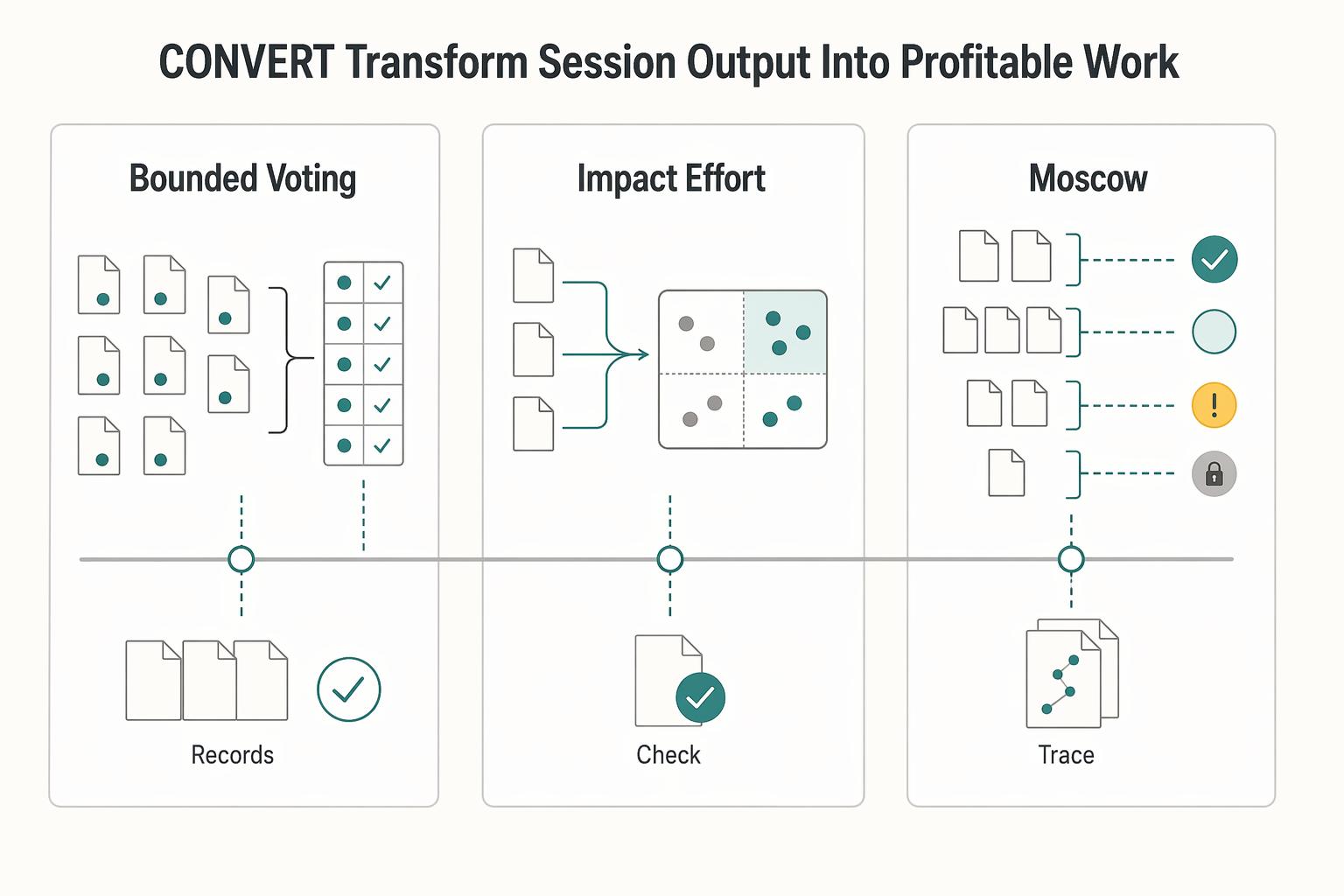
Part 3: CONVERT - Transform Session Output into Profitable Work#
Turn captured ideas into decisions and a proposed next scope. A workshop shortlist does not authorize delivery or automatically make the next phase billable: compare it with the existing agreement, then obtain any required approval for scope, fee and timing.
| Step | What to do |
|---|---|
| Step 1 | Cluster ideas into themes, keep every item traceable, and map each proposed work item to captured board labels |
| Step 2 | Run a quick filter first if needed, then use one prioritization method on the shortlist with the decision owner explicit |
| Step 3 | Write one Work Package for each priority with objective, deliverable definition, dependency owner, decision owner, scope boundary language, explicit out-of-scope notes, and acceptance criteria |
| Step 4 | Summarize chosen priorities, list open approvals, attach the Work Packages, and ask which package is approved now, who signs off, and what starts first |
Step 1. Cluster ideas into themes and keep every item traceable. Work from the shared board, not memory. Group ideas by similarity (affinity style), then name each cluster in plain language the client will recognize in the proposal. Keep useful ideas even when the list is short; volume is not a quality measure.
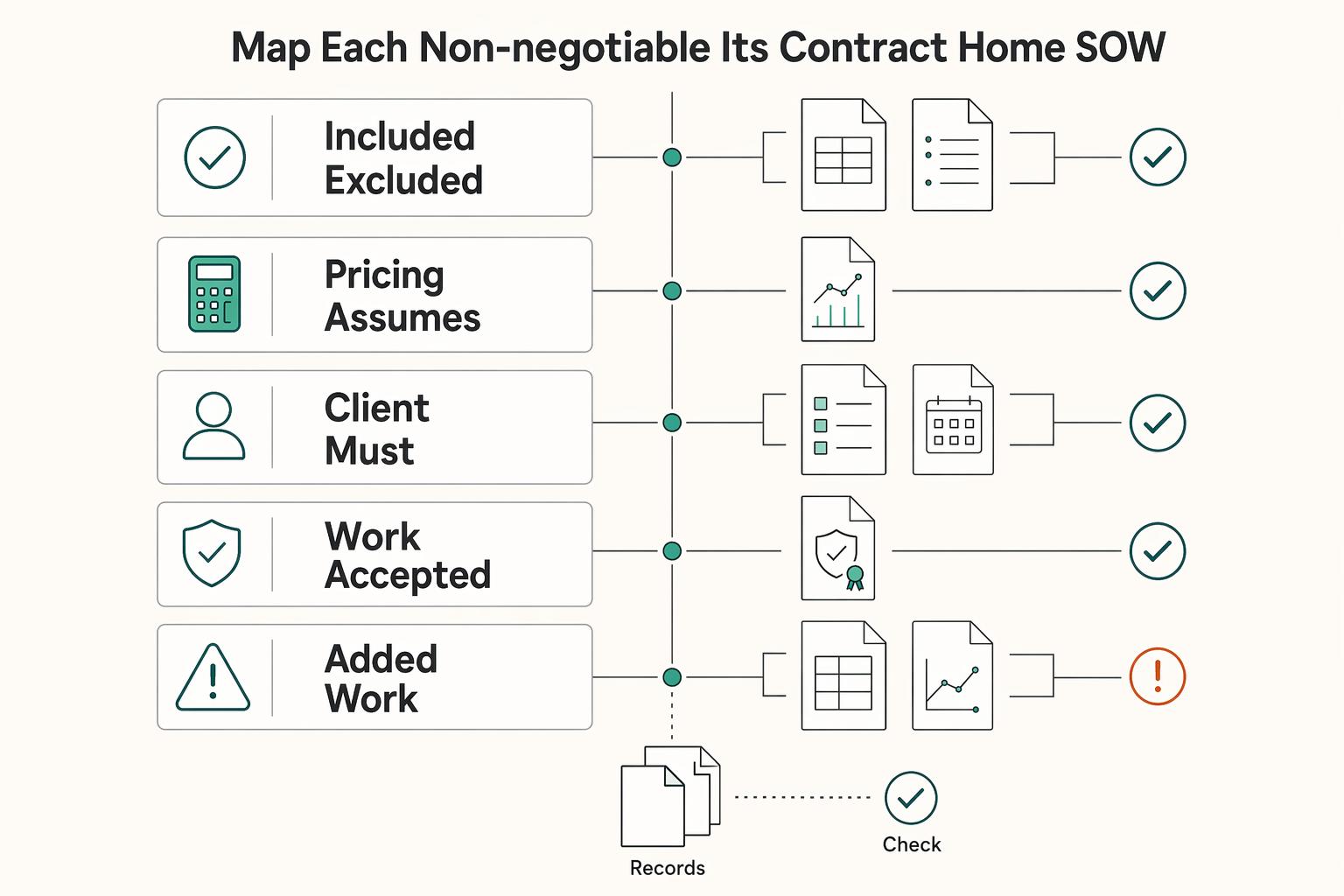
Use one non-negotiable rule: every proposed work item must map to captured board labels, or it returns to the Parking Lot for clarification. If a theme cannot be traced to specific labeled ideas, do not move it forward.
Step 2. Prioritize with one method at a time, and keep the decision owner explicit. If the list is still long, run a quick filter first (for example, six votes per person), then use one prioritization method on the shortlist. Do not stack frameworks to simulate certainty. These methods improve comparison, but they do not replace the single decision owner.
| Method | When to use it | What it cannot decide | Bias warning signs |
|---|---|---|---|
| Bounded voting | You need a fast cut from a long list to a workable shortlist | Feasibility, scope boundaries, commercial fit, final approval | People vote for familiar options, their own ideas, or senior voices |
| Impact vs. Effort | You need a quick sequence for what to do first; simple grids are faster, complex matrices are more precise | Exact estimates, ownership, acceptance criteria, final approval | Impact gets overstated, effort gets understated, or scoring shifts to justify favorites |
| MoSCoW | You need clearer agreement on Must/Should/Could/Won't this time | Budget/timeline commitment, final approval, accountability | Too many items become Must, or teams avoid hard tradeoffs by relabeling |
Checkpoint: after prioritization, you should be able to explain each rank without relying on "it felt important."
Step 3. Turn each chosen theme into an approval-ready Work Package. For each priority, write one Work Package with: objective, deliverable definition, dependency owner, decision owner, scope boundary language, and explicit out-of-scope notes. Add acceptance criteria so acceptance conditions are clear before delivery.
If a dependency touches another team or system, name the owner and set a recurring review rhythm (for example, weekly or monthly) so follow-through does not fade after the workshop.
Step 4. Send a handoff that asks for a decision, not just acknowledgment. Summarize chosen priorities, list open approvals and attach the Work Packages. Propose a response date that fits the client’s decision process and your capacity; distinguish that date from an agreed delivery deadline.
Close with a direct approval ask: which package is approved now, who signs off, and what starts first.
From Facilitator to Strategic Partner#
If you want to be seen as a strategic partner, run the session toward a decision, not just a discussion. Your operating standard is clear: one scoped question, one explicit decision owner, traceable priorities, and a written approval ask.
| Observable signal | Meeting runner posture | Strategic partner posture |
|---|---|---|
| Scope discipline | Lets the brief expand as new ideas appear | Repeats the exact decision question, enforces boundaries, and parks out-of-scope items for later review |
| Decision hygiene | Treats all input as equal authority | Sets one final Approver, assigns a Driver to keep scope/date on track, and separates input from decision authority |
| Conversion to next actions | Ends with notes and impressions | Ends with ranked options, named owners, due dates, and a written request for approval |
Contain the decision#
Open by stating the decision to be made in one sentence. Before ideation starts, name one Approver and one Driver so authority and operating ownership are explicit. Confirm the boundary out loud and checkpoint it: everyone should be able to repeat the decision question, what is out of scope, and who makes the final call.
Extract options without muddying authority#
During idea generation, enforce a no-evaluation rule so the room produces options before judging them. Keep capture visible, and if one voice starts narrowing the group too early, switch to silent capture or round-robin input. Then move to selection as a separate step so you do not confuse contribution with authority.
Convert output into an approval-ready handoff#
Close by labeling and clustering ideas, then rank them with explicit criteria the client agreed to. Turn selected items into next actions with an owner and due date, and tie each action back to a captured item from the session record. In your follow-up, send the priority list, confirm the decision owner, and include a direct written approval ask.
Frequently Asked Questions
How do you prevent scope creep in a client brainstorming workshop?
Lock the question and rules before ideation starts. Capture every idea on a visible board or flipchart as it is voiced, and stop evaluative comments during ideation. Before you close, prioritize the full list into a shorter list and clearly mark which ideas are deferred in the written recap. The recap records choices; it does not amend the signed scope or fee without the agreed approval.
What is a professional agenda for a paid client discovery session?
Start with the exact question to be solved and review the brainstorming rules first. Then run ideation with visible capture, use a one-minute quiet thinking period if needed, and finish by prioritizing the full list into a shorter one. End by naming the next review step and the project checkpoint the shortlist feeds (for example, a SOW draft or PDR).
How do you turn brainstorming ideas into a Scope of Work?
Build the SOW from captured session output so each deliverable is traceable. After ideation, number or letter the ideas and prioritize the shortlist. Turn shortlisted items into deliverables with clear scope boundaries and a defined review checkpoint (such as PDR). If a proposed deliverable cannot be traced back to the captured list, pause and clarify before it enters the SOW.
How do you charge for facilitating a brainstorming session?
Agree the workshop fee before the session, including preparation, facilitation and the written recap. For example, an illustrative fixed-fee package could cover two hours of preparation, a 60-minute workshop and a prioritized recap; follow-up design or implementation requires a separately agreed scope unless already included. State who can approve extra time and how it will be charged.
What changes when you facilitate for an internal team instead of a client?
Keep the core method the same in both settings: clear question, no-evaluation rule, visible capture, and prioritization after ideation. Internal workshops are not automatically better or worse than client workshops. In either case, make the next artifact or checkpoint explicit so decisions trace back to the captured session output.
Try a related tool
Researched and edited by the Gruv editorial team. Gruv builds cross-border billing, payouts, and finance-operations software for global businesses.
Sources
Includes 1 external source outside the trusted-domain allowlist.
- acf.gov/sites/default/files/documents/ocs/TTA_CSBG_P...trusted
- extension.umn.edu/public-engagement-strategies/create-working-...trusted
- hr.mit.edu/learning-topics/meetings/articles/brainstormingtrusted
- hr.mit.edu/learning-topics/meetings/articles/basicstrusted
- mit.edu/course/21/21.guide/agenda.htmtrusted
- sloanreview.mit.edu/article/improve-creative-brainstorming-with-...trusted
- web.stanford.edu/group/instr_design/cgi-bin/LEAD_TIP/dt_to_go...trusted
- agilebusiness.org/dsdm-project-framework/moscow-prioritisation...external
Educational content only. Not legal, tax, or financial advice.
Related Posts
Run a Brand Workshop With a Client That Clarifies Scope Early
If you want to [run a brand workshop](https://trekk.com/insights/how-to-run-a-brand-workshop) well, treat brand as a decision model, not a debate about fonts. The real job is to help a client define how they explain value, where they draw boundaries, and how work gets approved before visuals lock anything in.

The Freelance Payment Penalty: A Modeled Audit of Platform Fees, FX Spreads, and Payout Delays
The money rarely disappears through a single, easy-to-spot fee. The real loss is stacked. A marketplace takes its commission, a processor adds a charge for international cards, a bank or payment company converts the currency at a spread, a platform holds the funds before release, and a wire sheds a little to intermediaries on the way in. Each layer looks defensible on its own, but the worker feels the combined result as a smaller deposit and a later payday.

How to Respond to a Subpoena for Business Records
Move fast, but do not produce records on instinct. If you need to **respond to a subpoena for business records**, your immediate job is to control deadlines, preserve records, and make any later production defensible.