
Quick Answer
Start with a simple weekly system: pre-plan your first grocery stop, keep repeatable meals built around protein and produce, and use fallback rules for airport, gas station, and fast-food days. To eat healthy while traveling long-term, treat choices as consistency over several meals, not perfection at every stop. A practical checkpoint before busy days is to confirm your next meal window, your backup option, and where you are most likely to make a rushed choice.
Eat Healthy While Traveling Long-Term Without Overthinking Every Meal#
Step 1. Set a realistic target. Healthy eating gets harder on long trips for predictable reasons: long travel days, restaurant-heavy routines, and work that keeps moving. If you are staying somewhere for weeks or months, the goal is not to get every meal right. The goal is to make enough solid choices that one rushed breakfast, late dinner, or convenience-store stop does not turn into a full-week slide.
This guide is for that longer-stay reality, not a short vacation where you can just wing it. You should expect tradeoffs, limited options, and days when work gets in the way. The promise is simple: you can enjoy where you are and still keep moving toward your health goals.
Step 2. Decide before hunger makes the call. The biggest shift is not finding the perfect meal. It is having a short list of good-enough defaults ready before you are tired, late, or stuck with whatever is closest.
That matters because common travel food pitfalls often start when you skip meals, eat whatever is convenient, or snack mindlessly. By the end of this guide, you should have workable rules for the moments that break good intentions first: rushed days, limited options, and messy transit schedules.
Step 3. Measure progress across a stretch of travel, not one plate. Treating every meal like a test makes this harder than it needs to be. If lunch was random because your train was delayed, the next decision is what matters. If dinner was heavier because you went out with friends, you do not need to "fix" it by restricting the next morning.
A better standard is consistency across the next few meals. That keeps you out of the common loop: long gap, poor choice, guilt, overcorrection, repeat. On long trips, steadiness beats intensity.
Step 4. Use a simple checkpoint. Before a workday, travel leg, or outing, pause for 30 seconds and confirm three things:
- What is your next real meal window?
- What is your backup if plans slip?
- Where are you most likely to make the wrong choice because you will be rushed?
If you can answer those quickly, you have planned enough. If you cannot, that is a red flag. Many bad food days start with no plan, no backup, and a long gap before the next meal. That is the thread for the rest of this guide: practical, flexible, and built for real constraints.
If you want a deeper dive, read How to Stay Healthy and Fit While Traveling.
Prepare Before Departure So Healthy Choices Are the Default#
Set simple defaults before you leave so you make fewer food decisions during travel.
Build a 7-day starter list#
Start with fuel foods, then add fun foods on purpose. This keeps your first week structured without turning eating into rules-heavy tracking.
Write a short list of meals and snacks you can realistically repeat after arrival, then layer in the treats you actually want. If your list has fun items but no reliable meal or snack anchors, tighten it before you go.
Pack a transit kit you will actually use#
Transit is often where healthy choices get harder, so plan for delays. Pack a small shelf-stable snack kit with options you already know you will eat, plus one filling backup.
Do a quick check the night before departure so it is in your personal bag and ready when plans slip.
Pre-decide your fallback order#
On low-option days, use a rule instead of improvising. If you end up with fast food or a food court, choose the least greasy option and lean toward sandwiches, salads, fruit, or similar lighter choices when they are available.
Deciding this before departure makes rushed choices easier when you are tired or behind schedule.
Save nearby food options before arrival#
A few minutes of pre-trip research helps you spot airport dining, restaurants, and grocery stores near your destination. Save the places you are most likely to use first so your first day does not default to random choices.
Quick check: can you name your first grocery stop and your first fallback meal option? If not, finish that before you leave.
You might also find this useful: A Guide to Healthy Snacking for a Productive Workday.
Set Up Your First 48 Hours in a New City#
Your first 48 hours can set the tone for how easy your food choices feel, so set simple defaults early instead of deciding everything when you are tired.
| When | Focus | Grounded detail |
|---|---|---|
| When you arrive | Check the kitchen before making a food plan | Review cold storage, basic prep space, and enough utensils for simple meals |
| Before optional dining out | Do a first haul at a local supermarket | Focus on reliable breakfast options, portable work snacks, and quick, simple dinners |
| Early workdays | Build one no-decision workday template | Choose a repeatable breakfast, a simple lunch plan or fallback, one snack, and one fast dinner |
| By the end of day 2 | Verify what is already in your lodging | Be able to put together meals and snacks without relying on delivery apps; do a small restock if not |
Step 1. Check the kitchen before making a food plan. When you arrive, do a quick reality check on what you can actually use: cold storage, basic prep space, and enough utensils for simple meals. If the setup is limited, adjust immediately and buy foods that need less prep.
Step 2. Do a first haul at a local supermarket before optional dining out. Keep the first shop focused on function so the next two days are covered:
- reliable breakfast options
- portable work snacks
- quick, simple dinners you can make without much effort
Travel days are often less routine than home days, so defaults help when your schedule is unpredictable.
Step 3. Build one no-decision workday template. Pick a repeatable breakfast, a simple lunch plan (or fallback), one snack, and one fast dinner. The goal is to lower decision load while you settle in, not to create a perfect menu.
Step 4. Verify by the end of day 2. Use a practical check: can you put together meals and snacks from what is already in your lodging without relying on delivery apps? If not, do a small restock now so busy workdays do not push you into random fast food choices.
Use Fuel Foods and Fun Foods as a Weekly Decision System#
Once your first 48 hours are set, stop making every meal a new decision. Use one weekly rule: keep most meals in your fuel-food routine, and plan fun foods on purpose.
Step 1. Set a repeatable baseline for ordinary meals. For day-to-day breakfasts, lunches, and quick dinners, use a consistent template built around non-starchy vegetables, lean protein, and complex carbohydrates. You do not need strict ratios; you need a default you can repeat across grocery runs, simple kitchens, and casual restaurants.
Step 2. Put fun foods on your calendar in advance. Treat fun foods as planned events, not open-ended defaults. Pick where they fit in your week (for example, a social dinner or local specialty meal) so they stay intentional instead of drifting across multiple days.
Step 3. When heavier meals are coming, keep earlier meals simple. If you already know you have a client dinner or food-focused event, keep earlier meals anchored to your fuel-food template and regular timing. The goal is consistency through the day, not trying to "undo" the later meal.
Used this way, the system stays simple: routine meals are predictable, and fun meals are deliberate.
Make Fast Choices in Airports, Gas Stations, and Fast Food Stops#
When options are limited, use a good-enough rule: make one fast, stable choice and move on instead of waiting for a perfect meal.
Make the fastest workable choice#
Scan in this order: protein first, produce second, then hydration. If you can identify at least two of those three, you have a workable stop.
| Stop type | Protein check | Produce check | Common trap |
|---|---|---|---|
| Airport | Pick one item with a clear protein source | Add one produce item if available | Letting urgency turn coffee and a pastry into the whole meal |
| Gas station | Choose one protein item you can eat immediately | Add any available produce option | Treating a "quick stop" like it does not count, then buying only fast energy |
| Convenience store | Pick one simple item with a clear protein source | Add one produce item from the cold case or shelf | Grabbing a combo that is cheap now but does not hold you for long |
| Fast food | Order the most straightforward protein-forward option | Add the produce side or produce built into the meal | Building the order around extras instead of the core meal |
One grounded airport pricing detail: at PANYNJ airports, the Street Pricing policy describes concession pricing at street prices with a capped surcharge and requires some lower-priced food and beverage options. Do not assume that policy applies at every airport; check what is posted where you are.
Use a stopgap when no full meal exists#
If no full meal exists, combine two snack items and treat it as a bridge to your next real meal. For example, nuts plus fruit can be enough to stabilize you when choices are thin.
Use this threshold: hit at least two of three before you leave the stop.
proteinproducehydration
That keeps you out of all-or-nothing thinking and reduces the "underfed now, overbuy later" pattern.
Adjust for red-eye days vs road-trip days#
On red-eye days, decide earlier: eat before boarding when possible, hydrate before you lose control of timing, and carry one compact backup snack for delays.
On long road-trip days, decide fewer times: pick planned food-and-water stops, and buy your next snack before you are already tired and making rushed choices.
If you want one memory rule: flight days need earlier decisions; road days need fewer decisions.
Pack and Restock Snacks That Survive Real Transit#
Keep this part flexible and low-risk. Make adjustable choices during transit, then settle into a fuller routine once you can reliably restock at your destination.
What to pack for real transit#
This section stays intentionally light on hard rules. It does not rely on a fixed restock cadence or detailed durable-versus-delicate snack rules.
Practical use of this section right now#
Use this section as a reminder to make adjustable transit choices, then lock in your food routine once you can reliably restock at your destination.
Handle Restaurants and Local Foods Without Losing Your Week#
Restaurant meals usually do not derail your week on their own. The bigger risk is when large portions, travel habits, and frequent rich choices stack up across multiple meals. Keep local food in the plan, but make most orders deliberate so splurges stay intentional.
Step 1. Set a default before you order#
Set a default before you order: aim for a meal with a solid protein option and some produce when available, then decide whether a richer local specialty fits this meal or a later one. That keeps you from turning every restaurant stop into the heaviest option on the menu.
This is not a strict diet rule. It is a judgment rule for travel, when routines slip and meals can drift toward more carbohydrates and less protein. Enjoy the specialty meal on purpose, then return to your usual structure at the next meal.
Step 2. Plan team meals and client dinners in advance#
Team meals and client dinners are easier when you decide early. If you can, check the menu in advance and pick a default order so you are not choosing under pressure. If the meal is fixed or family-style, build one plate once, then pause before going back for extras.
The main risk is usually portion-driven overeating, not one specific food. Restaurant meals are often calorie-dense, and people tend to eat more when more food is in front of them. In practice, do not treat every add-on as automatic just because it is on the table.
Step 3. Make the next decision quickly after a heavier meal#
After a heavier meal, make the next decision quickly so one dinner does not spill into the next two. If you feel normal, eat normally at your next meal. If you feel heavy, choose a lighter, straightforward meal and keep regular timing. If you feel overly full or sluggish, hydrate and return to a simple balanced meal instead of skipping and overeating later.
There is no quick recovery from a full week of overdoing it, but there is a clear next move after one rich meal: make the next meal ordinary and steady.
Recover Quickly After Off-Plan Days#
One off-plan day does not erase your progress. If travel disruption leaves you feeling sluggish, recover by getting back to your normal routine quickly instead of trying to "make up" for it.
Step 1. Run a simple reset at the next meal#
At the next meal, run a simple reset: choose a straightforward, balanced plate and return to your usual eating pattern. Keep the goal practical, not perfect. Your healthy efforts are not lost, but recovery takes a deliberate return to normal habits.
Step 2. Use a simple plan you already trust#
When your schedule breaks down, use a simple plan you already trust instead of improvising while stressed or tired. Even a "good enough" choice is useful when structure disappears. In disrupted travel days, a basic plan is usually what keeps the day from drifting further off track.
Step 3. Avoid all-or-nothing reactions after a rough day#
Avoid all-or-nothing reactions after a rough day. Stay focused on consistency, because that is what keeps one disruption from turning into a longer slide. If you finish the day back on ordinary meals and routine, the reset did its job.
For a step-by-step walkthrough, see How to Maintain a Healthy Routine While Traveling.
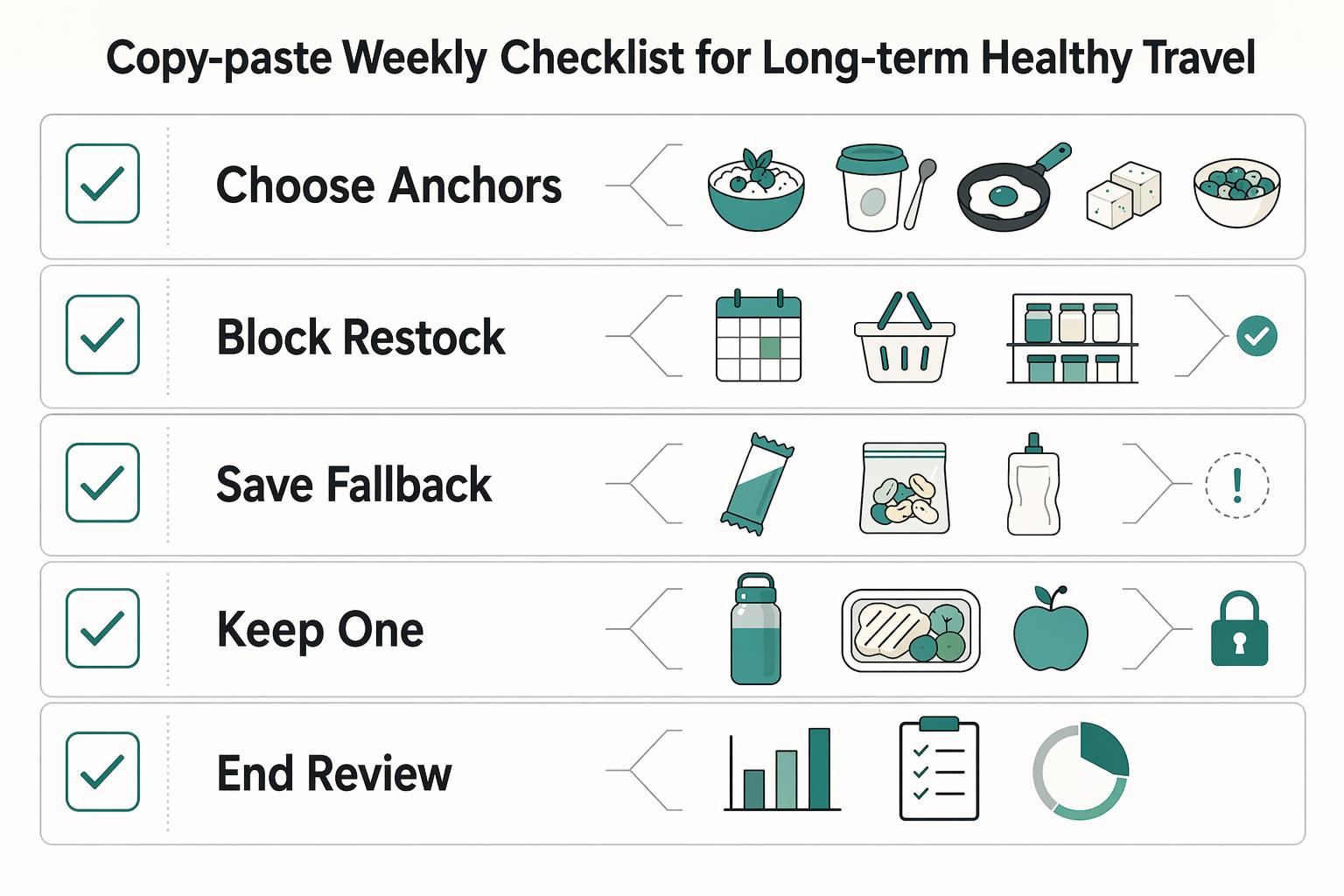
Copy-Paste Weekly Checklist for Long-Term Healthy Travel#
Use this as a weekly reset, not a perfection test: the goal is fewer decisions and fewer hunger emergencies, especially on transit-heavy days.
| Checklist item | Grounded target | Details |
|---|---|---|
| Choose your anchors | 2 to 3 default breakfasts, 2 portable snacks, 2 quick dinners | Build each main meal around a protein anchor first |
| Block restock and fun food | 1 restock block and 1 fun-food meal | Schedule one restock block before you run low, and plan one fun-food meal on purpose |
| Save fallback choices | 1 default choice for an airport, gas station, and convenience store | Use the same order structure each time: protein first, add produce if available, then one carb source |
| Keep one visible food rule | Protein at each main meal, one produce item when you can, carbs timed around when you need energy | Keep this rule where you will actually see it before you choose food |
| End with a review | 5-minute review | Write down what worked, what failed, and what to adjust next week |
Step 1. Choose your anchors. Pick 2 to 3 default breakfasts, 2 portable snacks, and 2 quick dinners you can repeat this week. Treat these as your template, not a hard rule. Build each main meal around a protein anchor first (for example, eggs, Greek yogurt, tofu, beans, grilled chicken, or turkey when available).
Step 2. Block one restock window and one fun-food meal. Schedule one restock block before you run low, and plan one fun-food meal on purpose. This keeps local eating enjoyable without turning the whole week into random choices.
Step 3. Save fallback choices for low-option days. Pre-save one default choice for an airport, gas station, and convenience store. Use the same order structure each time: protein first, add produce if available, then one carb source; if there is no full meal, combine two snack items as a bridge.
Step 4. Keep one visible food rule. For most meals, use a predictable base: protein at each main meal, one produce item when you can, and carbs timed around when you need energy. Keep this rule where you will actually see it before you choose food.
Step 5. End with a 5-minute review. At week's end, write down what worked, what failed, and what to adjust next week. If your list gets shorter and easier over time, your routine is becoming repeatable.
This pairs well with Manage Finances While Traveling Long-Term Without Cashflow Gaps.
Frequently Asked Questions
How can I eat healthy while traveling long-term if my schedule changes every week?
Use a weekly reset, not a daily perfection standard. Each time your city, housing, or work rhythm changes, rebuild a simple plan for your next meals and snacks. If you already know tomorrow’s first meal and your late-day backup, your week is structured enough.
What are the best healthy travel snacks for flights, trains, and road days?
The best snacks are the ones that survive transit and actually get eaten. Keep perishable foods for same-day use, and avoid leaving food in the 40°F to 140°F danger zone.
How do I eat healthy at an airport, gas station, or fast food stop when options are limited?
Use a good-enough rule instead of waiting for a perfect meal. Pick the best available option, and if there is no real meal, combine two snack items as a bridge to your next stop. Before you eat, wash your hands with soap and water when possible, or use an alcohol-based hand sanitizer with at least 60% alcohol.
Can I eat local fun foods and still stay on track over a multi-month stay?
Yes, if you plan them as part of the week instead of making every meal a splurge. Planning ahead helps you avoid common travel pitfalls like skipping meals or eating whatever is most convenient.
What should I buy first at a local supermarket in a new city?
Buy by function, not just cravings: foods that cover your next meals and portable snacks. Once you buy food, store and serve it safely by keeping cold foods cold and hot foods hot.
What do I do the day after I overeat or miss my normal routine?
Reset at the next meal with a simple plan for the day so you do not slide into skipped meals or convenience-only choices. If the issue may be food or water safety, tighten that up quickly, since contaminated food or drinks can cause travelers’ diarrhea and disrupt a trip.
Try a related tool
Researched and edited by the Gruv editorial team. Gruv builds cross-border billing, payouts, and finance-operations software for global businesses.
Sources
- bu.edu/housing/wp-content/themes/r-housing/js/vendo...trusted
- bu.edu/housing/wp-content/themes/r-housing/js/vendo...trusted
- chfs.ky.gov/agencies/dcbs/dfs/Documents/OMVOLII.pdftrusted
- congress.gov/bill/114th-congress/house-bill/2029trusted
- ctcd.edu/sites/myctcd/detailtrusted
- dot.ca.gov/-/media/dot-media/programs/traffic-operation...trusted
- gacc.nifc.gov/oncc/logistics/equipment_supplies/docs/14_Mo...trusted
- ldh.la.gov/page/sun-buckstrusted
Educational content only. Not legal, tax, or financial advice.
Related Posts

How Remote Professionals Stay Healthy During Long Stays Abroad
Use this sequence before workload, housing, and travel friction make health tasks harder to execute. If you are traveling for months, treat this as four pass-fail gates. A gate is closed only when you have a written output you can verify.

How to Integrate Calendly with Your Website
Start with a simple three-step launch sequence: choose the embed path that fits the page, lock in your real availability, then validate the booking flow before you publish. That turns a Calendly embed into a client-facing booking process, not just a design element on the page.
Healthy Snacks for Work That Support a Productive Day
If your food choices happen only when you are already hungry, distracted, or rushing, you are making those decisions under pressure. This is not just a discipline problem. It is also a decision-load problem. Unplanned eating often shows up at the exact moments when your attention is already split.