
Quick Answer
Yes, you can follow ftc guidelines for affiliate links with a practical sequence: identify any material connection, place plain-language disclosure before a reader can act, and verify the published version on phone and computer views. For video, include disclosure inside the video itself instead of relying only on collapsed description text. Keep a small evidence set with URL, capture date, and screenshots so later edits do not erase your compliance trail.
How to Disclose Affiliate Links Legally: The Professional's Framework (FTC Guidelines)#
Before you publish, decide how you will disclose. Use the FTC framework as a pre-publish check: what connection exists, where people will see the disclosure, and whether it is easy to notice and understand in that format. The Endorsement Guides are guidance, not regulations, but the FTC may investigate unfair or deceptive practices when advertisers do not follow that guidance.
Start with three working terms. An affiliate link is a link in content, for example in a product review, that may require disclosure of your relationship. A material connection is a relationship that could affect how people evaluate your endorsement, including financial, personal, family, or employment ties. Clear and conspicuous means the disclosure is hard to miss and easy for ordinary consumers to understand.
| Decision point | Minimum FTC-aligned behavior | Defensible professional standard |
|---|---|---|
| Placement | Put the disclosure with the endorsement message | Put it before the first affiliate link and repeat when layout or format separates claim and link |
| Long-form content | One disclosure may be adequate if readers can see the disclosure and link at the same time | Use a clear page-level disclosure and add local cues where links appear on longer or denser pages |
| Video | Put the disclosure in the video itself | Put it in the video and also in the description for backup clarity |
Step 1. Assess the connection and audience. Start by mapping every place you endorse or link: site content, social posts, email, and video. If it is reasonably foreseeable that your post affects U.S. consumers, FTC expectations can apply even when you publish from abroad. The practical check is simple: identify the material connection for each format before you schedule anything.
Step 2. Implement the disclosure where people will notice it. Placement does most of the work. Use plain language near the endorsement. Do not rely only on profile or About pages, or on end-of-post or end-of-video placement that people can easily miss. For video, include the disclosure in the video itself. For reviews and blog content, a single disclosure can work in some cases only when people can view the disclosure and the link together.
Step 3. Verify the live experience. Check the live version on desktop and mobile before publishing. Common failures are simple: the disclosure appears too late, sits too far from the link, or shows up only in places many users will never open. Keep basic proof, such as screenshots, URLs, and publish dates, so you can show what was visible when the content went live.
That Assess, Implement, Verify sequence runs through the rest of this article. First decide whether disclosure is required. Then place it correctly by format. Then make sure it stays visible after publishing. Related: Taxes in Germany for Freelancers and Expats.
The Risk Audit: What's the Real Cost of Non-Compliance?#
The cost is layered. Disclosure failures can create financial exposure, contract risk, and trust damage at the same time. Treat this as a risk audit, not a wording exercise.
Start by listing every asset with affiliate links: blog posts, social captions, email issues, video descriptions, PDFs, and lead magnets. Then audit the live version users actually see on mobile and desktop.
Step 1 Define exposure in plain language#
A material connection is a relationship with a brand that people should know about when evaluating your endorsement, including financial, personal, family, or employment ties. If you were paid or given something of value, treat disclosure as in scope.
A civil penalty is a non-criminal monetary remedy. For FTC exposure, use the inflation-adjusted schedule in 16 CFR 1.98 by date, and verify the current amount before you include it in internal docs or client advice.
Disgorgement means giving up profits tied to wrongful conduct. It is not automatic in every endorsement matter, but it is still a serious revenue-risk concept because it targets earnings already received.
Step 2 Rate risk by channel#
The standard applies across media, but the failure points change by format. That makes a channel-by-channel review more useful than one generic policy.
| Channel | Likely impact if missed | Easy-to-miss failure | Verification point |
|---|---|---|---|
| Blog posts | Medium to high | Layout updates move the first affiliate link above disclosure | Confirm readers can see disclosure and first link together on mobile |
| Social captions | High | Disclosure appears only after "more" or is buried in hashtag or link clusters | Confirm disclosure is visible before truncation |
| Video descriptions | High | Description is collapsed, so text disclosure is not seen | Include disclosure in the video and in the description |
| Newsletters | Medium to high | Product blocks go out without clear disclosure near endorsements | Send test emails and review in at least one mobile inbox |
| Downloadable resources | High | Export or formatting changes can separate links from nearby disclosure context | Open exported files and check each linked section |
If you publish cross-border, do not assume you are out of scope. FTC guidance says U.S. law can apply when it is reasonably foreseeable that content affects U.S. consumers.
Step 3 Check realistic secondary exposure#
A common next layer of risk is contractual and commercial. Affiliate programs can require legally compliant disclosures. For example, Amazon Associates requires compliant disclosure language and indicates violations can lead to account-closure scenarios.
Do not assume insurance will cover disclosure-related disputes. Check policy wording for fines and penalties, investigations, advertising claims, and contractual liability before you rely on coverage.
Trust risk matters too. If affiliate links appear in client-facing resources, white-label content, or advisory materials, a disclosure failure can quickly turn into a trust and independence issue.
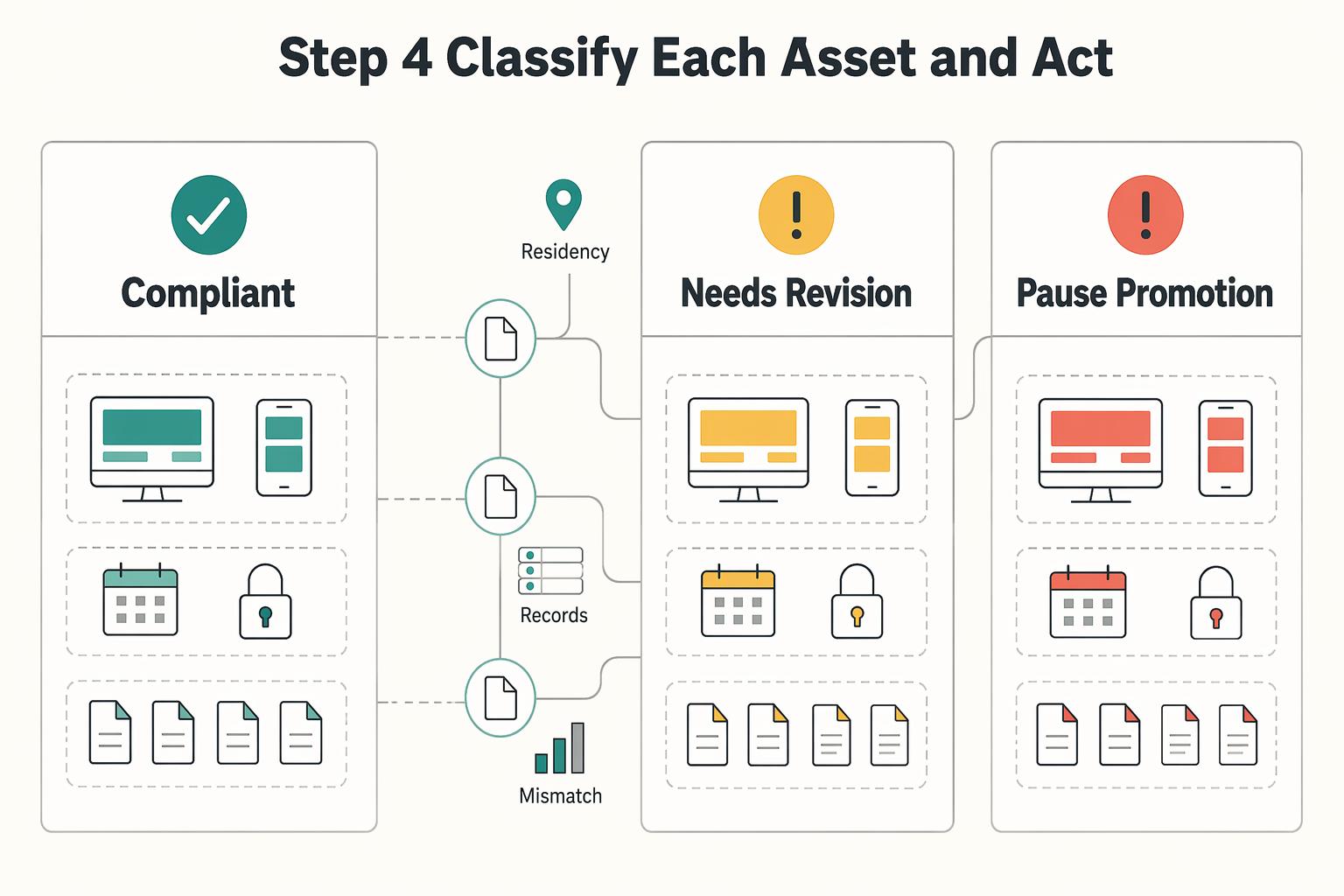
Step 4 Classify each asset and act#
Use one status per asset so the audit leads to action:
| Status | Definition |
|---|---|
| Compliant | Disclosure is clear, easy to notice, and placed with the endorsement so users can see it with the link or recommendation. |
| Needs revision | Disclosure exists but is weak in placement, hidden behind expansion, mixed into hashtag clusters, or missing in a key format such as mobile, PDF export, or video view. |
| Pause promotion until fixed | No disclosure, unclear relationship, or a high-visibility asset where disclosure is effectively invisible. |
Keep a small evidence pack for each audited asset: screenshot, URL or file name, capture date, device view, and affiliate program. That gives you a record of what was live and helps you catch regressions after edits or redesigns. If you want a deeper dive, read Germany Freelance Visa: A Step-by-Step Application Guide.
The Implementation Framework: Your Compliance Operating System#
Treat disclosure as a publish gate. For interactive media, a disclosure is clear and conspicuous only when people can notice and understand your material connection without extra effort. They should get that context before they act on the endorsement.
Step 1 Apply a pass/fail check before publishing#
Use a simple pass or fail test. If any answer is No, fix the asset before it goes live.
- Visible before action: Can people see it before they click, tap, or buy?
- Unavoidable in context: Is it visible without opening "more," visiting a profile or About page, or hunting for it?
- Plain-language meaning: Would a general audience understand that you may benefit from the recommendation?
- Placed with the endorsement: Is it with the claim, link, or CTA it relates to?
- Verified in live formats: Did you check mobile, truncated captions, video playback, email preview, and exported files?
A common operational failure mode is drift after edits, such as layout changes, caption truncation, or export formatting. Your quick check is to open the live asset on mobile and confirm the disclosure appears with the first endorsement a user can act on.
Step 2 Use wording people do not need to decode#
Clarity beats cleverness here. If people need to interpret the label, it is doing less work than you think. Name the relationship directly. If you received free or discounted products, say that plainly.
| Wording | Use | Why |
|---|---|---|
#ad or Ad: | Use | FTC staff says #ad can work for paid posts and free-product relationships. |
Sponsored or Sponsored by [Brand] | Use | Plain language that signals a commercial relationship. |
I may earn a commission if you buy through these links / (paid link) | Use | States the material connection directly. |
sp, spon, collab, ambassador, thanks [brand] | Avoid as standalone disclosure | FTC staff flags vague or confusing shorthand as risky. |
Step 3 Use a channel-by-channel placement map#
FTC disclosure adequacy is context-dependent, so use this map as an internal control, not a rigid legal script. Apply the same proximity and unavoidability principles in every format.
| Channel | Minimum placement | Repeat near links/CTAs when... |
|---|---|---|
| Article pages | Put disclosure with, or immediately before, the first affiliate link or endorsement. | The page has long scroll, jump links, product tables, or lower-page CTA blocks. |
| Social posts | Put disclosure where it is visible before truncation. Do not bury it in hashtag or link clusters. | Multiple product mentions or separate CTA blocks appear in one post or thread. |
| Video | Put disclosure in the video itself, not only the description. | Add text near key recommendation moments and keep written disclosure in the description. |
| Newsletters | As a conservative policy, put disclosure in the intro when endorsements appear across the email. | Repeat above product blocks or CTA sections that can be skimmed or forwarded out of context. |
| Downloadable assets (PDFs/guides/checklists) | As a conservative policy, put disclosure on page one when endorsements run throughout. | Repeat in sections or pages that contain affiliate links or recommendation CTAs. |
Step 4 Standardize templates, SOP, and contract clauses#
Standardization keeps disclosure quality from slipping when volume goes up. Use short templates:
| Context | Sample disclosure |
|---|---|
| Article/newsletter intro | This content contains affiliate links. If you buy through them, I may earn a commission. |
| Social | Ad: I may earn a commission if you buy through this link. |
| Free product/perk | [Brand] sent me this product for free. If you buy through my link, I may earn a commission. |
Keep the same discipline in your workflow. Use a simple SOP:
- Draft: Add disclosure as soon as you add a material connection.
- Review: Check live, mobile, truncated, and exported views.
- Publish: Confirm disclosure appears with the first practical endorsement.
Also include a clause checklist in brand or client agreements:
- Responsibility: who adds and maintains disclosures by channel.
- Disclosure standard: clear, conspicuous, and placed with endorsements.
- Remediation: prompt correction and notice obligations when issues are found.
If a brief asks you to hide disclosure, rely only on profile-level language, or place disclosure after the link cluster, pause publication until the terms are corrected. You might also find this useful: A guide to 'Affiliate Marketing' for creators. Standardize your partner terms and disclosure language in one place with the Freelance Contract Generator.
The Verification Process: Maintaining Your Compliance#
Compliance is ongoing. Use a repeatable cycle so disclosure quality does not drift: trigger, review, fix, log.
Step 1 Set your review cycle#
Set your review cadence based on publishing volume, then use the same loop each time:
| Stage | What to do |
|---|---|
| Trigger | New partner, new offer, new template, new format, or an update to older live content. |
| Review | Confirm whether a material connection exists, including financial, employment, personal, or family ties, and non-cash value such as free or discounted products or services. |
| Fix | If a relationship exists, make sure a clear disclosure is present with the endorsement. |
| Log | Record what you checked and what you changed. |
Step 2 Run pre-publish checks before promotion#
Before you promote, verify the live asset version and confirm:
- you identified whether a material connection exists
- if anything of value is involved, disclosure is included
- disclosure clearly explains your relationship to the brand
- disclosure appears with the related endorsement
Do not skip disclosure because the mention was not requested, because the value was non-cash, or because you think followers already know the relationship.
Step 3 Run post-publish checks and keep a lightweight log#
After publishing, do a spot check on the public asset and confirm the disclosure is still clear in context. If anything moved or changed, fix it and log the update. If you keep a lightweight log, include:
- date
- asset URL
- relationship type
- what was checked
- what changed
Step 4 Assign ownership and monitor official updates#
Someone needs to own this. You are responsible for disclosure compliance even if other people help produce the content, so do not rely on others to do it for you. Assign one owner to monitor FTC Disclosures 101 and the FTC Endorsement Guides, and review the process when guidance changes. When updates affect your process, update templates first, then recheck affected live assets. We covered this in detail in How to Structure an Affiliate Agreement for Your Digital Product.
Conclusion: Compliance as a Competitive Advantage#
The advantage here is operational. When you disclose material connections clearly, in the right place, every time, and can prove your process, you reduce avoidable FTC scrutiny risk. You also make affiliate partner reviews easier and give readers what they need to evaluate your endorsements.
Step 1. Make disclosure a publish gate. Treat disclosure as a release condition, not cleanup. If content includes an endorsement tied to a material connection, place the disclosure with that endorsement and make it hard to miss in the live format.
Disclosures on an About or profile page can be missed. Disclosures behind MORE can be missed. Video disclosures should appear in the video itself, not only in the description. If you use a platform disclosure tool, still verify that the disclosure is clear in context, because built-in tools may be inadequate on their own. As the endorser, you are responsible for making these disclosures.
Your check is simple: view the published asset like a user and confirm the disclosure appears with the endorsement, without extra clicks.
Step 2. Use practical decision criteria. Use this as your working standard in daily reviews:
| Decision point | What to do | Red flag |
|---|---|---|
| Before publish | Confirm whether a material connection exists, including financial, personal, family, or employment relationships | Assuming people already know about the relationship or deciding a connection does not need disclosure |
| Disclosure placement | Put disclosure with the endorsement message itself, where it is hard to miss | Burying it in a footer, profile page, or separate disclosure page |
| In-line labels | Use an in-line label like affiliate link or paid link when someone may see a specific link without the main disclosure first | Relying only on one general note when links appear later or out of context |
| Format checks | Review the final published version for each channel, including blog, email, social, and video | Assuming the draft view matches what users actually see |
| Documentation | Keep a lightweight log: date, URL, channel, relationship type, checks performed, changes made, approver | No evidence trail when a partner, reviewer, or regulator asks what you did |
Partner terms matter too. Some programs require compliant disclosures as a condition of participation. For example, Amazon requires a legally compliant disclosure with links and Amazon Associate identification, so disciplined execution can support account continuity and review readiness.
Step 3. Keep an evidence trail. Consistency becomes credibility when you can show your process, not just describe it. A simple log with the date, URL, channel, relationship type, checks performed, changes made, and approver gives you a clear record for internal reviews and partner questions.
If your content can reasonably affect U.S. consumers, do not assume posting from outside the U.S. removes FTC exposure. Use one clear-and-conspicuous standard across channels so decisions stay predictable. On your next affiliate post, run your publish gate. Place the disclosure with the endorsement, add in-line labels where context can break, and save the check record before you publish. For a step-by-step walkthrough, see How to Set Up an Affiliate Program for Your SaaS Product. When your affiliate revenue becomes cross-border, keep payouts and records as controlled as your disclosure workflow with Gruv Payouts.
Frequently Asked Questions
What are the exact penalties for not disclosing affiliate links?
Do not hard-code a dollar figure unless you verify it against current FTC materials or current legal advice. Verify the current amount before you put it in templates, training docs, or client memos. Focus your process on clear disclosure, not on repeating a number that may be outdated.
Where should you put an affiliate disclosure on a blog post?
Put a plain-language disclosure where readers will see it with the endorsement or affiliate link. “Clear and conspicuous” means people can immediately understand your relationship when they see the endorsement message. Check the live page and confirm a first-time reader can spot the relationship without hunting.
Is one disclosure on your About page or sitewide disclosure page enough?
Treat a sitewide disclosure as background context, not the only disclosure for a specific endorsement post. A practical approach is to place the disclosure with the endorsement so readers do not need to search elsewhere. If someone can reach the recommendation without seeing your relationship, the placement is weak.
What counts as a material connection?
A material connection includes personal, family, employment, or financial relationships with a brand. Financial is broader than cash, so anything of value tied to mentioning a product should be disclosed. If that connection could affect how people weigh your opinion, disclose it with the endorsement.
Do you need to disclose free products or discounts if you do not earn a commission?
Yes. If you got free or discounted products or other perks and then mention the product, disclose that relationship. Do this even when you were not asked to mention that specific product.
Can you rely on a brand, platform tool, or manager to handle disclosures for you?
No. Treat disclosure as your responsibility when your endorsement goes live. Do not rely on others to do it for you, and do not assume a platform label or third-party setup is clear enough in every format. Before publishing, verify the live post yourself.
Do these rules matter if you are outside the United States?
These FTC excerpts do not define every cross-border scenario. A practical approach is to use one clear disclosure standard across public content instead of guessing post by post. If your audience, contracts, or jurisdictions are unclear, get legal advice before relying on an exemption.
Which labels or hashtags should you use?
Use wording your audience understands immediately, not insider shorthand. Pick clarity over brevity. | Clearer wording | Riskier jargon or vague labels | | --- | --- | | Ad | #aff | | Sponsored | #sp | | Affiliate link | partner | | Paid link | collab | | I may earn a commission | ambassador |
What should you check right before you publish?
Run one repeatable check: placement, clarity, and connection. Confirm the disclosure appears with the endorsement, the wording is instantly understandable, and the relationship disclosed matches the one you actually have. Then review the live version and save your evidence record.
Try a related tool
Researched and edited by the Gruv editorial team. Gruv builds cross-border billing, payouts, and finance-operations software for global businesses.
Sources
- consumer.ftc.gov/consumer-alerts/2021/10/ftc-puts-advertisers...trusted
- ecfr.gov/current/title-16/chapter-I/subchapter-B/part...trusted
- ecfr.gov/current/title-16/chapter-I/subchapter-A/part...trusted
- federalregister.gov/documents/2023/07/26/2023-14795/guides-conce...trusted
- ftc.gov/business-guidance/resources/disclosures-101-...trusted
- ftc.gov/system/files/documents/plain-language/1001a-...trusted
Educational content only. Not legal, tax, or financial advice.
Related Posts

Germany Freelance Visa Application Path for Freiberufler and Gewerbe
Choose your track before you collect documents. That first decision determines what your file needs to prove and which label should appear everywhere: `Freiberufler` for liberal-profession services, or `Selbständiger/Gewerbetreibender` for business and trade activity.
Taxes in Germany for Freelancers and Expats
Low-stress compliance in Germany comes from decision order, not tax tricks. Use this sequence: confirm core facts, apply conservative temporary assumptions, verify the few points that can break invoices or filings, and keep one evidence file that explains each decision.
Affiliate Marketing for Creators Who Need Predictable Payouts
The real win is not proving that affiliate links can generate revenue. It is making that revenue predictable enough to plan around. If you are a freelancer, a creator, or a small team, the useful question is not "Can this convert?" It is "Can I trust the path from click to paid balance well enough to budget against it?"