
Quick Answer
To deal with jet lag, run three steps that start before departure, continue through travel day, and guide your first 72 hours after landing. Shift your sleep schedule toward destination time, run strategic light exposure, and protect a consistent wake time. Use naps as a deliberate decision, and treat melatonin or sleeping pills as clinician-guided decisions while you focus on stable output during adaptation.
Jet Lag Can Wreck Week One of a Move if You Do Not Run a System#
Jet lag can cut your decision quality right when your move demands your best judgment, so treat it as an operations problem, not just a sleep problem.
When remote professionals cross multiple time zones, tiredness is only part of the risk. Focus drops, mood swings, and slower thinking can derail housing choices, onboarding tasks, and first client calls. If you land and operate on instinct, small mistakes stack fast. If you land with a system, you keep output stable while your body clock catches up.
Jet lag is a mismatch between your internal clock and local time. It usually occurs when you travel across more than three time zones, but it can affect anyone who travels across multiple time zones. There is no instant cure. Adaptation is gradual, often around one to one and a half days per time zone.
Use this simple checklist to protect output while sleep disruption is still active. Run each step so week-one disruption does not run your work.
| Step | Phase | Decision gate | Verification point |
|---|---|---|---|
| Step 1 | Before Departure | A few days before you travel, start adjusting your sleep schedule toward destination time (often by an hour or two at a time). | You depart with less clock mismatch. |
| Step 2 | Travel Day | Expect your sleep to be off. Plan around reduced concentration and performance while you are in transit and right after landing. | You land with a usable day plan, not guesswork. |
| Step 3 | First Few Days | Use light strategically, since it is the main environmental cue for resetting circadian timing. Keep expectations realistic while your clock adapts. | Your sleep and focus start stabilizing as your routine settles. |
Before You Start#
This is practical travel health operations, not personal medical advice. If you have medical questions or underlying conditions, confirm your plan with a licensed clinician.
Prepare a Control Sheet, a Behavior Baseline, and a Team Buffer#
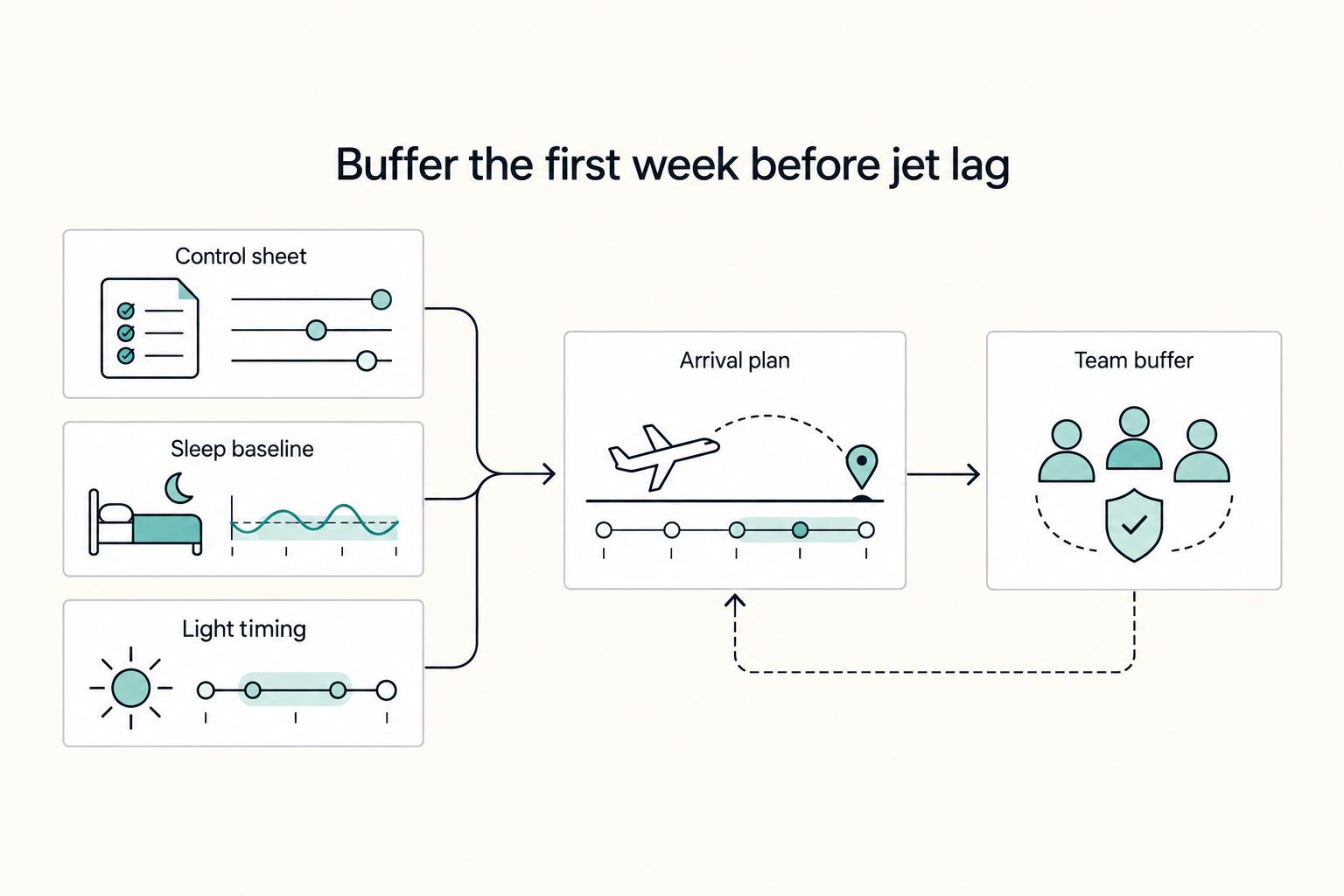
Prepare one control sheet, one behavior baseline, and one team buffer before departure so jet lag does not control your first week.
You have the three-phase roadmap. Now set up the inputs that make it usable when sleep pressure rises. The goal is simple: reduce decision-making when your brain is least reliable.
Jet lag is a common hurdle when your calendar demands focus but your body wants sleep. Having to respond to mental challenges during your biological sleep window can put you at reduced cognitive capacity, which matters if you are handling housing, onboarding, and client communication in the same week.
Before You Start#
Same boundary as above: this is operational guidance, not personal medical advice. Confirm any melatonin or sleep medication decision with your licensed clinician before travel.
- Build a one-page prep sheet.
Include destination time, your first few work commitments, and your target sleep schedule for the first days after arrival. Keep it visible on your phone and laptop so you can act fast when fatigue hits. Verification point: You can explain your next sleep window and next work commitment in under a minute.
- Define non-negotiables before you feel tired.
Prioritize strategic light exposure first. Then lock in meal timing, sleep anchors, and minimum exercise blocks you can still execute on low sleep.
| Control lever | Your rule | Verification point |
|---|---|---|
| Strategic light exposure | Protect daily light and dark windows. | You follow the window without debating it in the moment. |
| Meal timing | Anchor meals to local clock times. | You avoid random grazing across the day. |
| Exercise | Commit to short, repeatable movement. | You complete movement even on a rough day. |
- Set yourself up for plan compliance, not comfort habits.
Reduce friction around the behaviors you picked: light, sleep, meals, and movement. If melatonin is part of your plan, document the clinician-approved approach so you are not making decisions while depleted. Verification point: Everything you bring or set up directly supports your schedule.
- Set a communication buffer with your team.
Flag your lowest-alertness windows in advance, then move high-stakes tasks outside them. Ask for async updates when timing collides with your biological night. Verification point: Your calendar protects deep work and avoids critical calls at your lowest alertness window.
For a broader baseline routine you can pair with this plan, use How to Stay Healthy and Fit While Traveling. If you want a deeper dive, read our digital nomad visa index for 50+ countries.
Step 1 Before Departure Builds the Adaptation Base#
Start shifting your routine before takeoff so your circadian rhythm arrives closer to local time instead of absorbing one hard reset.
You built the prep sheet, non-negotiables, and team buffer. Now turn that plan into daily actions before departure. This is where you protect decision quality before week one starts.
Jet lag is a circadian rhythm timing disruption, not just tiredness. Symptoms can include fatigue, insomnia, irritability, and digestive problems. Normalization can take multiple days, so plan for steady adaptation, not instant relief.
Run the pre-departure sequence#
- Shift your sleep schedule in small moves.
Move bedtime and wake time toward destination time over the days before departure. Keep each change manageable so you can hold it without a rebound night. Verification: You can wake and sleep closer to destination timing without a major energy crash.
- Pre-commit light and dark windows in writing.
Use strategic light exposure as your primary lever. Write when you will seek bright light and when you will protect darkness, then follow the rule instead of negotiating with yourself. Verification: You can state your light plan in one sentence and execute it that day.
- Keep the rest of your day predictable.
If it helps you stick to the sleep and light plan, keep meals and light movement consistent and repeatable so a rough night does not blow up your whole schedule. Verification: You keep your day structured even on a rough day.
- Use a safe-default energy rule.
Avoid reactive "just get through it" choices that pull you off your planned sleep window. When alertness drops, protect your next sleep window first and use light timing to support it. Verification: You finish the day on schedule instead of chasing short-term alertness.
| Decision gate | Safe default | If you drift |
|---|---|---|
| Sleep timing | Keep gradual shifts only | Return to the next planned sleep window |
| Light exposure | Follow written light and dark windows | Resume at the next window and keep the structure |
| Energy management | Use light timing and gentle movement first | Protect bedtime and get back to the plan |
Step 2 Travel Day Is an Execution Window Not a Recovery Day#
Run travel day like an execution window, not a recovery day, so your circadian rhythm keeps moving toward destination time from the moment you board.
You set your rules in Step 1. Travel day is where you apply them under real pressure, when fatigue and airport friction can pull you off plan. Also keep your expectations realistic: it can take about one day per time zone for your inner clock to shift, so the goal is steady progress, not instant adjustment.
Run your travel day control loop#
| Travel-day action | What to do | Verification |
|---|---|---|
| Single clock context | If it helps you stay consistent, set your watch and phone to destination time and make decisions off that clock. | You can answer "what time is it at destination" instantly and act on that clock. |
| Light and darkness timing | Seek light when your destination schedule calls for wakefulness, and protect darkness when it calls for sleep. | You follow your light and dark windows without renegotiating mid-flight. |
| Naps | Nap only when it supports your destination sleep schedule and your next required task. | Your nap choice supports tonight's planned sleep window. |
| Melatonin or sleep aids | If you use anything, follow prior medical guidance, and if you do not have that guidance, skip the experiment. | You follow a pre-approved plan or hold off until you can confirm with your clinician. |
- Pick a single clock context at boarding.
If it helps you stay consistent, set your watch and phone to destination time and make decisions off that clock. This does not cure jet lag, but it can reduce "what time is it really?" drift. Verification: You can answer "what time is it at destination" instantly and act on that clock.
- Prioritize strategic light exposure and darkness timing.
Use light and darkness as your primary control levers. Seek light when your destination schedule calls for wakefulness, and protect darkness when it calls for sleep. Verification: You follow your light and dark windows without renegotiating mid-flight.
- Use naps as tactical support, not drift.
Nap only when it supports your destination sleep schedule and your next required task. Avoid unplanned sleep that makes it harder to sleep when your destination bedtime arrives. Verification: Your nap choice supports tonight's planned sleep window.
- Keep melatonin and other sleep-aid decisions inside medical guidance.
Melatonin is a hormone involved in regulating wake and sleep timing, but travel is not the time to freestyle dosing or mix-and-match sleep aids. If you use anything, follow prior medical guidance, and if you do not have that guidance, skip the experiment. Verification: You follow a pre-approved plan or hold off until you can confirm with your clinician.
| Decision gate | Default choice | What to avoid |
|---|---|---|
| Time cues | Use one clock consistently (often destination time) | Switching back and forth between local and destination time |
| Light control | Follow planned light and darkness windows | Comfort-driven light exposure at random times |
| Fatigue management | Nap only if it supports your planned sleep window | Unplanned sleep that breaks your night plan |
Step 3 First 72 Hours Is Where Most Plans Fail and Can Be Recovered#
In the first few days, expect a gradual reset and use light to help your circadian rhythm realign to local time.
Travel day gets you on the ground with structure. The first 72 hours decide whether you keep that structure or drift into improvised sleep that wrecks your work week.
Expect a gradual reset, not a perfect night right away. Symptoms like fatigue, insomnia, irritability, and digestive problems can continue for multiple days and may last weeks after a flight. A useful planning assumption is that your inner clock often needs about one to one and a half days per time zone crossed.
Run a simple first-few-days recovery loop#
| Action | What to do | Verification |
|---|---|---|
| Wake time | Pick a consistent local wake time as much as practical and try to stick to it. | You are not drifting later and later each morning. |
| Light | Get bright light during your daytime hours and protect darkness near planned sleep. | Daytime alertness improves and evenings feel less "wired." |
| Routine | Keep meal timing and movement steady if it helps. The goal is fewer variables while your clock catches up. | You are keeping days structured even if sleep is uneven. |
| Insomnia response | Treat insomnia as part of the adjustment and focus on getting back to your next daytime light window and local schedule. | You return to your routine the next day instead of spiraling into schedule drift. |
- Pick a consistent local wake time (as much as practical) and try to stick to it.
Consistency helps you stop renegotiating the day from bed to bed. Verification: You are not drifting later and later each morning.
- Use light as your main lever.
Get bright light during your daytime hours and protect darkness near planned sleep. Light is the fastest environmental lever for resetting your circadian clock. Verification: Daytime alertness improves and evenings feel less "wired."
- Keep the rest of your routine steady if it helps.
Meal timing and movement do not need to be perfect. The goal is fewer variables while your clock catches up. Verification: You are keeping days structured even if sleep is uneven.
- When insomnia hits, treat it as part of the adjustment, not a signal to abandon the plan.
Focus on getting back to your next daytime light window and local schedule rather than chasing sleep at random hours. Verification: You return to your routine the next day instead of spiraling into schedule drift.
Should You Nap After Landing or Stay Awake#
Choose between a short, controlled nap and staying awake by using local time, current sleep pressure, and your next required task, then protect your sleep schedule.
This is a common failure point on arrival day. You feel wrecked, want relief, and make a decision that steals tonight's sleep. Treat the nap decision like a gate: quick inputs, one choice, then execute.
Jet lag is linked to an abrupt circadian rhythm mismatch, often after crossing more than three time zones. Symptoms like headaches and insomnia can show up. Do not chase comfort in the moment. Protect tonight's sleep first, then protect tomorrow's decision quality.
Run the landing decision gate#
| Step | What to check or do | Decision cue |
|---|---|---|
| Local time and next task | Write your local bedtime target and your next high-focus commitment. | This keeps your choice tied to output, not mood. |
| Sleep pressure and safety | If alertness feels unsafe for transit or critical work, treat that as a hard stop. | Note the natural dips in alertness, often mid-afternoon and later in the evening. |
| Nap branch | Take a short, controlled nap with an alarm, then return to your planned schedule. | You wake on time and still protect local bedtime. |
| Stay-awake branch | Stay awake until local bedtime, then keep your sleep routine steady and align meal timing to local time. | You reach bedtime without an unplanned second sleep block. |
| Day one and day two review | Log your choice, energy during key work blocks, and bedtime quality. | Keep what worked, then adjust tomorrow's gate inputs. |
- Check local time and your next non-negotiable task.
Write your local bedtime target and your next high-focus commitment. This keeps your choice tied to output, not mood.
- Assess sleep pressure and safety risk.
If alertness feels unsafe for transit or critical work, treat that as a hard stop. Note the natural dips in alertness, often mid-afternoon and later in the evening, so you do not confuse a normal slump with a full crash.
- Pick one branch and execute it.
| Condition | Decision | Verification point |
|---|---|---|
| Unsafe alertness or urgent fatigue | Take a short, controlled nap with an alarm, then return to your planned schedule. | You wake on time and still protect local bedtime. |
| Functional alertness and no safety risk | Stay awake until local bedtime, then keep your sleep routine steady and align meal timing to local time. | You reach bedtime without an unplanned second sleep block. |
- Document outcomes on day one and day two.
Log your choice, energy during key work blocks, and bedtime quality. Keep what worked, then adjust tomorrow's gate inputs.
Related reading if your arrival day also includes a scheduling setup: How to Integrate Calendly with Your Website.
Do Melatonin or Sleeping Pills Actually Help#
Treat sleeping pills as short-term sleep support, because jet lag comes from circadian disruption and sedation is not the same as alignment.
Jet lag is temporary and symptoms often improve within a few days, though they sometimes last longer. If you are going to use medication at all, keep that decision inside your system. Your foundation is still timing and light exposure. Medication is secondary support, not the steering wheel.
Circadian rhythm is your internal clock, and rapid time zone changes disrupt it. People often discuss melatonin for timing support, while sleeping pills target sedation. Those outcomes are not the same. Sedation may help you sleep, but you may still feel jet lag symptoms during the day.
| Option | Primary purpose | What it can do | What it cannot do | Operator default |
|---|---|---|---|---|
| Melatonin | Timing support (varies) | May be used as part of a timing plan (guidance varies) | Does not replace a light-exposure plan | Use only with clinician guidance |
| Sleeping pills | Sedation for sleep | Can improve sleep for a flight period and several nights after arrival | May not prevent daytime jet lag symptoms | Reserve for cases where other levers did not help |
| Light therapy | Rhythm adjustment | Use timed exposure to bright artificial light to help adjust to a new daylight schedule | Cannot create instant adaptation | Run daily as your foundation |
This article does not provide a contraindication framework for melatonin or sleeping pills. Do not turn travel into a self-experiment loop. Do not mix products on your own. Keep medication decisions inside clinician guidance, and keep your behavioral anchors consistent.
Use this red-flag escalation path:
- Seek professional medical review if insomnia persists and keeps disrupting core work blocks.
- Escalate quickly if severe daytime impairment affects safety, transit, or decision quality.
- Stop and contact a clinician if side effects show up, including confusion, amnesia-like gaps, sleepwalking, nausea, vomiting, or strong morning sleepiness.
If you land before a critical week, sleep poorly, and feel the urge to try multiple fixes in one night, do not stack changes. Hold wake time, run your light plan, and get clinician input before you change medication strategy.
Protect Work Quality While Your Body Clock Realigns#
Use this playbook to protect work quality while your body clock realigns, and measure progress by execution rather than perfect sleep.
Turn the details into one system. The goal is not heroics. The goal is stable output while your internal clock catches up to destination time.
- Set an operational success rule.
Define success as stable output under temporary friction. Jet lag is a chronobiological issue tied to travel across multiple time zones, and it involves a mismatch between your body clock and destination time. When your internal clock and local time do not match, symptoms can include poor cognitive performance, fatigue, headaches, and irritability. Treat symptoms as signals to tighten the system, not reasons to improvise. Verification point: You keep critical commitments and avoid avoidable errors while symptoms trend down.
- Run three anchors every day.
Use three simple anchors to keep the schedule coherent even when sleep feels noisy: a consistent wake point, consistent "destination-time" cues (for example, following the local day-night cycle), and a repeatable daily plan for your highest-risk work. These anchors do not promise instant relief, but they reduce decision churn when you feel off. If insomnia appears, keep the same anchors and reduce optional workload. Verification point: You stop improvising and follow one repeatable sequence each day.
- Stay confident on the core, cautious on add-ons.
Be firm about what is clear here: jet lag comes from body clock misalignment, and symptoms can include fatigue, headaches, irritability, and weaker focus. Be cautious with add-on tactics that are easy to overuse or overclaim. Treat melatonin and sleeping pills as clinician-led decisions, not operator hacks. (Rules and guidance vary by person and jurisdiction.)
Copy and use this checklist as your quick-start system:
Set destination time zone and commitments for the first few daysIf practical, reduce "schedule surprises" before departurePlan how you'll follow local day/night cues once you landDecide ahead of time how you'll handle naps (so you don't guess)Keep a consistent wake timeTreat melatonin and sleeping pills as medical decisionsRun a fallback routine if insomnia spikes
Frequently Asked Questions
How do you get over jet lag quickly if you have meetings within 24 hours of landing?
Jet lag is a temporary, short-lived sleep problem, and you may still feel it within 24 hours. A few days before you travel, begin adjusting your body’s natural clock to the time zone at your destination (go to bed an hour or two later than usual if traveling west, or an hour or two earlier than usual if traveling east). After landing, stick to local sleep and wake times as closely as you can. Protect your best alertness windows and reduce decision load everywhere else. Keep meeting agendas tight.
What is the best way to deal with jet lag after a long international flight?
Treat it like circadian rhythm alignment. A few days before you travel, start shifting your sleep toward destination time (later for westbound travel, earlier for eastbound). After you arrive, keep your sleep timing as consistent with local time as possible. If you want a broader baseline routine to pair with this guide, read How to Stay Healthy and Fit While Traveling.
How long does jet lag usually last after crossing several time zones?
Jet lag usually occurs when you travel across more than three time zones, but it can affect anyone who travels across multiple time zones. How quickly you feel better varies, so track function day to day. If impairment stays severe, escalate.
Should you nap after landing or force yourself to stay awake until local bedtime?
Prioritize safety first and then local timing. If fatigue makes transit or work unsafe, rest. If you can function safely, keep your sleep timing aligned to local time as best you can.
Is strategic light exposure more effective than just going to bed early?
This section’s sources do not compare those tactics head-to-head. What they do support is adjusting sleep timing toward your destination time zone before travel (earlier for eastbound, later for westbound).
Do melatonin or sleeping pills help and when should you avoid them?
This section’s sources do not cover melatonin or sleeping-pill guidance. Because these are medical decisions, get clinician input, especially if symptoms persist or side effects appear.
What should you do if your first 72-hour jet lag plan breaks on day one?
Do not scrap the system. Reset by re-aligning your sleep timing to local time as soon as you reasonably can, and keep it consistent. If mood, concentration, or physical and mental performance stay sharply impaired, move from self-management to professional review.
Try a related tool
Researched and edited by the Gruv editorial team. Gruv builds cross-border billing, payouts, and finance-operations software for global businesses.
Sources
Educational content only. Not legal, tax, or financial advice.
Related Posts

The 2026 Global Digital Nomad Visa Index for 50+ Countries
Start with legal fit, not lifestyle filters. The practical order is simple: choose a route you can actually document, then decide where you want to live. That single change cuts a lot of wasted comparison work and stops you from falling in love with places that were never a real filing option.

How Remote Professionals Stay Healthy During Long Stays Abroad
Use this sequence before workload, housing, and travel friction make health tasks harder to execute. If you are traveling for months, treat this as four pass-fail gates. A gate is closed only when you have a written output you can verify.

How to Integrate Calendly with Your Website
Start with a simple three-step launch sequence: choose the embed path that fits the page, lock in your real availability, then validate the booking flow before you publish. That turns a Calendly embed into a client-facing booking process, not just a design element on the page.