
Quick Answer
To deal with freelance imposter syndrome, stop treating confidence as a feeling and start treating it as a system: define scope and "done" in writing, store proof of outcomes, and route changes through a documented process. First, sort the problem into one of three buckets: an impostor loop, a real skill gap, or an offer/client-fit issue that keeps creating friction. Then install the right documents, templates, and routines so your work is verifiable and repeatable.
You're not "a fraud"-you're running a business without a system (and that's fixable)#
Freelance impostor feelings can flare when your work lacks clear, documented boundaries-even when you do have talent. You're the CEO of a business-of-one, and your job is to turn shaky moments into repeatable operations.
Impostor syndrome means "persistent doubt concerning one's abilities or accomplishments accompanied by the fear of being exposed as a fraud." That definition matters because it describes a feeling pattern, not a verdict on your competence. In solo service work, feelings can spike in the gaps: unclear expectations, shifting priorities, and "quick favors" that quietly turn into unpaid deliverables.
Step 1: Replace ambiguity with definitions (4 terms that help calm the room)#
Run your business like you expect hard questions, because you will get them. Start with four terms you can define and enforce:
| Term | Meaning | Use |
|---|---|---|
| Statement of work (SOW) | A formal document that defines a project's parameters, including goals, scope, timelines, milestones, deliverables, and budget. | Tighten it if you feel shaky before kickoff. |
| Scope creep | The work required to complete a project exceeds the work the team originally planned for. | Name it early, neutrally, and in writing. |
| Definition of Done | A formal description of the state when work meets the quality measures required. | Use it to create clarity about when work is actually done. |
| Change order | A formal, written amendment to an existing contract. | Use it when the client asks for "just one more thing." |
- Statement of work (SOW): "a formal document that defines a project's parameters, including its goals, scope, timelines, milestones, deliverables, and budget." If you feel shaky before kickoff, your SOW likely needs one more sentence of specificity.
- Scope creep: when "the work required to complete a project exceeds the work the team originally planned for." Name it early, neutrally, and in writing.
- Definition of Done: "a formal description of the state...when it meets the quality measures required." (You don't need Scrum to use this; you need clarity.)
- Change order: "a formal, written amendment to an existing contract." Use it anytime the client asks for "just one more thing."
Step 2: Build "audit-ready" confidence (evidence beats vibes)#
You're building a solopreneur confidence system: you can point to artifacts, not adrenaline. Use this as your baseline:
| If you're thinking... | Install this system piece | What "done" looks like |
|---|---|---|
| "They'll realize I'm guessing." | SOW + milestones | You can list deliverables and dates in one breath. |
| "I can't tell if this is finished." | Definition of Done | You and the client share the same acceptance criteria. |
| "This keeps expanding." | Scope boundary + change order | Every extra request routes to price/time tradeoffs. |
| "I'm nervous about new tools." | Process notes + decision log | You can explain how you got to the output. |
Mindset still matters-mental health always matters-but your fastest win often comes from action. When you document the work, you stop negotiating with your own doubt and start operating.
Is this imposter syndrome, a skill gap, or a business model problem? (10-minute diagnostic)#
You don't fix freelance impostor syndrome with pep talks-you fix it by correctly naming the failure mode, then installing the right countermeasure. With the "paperwork and receipts" framing in place, use this quick sorting exercise to decide whether you're dealing with (1) an impostor loop, (2) a real skills gap, or (3) an offer/client-fit issue that's creating friction.
Step 1: Sort it into a bucket (fast, written)#
Set a short timer if it helps you stay honest, then write answers, not thoughts.
| Bucket | What it looks like in real life | What's true underneath | Your safest next action |
|---|---|---|---|
| Impostor loop | You hit the deliverable, the client accepts it, and you still feel like you "got away with something." You downplay wins as luck. | Merriam-Webster defines impostor syndrome as "persistent doubt concerning one's abilities or accomplishments accompanied by the fear of being exposed as a fraud." Britannica adds it can show up as doubt "despite a record of achievement." | Reduce ambiguity and store proof: tighten your Definition of Done ("a formal description...when it meets the quality measures required") and start a proof file (wins, acceptance emails, before/after). |
| Skill gap | You miss requirements, produce avoidable rework, or freeze because you don't know the "next right step." | A real skills gap equals "a genuine disparity between what you can currently do versus what a role requires you to do." That's not shame; that's information. | Create a learning plan and add guardrails in your SOW ("defines project scope, deliverables, timelines, and responsibilities"). Ask for targeted feedback-Vanderbilt's guidance: "Be realistic about strengths and weaknesses (seek feedback...)." Also, be "pro-active about doing things to fill in gaps in skill set or training." |
| Offer/client-fit friction | You repeatedly sell work that requires constant renegotiation, unclear ownership, or emotional labor you didn't price. | Sometimes the stress isn't about competence-it's about boundaries and expectations not being explicit. | Repackage and reposition: define inclusions/exclusions, route expansions through a change order ("a formal, written amendment to an existing contract"), and revisit who you serve. |
Step 2: Pressure-test with three quick prompts (no mind-reading)#
Answer in one sentence each:
- Wins vs. feelings: When you meet the SOW outcomes, do you still discount the result or assume others "overestimate your abilities"? (MIT Sloan: "Impostor thoughts reflect the belief that others overestimate your abilities.")
- Ambiguity vs. performance: Do issues improve when you add acceptance criteria (Definition of Done), or do they persist even with clear criteria (which can point to a skill gap)?
- Negotiation vs. delivery: Do you spend more time defending scope/price than delivering? If yes, consider whether packaging and client-fit are part of the problem.
Practical output (copy/paste): "My freelance impostor syndrome mostly triggers when ___, so this month I'm installing ___ (e.g., tighter Definition of Done + proof file, or SOW guardrails + training plan, or change-order workflow + offer packaging)."
What to prepare before you start (tools, documents, and a "safe default" baseline)#
Build a small, repeatable "professionalism kit" so your freelance imposter syndrome has fewer gaps to latch onto. You've diagnosed the failure mode; now you're installing the baseline: documents, storage, and default decisions that keep projects clean even when your confidence wobbles.
Step 1: Assemble your minimal professionalism kit (documents you reuse)#
Action: create two templates and save them where you can copy/paste fast.
- Statement of Work (SOW) template: A SOW "establishes and defines" the requirements for your work (it can live as a portion of a contract). Keep it short, but include:
- Deliverables + timeline * What you need from the client (inputs, access, reviews) * Payment terms (due date, late fee policy if you use one, payment methods) * Definition of Done: an agreed list of activities/criteria required for work to count as "done." Example: "Homepage draft is 'done' when client approves in writing and all listed revisions (up to X rounds) apply."
- Change Order template (email-friendly): A change order is a written amendment that changes the original agreement's conditions. Your template should include: what changed, impact on timeline, impact on price, and "work continues after approval." (This is how you control scope creep without sounding defensive-just procedural.)
You can keep the "what goes where" view this simple:
| Tool | When you use it | Outcome you can verify |
|---|---|---|
| SOW + Definition of Done | Before work begins or before a new phase | You can point to agreed deliverables and acceptance criteria |
| Change Order | The moment a request changes scope, timeline, or cost | You have written approval for the new plan |
Step 2: Set up organized storage + policy defaults (without overbuilding)#
Action: create a structure that separates sensitive client material from marketing/proof material.
| Item | What it covers | Operational note |
|---|---|---|
| Client-documents folder | Contracts/SOWs, briefs, invoices, and anything containing PII. | Organize by client -> project -> year so you can retrieve records quickly. |
| Proof folder | Before/after screenshots, anonymized metrics, testimonials, and wins. | Get explicit permission for client-specific details or redact. |
| Start conditions | What must happen before work starts. | Examples given: signed SOW, kickoff call complete, or first invoice scheduled. |
| Scope changes | How you route new requests. | Confirm in writing via a change order before you adjust timeline or price. |
- Client-documents folder: contracts/SOWs, briefs, invoices, and anything containing PII-data that can identify a person directly or indirectly (alone or combined with other information). Keep it organized by client → project → year so you can retrieve records quickly.
- Proof folder: before/after screenshots, anonymized metrics, testimonials, and "wins." If you want to use client-specific details, get explicit permission (or redact).
Action: write down your defaults so you don't negotiate against yourself when you're tired.
- Start conditions: decide what must happen before work starts (for example: signed SOW, kickoff call complete, or first invoice scheduled).
- Scope changes: decide how you route new requests (for example: "I'll confirm in writing via a change order before I adjust timeline/price.")
If you work across borders, plan for process friction without making it personal. Some counterparties may ask for an NDA (a contract to keep certain information confidential) or verification steps like KYC (individuals) vs KYB (businesses).
Finally, pick one invoicing flow you can execute consistently. Hosted invoice links can reduce back-and-forth (Stripe invoices can include a unique URL), and some tools offer status tracking and reminders (PayPal markets status tracking and scheduled reminders). Consistency beats intensity for a calm solopreneur system.
Step 1: Build "Audit-Ready Confidence" (proof beats feelings)#
Create a lightweight evidence system that ties your confidence to delivered outcomes, not your mood. You already have the documents; now you're going to use them as your "truth source" when impostor feelings flare up. (Some experts prefer impostor phenomenon or impostor experience over "syndrome," because it isn't a clinical diagnosis.)
Impostor feelings thrive on a specific distortion. HelpGuide describes impostor syndrome as a belief that persists even when concrete evidence proves you're worthy of your accomplishments. Your job as a solopreneur operator is to store that evidence where you can retrieve it fast.
Action 1: Create a "Proof of Work" file (a victory file you can audit)#
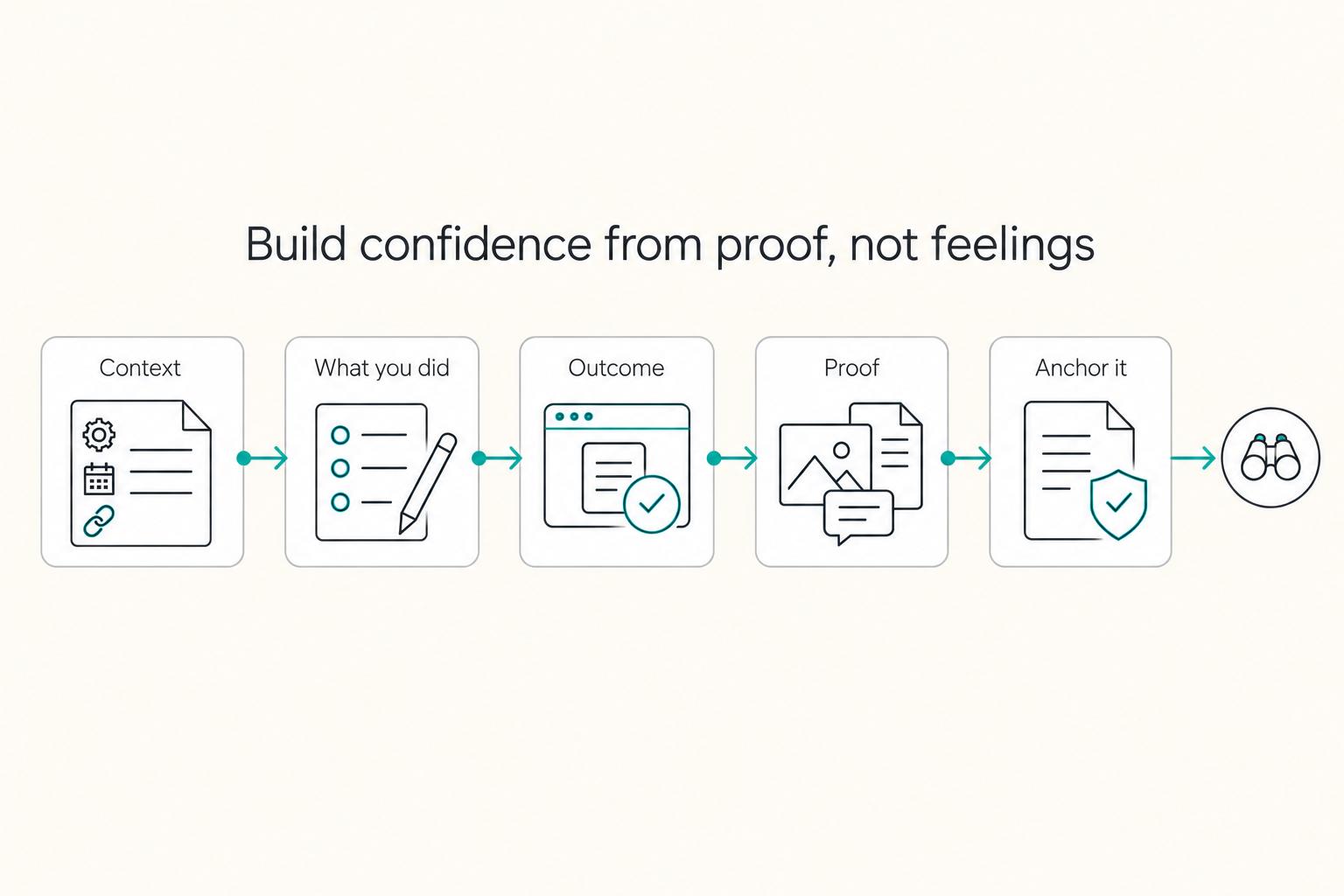
Start a "victory file"-SolidGigs puts it plainly: "Create a 'victory file' where you save client testimonials, positive feedback, successful project outcomes, and even small wins." Use any format you'll actually maintain.
For each project win, capture (at whatever level of detail is realistic):
- Context: problem + constraints (budget, timeline, dependencies)
- What you did: key actions and decisions
- Outcome: what changed (delivered deliverable, approved milestone, measured result if you have it)
- Proof: link, screenshot, client message, before/after artifact
- Anchor it: reference the SOW and the Definition of Done criteria you met (Agile Alliance defines Definition of Done as an agreed list of activities needed to reach "done.")
If a simple table helps you stay consistent, use something like this:
| Field | What to write | Why it matters |
|---|---|---|
| SOW/DoD anchor | "Phase 1 homepage draft - DoD met" | Replaces vibes with agreed completion criteria |
| Proof | Screenshot / approval email / delivered file link | Lets you verify reality quickly |
| Lesson | "Next time: confirm access earlier" | Converts anxiety into process improvement |
Action 2: Add a decision log to defuse second-guessing#
Add a short decision log per project. Capture:
| Log entry | What to capture | Why it helps |
|---|---|---|
| Assumptions | Assumptions you made and why they were reasonable at the time. | Keeps the reasonableness of the assumption in the record. |
| Tradeoffs | Tradeoffs you chose, such as speed vs. polish or depth vs. scope. | Captures the tradeoff you chose instead of leaving it implicit. |
| What you intentionally did not do | What you intentionally did not do. | Prevents omissions from becoming "evidence" you failed. |
| Change orders | Any change orders and what you agreed to. | Records written amendments that modified scope, cost, or timeline after signing. |
- Assumptions you made (and why they were reasonable at the time)
- Tradeoffs you chose (speed vs. polish, depth vs. scope)
- What you intentionally did not do (so omissions don't become "evidence" you failed)
- Any change orders (Ironclad describes a change order as a written amendment that modifies scope/cost/timeline after signing) and what you agreed to
This supports cognitive restructuring, a CBT technique that involves recognizing unhelpful thoughts and examining evidence for and against them. You're not doing therapy here; you're giving your brain receipts.
Action 3: Install an "evidence cadence" you can keep#
Pick a recurring slot you'll actually stick to. Each week, update (for example):
- A metric (time saved, approval cycle, conversion lift-whatever you can honestly measure)
- An artifact (screenshot, snippet, testimonial, change order)
- A lesson learned (a system tweak you'll reuse)
If you share publicly, keep it factual: outcome, constraint, method-not a victory lap.
When the impostor loop says "I got lucky," answer like an operator: point to what was delivered, what "done" meant for that work, and the proof you saved. That's confidence you can audit.
Step 2: How do I stop scope creep without sounding defensive?#
You stop scope creep by making boundaries boring: write them into the SOW, define "done" in plain language, and route every extra request through a simple change-order path. With proof-of-work habits in place, protect them by closing the biggest confidence leak: ambiguous scope.
Upgrade your project boundary system (put guardrails in writing)#
Scope creep is when requirements expand beyond the original scope without matching adjustments to timeline, budget, or resources. Don't fight it with tone. Fight it with structure.
In your Statement of Work (SOW) (a formal document defining goals, scope, timelines, milestones, deliverables, and budget), add three sections as a safe default:
- Included: explicit deliverables, count/quantity, and rounds (e.g., "1 homepage + 3 section variants, up to 2 revision rounds").
- Excluded: name the common "extras" (e.g., "copywriting, new pages, analytics setup, new integrations").
- Assumptions: access, response times, who supplies assets, and who approves. Assumptions prevent "surprise" work from looking like "your failure."
Then reduce ambiguity with completion rules:
- Acceptance criteria (conditions the work must satisfy to count as complete) in plain language.
- A lightweight Definition of Done (the quality bar for "done") so you don't spiral on "will they hate it?" when the work already meets the bar.
Use this mini-template:
| Control | What you write | Why it calms projects (and your brain) |
|---|---|---|
| Included/Excluded | "Includes X. Excludes Y." | Removes interpretation fights |
| Acceptance criteria | "Approved when A/B/C are true." | Defines "complete" up front |
| DoD (quality) | "Delivered + QA'd + files organized + handoff sent." | Prevents endless polishing |
Use a two-option change order script (procedural, not personal)#
Change orders are formal, documented modifications to scope/timeline/budget and typically require approval before you implement the change. That approval rule is your backbone.
Copy/paste and customize:
"Thanks-this request sits outside the current SOW. We can handle it two ways: Option A: we trade off [X deliverable/revision] to keep the timeline. Option B: I'll send a change order for $[Y] and +[Z] days. Which do you prefer?"
When details feel fuzzy (common early on, or when you can't share specifics), use authority without arrogance:
"Here's what I know: ____. Here's what I need to validate: ____. You'll have an answer by ____."
Finally, kill the hidden IP anxiety early. "Work made for hire" can mean the hiring party owns the copyright; an "assignment of rights" typically means you own it first, then transfer it-but how this works can vary by jurisdiction and contract terms. Put a clear ownership line in the SOW/contract so you don't quietly panic mid-project.
Verification: You can point to (1) Included/Excluded, (2) acceptance/DoD, and (3) an approved change order before you do extra work: no defensiveness required.
If you want a deeper dive, read How to Learn a New Language as a Digital Nomad.
Step 3: What should I do when clients pay late or question my invoice?#
You handle late payments and invoice pushback by turning payment into a pre-written system: milestone invoices, documented terms, and a calm stop-work workflow that you follow every time. Once scope is controlled, do the same for cash flow, because "Where is my money?" uncertainty fuels freelance imposter syndrome fast.
Make payment terms automatic (not a fresh negotiation)#
Late payments happen-many guides flat-out call them a common headache for freelancers and small businesses-so build terms that assume friction and keep you professional.
Before you start (prerequisite): Put payment terms in your SOW, and make sure the contract covers payment terms, deliverables, timelines, usage rights, and liability.
Use two defaults:
- Deposit and/or milestone billing written into the SOW. Milestone billing invoices at key project stages or deliverables and ties payment to progress so you get paid as work completes.
- Invoice timing attached to deliverables: "Invoice #2 issues on delivery of X," not "sometime mid-project."
Add a stop-work rule and keep it boring. Don't threaten; state process. A sample "Right to Stop Work" clause may grant a contractor the right to stop work until overdue payment gets delivered-your job is to (1) include it in writing and (2) follow whatever notice/process your agreement requires.
| System piece | What you write in the SOW | What it prevents (mentally + operationally) |
|---|---|---|
| Milestones | "Invoices issued at delivery of A/B/C" | Waiting until the end to "earn" payment |
| Due/overdue | "Due on receipt / Net X; overdue after Y" | Ambiguity that turns into anxiety |
| Stop-work rule | "Work pauses on overdue invoices per contract" | Resentment, over-delivery, spiraling |
Treat delays like ops reality (not a verdict on you)#
When clients pay late, don't convert it into a confidence crisis. Vendor onboarding can be "tedious and slow," and it often involves intake, contracts, banking, and KYC/KYB coordination across teams and systems. That friction reflects their internal process, not your competence as a solopreneur.
If you work cross-border, set expectations early. Cross-border rails can rely on a "patchwork" of correspondent banks, and compliance frameworks can fragment across jurisdictions. Tell clients up front what you need (legal entity name, address, payment contact, PO requirements) and that onboarding/compliance gates can add lead time.
Lightweight contract concepts that reduce stress (not legal advice):
- Governing Law / Jurisdiction / Arbitration: these decide which laws apply and how disputes get handled-use a reputable template and escalate to counsel for high-stakes deals.
- Limitation of Liability: caps damages one party can claim (a risk-control lever).
- Indemnification: one party promises to compensate the other in defined situations (another risk-control lever).
Invoice dispute protocol (run it like a checklist):
- Restate delivery against the SOW + Definition of Done ("Delivered X on date Y; meets acceptance criteria A/B/C.")
- Offer a bounded remedy (small revision/bugfix window) or propose a Change Order for new work.
- If still unpaid, follow the stop-work rule and document your timeline (dates, emails, what's paused).
Operational note: use tools/workflows that give traceable invoice status, exportable records, and clear exception handling. Tight records protect your cash flow-and your freelance mindset-when emotion spikes.
Step 4: How do I stay credible when clients compare me to AI tools like ChatGPT?#
You stay credible by shifting the conversation from "who types faster" to "who owns the outcome"-and by tightening your process, privacy, and accountability. If AI comparisons trigger that "maybe I'm replaceable" spiral, your counter is the same as everywhere else in this post: make value contractable and verifiable.
Reframe your value: from typing → accountability (use this script)#
When a client says, "We could just use ChatGPT," don't argue. Agree with the tool's strength, then name what they actually buy from you: judgment plus responsibility inside the SOW.
Script (copy/paste): "ChatGPT can speed up drafts; you're hiring me for judgment, integration with your constraints, and responsibility for the outcome in the SOW. I'll use tools where they help, but I own the Definition of Done and the final deliverable."
Then make it concrete with a quick comparison:
| What the client needs | What AI can do | What you do (paid value) |
|---|---|---|
| A usable deliverable | Generate options fast | Choose the right option for their brand, risk, and goals |
| Fewer revisions | Draft variations | Manage constraints + approvals so work ships cleanly |
| Someone accountable | Not accountable for your outcome | Own the Definition of Done, QA, and delivery timeline |
Turn "AI pressure" into better ops (not more overwork)#
AI comparisons often mean the client hasn't defined inputs. Fix that at onboarding, in writing.
Add "Inputs Required" to your kickoff checklist:
- Brand rules (voice, banned terms, compliance notes)
- 3-5 examples of "good" and "bad"
- Hard constraints (claims you can't make, legal lines, formatting)
- Approval chain (who signs off, in what order, by when)
Then tie success to your Definition of Done: "Approved by X, matches brand rules, contains Y sections, passes Z checklist." If the client changes inputs midstream, run a change order-don't "work harder."
If you use AI: consider setting a client-specific disclosure policy. Some environments use NDA terms (confidential information stays confidential), and some clients will ask for tool details. You don't need a manifesto-just a clear yes/no and boundaries.
Protect sensitive data (this is a real risk) Do not paste client PII into unapproved tools. PII means "any data that can be used to distinguish or trace an individual's identity." It can do that either alone or in combination with other information.
If a client sends a vendor security questionnaire (a structured set of questions assessing third-party security), answer it with your actual workflow.
If you sign a DPA, treat it like operating instructions. The ICO makes this plain: "Whenever a controller uses a processor, there must be a written contract (or other legal act) in place." Under GDPR/UK GDPR Article 28, processors act on documented controller instructions. Align your tools and storage to what you agreed, or renegotiate before you proceed.
Operational default: a law firm warning puts it bluntly-"you should not enter confidential information into ChatGPT because it saves all user inputs." Build your system so you can confidently say, "We don't put confidential client data into unapproved AI tools."
Verification point: you can explain your AI usage, data handling, and Definition of Done in under 60 seconds-calmly.
Build an AI-era case study asset: capture before/after, constraints, and the decisions you made (where automation failed, where judgment mattered). Publish a trimmed version on LinkedIn with no PII to make your credibility visible before the next sales call.
When things go wrong: the common mistakes that keep imposter syndrome alive (and how to recover fast)#
You don't "fix" freelance imposter syndrome by trying to feel confident-you fix the operational leak that keeps creating new evidence against you. Even with good systems, you'll slip. The win is having a clean recovery move that protects the relationship and your nervous system.
Term check: Impostor syndrome shows up as a pattern of self-doubt-fear you'll get "found out" and that you don't deserve what you've earned. That story gets louder when your ops stay fuzzy.
Step 1: Identify the mistake pattern (then choose the matching recovery)#
Use this as a fast triage map: no shame, just next actions:
| Mistake that fuels imposter syndrome | What it looks like in real life | Recovery move (fast, professional) | Verification point |
|---|---|---|---|
| You say yes without a boundary to feel "legit" | "Sure, I can add that" (even though it's new scope) | Draft a Change Order tied to the existing SOW: restate the Definition of Done, new timeline, and cost. A change order is a formal written amendment that modifies a contract when scope/cost/schedule changes after execution. | Client replies "approved" (in writing) or you realign work back to original SOW. |
| You underprice to avoid rejection, then resent the work | You dread messages, rush delivery, overwork | Set a next-contract rule: (1) pricing rule (your minimum), (2) scope rule (what you no longer include). Add explicit Scope Creep language and require a deposit to start the next project to reset seriousness. | You can quote your minimum + what triggers a change order in one sentence. |
| You treat late payment like a personal failure | You send "just checking..." texts and keep working | Run your invoice protocol: document invoice date, due date, follow-ups, and what you delivered; reference the payment terms; pause work if your SOW allows it. | You follow your timeline, not your mood. |
| You accept legal/compliance clauses you don't understand | You sign fast, then panic later | Flag these as review items: Indemnity/Indemnification (one party compensates the other for prospective loss), Limitation of Liability (caps damages), Governing Law (which state's laws interpret the agreement), Arbitration (binding decision by an arbitrator). Use a lawyer when exposure feels high. | You can explain each flagged clause in plain language before signing. |
| You confuse coaching content with mental health care | You "optimize" while symptoms worsen | Treat panic symptoms, depression, or inability to function as a healthcare issue, not a solopreneur productivity issue. For acute crisis: NIMH advises calling 911 or going to the ER in life-threatening situations, and contacting the 988 Lifeline for 24-hour confidential support. | You get real support, not another template. |
Step 2: Lock in the prevention rule (so you don't repeat it)#
After you recover, write one sentence you'll reuse next time (save it in your templates). Example: "Any request that changes the Definition of Done triggers a change order before I continue work." That's freelance mindset maturity: you stop negotiating with anxiety and start operating a system.
The operator's conclusion: confidence is a ledger, not a mood (copy/paste checklist)#
Durable confidence when impostor feelings hit can get easier when you run operations that generate evidence-on purpose-so your brain has fewer gaps to fill with doubt. You're not trying to "feel confident" on command. You're building a system that keeps producing receipts.
Impostor phenomenon often shows up when high achievers can't internalize success and chalk outcomes up to luck. You don't argue with that feeling. You out-document it.
One clinical-adjacent tactic in the literature mirrors this operator move: focus on the facts of accomplishments and attribute them to skill/ability, not external factors. Your systems become the container for that evidence.
Build the system once (then let repetition do the work)#
Use these definitions as your safe defaults:
- SOW (Statement of Work) = a formal document defining scope, deliverables, timelines, and responsibilities. When you feel "behind," it's often because the SOW left wiggle room.
- Definition of Done (DoD) = a formal description of what "done" means (quality + acceptance). This can help stop the "maybe they'll hate it" spiral because you can verify completion.
- Change Order = a written amendment that modifies scope/cost/timeline after signing. You don't "be flexible." You process changes.
- Scope Creep = unplanned scope growth without matching budget/schedule/resource changes. Name it early; manage it in writing.
A clean money lifecycle also matters for your freelance mindset: invoices, status tracking, payout records, and receipts in one place. Some payment providers add identity/business verification gates-KYC (Know Your Customer) and KYB (Know Your Business)-as part of anti-money-laundering programs. Requirements vary by provider, program, and jurisdiction. Don't treat that as drama; treat it as ops. It's traceability.
Copy/paste: Freelance Imposter Syndrome Anti-Chaos Checklist (7 items)#
- ☐ I can name my primary trigger (imposter loop vs skill gap vs business model mismatch).
- ☐ Every project has a signed SOW with an explicit Definition of Done.
- ☐ I run a written Change Order process to prevent Scope Creep.
- ☐ I maintain a Proof of Work file (metrics + artifacts) updated weekly.
- ☐ My invoice terms are written down (deposit/milestones + when I pause work if payment is late).
- ☐ I protect client PII ("data that can distinguish or trace an individual's identity") and follow NDA (confidentiality) / DPA (how a processor handles personal data) limits on tools (especially AI).
- ☐ I have a recovery protocol for late payment, scope disputes, and contract red flags (Limitation of Liability = a ceiling on damages; Indemnification = who covers prospective loss; Governing Law/Arbitration = how disputes get handled).
If you want extra mental-health infrastructure while you scale, build support like you build ops: Digital Nomad Health Insurance: A Comparison of Top Providers.
Frequently Asked Questions
What is imposter syndrome in freelancing?
Imposter syndrome is a psychological phenomenon where you persistently feel like a fraud despite real evidence of competence and results. Merriam-Webster frames it as "persistent doubt" about your abilities plus fear of being exposed, and Britannica highlights the same pattern: doubt despite achievement or peer respect. In freelancing, it can show up as "I got lucky" thinking even after a clean client win.
Is imposter syndrome normal for freelancers?
Impostor feelings are common. The APA has reported estimates as high as 82% of people experiencing feelings of the impostor phenomenon. Don't over-medicalize it: a professional practice article notes it doesn't appear in DSM-5 or ICD-10, and Cleveland Clinic also says it isn't a "true medical diagnosis." It can help to treat it like a mental pattern-especially one that may feel louder when you're working under uncertainty, scrutiny, or growth.
How do I know if it's imposter syndrome or I'm not qualified?
A useful distinction is whether your doubt persists even when you have evidence. If you can point to past outcomes, a repeatable process, and satisfied clients, but your brain still says "fraud," you may be dealing with impostor feelings. If you can't describe how you'll deliver the work, can't meet clear requirements, or keep missing fundamentals, you may be looking at a skill gap-meaning training, narrower scope, or support could be the next move.
What are the signs of imposter syndrome as a freelancer?
Anchor on the definition: persistent self-doubt despite evidence of competence, plus fear of being exposed as a fraud. In day-to-day freelance life, that often looks like discounting achievements, attributing wins to luck, or feeling less competent than others perceive you to be.
How do I overcome imposter syndrome as a freelancer (without losing productivity)?
Focus on keeping momentum without waiting for a "confidence switch" to flip. Psychology Today frames impostor experiences as thoughts that can come and go-so you don't need to "become confident" to work; you may just need a structure that keeps you moving. Some freelancers find it helpful to track concrete evidence (a simple wins log, saved client feedback, documented results) and reduce avoidable ambiguity (clear scope, written agreements, and a quick check before accepting changes).
How do I stop underpricing because I feel like a fraud?
Stop negotiating against your nervous system. Set a pricing floor (your minimum viable rate) and a scope floor (what that price includes), then enforce it with a written SOW and change orders. If you can't say your price out loud without apologizing, narrow the offer until you can.
Does imposter syndrome go away with experience-and what helps long-term?
Experience can help, but impostor thoughts don't always disappear automatically. Long-term, it can help to make your work more concrete: clearer positioning, clearer deliverables, documented results, and consistent business hygiene (contracts, invoicing, boundaries). Treat confidence like a ledger-add proof entries regularly, and you'll rely less on mood.
Try a related tool
Researched and edited by the Gruv editorial team. Gruv builds cross-border billing, payouts, and finance-operations software for global businesses.
Sources
Educational content only. Not legal, tax, or financial advice.
Related Posts

Digital Nomad Health Insurance Comparison for Long-Stay Moves
Use focused time now to avoid expensive mistakes later. Start with a practical `digital nomad health insurance comparison`, then map your route in [Gruv's visa planner](/tools/visa-for-digital-nomads) so we anchor policy checks to your real plan before pricing pages pull you off course.

How to Learn a New Language as a Digital Nomad
If you want to **learn language while traveling** without winging it, aim for reliability before fluency. Your first job is not to sound impressive. It is to get through early daily interactions when the conversation speeds up and reading skills stop helping.

The Freelance Payment Penalty: A Modeled Audit of Platform Fees, FX Spreads, and Payout Delays
The money rarely disappears through a single, easy-to-spot fee. The real loss is stacked. A marketplace takes its commission, a processor adds a charge for international cards, a bank or payment company converts the currency at a spread, a platform holds the funds before release, and a wire sheds a little to intermediaries on the way in. Each layer looks defensible on its own, but the worker feels the combined result as a smaller deposit and a later payday.