
Quick Answer
Build serendipity for freelancers by using one repeatable decision system: prepare records early, qualify demand through useful relationship maintenance, and label every lead Go, No-Go, or Go with conditions before proposal work. Use concrete proof at intake, including the right W-9 or W-8BEN path when relevant, because missing tax-identification handling can trigger 24% backup withholding and stall momentum.
First, Build Your 'Compliance Shield': The Foundation for Fearless Opportunity#
You can only say yes to unexpected work if your records are solid enough to survive billing, tax, and travel questions. Treat contract intake, tax-status checks, invoice prep, and evidence storage as one control chain. That will not guarantee a clean outcome in every jurisdiction, but it can cut avoidable errors, rework, and payment friction.
Capture and verify intake data before you invoice#
Build the file before the work starts. Save the signed contract, statement of work, and purchase order if there is one. Then record the facts your invoice will depend on later: client legal entity name, billing contact, billing address, currency, payment terms, PO requirement, and any tax fields the client asks for. Add a one-line scope summary so the contract and invoice tell the same story.
Then verify the tax-status path that actually applies. If you are dealing with a U.S. payer, do not wait for accounts payable to ask for missing paperwork. A U.S. person may be asked to furnish a Form W-9 with TIN certification in writing. A foreign individual may use Form W-8BEN to establish foreign status and, where applicable, claim treaty-based withholding reduction. Missing or incorrect required tax-identification handling can trigger backup withholding at 24 percent, so do not leave this for later.
Use a small set of invoice templates instead of recycling old invoices. Keep separate versions for domestic, cross-border, and special-treatment cases. Give each one clear unresolved-state fields such as "Current verification portal/process pending official verification" or "Current VAT or withholding rule pending adviser verification." Before you send anything, validate the legal name, scope, PO, due date, bank details, invoice numbering, and tax note. If the contract, invoice, and evidence would confuse your bookkeeper six months from now, stop and fix it first.
| Control point | If you do it ad hoc | If you control it |
|---|---|---|
| Client identity and tax status | Wrong legal name, missing form, or name/TIN mismatch can create setup delays or follow-up requests | Capture legal entity data at intake, store the signed W-9 or W-8BEN when relevant, and save the verification result or request trail in the client folder |
| Invoice preparation | You copy an old invoice and miss a PO, tax note, or payment term | Select the right template first, then run the same pre-send check on every invoice |
| Payment timing | Client questions can pause payment while you resend corrected paperwork | Match invoice fields to the signed contract and PO before sending so accounts payable has fewer reasons to bounce it |
| Audit traceability | Evidence lives across email, chat, and desktop files | Archive the sent invoice, client approval, contract, and tax-status evidence together so support is easy to retrieve |
Keep this in your pre-send review. If a U.S. client uses IRS TIN Matching, mismatches can surface before information returns are filed. That is why you want name and TIN details captured cleanly at intake, not pulled from memory right before the January 31 Form 1099-NEC filing deadline.
Track travel days and test cross-border scenarios early#
Travel risk gets expensive when you reconstruct it later. If the work involves travel, relocation, or delivery from another country, start a day log on day one. Record entry date, exit date, where the work was physically done, which client it related to, and where the income was billed from. Do not depend on airline emails or a calendar rebuild at year end.
| Jurisdiction | Test or guidance | Threshold or rule |
|---|---|---|
| U.S. | Substantial presence test | 31 days in the current year and 183 days across a 3-year period with 1/3 and 1/6 weighting for prior years |
| UK | Statutory Residence Test | Includes automatic overseas tests, automatic UK tests, and a sufficient ties test; 183 or more days is a key threshold |
| Relevant EU short-stay cases | Border-crossing guidance | 90 days per period of 180 days |
Before you accept or extend a trip, test the proposed dates against the jurisdictions in play. For the U.S., the substantial presence test uses explicit day-count rules, including 31 days in the current year and 183 days across a 3-year period with 1/3 and 1/6 weighting for prior years. For the UK, the Statutory Residence Test includes automatic overseas tests, automatic UK tests, and a sufficient ties test. In that framework, 183 or more days is a key threshold. For relevant EU short-stay cases, the border-crossing guidance references 90 days per period of 180 days. For anything else, keep a tracker field that says the threshold and test name must be verified from official residency or border records before use.
The common failure mode is mundane and expensive. You accept a promising trip, then try to rebuild movement later and realize the real risk question should have been asked before you booked.
Create one source of truth and assign the handoff#
Fragmented records create fake emergencies. Keep one cloud folder, one invoicing or bookkeeping record, and one travel log. Then make ownership explicit.
| Element | What to do |
|---|---|
| Owner | You own completeness at intake and before invoice send |
| Folder structure | /Clients/Client Name/01 Contracts/02 Invoices/03 Tax Checks/04 Approvals/05 Travel |
| Handoff | Send your bookkeeper or accountant a monthly exception pack, not a rescue job, with missing forms, invoice corrections, unusual withholding notes, and travel flags |
| Review cadence | 15 minutes weekly to file new items, monthly review on unpaid invoices and numbering gaps, and a deeper tax-check cadence to confirm with your adviser |
| Retention | Keep supporting records based on the rules that apply to you; the IRS says generally until the limitations period for the return expires, and UK self-employed records must be kept for at least 5 years after the 31 January submission deadline |
Before you accept new work, run a fast self-audit. Do you know the contracting entity? Do you have the tax-status evidence you need? Can you explain where the work will physically happen and how you will document it? If any answer is no, pause the yes. Related: LinkedIn for Freelancers Who Want a Predictable Client Pipeline.
Next, Engineer Your 'Opportunity Engine': A System for Attracting High-Value Work#
Once your compliance basics are stable, build opportunity creation as a system: qualify the right conversations early instead of trying to be visible everywhere. Weak ties often surface newer opportunities than your closest circle, and if 95% of business clients are not actively buying at a given moment, your job is to stay useful and memorable until timing changes.
Segment weak ties and track the next useful reason to reconnect#
If your contact list is fuzzy, your outreach will be fuzzy. Keep one contact sheet with three buckets: past clients, peer referrers, and buyer-side contacts. For each person, log last touchpoint, what they know you for, current role/company, likely buying or referral path, and one relevant reason to reach out now.
| Bucket | What to log | Primary role |
|---|---|---|
| Past clients | Last touchpoint, what they know you for, current role/company, likely buying or referral path, and one relevant reason to reach out now | Rehire |
| Peer referrers | Last touchpoint, what they know you for, current role/company, likely buying or referral path, and one relevant reason to reach out now | Refer |
| Buyer-side contacts | Last touchpoint, what they know you for, current role/company, likely buying or referral path, and one relevant reason to reach out now | Buy directly |
If you have not set them yet, mark the cadence target and review cycle as pending source-record verification. Keep it human: no automated message you would not want forwarded back to you.
Quick test: can you sort the sheet in 30 seconds and identify who can rehire, refer, or buy directly? If not, tighten the data before you send more outreach.
Publish formats that match buyer intent#
Publish so buyers can qualify you before a call. Many prefer a self-directed journey, so each piece should answer a real buyer question and show how you think.
| Format | Buyer intent | Trust signal | Expected next action |
|---|---|---|---|
| Short lesson from recent work | "Do you understand my type of problem?" | Clear judgment from real practice | Save, follow, or reply with a related issue |
| Common mistake breakdown | "What should we avoid before hiring?" | Specific, people-first guidance | Ask a clarifying question or share internally |
| Mini case study | "Can you handle a scoped engagement like ours?" | Decision context, constraint, and concrete guidance | Request a call or ask about similar work |
Stop doing this: if a post does not support an active offer, answer a buyer question, or demonstrate your decision process, do not publish it.
Help publicly, then open a private conversation only on clear signals#
Start value-first in public; move private only when the signal is clear. In niche communities, keep helping in-thread until you can see three things: a specific problem, clear service fit, and a plausible authority path, even if the final approver is not present yet. If you mention your service, disclose your affiliation and keep the public answer useful without the pitch.
Before you do more outreach, run a lightweight qualification checkpoint:
- Is the need specific enough to scope?
- Is there a route to decision authority?
- Does this fit your offer without forcing it?
If any answer is no, stay helpful, refer when appropriate, and avoid pushing the conversation. You might also find this useful: A Daily Stoic System for Freelancers.
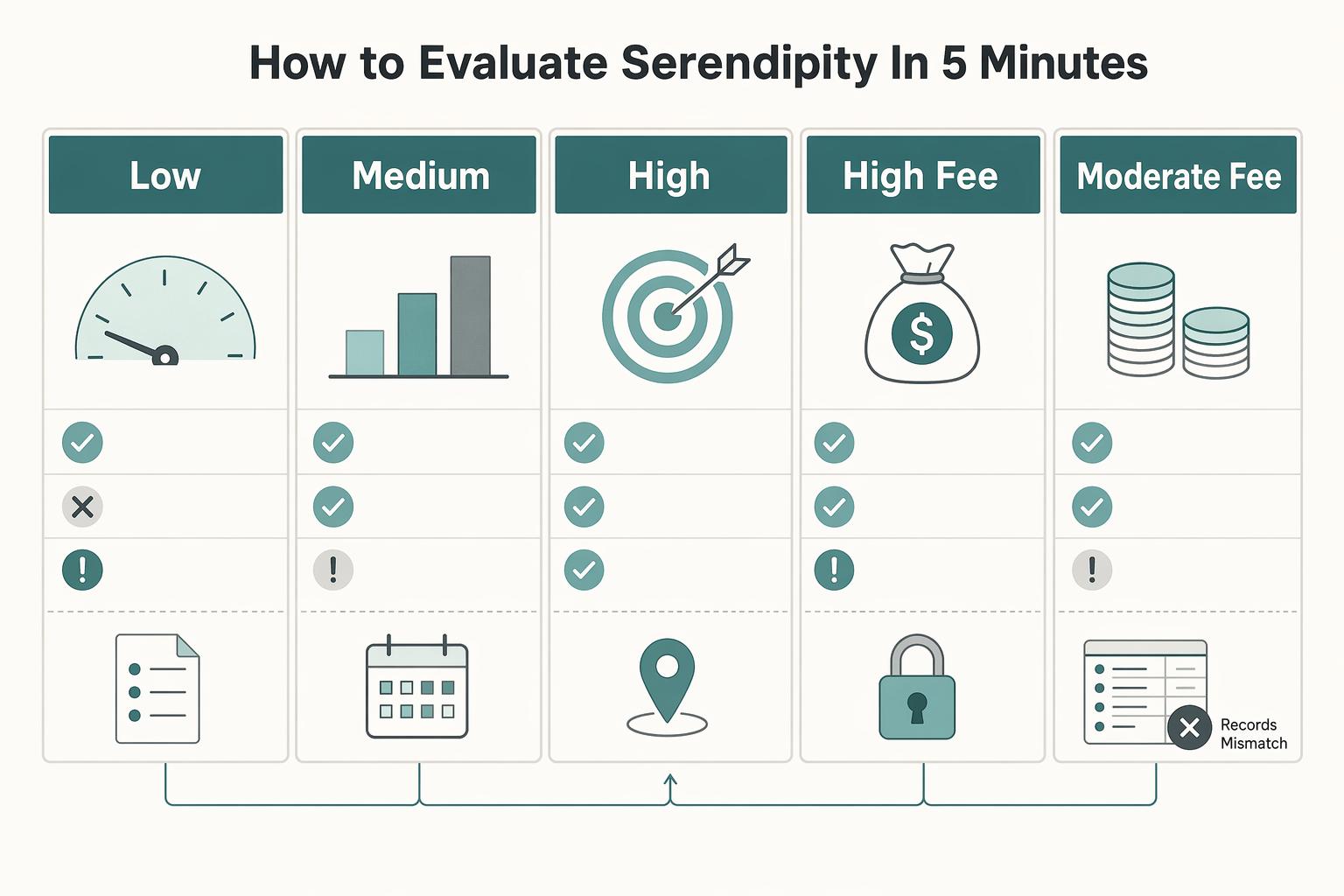
Finally, Deploy the 'Go/No-Go Matrix': How to Evaluate Serendipity in 5 Minutes#
When a new lead comes in, decide before you draft: every inquiry ends as Go, No-Go, or Go with conditions in writing.
Step 1. Check strategic alignment first. Run three yes/no checks: does this match your current offer, does it put you in front of buyers you want more of, and what opportunity cost do you take on if you pursue it? If you need to bend the offer, chase a buyer type you do not want, or crowd out better-fit work, default to No-Go unless the scope is quickly reframed.
Use one blunt checkpoint: can you explain fit in one sentence without "it could turn into something"?
Step 2. Estimate true profitability, not headline fee. Use one formula every time:
Quoted fee - delivery effort - coordination overhead - compliance/admin load
Then compare the result to your internal floor. Verify the margin benchmark and break-even threshold from your own source records before use. Treat margin and break-even as math, not intuition.
If a U.S. client requests Form W-9, include it in your decision evidence pack. Give the form to the requester, not the IRS, and make sure line 1 name matches the TIN.
Step 3. Rate compliance complexity by evidence, not optimism. Before any yes, confirm what you can prove, not what you assume.
| Complexity level | What is true now | Evidence required before a yes decision | Default decision |
|---|---|---|---|
| Low | Signer, billing entity, payment terms, scope, and data handled are already clear | Standard contract and billing records are complete | Go |
| Medium | One material area is unclear | Resolve the specific gap, for example processor terms, personal-data categories, or the current jurisdiction rule to confirm from the official source, and log the update | Go with conditions |
| High | Multiple unknowns exist across entities, cross-border data, or payment flow | Required documents/approvals are still missing | No-Go until evidence exists |
If personal data is involved, keep written processor terms and documentation of processing activities in your file. For deeper context, see GDPR for Freelancers: A Step-by-Step Compliance Checklist for EU Clients.
Step 4. Weigh future value, then assign the outcome. Count future value only when it is specific and documented.
| Lead pattern | Main tradeoff | Evidence needed before yes | Default action |
|---|---|---|---|
| High fee, weak fit | Revenue can hide poor positioning and high opportunity cost | Scope is reshaped into your core offer | No-Go unless reframed |
| Moderate fee, strong fit, repeatable delivery | Lower headline fee can still produce cleaner margins and execution | Normal contract and billing checks | Go |
| Strong fit, decent fee, unresolved compliance or stakeholder gaps | Good work can still become admin-heavy and slow to collect | Missing signer, data terms, payment path, or current jurisdiction rule to confirm from the official source | Go with conditions |
Close every lead with one dated log standard: decision, rationale, next action, owner. Then execute:
- Go: send proposal with scope, assumptions, timeline, and required client inputs.
- No-Go: decline clearly and record the pattern.
- Go with conditions: list exact missing answers or documents required before proposal.
If you want a deeper dive, read How to Manage Your Personal Brand as a Freelancer.
Your Business of One, Ready for Anything#
Run one operating loop every week: Compliance Shield -> Opportunity Engine -> Go/No-Go Matrix. This keeps opportunity decisions consistent when work gets busy.
| Area | Reactive mode | Resilient mode |
|---|---|---|
| Compliance | Searches for contract terms, invoice details, or tax notes after a lead becomes urgent. | Updates templates and client folders before outreach, and keeps approval/supporting records easy to retrieve. |
| Money and records | Treats tax as a year-end task and reconstructs records later. | Reviews income as it arrives, treats estimated tax as pay-as-you-earn, and checks whether the U.S. $1,000 threshold may apply. |
| Pipeline | Pauses relationship work during delivery weeks and waits for inbound when work slows. | Keeps a weekly outreach/follow-up rhythm, and ships proof assets tied to active offers. |
| Decisions | Says yes based on headline rate or urgency. | Marks each lead Go, No-Go, or Go with conditions after missing facts are written down. |
-
Stabilize your base first. If you operate as a U.S. sole proprietor, your business is not legally separate from you, so structure, taxes, and personal-asset risk are operational issues, not admin extras. Confirm you can quickly find each active client's contract, scope, invoice details, and records needed to support return positions.
-
Keep demand warm while you deliver. Customer acquisition is a common operating challenge, so keep relationship maintenance active even in busy periods. Use weak ties deliberately, but do not force one rule everywhere: they tend to help more in digital industries, while stronger ties may carry more weight in less digital contexts. If momentum is thin, restart with past clients and close collaborators, then widen from there; for a deeper method, see How to Network Effectively as a Remote Freelancer.
-
Audit your system in one weekly pass.
- Compliance check: Verify the response-time target from source records before using it to judge record retrieval. * Opportunity check: Verify the pipeline target from source records before using it to count active conversations, warm targets, or scheduled follow-ups. * Decision check: Are new leads labeled Go, No-Go, or Go with conditions the same day once facts are complete? * Recovery check: If one client pauses, what is the next named action already on your calendar?
For a step-by-step walkthrough, see Best Business Books for Freelancers Building a Durable Business.
Frequently Asked Questions
How can you actually create your own luck as a freelancer?
You create it by getting ready before the lead appears, not by waiting for a random break. Early freelance work often comes from previous employers or your existing network, so opportunity quality improves when your Opportunity Engine is active and your Compliance Shield lets you respond without scrambling. This week, make one short list of past clients, colleagues, and collaborators to recontact.
What is the biggest barrier to freelance serendipity?
Usually, it is acting on momentum without clear decision discipline. People with similar experience and connections can still end up empty-handed, so preparation and judgment matter. Before your next call ends, write down the missing answers and mark the lead Go with conditions until those answers exist in writing.
What is "smart luck" for a freelancer?
It means a good-fit opportunity arrives and you are already prepared to judge and act on it. People with similar experience and connections can still end up empty-handed, so the difference is often decision discipline, not talent or optimism. Keep a usable intake checklist, proposal draft, and evidence folder ready, then record a Go, No-Go, or Go with conditions outcome before you spend proposal time.
How does personal branding create serendipity?
It can help, but it is not a guarantee by itself. A stronger pattern is that consistently good work and satisfied clients create word of mouth, so your public presence should make your fit and proof easy to understand. Publish one proof asset this week tied to a single offer, such as a short case note or before-and-after example. Then remove one profile line that sounds impressive but does not help a buyer qualify you.
Is networking still important for creating freelance opportunities?
Yes, but it works best when you treat it as relationship maintenance, not constant self-promotion. Opportunity quality improves because satisfied clients create word of mouth, and useful follow-up with existing contacts tends to produce better-fit conversations than cold visibility alone. Restart two conversations this week with a specific reason and log them in your Opportunity Engine. Then set a follow-up rhythm you can sustain; if you need a deeper method, read How to Network Effectively as a Remote Freelancer.
Try a related tool
Researched and edited by the Gruv editorial team. Gruv builds cross-border billing, payouts, and finance-operations software for global businesses.
Sources
- commission.europa.eu/law/law-topic/data-protection/rules-business...trusted
- extension.oregonstate.edu/sites/extd8/files/documents/8341/prescribed-...trusted
- irs.gov/businesses/small-businesses-self-employed/ba...trusted
- irs.gov/businesses/small-businesses-self-employed/es...trusted
- ndm.edu/sites/default/files/pdf/go_no_go_document_ii...trusted
- news.mit.edu/2022/weak-ties-linkedin-employment-0915trusted
- news.stanford.edu/stories/2022/09/real-strength-weak-tiestrusted
- portal.ct.gov/-/media/departments-and-agencies/dss/ct-mets...trusted
Educational content only. Not legal, tax, or financial advice.
Related Posts

GDPR Compliance Checklist for Freelancers Working With EU Clients
Start by separating the decisions you are actually making. For a workable **GDPR setup**, run three distinct tracks and record each one in writing before the first invoice goes out: VAT treatment, GDPR scope and role, and daily privacy operations.

How to Network Effectively as a Remote Freelancer
Treat **remote freelance networking** as recurring relationship work, not a burst of applications or random visibility. That shift turns a noisy week into a useful one. You spend less time in low-fit conversations, lose less time to busywork, and end each session knowing the next move.

How to Manage Your Personal Brand as a Freelancer
Your brand is not a mood board. Think of it as the experience people have of your work: the promise you make, the proof you can show, and the way you present yourself across client touchpoints. Get that clear first, and your fit is easier to read from profile to proposal.