
Quick Answer
Define a bounded deliverable and acceptance criteria, estimate full effort and direct costs, then align proposal, SOW, revision rules and payment triggers before agreement. Use a change order for genuine additions; do not charge extra automatically for owed corrections. Keep deposits, delivery, acceptance, invoicing and bank receipts as distinct records.
Define the package before you price it#
How you start a project shapes the rest of the engagement. Packages work best when you treat them as written delivery terms, not just a pricing format. If scope, change handling, and payment timing are clear early, you reduce late-stage confusion and stalled invoices.
Lock the core documents early. A repeatable client onboarding checklist, aligned proposal and contract language, and explicit invoice checkpoints keep decisions clear when pressure rises.
Document drift happens easily. The proposal says one thing, the SOW says another, and kickoff notes add a third version. Once that happens, revision and invoice conversations slow down. The steps below reduce that risk before delivery starts. Each section turns one decision into a document, rule, or checkpoint you can use right away.
- Step 1: Build a client intake form that creates early clarity.
Capture the objective, timeline, decision-maker, budget range, and required inputs before you quote.
- Step 2: Draft your Statement of Work (SOW) before final pricing.
Draft the scope assumptions before quoting, and identify whether the proposal is a nonbinding estimate or can become an agreement on acceptance. Align the proposal, SOW and service agreement before the client commits and before work starts; specify which approved document governs if wording conflicts.
- Step 3: Publish a revision policy and a change-order rule.
Set the line between an in-scope revision and paid net-new work before delivery starts so you do not relearn how to prevent scope creep mid-engagement.
- Step 4: Tie payments to milestones and invoice discipline.
Use a deposit and clear invoice checkpoints. A 50% deposit is one example, not a universal rule.
- Step 5: Stabilize execution, then improve positioning.
Once delivery is consistent, sharpen the offer narrative, including a move toward a clearer productized service.
Gather the inputs before you package#
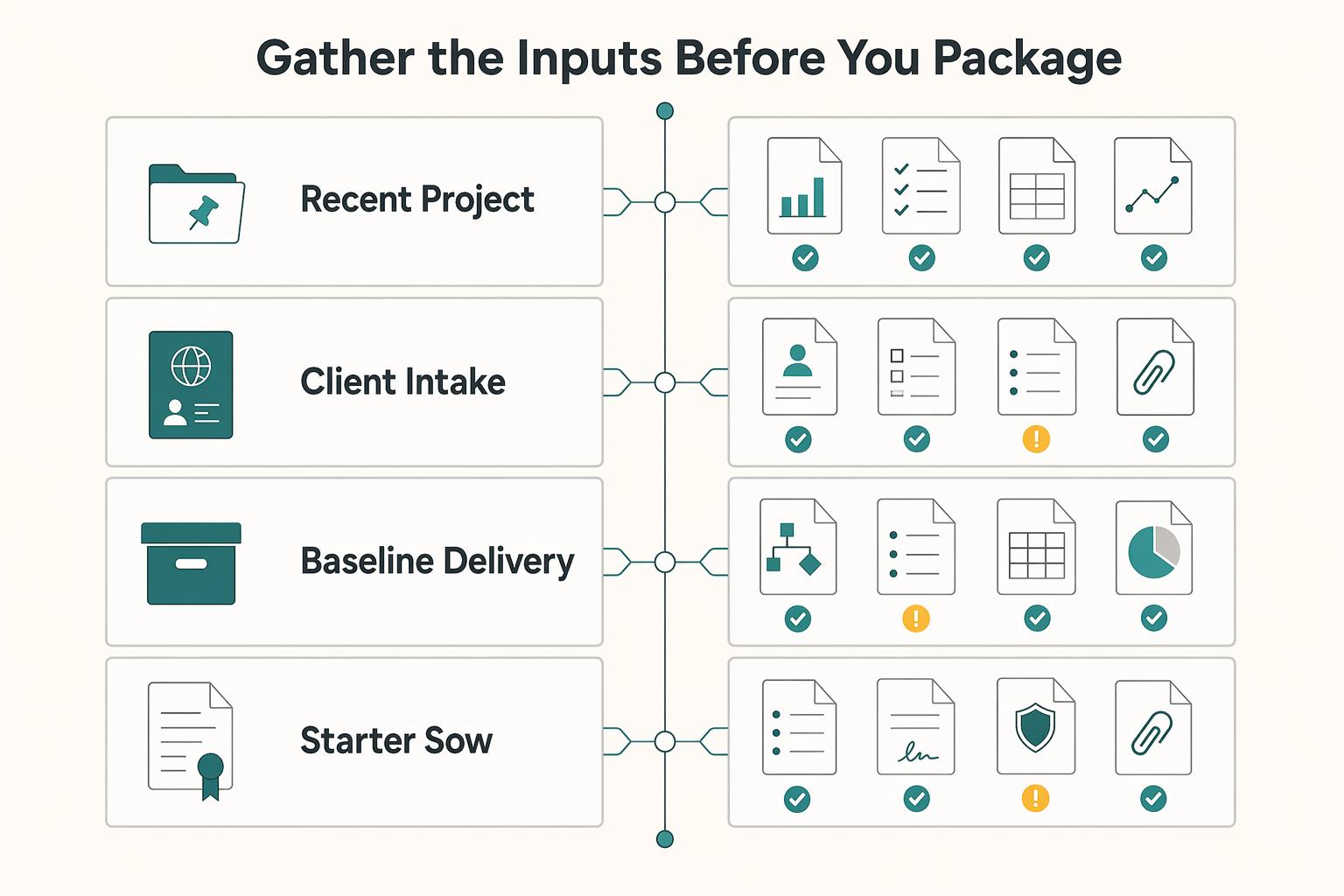
Start packaging only after you document the inputs. When your intake notes, prior scope, and contract templates are in one place, pricing gets easier because you're working from evidence instead of memory.
| Item | What to prepare | Check |
|---|---|---|
| Recent project audit | Map what was sold against what was delivered, then note where effort expanded and which requests caused it | Each reviewed project shows sold scope, delivered output, and any extra requests |
| Client intake form | Capture communication preferences, working style, feedback methods, and expectations from both sides | One completed form gives enough context to proceed, re-scope, or decline |
| Baseline delivery SOP | Document intake, proposal, contract, kickoff, review, and sign-off as named stages with a trigger, an owner, and a completion signal | If a stage has no owner or no completion signal, delays and rework are harder to prevent |
| Starter SOW | Use the proposal template as the base; keep deliverables, timing assumptions, and approval checkpoints consistent; confirm the legal service agreement is signed before delivery starts | Proposal and SOW describe the same scope in the same terms |
Pull recent project records, current proposal templates, signed agreements, and delivery artifacts into one working folder before you draft tiers. This reduces guesswork and improvisation.
Before you set prices, run a quick evidence pass on each project: what changed, who approved it, and where it was recorded. If those answers are hard to find, your source material is not ready.
- Step 1: Audit recent projects against original scope.
Map what was sold against what was delivered, then note where effort expanded and which requests caused it. Verification point: each reviewed project shows sold scope, delivered output, and any extra requests.
- Step 2: Build a client intake form as an onboarding questionnaire.
Capture communication preferences, working style, feedback methods, and expectations from both sides. Verification point: one completed form should give enough context to proceed, re-scope, or decline.
- Step 3: Draft a baseline delivery SOP with clear handoffs and checks.
Document intake, proposal, contract, kickoff, review, and sign-off as named stages. For each stage, assign a trigger, an owner, and a completion signal. Red flag: if a stage has no owner or no completion signal, delays and rework are harder to prevent.
- Step 4: Prepare a starter Statement of Work (SOW) before pricing.
Use your proposal template as the base so scope terms and pricing options stay aligned across sales and contract documents. Keep deliverables, timing assumptions, and approval checkpoints consistent, then confirm the legal service agreement is signed before delivery starts. Verification point: proposal and SOW describe the same scope in the same terms.
With these inputs in place, choose a pricing model that fits the uncertainty and unpaid exposure. See Hourly vs Project-Based Rates.
Pick the pricing model with a clear decision rule#
Choose pricing by risk profile, not habit. Hourly pricing can work when scope is still uncertain, fixed pricing works better when estimates are reliable, and a retainer agreement is often a better fit for recurring needs.
Use the same four criteria each time: scope uncertainty, delivery data maturity, client need for predictability, and admin overhead. One decision rule keeps your pricing logic consistent as the offer evolves.
| Model | Best fit | Main tradeoff | Verification checkpoint |
|---|---|---|---|
| Hourly pricing model | High uncertainty, weak delivery-time history, changing inputs | Can limit upside and add time-tracking friction | Scope defines phase caps and what happens at each cap |
| Flat-rate pricing model | Stable estimates, clear deliverables, client wants predictable spend | Hidden labor if boundaries are loose | SOW lists inclusions, exclusions, and milestone approvals |
| Retainer | Recurring needs and ongoing decisions | Can be a poor fit for one-off deliverables | Agreement defines recurring cadence and monthly scope boundaries |
If uncertainty is high and the buyer still asks for one fixed total, avoid forcing a flat quote from weak data. Consider starting with a capped discovery phase, then converting to fixed pricing after criteria, dependencies, and deliverables are stable.
- Step 1: Score the engagement against the four criteria.
Rate each criterion as low, medium, or high. If uncertainty is medium or high, avoid jumping straight to fixed pricing.
- Step 2: Choose the lowest-risk model for your current data quality.
If delivery times are volatile, start hourly with capped phases. If estimates are stable and scope is tightly defined, use fixed pricing with agreed project-level or milestone-based payment releases.
- Step 3: Use retainer primarily for recurring work.
If work ends after one deliverable cycle, project pricing is often cleaner.
- Step 4: Keep a la carte visible, then recommend one bundled outcome.
Show component pricing for comparison, then guide buyers to one package with clearer boundaries and fewer approval handoffs.
That keeps expectations realistic and protects your margin when uncertainty is still high.
Define one package around outcomes and evidence#
Define a result you can deliver and a clear way to verify it. Distinguish the contracted output from a business benefit you hope it supports: a delivered landing page can have objective acceptance criteria, while sales growth depends on traffic, offer and other factors outside your control.
A repeatable, productized offer is often easier to price and explain than ad hoc hourly work, and it can help address common objections.
Use a simple readiness test before publishing: can the client restate the expected outcome in one sentence, and is the package language specific enough to avoid guesswork? If either answer is no, tighten the package language.
- Step 1: Define one promised outcome in plain language.
Write one concrete result statement and qualify client dependencies. Do not promise a business metric you cannot control unless you have expressly agreed its measurement and risk.
- Step 2: Convert the repeatable offer into a productized service.
Name the deliverables in clear, bounded terms so scope stays outcome-led rather than time-based. Where scope can vary, use bounded language such as up to.
- Step 3: Address common objections in the package description.
Preempt common myths and reservations about moving from hourly billing to package pricing with direct, plain-language explanations. If you are still shaping the offer ladder, compare your draft against tiered pricing for freelancers.
- Step 4: Add one verification checkpoint before final sign-off.
Set one explicit review point where the client confirms the promised outcome was delivered, then record that decision in writing.
| Illustrative landing-page package | Agreed boundary |
|---|---|
| Output | One responsive five-section landing-page design and agreed source files; copy supplied by client |
| Dependencies | Client supplies approved copy/brand assets and one feedback owner before the start date |
| Included review | Two consolidated refinement rounds on the agreed version; original nonconformities remain subject to the correction obligation |
| Acceptance | Named sections and breakpoints meet agreed criteria; review window and objection process specified |
| Excluded | Copywriting, additional pages, development and third-party integrations |
| Change example | An extra page at an illustrative 400 dollars requires approved scope/date/fee; fixing a missing agreed section is an owed correction |
Lock scope boundaries in writing#
Write scope once, then reuse the same wording across proposal, SOW, and delivery notes. When language drifts between documents, expectations drift with it.
Scope control also needs version control. Date each approved scope file, and note when a change order replaces prior language. If an older file resurfaces later, you can point to the current approved text instead of debating memory.
- Step 1: Convert verbal promises into scope of work lines.
For each deliverable, define the output, format, delivery timing, and required client dependencies. Keep the wording specific enough that someone outside the project can understand what is being delivered.
- Step 2: Mirror that language inside the Statement of Work (SOW).
Carry approved scope wording into the SOW, then attach acceptance criteria, milestones, timelines, dependencies, and clearly stated payment terms so each promise has a written anchor.
- Step 3: Add a clear Not Included block.
List excluded tasks in plain language so clients can separate included work from optional add-ons.
- Step 4: Route out-of-scope requests through a change order.
Assess a request against the actual agreed scope. A correction needed to meet existing acceptance criteria is not automatically extra paid work. For genuine scope, timeline or dependency changes, agree the impact and approval before starting the expanded work; record a zero-cost change too if that is what both sides agree.
Set revision limits and change handling before sales calls#
Set revision boundaries before proposal approval, not after drafts start. A written revision policy and a clear change-order trigger make it easier to stay consistent under pressure.
| Control | Written rule | Checkpoint |
|---|---|---|
| Revision policy | Define consolidated feedback rounds on named versions, examples of refinement and net-new scope, and an included cap; distinguish owed corrections of nonconforming work | Ask the client to classify two sample requests before signing |
| Change-order trigger | Genuine additions need agreed scope, price/timing impact and approval; record no-charge amendments separately; owed defects are not automatically extras | Keep a scope log with request date, in-scope or out-of-scope decision, and approver name |
| Required change-order fields | Each change order includes timeline impact, price impact, and updated acceptance criteria; if any field is missing, treat the request as incomplete until updated and approved in writing | Use a one-page format with requested change, reason, revised date, added fee, updated acceptance criteria, and approval |
| Proposal and SOW alignment | Use matching revision and change-order language in both documents so expectations stay aligned during the project | Confirm the same revision cap and scope-change trigger appear in both files |
Before kickoff, run a short calibration with the client using your policy language. Walk through one in-scope revision and one out-of-scope request. This can surface interpretation gaps early, before they turn into billing conflicts.
- Step 1: Publish your revision policy in plain language.
Define an included revision round as one consolidated feedback set on a named version, with an agreed response window. Give examples of refinements and genuinely new scope, set the included round count and distinguish correction of nonconforming work already owed under the agreement.
- Step 2: Use a clear trigger for paid change orders.
Use the agreed scope and acceptance criteria to classify the request. Price genuine additions through a change order, and record any agreed no-charge change. Keep defects and owed corrections separate from optional extras.
- Step 3: Require complete change-order fields before work starts.
Each change order should include timeline impact, price impact, and updated acceptance criteria. If any field is missing, treat the request as incomplete until updated and approved in writing. Checkpoint: use a one-page format with requested change, reason, revised date, added fee, updated acceptance criteria, and approval.
- Step 4: Mirror the same rules in the proposal and Statement of Work (SOW).
Use matching revision and change-order language in both documents so expectations stay aligned during the project. Checkpoint: confirm the same revision cap and scope-change trigger appear in both files. If you use sample clauses, treat them as drafts and have final contract language reviewed for your specific situation.
Build tiers buyers can choose without confusion#
Each tier needs a clear purpose, scope and boundary. Standard tiers can make selection easier, but eligibility, unusual requirements and dependencies may still need a scoping conversation.
Keep tier comparison easy to scan. Show each option in the same order: expected outcome, included deliverables, client responsibilities, revision limits, and acceptance checkpoint. A consistent layout makes the options easier to compare.
- Step 1: Anchor options around a clear base tier.
Use a base tier for the narrow core result, then add higher tiers for broader impact or expanded depth, speed, or support.
- Step 2: Differentiate by scope and responsibilities, not only quantity.
Define each tier’s scope, client responsibilities and acceptance criteria. Volume can be a useful differentiator if it matches buyer needs; also explain any differences in support, turnaround or complexity. Avoid charging different prices for an otherwise indistinguishable offer.
- Step 3: Use a la carte add-ons to protect package boundaries.
Price optional requests separately so clients can customize without rewriting the base package.
- Step 4: Add one plain-language scenario rule.
State a simple chooser in your proposal summary, such as: if you need faster turnaround and higher involvement, choose this tier.
- Step 5: Position retainers as an optional post-delivery path.
If you offer recurring service, introduce it after the initial package is delivered and accepted so the first buying decision stays focused. If two tiers feel interchangeable, merge or rewrite one until each has a distinct job.
Price for margin and delivery reality#
Price from your delivery load and your minimum acceptable rate, then pressure-test the quote before you send it. The pricing model is a tool, not an identity.
Before you send numbers to a client, use a two-pass review: one pass for production effort by deliverable, and a second pass for revision and communication load by stage. This helps catch work that a build estimate can miss.
- Step 1: Calculate your floor before quoting a package.
A salary divided by all working hours is not a sustainable billing-rate calculation. For example, 100000 dollars divided by 2080 is about 48.08 dollars per hour; a 20 percent markup gives 57.69, not a reliable 60-dollar floor. Estimate annual compensation, overhead and other required provisions, then divide by realistic billable hours. The SBA break-even guidance distinguishes fixed costs from price less variable costs; avoid counting the same cost in both buckets.
- Step 2: Build flat-rate quotes from real scope load.
Estimate production, revisions, meetings, administration and direct costs for this exact scope. Test a downside case, including delays and extra effort. If the projected return is too low, change price or scope before agreement, or separate uncertain discovery. Label the calculation as a planning estimate, not guaranteed accounting profit.
For that same illustrative package, estimate 20 production hours, four revision hours and six meeting/admin hours: 30 total. At an internal planning rate of 50 dollars per hour plus 200 direct costs, planned cost is 1700. A 2400 price leaves 700, or 29.17 percent of revenue, before any costs not included in the estimate and tax. Eight extra unpriced hours add 400 cost, reducing the planned surplus to 300 (12.5 percent). A 20 percent markup on 1700 would produce 2040 and a 16.67 percent margin, not 20 percent.
- Step 3: Define the actual billing trigger for each payment stage.
Stage payments across the project where agreed. Define each charge’s trigger—such as deposit before kickoff, time billed for a period, or delivery/acceptance of a named milestone—and the amount, due-date starting event and required approver or evidence. A deposit does not require completed delivery.
- Step 4: Match the pricing model to scope clarity.
There is no one-size-fits-all pricing model. If requirements are unstable, consider starting hourly and moving to a fixed package after scope stabilizes. Checkpoint: define what evidence ends discovery and triggers fixed pricing.
- Step 5: Recheck capacity on a regular cadence.
Review commitments against real calendar capacity, including revisions and communication. Adjust the next offer’s price or lead time only when the evidence warrants it; otherwise record that the current settings still fit. Do not invent a change each review cycle.
The practical rule is simple: verify effort, structure payments intentionally, and switch models when scope clarity changes.
Put payments and records on rails#
Set payment and record rules before kickoff so each charge maps to its actual agreed billing trigger. A deposit can precede delivery; acceptance, invoicing, receipt and bank payout are distinct events.
| Control | What to include | Why it matters |
|---|---|---|
| Payment terms | Document the payment structure in the proposal and SOW, such as a deposit, in-progress milestones tied to deliverable batches, and a final invoice after acceptance; state that payment timing can change after approved updates | Each charge maps to its agreed deposit, time-based, stage or completion trigger |
| Invoice content | Use a consistent invoice template with package name, deliverable batch, current status, issue date, due date, payment method, and related SOW or contract ID | Supports tracing; required evidence follows the agreed billing trigger, including advance payments |
| Audit trail | Store approvals, scope updates, and payment confirmations in one consistent record set | You should be able to answer who approved what, what was delivered, and which contract term allowed payment |
| Cross-border timing | For cross-border clients, document timing assumptions in package terms and communicate early if timing shifts | This can reduce dispute friction when scope or timing changes |
Pick one paid invoice and trace it to the relevant SOW provision, billing trigger and actual payment records. Include delivery or acceptance evidence where required for that charge. IRS recordkeeping guidance supports income and expense records; it does not require every receipt to follow completed-deliverable acceptance.
- Step 1: Define payment terms before work starts.
Document your payment structure in your proposal and SOW (for example, a deposit, in-progress milestones tied to deliverable batches, and a final invoice after acceptance). If scope changes, state that payment timing can change after approved updates. Checkpoint: one shared schedule lists trigger event, amount, due date, and approval owner for each payment release.
For the illustrative 2400-dollar package, agree 50 percent (1200) before kickoff and 1200 due 15 days after the agreed final acceptance trigger. A new page approved at 400 adds to the final invoice, making it 1600 and total compensation 2800. If the client pays 1600 and the processor deducts a disclosed 40 fee, record 1600 gross paid and 1560 bank credit, not an unpaid 40 client balance. These amounts illustrate reconciliation rather than any provider fee schedule.
- Step 2: Standardize invoice content for reconciliation.
Use a consistent invoice with package name, billing stage, relevant period or deliverable, issue/due dates, amount/currency, method and SOW reference. Show deposits and hourly work accurately. Missing acceptance is a problem when acceptance is the agreed billing trigger, not a reason to reject every advance invoice.
- Step 3: Keep a traceable audit trail.
Store approvals, scope updates, and payment confirmations in one consistent record set. You should be able to answer who approved what, what was delivered, and which contract term allowed payment.
- Step 4: Set cross-border payment expectations early.
Agree currency, due-date starting event, available payment route, fee allocation and any conversion rule. Distinguish the client’s obligation to pay by a date from the bank or platform’s estimated availability date. Handle genuine changes through the agreed amendment process, not a silent extension because a payout is delayed.
Add compliance and tax hygiene from day one#
Treat compliance and tax hygiene as onboarding tasks, not year-end cleanup. Starting documentation early can make reporting easier as client volume grows.
Use a recurring monthly admin block to reconcile three items: onboarding documents, invoice/payment status, and unresolved contract details. Short, regular maintenance is usually easier than rebuilding records after several projects have closed.
- Step 1: Collect required onboarding documents before work starts.
Collect only paperwork actually required for the engagement, provider or applicable reporting obligation. Ordinary service packaging does not itself require passport or ID copies from every client. Document the purpose, secure channel and limited access; a verification hold must follow the relevant obligation and agreement rather than automatically blocking money already due.
- Step 2: Keep one evidence pack per client and maintain it.
Store reviewed contract details, verification notes, invoice/payment history, and key approvals in one audit trail. Tie each item to a date and project phase. Checkpoint: pick a random invoice and quickly find the matching contract detail and approval note.
- Step 3: Separate business and personal records from day one.
Keep business records and clearly identify any owner contributions, drawings or reimbursements. Personal spending is not a business expense merely because it appears in the business account; classify it accurately rather than deleting it from the reconciliation.
- Step 4: Retain only necessary data and limit access by role.
Collect only what you need for onboarding and delivery. Keep identity files in restricted access, and limit raw-file access to approved roles. Red flag: if multiple people can access raw identity files without a clear reason, tighten permissions and document approved access.
Install delivery checkpoints that prevent last-minute surprises#
Use delivery checkpoints as release gates for work, feedback, and billing. This keeps decisions documented as the project moves instead of debated at closeout.
Two moments need extra discipline: kickoff and closeout. At kickoff, confirm the proposal deliverables, gate owners, response windows, and required client inputs in writing. At closeout, confirm what was accepted, where final files live, and how final approval is documented.
- Step 1: Turn your delivery SOP into stage gates.
A practical gate list can include kickoff, first draft, revision window, acceptance, and closeout. Assign one owner and one required output for each gate. Checkpoint: before work starts, both sides can reference the same gate list with dates, owners, and outputs.
- Step 2: Document the agreed final-billing trigger.
Where final billing depends on acceptance, retain a record identifying the deliverable version and decision. Agree the review period, objective criteria, correction route and treatment of silence before work starts; do not invent deemed acceptance later. If billing follows another trigger, document that actual trigger separately.
- Step 3: Update intake whenever friction repeats.
When an issue repeats, add a targeted intake question or clarification. Record a proposed change only when a specific delay or rework event supports it; a clean project does not require an arbitrary intake update.
- Step 4: Keep a post-project review log that updates your documents.
After each project, note where scope stretched, revisions expanded, or approvals slowed. Use those notes to tighten your scope wording, revision policy, and proposal language for the next package. The extra documentation takes time, but it can prevent expensive surprises at the end.
Handle common failure modes and recover quickly#
Most recoveries come down to speed and documentation. When disruption appears, decide quickly, document the change, and reprice before extra work starts. Project-only client work can be unpredictable, so build recovery rules for volatility instead of best-case delivery.
When recovery begins, send a status note that separates facts from assumptions: what changed, what commitments remain, and what decision you need from the client next. Clear requests can speed approvals and limit extra drift.
- Step 1: Notify the client of a credible timeline slip and agree any necessary changes.
When a deadline is at risk, notify the client early with cause, affected work and proposed dates. Follow the contract’s notice and suspension terms for existing commitments. Agree scope or payment-schedule changes explicitly; a slip does not automatically let either side reset obligations unilaterally.
- Step 2: Convert scope creep into a priced change order before work starts.
Use your written revision terms as the gate. If a request changes the objective, audience, or core deliverable, issue a change order with timeline and price impact before execution. Checkpoint: every net-new request has a dated change order and explicit approval before delivery.
- Step 3: Anchor edit limits to acceptance criteria and offer a la carte pricing for extras.
Separate optional extra edits from corrections needed to satisfy original criteria. Once included refinement rounds are used, quote further optional refinements with scope, date and fee, then seek approval. Keep any owed defect correction under the original obligation.
- Step 4: Shift repeat clients to a right-sized retainer to reduce revenue swings.
For ongoing needs, offer recurring services with clear boundaries on what is included and excluded. Recurring work can reduce constant new-client hunting, but it still requires strict scope control. Checkpoint: review recurring commitments against project revenue and tighten boundaries where overages repeat.
The recovery rule is to document early, price changes before delivery, and enforce boundaries consistently.
Conclusion#
Draft one package around a result you can deliver, clear scope, objective acceptance criteria and an agreed revision/change process. Validate its price and capacity before offering it to a client.
Do not wait for a perfect menu of tiers before you launch. Run one offer through intake, proposal, approval, delivery, and closeout, then tighten the weak points you observe. Real delivery feedback is what improves the package, so use this checklist to launch:
- Finalize your client intake form before quoting.
- Choose an hourly pricing model or a flat-rate pricing model and write the rule for when each applies.
- Draft your Statement of Work (SOW) with explicit inclusions, exclusions, and acceptance criteria.
- If you use tiers, publish clearly distinct options.
- Set payment expectations in writing before work starts.
- Create a change order template so scope changes are priced and approved.
- Keep approvals, scope updates, and key decisions in one audit trail.
- Collect required onboarding documents relevant to the engagement.
Run one package with real clients, review where scope or revision pressure appears, then tighten the next version with what you learned.
Frequently Asked Questions
What is a freelance service package?
A freelance service package is a bundled offer that combines services that work best together to produce a stronger client result. It can be simpler to deliver than building a custom offer for every lead. Packaging also helps when different clients need a similar mix of deliverables. It gives both sides a cleaner baseline for approvals and change requests.
How many package tiers should I offer at first?
There is no universal tier count. Start with a small set that clients can compare quickly, then adjust based on real buyer choices. If prospects keep asking for one-off variants, tighten the offer before adding more tiers. Keep options easy to compare at a glance.
Should I start with an hourly pricing model or a flat-rate pricing model?
Neither is always better. Match the model to scope clarity: the clearer the deliverables and acceptance criteria, the easier it is to use fixed pricing confidently. If those are still unstable, keep pricing flexible until scope is defined. Write your model-switch rule down so the same job is not priced two different ways.
What must every package include to prevent scope creep?
Define deliverables with clear acceptance criteria so both sides know what complete means. Use specific measurable standards instead of vague quality language. Add a formal change process so scope changes move through documented change orders. Keep that rule in both sales and contract documents.
Is discounting bundled services better than showing a la carte pricing?
There is no single right approach. The key is making package value clear by showing why bundled services create better outcomes together. Positioning and scope clarity can matter as much as discounting. If option differences are unclear, lower pricing may not solve the confusion.
What is a safe revision policy for client work?
Define the included refinement rounds, consolidated feedback, review window and examples of genuine new scope. A revision cap does not automatically remove corrections owed because the original deliverable fails agreed criteria. Agree optional changes before extra work starts.
What should always appear in a Statement of Work (SOW) when selling packages?
Your SOW should define what each deliverable includes and exactly what counts as complete. It should also include specific measurable completion standards. Add clear change-order rules so scope updates are documented and approved. Use wording that matches your proposal to avoid drift.
Try a related tool
Researched and edited by the Gruv editorial team. Gruv builds cross-border billing, payouts, and finance-operations software for global businesses.
Sources
Educational content only. Not legal, tax, or financial advice.
Related Posts

How to Create a Productized Service for Your Freelance Business
If your recent client work produces similar results from similar inputs, you may be ready to turn it into a defined offer. The shift is operational, not cosmetic. You are deciding what you sell, what the client gets, what it costs, and how delivery happens, instead of rebuilding every job from scratch.

Xolo Go vs Xolo Leap: How to Choose
A lower subscription price cannot resolve a mismatch in who contracts with your client. Start with whether you need partnership-based invoicing or a company you own. Then compare eligibility, administration and the cost of moving money to you.

The Freelance Payment Penalty: A Modeled Audit of Platform Fees, FX Spreads, and Payout Delays
The money rarely disappears through a single, easy-to-spot fee. The real loss is stacked. A marketplace takes its commission, a processor adds a charge for international cards, a bank or payment company converts the currency at a spread, a platform holds the funds before release, and a wire sheds a little to intermediaries on the way in. Each layer looks defensible on its own, but the worker feels the combined result as a smaller deposit and a later payday.