
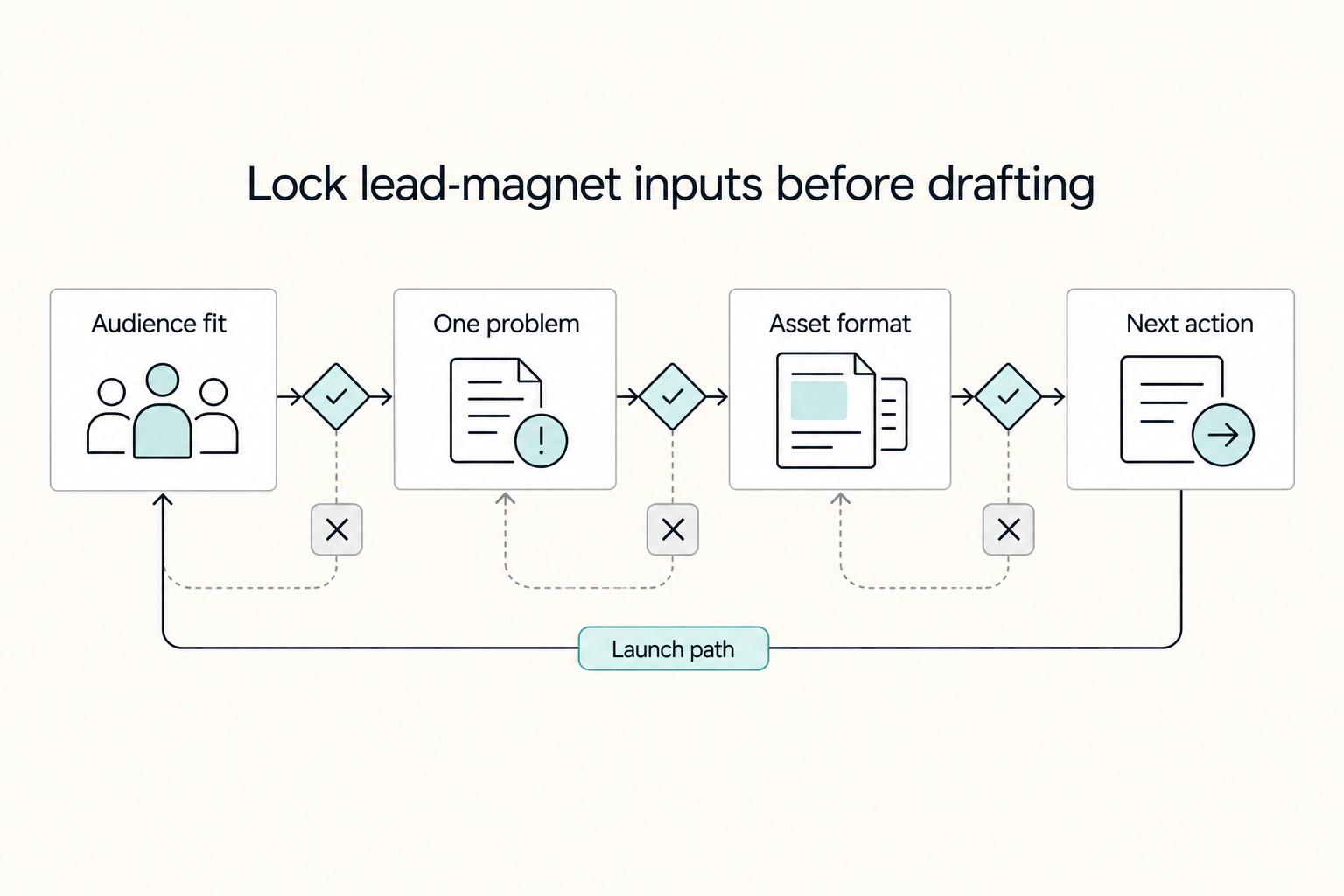
Quick Answer
Use one clear promise for one audience, then build the freelance lead magnet so the first action is obvious right after signup. Put scope and trust cues beside the submit button, deliver through your ESP immediately, and keep the same message in the thank-you step and first follow-up email. Judge quality by behavior after opt-in: delivery confirmation, asset use, relevant replies, and movement to your next CTA. If results slip, repair a single stage before increasing promotion.
Start Here and Build for Client Fit Not Subscriber Count#
If you have to choose between more signups and better-fit leads, choose fit. A freelance lead magnet should earn trust with people you can genuinely help, not just pull in a bigger list. Over time, trust matters more than traffic or subscriber totals, and trust is unlikely to form when someone downloads your resource and never uses it.
Use that as the rule throughout this article: do not judge success by subscriber count alone. Judge it by whether the right people actually use what you send and get value from it.
Set a pre-draft gate before you write a word#
Before you touch the landing page, write one short intent brief. A practical way to do this is to keep three inputs in one place: who the asset is for, the urgent problem it helps with now, and the next action you want after the opt-in. If one of those is fuzzy, tighten it before you draft copy.
Lead quality issues often start upstream. If your audience and promise are too broad, people may download the asset but never use it. If the next action is unclear, momentum from signup to real trust can stall.
Use a simple test: can you read your brief out loud in under 30 seconds and picture one person taking one next step? If not, your page copy will probably drift too broad.
Choose trust first when copy decisions conflict#
When headline breadth, CTA wording, or promise scope pull in different directions, use a trust-first rule. Pick the option that helps a qualified reader recognize themselves quickly, even if it lowers total opt-ins.
For headlines, narrower can beat clever. For CTAs, outcome-tied language can beat generic "subscribe" wording. For promise scope, one urgent problem can beat a resource that tries to solve five related issues at once. You are not trying to sound useful to everyone. You are trying to make the right person think, "This is for me, and I know what happens next."
| Area | Volume-first execution | Fit-first execution |
|---|---|---|
| Message clarity | Broad promise that could apply to many buyers | Specific promise for one buyer with one immediate problem |
| Follow-up quality | First email may need to re-explain who it is for and why it matters | First email can continue the same promise with less reset |
| Qualification signal | More opt-ins, but weaker clues about intent | Fewer, clearer signals from who engages |
The risk with volume-first copy is not just list quality. It can also make results harder to interpret. Clearer boundaries give you cleaner signals.
Verify use before you scale distribution#
Downloads are not enough. If people download the asset and never act on it, you are in the failure pattern where the resource turns into digital dust and trust never starts.
Before you put more effort behind promotion, check three things. First, are people completing the first action inside the asset, even if it is small? Second, when they reply, click, or ask questions, are those responses relevant to the problem you promised to solve? Third, does the promise on the opt-in page match the promise in the first email in practical terms?
That last check is easy to miss. Put the landing page headline and first email opening next to each other. If the page promises a concrete outcome but the email turns into a general welcome note, alignment may already be broken. Fix that before you blame traffic. Then use this execution checkpoint before moving on:
- Intent brief complete with audience, urgent problem, and next action in one place
- CTA-to-follow-up match checked between opt-in page, delivery step, and first email
- Baseline scorecard fields ready for the next sections, including opt-ins, delivery success, first-action completion, and engagement signal
For a step-by-step walkthrough, see Build a Freelance Marketing Plan You Can Run Every Week.
Gather the Inputs Before You Create Anything#
Lock your inputs before you draft. Most lead magnet drift starts upstream. When audience, problem, format, or next action is unclear, your page, asset, and follow-up stop matching each other.
Turn your prep note into a working input brief. You are locking who this is for, what pain matters now, how you will distribute it, what format delivers value fastest, and what happens right after signup.
Build a brief you can actually use#
Keep one short brief you can review in two minutes:
| Input | What to lock | What to watch for |
|---|---|---|
| ICP snapshot | One buyer type, one business context, one immediate need | If it fits several very different buyers, narrow it |
| Buying-stage pain | The problem they want solved now | If it reads like broad education, tighten to an immediate use case |
| Distribution method | The channel and delivery path you will use | Channel choice changes promise, depth, and execution effort |
| Offer format | Checklist, template, tool, workshop, or another clear format | Choose for prospect value, not format popularity |
| CTA path | The first step after delivery (reply, booking, form, etc.) | If no next move is clear, handoff will stall |
| Disqualifier criteria | Who this is not for or when fit is poor | Without this, you invite low-fit conversations |
If you cannot name the first action inside the asset, pause drafting. Action tasks are often what create a quick win instead of a download that gets parked.
Compare the three handoff points before polishing copy#
Before you polish copy, compare these side by side: opt-in headline, asset opening, first email. This is a practical internal check, not a formal standard.
| Handoff point | Compare with | Scan for |
|---|---|---|
| Opt-in headline | Asset opening and first email | Promised problem, promised outcome, tone |
| Asset opening | Opt-in headline and first email | Promised problem, promised outcome, tone |
| First email | Opt-in headline and asset opening | Promised problem, promised outcome, tone |
Scan for three things: promised problem, promised outcome, and tone. If those drift across the three assets, revise the brief first, then polish copy.
This check also helps prevent format inflation. A tool can deliver immediate value and collect useful data, but it usually needs more build resources. A live workshop can build stronger connection, but scheduling and retention risks increase. If your goal is a fast, low-friction win, keep the format aligned to that goal.
Put trust details and tracking in place before traffic#
Place trust-setting details near the form submission area, where decisions happen. Keep includes/excludes, delivery expectation, consent language, and your Privacy Policy link close to the submit action instead of burying them in the footer.
Set your baseline tracker before promotion. Page views and raw signups by themselves are vanity metrics; pair them with engagement and conversion-adjacent signals so you can diagnose fit early.
Start with these fields:
- source channel
- signup quality signal
- delivery confirmation
- first-action completion
- reply intent
These fields make early decisions clearer. Strong signups with weak reply intent usually signal fit issues. Clean signups with weak delivery confirmation point to handoff problems. Good delivery with low first-action completion points back to asset usefulness.
You might also find this useful: How to Create a Content Calendar for Your Freelance Business.
Pick One Painful Problem and One Fast Win#
After you lock your inputs, make one core choice: your offer should solve one painful problem and deliver one fast, visible win. If you try to cover an entire topic, people often sign up out of curiosity, save the download, and never act on it.
A one-thing offer works as both a hook and a filter. It helps the right reader say yes quickly, and it helps the wrong-fit reader self-exclude before they enter your pipeline.
Use a decision gate before you draft#
Before writing the opt-in page, complete these three lines in plain language:
- Audience: Who is this for in one business context?
- Painful problem: What do they need solved now, not later?
- Expected result: What result should they get right after using it?
Treat this as a gate, not a warm-up. If any line is broad enough to include multiple buyer types, broad interest, or a vague outcome, tighten it until a wrong-fit lead can clearly tell this is not for them.
Choose format by reader effort and signal quality#
Start with the lightest format that can produce the promised win. If the offer feels vague, complicated, or high-effort, it is more likely to be downloaded and ignored.
| Format | Completion speed | Depth | Qualification signal |
|---|---|---|---|
| Lightweight (checklist, short worksheet, decision tree) | Faster | Narrow, practical | Early signal from people who take the first action |
| Heavier (workshop, webinar, multi-part resource) | Slower | More context and nuance | Stronger signal only if people attend and act |
Use heavier formats only when the win actually requires more explanation or live context.
Keep promise, outcome, and follow-up on one track#
Run one alignment check before launch: your opt-in headline, asset outcome, and first follow-up action should describe the same single win for the same buyer stage. If your page promises a quick fix, the asset should deliver that fix first, and your first follow-up should ask for the next related step.
Before you scale promotion, check early opt-ins for qualified intent: action taken inside the asset, a relevant reply, or clear next-step readiness. If signups increase but these signals stay flat, fix scope, effort level, or stage match before adding more traffic.
Need the full breakdown? Read How to Create a Content Flywheel for Your Freelance Business.
Choose the Right Format With Explicit Tradeoffs#
Once you have one painful problem and one fast win, format becomes an operating decision. Choose the format that matches one promised outcome, one realistic effort level, and one next action for the reader.
Before you draft, make these three lines agree:
- promised result
- reader effort required
- next step after the asset
If they do not align, change the format first. Start with the lightest format that can deliver a real win, and only use a higher-commitment format when the decision or implementation genuinely needs more explanation or demonstration.
Match the format to the kind of win#
Use this as a tradeoff view, not a ranking.
| Format | Best fit for promised outcome | Reader effort | Completion likelihood | Context depth | Qualification strength | Production load | Follow-up fit |
|---|---|---|---|---|---|---|---|
| Checklist | Quick win, first action, simple decision | Low | Often higher because it is short | Low | Early signal: did they take the first action? | Low | Strong when next step is a small action (reply, click, quick task) |
| Template or worksheet | Applied result using the reader's own inputs | Medium | Can be solid when scope is tight | Medium | Stronger signal if they complete and customize it | Medium | Works when next step asks them to share inputs or request help |
| Workshop or webinar | Complex decision or implementation walkthrough | High | More friction unless need is clear | High | Stronger signal when they attend and engage | High | Fits guided next steps (diagnostic or implementation support) |
If a checklist can produce the promised first result, do not force it into a webinar. If the promised result depends on deeper explanation or live demonstration, the heavier format is easier to justify.
Test format without muddying attribution#
When you test format, hold the audience, pain point, and CTA constant so your comparison stays interpretable. If you change multiple variables at once, you cannot tell what actually caused the difference.
Before scaling, review early signups by hand and look for behavior, not just downloads:
- in-asset action completion
- first email follow-up that matches the original promise
- evidence of use (for example, a completed worksheet, relevant reply, or intended next-step click)
Also validate delivery mechanics before you add traffic: the asset should be delivered automatically through your email platform, and the experience should be mobile-friendly. If delivery breaks or mobile usage is poor, even a good format choice will underperform.
Write an Opt-In Page That Sets Professional Boundaries#
Use your opt-in page to filter for fit and set expectations, not to persuade everyone. The goal is qualified leads, not raw volume.
Build the page from the four inputs you already set: audience, painful problem, format, and next-step CTA. Write a headline with one outcome and one limit. Example: "Get the Client-Fit Checklist for B2B copywriters who need to tighten discovery calls." If your headline could fit five different services, narrow it and ask: "Would someone pay for this?" If not, the asset is more likely to be ignored.
Put scope beside the form#
Show scope before the submit action so people can quickly decide if this is for them.
Use simple labels:
- Includes: a 1-page checklist, one example, and a short next-step prompt
- Not included: custom feedback, a live audit, or a done-for-you setup
- Best fit for: solo consultants already selling service X who need help with problem Y
This sets boundaries in a professional way and makes the offer easier to trust.
| Page choice | Weak | Strong |
|---|---|---|
| Headline specificity | "Free guide to get more clients" | "Get the Client-Fit Checklist for freelance designers pitching retained work" |
| Boundary language | No scope, no exclusions | "Includes" / "Not included" / "Best fit for" near the form |
| Button copy | "Subscribe" | "Get the Client-Fit Checklist" |
| Trust cue placement | Privacy link buried in footer | Consent text and Privacy Policy link beside the submit button |
Put trust cues where the decision happens#
Place trust and expectation language next to the button. Keep it short and plain, for example: "I'll send the checklist plus occasional follow-up emails about client acquisition. You can unsubscribe anytime." Keep the Privacy Policy link in that same area, and make sure the page uses HTTPS so the secure-connection cue is visible.
If your thank-you page or follow-up email includes affiliate recommendations, disclose that in context. Example: "This email includes affiliate links, which means I may earn a commission if you buy through them."
Then keep the handoff consistent: your thank-you copy should confirm delivery and the next step. Example: "Check your inbox for the checklist. Start with page 1, then reply with your biggest blocker if you want feedback."
Before publishing, run one checkpoint: does the button, thank-you page, and first follow-up email promise the same asset, the same outcome, and the same next step? If not, align them before sending traffic.
Related reading: How to Create an FAQ Page for Your Freelance Website.
Create the Asset So It Gets Used Instead of Parked#
Build the asset so the reader can take one clear action without extra explanation from you. Start by restating your four locked inputs at the top: audience, painful problem, format, and next-step CTA. If you cannot describe the first action in one sentence, tighten the scope before you keep drafting.
| Checkpoint | Parked asset | Used asset |
|---|---|---|
| Scope clarity | Broad topic, unclear result | One audience, one problem, one clear result |
| Effort to start | Long setup before action | First useful step appears immediately |
| Artifact usefulness | Mostly explanation | One practical tool the reader can use right away |
| End-of-asset CTA focus | Multiple competing next steps | One clear handoff action |
Draft a rough version first, then test whether the action path is obvious. Keep structure simple: short headings, direct prompts, and no extra branches. If a test reader hesitates on what to do first, simplify the sequence.
Add one practical artifact that matches intent. If they need to choose, use a decision aid. If they need to execute, use an implementation checklist. If they need to prepare for a call, use intake prep prompts. Pick one path and build it cleanly.
End with one handoff action only, then run a quick usability pass before distribution. Check for three issues: unclear instructions, too many steps before the first useful action, or more than one meaningful CTA at the end.
We covered this in detail in How to Use LinkedIn Sales Navigator for Freelance Lead Generation.
Set Up Delivery and Follow-Up in the Right Order#
Run this as one connected flow: capture, immediate delivery, follow-up, engagement branch, then a verification pass. Keep one core promise from the form through every message, or you risk lower trust and lower use of the asset.
| Stage | What to do | What to confirm |
|---|---|---|
| Capture | Start with a small first ask | People can say yes quickly and you can still deliver the resource |
| Confirmation page | Repeat the same promise from the opt-in | Show exactly how they get the asset and include one visible Start here action |
| Delivery email | Use the same promise language | Include a clear asset link and one plain first step |
| Follow-up sequence | Stay focused on that same problem | Keep the experience continuous, not like a topic switch |
| Engagement branch | Branch after engagement signals appear | Low engagement: reduce effort and point back to Start here; high engagement: advance to one next action without changing the core message |
| Verification pass | Test the flow end to end before launch | Check delivery timing, links on mobile and desktop, follow-up order, and message continuity |
Start with a small first ask so people can say yes quickly. On the confirmation page, repeat the same promise from the opt-in, show exactly how they get the asset, and include one visible Start here action that takes them straight to page 1 or screen 1.
Use the delivery email to confirm a fair exchange: the same promise language, a clear asset link, and one plain first step. Then send a short follow-up sequence focused on that same problem so the experience feels continuous, not like a topic switch.
| Correct order | Common misorder | Likely impact |
|---|---|---|
| Capture -> confirmation/delivery -> follow-up | Capture -> generic newsletter | Trust weakens because the promised resource is no longer central |
| Same core promise across each touchpoint | Different promise language at each step | Lower activation because readers are unsure what to do next |
| Branch after engagement signals appear | Push a hard next step before engagement | Weaker qualification and more low-intent responses |
Keep branching simple and consistent with the original promise. For low engagement, send a reactivation message that reduces effort and points back to Start here. For high engagement, advance to one next action, for example a diagnostic or call, without changing the core message.
Before launch, run a flow QA pass:
- Submit the form with a real test email.
- Confirm delivery timing and that links work on mobile and desktop.
- Verify the first follow-up triggers after delivery, not before.
- Read the full sequence end to end and confirm message continuity.
Qualify Leads Early So You Protect Time and Positioning#
Qualify early by making your opt-in and first follow-up do one job: filter for fit around one audience, one problem, and one next step.
Start with pre-qualification on the page. State who this is for, who it is not for, and what happens after signup in plain language. For example: "For solo consultants who need a clearer discovery process." "Not for teams that need full sales training." "After signup, you get the checklist and a short follow-up sequence with the next step." This keeps your positioning clear without sounding defensive.
Keep intake fields to what you need for routing. Use email for delivery, then add only essential qualifiers that change the next message. After signup, route contacts into three paths you control: best fit (they use the asset or respond with a specific problem), not yet (low engagement), and out of scope (clear boundary and no-call path).
| Unqualified volume signals | Qualified intent signals |
|---|---|
| Download with no action after delivery | Asset completed and first action taken |
| Vague reply like "interested" | Reply describes a specific problem |
| Broad clicks with no clear next step | Clicks tied to the promised next step |
| Opt-ins that stall after signup | Continued engagement across delivery and follow-up |
Treat delivery reliability as a filter check, not a separate project. Confirm the thank-you step appears, the delivery email is easy to recognize, and the first message repeats the same promise as the form. Broken forms or mismatched messaging can make good leads look low intent.
Before launch, run this section checklist:
- Verify intake clarity: audience, problem, exclusions, and next step are explicit.
- Verify routing logic: behaviors map cleanly to
best fit,not yet, orout of scope. - Verify promise continuity: each follow-up path matches the original offer.
Distribute Across Channels Without Diluting the Offer#
Protect lead quality by changing channel packaging, not the offer itself. Keep one unchanged promise, one audience definition, and one CTA destination across channels, or you will not know whether distribution is working or whether you accidentally created different offers.
Promotion is a separate job from creation. A useful asset does not distribute itself, and referrals alone can leave you exposed when inquiries slow down. To stay consistent, use one short source doc and publish channel versions from it with this message hierarchy:
- Core message: promise, audience, and next step. Keep this unchanged from post to opt-in page to first email.
- Channel wrapper: hook, format, length, and opening example. Adapt this to the channel.
If the wrapper changes but the core message stays fixed, the value exchange stays clear and trust is easier to maintain. If the social post promises a fast fix for one specific problem but the opt-in page shifts to a broader offer, you may get signups, but fit and continuity usually weaken.
| Approach | Lead fit | Trust | Conversion continuity |
|---|---|---|---|
| Consistent multi-channel distribution | Better alignment with people who have the specific problem | Stronger message consistency across touchpoints | Cleaner read from channel to opt-in to follow-up |
| Diluted channel-by-channel rewrites | More broad-curiosity traffic and weaker qualification | Lower consistency because promises shift | Harder to diagnose because channels are selling different things |
Anchor distribution to one primary asset and one destination. Build the main asset first, then create channel cutdowns that all point to the same opt-in page and the same first action after signup. That keeps your offer from drifting as you publish.
Use social channels for discovery, then move qualified interest into your email follow-up flow quickly and consistently so you can nurture the relationship on a path you control. If a post gets attention but subscribers from that source do not open, click, reply, or take the first in-asset action, treat it as a message-match issue before treating it as a channel win.
Before you scale up or cut a channel, run a quick loop: check message match from post to opt-in page, check early follow-up engagement quality, and check qualification outcomes, for example problem-specific replies or booked calls. If volume is high but fit is weak, tighten the wrapper around the same core message and retest once before reducing effort.
Track Lead Magnet Quality With a Simple Operating Scorecard#
Track quality by what happens after signup, not by list growth alone. Your scorecard should help you find the exact break in the path: opt-in, delivery, engagement, or qualified next step.
Use these four lines each review period: opt-ins, delivery success, follow-up engagement, and downstream actions. You do not need a complex dashboard to diagnose most issues.
| Tracking approach | What you watch | What it helps you decide next |
|---|---|---|
| Vanity tracking | Signups, pageviews, social clicks | Whether your promotion is generating attention |
| Operating scorecard | Opt-ins, delivery success, follow-up engagement, downstream actions | Whether to fix the page, handoff, asset, or CTA path |
Run a pre-read before you trust the numbers#
Before you evaluate performance, run the same path check every time:
- Submit the opt-in form and confirm the thank-you page appears.
- Verify the automated delivery email arrives.
- Open the asset and confirm access works.
- Check the first follow-up email still matches the signup promise and points to the right next step.
If any step fails, fix the path first. Do not change channels or rewrite positioning until delivery and continuity are reliable.
Read mixed signals like an operator#
If opt-ins are high but downstream actions are weak, start by inspecting the handoff before changing channels. Check whether the asset solves one immediate problem, whether the first follow-up continues the same promise, and whether the next action is clear. If delivery is solid and engagement exists but qualified movement stays flat, focus next on CTA clarity or offer fit.
| Signal pattern | Focus area | What to check next |
|---|---|---|
| Opt-ins are high but downstream actions are weak | Handoff | Check whether the asset solves one immediate problem, whether the first follow-up continues the same promise, and whether the next action is clear |
| Delivery is solid and engagement exists, but qualified movement stays flat | CTA clarity or offer fit | Focus next on CTA clarity or offer fit |
| Opt-ins are low | Audience-message match on the page | Revisit audience-message match on the page |
| Delivery works but engagement is flat | Asset scope | The asset may be too broad; in many cases, a focused checklist drives more completion than a broad ebook |
If opt-ins are low, revisit audience-message match on the page. If delivery works but engagement is flat, your asset may be too broad; in many cases, a focused checklist drives more completion than a broad ebook. That is why behavior after delivery matters more than raw subscriber count.
Keep comparisons clean: hold audience, offer, and review window constant, then change one variable at a time - headline, format, CTA, or first follow-up step - so results stay attributable.
After each review cycle, choose one action: keep, revise, or roll back. Keep when engagement and qualified next-step movement improve together. Revise when one stage lags while the rest is healthy. Roll back when a change raises attention but weakens engagement or qualified movement. This pairs well with How to Use SEO to Attract High-Quality Freelance Clients.
Fix the Most Common Failure Modes Fast#
When performance stalls, fix one leak at a time instead of rewriting the whole funnel. Trace the handoffs you control in order: opt-in promise, delivery, first follow-up, and next-step CTA.
Map stage conversion before you choose a fix. Check who opts in, who actually gets the asset, who uses it or clicks from the first follow-up, and who takes the next step. High download volume can still hide weak conversion behavior.
| Symptom | Likely root cause | Fastest diagnostic check | First fix to run | Success signal to confirm recovery |
|---|---|---|---|---|
| Good opt-ins, weak engagement after delivery | Your asset is too broad | Compare the opt-in promise to the opening of the asset. If it teaches a broad topic instead of solving one early bottleneck, scope is off. | Narrow the asset to one specific problem and one first action. | More first-follow-up clicks or direct usage actions |
| Opt-ins come in, but replies and progression stay weak | Your trust signal is weak across handoffs | Read the opt-in promise, thank-you page, and first follow-up in sequence. If the promise shifts or gets vague, trust drops. | Keep one clear promise line across signup, delivery, and follow-up. | Fewer early drop-offs and stronger follow-up engagement |
| Downloads are high, but usage is low | People collect the asset but do not act | Open the asset and find the first action and CTA. If either is buried, usage stalls. | Move one clear "start here" action to the top and keep one next-step CTA path. | More in-asset actions and more next-step CTA clicks |
| Lead volume rises, but fit gets worse | Your promise is attracting the wrong problem or audience | Review who reaches the CTA and who advances. If low-fit leads move early while ideal leads stall, targeting is loose. | Rewrite the promise around one audience and one bottleneck; do not scale traffic yet. | Fewer low-fit inquiries and better qualified next-step movement |
Use this fix sequence each cycle:
- Isolate one stage.
- Run one change.
- Verify downstream behavior, not just signups.
- Scale only after the leak is reduced.
Wrap Up With a Copy-Paste Launch and Review Checklist#
Launch only when each step is verifiable in one pass. If you cannot clear these checks in one sitting, hold traffic until you can.
Before you publish, create one shared tracker and log both your pre-launch baseline and each post-cycle result in the same place: opt-ins, delivery success, first action completed, qualified conversations, and closed work if that is part of your flow. Each cycle, change one variable only, then review again.
- Lock the promise first.
Write one sentence with one audience, one painful problem, one outcome, and one next step. Pass if that exact sentence still fits the opt-in page, the asset, and the first follow-up email. Fail if you need extra explanation to clarify who this is for.
- Publish one opt-in page with compliant email setup.
Run delivery through an ESP, not a regular Gmail or Outlook workflow, and state the exchange clearly. If you market in Australia, confirm consent and unsubscribe are covered under the Spam Act 2003. Pass if the form, confirmation, and email setup reflect the same exchange. Fail if signup expectations are unclear or list handling is unreliable.
- Test delivery and follow-up end to end.
Submit the form yourself, confirm the email arrives, open the asset on mobile and desktop, and make the first step obvious. Pass if a new subscriber can access the asset and complete the first action without guessing. Fail if links break, files are hard to open, or the first follow-up feels disconnected.
- Check the bridge to your offer.
Make your next action a clear continuation of the asset, not a jump to a bigger ask. Pass if the reply prompt, call, or diagnostic feels like the natural next step. Fail if people use the resource but ignore your next action.
- Run one review loop per cycle.
Diagnose by stage, not by signup totals alone. Pass if you can name one bottleneck and one next variable to test. Fail if you are changing traffic, page copy, format, and follow-up at the same time.
| Checkpoint | What to verify | Common failure sign | First fix |
|---|---|---|---|
| Promise | One audience, one problem, one outcome, one next step | Broad headline, mixed audience, vague benefit | Narrow the audience or the outcome |
| Opt-in page | Clear exchange, ESP active, consent/unsubscribe covered where relevant | Signups increase but expectations stay unclear | Rewrite the page around the exact promise |
| Delivery + follow-up | Form works, email arrives, asset opens, welcome sequence starts | Broken links, delayed email, weak mobile experience | Fix the first broken step in the path |
| Offer bridge | Next action matches the asset and audience intent | Resource engagement is fine, replies/calls are weak | Tighten CTA language to the same problem |
| Review loop | Pre-launch and post-cycle results logged in one shared tracker | Decisions come from memory or signup volume only | Review tracker, then change one variable only |
If you want a second set of eyes, ask for a practical setup review of your page, delivery path, and follow-up flow before you scale traffic.
Need to confirm what is supported for your country or program? Talk to Gruv.
Frequently Asked Questions
What is a freelance lead magnet, and how is it different from a generic freebie?
Treat it as your first trust exchange, not a download-bait piece. It is a free offer in exchange for an email address, but the real test is whether your opt-in promise matches the asset and helps people take a clear next step. If people grab it and never use it, you have a freebie, not a useful client-acquisition step.
Which format should you choose: checklist, template, workshop, or audit?
Start with the lightest format that can solve one simple problem and point to one next action. Quick, easy formats are easier to consume, and checklist or template assets are explicitly cited as formats that work well. If subscribers do not use what you send, trust does not grow.
How much information should you ask for on the opt-in form without hurting conversion?
Ask only for information you will actually use in delivery, segmentation, or the first follow-up. There is no supported magic number of fields, so verify the choice by checking whether the extra question changes the next action you send. If a field does not change routing, personalization, or qualification, cut it.
Should you use a free offer or a paid diagnostic?
This guide describes lead magnets as free offers exchanged for email, and it does not show that free or paid wins by default. Use one clear CTA based on your goal: free when you want to start trust and an email relationship, paid when you are intentionally asking for a higher-commitment next step with a clearly different deliverable.
What should happen in the first 24 hours after someone subscribes?
There is no supported required first-24-hours sequence in this evidence. The low-risk baseline is to deliver the promised asset and make the first interaction about helping people use it, not just collecting contact details. If subscribers never use or benefit from the asset, trust is unlikely to grow.
How do you tell whether weak performance is a traffic problem or an offer-fit problem?
Read the funnel by stage, but keep conclusions modest. If downloads happen but usage is weak, that matches a common failure mode: the content gets ignored after signup. In that case, tighten the promise and make the asset easier to use before assuming traffic is the core issue.
What should you do if you launched the wrong thing?
Shrink the scope before you rebuild from scratch. Return to one simple problem, one clear promise, and one next action so the asset is easy to use. Then change one variable at a time and judge the fix by whether subscribers use and benefit from what they downloaded, not signups alone.
Try a related tool
Researched and edited by the Gruv editorial team. Gruv builds cross-border billing, payouts, and finance-operations software for global businesses.
Sources
- allegany.edu/college-catalog/documents/ACM-Catalog-2017_1...trusted
- azmag.gov/Portals/0/Documents/BaP_2015-05-26_Valley-Pa...trusted
- clarkstate.edu/media/cdzpycvwshhb4l2lxf0j3brshi/5a5caevrvjk...trusted
- ecfr.gov/current/title-38/chapter-I/part-1trusted
- govinfo.gov/content/pkg/FR-2026-03-06/pdf/FR-2026-03-06.pdftrusted
- irs.gov/pub/irs-pdf/p5774.pdftrusted
- kings.edu/academics/course-descriptions/index.htmltrusted
- mccb.edu/about/publications/ucnstrusted
Educational content only. Not legal, tax, or financial advice.
Related Posts

The Best Password Managers for Freelancers and Teams
A client asks for an urgent file, you open their portal, and the login fails. Ten minutes later your invoicing app wants a reset too. That is why your password setup is a business risk, not just a nuisance. Weak credential habits can turn one mistake into wider account access problems, then into delivery delays and cleanup work.

How to Compare Debit Cards with No Foreign Transaction Fees
Pick your card stack with a verification-first process, not rankings. If you run freelance or small-team cashflow across borders, this article helps you build a **debit card no foreign transaction fee** setup that is more predictable in practice.

The Freelance Payment Penalty: A Modeled Audit of Platform Fees, FX Spreads, and Payout Delays
The money rarely disappears through a single, easy-to-spot fee. The real loss is stacked. A marketplace takes its commission, a processor adds a charge for international cards, a bank or payment company converts the currency at a spread, a platform holds the funds before release, and a wire sheds a little to intermediaries on the way in. Each layer looks defensible on its own, but the worker feels the combined result as a smaller deposit and a later payday.