
Quick Answer
A freelance financial model combines a profit forecast with a dated cash forecast. Record opening cash, expected receipts, expenses and other outflows, then calculate each period’s closing cash and the funding needed to preserve your minimum reserve. Stress-test delays before accepting new work, fund existing obligations by their actual due dates, and update the forecast against bank and ledger records weekly.
Separate Booked Work From Cash in the Bank#
Use the model to decide whether you can fund a new engagement, what terms to negotiate and how much cash to reserve. Keep earned income, invoices, receipts and outgoing obligations separate. The forecast helps you plan; it does not change payment rights or make a subcontractor’s invoice contingent on your client paying.
For an independent operator with more than one client, the file should give you a working view of earnings, costs, and payment timing. It supports budgeting and forecasting, and it can help frame broader valuation or fundraising conversations when those come up. Its real job is simpler: help you make better day-to-day calls while terms are still negotiable and assumptions are still easy to fix.
Start with a narrow scope. Use only inputs that can change a near-term decision, especially projected revenue, expected payment timing, and fixed monthly obligations that cannot move. If something important is missing, label it as risk instead of quietly filling the gap with optimism. An empty assumption is often more dangerous than a conservative one because it makes the plan look safer than it is.
Separate projected revenue from cleared cash on day one. Work can look profitable on paper while your account balance is still exposed because money lands later than expected, arrives short, or gets tied up in a dispute. A useful model makes that gap obvious in plain language so you can act before it becomes a cash problem.
Keep the operating sequence simple:
- Define one operating cycle. Track planned work and costs, invoice issuance, client payment, and confirmed usable cash. Use the same stage names for every client so timing drift is easy to spot.
- Model three payment outcomes first. Run an on-time case, a delayed-payment case, and a partial or failed-payment case. Keep scope and expense timing constant so the difference comes from payment behavior, not quiet edits elsewhere.
- Lock the decision rule before review. Write down what triggers
accept,renegotiate, ordeclinebefore you look at outputs. Precommitted rules help you resist urgency when the evidence says slow down.
Use one verification checkpoint in every cycle: compare expected payment timing with actual cleared timing on recent invoices. If receipts keep landing later than forecast, fix the timing assumptions before you touch rates, staffing, or spending.
That basic sequence is enough to make the model useful, but only if the file stays tightly bounded. The next step is deciding what belongs in it at all.
Define the model boundary before you open a spreadsheet#
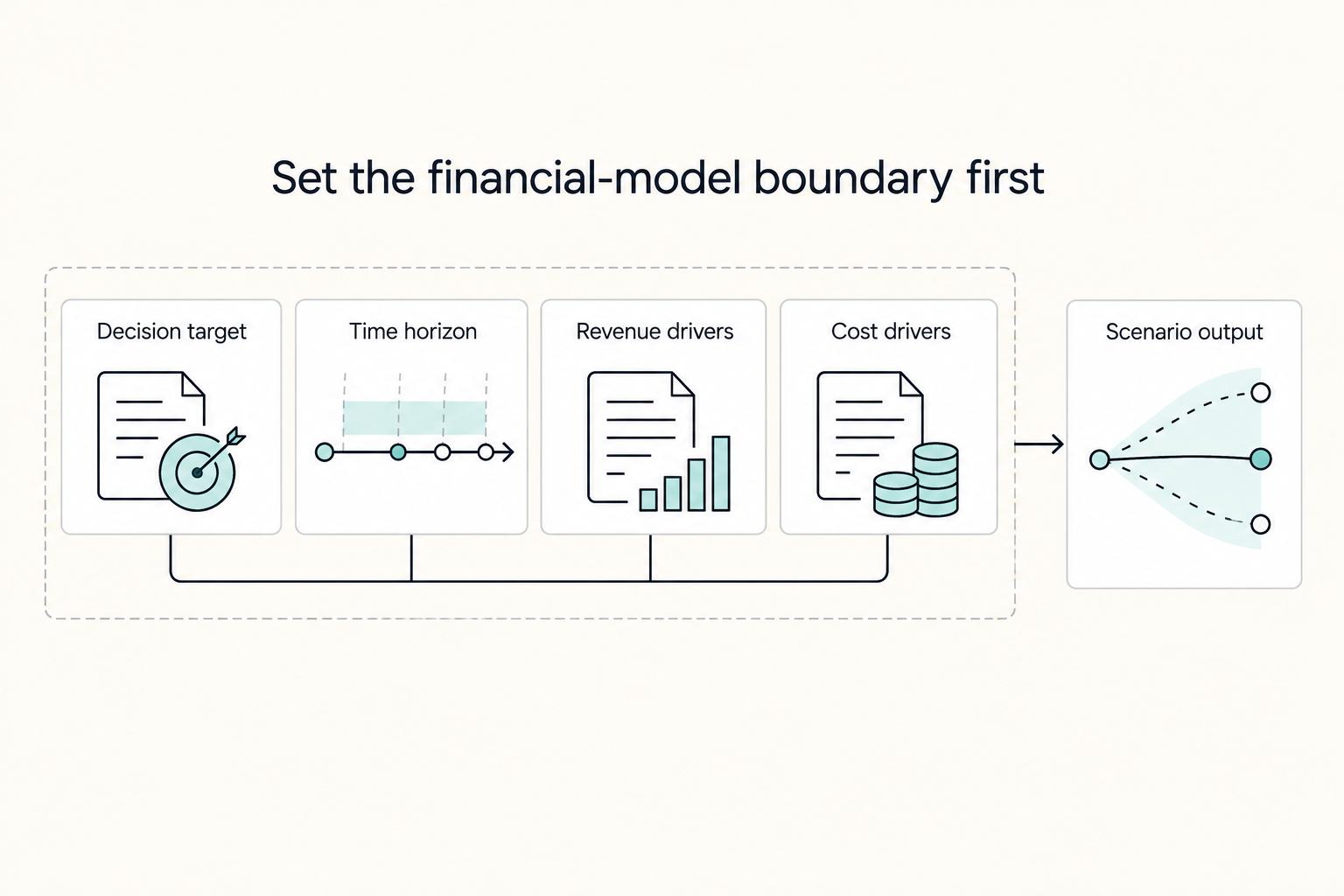
Set the boundary first, or the file will sprawl into something that looks thorough and helps with nothing urgent. You do not need a grand master spreadsheet. You need one working tool that can still improve a decision this week.
Start with a four-week example, a profit view, a dated cash forecast and a decision note. Include opening usable cash, receipts, required outflows and a minimum reserve. Keep wider commitments that fall inside the planning horizon even when they relate to another client; limiting the model to one engagement must not hide rent, taxes or collaborator payments.
Choose three outputs: projected operating profit, the lowest dated cash balance and the funding needed to stay above your reserve. Use the same cost categories in the baseline and forecast. Extend the horizon if payment terms or an obligation fall beyond it; a four-week sheet must not omit a six-week invoice simply to look balanced.
Use these boundary rules:
- Bound one operating cycle. Apply the same cycle logic to each client. Ad hoc cycle definitions hide drift and make comparisons unreliable.
- Define outputs before inputs. Lock the P&L view, the cash flow forecast, and the risk decision output first. If a data point does not feed one of those, remove it.
- Set scenarios before formulas. Start with one base case and two downside cases. Keep them simple enough to revise quickly when actual behavior changes.
- Run an action test on each tab. Keep inputs that affect pricing, funding, required outflows, reserves or client selection. Preserve important later-dated commitments even if they do not change this week’s quote.
It helps to put a short out-of-scope note at the top of the file. Exclude valuation logic you are not using in negotiations, vanity charts, and long-horizon projections that do not change near-term terms. That note is less about formatting than about restraint. It tells future you what this model is for, and what it is not for, so the file does not slowly turn into a dumping ground.
Before you trust anything in the sheet, hand-check one risk line, especially an average-based metric. A quick manual review often catches formula smoothing that hides downside volatility. In practice, that kind of smoothing is exactly what makes a risky client look ordinary.
Once the boundary is clear, move to evidence. A tidy file built on weak inputs still leads to weak decisions.
Gather the minimum inputs and documents#
Gather the essential scope, price, expense and due-date inputs before final pricing. If a new client has no payment history, label the timing assumption and stress-test it; lack of history does not prevent you from building a useful forecast.
| Item | What to record | Status note |
|---|---|---|
| Contract language | Operative agreement or draft for a new deal: invoice trigger, due-date anchor, advance/refund terms, objection process and any lawful suspension terms | Resolve differences and incorporation/precedence; a proposal term is not automatically ineffective merely because it is not copied into the contract |
| Billing data from the last 3 to 6 cycles | Issue date, expected due date, paid date, amount received, and any reversal tied to dispute activity | Record uncertainties and use labelled conservative scenarios; a new client will not have your prior invoice history |
| Tax and compliance documents | What is required for the engagement and whether each item is complete before final pricing | Determine the actual obligation and remedy; annual reporting is not a general payout condition |
| Cross-border documentation risk | Where extra documentation may be needed | Assign an owner to confirm requirements early |
| Minimum evidence pack | Term draft, billing extract, tax-document status, open questions, and one-line recommendation | For new work, resolve material decision gaps; existing amounts due retain their own deadlines |
Use one intake sheet per prospect or new engagement, and make the status visible. Mark every required field as complete, missing, or unclear so unresolved items do not disappear into notes or email threads. This is not admin for its own sake. It is the simplest way to stop missing information from turning into optimistic assumptions later.
Keep the intake narrow and decision-oriented. You are not building a perfect archive before work starts. You are checking whether there is enough evidence to say go, revise, or hold, and to know why.
At minimum, collect the following:
- Terms: identify the operative agreement and authorized changes, or proposed terms for a new deal. Record invoice triggers, due dates, advances and any permitted late-payment or pause provisions.
- Receipt history: use your last three to six cycles where available, keeping issue, due, initiation and actual receipt dates separate. For a new client, label the timing assumption rather than demanding unavailable history.
- Required documentation: identify relevant tax, provider and counterparty requirements, their actual deadlines and any lawful withholding or restriction; do not convert every missing form into a full payment freeze.
- Cross-border documentation risk. For cross-border work, note where extra documentation may be needed and assign an owner to confirm requirements early.
- Decision file: keep terms, receipt assumptions, documentation status and open questions with the recommendation. Resolve material gaps for new work without postponing existing obligations.
When records conflict, retain both and investigate the discrepancy: an invoice due date, payer initiation date, bank receipt date and ledger date may all legitimately differ. Do not overwrite one with another. Link the source for each field and keep any correction traceable.
For a new prospect, distinguish missing essential terms from information you can model provisionally. A client with no invoice history is not automatically a bad fit. Use a disclosed timing sensitivity and decide whether an advance or smaller initial scope would fund the risk.
With intake in place, you can build the baseline view. That baseline becomes the reference point for every timing test and contract decision that follows.
Build a baseline profit and loss statement#
Build the baseline profit and loss statement before you start testing scenarios. It gives you a stable operating picture and helps you see whether margin pressure is really a pricing problem, a cost problem, or a timing problem pretending to be one.
A historical P&L shows performance over its period; a forecast uses the same categories prospectively. State the accounting basis. For internal planning, separate earned revenue from cash receipts; your statutory accounts or tax return may use a different basis. A signed $3,000 order, a $3,000 invoice and $3,000 collected are different events, not three separate sales.
Keep revenue and operating expenses in a fixed order. Use stable line names, and do not merge unlike costs into one bucket just to save space. Clean categories make review faster and reduce misclassification risk when you are moving quickly.
A few habits make the baseline more dependable:
- Keep the same revenue categories each cycle.
- Separate recurring operating costs from one-off items.
- Use a short note block for manual overrides and one-time assumptions.
- Write why each exception exists and when it should be removed.
For a simple internal earned-revenue model, calculate fee revenue from expected billable hours times rate plus separately agreed fixed fees, avoiding overlap. Subtract attributable work costs and operating expenses to estimate operating profit. Track owner withdrawals, borrowing and tax reserves separately in the cash plan rather than assuming all are operating expenses.
After the baseline is complete, build a forward P&L forecast in the same structure. Reusing the format matters because it lets you compare historical and projected views without wondering whether a category shift created the difference. You want one operating language across the whole file.
Example assumptions for the scenario below: $3,000 earned fees and $2,600 operating expenses, producing $400 projected operating profit before tax and owner withdrawals. For simplicity, all those expenses are paid within the four weeks. If a receivable becomes uncollectible, assess the accounting and tax treatment separately; a forecast should not preserve a collectible asset by assumption.
If you use this section to support a broader business plan, review income statement projections alongside cash flow statement and balance sheet projections as one package. The package matters more than any single view.
The baseline tells you whether the work looks worthwhile. The next section tests whether the timing of the money makes it workable.
Add a cash flow forecast that reflects payment timing#
The cash view is where timing risk stops being abstract. Profit does not tell you when funds are available to spend, so the forecast should answer a narrower and more useful question: when money clears and becomes usable.
Use one planning window across cycles so timing drift stays visible instead of disappearing inside shifting date ranges. For each invoice, keep expected payment date and actual cleared date in separate fields. Do not mix those with accounting recognition fields. Once those ideas get blended, the file starts telling a cleaner story than the bank balance.
Distinguish invoice issue, due date, payer initiation, processor or bank receipt, available balance and reconciliation. An invoice is a claim for payment, not a collection rail. Forecast card, bank or other receipts by their actual availability, including fees, reserves, conversion and possible returns. Internal posting alone does not prove spendable funds.
A few working rules make the forecast more dependable:
- Update assumptions with the smallest justified adjustment. Big rewrites hide patterns and make history hard to review.
- Keep a short exception log next to the forecast. Record where expected and actual clearing diverged, why it diverged, and whether you tightened terms afterward.
- Treat repeated delay as a signal, not a fluke. If cleared funds arrive late for the same client more than once, tighten timing assumptions and revisit terms before you accept added scope.
Use closing cash = opening cash + usable receipts − cash outflows for each dated period, with that closing balance carried into the next period. Calculate reserve gap = max(0, minimum reserve − lowest projected balance). A reserve is a target within cash, not another expense to subtract twice. If the result is negative, the plan needs funding or a valid prospective change; it does not mean you can actually run an unfunded payment.
Once the cash view is grounded in actual timing, move straight into downside cases. That is where you find out how much delay your obligations can really absorb.
Stress-test delayed, partial, and failed payments#
Before kickoff, test whether you can meet obligations if this client pays late or not at all. Keep expenses on their actual due dates. Negotiate any change with the relevant party before relying on it; the forecast cannot shift a subcontractor’s due date or create a new right to pause contracted work.
Keep the client set and expense calendar unchanged across scenarios. Change only payment behavior. That one rule shows whether the business stays stable under ordinary friction, and it avoids a common modeling failure: changing scope, pricing, and timing at the same time until the real risk disappears into the noise.
Worked example: opening usable cash is $1,000 and the chosen minimum reserve is $500. Weekly outflows are $800, $1,000, $400 and $400, totaling $2,600. The $3,000 client receipt arrives before the relevant week’s outflow. There are no other receipts, fees, taxes, borrowing or owner withdrawals in this simplified example. Compare the same outflows in all three cases:
| Scenario | Receipt assumption | Week-end cash, weeks 1–4 | Lowest cash / funding to preserve $500 |
|---|---|---|---|
| On-time | $3,000 in week 1 | $3,200; $2,200; $1,800; $1,400 | $1,000 including opening balance / $0 |
| Delayed | $3,000 in week 4 | $200; −$800; −$1,200; $1,400 | −$1,200 / $1,700 needed before the deficit |
| Failed | No receipt in the four-week horizon | $200; −$800; −$1,200; −$1,600 | −$1,600 / $2,100 needed before the deficit |
- Run three scenarios. Keep an on-time case, a delayed-payment case, and a partial or failed-payment case. Hold scope, pricing, and expense timing constant.
- Add a survival line. Define the minimum cash needed for obligations that cannot slip, then flag the first date and amount where any scenario falls below that line.
- Model the full path to cleared funds. Track each invoice from payment initiation through final clearing, including points where status can stall or reverse.
- Make tradeoffs explicit. Compare tighter upfront terms with looser terms in the same model. Treat close-rate impact and financing impact as sensitivities, not fixed assumptions.
- Set one pre-kickoff rule. Base it on your own risk tolerance and required cash coverage, then apply it consistently.
In the delayed case, week 1 already falls $300 below the $500 reserve; week 2 cannot be funded from the assumed cash alone. The largest reserve gap is $1,700 at week 3. Both collected cases end at $1,400, but their earlier liquidity differs sharply. Use dated transactions if a weekly total would hide an outflow that falls before the receipt.
For a partial case, suppose only $1,500 arrives in week 1. Week-end balances become $1,700, $700, $300 and −$100; the peak gap against the $500 reserve is $600. Do not simply mark the $3,000 invoice paid: keep the remaining receivable and its expected recovery separate from the received amount.
Do not let one good month weaken discipline. Keep delayed and failed-payment cases active in every review cycle so decisions stay tied to behavior instead of optimism. If subcontractor timing is part of your downside case, this companion checklist can help: Hiring Your First Subcontractor: Legal and Financial Steps.
Once the downside is clear, the next move is straightforward. Put what you learned into the contract before work starts.
Set contract terms that protect cash before work starts#
Negotiate precise payment terms before the new engagement. State invoice triggers and due-date anchors, advance treatment, objection handling and any permitted charges or suspension rights. Applicable payment protections may exist independently of a clause; a forecast or internal policy does not waive them.
Get the core terms in writing before any delivery begins. The contract should state scope, payment terms, and deadlines in language both sides can use without interpretation. This is where the model stops being internal planning and starts shaping the actual deal.
The strongest approach is a simple commercial sequence that stays consistent across documents. If the proposal says one thing and the contract draft says another, you are already creating room for a dispute about timing. That mismatch often shows up later as a collection problem that feels surprising but was actually set up at signing.
Use these checkpoints:
- Clarify payment terms before finalizing the engagement. Define how and when payment is due so expectations are aligned from the start.
- Set payment sequence in plain language. Keep one clear sequence in both proposal and contract, and tie each payment point to a specific deliverable or invoice trigger.
- Define how invoice objections are raised. State where objections are submitted and what detail is required for review.
- State what happens when payment is late. Include clear next steps so late-payment events are handled consistently instead of improvised.
Document every concession in writing. If terms change during negotiation, keep one updated version so both parties are working from the same agreement. It sounds basic, but it is still one of the simplest ways to avoid collection confusion later.
Avoid soft phrases like reasonable delay or prompt payment when more precise wording is available. Ambiguity can feel cooperative at signing and become costly once collection becomes a live issue.
Trace the money path and its availability, then compare it with obligations already due. Use reserves or other authorized funding when receipts lag. New unfunded commitments can be declined; existing supplier payments require their own contractual and legal treatment.
Map how money moves from invoice to payout#
Treat the gap between "client says paid" and "funds are actually usable" as operational risk. If you do not map that gap, you can end up releasing money based on status signals that are not final.
Link invoices to receipt allocations, fees, refunds and remaining balances. An invoice may be paid through multiple receipts, and one batch may pay multiple invoices. Maintain those allocations without forcing a one-to-one transfer relationship. Link collaborator costs to the relevant project for profitability, but keep their own payment due dates and funding sources separate.
A practical map looks like this:
Document one end-to-end path per invoice. Keep one current stage status and a last-updated timestamp so stalled items are visible. If you need to ask what happened to a payment, the answer should come from the record, not from memory.
Confirm funds against the actual bank or provider record and reconcile the ledger. A client-paid notification or manual ledger posting is not proof of availability. Record restrictions and possible returns; confirmed receipt does not make every payment irrevocable.
Compare collection rails using your own history. If you collect through multiple rails, compare observed timing consistency, fee impact, and exception rate. For card payments, watch the time from client-paid status to usable balance, fee impact, and reversals. For bank transfers, watch the time from payment confirmation to usable balance, transfer costs, and exceptions. Repeated drift between paid status and posted funds, or repeated confirmation-to-posting delays that disrupt payout timing, are red flags.
Plan collaborator payments by their own due dates. Record amount, recipient, contractual trigger and available funding. Do not wait for a linked client receipt unless a valid applicable arrangement actually supports that timing. If cash is insufficient, obtain funding or a permitted agreement on timing; an internal release check does not suspend earned-pay rights.
Reconcile gross and net amounts without another sale. If a $1,000 invoice is fully paid and a seller-borne $30 processor fee leaves $970 received, link $1,000 to settlement, $30 to the fee and $970 to cash. The fee does not automatically leave $30 owed by the client. Paying an already recognized $600 collaborator liability leaves $370 of that receipt; it is not a second recognition of the same expense.
Give unresolved payments an owner and trace the actual issue. An unknown transfer result needs a status query before replacement, not a blind duplicate. A ledger gap can require correction while an independent payable remains due; record the basis and deadline for any actual restriction.
This map also improves client communication. If timing is disputed, stage-level records let you resolve the issue from evidence instead of memory. If you need cleaner invoice fields before weekly reconciliation, use the free invoice generator.
Keep reporting and required payment checks visible, with the remedy and due date for each. Do not treat the whole tax checklist as permission to hold money.
Separate Payment Requirements From Annual Reporting#
Identify the specific legal or provider requirement before restricting a payment. A missing status field is not itself a legal hold. Complete necessary checks early, resolve discrepancies promptly and retain payment and filing deadlines separately.
Use statuses such as complete, not applicable and needs review, with an owner and due date. Add a hold only where an actual rule or operative term supports it, naming the basis and remedy. Annual reporting reviews should have their own workflow rather than being automatic payout gates.
Build the gate around a short checklist:
Record the actual payment checks. Identify payee details, applicable tax treatment and provider requirements for this transaction. Record what a missing item changes, such as required withholding or a provider restriction, rather than presuming a complete freeze.
Collect relevant tax information early. For example, missing or incorrect TIN information can require US backup withholding, currently 24%, on covered payments. This is a specific withholding mechanism, not a general instruction to retain the entire payment. Determine applicability and preserve reporting records.
Review Form 8938 separately from payment release. It is an annual specified-foreign-asset report for covered US taxpayers, attached to the income tax return when required. For an unmarried individual living in the US, thresholds are more than $50,000 at year end or $75,000 at any time; other statuses have different thresholds. No required income tax return means no Form 8938 for that year. IRS guidance explains the scope. This is not routine authorization for withholding a collaborator payout.
Check FBAR independently. Under FinCEN guidance, a US person with relevant financial interest or signature authority generally files when aggregate foreign-account value exceeds $10,000 at any time in the calendar year. Its scope differs from Form 8938; one does not replace the other. Capture maximum values and convert/round under the filing instructions. The review belongs on the reporting calendar, not an automatic payout hold.
Apply the remedy that actually fits. Confirm payment-specific tax or provider restrictions, annual reporting tasks and record-retention duties separately. If a true restriction affects payment, record its authority, communicate appropriately and resolve it within applicable requirements; an internal review does not extend a due date by itself.
Store payment decisions with transaction records and annual filing tasks with their reporting calendar. Keep status evidence and its owner linked, so neither a missing report nor an unexplained payment hold disappears into a separate inbox.
Do a quick monthly cleanup. Review stale holds and confirm whether each is still valid, resolved, or needs escalation. That small routine prevents old exceptions from becoming silent operating debt.
Use the forecast and open issues to make prospective client decisions. Keep unknowns explicit, but distinguish missing evidence from established nonpayment or an actual legal restriction.
Use a client risk score to accept, renegotiate, or decline#
Keep the scoring simple, but make it change your behavior. You do not need mathematical precision here. You need a repeatable way to slow yourself down when pressure to say yes is high.
Start with records you already keep: draft terms, invoice history, and the gaps you found during intake. If key information is missing, score it as unknown instead of filling the hole with optimism. Unknowns should push the decision toward caution by design, because they represent unresolved risk, not neutral information.
In practice, the score is most useful when it connects directly to quoting and term-setting behavior. It should affect whether you quote now, quote conditionally, ask for stronger terms, or decline entirely. If the score does not change any of those actions, it is just a label.
A practical set of inputs looks like this:
- Pause before quoting and calculate your fee. Do not quote immediately. Take enough time to calculate your fee deliberately.
- Use ranges or minimums when details are still open. Quoting a range or a minimum can be appropriate while scope and risk are still being clarified.
- Test an advance or smaller initial scope. For example, a negotiated 30% advance on the $3,000 job is $900; model its receipt timing and any refund obligation. It is a choice for this example, not a required industry percentage.
- Record the decision and why. Keep final terms and a short note on why you accepted, renegotiated, or declined.
In the delayed example, a $900 advance alone does not cover the $1,700 peak reserve gap. If the total price stays $3,000 and the remaining $2,100 arrives in week 4, the reserve gap falls to $800. Keep the advance within the original price and record the later receipt at the reduced amount, so deposits are not counted as extra revenue.
If important evidence stays unresolved, keep the score in renegotiate or decline territory until the record improves. A score that always trends toward yes is not really a risk score. It is just a softer way to approve work.
Tie the final score directly to your accept, renegotiate, and decline triggers, then apply those triggers the same way each time. The method can stay simple as long as the action stays consistent.
Fix common modeling mistakes before they cost you cash#
Most costly modeling mistakes start as small classification shortcuts. They look harmless in the moment, then turn into cleanup work when cash is already tight or filing work is already underway. Fix them early, and review them on a schedule before they spread across a full cycle.
| Mistake | Use instead | Key detail |
|---|---|---|
| Treating W-2 and 1099 as interchangeable | Check actual worker classification and the appropriate reporting form | W-2 reports employee compensation/withholding; a label does not decide worker status |
| Combining every nonemployee payment | Keep service and other payment categories separate | 1099-NEC commonly covers reportable nonemployee services; 1099-MISC includes listed non-service categories |
| Tracking only recipient copies | Track required agency filing and recipient delivery | Maintain separate completion records for each reporting obligation |
| Using unlabeled thresholds | Map the amount to payment category and payment year | Generally $2,000 for covered 2026 business payments, versus $600 before 2026; $10 royalty/broker-substitute categories and $5,000 specified direct consumer-product resale have distinct rules |
Keep classification separate from payment method. Paying someone through an invoice or issuing a tax form does not establish independent-contractor status. Model the appropriate compensation and reporting process from the actual relationship, including any payroll obligations.
Maintain payment categories. Link service fees, royalties and other payment types to the relevant current reporting instructions, payer and year. Retain the gross payment and applicable withholding separately from the net received, rather than copying a bank deposit into every reporting field.
Track both required reporting steps. Keep agency filing and recipient-copy status as separate fields, with their actual deadlines and any correction record. For employees, use the W-2/SSA process where applicable; an internal budget entry is not proof of filing or delivery.
Apply category-specific thresholds. The IRS reporting FAQ describes the covered $2,000 threshold for payments after December 31, 2025, alongside distinct $10 and $5,000 categories. Exceptions and payment channels can change reporting. A reporting threshold does not make income below it tax-free.
The pattern across all four mistakes is the same: a small shortcut now creates bigger correction work later. Keep this practical with a recurring pre-cycle review of form classification, payment category, and threshold logic. Catching one misclassification early is usually much cheaper than correcting an entire cycle after filing work starts.
Once the logic is clean, the last piece is rhythm. A model only helps if it stays current enough to influence the next decision.
Copy and paste this weekly operating checklist#
Use a short weekly routine instead of occasional heroic rebuilds. If the checklist is short enough to finish in a busy week, it is much more likely to stay alive.
Run this sequence once a week:
- Update actuals first. Record last week's actual income and expense changes in your business budget spreadsheet before changing assumptions.
- Re-run the comparison with the same inputs. Use the same week-end actuals each cycle so differences come from updates, not ad hoc edits.
- Review open items by status. Mark unresolved items as
complete,missing, orin_review. - Decide on new exposure. Keep terms, seek an authorized change or pause new scope. Existing work may be suspended only on the applicable contractual or legal basis.
- Schedule outgoing obligations. Keep ready and scheduled statuses distinct, and fund payments by their actual due dates; an internal batch cadence does not postpone them.
- Keep ownership visible. Use one owner for every unresolved item and one due date for each follow-up.
Carry open issues forward with a specific owner, deadline and next action. Use a payment hold reason only when there is an actual basis; reporting tasks and unverified assumptions need their own status.
Finish with a short note listing actual changes, prospective term requests, due payments and unresolved information. If a payment date changed, preserve the permitted agreement or other basis; do not treat the closeout note as authorization to defer it.
Those weekly habits usually surface the same recurring questions, so it helps to settle a few of them in writing.
Use the Model Before Adding New Commitments#
This model earns its keep when it changes decisions early, before timing risk turns into cash stress. Use it to test assumptions, pressure-check payment timing, and decide which opportunities are worth onboarding now.
Keep the sequence the same each cycle: update actuals, run the base and downside cases, check the path from invoice to usable cash, and apply your accept, renegotiate, or decline rule. Repetition is useful when it keeps judgment tied to records instead of mood.
If a client plan fails your timing or term assumptions, renegotiate before kickoff or decline the work. That is how you keep the profit view and the cash view aligned as the practice grows. If your country or program has edge cases, confirm scope first: Talk to Gruv.
Frequently Asked Questions
What is a freelance financial model, and how is it different from a startup valuation model?
A freelance financial model forecasts earnings, cash timing and funding needs to support near-term decisions. It helps you decide whether to accept new work, negotiate terms or fund existing obligations. A startup valuation model serves a different purpose: estimating enterprise value rather than showing whether next week’s payments can be met.
What should a freelance cash flow forecast include at minimum?
At minimum, track expected inflows, required outflows, and the date funds become usable. Keep booked revenue separate from cleared cash so your spending decisions reflect what is actually available rather than what looks earned on paper.
How do I model delayed client payments without guessing random numbers?
Use your own records first: invoice issue dates, expected payment dates, and actual cleared dates. That gives you a grounded delayed-payment case without inventing numbers that look precise but mean very little.
When should I require a retainer clause instead of standard net payment terms?
Use stronger upfront protection when payment timing risk could threaten obligations that cannot slip. Make that call before kickoff, based on your own risk tolerance, required cash coverage, and recent payment behavior.
How often should I update the model for it to stay useful?
Weekly is a practical baseline if you can sustain it. Update the file immediately after a material payment change or scope change as well, because that is when old assumptions stop being trustworthy.
What triggers should make me pause work or decline a client?
For new work, use a defined cash-reserve threshold and material unresolved terms to decide accept, renegotiate or decline. For active work, check the operative suspension rights and required notices; an internal risk score alone does not authorize a pause or payment deferral.
Which tax and compliance documents should I collect before the first payout?
Identify the documents required by the parties, payment and jurisdictions. Collect relevant tax identity/status and provider-required receiving details through controlled channels. A missing document may require a specific remedy such as withholding; it is not automatically a reason to freeze the whole payment.
Try a related tool
Researched and edited by the Gruv editorial team. Gruv builds cross-border billing, payouts, and finance-operations software for global businesses.
Sources
Educational content only. Not legal, tax, or financial advice.
Related Posts

Hiring a Subcontractor for the First Time Without Costly Surprises
Hiring your first subcontractor works best when you can describe the job, review the result and afford the coordination time. Agree on scope, authority and payment terms before handing over client work, then pay according to those terms.

The Freelance Payment Penalty: A Modeled Audit of Platform Fees, FX Spreads, and Payout Delays
The money rarely disappears through a single, easy-to-spot fee. The real loss is stacked. A marketplace takes its commission, a processor adds a charge for international cards, a bank or payment company converts the currency at a spread, a platform holds the funds before release, and a wire sheds a little to intermediaries on the way in. Each layer looks defensible on its own, but the worker feels the combined result as a smaller deposit and a later payday.

How to Respond to a Subpoena for Business Records
Move fast, but do not produce records on instinct. If you need to **respond to a subpoena for business records**, your immediate job is to control deadlines, preserve records, and make any later production defensible.