
Quick Answer
List gross revenue and business costs, calculate the profit needed for owner draw and tax provision, then forecast collection and payment dates. Keep unpaid invoices visible, netted fees counted once and protected reserves separate from spendable cash.
Build both a profit plan and a dated cash forecast#
A freelance budget has to answer two questions: does the work earn enough after business costs, and will the money arrive before your bills and personal draw are due? A profitable project can leave you short of cash if the client pays next month while a subcontractor needs payment this week. Keep the profit plan and the cash calendar connected, but do not treat them as the same report.
Start with actual records, then forecast explicitly. Label work already invoiced, signed work not yet invoiced and possible pipeline separately. Historical low-deposit months are useful stress cases; they are not guaranteed future income. A retainer can end or pay late, so its contract amount alone does not establish a dependable cash floor.
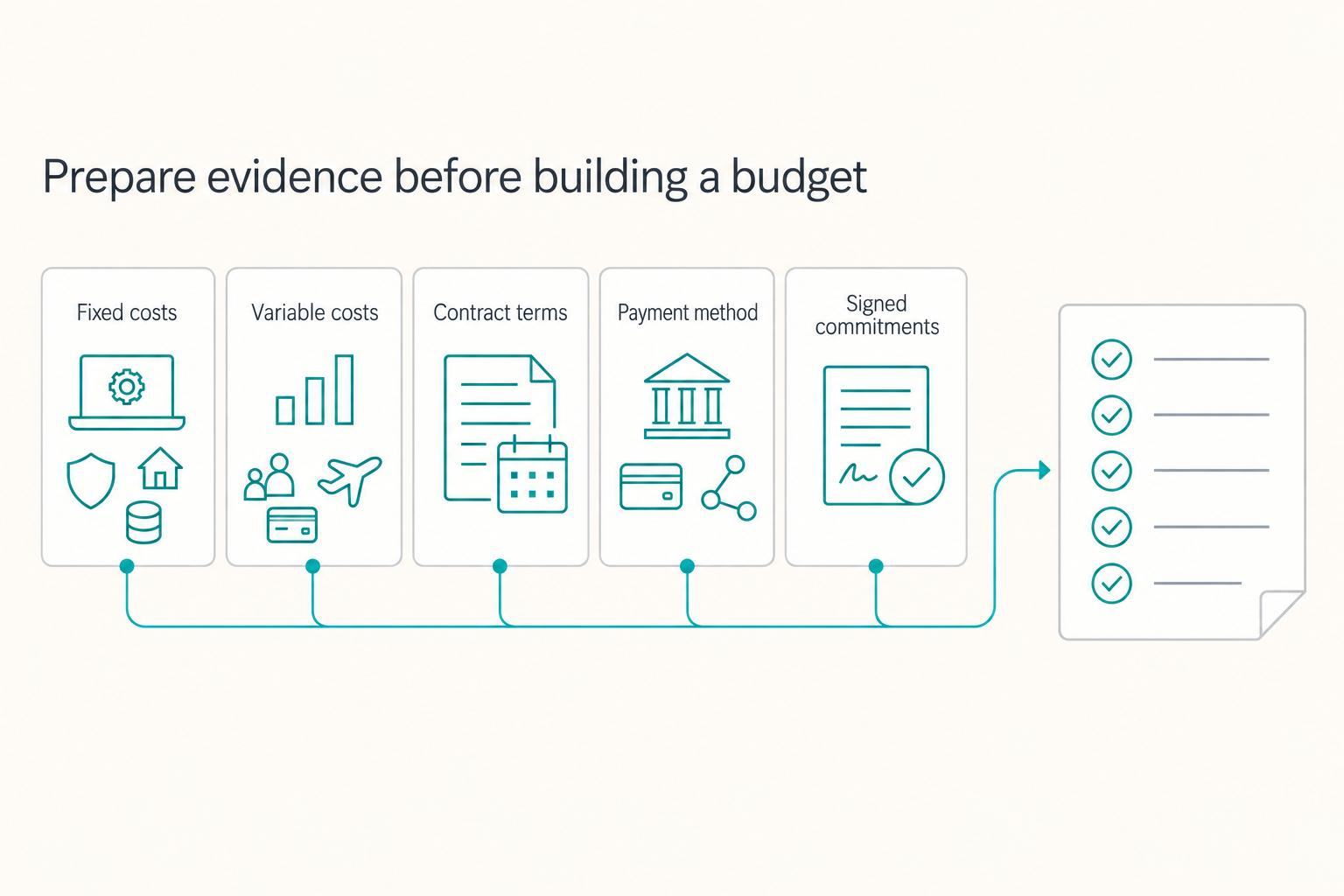
1. Gather the records that explain receipts and costs#
Collect bank and processor statements, invoices, open receivables, signed commitments, delivery costs, recurring bills and recent tax calculations. Use enough history to capture your seasonal pattern; six months may miss an annual quiet period. Match receipts to invoices and identify transfers between your own accounts so they do not inflate revenue.
Record gross client charges and the fees deducted before deposit. A $1,000 invoice with $30 processing fees produces $970 cash, but a profit plan should show $1,000 revenue and $30 fees. When you start the cash forecast from the $970 net deposit, do not subtract that same $30 again. Keep collected sales tax, VAT or GST separate from your own service revenue and available cash.
For each open invoice, keep the amount, remaining balance, issue and due dates, service period, expected collection date and any dispute or payment hold. A deposit already received and an unpaid balance are different inputs. Identify which project delivery costs the advance must fund before treating it as a personal-pay surplus.
2. Separate business expenses from owner cash needs#
| Budget category | Examples | Treatment to keep clear |
|---|---|---|
| Fixed operating costs | Software, insurance, workspace and professional services | Record amount and payment date, including annual renewals |
| Direct or variable delivery costs | Subcontractors, assets, job travel and processing fees | Link committed costs to the work, even in a low-receipt month |
| Capital and financing cash | Equipment purchases, loan principal and interest | Cash payments and accounting expenses can differ |
| Owner draw | Personal living costs paid from a sole proprietor’s business | Cash outflow; not a deductible salary expense |
| Tax provision and payments | Estimated applicable income and self-employment taxes | Reserve funding is distinct from actual tax remittance |
| Operating buffer | Cash retained for gaps in receipts | An internal transfer is not another operating expense |
Variable does not mean cancellable. A subcontractor payment may scale with projects but become a fixed contractual commitment once you order the work. List those dated obligations before deciding how much cash can be withdrawn. For a company that pays the owner through payroll, budget the applicable salary, employer costs and remittances rather than applying a sole-proprietor draw model.
For US sole proprietors, IRS Publication 334 says personal withdrawals and the proprietor’s own salary are not deductible business pay. Keep those draws out of the expense total used to estimate business profit. Track personal health coverage, retirement saving and leave needs in their appropriate places; they still affect how much the business must support.
3. Calculate the revenue needed to support the draw#
Use a formula with defined assumptions rather than adding a tax percentage as though it were a dollar amount. For a simplified planning model, let R be monthly service revenue, v the proportion spent on variable business costs, F fixed business costs and t an illustrative tax provision on profit after those costs. Let D be the desired owner draw and B new buffer saving. Then (R × (1 − v) − F) × (1 − t) must cover D + B.
Solving gives R = [F + (D + B) ÷ (1 − t)] ÷ (1 − v). This model assumes all revenue collects in the period, the defined variable-cost rate stays stable, and no separate capital, debt-principal or indirect-tax outflows. The provision is an effective planning assumption, not a statutory rate or a personal tax-return calculation.
Suppose F=$800, v=10%, t=25%, D=$3,000 and B=$300. Required revenue is [$800 + $3,300 ÷ 0.75] ÷ 0.90 = $5,777.78, rounded up for planning. At that amount, variable costs are about $577.78, leaving $4,400 profit before the illustrative provision; $1,100 provision leaves $3,300 for the draw and buffer. Owner draw does not reduce that $4,400 profit.
If 80 billable hours are realistically available each month, the model requires about $72.23 revenue per billable hour. That is a planning floor under these assumptions, not a recommended market rate. Nonbillable selling, administration and leave reduce available hours; project pricing must also accommodate overruns and the value clients buy.
4. Test the plan with an actual monthly example#
Assume a hypothetical US sole proprietor plans $6,000 of service revenue, with no collected indirect tax, and expects it all to collect this month. Direct delivery costs are $600, processing fees $180 and fixed operating costs $800. Business profit before owner tax is $6,000 − $600 − $180 − $800 = $4,420. This case uses the actual fees listed, rather than reusing the earlier 10% variable-cost assumption.
| Planned use of the $6,000 receipts | Amount |
|---|---|
| Direct delivery costs | $600 |
| Processing fees | $180 |
| Fixed business costs | $800 |
| Illustrative 25% provision on $4,420 profit | $1,105 |
| Owner draw | $3,000 |
| New buffer saving | $300 |
| Remaining unallocated cash | $15 |
| Total | $6,000 |
The small $15 surplus shows how little room this plan has. Check that all costs are included and that $1,105 matches a separately prepared tax forecast before treating it as adequate. The 25% rate is invented for the example. Do not add actual estimated-tax payment on top of the same fully funded provision as a second profit-plan expense; show when reserved cash is paid in the cash calendar.
If the processor deposits $5,820 after the $180 fee, the bank-cash view starts at $5,820 and pays the other listed items. The gross-receipt view starts at $6,000 and includes the fee once. Both reconcile to the same result. Moving $300 between business accounts preserves total business cash while making that amount unavailable for ordinary spending.
5. Put collection dates into a cash calendar#
Make a weekly forecast for the next few payment cycles. Opening cash means available cash in the accounts included, not a total that also includes pending receipts or protected reserves as spendable. Add expected collections on plausible dates, subtract actual payments on their dates, and show closing unrestricted cash. If a tax reserve sits outside that cash total, transfers into it are outflows from the unrestricted forecast.
For the $6,000 example, suppose one $2,000 invoice slips into next month. With $1,000 opening unrestricted cash, this month has $4,000 collected and $5,000 available before outflows. If the $600 delivery costs, $180 fees and $800 overhead still fall due, a deliberately stress-tested plan that also funds $1,105 tax reserve, $3,000 draw and $300 buffer would end at negative $985: $5,000 − $5,985.
That stress case deliberately keeps all costs and reserve funding due even though one collection moves. Actual fees and tax timing may change; update them with evidence rather than assuming the delay cancels obligations. The $2,000 invoice stays in receivables and moves to the new forecast date. It is not removed from the plan simply because the client never paid an upfront deposit.
Respond before cash goes negative. If the tax forecast and contractual payments still require those amounts, reduce or delay the $300 discretionary buffer addition and $685 of the planned draw to reach zero, or arrange another authorized funding source. A forecast ending at zero still has no cushion. Add a downside date for that invoice and decide what minimum balance the business needs to keep operating.
Keep deposits and remaining balances from being counted twice. A $3,000 project with a $1,000 advance already received contributes only its remaining $2,000 to future collections. That advance may also have delivery or refund obligations. Agreed upfront payments and milestones can reduce exposure, but their absence is not a reason to hide a signed, unpaid obligation from the forecast.
Calibrate tax provisions to the actual taxpayer#
A reserve percentage is a cash technique. Estimate the liability using the applicable tax year, entity, income, expenses, other earnings, deductions, credits and withholding, then derive a practical funding rule from that estimate. A slow collection month and taxable profit can differ depending on your accounting method; do not use a bank-transfer rule as the tax calculation.
For US self-employed individuals, the IRS self-employment tax page lists 15.3% for Social Security and Medicare combined, separate from income tax. It is not a flat tax on gross client deposits. The Social Security part has an annual earnings limit and wage interaction, and additional Medicare tax can apply. Use the current Schedule SE calculation rather than treating that headline rate as the total provision.
IRS estimated-tax guidance says individuals generally make estimated payments if they expect to owe $1,000 or more, subject to the applicable rules; withholding and exceptions can change the requirement. Payments follow four specified periods, not four equal three-month quarters. Uneven income may support an annualized-income calculation. Confirm due dates and the amount needed for each period; a savings transfer does not pay the IRS.
Handle currency and buffer assumptions once#
Keep a forecast currency for household and business spending, while retaining each invoice’s original currency. For a hypothetical $2,000 receipt, a planning rate of €0.90 per dollar gives €1,800 before fees; €0.87 gives €1,740, a €60 reduction. Subtract actual quoted conversion and transfer costs once. If an all-in rate already incorporates the spread, do not add that same spread as another expense.
A contingency reserve can absorb a defined rate downside or a delayed receipt, but it does not stop exchange rates moving. Size the cash buffer from obligations and a stress scenario, including the necessary owner draw and committed delivery work. A three-month target may fit one business and miss another’s large annual renewal or concentrated-client exposure. State what it covers and how it will be funded.
Review variances without rewriting the history#
At each monthly close, compare planned and actual revenue, direct costs, overhead, fees and collections. Explain whether a shortfall came from less work, a delayed invoice, a cost overrun or FX movement. Keep old forecasts and date the new version so improvement does not simply mean replacing the original numbers with actuals.
Reforecast sooner when a client cancels, a large invoice is disputed, a provider holds funds or a cost commitment changes. Update the next cash dates and owner-pay decision, not only the annual revenue target. Separate restricted tax and delivery reserves from cash available for growth. A useful budget makes that next decision visible before the bank balance forces it.
Frequently Asked Questions
Should I forecast only money already received?
Use actual receipts for the opening position and historical evidence, then forecast unpaid invoices and contracted work on explicit expected dates. Keep uncertain pipeline separate and test collection delays rather than excluding every project without a deposit.
Is my owner draw a business expense?
For a US sole proprietor, personal withdrawals are not deductible business pay. Show them as cash outflows after estimating business profit. A company payroll arrangement requires its own salary and employer-cost treatment.
What revenue does the worked target formula require?
With $800 fixed costs, 10% variable costs, a hypothetical 25% provision on profit, a $3,000 draw and $300 buffer addition, the formula gives about $5,777.78 monthly revenue, assuming collection in the period.
How much should I reserve for tax?
Use the actual taxpayer’s current-year estimate, including applicable income and self-employment taxes, other earnings and withholding. The example’s 25% is hypothetical; neither gross deposits nor the 15.3% SE headline rate establishes the correct total.
How do I avoid counting fees twice?
Either start from gross receipts and subtract the fees, or start from a net deposit and omit fees already deducted from that cash. Preserve gross revenue and fees separately in the profit records.
What should change when a client pays late?
Move the outstanding balance to a realistic collection date and recalculate closing cash while retaining due obligations. Adjust discretionary saving or owner draws, or arrange authorized funding, before the forecast becomes negative.
Researched and edited by the Gruv editorial team. Gruv builds cross-border billing, payouts, and finance-operations software for global businesses.
Sources
Educational content only. Not legal, tax, or financial advice.
Related Posts

The Freelance Payment Penalty: A Modeled Audit of Platform Fees, FX Spreads, and Payout Delays
The money rarely disappears through a single, easy-to-spot fee. The real loss is stacked. A marketplace takes its commission, a processor adds a charge for international cards, a bank or payment company converts the currency at a spread, a platform holds the funds before release, and a wire sheds a little to intermediaries on the way in. Each layer looks defensible on its own, but the worker feels the combined result as a smaller deposit and a later payday.

How to Respond to a Subpoena for Business Records
Move fast, but do not produce records on instinct. If you need to **respond to a subpoena for business records**, your immediate job is to control deadlines, preserve records, and make any later production defensible.

A US Expat's Guide to Investing in UCITS ETFs to Avoid PFIC Issues
The real problem is a two-system conflict. U.S. tax treatment can punish the wrong fund choice, while local product-access constraints can block the funds you want to buy in the first place. For **us expat ucits etfs**, the practical question is not "Which product is best?" It is "What can I access, report, and keep doing every year without guessing?" Use this four-part filter before any trade: