
Quick Answer
Start by deciding worker status and work location before you draft anything. Use IRS behavioral, financial, and relationship factors plus the FLSA economic-dependence lens to classify the role from actual working facts, not the label. Then draft clauses that match that jurisdiction, including pay terms, probation only where lawful, and workable contingencies. If classification is still unclear after fact-checking, pause and use Form SS-8 rather than sending a mismatched offer.
Worker Status and Jurisdiction Decide the Rest of the Letter#
A defensible offer letter starts with two calls before you write a line: what the worker legally is, and which jurisdiction controls the deal. Those two calls determine almost everything that follows. The right compensation clause looks different once status is fixed. The right probation sentence depends on local limits. The right termination language depends on the place where the person will actually work.
Most offers go wrong for simple reasons. The status label does not match the facts, local notice requirements get missed, or a copied termination clause does not work where the person will actually work. None of those problems is solved by making the prose sound more formal. If the inputs are wrong, the letter is wrong.
Before you draft#
Most offer-letter problems start upstream, not in the wording. Get status and governing law right first, then draft around those facts. If you skip that order, you usually end up revising the same letter several times and still missing the real issue.
A good way to slow yourself down before drafting is to write a short factual summary of the role as it will actually operate. Not the title. Not the label you want. The day-to-day facts. Who decides how the work gets done? Who controls the schedule? Who provides the tools? Who carries the expenses? Is this a project-based engagement through a separate business, or an ongoing role that depends on your company? Those are the facts you need before you open a template.
Step 1: Classify the role based on facts, not the label you want. The IRS still looks at behavioral control, financial control, and the relationship of the parties. It expressly says the paperwork label does not decide status. Under the FLSA, the question is also whether the person is economically dependent on you or in business for themself. No single factor controls. U.S. guidance is still moving, with a DOL NPRM announced on February 26, 2026, so verify the current rule before relying on older summaries.
| Signal | More likely contractor | More likely employee |
|---|---|---|
| Control over work | You buy an outcome, and they choose method, schedule, and tools | You direct how, when, and where the work is done |
| Money and equipment | They carry expenses, use their own equipment, and can profit or lose | You provide tools, reimburse costs, and pay regular wages |
| Business reality | Separate business, project-based work, less economic dependence on your company | Ongoing role, greater economic dependence on your company |
Do not use that table as a box-ticking exercise after the decision is already made. Use it before the decision. If the hiring manager says, “We want this person to be a contractor,” translate that into facts and see whether the facts support it. A contractor label paired with company-set hours, required training, and company-provided equipment is a warning sign, not a drafting challenge.
A common failure mode is mixed signals across teams. Finance expects invoices. The manager expects a regular schedule. IT plans to issue company equipment. The draft offer says “independent contractor” because that was the original plan. By the time anyone compares the actual arrangement with the language, the wrong paper is already in circulation. The fix is simple but easy to skip: get the operating facts from the manager before you draft, then test the draft back against those facts before it goes out.
Another common mistake is letting the title drive the analysis. “Consultant,” “advisor,” or “freelance” can sound useful internally, but the label will not rescue an arrangement that looks like employment in practice. The reverse is also true. If the role is truly outcome-based, project-based, and carried on through a separate business, do not weaken the analysis by writing employee-style control into the letter out of habit.
Verification point: if your draft says “independent contractor” but you set hours, require training, and provide the equipment, stop. If the facts still do not point clearly one way, use Form SS-8 instead of guessing.
That stop point matters. It is much easier to pause before sending than to unwind a bad classification after the person starts. If the facts are still changing while you are drafting, you are probably drafting too early.
Once status is right, the next common failure point is local law. Step 2: Confirm the governing law and mandatory terms for the work location. Start by identifying where the person will physically work, because that often drives required written terms, notices, and local employment rules. Then check three things in that jurisdiction: required written terms, pay notices, and any probation or termination language that needs local review.
For example, New York requires a written wage-rate notice for each new hire, including pay basis and overtime rate if it applies. In the UK, the written statement of employment particulars is a statutory document and is not the same thing as an employment contract. The principal statement is due on the first day of employment, and the wider written statement within 2 months. If the role is in an EU member state, verify the local implementation of the rule requiring essential terms early and in writing. Also confirm whether the probation cap is six months in that jurisdiction.
The practical lesson is that “remote” is not a usable legal location by itself. Your letter should be built around the place where the person will actually work. That is the place that often drives the written-term rules, notice requirements, and any probation or termination language that needs local review. A clean draft starts with a clean location answer.
Treat the jurisdiction check as three separate questions, not one general legal review. That keeps the review focused and easier to verify:
- What written terms must be given, and when?
- Is there a separate pay notice or wage-rate notice requirement?
- What probation or termination language needs local review in that location?
That structure helps because the answer is often not “the offer letter covers everything.” The New York example shows why: the wage-rate notice is its own requirement. The UK example shows the same point from another angle: the statutory written statement is not the same thing as an employment contract. If you assume one document does all the work everywhere, you will miss the jurisdictions that split those obligations across separate documents or separate timing rules.
A useful drafting discipline is to write the location into your internal approval notes before you draft the letter. Then review every major clause as if the location were the headline fact. Compensation terms, probation, termination wording, and even whether the offer pack needs separate documents all become easier to review once the work location is fixed.
If you want a deeper dive, read Germany Freelance Visa: A Step-by-Step Application Guide. If you want a quick next step for “create an offer letter,” try the SOW generator.
Build the letter#
With status and governing law settled, draft the letter in plain language and test each clause against the place where the person will work. Plain language matters here because a short, direct sentence is easier to review for legal fit than a paragraph full of inherited template language. A bulletproof offer letter is not the one with the most legal-sounding words. It is the one where each clause says what you actually mean and matches the governing rules.
Step 3: Draft the core clauses in plain language, then check each one against local law. Use this clause matrix as a build checklist:
| Clause | What to include | Common mistake |
|---|---|---|
| Status | State full-time, part-time, fixed-term, or contractor. This affects wage, overtime, and termination analysis. | Calling someone a contractor while drafting employee-style control |
| Location | State the actual work location, even for remote work. This anchors the local law review. | Writing only “remote” |
| Compensation terms | State salary or rate, pay basis, currency, pay frequency, and overtime handling if applicable. | Leaving variable pay vague |
| Probation | Include it only if lawful locally, with duration and review points. | Copying a probation clause without checking local limits |
| IP | Say what work product belongs to the company and whether a separate assignment is needed. “Work made for hire” helps in qualifying cases, but do not assume the offer alone solves ownership everywhere. | Assuming the offer letter settles ownership in every jurisdiction |
| Confidentiality | Define confidential information and point to your secrecy measures. Trade secret protection depends on taking reasonable measures to keep information secret. | Using a broad clause without matching it to how you actually protect information |
| Conditions | List real contingencies only, such as right-to-work checks or a lawful background screen. | Adding broad conditions you cannot administer consistently |
| Entire agreement | Use it to reduce “you promised me” disputes. | Treating it as automatically enforceable in every jurisdiction without review |
The easiest way to use this table is to read it as a sequence rather than a set of isolated clauses. Start with status and make sure the surrounding language does not undermine it. If the person is an employee, say so directly. If the role is fixed-term, say that directly. If the role is a contractor engagement, do not wrap it in employee-style control language. A contradiction in the first paragraph tends to spread through the rest of the letter.
Then lock down location with equal precision. This is more than an address field. It is the anchor for the legal review you already did. If the letter says only “remote,” you force everyone reading it later to guess which rules were supposed to apply. State the actual work location so the document can be understood on its own.
Move next to compensation terms, because vagueness here creates avoidable disputes. State the salary or rate, the pay basis, the currency, the pay frequency, and overtime handling if it applies. If some part of pay is variable, the main rule is not to imply certainty where there is none. Say what is fixed, and do not leave the reader to infer the rest from recruiting conversations or side emails. Compensation clauses are strongest when a third party can read the signed document and tell what was actually promised without reconstructing a negotiation thread.
For probation, the discipline is simple: include it only if it is lawful locally, and say how long it lasts and when the review points occur. This is one of the easiest places for copied template language to create problems. Founders often inherit a standard probation paragraph and paste it into every offer. That is exactly backward. Probation language should appear only after the local check, not before it.
On IP, stay practical. Say what work product belongs to the company and whether a separate assignment is needed. The warning in the draft is important: “work made for hire” can help in qualifying cases, but do not assume the offer alone solves ownership everywhere. If your process needs a separate assignment, treat that as part of the hiring packet, not as an afterthought you hope to clean up after the start date. Ownership problems often come from paperwork gaps, not from a lack of strong words.
For confidentiality, match the clause to reality. Define confidential information and point to your secrecy measures. Trade secret protection depends on taking reasonable measures to keep information secret, so a broad clause is only part of the picture. If your actual handling of sensitive information is casual, the clause and the practice do not line up. The goal is not to make the paragraph longer. The goal is to make the paragraph fit the way your company really protects information.
For conditions, list real contingencies only. A good rule is this: if you cannot explain how the condition will be checked and administered, it probably does not belong in the offer. Right-to-work checks and a lawful background screen are concrete. A vague basket of open-ended conditions is not. Overbroad contingencies create two problems at once: they look sloppy to the candidate, and they become difficult to apply consistently later.
For entire agreement, use the clause for its real purpose. It helps reduce disputes built around “you promised me” statements from recruiting calls or informal messages. But it works best when you also clean up the rest of the process. If a term matters, put it in the final offer or in the documents the offer expressly incorporates. Do not rely on the entire-agreement sentence to erase messy negotiation history you never resolved in writing.
Before you send the letter, do one last line-by-line check with the clause matrix in mind. This is where small contradictions usually show up:
- Does the status language match the actual level of control described by the business?
- Does the location clause identify where the person will physically work?
- Do the compensation terms say exactly how pay works, including overtime handling if it applies?
- Is probation both lawful locally and drafted with a clear duration and review points?
- Do the IP and confidentiality clauses match the rest of your hiring documents and actual practices?
- Are the conditions real, narrow, and administrable?
- Does the entire agreement clause fit the way the deal was finalized?
That kind of review catches more problems than a general “looks fine” pass. You are not just proofreading. You are checking whether the legal and operational story is consistent from start to finish. If classification is the weak point, see What to Do If You've Been Misclassified as an Independent Contractor.
Close and verify#
A good offer letter is not finished when you send it. How you issue, accept, and store it matters if you ever have to prove what was agreed.
This is where otherwise solid offers often get weakened by process. An outdated version gets signed. A negotiated term lives only in email. Or the signed copy is saved without the supporting documents that explain what the role and pay were supposed to be.
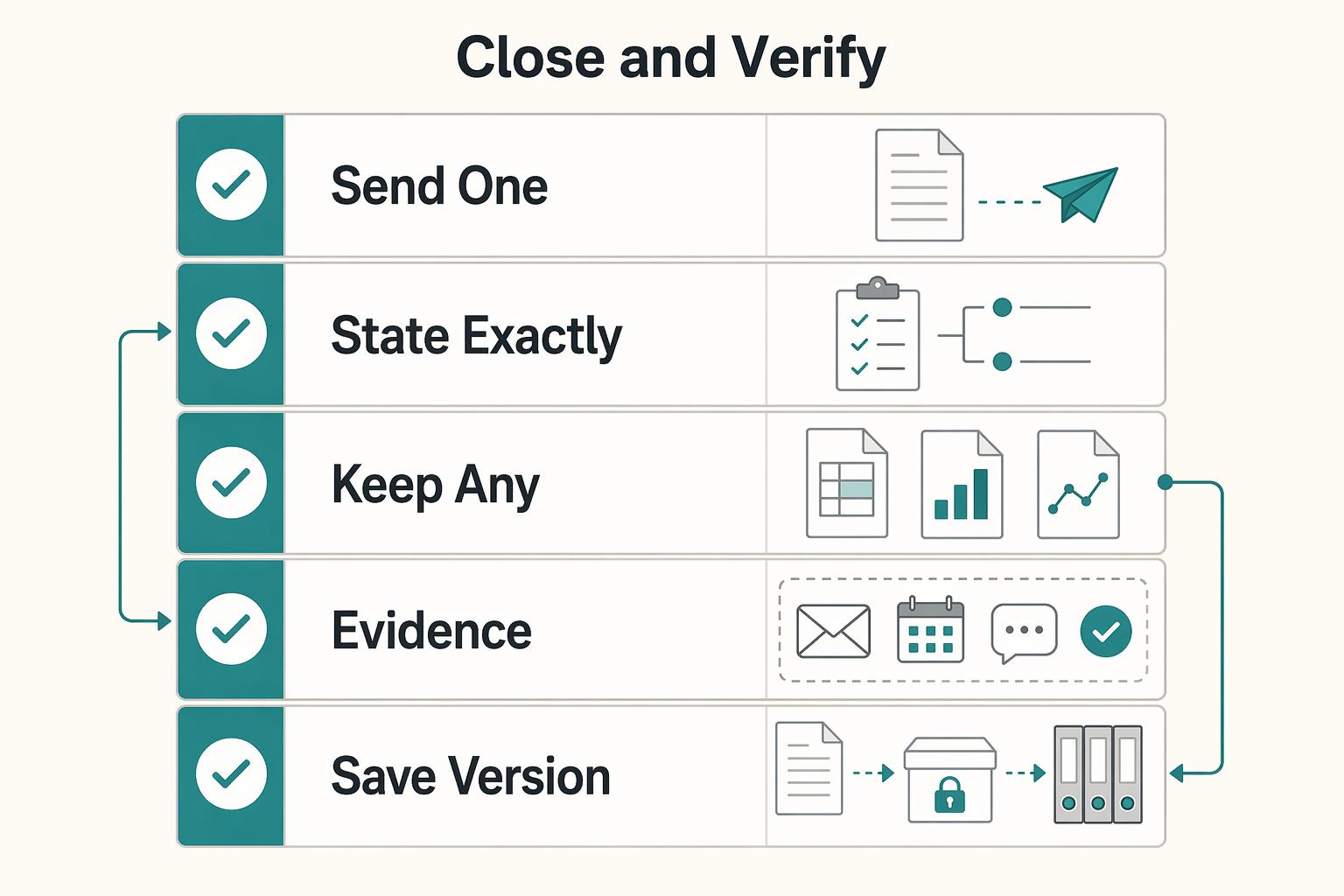
Step 4: Send, accept, and store the offer like evidence. In U.S. commerce, an e-signature generally cannot be denied effect solely because it is electronic, but do not assume the same rule applies unchanged outside that context.
Think like someone who may need to reconstruct the deal later. The goal is a clean record showing what version was sent, what conditions applied, when the candidate accepted, and what documents sat behind the final approval. The easier your file is to understand later, the stronger the letter is in practice. A simple process usually works best:
- Send one clean final version, not a marked-up chain of drafts.
- State exactly how and when the offer should be accepted.
- Keep any contingencies limited to the real items you will actually verify.
- If terms change during negotiation, update the final document rather than relying on an email to override it.
- Save the version that was signed, not just the template you started from.
Those are process habits, not legal flourishes, but they matter. An offer letter is often judged as much by the paper trail around it as by the clause text inside it.
Do this: “Please sign and return this offer by [date and time]. This offer remains conditional on [right-to-work verification / lawful background screen / jurisdiction-specific item, verify locally].”
Avoid this: “Send us your passport only” or any other request for specific I-9 documents. Employees may complete Form I-9 Section 1 after accepting the offer, but no later than the first day of employment. You complete Section 2 within 3 business days of hire.
That contrast captures a larger point: keep the acceptance step clean, and keep compliance steps separate enough that you do not ask for the wrong thing in the wrong way. If you need verification, say that verification is required. Do not turn the offer email into an improvised document request that creates a different problem.
Version control matters too. If the candidate negotiates a different start point in the compensation terms, a revised location, or any other material change, reissue the final letter so the signed copy reflects the actual deal. A file full of “see later email” explanations is harder to defend than a file with one final signed document and the supporting approvals behind it.
Verification point: save the signed letter, compensation approval, job description, and any pay notices in your records. Keep employment tax records for at least four years after filing the fourth-quarter return for that year.
Do not treat those records as separate administrative scraps. Keep them as one defensible packet. The signed letter shows what the candidate accepted. The compensation approval shows what the company approved. The job description helps show what role was actually contemplated. The pay notices show that the required written pay information was handled. If you ever need to answer a question about classification, pay, or what documents were provided at the start, that packet is much more useful than a folder of disconnected files.
A practical test is this: if someone new had to understand the hire from the record alone, could they do it without guessing? They should be able to see the final signed letter, the approved pay, the role description, and any required notices without piecing together a story from scattered messages.
Is a signed offer always the employment contract?#
No. In the UK, the statutory written statement is distinct from an employment contract. A signed offer can still contain important terms, so do not assume the document title answers the question. If the document is signed and contains the terms the parties are acting on, treat it with the same discipline you would give any other important agreement.
Can you make the offer contingent on a criminal background check?#
Sometimes, but do not treat that as automatic. If you use criminal history, keep it job related and consistent with business necessity, and include an individualized assessment. Draft the contingency to match the review you will actually perform, then follow that process consistently.
That is the core discipline behind a bulletproof offer letter. Decide status from facts. Draft for the place where the person will actually work. Use plain language for the key clauses. Then send, accept, and store the document as if you may need to prove every step later. When those pieces line up, the letter feels simple to the candidate and much stronger to the company.
You might also find this useful: How to Write a Job Description That Attracts Top Talent.
Compensation and Contingency Matrix#
Use a consistent matrix before releasing each offer. Validate classification and pay records against IRS employee classification guidance, DOL employment relationship rules, and right-to-work steps in USCIS I-9 Section 2 guidance.
| Offer Element | Minimum Detail | Owner | Risk if Missing |
|---|---|---|---|
| Compensation | Exact salary/hourly rate and pay cycle | Hiring manager + payroll | Payroll correction and candidate disputes |
| Classification | Employee status statement and exemption context | HR + legal | Misclassification exposure |
| Contingencies | Background, references, and authorization checks | Recruiting operations | Unclear withdrawal conditions |
| Start conditions | Start date, reporting line, and location terms | Hiring manager | Onboarding and equipment delays |
Offer Letter QA Checklist for Remote-First Teams#
| QA Check | Pass Condition | Evidence Artifact | Escalate When |
|---|---|---|---|
| Template version | Latest approved template hash used | Template changelog ID | Manual edits bypass template controls |
| Jurisdiction clause | State/country terms align with work location | Legal review note | Candidate location differs from approved payroll setup |
| IP/Confidentiality references | Terms cross-reference employment docs | Linked agreement ID | Offer omits assignment language |
| Signature workflow | All approvals and signatures captured | Signed PDF + audit trail | Missing approver or unsigned final copy |
Offer Letter Metrics to Track in 2026 Hiring Cycles#
Track measurable thresholds: target under 48 hours from verbal acceptance to issued offer, under 24 hours for post-signature file completion, and less than 5% offer reissue rate by quarter.
Linked Internal Operating Notes#
Pair this process with digital file naming SOP, offer packaging examples, and cross-border onboarding prep to keep recruiting, payroll, and compliance synchronized.
Frequently Asked Questions
What clauses should always appear in an offer letter for a new employee?
At minimum include role, pay basis, start date, reporting line, classification language, contingencies, and at-will or local equivalent employment language where legally valid.
How should you document contingency checks in the offer process?
Use a dated checklist for references, background screening, and right-to-work verification, and keep the completion record with the signed offer packet.
Can compensation ranges be written as broad bands?
Use defensible bands tied to job level and location, and state the exact starting rate or salary in the final accepted letter to reduce interpretation disputes.
What is the safest way to handle remote-hire jurisdiction terms?
Specify governing law, work location assumptions, and a process for location change approvals before start date so payroll and tax setup stay accurate.
Should an offer letter include intellectual property language?
Yes, include assignment and confidentiality language that aligns with your employment agreement and local enforceability rules.
How do you reduce rework after the candidate verbally accepts?
Freeze a version-controlled template, run a legal and payroll preflight, and issue one clean final version with signature and audit timestamps.
Which internal guides should support the offer-letter workflow?
Link your filing SOP, hiring checklist, and document naming standard so the recruitment-to-onboarding handoff stays complete.
Try a related tool
Researched and edited by the Gruv editorial team. Gruv builds cross-border billing, payouts, and finance-operations software for global businesses.
Sources
- copyright.gov/circs/circ30.pdftrusted
- dol.gov/agencies/whd/fact-sheets/13-flsa-employment-...trusted
- dol.gov/agencies/whd/flsa/misclassification/rulemakingtrusted
- dol.ny.gov/notice-pay-ratetrusted
- ecfr.gov/current/title-29/subtitle-B/chapter-V/subcha...trusted
- eeoc.gov/laws/guidance/arrest-and-conviction-records-...trusted
- employment-social-affairs.ec.europa.eu/policies-and-activities/rights-work/labour-l...trusted
- irs.gov/businesses/small-businesses-self-employed/em...trusted
Educational content only. Not legal, tax, or financial advice.
Related Posts

Germany Freelance Visa Application Path for Freiberufler and Gewerbe
Choose your track before you collect documents. That first decision determines what your file needs to prove and which label should appear everywhere: `Freiberufler` for liberal-profession services, or `Selbständiger/Gewerbetreibender` for business and trade activity.

What to Do If You've Been Misclassified as an Independent Contractor
Treat this as a protection problem first, not a label debate. If your work was treated as an independent contractor arrangement even though the relationship functioned differently, your first goal is to protect pay, rights, and records while you choose the least risky escalation path. You can do that without making accusations on day one, which often keeps communication open while you document what happened.
How to Write a Job Description That Attracts Top Talent
If you are buying a defined result from an outside professional, start with a project charter, not a hiring document. A charter can make the outcome, boundaries, approval path, and proof of completion clearer before work starts. That clarity is often what keeps projects cleaner than role-based paperwork.