
Quick Answer
Use your freelance faq page as a policy screen before booking. Put every answer in one lane: qualify fit, set terms, or reduce delivery risk, then end with the next client action. Check each line against your SOW, proposal language, and payment terms so scope, revisions, and timing match what you enforce. For cross-border clients, keep KYB/KYC and W-8 or W-9 notes conditional and route unclear tax treatment to advisor confirmation.
Build a freelance FAQ page that works like an operating system#
Your freelance FAQ page should be where you and your clients go to make decisions, not a polished filler page. You want one place for answers; otherwise you end up digging through folders, emails, and calendars every time a lead asks a familiar question.
Start with policy, not copy. If the rule is unclear in your own process, the page will only spread that confusion.
-
Step 1 Define policy in plain language. Write answers around four things: what is included, what is excluded, what is billed, and what gets delayed when client inputs slip. End each answer with a next action. If something is included, tell the reader how to book it. If it is excluded, point to an add-on, referral, or a clear no. If feedback, assets, or approvals arrive late, state how the timeline is re-estimated. Checkpoint: test five real client questions against the page and confirm you can answer each one without opening old email threads.
-
Step 2 Separate marketplace flow from your own rules. If you use a platform, separate its workflow from your own policy layer.
| Decision area | Platform workflow | Your policy layer |
|---|---|---|
| Fit screening | Proposal and messaging flow inside the platform | Who you work with, what information you require before scoping, and what projects you decline |
| Terms control | Platform terms and process | Your scope edges, revision boundaries, billing sequence, and dependency rules |
| Risk handling | Platform dispute and account process | Your escalation contact, change-request path, and pause conditions |
- Step 3 Publish a first release you can actually use. Start small and make it operational. Draft answer templates for scope, pricing, revisions, delays, and communication. Add one escalation path for exceptions. Your services page should create interest. The FAQ should define how the work runs and absorb repeat objections.
Why your freelance FAQ page should pre qualify clients before they book?#
If you want fewer poor-fit calls, make your FAQ handle screening before anyone reaches your calendar. Your services page creates interest; your FAQ should confirm fit, set terms, reduce delivery risk, and tell the reader what to do next.
| Generic pre-sale FAQs | Policy-driven pre-qualification FAQs |
|---|---|
| Explain what you do | Explain who the service is for and who should not book |
| Answer broad client questions | State scope edges, revision process, timeline assumptions, and handoff dependencies |
| End with "contact me" | End with a clear next action such as book, send a brief, or request custom scoping |
- Qualify fit: one rule, one action.
Set minimum requirements in plain language. If a project matches your accepted work and the client can provide baseline scoping information, invite them to book or submit an inquiry; if not, tell them not to book and route them to a referral, another service, or custom scoping. If you need a quick signal before offering time, check whether their site shows hiring pages like "Jobs," "Careers," or "Join our team."
- Set terms: one rule, one action.
Use the FAQ to define how work runs before a call starts: what is in scope, how revisions are handled, how timelines are estimated, and how changes are handled. If the client can work inside those terms, they should book or request a proposal; if they need exceptions, route them to your documented change process instead of ad hoc promises. Keep this clear even on marketplaces where buyers compare rate quotes and time estimates.
- Reduce delivery risk: one rule, one action.
List the inputs needed to start and keep momentum, such as assets, approvals, and feedback. If the client can provide required inputs on time, move forward; if not, ask them to wait or request a revised start plan. For edge cases, use narrow qualifiers: if timing or process varies by jurisdiction, contract route, or workflow, say that directly and send exceptions to written change rules.
Your services page should attract the right interest. Your FAQ should help that reader make a clear yes/no decision before booking.
What should you prepare before writing a single FAQ answer?#
Before you draft anything, build one prep file from real client questions and current policies so your FAQ is clear, consistent, and easy to trust.
| Prep task | Source to use | Rule |
|---|---|---|
| Gather recent questions | Emails, forms, call notes, and proposal threads | Turn repeated questions into standardized answers in plain language |
| Build a source note | Real conversation patterns and current policies, including pricing, refunds, or cancellations where relevant | If you cannot point to a clear source for an answer, do not publish it yet |
| Clarify payment and process ownership | What you directly control | Keep wording conditional if parts of the process depend on your payment setup or vary by customer context |
| Run a pre-publish conflict check | Current terms and process | Rewrite wording that creates a promise your workflow cannot support or route the reader to a defined next step |
Gather recent questions from real conversations#
Start with what people already ask in emails, forms, call notes, and proposal threads. Group those questions by stage so you can see where decisions stall, then turn repeated questions into standardized answers in plain language.
| Conversation pattern | Typical stage | FAQ intent label |
|---|---|---|
| "Are you the right fit for this kind of project?" | Early inquiry | Qualify fit |
| "What is included, and how do revisions work?" | Evaluation or negotiation | Set terms |
| "What do you need from us before work starts?" | Pre-start planning | Reduce delivery risk |
| "What happens if timing changes, we pause, or we cancel?" | Negotiation or pre-start planning | Set terms |
Build a source note for every answer you plan to publish#
For each draft answer, write down where it comes from before you publish it. Use your real conversation patterns and your current policies, including pricing, refunds, or cancellations where relevant, then translate that into clear public wording.
If you cannot point to a clear source for an answer, do not publish it yet.
Clarify payment and process ownership in plain language#
Keep payment-related answers specific to what you directly control, and avoid broad promises about every step of checkout. If parts of the process depend on your payment setup or vary by customer context, say that plainly and keep the wording conditional.
Run a pre-publish conflict check#
Before publishing, compare each answer against your current terms and process. If wording creates a promise your workflow cannot support, rewrite it or route the reader to a defined next step, for example, a custom scope request or written clarification.
Build your FAQ with the three decision lanes#
Use the three lanes as a drafting filter: each FAQ answer should drive one decision for the reader. If a question does not help someone decide fit, terms, or delivery readiness, move it to your services page, proposal, or direct email.
This keeps the page operational in a project-to-project work cycle, where unclear answers can cost you time between paid engagements.
Map each question to one lane only#
Assign one question to one lane, with one owner and one required next action. If an answer tries to do multiple jobs, split it.
| Lane | Question type | Source policy artifact | Owner | Required client next action |
|---|---|---|---|---|
| Lane 1 | Fit and pre-qualification | Business plan, service criteria, positioning notes | You | Proceed with the right intake step or self-select out |
| Lane 2 | Terms, pricing, revisions, objections | Signed terms, proposal language, payment policy | You | Accept terms, request scoped changes, or request written clarification |
| Lane 3 | Delivery risk, dependencies, delays, escalation | Kickoff checklist, project assumptions, delivery notes | You and client | Provide missing inputs, confirm timeline changes, or escalate through the named contact |
Lane 1: qualify fit fast and route non-fit clearly#
State who you serve, who you do not serve, and what the next step is for both groups. Avoid soft endings that keep non-fit leads in limbo. End each answer with a clear prompt such as: continue with intake, request a custom review, or stop here if the project is outside scope.
Lane 2: keep terms answers aligned with what you enforce#
Write answers so they match your signed documents, not your best-case intent. When an objection or request changes scope, timeline, or cost, route it to revised scope and written confirmation instead of informal promises. For discount pushback, direct readers to What to Do When a Client Asks for a Discount.
Lane 3: turn delivery risk into usable decision paths#
Write this lane for pressure moments, not ideal conditions. Cover common scenarios like missing inputs, delayed approvals, timeline changes, and escalation.
| Scenario | What is blocked | Owner to unblock | Client next action |
|---|---|---|---|
| Required files or inputs are missing | Work cannot proceed as planned | Client | Send missing inputs so scheduling can continue |
| Approval is delayed | Next phase cannot start | Client | Approve or provide consolidated feedback in writing |
| Timeline changes mid-project | Original sequence no longer holds | You and client | Confirm revised timing and updated plan in writing |
| Issue needs escalation | Day-to-day thread is no longer resolving it | Named escalation contact | Escalate through the kickoff contact path |
If a reader cannot tell what to do next in one pass, tighten the answer until the next action is explicit.
What payment and pricing policies should your FAQ make explicit?#
Your FAQ should let a buyer understand pricing and payment without emailing you for basics. In this lane, state what you charge, what triggers payment, and what pauses delivery.
Name the pricing model and the scope boundary#
If you use bid proposals, say that each proposal includes both the rate quote and the time estimate, then state what the client must approve before work starts. If detailed fees live elsewhere, point to that document as your Fees & Charges reference.
| Model | Use it when | Scope boundary to state | Client next action |
|---|---|---|---|
| Fixed scope | Deliverables are known before kickoff | Name deliverables, revision limit, and what counts as a new request | Approve scope in writing or request changes before start |
| Retainer | The client is buying ongoing capacity | State what is included in the monthly allocation and whether unused time expires | Choose a capacity level and confirm the start month |
| Milestone | Work can be split into approval checkpoints | State whether later milestones wait for prior approval and payment | Approve the milestone plan and payment sequence |
Next step: pick one model and confirm scope boundaries before kickoff.
Publish the payment sequence line by line#
Write this as a client-facing sequence: "You receive an invoice when the agreed billing event occurs. Payment is due under the due-date rule in our signed agreement. I accept the payment methods listed in the invoice. Work starts after any required deposit or first payment and required approvals are in place."
| Condition | Payment-sequence wording |
|---|---|
| Files, approvals, or access are late | The schedule moves |
| Work pauses beyond the pause window in the agreement | Restart follows the restart condition in the agreement |
| Payment is late | The next step follows your verified late-payment terms |
Then define exceptions: if files, approvals, or access are late, the schedule moves; if work pauses beyond the window in your agreement, restart follows the restart condition in that agreement; if payment is late, the next step follows your verified late-payment terms. Next step: review the sequence and confirm acceptance before kickoff.
Trade discounts for one thing only#
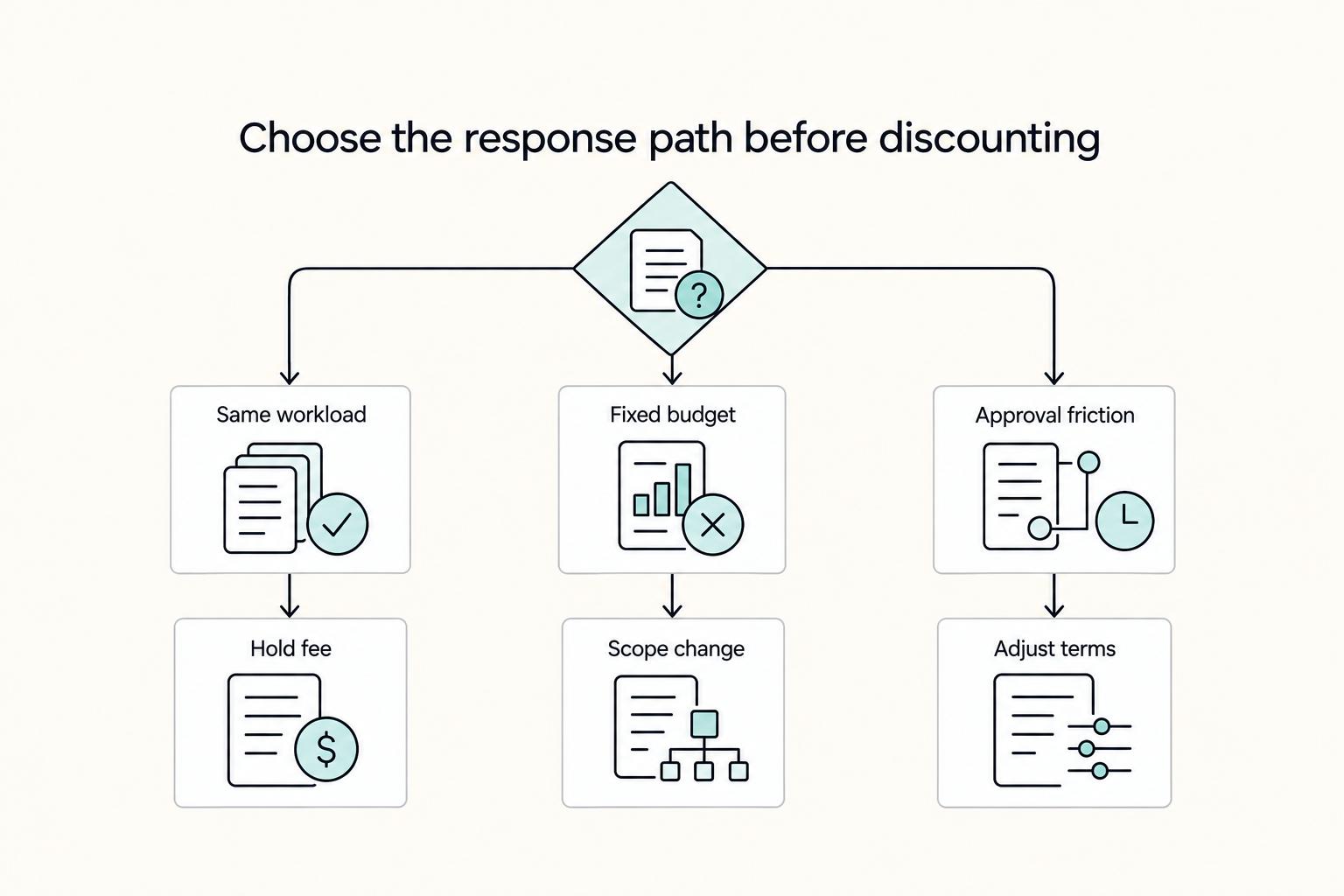
State this rule directly: a lower fee changes one of three things, scope, timeline, or support level. If a client asks for a discount, ask which tradeoff they want reviewed and revise the proposal accordingly.
For repeated pushback, link to What to Do When a Client Asks for a Discount. Next step: choose the tradeoff and request a revised scope.
Add cross-border qualifiers before the client assumes payment is simple#
Do not imply every cross-border payment is straightforward. State who handles payment in your setup, you, your provider, or a merchant of record, and clarify that tax handling can vary by market, jurisdiction, and registration status. If a VAT or tax threshold affects the project, verify the current threshold from official source records before publishing it.
Also state that authorization status can block payments: in some cases there is "no authorization in effect," some transactions are prohibited unless specifically authorized, and additional licensing can require a specific license. If a provider flags a country, party, or ownership issue, stop and verify authorization before booking the project. Next step: confirm billing country, entity details, and tax handling before issuing the contract.
Add compliance and cross border clarity without sounding like a lawyer#
Cross-border projects can slow down for a few predictable reasons, so your FAQ should state what may delay onboarding or payout, why, and what the client should do next.
Add a simple verification gate#
Keep this rule near your payment terms: timelines may shift if a payer, platform, or payment provider asks for identity, business, payment, or tax verification in that workflow. Use plain language, for example: "If verification is required before work starts or before funds are released, I'll tell you exactly what is needed. The timeline resumes after that check clears."
This gives you a clear pause point and helps you avoid starting work before payment details are fully confirmed in writing.
Separate common request types#
Do not present KYB, KYC, and tax forms as one default checklist. Treat each as a separate scenario with a clear next action.
| Scenario | When it may appear | What you may ask for | Client next step |
|---|---|---|---|
| KYB | When the payment workflow requests business verification | Entity details requested in that workflow | Send the exact business details that match contract and invoice records |
| KYC | When the payment workflow requests individual verification | Identity details or documents requested in that workflow | Submit the requested ID using the same details as the payment account |
| Tax form (for example, W-8 or W-9) | When a payer or platform requests tax setup details | Only the specific form requested | Confirm which form is required, complete that form, and return it before invoicing when required |
Practical rule: these are conditional requests, not automatic requirements in every project.
Add cross-border caveats that affect timing#
Make the operational caveats explicit: payment options can vary by country, and each option can differ on fees, processing time, and currency conversion behavior. Confirm two items before kickoff: who covers transaction fees, and when payment is considered received. "Payment sent" is not the same as funds in your account, and international transfers can take three to seven business days depending on method and countries involved.
| Caveat | Detail | Related check |
|---|---|---|
| Payment option varies by country | Fees, processing time, and currency conversion behavior can differ | Confirm who covers transaction fees |
| "Payment sent" vs. received | "Payment sent" is not the same as funds in your account | Confirm when payment is considered received |
| International transfer timing | Transfers can take three to seven business days depending on method and countries involved | Confirm payment method before work begins |
| Exchange-rate movement | A 5-10% move over a project is not unusual; on a $5,000 contract, that can mean about $250-$500 difference in what you keep | Say whether you use a multi-currency account provider or convert immediately |
Add one currency warning in plain English: exchange-rate moves can change your real take-home amount on foreign-currency invoices. A 5-10% move over a project is not unusual; on a $5,000 contract, that can mean about $250-$500 difference in what you keep. If you use a multi-currency account provider, say that. If you convert immediately, say that instead.
If this comes up, route it like this:
- Confirm payment method, fee responsibility, and any requested verification in writing before work begins.
- If tax treatment or thresholds may apply, state the unresolved item plainly: Current VAT or tax threshold pending official verification.
- If residency, withholding, or local filing treatment is unclear, ask the client to confirm with their advisor and refer them to your formal billing and payment terms before contract issue.
What breaks after launch and how do you recover fast?#
Most FAQ pages break after launch because they drift. Treat this section as a living policy layer: when one answer fails, fix it against the governing source first, then republish matching client-facing copy in one controlled update.
Align risky answers to a governing source#
Start with answers about scope, revisions, timing, liability, payment, and disruptions. Map each one to a single source, for example, your SOW, payment terms, indemnification language, or force majeure clause, then replace broad promises with constrained language like "when applicable," "per contract terms," and "once verified."
Verification check: for each high-risk answer, you can point to one governing source and one next step if a client asks for an exception.
Trigger updates from incidents, not memory#
When the same objection repeats in calls, email, or rescue threads, document the failure before editing. Capture when it started, what happened, whether it is consistent or intermittent, and what changed recently; if multiple things changed, isolate one variable at a time.
Verification check: each repeated objection ends with either revised wording or a short note on why the current wording stays.
| What failed | Root cause | Governing clause or policy source | Revised FAQ wording | Prevention owner |
|---|---|---|---|---|
| "Turnaround is always X days" | Promise exceeded real capacity or approvals | SOW and delivery terms | "Timelines are estimates and may shift based on dependencies, feedback, and availability." | You |
| "Two rounds of revisions included" still caused scope disputes | Revision limits differed across touchpoints | SOW | "Included revisions are limited to the rounds and scope listed in the SOW." | You |
| "Payment due on receipt" but onboarding stalled | Verification/setup conditions were not stated early | Payment terms | "Work or payout timing may change once verification or payment setup is complete, when applicable." | You or admin owner |
| "Work continues through outages or emergencies" | No plain disruption rule | Force majeure clause | "If a major disruption affects either party, dates may pause or move per contract terms." | You |
Sync policy touchpoints in one controlled cycle#
When you revise an FAQ answer, update related wording in your FAQ, proposal language, and contract-facing text in the same revision cycle so clients do not see conflicting versions. Then cross-check your services messaging against How to Create a High-Converting Freelance Services Page, and sync any Help Center or separate fees page if you use them.
Verification check: your services page, FAQ, proposal, and contract packet use consistent scope, fee, and timing language.
Use a plain escalation path for delays and disruptions#
Use this micro-flow under pressure:
- If the delay is a client dependency, request the missing approval or asset and pause date commitments until it arrives.
- If the issue is technical, verify fundamentals first, including server/domain status, recent changes, and server/app/browser error logs.
- If the issue is a wider disruption, apply your force majeure wording and set the next review point.
- If diagnosis runs past 2 hours without clear progress, escalate to the right expert or place the work on documented hold.
Verification check: you can state what paused, what is needed, and when you will update the client next.
Keep an incident log and close the loop#
For every failure, log the exact FAQ line, the client's real question, the source used to resolve it, the revised wording, and the prevention owner. For technical or delivery issues, attach start time, recent changes, and any relevant error evidence; for planned disruptions, block your calendar so availability is clear.
Verification check: your log makes the cause clear, whether it was a wording gap, source mismatch, capacity issue, or real disruption, and shows what changed to prevent repeat incidents.
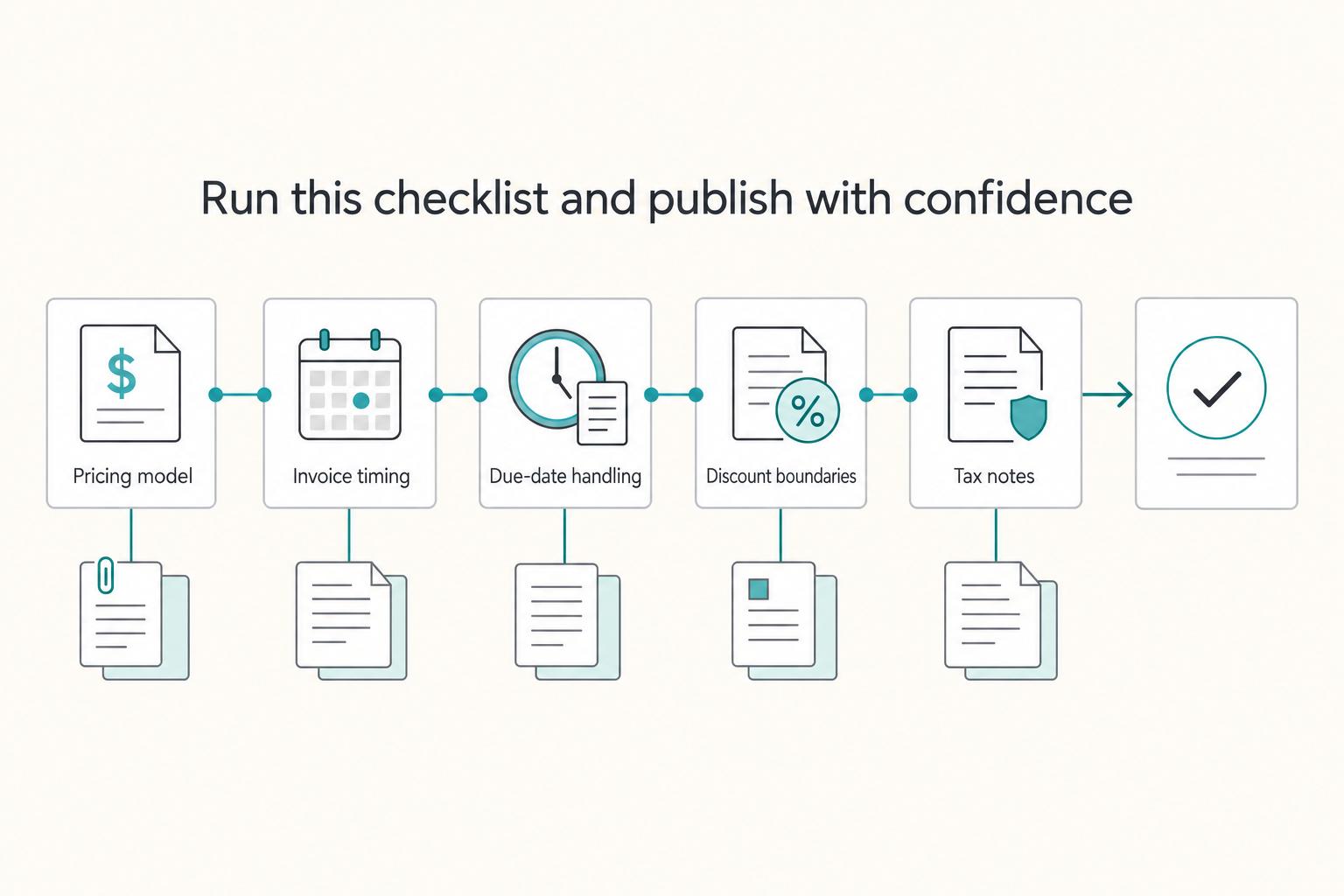
Run this checklist and publish with confidence#
Run these five checks before you publish your FAQ page. You do not need to feel 100% ready, but you do need clear answers that match how you actually work so you do not stay stuck preparing forever.
-
Give each answer one clear job and one next step. If you are using the three-lane framework in this article,
qualify fit,set terms,reduce delivery risk, keep each answer in one lane and end with a specific client action. If an answer has no clear action, rewrite or remove it. -
Match FAQ wording to your real documents. Cross-check policy answers against your current working docs, for example, your proposal, contract, and delivery terms, so scope, approvals, confidentiality, data handling, and exits do not conflict across touchpoints.
-
Make payment answers decision-ready. A client should be able to repeat your payment policy back to you in one sentence.
| Policy point | What your answer should clarify |
|---|---|
| Pricing model | How you charge for the work |
| Invoice timing | When you invoice and what starts work |
| Due-date handling | What changes if payment, approvals, or materials arrive late |
| Discount boundaries | Whether changes come from scope, timeline, or both |
| Tax notes | What applies when required and what varies by market |
-
Keep compliance language constrained. Use plain qualifiers such as
when requiredandvaries by workflow/market. If a threshold or filing rule is not verified, say the current threshold or rule is pending official verification instead of publishing a number you may need to retract. -
Test the page where clients actually read it. Check mobile and desktop for scanability, table readability, and CTA clarity. Then publish with one verb-led CTA and keep that same action consistent across your contact page, proposal email, and intake form.
We covered this in detail in How to Create a 'Hire Me' Page That Converts.
Frequently Asked Questions
What should a freelance faq page include?
Include the questions that stop a client from moving forward: fit, scope, pricing, payment terms, and process details clients ask about repeatedly. If your list is short, keep it on one page. If it grows, add a simple FAQ TOC so people can find answers without scrolling through everything.
How should I write each answer so it actually helps?
Use one pattern every time: brief decision context, policy-level answer, then one next action. A quick check is whether each answer points to one real source, such as your SOW, payment terms, or discovery checklist, and tells the reader what to send, review, or confirm next.
What is the difference between a services page and an FAQ page?
Your services page explains what you offer and why it matters. Your FAQ handles the practical client questions that decide whether someone can work with you on your terms. If a sentence is selling the offer, it belongs on the services page. If it is resolving risk, scope, timing, or payment doubt, it belongs here.
How do I answer scope questions without inviting scope creep?
State what is in scope and what is explicitly out of scope, then tell the client how changes are handled. If the answer cannot name a boundary, it is too loose and will likely create friction later. A discovery checklist helps here because it clarifies deliverables, assumptions, and exclusions before work starts. Pricing and payment
What payment terms should I state on the page?
Tell clients how you price, what is included, what is excluded, when you invoice, and what happens if approvals or materials arrive late. If you keep detailed fee logic elsewhere, route people to that exact resource, just like larger platforms separate FAQs from a dedicated Fees & Charges page. The next action should be concrete: review the proposal, confirm the pricing model, or ask for a scope adjustment before signing.
How do I answer discount requests without sounding defensive?
Treat price cuts as a scope or timing decision, not a debate about your value. If a client wants a lower fee, offer a narrower deliverable, fewer revision rounds, or a different timeline so margin and workload still match. If you want a fuller script for that moment, send them or your own team to What to Do When a Client Asks for a Discount.
Should I mention deposits or upfront payment?
Only if it reflects your actual policy. Do not copy example wording like paying “1/2 the price up front” unless that is truly how you work and your proposal and contract say the same thing. The failure mode is simple: one loose FAQ answer becomes the promise the client remembers when the invoice lands. Updates and compliance
How often should I update my FAQ page?
There is no universal cadence. Update answers when your policy changes or when the same question keeps appearing in sales or support conversations. Verification point: after an update, your FAQ, proposal, and contract packet should all use the same wording for scope, fees, and timing.
Should I include compliance and tax questions like VAT, W-8, or W-9?
Include them only when they are relevant to your market, payment flow, or client mix. Keep the language plain and constrained, avoid publishing unverified thresholds, and confirm details with a qualified advisor before finalizing policy language.
Should I include links and contact details inside the FAQ?
Yes, if they help the client make the next decision faster. Link to the exact page that answers the next step, not to a generic “read more” destination, and keep your contact route visible even if it appears elsewhere on your site. That also makes the page more useful operationally, because you can send prospects straight to the FAQ URL instead of retyping the same answer in every email.
Try a related tool
Researched and edited by the Gruv editorial team. Gruv builds cross-border billing, payouts, and finance-operations software for global businesses.
Sources
- apps.usfa.fema.gov/ax/sm/sm_0297.pdftrusted
- board.oc.gov/sites/bos.egovoc.com/files/2022-01/rev-sup%2...trusted
- cfo.asu.edu/cfo-pdf-site-maptrusted
- clame.nyu.edu/libweb/E18C71/315722/transcribeme-english__e...trusted
- data.consilium.europa.eu/doc/document/ST-15701-2025-ADD-2/en/pdftrusted
- fec.gov/help-candidates-and-committees/registering-s...trusted
- ofac.treasury.gov/faqs/updatedtrusted
- sec.gov/Archives/edgar/data/1762301/0001047469200032...trusted
Educational content only. Not legal, tax, or financial advice.
Related Posts

Georgia 1% Tax for Entrepreneurs Without Filing Surprises
Treat Georgia's 1% tax path as a compliance question first and a rate discussion second. The goal is a setup you can defend under review, not a shortcut that fails at filing time.
What to Do When a Client Asks for a Discount
Treat a discount request as a deal redesign, not a quick yes or no on price. Slow the conversation down enough to find what is driving the ask. A lower fee for unchanged work usually means you gave something away and got nothing back.

How to Create a High-Converting Freelance Services Page
If you want fewer renegotiation loops, treat your page as a qualification tool, not a polished brochure. The goal is not more inquiries for their own sake. It is fewer vague inquiries that turn into messy delivery.