
Quick Answer
Yes. If your single-member LLC elected S corporation tax treatment, usually via Form 2553, set up the reimbursement process before paying yourself back. Use a dated written policy, submit an expense report with receipts or logs, approve it, then pay the exact approved amount as a separately identified reimbursement. For mixed-use costs such as home office, mileage, phone, and internet, reimburse only the documented business portion. If support is missing or payments are mixed with payroll or draws, amounts can be treated as wages.
Do You Even Need an Accountable Plan? The Critical S Corp Distinction#
Start with one question. Are you taxed as a default single-member LLC, or did you elect S corporation treatment? If you are still in default single-member LLC tax status, this employee reimbursement structure usually is not the right path. If you elected S corp treatment, typically via Form 2553, set up reimbursement handling before you treat owner-paid expenses as accountable-plan reimbursements.
Check your federal tax status first#
Use your federal tax treatment, not your state-law LLC label. If you did not elect corporate treatment, a one-owner LLC is generally treated as a disregarded entity for federal income tax. Business activity is reported on your return, commonly on Schedule C (Form 1040), with sole-proprietor-style self-employment tax treatment.
If you did elect S corp treatment, your pay and reimbursement analysis changes. When a corporate officer performs services, compensation is generally treated as wages.
| Path | Federal tax treatment | Accountable plan needed for owner-paid business expenses? | How expenses are handled | Primary compliance risk |
|---|---|---|---|---|
| Default single-member LLC | Disregarded entity, activity reported on owner's federal return | Usually no | You track and report business income and expenses on your own return, commonly Schedule C | Weak records can undermine deductions |
| LLC taxed as S corporation | Corporation for federal tax purposes after S election (Form 2553) | Yes, when the corporation reimburses you as an employee for expenses you paid personally | Corporation reimburses under accountable-plan rules, not as wages | Failed reimbursement treatment can be pulled into wages and employment-tax exposure |
Match expense handling to that status#
Your expense process has to match that status. If you are a default single-member LLC, you generally track and support expenses on your own return rather than reimbursing yourself as an employee.
If you are taxed as an S corp, your reimbursement setup should satisfy the three accountable-plan requirements:
- Business connection
- Substantiation
- Return of excess amounts
Your documentation should show what was paid, when, why it was business-related, and that the reimbursement did not exceed substantiated amounts. If wages and reimbursements are paid together, the reimbursement amount must be separately identified.
Understand the consequence chain before you improvise#
For S corps, the risk is specific. If the reimbursement conditions are not met, payments are treated under nonaccountable-plan rules, included in wages, and moved into employment-tax withholding and payment treatment.
Classification errors make that worse. IRS guidance says S corporations should treat officer-service payments as wages, not distributions or loans. On the S corp path, clean classification and clean reimbursement records are the control point.
Decision rule. Default single-member LLC means focus on deduction records on your return. S corp election means build compliant reimbursement handling before paying yourself back. Once that is clear, build a process you can follow consistently.
If you want a deeper dive, read Sole Proprietorship vs. LLC: The Definitive Guide for Global Freelancers.
Step 1: Write and Formally Adopt Your Reimbursement Policy#
Do not start by paying yourself back. Start with a written plan that explains how reimbursements will work. The goal is a document you will actually use, with clear ownership and a process someone else could follow from request to approval.
Use plain policy language you can copy into your document:
- Eligibility and scope: "Define which expenses are reimbursable and which are out of scope."
- Documentation: "Each reimbursement request includes backup showing what was paid, when, how much, and the business purpose."
- Workflow and timing: "Define who reviews requests and the cadence for submission and approval."
At minimum, your document should include:
- Plan title
- Effective date
- Who submits requests
- Who approves requests
- Required backup for each request
- Reimbursement timing cadence you will follow
- Where records are stored
In a one-owner setup, still assign roles clearly and document who handles each step. Keep the adoption record with company files. Treat this as a living document and update it when your process changes so it stays tied to day-to-day operations.
| Must-have policy clauses | Helpful operational clauses |
|---|---|
| Plan title | Standard expense report form name |
| Effective date | Submission cadence, for example monthly |
| Reimbursement scope and eligibility | Payment labeling convention for reimbursements |
| Required backup for each request | Folder path or cloud location for records |
| Approval responsibility | Examples of acceptable supporting documents |
| Review checkpoint and update schedule | Scheduled review checkpoint to update the plan |
Adopt it formally and store proof of adoption with your records. Your check is simple: if someone opens your files, they should be able to find the policy, see when it started, and follow how reimbursements work in practice. Related: Hiring Your First Subcontractor: Legal and Financial Steps.
Step 2: Run a Consistent Submit and Approve Routine Each Cycle#
Once the plan exists, consistency matters more than complexity. In a one-owner setup, keep a clear handoff between your submitter step and your approver step so deadlines and approvals do not collapse into memory or good intentions. Treat this as an internal workflow template, not a statement of legal requirements.
Wear the two hats on purpose#
Use the two roles deliberately:
- Submitter action (you submit): Capture expenses, keep backup, and submit a complete report on your chosen cadence.
- Approver action (you approve): Review the submission, return incomplete items, approve supported items, and queue reimbursement.
Document that handoff each cycle. If you cannot show where submission ended and approval began, the process is relying on memory instead of records.
Repeat this sequence every cycle#
Pick one recurring submission date and treat it as fixed.
| Step | Action | Article detail |
|---|---|---|
| 1 | Collect documentation | Collect documentation as expenses happen and store it in one folder for that cycle. |
| 2 | Complete the expense report | Complete the expense report with one line per reimbursement request. |
| 3 | Attach backup | Attach backup so each line maps to specific support. |
| 4 | Submit the report | Submit the report by your recurring date. |
| 5 | Review the report | Review the report for completeness and support. |
| 6 | Approve the report | Approve the report using your chosen written approval record and store it with the report. |
| 7 | Queue reimbursement | Queue reimbursement only after approval. |
Quick check: opening the cycle folder should immediately show the report, supporting files, and approval record.
Core fields for each line item#
For consistency, every expense line can carry the same core details:
- Business purpose
- Payee
- Amount
- Payment method
- Supporting file reference
Your supporting file reference can be a filename, cloud link, or receipt ID, as long as it points clearly to the backup.
Make approval evidence consistent#
In an owner-only setup, keep approval evidence simple but repeatable. A saved approval note in your accounting system, a signed internal memo, or another written approval record are all workable ways to document approval. Pick one method, use it every time, and store it with the report.
If a submission is incomplete, move it to pending, note what is missing, and do not approve it until the report and backup align. Once approval is locked, keep the payment trail just as clean. For a step-by-step walkthrough, see Can an LLC Pay for a Member's Health Insurance?.
Step 3: Create an Unbreakable Paper Trail - Payment & Record-Keeping#
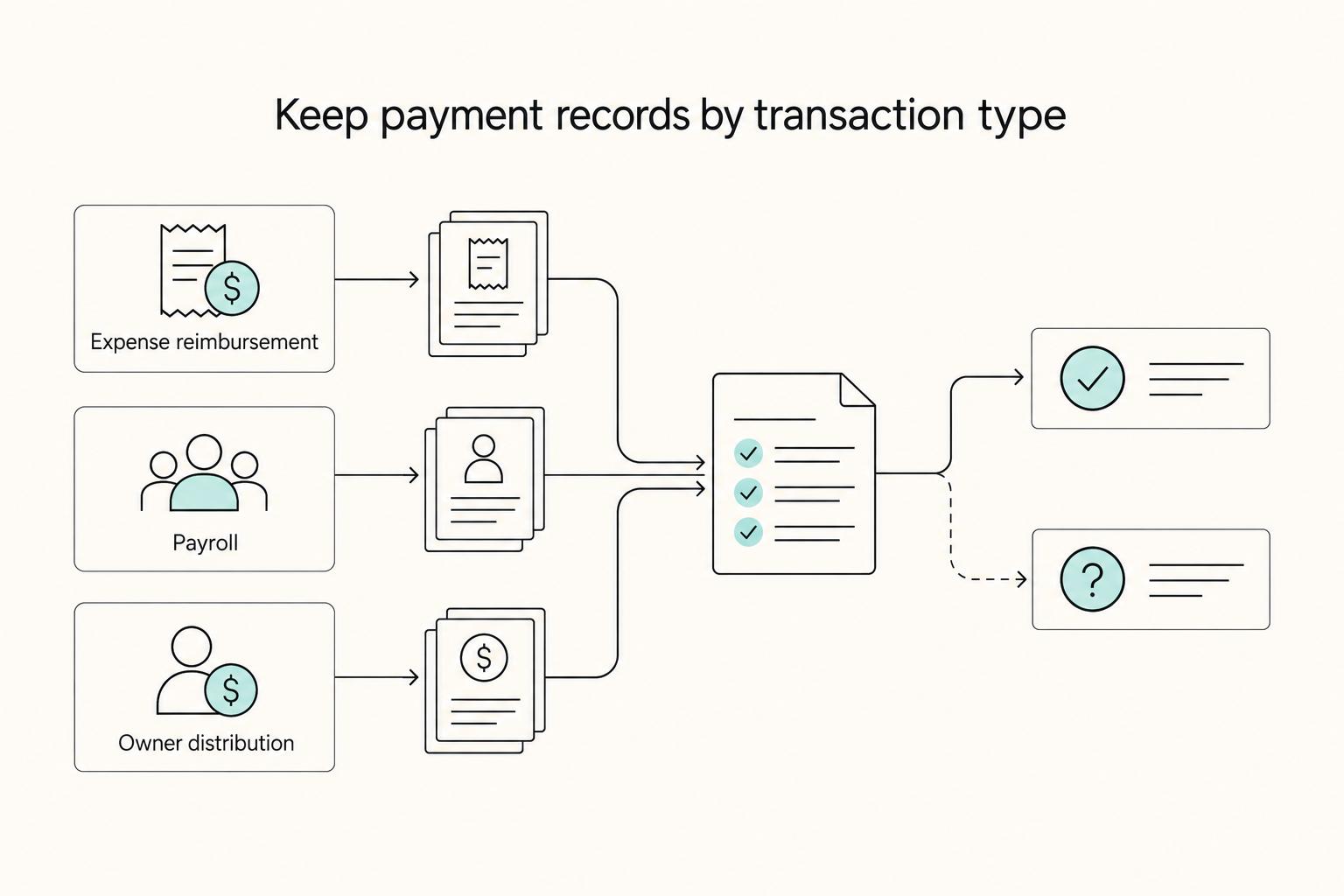
After approval, keep the trail simple: what you approved, what you paid, and where the support lives. A practical control is to classify reimbursements clearly and document them separately from payroll and owner draws in your records so review and bookkeeping stay clean.
This is more than neatness. It supports compliance and risk management. Weak records can lead to audits, disputes, and operational disruption.
1. Record and pay the approved amount as a clearly identified reimbursement#
Pay the exact approved amount from the business account and label it clearly as reimbursement. When your system allows, keep the reimbursement visible as its own transaction in your bank feed, ledger, and records folder.
Do
- Pay the exact amount on the approved report.
- Use one memo format every time, for example
EXP REIMB | 2026-03 | RPT-2026-03. - Keep naming consistent across bank memo, accounting entry, and file name.
- Release payment only after approval evidence is saved.
Do not
- Combine reimbursement with payroll, contractor pay, or owner draw without clear, separate documentation.
- Use vague labels like
transfer,owner payment, ormisc. - Change memo conventions month to month.
- Pay first and reconstruct support later.
Quick check: the approved report total, payment amount, and accounting entry should match.
2. Keep reimbursement, payroll, and draws distinct in bookkeeping#
Your bookkeeping should make the purpose of each payment obvious without guesswork. Use clear transaction labeling and attach support so anyone reviewing the file can tell what happened.
| Payment type | What it represents | Example account mapping | Payment label convention | Supporting document link |
|---|---|---|---|---|
| Expense reimbursement | Repayment of approved business expense paid personally | Reimbursement clearing or underlying expense account, based on your setup | `EXP REIMB \ | YYYY-MM \ |
| Payroll | Compensation processed through payroll | Wages or payroll expense | Payroll batch or provider reference | Payroll register or provider report |
| Owner distribution or draw | Owner funds transfer that is not reimbursement | Owner equity, distribution, or draw account | `OWNER DRAW \ | YYYY-MM-DD` |
These labels are examples. What matters is using one convention consistently.
3. Store one monthly records package#
Keep one folder per month so the full trail sits in one place. Example path: /Corporate Records/Accountable Plan/2026/2026-03/
Include:
- Approved expense report
- Supporting receipts and logs
- Payment proof, such as a bank confirmation, cleared check image, or transfer record
- Approval record
This monthly package gives you a verifiable history and makes regular internal record audits faster. Also keep a written retention policy that matches the rules applicable to your entity, industry, and location.
4. Fix gaps immediately with a standard workflow#
Most breakdowns are routine. The mistake is letting them sit until close or tax time.
| Gap | Correction |
|---|---|
| Commingled payment | Document the issue, reclassify entries as needed, and store the correction note in that month's folder. |
| Missing memo detail | Update the accounting description, add report ID in notes, and save payment proof. |
| Incomplete backup | Mark pending, collect missing support, then close only after the package is complete. |
| Unmatched report-to-payment trail | Trace and document the variance, then correct through adjustment or re-payment. |
Use the same sequence every time: pause closeout, document the gap, repair the records, attach the correction note, and re-check the match.
For related governance context, see How to Structure an LLC Operating Agreement for a Multi-Member Partnership.
What Can You Reimburse? A Modern Expense List#
The right question is not whether an item feels business-related. The question is whether it has a business connection, a clear business purpose, and support that shows amount, time, place, and purpose. If you cannot show the business use and your calculation, do not submit it yet.
Classify each expense first#
Before an item hits the report, sort it as either fully business-use or mixed-use.
| Expense category | Full vs partial reimbursement | How to calculate | Records to keep | Common error to avoid |
|---|---|---|---|---|
| Home office | Partial for shared home costs, full for direct office-only costs | Use the regular actual-expense method: calculate business-use percentage for indirect home costs, and reimburse direct office expenses in full | Office-area calculation, allocation worksheet, rent or mortgage-interest and tax records, utilities, insurance, maintenance and repair bills | Mixing simplified and actual home-office treatment in the same tax year, or reimbursing full shared home costs |
| Personal vehicle used for business | Partial | Use your chosen documented method: standard mileage or actual vehicle costs | Mileage log, date, destination, business purpose, miles, calculation worksheet, related receipts if using actual-cost method | Reconstructing mileage later from memory or including non-business miles |
| Personal phone and home internet | Partial | Apply a reasonable business-use allocation and document how you determined it | Monthly bills plus allocation note and usage basis | Claiming full reimbursement without support for business-use allocation |
| Software, cloud tools, and hardware used only for business | Usually full | Reimburse full cost when the item is ordinary, necessary, and used only for business | Receipts or invoices, license details, short business-purpose note | Treating mixed personal and business use as fully reimbursable |
| Coworking, professional dues, and education that maintains current skills | Usually full when tied to current work | Reimburse invoiced amount tied to your present business activity | Receipts or invoices, course or program details, business-purpose note | Reimbursing education that qualifies you for a new trade or business |
Home office, vehicle, and mixed-use tech: method matters#
For home office, this section uses the regular actual-expense method. Direct office expenses can be reimbursed in full, while indirect home costs are allocated by business-use percentage. Deductible home-cost types can include rent, mortgage interest, real estate taxes, utilities, insurance, depreciation, maintenance, and repairs. Do not combine simplified home-office treatment, $5 per square foot, up to 300 square feet, with actual-expense treatment in the same tax year.
For vehicle reimbursement, keep a detailed mileage log and calculate using your documented method. If you use the standard mileage method, the 2026 business rate is 72.5 cents per mile, effective January 1, 2026. If you are reimbursing another year, confirm that year's rate before you calculate.
For phone and internet, reimbursement is usually an allocation exercise. Keep the source bill and a short note showing why your business-use percentage is reasonable.
Keep an evidence pack for each claim#
Before reimbursement, keep enough support so someone else can reproduce the amount. Lodging requires documentary evidence, and documentary evidence is generally required for other expenditures of $75 or more. For allocated items, keep both the original bill and the allocation worksheet. For fully business-use items, keep the receipt and a short business-purpose note.
| Claim type | Support to keep |
|---|---|
| Lodging | Keep documentary evidence. |
| Other expenditures of $75 or more | Documentary evidence is generally required. |
| Allocated items | Keep both the original bill and the allocation worksheet. |
| Fully business-use items | Keep the receipt and a short business-purpose note. |
This pairs well with our guide on How to Contribute a Personal Asset Like a Car to an LLC.
Beyond Compliance: Your Accountable Plan as a Strategic Asset#
Handled well, this is more than a tax formality. The same operating discipline that protects reimbursement treatment also gives you cleaner books and better visibility into what the business is actually spending.
| Area | Reactive bookkeeping | Accountable-plan workflow |
|---|---|---|
| Visibility | Owner-paid costs surface late, often during cleanup | You capture reimbursable costs through expense reports and receipts |
| Risk control | Mixed payments and missing support are harder to fix | You verify substantiation before payment and keep reimbursements separately identifiable |
| Decision quality | Financial reporting is harder until costs are rebuilt | Reporting reflects approved business expenses sooner |
Submit. Submit reimbursement reports with receipts, logs, and any allocation support. Outcome: your records can clearly show income and expenses, with support retained for inspection.
Review. Check business purpose, amount, and that mixed-use items include only the business portion. If you use accountable-plan safe-harbor timing, substantiate within 60 days after the expense is paid or incurred. Outcome: fewer estimate-based approvals to repair later.
Reimburse. Pay only the approved amount and identify it clearly, ideally as a separate payment tied to the approved report. Outcome: cleaner separation between reimbursements and other payments, with a clear approval trail.
Reconcile. Confirm no excess is kept. If an advance or overpayment exists, return and document the excess. If you use safe-harbor timing, return excess within 120 days after the expense is paid or incurred. Outcome: records stay aligned with substantiated amounts.
That loop is the real payoff. It keeps the reimbursement treatment defensible now, and it leaves you with a repeatable process for collecting support, approving against a standard, issuing traceable payments, and keeping records ready for review later.
You might also find this useful: A Guide to Accountable Plans for S-Corp Expense Reimbursements.
If you want to pair this accountable-plan process with compliant money movement as you grow, review Merchant of Record for freelancers.
Frequently Asked Questions
Do you need a written accountable plan document?
A dated written policy is a practical way to show that reimbursements follow business-connection and substantiation rules. This article does not pin that rule to a specific IRS form or say a written document is always mandatory. If you are not using the S corp structure discussed earlier, verify current treatment for your entity before you apply this process.
How do you actually reimburse yourself each month?
Run one consistent monthly cycle. Submit an expense report with receipts, logs, and allocation worksheets, then issue a reimbursement payment for the approved total. Keep the report total, approval amount, and bank payment aligned, and do not pay first and document later.
What records do you need to keep for each reimbursement?
Keep one packet per reimbursement period: expense report, receipts or invoices, any mileage or allocation support, and proof of the payment. Each item should show amount and business purpose, and travel items should also show time and place. If someone else cannot reproduce the number from your file, pause and fix the support before reimbursement.
What is the difference between a reimbursement and an owner distribution?
An accountable-plan reimbursement is a documented repayment of a business expense, and it can be tax-free and deductible if the plan conditions are met. If those conditions are not met, reimbursements can be treated as taxable wages. Confirm owner distribution treatment with a qualified adviser.
Can you reimburse home office, phone, internet, and other mixed-use costs?
Reimburse only the documented business-use portion. Submit the original bill plus the worksheet that shows your allocation method, then reimburse that calculated amount through your normal monthly process. If the percentage is a guess or reconstructed later, stop and document it before payment.
Can you use per diem instead of collecting every meal and lodging receipt?
Yes, in some cases, per diem can replace receipts for meals and lodging. Amounts above federal rates are treated as wages. Before paying, verify the current rate and keep records of business purpose, travel time, and travel place.
If this goes wrong, what usually happens?
The main failure mode is reclassification. Reimbursements can be treated as taxable wages, and that can also create employer payroll-tax exposure. Before filing, review months with missing support, mixed payments, or per diem issues, then confirm current treatment for your year and entity.
Try a related tool
Researched and edited by the Gruv editorial team. Gruv builds cross-border billing, payouts, and finance-operations software for global businesses.
Sources
Educational content only. Not legal, tax, or financial advice.
Related Posts

Sole Proprietorship vs LLC for Global Freelancers in 2026
For most freelancers in 2026, the practical default is still simple: use the simplest structure you can run cleanly, then formalize when risk actually rises. If your work is still in validation mode and the downside is contained, a sole proprietorship is often the practical starting point. When contract exposure, delivery stakes, or dispute risk starts climbing, forming an LLC deserves earlier attention.

Hiring a Subcontractor for the First Time Without Costly Surprises
**Start with a risk-control sequence, not an ad hoc handoff.** As the Contractor, your goal is simple: deliver cleanly, control scope, and release payment only when the work and file are complete.
How to Run an S-Corp Accountable Plan With Defensible Records
Start here: treat reimbursements as a formal employer process, not informal owner spending. That matters most when you are a solo owner-employee, because you are both the spender and the approver. When the business purpose and support are unclear, you are not running a reimbursement process you can defend. You are moving money and creating cleanup risk later.