
Quick Answer
Start with a decision-first page, not a gallery: define your target work, feature only proof that matches it, and explain each clip with role and deliverable context. A strong freelance writer portfolio should show what you write, who you write for, and why a buyer should trust you quickly. Use one clear structure across platforms like Contently, Clippings.me, or Journo Portfolio, then add intake guardrails so qualified prospects move to the right next step.
Build a decision-first portfolio page#
Step 1. Treat your freelance writer portfolio like sales collateral, not a scrapbook. Many guides offer examples, templates, and beginner encouragement. That can help you get a page live, but it does not always help you decide what belongs there once your services, niche, and client mix start shifting. Your portfolio is not just a summary of past work. It functions like your resume, business card, and shop front. If you build it with that job in mind, every sample has to earn its place.
Step 2. Judge the page by how much client risk it removes. Editors and buyers use samples to decide whether to commission you at all. That is the practical standard. A strong pitch may get attention, but the samples are what make someone believe you can deliver. So do not ask only, "does this look impressive?" Ask three simpler questions. Can a busy person tell what you write, who you write for, and why you are a credible fit without digging? If someone lands on your page and still has to guess your niche or typical deliverable, it is not clear enough.
This is where many decent portfolios break down: they collect links, screenshots, or clippings, then leave the buyer to connect the dots. That adds friction at the exact moment you want a faster decision. A page can go live quickly; one example was assembled in 30 minutes. Speed is useful for getting something live, but a fast setup is not the same as a useful business asset. If the page does not reduce uncertainty, the time you save up front can come back later as extra clarifying emails and shakier discovery calls.
Step 3. Build for the decisions you will face six months from now, not just launch day. As your business grows, you need rules for what to include and what to hide. You also need a way to show range without looking generic and a way to talk about sensitive work like ghostwriting without creating confusion. Keep the page current so it reflects the projects you want next, not just the ones you happened to finish last year. That matters because positioning comes before presentation.
Keep that lens in mind as you read on. You are not building a gallery for compliments. You are building a decision tool that helps the right client decide faster, ask better questions, and start delivery conversations with fewer false assumptions. Before you choose a platform or rewrite samples, gather the raw material you need to make those calls well. For a step-by-step walkthrough, see Best Freelance Portfolio Tools for a Website You Can Keep Updating.
What to prepare before you build#
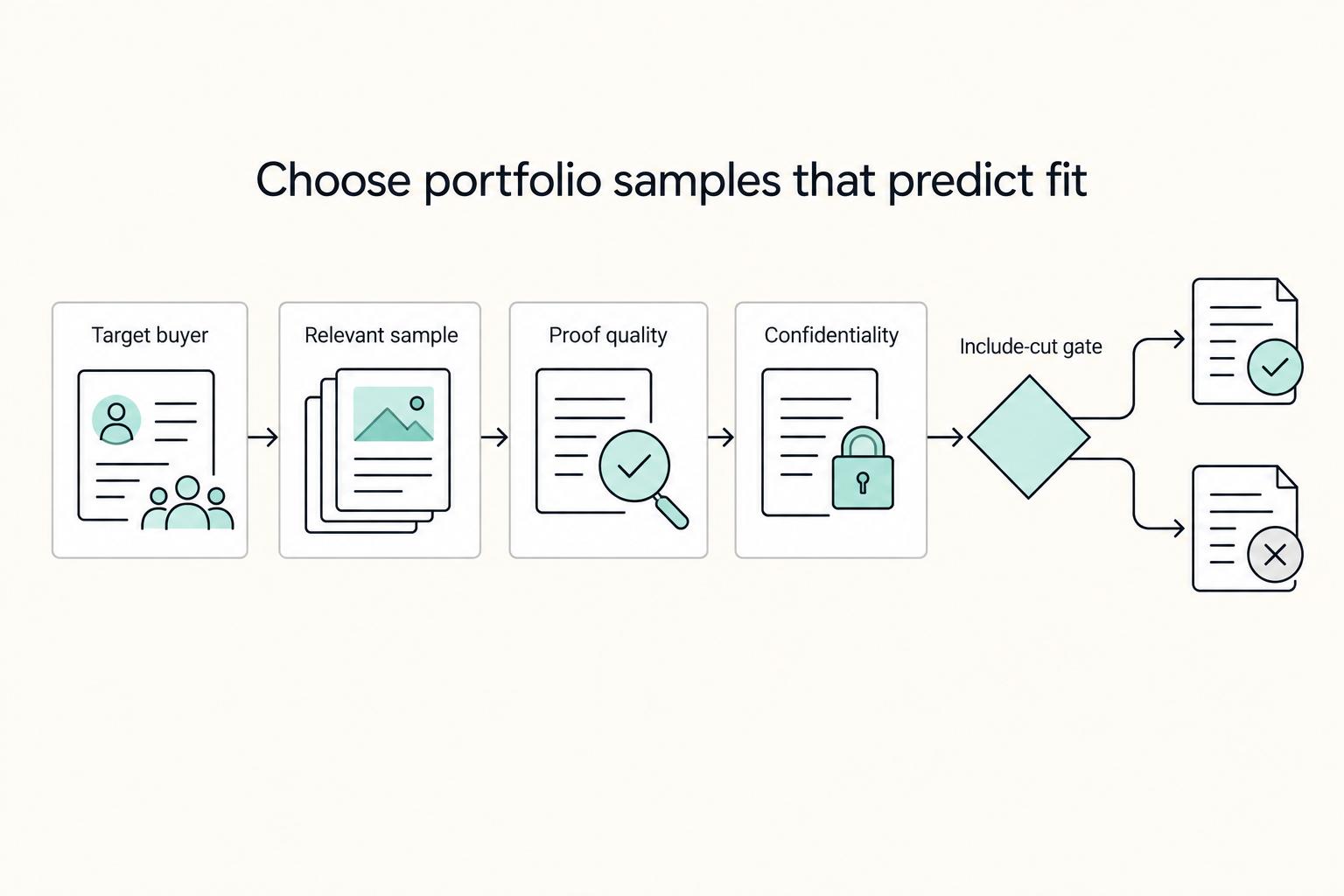
Before you choose a platform, set one inclusion rule: if a sample does not help an editor or buyer predict your fit, cut it. That keeps the page focused on decision-making, not collection.
Step 1. Define your six inputs on one page. List your target client types, preferred work types, proof assets, a short bio draft, your contact CTA, and your update cadence. Keep the work types specific so your samples match what ideal clients would hire you to write.
Step 2. Gather every possible clip in one review folder. Pull candidates from past platforms, client files, and drafts so you can decide in one pass. If you do not have published credits yet, include self-published pieces so you still have usable proof.
Step 3. Add a small evidence pack to each clip. For every sample, note role, objective, scope, constraints, and result signal. If that evidence is thin or unclear, mark the clip as backup instead of featured.
Step 4. Run a fit check before publishing. Ask: would a busy client understand what this proves without extra explanation? If the answer is no, revise the context or remove the sample.
Decide your positioning and sample mix#
Make it easy to hire you: lead with one clear promise, then use a smaller secondary lane to show range without looking generic.
Step 1. Choose one primary promise and one secondary lane. Start with the work you most want to get hired for. A clear niche helps editors and clients quickly understand who you are as a writer, while a secondary lane adds range without diluting your positioning. If you are early stage, keep the primary promise focused enough to feel credible.
Step 2. Apply a byline decision rule before you feature samples. If you have strong bylined work in your target lane, put it first. Editors may still pass on strong pitches when samples are missing, so lead with your clearest proof. If you do not have strong bylines yet, use self-published samples and label them clearly with role context and objective so they read as intentional proof, not filler.
Step 3. Balance breadth and depth on purpose. Use your mix to match how buyers actually evaluate writers. Keep one lane for recurring-demand work, like SEO pages or lifecycle copywriting, and one lane for authority pieces, like white papers or long-form work. Weight the page toward your main lane so your first-fit service is obvious.
Step 4. Add one adjacent credibility item only when it supports trust. Include a single relevant credential only if it directly supports the work shown in your samples. Place it in your bio or credentials area so the samples stay central. If it does not make your fit clearer, leave it out.
Need the full breakdown? Read Create a Freelance Lead Magnet That Filters for Ideal Clients.
Choose your platform and page structure#
Platform choice should reduce friction, not add complexity. Pick the tool that lets you present clear fit fast, keep clips easy to scan, and move a client to the next step.
Compare Contently, Clippings.me, and Journo Portfolio with one short test#
Use one framework across all three: features, ease of use, presentation style, and SEO visibility. In practice, check whether you can set a custom URL, whether the page is Google-indexable, and how easily you can add and reorder clips.
| Platform | What to test first | What would rule it out |
|---|---|---|
| Contently | Add your headline, three clips, and one contact path. Check whether your offer is clear before someone starts clicking. | If your service lanes and proof notes are hard to surface, readers may see history but miss fit. |
| Clippings.me | Build a lean page with your core samples and short role notes. Check whether setup stays simple and readable. | If clip context is hard to add or labels are unclear, the page can feel like a list instead of a decision tool. |
| Journo Portfolio | Test layout control and publishing flow early. Check import, embed, backup, and direct blog-posting options before you commit. | If design tuning delays publishing, extra control is working against clarity. |
Choose the platform that gives you a clear, publishable page in one sitting. That usually matters more than feature depth you never use.
Keep one fixed architecture no matter where you host it#
Keep the same structure even if you switch tools:
- Headline promise
- Service lanes
- Selected clips
- Proof notes
- Process
- Contact path
This order matches buyer behavior: first what you do, then whether it matches their need, then proof. If samples come before context, readers have to infer your niche from titles and outlets, which slows decisions.
Proof notes keep a polished grid from reading as generic. Under each sample, add brief role clarity: audience, deliverable type, and whether it was bylined, ghostwritten, or self-initiated.
Verify clarity with one peer before you call it done#
Run one cold-read check before you polish design. Ask a peer what you want to be hired for and which sample proves it best; if either answer is unclear, fix order and labels first.
Most portfolio misses come from structure, not effort: too many clips up top, vague sample labels, or contact shown before proof. Prioritize clarity, then polish.
Build each sample entry so editors can say yes fast#
Editors and clients usually need to judge fit quickly, so each sample should explain the assignment before they open the clip. Make every entry clear on what was needed, who it served, what you owned, and why it matters for similar work.
Use one fixed card format for every sample#
Use the same compact structure for every sample so your portfolio is easy to scan and compare.
| Field | What it covers |
|---|---|
| Problem | what the piece needed to do |
| Audience | who it was for |
| Your role | what you were responsible for |
| Deliverable type | what you produced |
| Hiring match | what this sample proves for a similar project |
Keep each field to one or two lines. If a reader cannot identify your role or the assignment goal quickly, rewrite the note.
Label the deliverable, not just the topic#
Topic alone is not enough. A subject label tells readers what the piece is about, but not what kind of writing service you can deliver. Name the deliverable type clearly near the top of the card, and state your role separately if the work was collaborative or ghostwritten.
Avoid vague labels that hide the actual work. Clear labels make faster yes-or-no decisions possible.
Add constraint context and one transferability line#
Strong sample entries show judgment, not just output. If a real constraint shaped the work, add it briefly, for example: tight timeline, limited source material, or multiple reviewers.
Then end with one transferability line: what this sample proves you can do again in a new assignment, even with a different topic.
Use a quick check before publishing: skim three cards without opening any clips. If you can see the problem, audience, role, deliverable, and transferability signal in under a minute, the entries are doing their job. Related reading: Freelance Prompt Engineering Without Scope Creep.
Handle ghostwriting and no-bylines without ethical risk#
For ghostwritten or no-byline work, make credit, ownership, and sharing permission explicit before you publish any sample note.
| Scenario | Portfolio handling |
|---|---|
| Ghostwritten work | Describe your contribution instead of implying authorship; name your scope directly: research, structure, drafting, and revisions |
| No public byline | Use a short de-identified excerpt plus role-and-scope notes: deliverable, audience, what you owned, and key constraints |
| Permission is unclear | Treat the work as confidential |
| Contract or NDA blocks disclosure | Do not share the finished client work publicly; share process artifacts instead, such as a de-identified outline, research notes, headline options, or a brief case summary without client identifiers |
| Disclosure is allowed | Add contextual proof carefully and state where your work started and ended |
| Sensitive clips | Keep a permissions log with client, project, ghostwriting status, byline status, NDA/contract status, what can be shown, approval record, and allowed portfolio wording |
- State credit and ownership plainly.
Ghostwriting means the client publishes under their own name and receives public credit, not you. In many arrangements, the client also owns the completed work, so describe your contribution instead of implying authorship. Name your scope directly: research, structure, drafting, and revisions. Checkpoint: if a reader could confuse your role with the bylined person's role, rewrite the entry.
- Use anonymized excerpts when there is no byline.
If there is no public byline, use a short de-identified excerpt plus role-and-scope notes: deliverable, audience, what you owned, and key constraints. Pair it with one or two self-published samples so clients can still evaluate your voice and craft. If permission is unclear, treat the work as confidential.
- Apply a simple if/then contract rule.
If the contract or NDA blocks disclosure, do not share the finished client work publicly. Share process artifacts instead, such as a de-identified outline, research notes, headline options, or a brief case summary without client identifiers. If disclosure is allowed, add contextual proof carefully and state where your work started and ended.
- Keep a permissions log for sensitive clips.
Use a simple spreadsheet and keep it current: client, project, ghostwriting status, byline status, NDA/contract status, what can be shown, approval record, and allowed portfolio wording. This lets you answer diligence questions quickly and consistently.
We covered this in detail in Building a Portfolio Career With Multiple Freelance Income Streams.
Add conversion mechanics and client intake guardrails#
Your portfolio should route people into the right conversation quickly, with enough guardrails that you are not renegotiating basics on every inquiry.
| Element | What to include |
|---|---|
| CTA paths | start a project; request availability; ask about fit |
| Intake mini-form | Qualify scope, timeline, and deliverable type |
| Clarification rule | Send a clarification script before pricing if request quality is low or boundaries are unclear |
| How I work block | State revision limits, communication rhythm, and handoff expectations |
- Split calls to action by intent.
Use separate CTA paths for start a project, request availability, and ask about fit. Each path should trigger a different response template, so visitors move into a specific next step instead of one generic inbox.
- Add a short intake mini-form before discovery calls.
Qualify three things up front: scope, timeline, and deliverable type. For deliverable type, list your actual lanes, for example: SEO pages, copywriting, white papers, so people self-sort before a call.
- Apply a clarification rule before quoting.
If request quality is low or boundaries are unclear, send a clarification script before pricing. This keeps routine decisions consistent and makes real exceptions easier to handle without rushed quotes.
- Publish one "how I work" block near your contact path.
State your revision limits, communication rhythm, and handoff expectations in plain language. That pre-qualification step reduces avoidable mismatch later in the project.
Common portfolio mistakes and how to recover#
Portfolio pages usually underperform for one reason: they make the client work too hard in a first impression that lasts only a few seconds.
Step 1. Fix gallery-only samples before adding new clips. If a sample is only a thumbnail or link, add role, scope, and a result signal. A client should be able to see whether you wrote, edited, researched, or polished the piece without opening it.
Step 2. Narrow positioning to one primary lane plus one adjacent lane. "I write everything" weakens audience fit. Lead with one core offer, keep one adjacent offer for the same buyer, and remove samples that do not serve that audience.
Step 3. Run a quarterly relevance and quality pass. Each quarter, compare every featured sample to your current target client and archive work that no longer fits. Proofread titles and captions in the same pass, because visible grammar errors can cost trust quickly.
Step 4. Prioritize proof over decoration. Design helps only when the page stays easy to scan and navigate. Keep useful ideas, but cut flourishes that hide the basics: deliverable type, audience, role, and relevance. Plain language and clear proof beat style alone.
You might also find this useful: How to Build a Freelance Portfolio Clients Trust.
Final checklist you can copy this week#
Use this to make your portfolio easier to trust and easier to act on. The goal is simple: show what you can do and make the next step obvious.
- Finalize your core services before writing page copy, so your offer is clear from the start.
- Choose one place to publish your samples and keep the structure consistent.
- Keep only samples that support the work you want next, and add brief context so buyers can judge fit quickly.
- If you do not have public bylines yet, self-publish early pieces and collate them online.
- Add a clear CTA so interested clients know exactly how to contact you.
- If it fits your business, include a ballpark or starting price to filter out out-of-budget inquiries.
- Recheck the page and remove stale or off-target samples.
If you are building a fuller site, common pages include Home, About, Services, Portfolio, Blog, and Contact. If you are earlier stage, a standalone services page with brief service descriptions and a CTA can be enough. This pairs well with our guide on Create a Freelance Hire Me Page That Qualifies Better Clients.
Frequently Asked Questions
What should a freelance writer portfolio include to look credible fast?
Lead with the samples that best show capability in the type of work you want. A small, focused set of writing samples is easier for a busy client to review than a long mixed list. Add brief notes on your role and deliverable type so fit is clear quickly.
Can I win clients without public bylines?
Potentially, but you still need writing samples that show capability. If you do not have public clips, create pieces in your desired niche and self-publish your first pieces instead of waiting for permission to start. Editors may hesitate when there are no samples at all, so publish something real, then stick with one outreach strategy for a month before changing course.
How many samples should I publish when I am starting out?
Do not assume there is an exact required number. Publish enough samples to show clear capability in your desired niche, then improve relevance and quality over time.
Which platform should I choose first: Contently, Clippings.me, or Journo Portfolio?
Do not assume one platform is a universal winner, so choose the one you can set up and keep current this week. The right first choice is the one that makes it easy to compile samples and update entries without friction.
What makes a portfolio convert better instead of just looking polished?
Based on this material, credibility improves when your samples make capability easy to evaluate. For each sample, include enough context on what you produced and for whom so a client can judge fit quickly. A polished layout helps less if your actual contribution is unclear.
How should I present ghostwriting work ethically and clearly?
Keep claims conservative: describe your contribution truthfully, avoid implying authorship you do not own, and follow each client agreement on what can be shared.
Try a related tool
Researched and edited by the Gruv editorial team. Gruv builds cross-border billing, payouts, and finance-operations software for global businesses.
Sources
Includes 2 external sources outside the trusted-domain allowlist.
- adrian.edu/files/assets/24-25adriancollegeundergraduate...trusted
- checkout.columbiacollege.edu/uploaded-files/E703Gf/1FE031/HowToGetWriting...trusted
- ecfr.gov/current/title-19/chapter-I/part-10trusted
- egrove.olemiss.edu/cgi/viewcontent.cgitrusted
- sec.gov/Archives/edgar/data/1811935/0001811935250000...trusted
- waketech.edu/programs-courses/non-credit/personal-enrichmenttrusted
- amysuto.com/desk-of-amy-suto/how-to-build-a-freelance-wr...external
- askamanager.org/2024/11/boss-wants-to-dumb-down-my-writing-t...external
Educational content only. Not legal, tax, or financial advice.
Related Posts

Georgia 1% Tax for Entrepreneurs Without Filing Surprises
Treat Georgia's 1% tax path as a compliance question first and a rate discussion second. The goal is a setup you can defend under review, not a shortcut that fails at filing time.
The Best Digital Nomad Cities for Winter Sun in 2026
Treat your 2026 winter base as a risk decision first and a lifestyle decision second. That framing is what saves you from expensive rework. Start with legal stay, work continuity, cost realism, and evidence quality before you pay anything non-refundable.

The Freelance Payment Penalty: A Modeled Audit of Platform Fees, FX Spreads, and Payout Delays
The money rarely disappears through a single, easy-to-spot fee. The real loss is stacked. A marketplace takes its commission, a processor adds a charge for international cards, a bank or payment company converts the currency at a spread, a platform holds the funds before release, and a wire sheds a little to intermediaries on the way in. Each layer looks defensible on its own, but the worker feels the combined result as a smaller deposit and a later payday.