
Quick Answer
Start by building one enforceable travel policy for remote team decisions that requires three gates: compliance checks before booking, a business-case screen before approval, and complete records before reimbursement. Use a live day-count log by jurisdiction, define contractor conduct limits to reduce Permanent Establishment risk, and require pre-trip readiness items like verified entry rules and insurance terms. Then separate business and personal costs upfront, especially when travel becomes mixed-use.
The Compliance Shield: Mitigating the Risks You Can't See#
A travel policy for a remote team works only if it tells you what to verify, what to log, and when to stop and ask for advice. The job is simple: do not rely on generic travel lore when tax, immigration, or contractor-status rules may change from one country to the next.
Before you do anything else, choose one place where your evidence lives. That can be a shared spreadsheet, a travel admin tool, or a secure folder for trip dates, country notes, screenshots, contract copies, and insurance documents. If a rule is important enough to shape your travel, save the official page or PDF you relied on and note the date you checked it.
Step 1 Track residency exposure in one live log#
Start with a country-by-country presence log, not a rough memory of where you were. For each trip, record arrival date, departure date, city and country, purpose of trip, client tied to the trip, where work was performed, and whether the stay changed after booking. Add a field for the current tax residency or stay threshold, and mark it as pending until it has been verified against an official source.
| Log field | What to record |
|---|---|
| Arrival date | Record for each trip |
| Departure date | Record for each trip |
| City and country | Record for each trip |
| Purpose of trip | Record for each trip |
| Client tied to the trip | Record for each trip |
| Where work was performed | Record for each trip |
| Stay changed after booking | Record whether the stay changed after booking |
| Current tax residency or stay threshold | Confirm the current threshold with the relevant tax authority |
Review that log weekly while you travel and monthly across the full year. This is not just day counting. You are looking for clustering in one jurisdiction, repeated returns to the same place, or a trip extension that may require a legal check.
Use official sources first. For U.S. government checks, a .gov domain is a clear signal that you are on an official government website, and the HTTPS lock confirms a secure connection. If you use a database record, article summary, or third-party guide, verify the underlying source before you turn it into policy language.
A research record with a publisher link, downloadable PDF, and DOI 10.1016/j.tourman.2022.104688 is still only a starting point. Indexing access does not equal endorsement, so direct verification still matters. If you cannot reach the underlying source, do not build a rule from it.
Verification point: your log should let you answer, in under two minutes, how many days you have spent in each jurisdiction this year and which official source supports each rule entered. Escalate for tax or legal advice when: you extend a stay unexpectedly, your travel pattern changes materially, or you are unsure whether an existing rule still applies.
Step 2 Set PE red lines for contractor work#
For contractor travel, treat permanent establishment analysis as a fact pattern, not a box you check once and forget. Your policy should reduce obvious risk patterns and force review before conduct may be interpreted as carrying on a client's business locally.
| Pattern to review with counsel | Lower-risk internal guardrail | Contract or process control |
|---|---|---|
| Negotiating final commercial terms in person and presenting yourself as able to close the deal | Keep final approval and signature with the client's own staff | Contract says you cannot bind the client; approval authority stays with named client contacts |
| Working regularly from the client's office or using their address on materials | Use your own address, coworking space, or short visitor access only when needed for meetings | Policy requires review before repeat onsite work in one country; no client address on invoices, site, or registrations |
| Acting like a dedicated local representative for one client for long stretches | Keep multiple clients and document project-based scope | Engagement letter states independent contractor status, defined deliverables, and no authority to represent the client publicly |
Do not assume one contract clause fixes everything on its own. The paper should match the facts on the ground. If your calendar, email signature, meeting patterns, and local presence say one thing while the contract says another, get advice before you continue.
Verification point: before travel, confirm that contract language, planned meeting locations, and approval paths all line up with how you will actually work.
Step 3 Require a pre-trip compliance readiness check#
Make this mandatory in your own policy, even if a law does not require it. Use the first list on every trip. Add the second when the trip is higher risk.
| Priority | Check |
|---|---|
| Mandatory | Confirm passport, visa or entry basis, and any applicable jurisdiction-specific work or stay rule from an official source |
| Mandatory | Verify where your itinerary, location log, contracts, and ID copies will be stored and accessible if your phone or laptop is lost |
| Mandatory | Name an emergency contact and give them passport copy, itinerary, insurer details, and a clear way to reach you |
| Mandatory | Validate the insurer and policy before departure, including medical treatment, emergency assistance, and any exclusions for work travel or destination |
| Optional | Government travel alerts for your destination |
| Optional | Secondary payment method and backup device access |
| Optional | Printed copies of key documents if you expect poor connectivity |
| Optional | A short escalation note covering who to call if you are denied boarding, hospitalized, or stranded |
If you do only one thing, make it this. Do not book first and research later. Your policy should force the check before the trip is approved so schedule changes are caught early.
If you want a deeper dive, read Canada's Digital Nomad Stream: How to Live and Work in Canada.
The Profit Engine: Is This Trip an Expense or an Investment?#
Treat each trip as an investment decision: book only when you can name the business outcome, set a clear go/no-go rule, and document how you will separate business and personal costs.
Step 1. Apply a pre-booking 3R decision filter#
Use Revenue, Relationship, and Retention as a hard filter before booking.
| Filter | What to identify |
|---|---|
| Revenue | A defined commercial result, for example signed scope, paid delivery, or expansion step |
| Relationship | The specific person you need to meet and why in-person contact materially changes the outcome |
| Retention | The account or project risk if you do not travel |
If it helps, write the 3R case in one line each before you book:
- Revenue: tie the trip to a defined commercial result, for example signed scope, paid delivery, or expansion step.
- Relationship: identify the specific person you need to meet and why in-person contact materially changes the outcome.
- Retention: name the account or project risk if you do not travel.
For each trip, write:
- Objective: one sentence on the primary 3R reason.
- Expected outcome: one sentence on what should happen if the trip succeeds.
- Go/no-go rule: one condition that must be met before booking.
If you cannot name the client, opportunity, or risk you are preventing, treat the trip as personal.
Step 2. Lock your tax-home position before deduction planning#
Before you evaluate deductions, document your tax-home analysis. Under IRS Publication 463 (2025), tax-home treatment is tied to your business/work base, uses factor-based analysis where needed, and may differ from your family home.
Keep a short base-of-operations file with evidence such as:
- where you run core business activity,
- where records and invoicing are managed,
- where you return between trips,
- and your ongoing business ties.
Re-check the classification when facts change, especially if you stop returning to your usual base or an engagement may shift from temporary to indefinite. Escalate to a licensed advisor when your facts are mixed or unclear.
Step 3. Separate business and personal components before travel#
Do the split before travel, not after receipts pile up. Publication 463 includes a "Separating costs" step, so your policy should require component-level planning before the trip starts. For non-U.S. treatment, leave the deductibility condition marked as pending until you verify it against current local guidance.
| Trip component | Business portion to track | Personal portion to track | Documentation to keep | Common audit-risk mistake |
|---|---|---|---|---|
| Main transport | Travel tied to the documented business purpose | Leisure routing, side trips, upgrades for personal preference | itinerary, dated business agenda, trip-purpose note | claiming full fare when personal routing changed total cost |
| Lodging | Nights required for business activity or timing | Extra personal nights | hotel invoice, dated schedule, allocation by night | leaving one blended hotel charge with no allocation |
| Local transport | Trips to business meetings, workspace, or required transit points | Sightseeing, errands, social plans | receipt + destination + business purpose note | keeping receipts without purpose notes |
| Companion travel | Any separately supportable business role, if applicable | spouse/partner/friend/guest expenses | role description, business purpose, separate receipts | combining another person's costs into your claim without support |
Step 4. Run a short profitability checklist before approval#
Approve travel only when all four items are clear:
- Planned revenue impact is defined.
- Relationship objective is specific.
- Retention risk is explicit.
- Documentation is ready: tax-home file, trip-purpose note, calendar evidence, and cost-separation plan.
If these are still vague, pause booking. You may still choose to travel, but that is a strategic or personal decision, not a clean expense position. You might also find this useful: A Guide to Deducting Business Travel Expenses.
The Automation Stack: Build a System That Runs Itself#
After a trip is authorized, your goal is to automate admin steps while keeping approval decisions human. Build your policy around one pre-trip authorization, one shared record location, and one post-trip claim packet.
Step 1. Set one source of truth#
Store each trip in one shared folder, not across inboxes and apps. Include itinerary, invoices, receipts, authorization notes, and any policy exceptions. Limit access to the traveler, finance/bookkeeping, and the approving official.
Use a consistent file name format so retrieval is predictable: YYYY-MM_Traveler_Destination_TripPurpose_DocType. If travel combines business and personal time, label the folder mixed-use at the start and keep the cost-split note in that same folder.
| Option type | Integration fit | Receipt capture quality | Policy controls | Reporting output |
|---|---|---|---|---|
| DIY stack | Clean export into accounting | Manual upload or email forwarding | Approval form plus folder rules | Basic monthly spend by trip |
| Expense-first tool | Card/bank sync plus accounting export | OCR or image capture | Category rules, approver field, exception tag | Claim report with linked receipts |
| Booking + expense tool | Booking, calendar, and accounting connections | Booking invoices plus out-of-pocket receipt upload | Pre-trip authorization and mixed-use flag | Trip-level spend and reimbursement file |
Step 2. Automate capture, approval, reconciliation, and exceptions#
Automate what is repeatable: capture spend at purchase, auto-categorize transactions, and route claims to the approving official. Do not close reimbursement until a person has approved it.
Treat the final claim packet like a travel voucher: trip purpose, dated authorization, receipts, and notes for disputed or mixed-use lines. Then run reconciliation so each reimbursable line ties back to receipts and trip records.
Set clear controls for claim timeline checkpoints and required receipts. If documentation is missing or a line cannot be supported, hold the claim for correction or disallow that line.
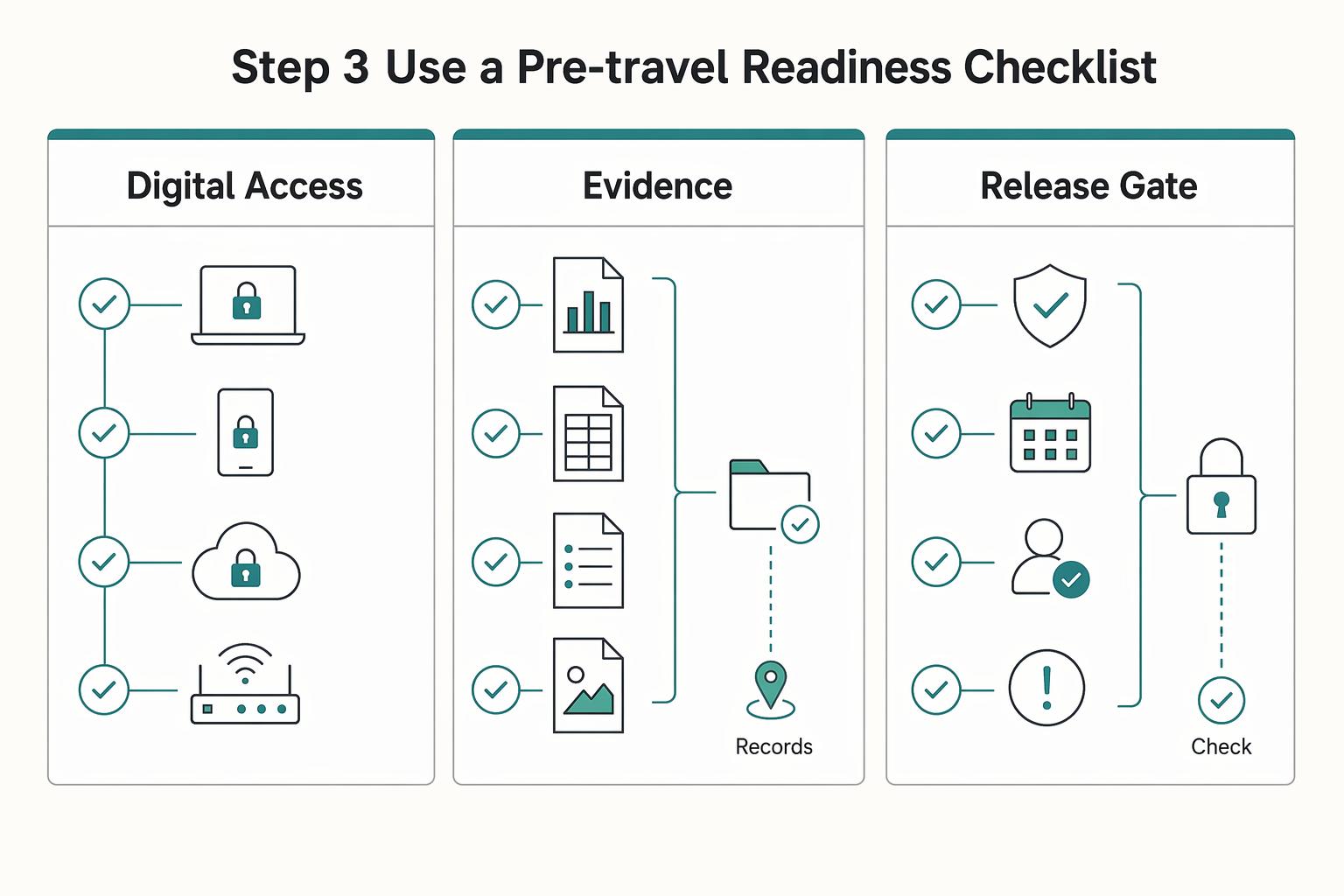
Step 3. Use a pre-travel readiness checklist#
Before departure, confirm the basics in three groups so execution does not fail mid-trip:
- Digital access: offline itinerary, insurer details, passport scan, payment backup, 2FA backup method, key contacts.
- Compliance documents: approval note, purpose summary, meeting calendar, entry documents if needed, mixed-use allocation note.
- Continuity safeguards: charger, hotspot option, alternate card, delegate contact, current client deadlines.
If you rely on a federal rule note, verify it against an official legal edition before treating it as final. FederalRegister.gov is useful for context, but not your sole legal basis.
For a step-by-step walkthrough, see How to Create a Communication Policy for a Remote Team.
Conclusion: Write the rules and run them on every trip#
Keep this practical: if a trip cannot clear your compliance shield, your 3R framework, and your operations stack, do not book it yet. The point is not to create more admin. It is to make the next decision cleaner, faster, and easier to defend.
-
Document your rules. Write the minimum viable policy now: what counts as business travel, who approves it, how mixed-use trips are handled, what receipts are required, and your timezone stance while traveling. Ask one question before approval: What must be true before I go? Verification point: you should be able to show one page of rules and one evidence-pack template, not scattered notes or a "don't ask, don't tell" arrangement.
-
Screen the next trip before booking. Run the 3R framework and ask: Does this trip drive Revenue, strengthen a Relationship, or support Retention? Then test the compliance shield. Check the dates, location, and any role or entity constraints that apply, and verify any threshold you plan to rely on before treating it as relevant to your case.
-
Track the trip while it is happening. Ask yourself: Can I prove what happened without rebuilding it later? Use your operations stack with standardized checkpoints, for example a shared script, dashboard tracking, and QA checklist, to capture approvals, itinerary changes, receipts, calendar evidence, and purpose notes as you go. If you wait until you get home, mixed-use details can blur and become harder to support.
-
Review the trip after travel. Close the file, reconcile costs, and note what broke. If the same confusion shows up twice, update the policy. That is how your policy stays active. Before travel you screen, during travel you capture, and after travel you refine.
Related: How to Create a Disaster Recovery Plan for Your Freelance Business.
Frequently Asked Questions
How do I create a travel policy for myself or a small remote team?
Start with three written rules: your compliance shield, your 3R framework for trip approval, and your operations stack for records. Then add one reimbursement rule that separates true business travel from routine remote work. If the policy touches cross-border tax, payroll, or employment issues, mark jurisdiction-specific thresholds as pending and require review before final approval.
How do I tell business travel from routine remote work?
Do not assume every trip from home is reimbursable. In one published remote work policy, UC Davis says work at an alternate work location is "not considered to be on travel status." It also says commute-like trips between a traditional and alternate work location are treated as normal commute, including mileage, parking, and tolls. For approved trips, calculate distance and cost from the "currently scheduled work location." If your facts are unclear, escalate to your finance contact or travel help desk before booking.
How does travel affect tax residency or state tax exposure?
Treat this as a verification job, not a shortcut rule. The cited legal analysis says there is no uniform state or federal guideline for teleworker taxation, so rules vary by jurisdiction. Overlapping residence and source claims can create double-taxation risk. Track where work was performed, the dates, the client entity, and the reason you were there. If the log suggests you may cross an unverified jurisdictional threshold, send the file to a qualified tax advisor.
Are travel expenses deductible or reimbursable if I work remotely?
It depends on your policy and jurisdiction. In the UC Davis example, routine commute-like costs tied to an alternate work location are not reimbursable, while approved business travel is handled from the currently scheduled work location. Your evidence pack should include the approval note, itinerary, invoices, receipts, and a short purpose memo explaining the business reason for the trip. If you rely on U.S. tax materials, verify the current edition before you use them, even if you have a recent copy on hand.
What should I document if a trip mixes business and personal time?
The burden goes up the moment a trip becomes mixed use. Tag it mixed-use at the start, split shared costs by day or by item, and keep calendar evidence showing which days supported business work. If the personal portion starts to dominate or you cannot explain the allocation cleanly, stop and get tax advice before you submit the claim. | Trip type | What to check | What to keep | | --- | --- | --- | | Business-use only | Approved purpose and business dates | Authorization, itinerary, receipts, meeting or work records | | Mixed-use | Business days versus personal days, shared costs | Everything above plus split-cost note and calendar showing the business days |
What is the biggest client-side risk when I travel for work?
A major risk is assuming one tax treatment applies everywhere. The legal analysis here describes non-uniform teleworker tax rules and potential overlap between residence and source taxation, which can increase double-taxation exposure. Document where work happened and what you did, and escalate to qualified legal or tax counsel before the trip when facts are unclear.
Try a related tool
Researched and edited by the Gruv editorial team. Gruv builds cross-border billing, payouts, and finance-operations software for global businesses.
Sources
- courts.ca.gov/system/filestrusted
- dodcio.defense.gov/Portals/0/Documents/CMMC/AssessmentGuideL2.pdftrusted
- doi.gov/sites/doi.gov/files/uploads/pfm-amended-doi-...trusted
- federalregister.gov/documents/2025/12/08/2025-22289/federal-trav...trusted
- irs.gov/publications/p463trusted
- irs.gov/irm/part4/irm_04-070-013trusted
- jeffersoncitymo.gov/2026-01-20%20packet.pdftrusted
- lawreview.law.ucdavis.edu/sites/g/files/dgvnsk15026/files/media/docume...trusted
Educational content only. Not legal, tax, or financial advice.
Related Posts
Canada Digital Nomad Visa Planning for Visitor Status and Work Permits
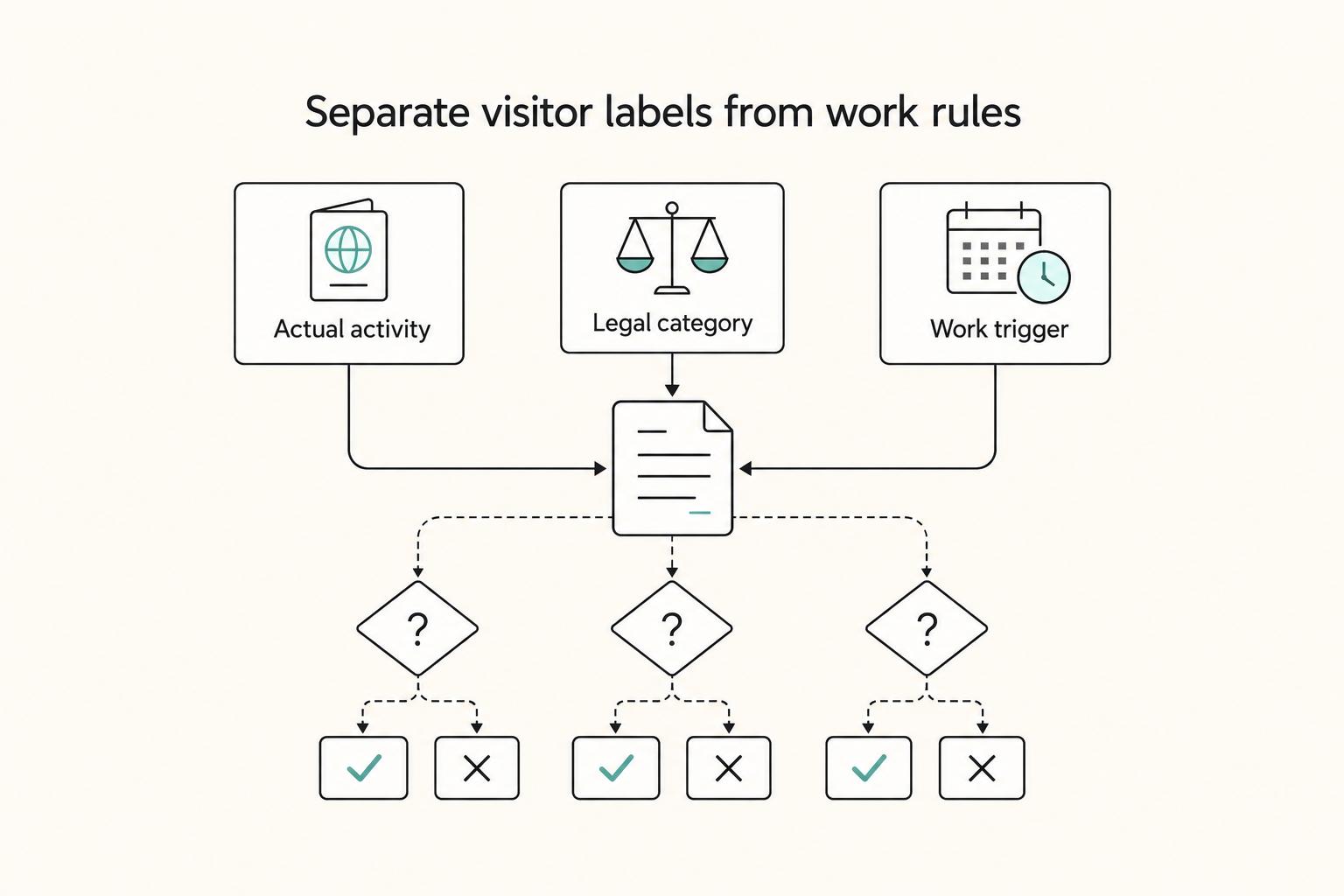
The phrase `canada digital nomad visa` is useful for search, but misleading if you treat it like a legal category. It is shorthand for existing Canadian status options, mainly visitor status and work permit rules, not a standalone visa stream with its own fixed process. That difference is not just technical. It changes how you should plan the trip, describe your purpose at entry, and organize your records before you leave.
How to Create a Disaster Recovery Plan for Your Freelance Business
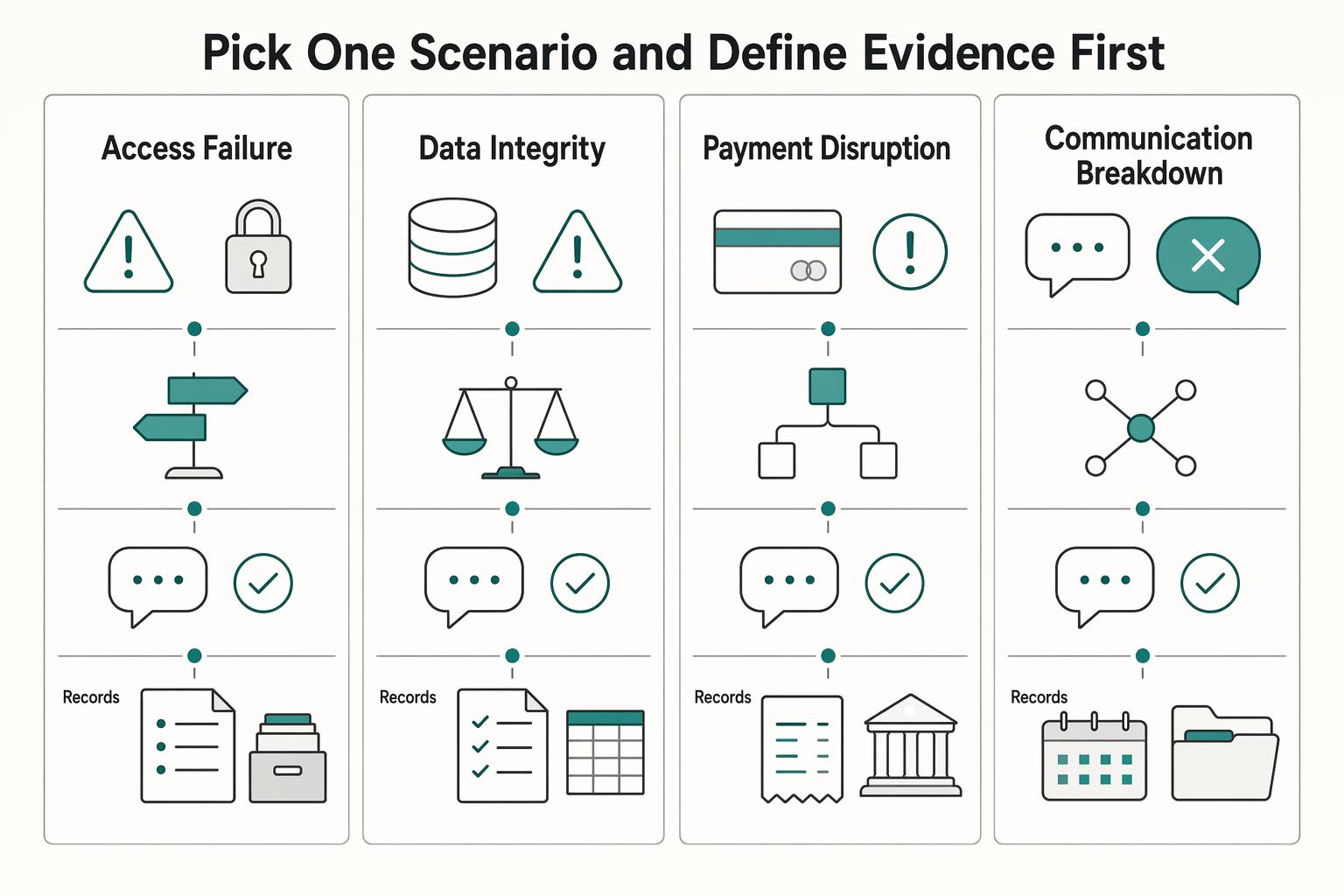
Build this as a baseline to create a freelance disaster recovery plan you can run under pressure: clear recovery targets, a restore order, client-ready messages, and one restore proof record. This helps reduce improvisation during an outage.
A Guide to Deducting Business Travel Expenses
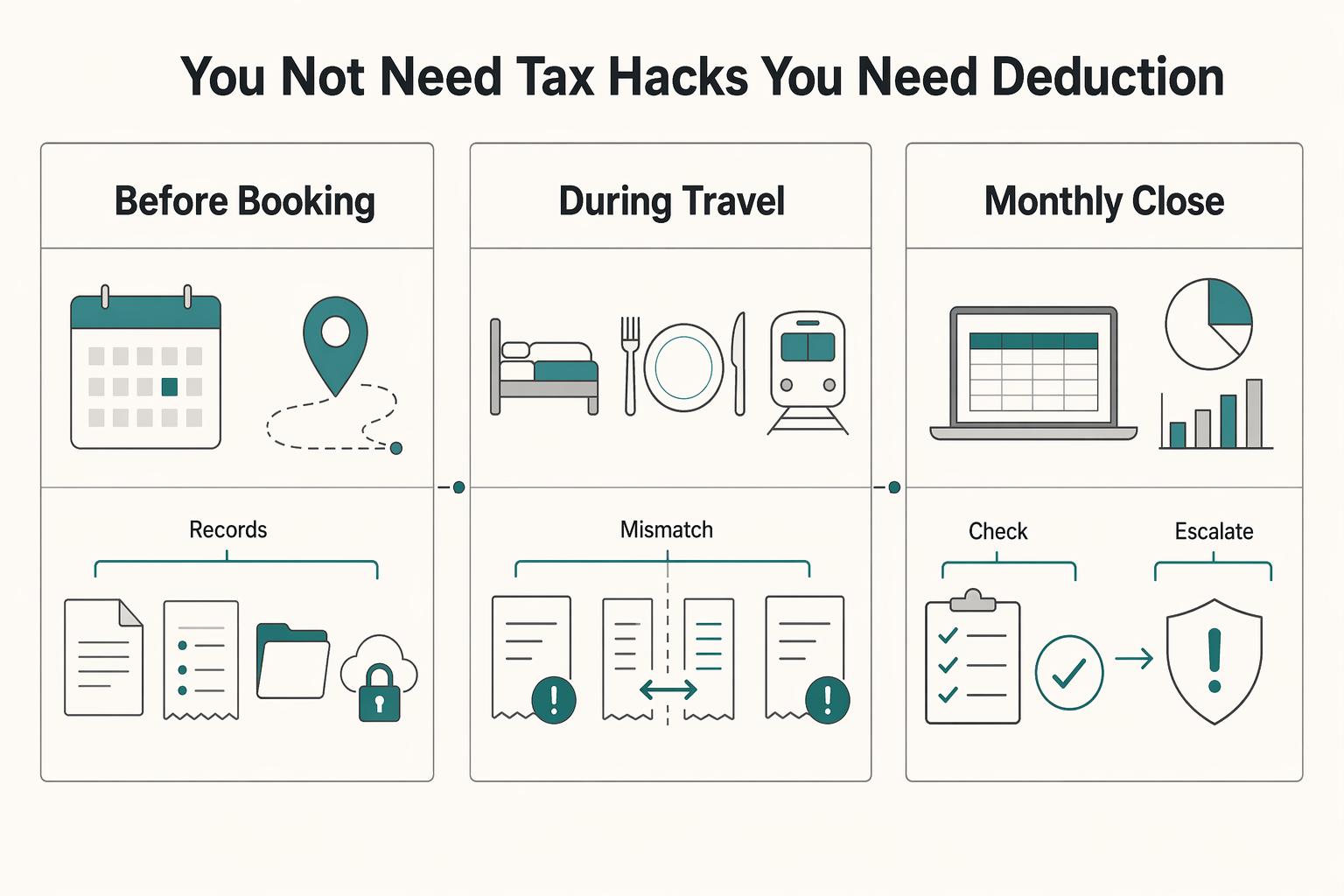
**For deducting business travel expenses, use a repeatable compliance system so you only claim costs you can prove.**