
Quick Answer
Start by mapping how your app actually collects, uses, stores, and shares personal data, then draft the privacy policy for saas from that map. Name your core providers, define who can access data, and explain how requests to know, delete, or opt out are handled in practice. Use GDPR as a high-standard baseline, run a CCPA exposure check before making California claims, and hold any unverified legal wording for counsel review.
For the founder of a Business-of-One, the privacy policy often feels like a legal chore, something to check off with a generic template and forget. That is the wrong way to treat it. In SaaS, your policy is one of the first public proofs of how you actually handle customer data.
This playbook gives you a three-step process to make the policy useful in practice. Done well, it reduces operational risk, supports trust with serious buyers, and holds up when someone asks how your data handling really works.
Step 1: Forge Your Shield with a Rock-Solid Foundation#
Start with verified operations, not polished wording. A privacy policy is strongest when each statement matches how your business actually handles personal data.
1. Define your working labels before drafting#
Get your internal language straight before you write. Define your personal-data categories in plain terms based on what you actually process to run the product. Keep those labels consistent so your policy stays clear and transparent.
2. Run a decision-based data audit#
Build the policy from real processing activity, not assumptions. For each data type, document what it is and why you process it as part of service delivery. If any field is uncertain, fix the operation first and draft second.
A simple test is to pick one data type, such as support communications, and trace it from collection through use. If you cannot trace it, your draft is not ready.
A generator can help produce draft language, but only after your inputs are accurate. As of February 20, 2026, one documented workflow is: you answer questions about your business and data processing activities, then generate policy text from those answers.
3. Keep one live data-practices table#
A single maintained table is a practical way to keep disclosures accurate. Use a practical internal table like this, review it whenever your stack changes, and verify each active entry against your current setup before publishing:
| Process or provider | Data received | Purpose | How it fits your current processing activities |
|---|---|---|---|
| Primary hosting provider | [fill in] | [fill in] | [fill in] |
| Payment provider | [fill in] | [fill in] | [fill in] |
| Support or communications provider | [fill in] | [fill in] | [fill in] |
4. Add detail only where you can prove it#
Overstatement is easy. Keep the wording tied to your real configuration and what you can verify today.
State only what you can support. If anything is still unclear, say less until you confirm it.
5. Turn transparency into an owned workflow#
Do not publish a policy that no one maintains. Assign ownership for updates, use one internal review path, and keep changes aligned to real operations.
Common failure points to prevent:
- Writing policy text that does not match current data processing activities.
- Leaving unclear sections unresolved instead of fixing operations first.
- Failing to update the policy as practices or legislation change.
If you want a deeper dive, read Taxes in Germany for Freelancers and Expats.
Step 2: Sharpen Your Signal with Radical Transparency#
Once your internal map is accurate, make the policy easy to scan and easy to verify. In practice, transparency means a reviewer can quickly tell which tools are in use, who has access, what data is processed, and what safeguards are in place. If the opening promises more than your records can support, you create a review problem before real diligence starts.
Use these working labels while drafting (internal labels, not legal definitions):
- Transparent notice: the part a reasonable reader can scan to find key facts quickly.
- Plain-language summary: a short opener for non-lawyers that matches the full policy facts.
- User-facing disclosure: any privacy statement users or buyers may rely on in your policy, privacy center, or product UI.
1. Surface decision-critical facts first#
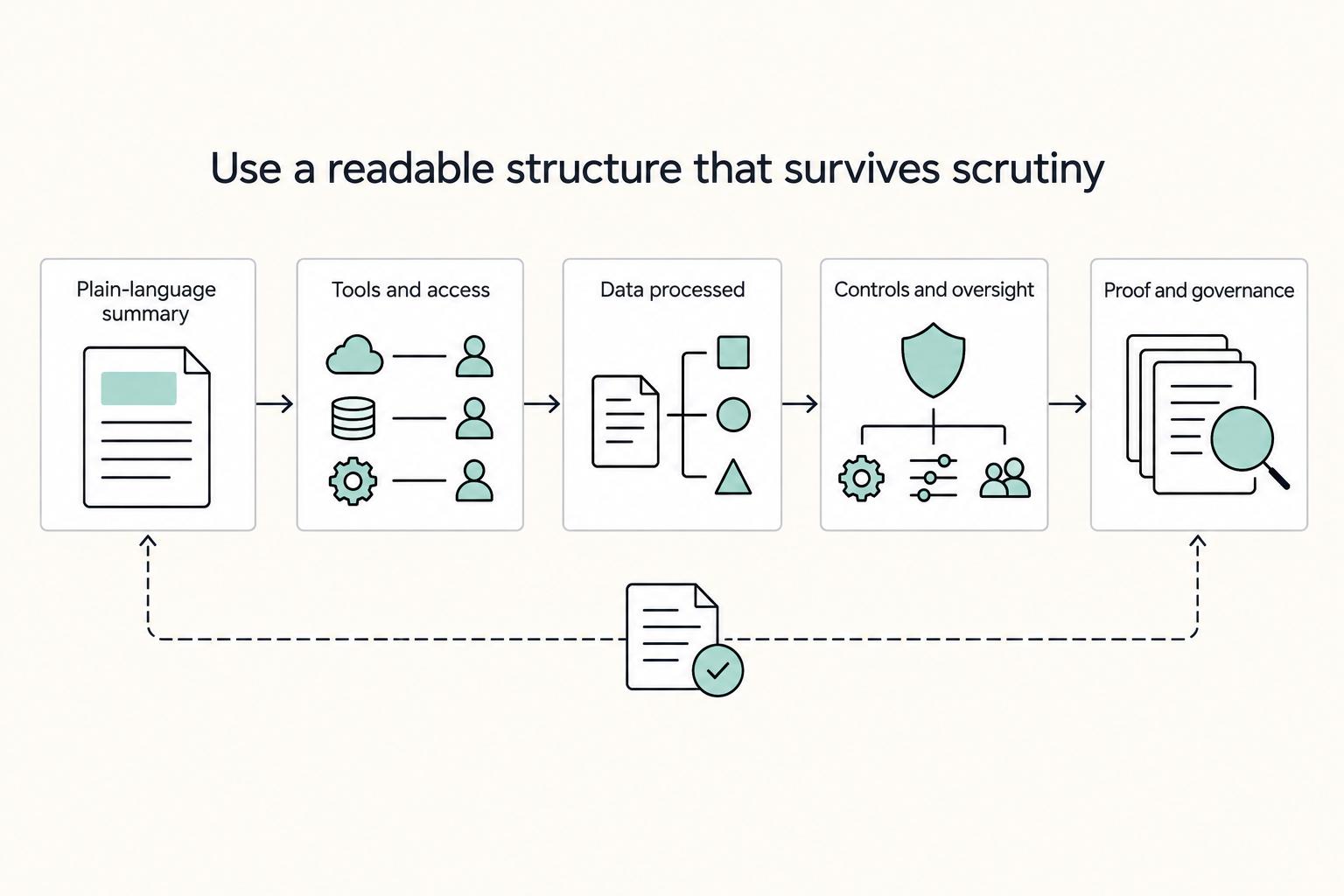
Lead with the facts that trigger scrutiny fastest, not a generic preamble. The opening should let a reviewer answer the basic questions without hunting through the rest of the document. Use this intro checklist:
- Tools in use: list the core systems involved in handling data.
- Access scope: state who has access and at what level.
- Data processed: state what data is handled.
- Safeguards and controls: summarize how access, data handling, and app usage are controlled.
- Vendor oversight ownership: state who owns third-party oversight and follow-up.
Quick test: a non-legal teammate should be able to answer five questions from the opening screen alone. Which tools, who has access, what data is processed, what controls exist, and who owns oversight.
2. Use a readability structure that survives scrutiny#
A scannable structure is not just nicer to read. It forces you to show which tools are in use, who has access, and what data is processed. That is also what you need when someone asks for proof that the environment is governed and secure.
| Section name | User question answered | Required disclosure elements | Common drafting mistake | Review owner |
|---|---|---|---|---|
| Plain-language summary | What matters first? | Tools in use, access scope, data processed, control overview | Opening with brand language instead of verifiable facts | Founder or privacy owner |
| Tools and access | Which systems and people are in scope? | Current tool list and access model | Stale or incomplete access information | Product or operations |
| Data processed | What do you process? | Data categories tied to real workflows | Vague mixed buckets that hide scope | Product or operations |
| Controls and oversight | How is risk reduced day to day? | Safeguards for access/data/app usage, plus vendor oversight owner | Controls named but not tied to owners | Operations or vendor owner |
| Proof and governance | Can you show this is governed and secure? | Review date, named owner, and supporting records | Claims with no supporting records | Security or privacy owner |
If you are solo, keep ownership explicit anyway. Assign yourself each row and add a review date.
3. Use a repeatable sharing framework in deals#
Use one repeatable package whenever privacy, security, legal, or procurement review is active.
Package the material by reviewer:
- Legal/compliance review: policy text plus a check that mapped rules match stated controls.
- Security review: a visibility snapshot of tools, access, data processed, and safeguards.
- Procurement review: current version date, named owner, and vendor-oversight summary.
Attach a lightweight proof set. Include the current policy link or PDF, the last review date, and a one-page visibility snapshot covering tools, access, data processed, and oversight ownership. Do not publish statements about regulatory status, contractual commitments, or jurisdiction-specific compliance claims until qualified counsel verifies them against current official sources.
4. Keep privacy dashboard promises within real operations#
A privacy dashboard helps only when it reflects how requests and controls are actually handled. Keep the scope aligned with real operations: clear intake paths, clear ownership, and accurate labeling of what is self-service versus manual.
If you do not have a full dashboard, publish an accurate fallback process instead: one intake channel, documented verification steps, request logging, and a clear next-step response. That avoids a common trust break where the policy promises clean control but the real process is fragmented.
For a step-by-step walkthrough, see How to Structure a US SaaS Consulting Contract for a German Enterprise Client.
Step 3: Extend Your Reach by Mastering Global Compliance#
Cross-border compliance is mostly an operations problem first. Your policy should only claim what your team can prove across user locations, processing locations, and vendor flows. A highest-standard-first approach can be useful, but it is still an operating choice, not a legal conclusion by itself.
1. Define exposure before making global claims#
Start with a facts file, not a country list. Use these as drafting labels:
- Territorial scope: where users are located, where your business operates, and where processing or access happens.
- Controller or processor role: your internal role-mapping question for each workflow.
- Cross-border transfer: personal data stored, accessed, or disclosed across national borders.
Treat those labels as working inputs, not final legal determinations. Leave jurisdiction-specific thresholds, role labels, and transfer requirements unpublished until qualified counsel verifies them against current official sources.
For CCPA, use this exposure check with the California Attorney General's CCPA guidance and the CPPA FAQ as your quick verification references:
-
Confirm you are for-profit, operate within California, and collect California residents’ data.
-
Then confirm whether at least one threshold applies:
-
revenue over $26,625,000
- handling personal information of 100,000 or more California residents, households, or devices
- deriving 50% or more annual revenue from selling California residents’ personal information
Do not treat those figures as automatically current for 2026 without legal verification.
2. Use a decision table your team can execute#
Once you know where exposure may exist, reduce it to decisions your team can actually follow by using a table like this:
| Operational choice | CCPA checkpoint supported by the excerpt | GDPR item to verify separately | Action now |
|---|---|---|---|
| Consent model | Excerpt supports stronger consumer control, not detailed consent mechanics | Exact consent rules are not established | Avoid jurisdiction-specific consent promises until verified |
| Rights workflow | Support know, delete, opt-out of sale, and non-discrimination handling | Full GDPR rights scope and timelines need separate confirmation | Build one intake path, one identity-check step, one response log |
| Notice obligations | Excerpt supports strict handling expectations, not detailed notice timing or content rules | Exact notice obligations need separate review | Keep policy notices factual: categories, uses, sharing, rights, contact |
| Sensitive-data handling | No detailed operational rule set is provided here | Sensitive-data obligations require separate validation | Narrow claims and escalate early where sensitive or high-risk data is involved |
| Escalation to counsel | Excerpt cites per-violation penalty and civil-damages exposure | Exact legal escalation triggers are jurisdiction-specific | Escalate when wording depends on thresholds, role labels, or transfer language |
3. Keep a verification checklist behind every cross-border claim#
If your policy mentions international processing, keep evidence behind that sentence. The ICO right-to-be-informed checklist and processor-contract guidance are useful operational references while you verify your own controls. At minimum, maintain:
- A current map of what personal information is in scope and which workflows or vendors touch it.
- The countries or regions where access or processing may occur, as currently understood.
- The consumer-rights requests you can actually fulfill now (know, delete, opt-out of sale, non-discrimination).
- A running list of statements that still require jurisdiction-specific legal verification.
This is a practical checklist, not a substitute for jurisdiction-specific legal advice.
4. Align policy text to actual controls#
Before you publish, make sure the policy matches live operations:
- Request handling: intake, verification, logging, and closure are repeatable.
- Rights capability: know/delete/opt-out/non-discrimination flows are tested in practice.
- CCPA exposure check: your for-profit/California/resident-data assumptions and threshold check are documented.
- Change management: product or ops changes that affect data use trigger policy review.
If a control is not live, narrow the policy claim first, then fix the operation. If processor-contract language is still being finalized, keep UK GDPR Article 28 in the working checklist with counsel review. You might also find this useful: A Guide to GDPR Compliance for SaaS Businesses.
As you finalize cross-border disclosures and data-rights workflows, map each policy promise to a real operational status flow so it is auditable in practice, not just in text. See the docs.
Your Privacy Policy: From Liability to Asset#
A privacy policy becomes an asset when it is tailored to your real operations. If it is copied, generic, or disconnected from how your business actually handles data, it remains a liability.
Step 1. Define the asset in plain terms#
A shield is risk control: policy language tailored to your business context that can help reduce exposure in the event of a breach or lawsuit.
A signal is trust evidence: clear disclosures that help third parties assess whether you meet their privacy standards and can be treated as a reliable partner.
A moat is practical defensibility: your policy reflects your actual industry, vendor relationships, data processes, and jurisdiction, rather than generic template text.
Step 2. Decide whether your policy is template-level or operational#
This is the practical dividing line: your policy is still template-level if any of these are true:
- It reads like copied language from another company.
- It does not reflect your industry, vendor relationships, data processes, or jurisdiction.
- It uses generic text that is not tailored to how your business actually operates.
Your policy is operational when all of these are true:
- Policy text is tailored to your business context.
- Disclosures reflect your actual vendor relationships and data processes.
- The policy can function as a clear trust signal for third parties evaluating privacy standards.
Step 3. Map outcomes to policy elements and checks#
| Asset outcome | Policy element | Operational check |
|---|---|---|
| Risk reduction | Tailored disclosures aligned to your business context | The policy reflects your industry, vendor relationships, data processes, and jurisdiction |
| Third-party trust signal | Clear privacy disclosures for third-party review | The policy helps show that you meet privacy standards and can be treated as a reliable partner |
| Compliance checkpoint | Checklist-based drafting and revision | You use a concrete privacy policy checklist instead of copy-paste text |
Step 4. Run this execution checklist#
Turn the article into a practical workflow:
- Use a privacy policy checklist as a drafting and revision checkpoint.
- Remove copy-paste text and tailor the policy to your business context.
- Confirm the policy reflects your industry, vendor relationships, data processes, and jurisdiction.
- Keep disclosures clear enough for third parties to assess your privacy standards.
If you do one thing now, do this: do not publish copied policy text. Tailor your privacy policy to your actual business context. Related: How to Write a Privacy Policy for Your Freelance Website.
If your policy references payout flows or region-specific compliance gates, confirm what is enabled for your program before you publish final language. Talk to Gruv.
Frequently Asked Questions
Do I absolutely need a privacy policy for my one-person SaaS?
Yes. The legal requirement is not tied to company size but to the act of collecting personal data. If you collect even an email address at sign-up, you need a policy. Laws like GDPR and CCPA apply to any business processing data from their residents, regardless of your location. Think of it as your first professional handshake with a user—it shows you respect their data from day one.
What specific clauses do I need for tools like Stripe and Google Analytics?
You don't need to be a lawyer, but you must be a responsible vendor. For each third-party tool, identify them as a "sub-processor." Name the service (e.g., Stripe, Google Analytics) and state its purpose clearly. For Stripe, explain they process payments securely. For Google Analytics, disclose that you use it to understand user behavior and improve your service. This transparency is a core requirement of modern data privacy laws.
What are the actual GDPR penalties for a small business?
The highest tier of fines can be up to €20 million or 4% of annual global turnover. However, context is critical. Supervisory authorities consider the nature of the breach, intent, and cooperation. They are not focused on making an example of a solo founder who has made a good-faith effort to comply. A clear, honest, and operationalized policy is your single greatest defense, as it demonstrates your intent to act responsibly.
What privacy clauses are needed for a SaaS that uses the OpenAI API?
You must list OpenAI as a sub-processor and be transparent about data handling. As of recent updates, OpenAI no longer uses data submitted via its API to train models by default. Your policy should state this, clarifying that user data is sent to OpenAI to provide the AI feature and that OpenAI retains API data for up to 30 days for abuse monitoring before deletion. Being upfront builds trust.
Can my US-based SaaS be sued under GDPR?
Yes. The GDPR has "extraterritorial reach," applying to any company processing the data of people in the EU. However, this isn't a reason for panic. Your compliance—evidenced by your robust privacy policy—is what matters. It's your proof that you respect global privacy standards and have done your due diligence.
How can my privacy policy help me win enterprise clients?
Enterprise clients vet partners for risk. A sloppy or generic policy is a massive red flag. A detailed, well-written policy signals that you are a mature, professional, and low-risk partner. It shows you understand corporate accountability and have built your operations on a solid legal and security foundation. Proactively sharing it can shorten sales cycles by preemptively answering the questions their legal and security teams will inevitably ask.
Are free privacy policy templates safe to use?
Use them as a starting point, never as a final solution. Free templates are useful for understanding basic structure but are too generic for a modern SaaS. They rarely account for specific data flows, third-party sub-processors (like AWS or OpenAI), or international data transfers. Your policy must accurately reflect your business practices, not a generic placeholder.
Researched and edited by the Gruv editorial team. Gruv builds cross-border billing, payouts, and finance-operations software for global businesses.
Sources
Includes 3 external sources outside the trusted-domain allowlist.
- cppa.ca.gov/faq.htmltrusted
- cppa.ca.gov/regulations/pdf/ccpa_statute_eff_20260101.pdftrusted
- legislation.gov.uk/eur/2016/679/article/28trusted
- oag.ca.gov/privacy/ccpatrusted
- oag.ca.gov/privacy/facts/online-privacy/privacy-policytrusted
- cookie-script.com/guides/saas-privacy-policyexternal
- cookieyes.com/blog/saas-privacy-policyexternal
- diva-portal.org/smash/get/diva2:1436386/FULLTEXT02.pdfexternal
Educational content only. Not legal, tax, or financial advice.
Related Posts
Taxes in Germany for Freelancers and Expats
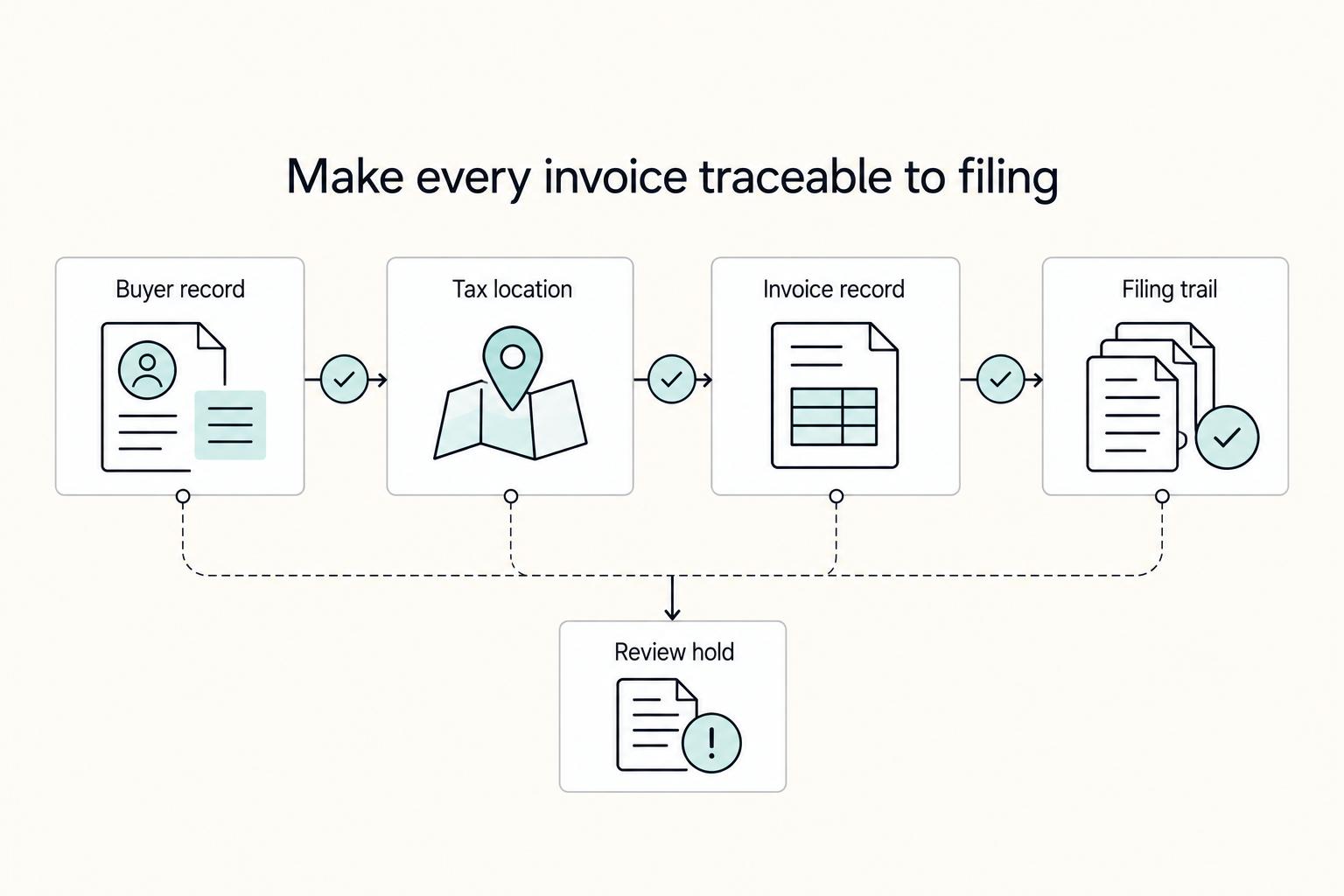
Low-stress compliance in Germany comes from decision order, not tax tricks. Use this sequence: confirm core facts, apply conservative temporary assumptions, verify the few points that can break invoices or filings, and keep one evidence file that explains each decision.
How to Write a Privacy Policy for Your Freelance Website
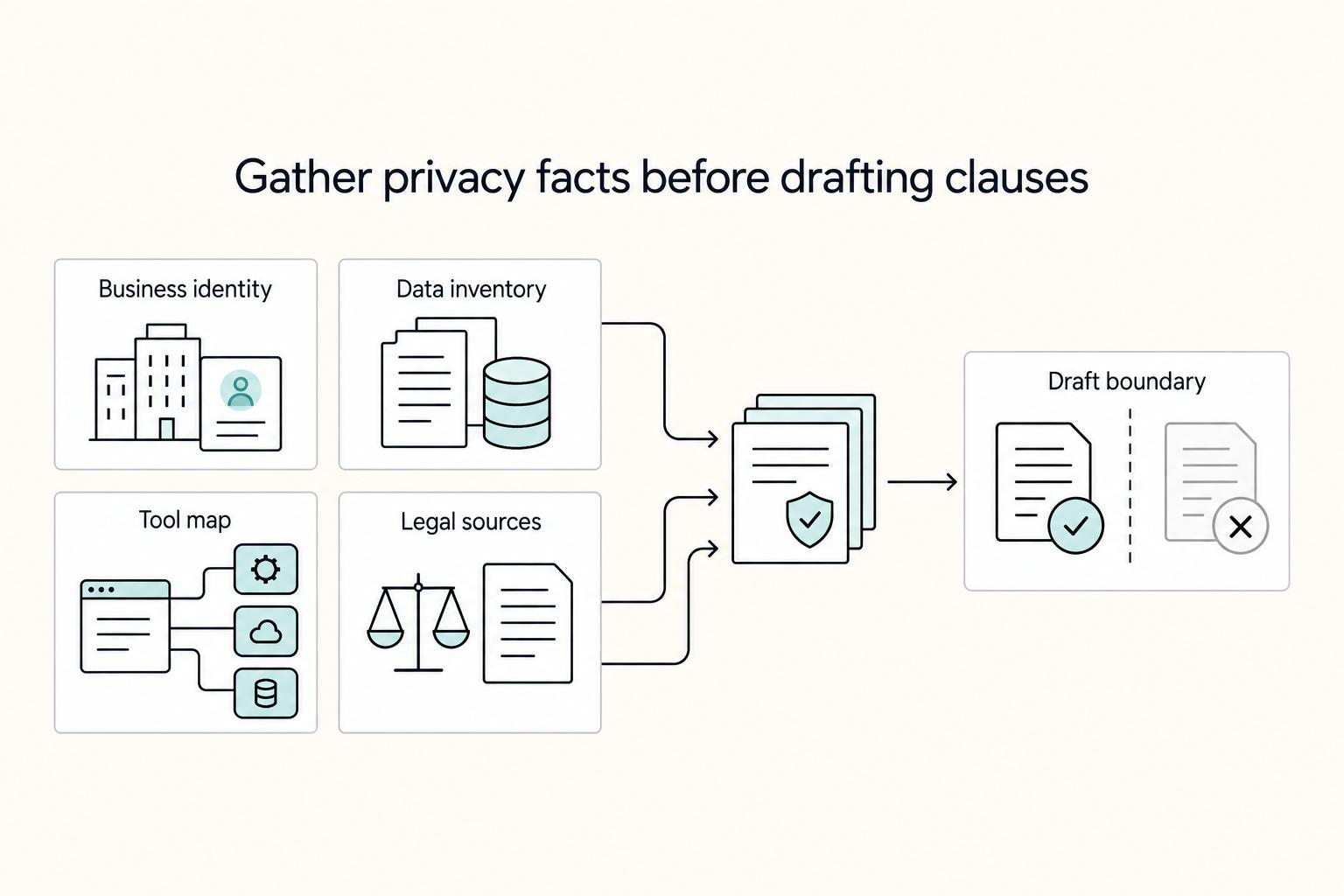
A [privacy policy](https://freelancersunion.org/privacy-policy) is easier to defend in client due diligence when each statement traces to real behavior. Treat it as a working record, not footer filler: what personal data you collect, how you use and manage it, and how someone can raise a concern.
A Guide to GDPR Compliance for SaaS Businesses
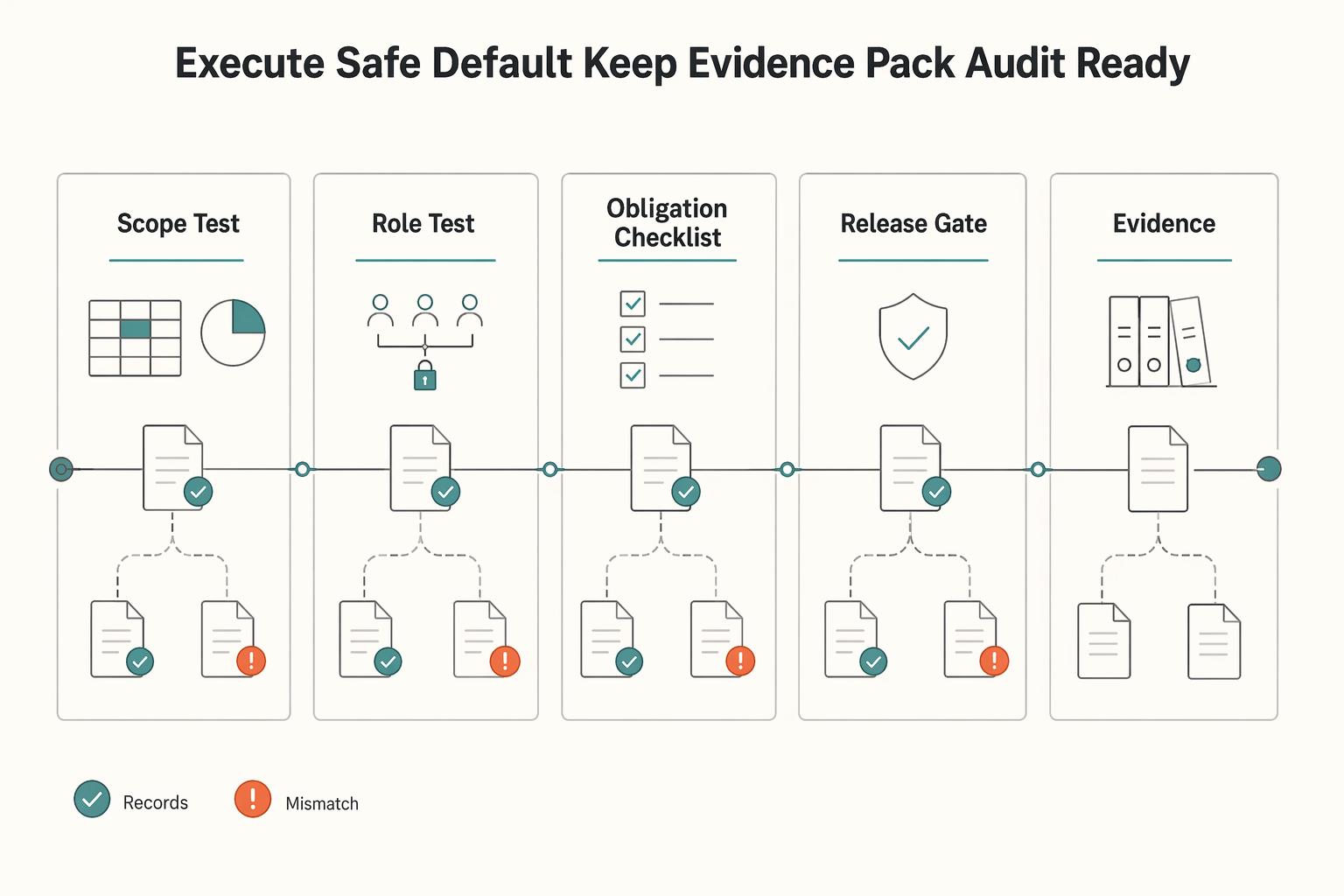
**Use GDPR for SaaS businesses as an operating playbook that protects trust and gives you defensible legal decisions before onboarding.**