
Quick Answer
Build the deck in three parts: value, operations, and commercial terms. Start by reframing the client's problem in business terms and tying deliverables to outcomes, metrics, and proof. Then show phases, approvals, responsibilities, and handoffs. Close with clear pricing, invoicing, payment details marked pending where needed, and vendor details that make approval easier.
Start with Value, Then Operations, Then Commercial Terms#
Use your pitch deck for freelance proposal to help a client make a decision, not to recite scope. The goal is to move the conversation from "What do you charge?" to "Is this the right investment, delivered the right way, on terms we can approve?"
| Proposal style | What the client sees | Likely reaction |
|---|---|---|
| Task-led proposal | A list of deliverables, hours, and activities | Compares you on price and asks for cuts |
| Framework-led proposal | A business problem, a delivery approach, and a commercial path | Judges fit, confidence, and approval readiness |
A strong proposal should do three things in order: show the problem is worth solving, show how the work will run, and make approval easier for the people buying, approving, and paying for it.
Reframe the problem in business terms#
Open with the client's problem, not your process. A strong first slide names a concrete pain point the client already recognizes: a stalled launch, inconsistent lead flow, low conversion, or a messy handoff between teams. If the opening slide could be reused for any client, it is too generic.
Map the delivery decision#
Once the problem is clear, show how you will solve it without overloading the room. Keep this part to the essentials: goals, boundaries, and routines. That tells the client what will happen, what is in scope, and how the work stays controlled. A common failure mode is making your approach look tidy by hiding tradeoffs or skipping risks. If the work depends on a review cycle, client-side input, or another team, say so.
Make the commercial ask easy to approve#
Close with the details that help a buyer evaluate a yes. Include pricing structure, payment logic, timeline, and the business details needed for internal approval or vendor setup. If it helps, attach credibility artifacts such as a testimonial or press mention, but only when they support this exact offer.
That is the shape of a strong proposal deck. Start with value, then operations, then commercial terms. In most cases, the client needs to believe the problem matters before they care how you will execute. They need to trust execution before legal, finance, or procurement can move.
If you want a deeper dive, read The Best Tools for Creating Professional Presentations.
Part 1: The Value Framework - Frame Your Solution as an Investment#
Use this section to prove one thing quickly: your work solves a business problem worth funding. Lead with an evidence-backed problem, map deliverables to decision metrics, and support your claims with credible proof.
Diagnose the problem with evidence, not intuition#
Start with a clear problem slide in the client's language: what is happening now, why it hurts, and what happens if they do nothing.
Work from this structure:
- Current state: what you observed in discovery
- Business pain: the operational or commercial impact
- Cost of inaction: loss, delay, waste, or missed upside, filled only after client validation
Instead of "Your brand needs refinement," write: "Your site and sales materials describe the offer inconsistently, which slows qualification and weakens buyer confidence. Current cost of inaction: client-validated figure pending."
Before you move on, confirm each claim ties back to discovery notes, client-shared metrics, customer feedback, or internal comments. If it does not, tighten it or remove it.
Translate each deliverable into an outcome, a metric, and a stakeholder reason to care#
Position deliverables as business changes the client can evaluate, not just tasks you will complete.
| Deliverable | Outcome language to use in the deck | Decision metric to name | Stakeholder who cares |
|---|---|---|---|
| Landing page redesign | Improve lead capture from existing traffic | Conversion rate, qualified form fills | Sales lead, founder |
| Messaging and positioning update | Reduce buyer confusion and improve sales conversations | Reply quality, qualification rate, win/loss feedback | Founder, marketing lead, sales |
| Reporting or analytics cleanup | Improve visibility so budget and channel decisions happen faster | Reporting accuracy, time to produce reports, channel attribution coverage | Marketing lead, finance |
| Content program | Build a repeatable path for attracting and educating prospects | Organic traffic quality, inbound inquiries, content-assisted leads | Marketing lead, founder |
If a deliverable cannot be tied to a metric and an owner, it likely belongs in operations rather than your value case.
Prove value with a tight Problem-Action-Result story#
Your proof slide should answer three questions quickly: what was wrong, what you changed, and what improved.
Follow this pattern:
Problem: baseline state and why it mattered. Action: intervention you led. Result: verified impact.
If you have approved performance figures, use them. If evidence is directional, say that directly and support it with a relevant testimonial, client quote, or press mention. Avoid proof that only shows tasks completed or visuals without business impact.
Run a value check before you move on#
Check these points before moving to operations:
- Every problem-slide claim is traceable to discovery or client-shared evidence.
- The cost of inaction is labeled as validated, estimated, or pending client confirmation.
- Each major deliverable maps to one business outcome and one decision metric.
- At least one proof slide follows Problem-Action-Result, not just portfolio snapshots.
- Any testimonial or press mention supports the exact claim being made.
You might also find this useful: How to Create a Pitch Deck for Your Agency.
Part 2: The Operational Framework - Engineer a Successful Engagement#
Your operations slides should answer one buyer question immediately: can this engagement run cleanly from kickoff to handoff? Use this section to reduce visible execution risk, especially missed deadlines, bottlenecks, unclear approvals, and revision loops.
Before building these slides, confirm three items from discovery or follow-up email: who approves, how feedback is consolidated, and what communication rhythm the client expects. If you guess, friction usually shows up as soon as work starts.
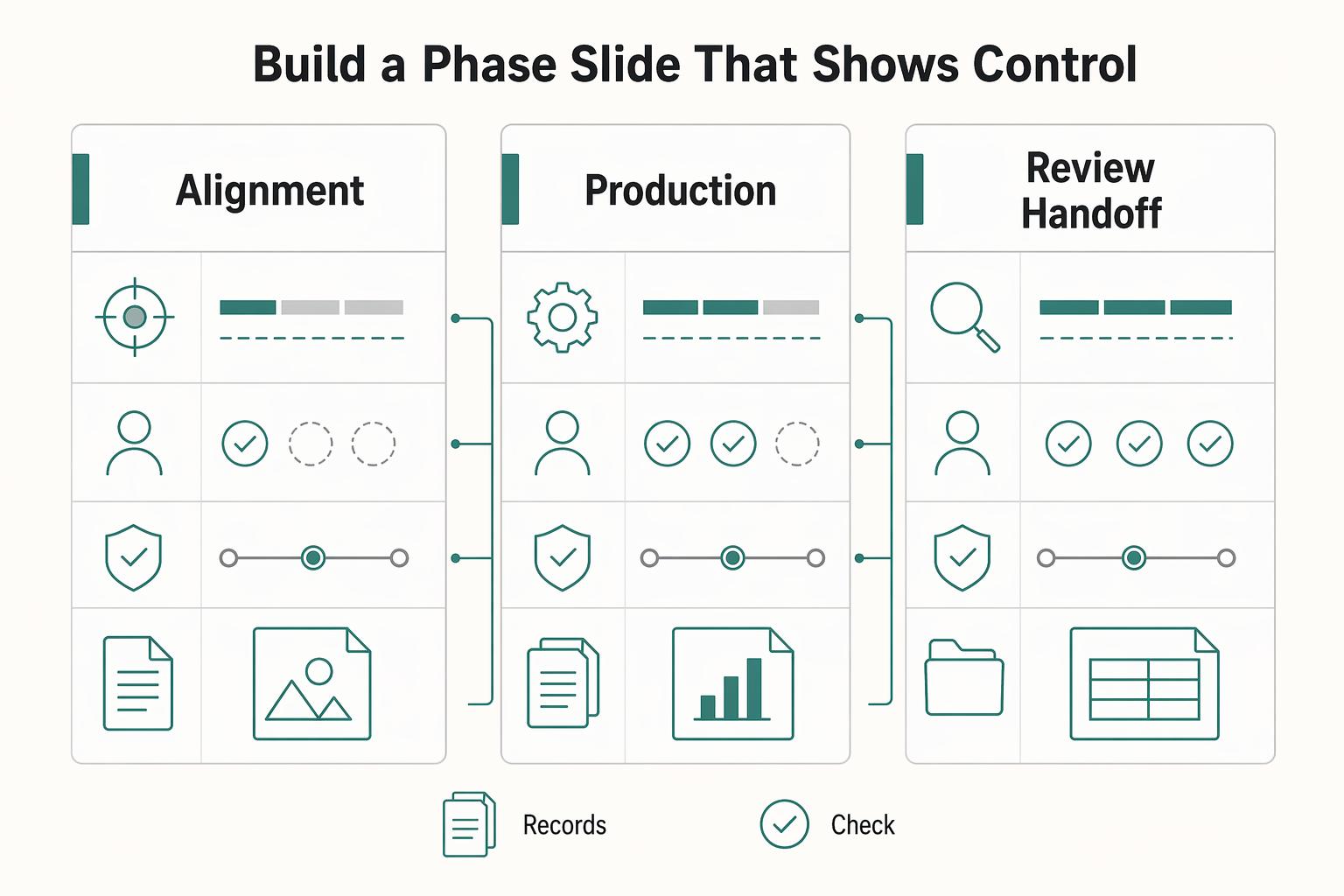
Build a phase slide that shows control, not just sequence#
Do not stop at "Phase 1, 2, 3." On each phase slide, show scope, client responsibility, the approval gate, and the handoff artifact.
Phase names can vary by project. What matters is a clear gate and clear output in every phase. That is what makes a structured workflow believable.
| Example phase | What to include on the slide | Client responsibility | Approval gate | Handoff artifact |
|---|---|---|---|---|
| Alignment | objectives, constraints, priorities, source materials | provide access, background files, and business context | written sign-off on goals and priorities | brief, roadmap, or agreed project summary |
| Production | creation of agreed assets or working draft | review against brief, answer open questions, consolidate internal input | written approval that draft is directionally correct | draft asset set, prototype, outline, or working file |
| Review and handoff | revisions tied to agreed brief, final checks, packaging | confirm final feedback and handoff destination | written acceptance of final package | final files, documentation, and next-step notes |
If someone outside the sales call cannot identify where work pauses for approval and what is handed over, the slide is still too vague.
Define each deliverable with a repeatable "done" template#
Prevent scope creep by defining completion before work begins. For each major deliverable, specify:
- Deliverable name
- Final format
- What is included
- Acceptance criteria
- Review and revision handling
- Out-of-scope rule
Example: if you include an editorial calendar, state the format and required fields, then define what must be true for approval. Avoid listing polished outputs without finish conditions, because that is where scope drift starts.
Set an operating cadence slide with verified working rules#
Treat this slide as working rules you and the client can follow. Include:
- Update rhythm
- Response window
- Escalation path
- Single point of contact
Mark unconfirmed team norms as pending until you verify them. Do not promise response timing you cannot sustain. For longer or recurring engagements, include the planning artifact too; an editorial calendar mapped to goals signals planned execution rather than improvisation.
Run a pre-send operational checklist#
Use this check before presenting the deck.
- Every phase includes scope, client responsibility, approval gate, and handoff artifact.
- Every major deliverable includes format, acceptance criteria, review handling, and an out-of-scope note.
- The communication slide includes one point of contact, one update rhythm, and one escalation path.
- Timing and response expectations match your real availability and the client's team norms.
- You can explain how feedback bottlenecks are handled and where work pauses when approvals are late.
If these checks are clear, your operations section is doing its job: making the engagement feel governable before anyone signs.
For a step-by-step walkthrough, see How to Create a Pitch Deck in Canva.
Part 3: The Commercial Framework - Give Finance What It Needs to Pay You#
Your commercial slides should answer three questions immediately: what the client pays, when each invoice is triggered, and what happens if payment is delayed. Write this part in plain language so procurement, finance, and your day-to-day contact can read it quickly without interpretation.
Write the pricing slide so nobody has to guess what gets billed, in what currency, or when#
Put total fee, billing currency, invoice sequence, and fee responsibility on one slide. If any of these is unclear, you invite renegotiation after verbal approval.
| Commercial point | Weak language | Stronger language |
|---|---|---|
| Currency | "Project fee: 12,000" | "Project fee: 12,000; billing currency pending confirmation." |
| Fee responsibility | "Client covers transfer fees if needed" | "Payment is due in the confirmed billing currency. Bank and intermediary fee responsibility remains pending confirmation." |
| Milestone invoicing | "50% upfront, rest later" | "Invoices are issued at confirmed milestones tied to the approval gates in Part 2; final milestone schedule pending confirmation." |
Use this test before sending: if this slide is forwarded on its own to accounts payable, can they process payment without a clarification call?
Build a cash-flow protection stack instead of one loose payment paragraph#
Show a complete payment stack, not a single sentence about terms.
- Deposit policy: pending confirmation in the final commercial terms
- Milestone triggers: tie each invoice to a visible approval or handoff from Part 2
- Invoice due-date policy: pending confirmation in the final commercial terms
- Late-payment remedy: pending lawyer review and jurisdiction confirmation
- Asset handover condition: pending confirmation in the signed agreement
If your project includes revisions, protect that iteration time in the contract so review cycles do not turn final payment into an open-ended event. Treat repeated requests for updated project plans before signature, or contract talks that stretch toward ten versions, as commercial risk signals. When those patterns appear, tighten scope language and use a lawyer-reviewed contract before relaxing terms.
Add a compliance footer that helps finance onboard you without chasing basics#
Keep this footer short, factual, and copy-ready for vendor forms.
- Registered business name
- Registered business address
- Billing contact email
- Local business registration identifier, pending jurisdiction check
- Tax ID, VAT, GST, or local equivalent, pending jurisdiction check
- Required tax document reference for the client jurisdiction, pending confirmation
- Remittance details or payment method reference, pending confirmation
Before sending, ask: "Does your finance team require vendor-onboarding details at proposal stage?" Also confirm how many people on the client side are part of the core project effort and who has authority to approve commercial terms, so you do not lose time in avoidable revision loops.
Related: How to Write a Proposal for a Six-Figure Consulting Project.
From Proposal to Partnership#
Once the client says yes, treat your deck as a working document, not a sales artifact. Use it as your shared baseline for value alignment, operating cadence, and commercial clarity during delivery.
| Proposal posture | What it emphasizes | Likely post-acceptance pattern |
|---|---|---|
| Price quote | Line items and cost | More re-explaining, more assumptions to resolve later |
| Partnership blueprint | Problem, intended outcome, delivery approach, commercial intent | Clearer kickoff conversations and fewer hidden assumptions |
| Overloaded deck | Too much information or random proof points | Slower alignment because essentials are harder to find |
Keep two anchors intact after acceptance: your problem framing and your call to action. If your opening problem slide no longer matches the client's current priority, or your call to action does not turn into concrete next steps, the handoff to execution gets messy.
What to do immediately after acceptance#
- Confirm kickoff alignment
Restate the problem, intended outcome, and in-scope deliverables so decision-makers and day-to-day contacts are aligned.
- Confirm delivery workflow
Lock review points, feedback format, and who gives consolidated approval.
- Set communication norms
Agree on the primary channel, update rhythm, and response expectations.
- Complete commercial/admin handoff
Route billing, invoicing, and vendor-onboarding details to the right finance contact right away.
This is the bridge from winning work to running it well: your proposal becomes the reference you return to during delivery to surface scope drift early and reduce avoidable friction. That consistency also makes repeat engagements easier to start.
We covered this in detail in How to Create a Standard Operating Procedure (SOP) for Your Freelance Tasks.
Frequently Asked Questions
How do you include payment terms in a proposal?
Put all commercial terms in one section so the client can see what is billed, when invoices are triggered, and which items are still pending verification. Label unverified legal or jurisdiction-specific details as pending instead of presenting them as fixed rules. If someone reads only that section, they should still understand the billing structure and what still needs confirmation.
What legal or compliance information should be in a proposal?
Use the proposal to summarize commercial intent, not to replace a contract or invoice. Include only verified onboarding details for the client and jurisdiction, and label uncertain items as pending until confirmed. Binding legal terms should live in the signed agreement, and unclear onboarding requirements should be checked with the client's finance team.
How should you handle pricing for international clients?
State the proposed billing setup clearly and specify who is expected to cover transfer-related fees. Confirm any client-side payment restrictions before finalizing, and call out exchange-rate movement or bank deductions if they could materially change what you receive. Do not agree on a headline fee without aligning on how the funds will actually arrive.
How can a proposal prevent scope creep?
Prevent scope creep by defining deliverables, review rounds, approval points, feedback ownership, and final handoff before work begins. Make completion criteria and out-of-scope rules visible so extra requests are easy to identify. If requested work falls outside listed deliverables or revision limits, treat it as a change order with its own timeline and budget.
What is the difference between a proposal and a contract?
A proposal helps the client decide whether to move forward. A contract is the signed document that sets enforceable terms. Use the proposal to guide the decision, but move detailed issues such as liability, IP ownership, or remedies into a lawyer-reviewed agreement.
Try a related tool
Researched and edited by the Gruv editorial team. Gruv builds cross-border billing, payouts, and finance-operations software for global businesses.
Sources
Includes 4 external sources outside the trusted-domain allowlist.
- hbs.edu/managing-the-future-of-work/Documents/Buildi...trusted
- journalism.utexas.edu/sites/default/files/sites/journalism.utexas....trusted
- repository.upenn.edu/bitstreams/6412c68a-7f96-411a-984f-a18808a43...trusted
- snap.berkeley.edu/project/10053261trusted
- alistapart.com/article/getting-to-noexternal
- behance.net/search/projects/partnership%20pitchexternal
- bestpitchdeck.comexternal
- blog.thinklions.com/best-pitch-decksexternal
Educational content only. Not legal, tax, or financial advice.
Related Posts
The Best Tools for Creating Professional Presentations
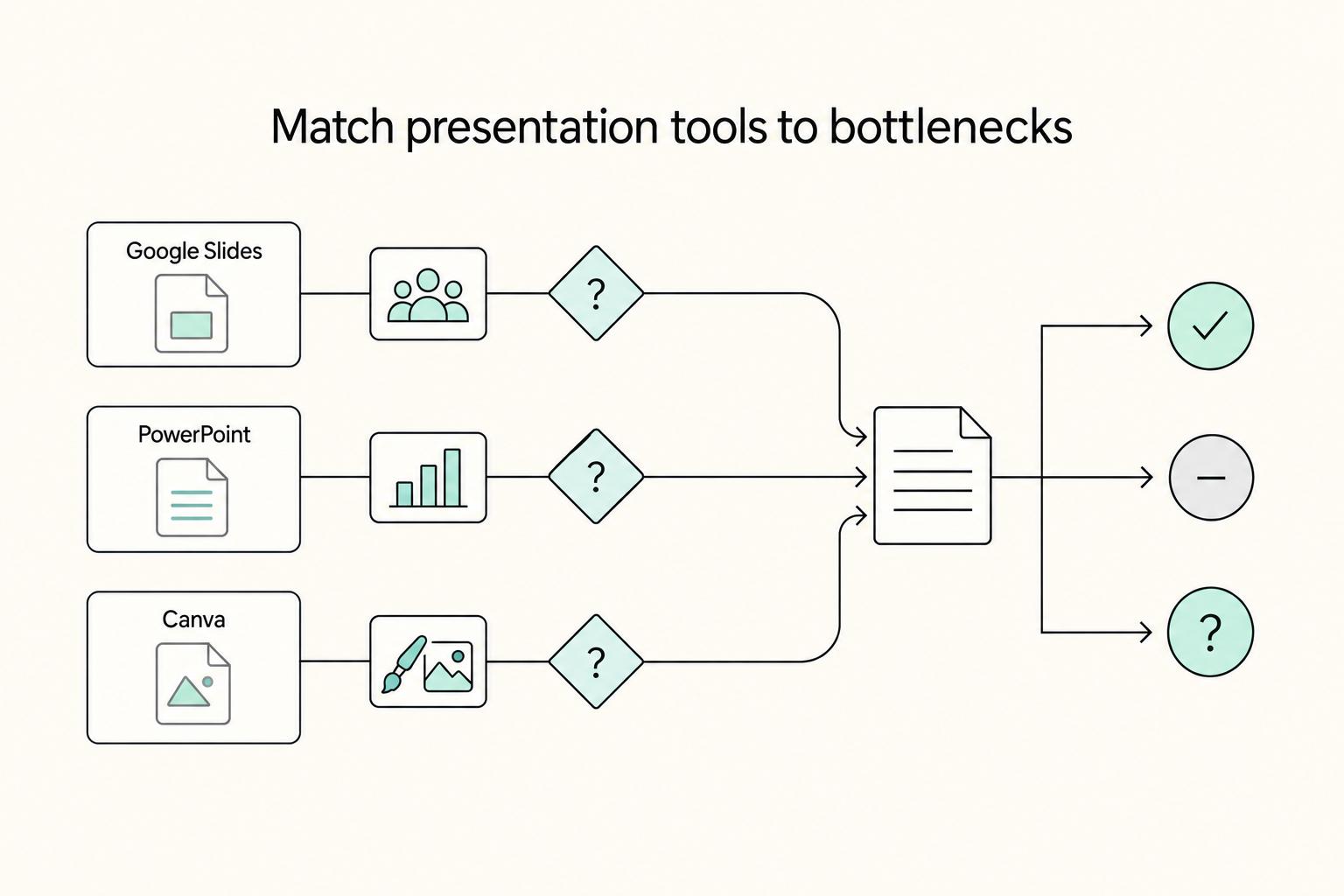
Use a 2025-2026 validation sweep each quarter: confirm one monthly software baseline ($15/month), one collaboration baseline ($30/month), and one premium workflow baseline ($60/month) before changing client-facing tool commitments.
How to Write a Proposal for a Six-Figure Consulting Project
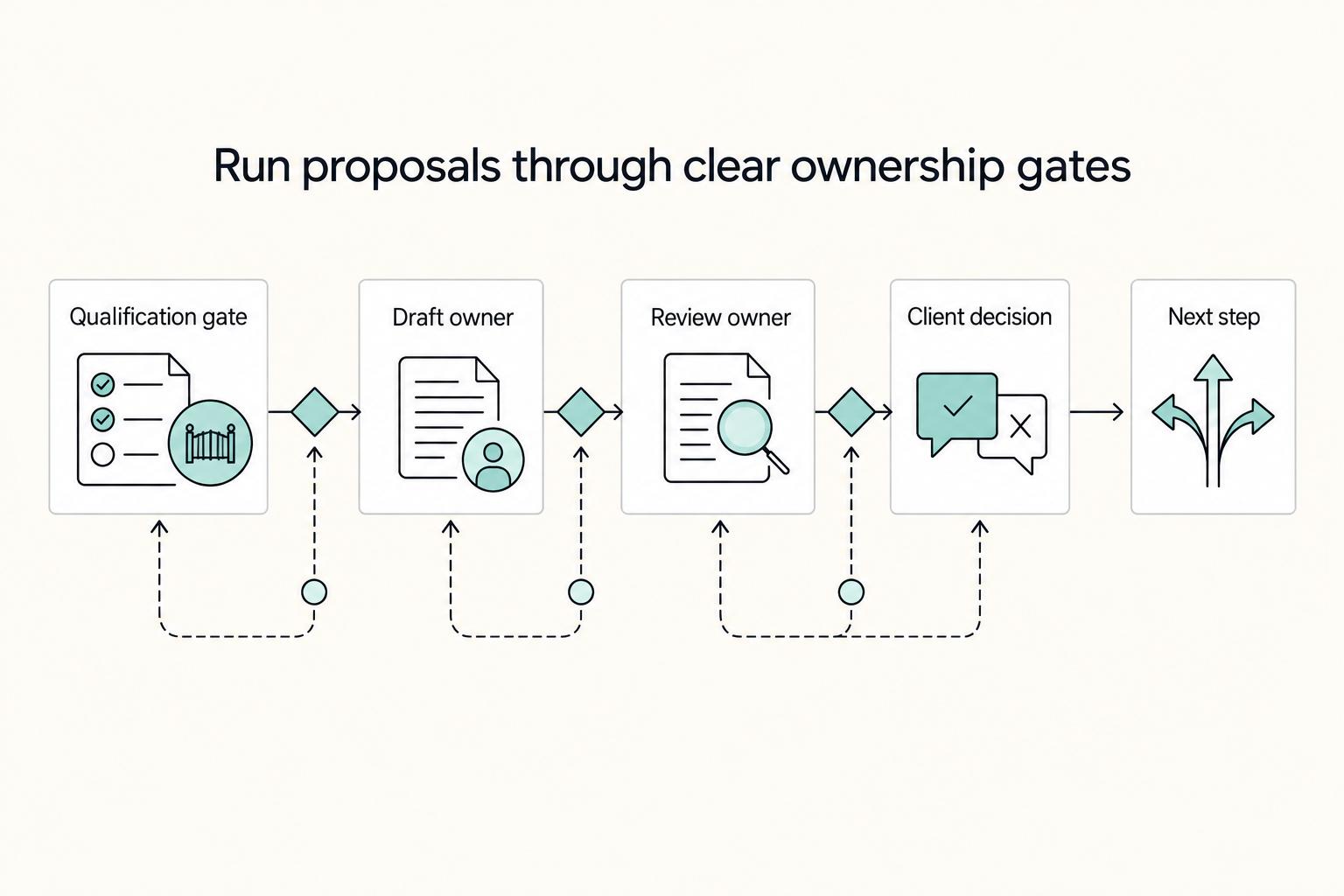
If you are sending a **six-figure-consulting-proposal**, treat it as an operating document, not just a polished PDF. Even indirect evidence supports a cautious rule for consulting work: clear definitions, named approvals, and written proof reduce avoidable surprises.

The Freelance Payment Penalty: A Modeled Audit of Platform Fees, FX Spreads, and Payout Delays
The money rarely disappears through a single, easy-to-spot fee. The real loss is stacked. A marketplace takes its commission, a processor adds a charge for international cards, a bank or payment company converts the currency at a spread, a platform holds the funds before release, and a wire sheds a little to intermediaries on the way in. Each layer looks defensible on its own, but the worker feels the combined result as a smaller deposit and a later payday.